
Golf apparel development fails when brands approve samples based on appearance but do not validate real-world performance before bulk production. A golf polo can look perfect in a sample room and still fail in the market because of hidden issues such as poor wet performance, restricted movement during swings, collar stretch after washing, decoration stiffness, grading errors, and inconsistent bulk fabric finishing.
For brands, the biggest development risk is not making a sample that looks good. It is making sure the product still performs after repeated wear, washing, movement, heat, and moisture. That is what determines:
- return rate
- review quality
- repeat purchase rate
- perceived product value
- margin protection
In this guide, I explain the most overlooked details in golf apparel development, including:
- why samples pass but bulk production fails
- how to test golf apparel fabric correctly
- how to validate golf-specific fit and mobility
- why collars, trims, and logos create hidden quality problems
- how spec sheets, grading, and tolerances affect bulk outcomes
- what QC and lab tests brands should require before production
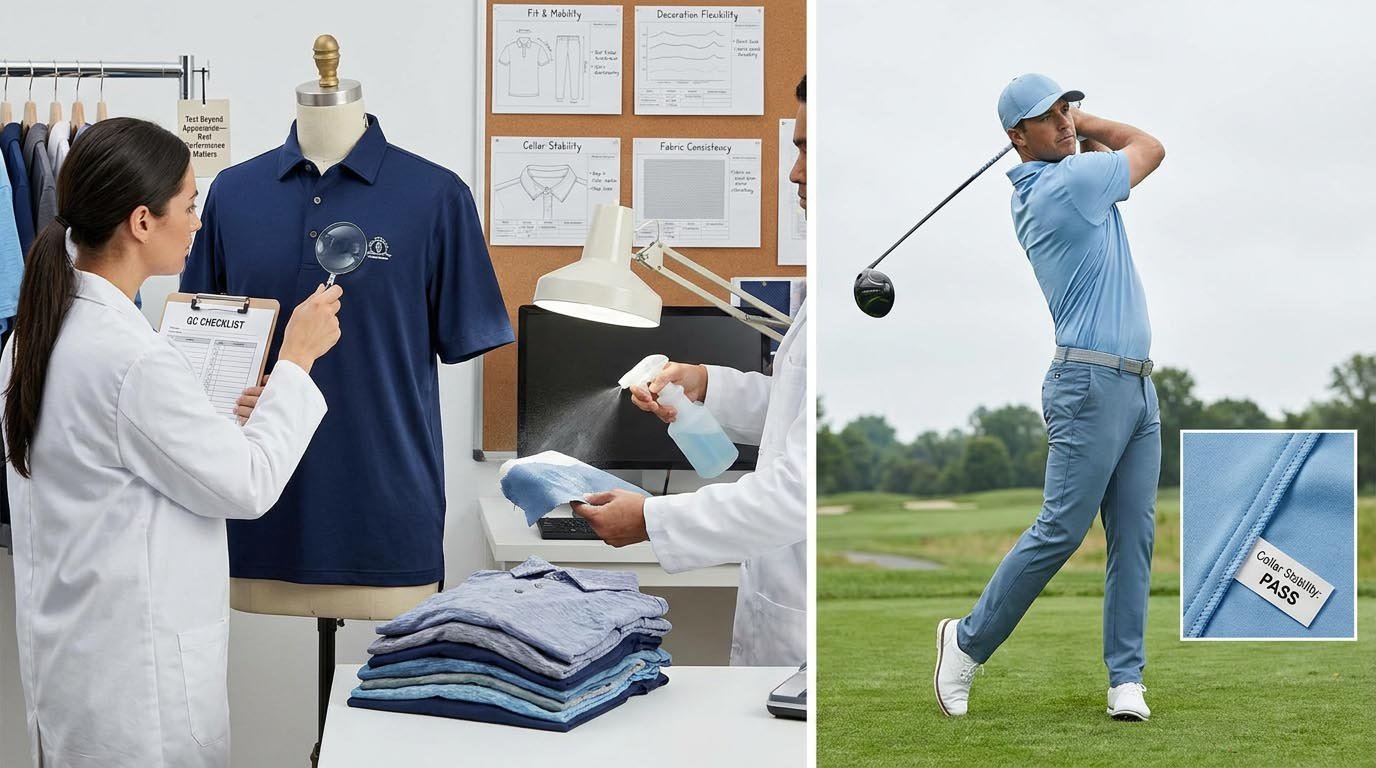
I am Will from FUWAY. Over the past 12 years, I have worked on 600+ golf apparel styles from sampling through bulk production. The patterns behind quality failure are consistent:
Most development problems are not obvious in the first sample. They appear only when the garment is worn, washed, stretched, decorated, graded across sizes, or scaled into bulk production.
Quick Answer: What Golf Brands Most Often Miss During Development
The most common hidden problems in golf apparel development are:
- wet fabric behavior is never tested
- dynamic fit is not validated during real golf movement
- collars and cuffs are approved new but not after repeated washes
- embroidery and prints change stretch, breathability, and comfort
- bulk fabric behaves differently from sample fabric
- grading rules do not match the brand’s actual customer body type
- spec sheets define measurements but not functional performance
- lab dips are approved, but bulk color controls are weak
- final QC checks visual defects but not real-use durability
If you want to reduce returns and improve product consistency, you should validate:
- fabric performance dry and wet
- fit static and in motion
- trim recovery after repeated washing
- bulk material consistency before cutting
- construction strength before shipment
Why Golf Apparel Samples Pass but Bulk Production Fails
Short answer
Golf apparel samples often pass because brands approve appearance, while bulk success depends on performance, consistency, and durability.
A real development pattern
A brand approved our sample because:
- fit looked right
- fabric felt premium
- color matched their target
- overall presentation was strong
They then ordered 1,500 pieces.
Within three months, returns increased sharply. The complaints repeated:
- collars stretched after several washes
- fabric felt sticky in humid conditions
- armholes restricted movement during swings
The sample was not “wrong.” It was simply under-tested.
What sample approval usually proves
Most sample approvals confirm:
- silhouette
- color direction
- styling
- basic hand feel
- visual logo execution
What sample approval does not prove
It often does not prove:
- how fabric behaves when wet
- how a golfer moves in the garment
- how trims recover after washing
- how bulk fabric differs from sample-room fabric
- how the product performs over time
Why this matters commercially
When development validates only appearance, brands face:
- higher return rates
- more negative reviews
- lower repeat purchase
- margin erosion from replacements and markdowns
- damaged product trust
A good-looking sample is not the same as a production-ready golf product.
How to Test Golf Apparel Fabric Before Bulk Production
Short answer
Golf fabric should be tested not only for hand feel and appearance, but also for wet performance, drying speed, stretch recovery, and durability after washing.
Why dry sample evaluation is misleading
Sample fabric often feels better than bulk fabric because it may be:
- pre-washed
- stabilized
- carefully handled
- from a small controlled lot
- evaluated only in dry indoor conditions
But golf apparel is worn:
- outdoors
- in humidity
- during sweating
- during repeated movement
- through repeated wash cycles
The most overlooked test: wet performance
One of the most common mistakes is approving fabric without testing how it behaves when saturated.
Problems that appear only when wet
- fabric clings to skin
- drying is too slow
- garment feels heavy
- stretch recovery weakens
- comfort drops sharply in hot weather
Practical wet test for golf apparel
Before bulk approval, a brand should:
- soak the fabric or garment
- wear it during movement for at least 20-30 minutes
- evaluate cling, cooling, breathability, and recovery
- measure drying speed
What to observe
- Does it feel breathable or sticky?
- Does it dry quickly enough for active play?
- Does it maintain shape when pulled while wet?
- Does it feel premium only when dry?
Suggested validation table
| Test Area | What to Check | Why It Matters |
|---|---|---|
| Dry hand feel | Softness, drape, surface finish | Initial retail impression |
| Wet feel | Cling, cooling, heaviness | Real-use comfort during play |
| Drying speed | Time from soaked to mostly dry | Comfort in hot and humid conditions |
| Wet recovery | Elasticity and shape after moisture exposure | Prevents sagging and distortion |
| Wash durability | Performance after repeated laundering | Long-term product satisfaction |
Commercial consequence of skipping wet testing
If the fabric performs badly in real conditions, brands may see:
- performance complaints in warm climates
- higher returns from active customers
- negative reviews using words like “sticky,” “heavy,” or “doesn’t breathe”
Golf fabric should be approved in use conditions, not just in showroom conditions.
How to Validate Golf Apparel Fit for Real Movement
Short answer
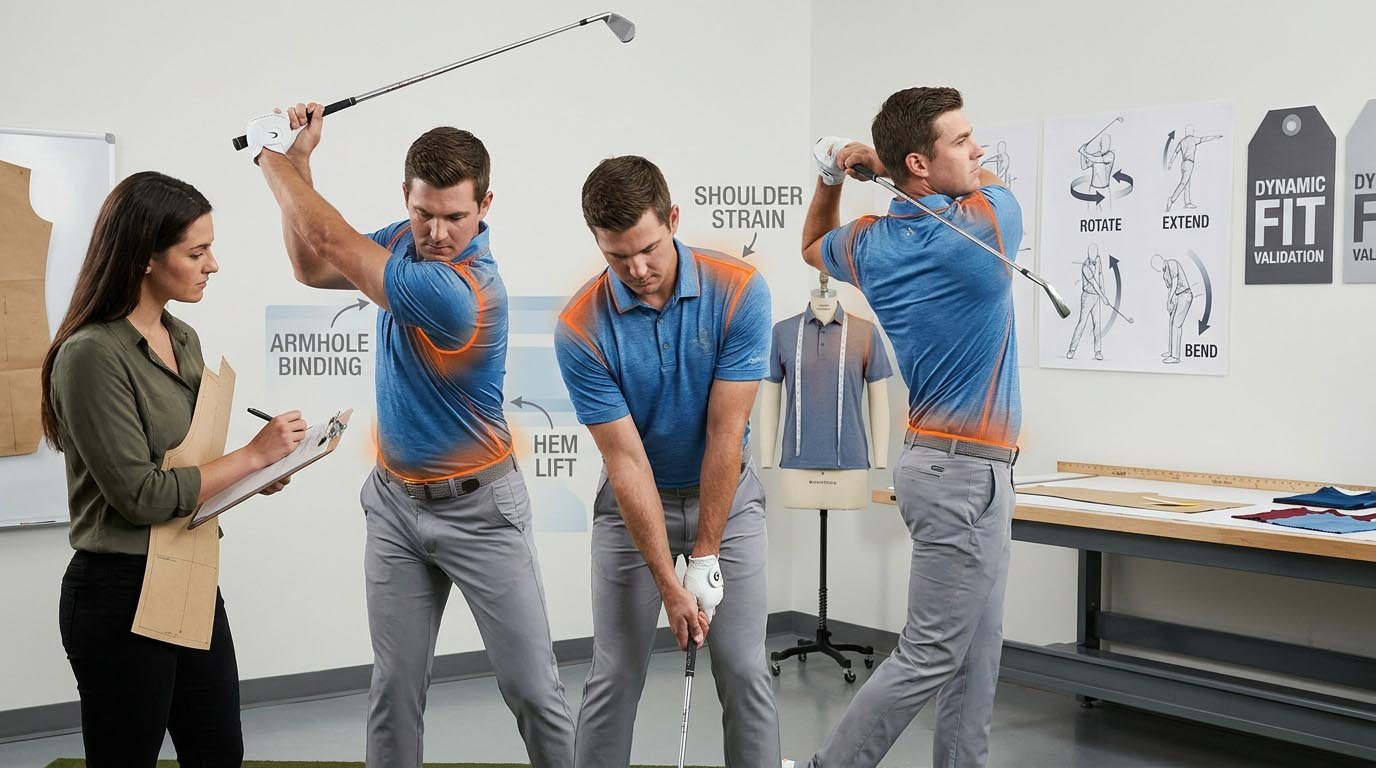
Static measurements are not enough. Golf apparel fit must be validated during actual golf movement, including swing rotation, reach, and bent posture.
Why flat measurements are incomplete
Most brands approve fit by:
- measuring chest
- checking body length
- checking sleeve length
- comparing results to the tech pack
This confirms dimensional accuracy.
It does not confirm functional comfort.
Golf-specific movement creates different fit requirements
A golf polo must perform during:
- backswing rotation
- follow-through extension
- reach-across movement
- bent-over address posture
- repeated torso rotation
Common fit failures that static reviews miss
- armholes bind during swing
- shoulder seams pull when rotating
- hem rides up when bending
- placket opens awkwardly during movement
- chest strain appears only during extension
Real development issue
A polo can pass all measurement points and still feel wrong because:
- armhole curve shape is too tight
- sleeve pitch is too straight
- back length is too short for bent posture
- shoulder balance does not support rotation
Better fit-validation process
A proper golf fit review should include:
1. Static fit check
Confirm:
- silhouette
- chest ease
- length balance
- neck opening
- sleeve proportion
2. Dynamic wear test
Have the sample worn during:
- full golf swings
- reach-across motions
- bent putting posture
- walking and repeated upper-body movement
3. Pattern correction
Adjust based on movement findings:
- armhole depth
- sleeve pitch
- back length
- shoulder angle
- side seam balance
Typical correction areas
| Fit Problem | Likely Pattern Cause | Common Adjustment |
|---|---|---|
| Tight during backswing | Armhole too high or front curve too tight | Add armhole depth or reshape curve |
| Hem rides up when bending | Back length too short | Add back length |
| Sleeve twists during motion | Sleeve pitch not aligned to activity | Rotate sleeve pitch forward |
| Tight across upper back | Shoulder balance too narrow | Increase upper-back mobility allowance |
Why this matters to returns
Customers do not say “the sleeve pitch is wrong.”
They say:
- “feels restrictive”
- “not comfortable to swing in”
- “fit is off”
- “fine standing still, bad while playing”
Golf fit is a movement problem, not only a measurement problem.
Why Collars, Cuffs, and Trims Fail After Washing
Short answer
Collars and cuffs often pass sample approval because they are new. Failures appear later due to rib quality, spandex content, operator tension, heat exposure, and repeated wash stress.
Why sample trims can be misleading
In sampling, collars and cuffs are often:
- sewn carefully by experienced technicians
- assembled slowly
- made from better available trim stock
- inspected immediately after sewing
In bulk production, results may vary because:
- operators work at line speed
- trim quality may be cost-reduced
- stretch tension varies by operator
- no one sees long-term recovery during production
Common collar and cuff failure pattern
The collar looks fine when new. Then:
- washes 1-5: still acceptable
- washes 8-12: slight loss of recovery
- washes 15+: visible stretch-out or “bacon neck” effect
Main causes
- lower spandex content in ribbing
- inconsistent sewing tension
- poor trim recovery specification
- no wash-cycle durability check before production
- heat damage from care conditions
What brands should test
Before bulk approval:
- wash the sample multiple times
- wear it between washes
- compare recovery against the original sample
- inspect collar stand, curl, looseness, and cuff memory
Trim durability checklist
| Area | What to Test | Failure Risk |
|---|---|---|
| Collar rib | Recovery after repeated washing | Stretched collar shape |
| Cuff rib | Elastic return after wear and wash | Loose cuff opening |
| Placket edge | Shape retention after wash | Curling or warping |
| Button attachment | Repeated opening and closing | Loose or detached buttons |
| Interfacing | Shape and stiffness retention | Flat or collapsing collar |
Why this matters commercially
Trim failure is especially damaging because customers notice it quickly. A collar that deforms early creates the impression that the whole garment is cheap, even if the body fabric is good.
New trims prove appearance. Repeated wash testing proves quality.
How Decoration Methods Affect Golf Apparel Performance
Short answer
Embroidery, heat transfer, and print methods can affect stretch, breathability, softness, drying speed, and movement comfort, even when the logo looks good in the sample.
What brands usually approve
Most brands focus on:
- logo sharpness
- size
- placement
- color accuracy
What they often do not test
They often do not test how decoration changes:
- chest stretch
- fabric flexibility
- airflow
- moisture handling
- comfort during swings
Why logos can create performance problems
Embroidery can:
- create a stiff zone
- reduce stretch around the logo
- require backing that blocks airflow
- create puckering after washing
Heat transfer or prints can:
- create a plastic hand feel
- trap heat
- reduce breathability
- crack or peel under repeated stretch
Real movement issue
A chest embroidery may look correct on a hanger, but when worn:
- the backing may restrict left-chest stretch
- the embroidered zone may feel rigid during rotation
- the decorated area may dry slower than the rest of the garment
Better decoration validation
Before production:
- test the decorated sample during movement
- compare decorated vs undecorated comfort
- wash the sample several times
- inspect for puckering, cracking, stiffness, and visibility issues
Decoration method comparison
| Method | Main Benefit | Main Risk for Golf Apparel |
|---|---|---|
| Embroidery | Premium look, durable branding | Stiffness, reduced stretch, backing discomfort |
| Heat transfer | Cleaner, thinner application | Heat feel, peel risk, reduced softness |
| Screen print | Good for larger graphics | Surface cracking, lower stretch tolerance |
| Woven label/patch | Strong visual identity | Bulk and local stiffness if oversized |
Recommended development principle
Decoration approval should answer two questions:
- Does it look right?
- Does it still perform right?
In performance apparel, logo execution should be evaluated as part of garment function, not only branding appearance.
What Fabric Specs Do Not Tell You
Short answer
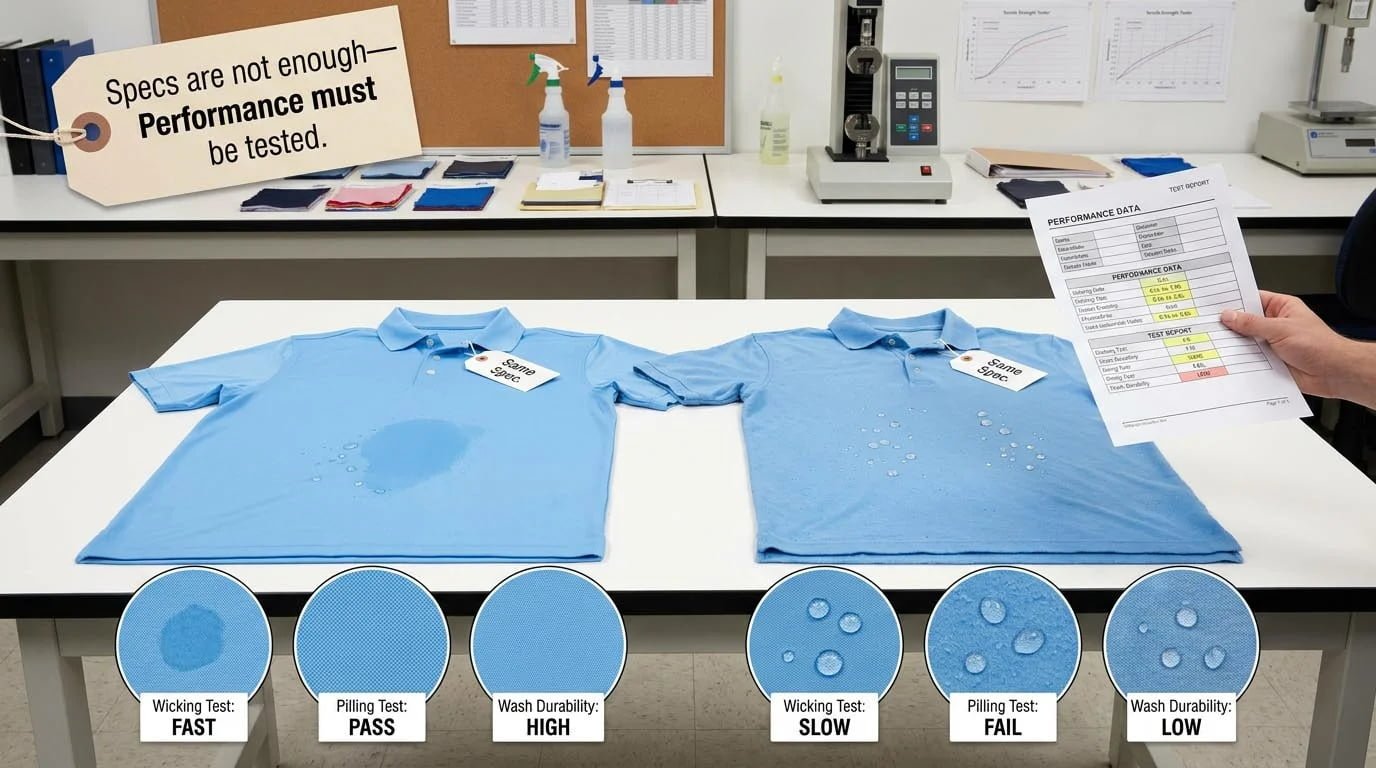
A fabric specification tells you what the material is made of, but not necessarily how it performs, how long that performance lasts, or how consistent it is across suppliers and bulk lots.
Why spec sheets create false confidence
A spec may say:
- 100% polyester
- 180 GSM
- single jersey
- moisture-wicking finish
That sounds complete. But it does not answer:
- what type of wicking system is used
- how durable the treatment is
- how fast moisture spreads
- whether performance survives 30 or 80 washes
- how consistent the finish is across the roll
Why two “same-spec” fabrics perform differently
Two suppliers can offer the same listed spec and still deliver very different results because of:
- yarn quality
- fiber cross-section
- finish chemistry
- application consistency
- curing method
- wash durability
What brands should require
Instead of relying on claims like “moisture-wicking” or “anti-pill,” ask for:
- numeric test results
- test standard used
- durability after washing
- consistency data where relevant
Better fabric validation table
| Supplier Claim | What You Should Request | Why |
|---|---|---|
| Moisture-wicking | Numeric wicking test report | Claim alone is too vague |
| Anti-pilling | Standardized pilling result | Surface quality drives perceived durability |
| Pre-shrunk | Wash dimensional stability result | Prevents post-sale fit complaints |
| Colorfast | Washing and rubbing fastness results | Protects color reputation |
Commercial lesson
When fabric performance fades quickly, customers feel misled.
They may not understand fiber engineering, but they understand:
- “this doesn’t work anymore”
- “it stopped breathing”
- “it pills too fast”
Specs describe inputs. Testing reveals customer experience.
How Spec Sheets, POMs, and Tolerances Create Hidden Problems
Short answer
A tech pack can still create disputes and bad production if it defines measurements without clearly defining how to measure, what tolerances are realistic, and what functional outcome matters.
Why POM disputes happen
Terms like:
- chest width
- body length
- sleeve length
sound simple, but they are not.
Different teams may measure from different points or under different fabric tension.
Common POM ambiguities
Chest width can mean:
- 1 cm below armhole
- widest point of chest
- across chest at underarm level
Sleeve length can mean:
- shoulder seam to cuff
- center-back neck to cuff
- underarm to cuff
Body length can mean:
- high point shoulder to hem
- back neck seam to hem
- center back excluding collar
Why this matters
A sample can appear “out of spec” even when the real issue is:
- different measurement method
- different tension during measuring
- unclear measurement path
Best practice for tech packs
For each POM, define:
- start point
- end point
- direction of measurement
- whether the garment should be relaxed or smoothed
- acceptable tolerance
Realistic tolerance thinking
Many brands choose very tight tolerances without considering:
- knit behavior
- fabric relaxation
- humidity
- trim thickness
- real production capability
Practical tolerance framework
| Measurement Type | Typical Realistic Tolerance | If Tighter, Expect |
|---|---|---|
| Body width/length | ±1 cm | More rejects, rework, cost |
| Sleeves | ±1 cm | More sampling rounds |
| Collars/cuffs | ±0.5 cm | Higher trim control demands |
| Details like placket | ±0.5 cm | Slower production and higher QC load |
Better development rule
Tolerances should be set by:
- customer-visible impact
- functional need
- manufacturing reality
Not by arbitrary preference for precision.
A clear spec sheet does not just define numbers. It defines how to achieve repeatable results.
How Stitch Type Affects Stretch, Durability, and Quality
Short answer
Stitch choice affects whether a golf garment can stretch, recover, resist seam failure, and maintain appearance. Many brands specify seam appearance but not seam function.
Why “quality stitching” is not a real spec
Phrases like:
- professional stitching
- strong seams
- clean finish
do not tell the factory:
- which stitch type to use
- where to use it
- how much stretch it must tolerate
- how strong it must be
Different stitch types solve different problems
| Stitch Type | Best Use | Strength | Stretch |
|---|---|---|---|
| Lockstitch | Plackets, collars, topstitching | High in straight lines | Low |
| Overlock | Seam finishing, light seam construction | Moderate | Good |
| Safety stitch | Side seams, structural seams | High | Moderate |
| Coverstitch | Hems and stretch zones | Moderate | Excellent |
Common mismatch
A jersey hem may be sewn with a lockstitch because it looks neat.
But when the customer pulls the polo over the head or stretches the hem, the thread may snap because the seam cannot stretch with the fabric.
Better stitch specification
A strong technical package should define:
- stitch type by location
- stitch density or SPI where relevant
- required seam behavior under stretch or load
Functional stitching mindset
For golf apparel, ask:
- does this seam need to stretch?
- is this a stress point?
- does this area need recovery after repeated use?
- is appearance more important than motion here?
The right stitch type is not about formality. It is about matching seam behavior to athletic use.
How to Control Color, Lab Dips, and Fabric Finishing in Bulk
Short answer
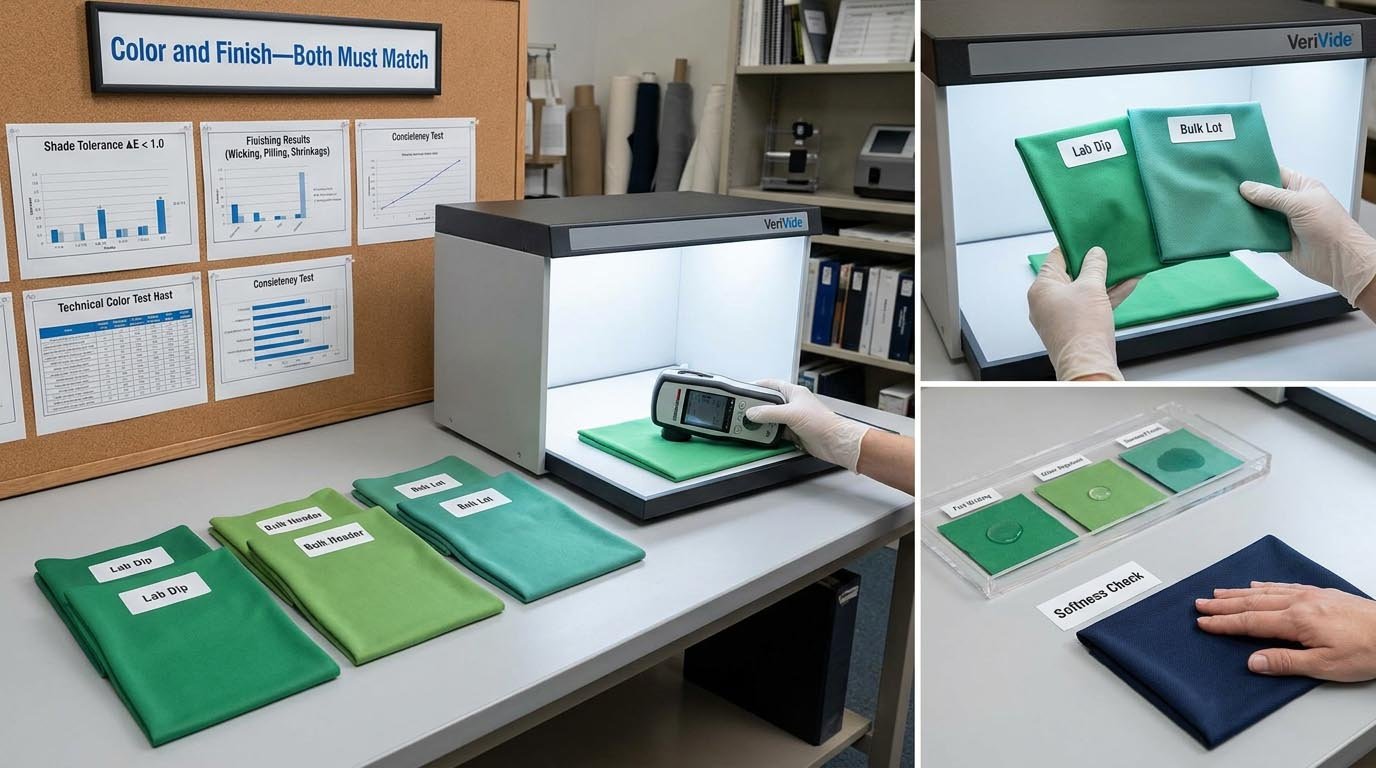
Approving a lab dip proves that a color is possible. It does not guarantee that bulk dyeing will match perfectly without proper process control, header approval, and finish consistency checks.
Why lab dips are only the first step
Lab dips are small and tightly controlled. Bulk dyeing introduces variables such as:
- water quality
- machine temperature variation
- pH differences
- dye mixing scale
- fabric tension during dyeing
What brands should require after lab dip approval
A stronger process includes:
- approved lab dip
- bulk header or strike-off before full dyeing
- defined acceptable color tolerance
- approval of finishing results, not just shade
Why fabric finishing also needs control
A fabric may also require finishing such as:
- moisture-wicking
- softening
- anti-pilling
- brushing or hand-feel enhancement
These finishes can vary across the fabric width or from lot to lot if application control is weak.
Development controls that reduce risk
| Control Point | Purpose | Risk Prevented |
|---|---|---|
| Lab dip approval | Confirm target shade recipe | Wrong development color |
| Bulk header approval | Confirm scale-up before full dyeing | Full-lot shade mismatch |
| Shade tolerance definition | Set pass/fail range | Subjective rejection disputes |
| Finish performance test | Verify wicking, softness, pilling | Finish claims not matching reality |
| Cross-width consistency check | Compare left/center/right roll behavior | Uneven garment performance |
Best practice
Do not approve color and finishing as separate ideas.
A fabric should be accepted only if it meets:
- color target
- finish performance
- durability expectations
- consistency standards
For golf apparel, bulk fabric control is not only about color. It is also about repeatable performance.
How Grading and Size Curves Affect Fit and Returns
Short answer
A base-size sample can fit perfectly while the full size range still performs badly if grading rules do not match the brand’s real customer body type or size demand curve.
Why standard grading often fails
Many brands use standard grading rules by default. These assume body growth is proportional across:
- chest
- waist
- shoulder
- body length
- sleeve length
But many golf customers do not scale proportionally.
Example: athletic-build mismatch
Athletic customers often have:
- broader shoulders relative to waist
- stronger upper back
- less proportional waist growth
- different torso balance than standard casualwear customers
If you use generic grading, larger sizes often become:
- too long
- too wide at the waist
- too relaxed through the body
- less flattering and less functional
Why this matters online
If customers cannot try on first, bad grading leads to:
- multi-size ordering
- higher return volume
- inconsistent fit reviews
- lower confidence in the brand
Grade rules should reflect the target market
For example, a golf brand targeting:
- club players
- younger athletic golfers
- older premium customers
- women’s golf consumers
may need different grading and inventory distribution logic.
Size curve errors also cost money
Production quantity by size should not rely only on generic market assumptions.
| Market Type | Common Size Risk If Using Generic Curve |
|---|---|
| Younger athletic golf | Too few smalls and mediums |
| Country club / mature customer base | Too few XL and 2XL |
| Premium fitted brand | Overproduction in larger relaxed sizes |
| Women’s golf | Wrong balance across XS-M-L spread |
Better planning process
Before bulk production:
- analyze sales data if available
- compare competitor sizing logic
- align grading to customer body type
- align size curve to expected demand
A well-fitting medium does not mean the size range is ready for market.
Which Construction Details Most Affect Perceived Quality
Short answer
Small construction upgrades in collars, plackets, buttons, and finish execution can create a much stronger premium impression than brands expect.
Why perceived quality matters
Customers often decide whether a polo feels “premium” based on small tactile and visual cues, including:
- collar shape
- button feel
- placket cleanliness
- logo sharpness
- seam neatness
- trim stability
They usually cannot explain these details technically, but they feel the difference immediately.
Highest-impact quality details
1. Collar construction
A stronger collar often comes from:
- better interfacing choice
- more controlled edge roll
- cleaner collar band finish
- better point shaping
2. Button quality
A thicker, better-finished button changes:
- tactile feel
- durability
- brand perception
- visual polish
3. Placket finish
A cleaner placket with better edge execution can make the whole garment look more expensive.
4. Logo execution
A premium logo is not just about the artwork. It is about:
- stitch density
- edge sharpness
- consistency
- softness vs stiffness balance
Cost vs perceived value table
| Detail Upgrade | Small Cost Increase | Perceived Impact |
|---|---|---|
| Better collar structure | Low | Strong premium signal |
| Better buttons | Low | Better hand feel and durability |
| Cleaner placket finish | Low | More refined appearance |
| Reinforced stress points | Low | Higher durability trust |
| Premium embroidery execution | Moderate | Better brand presentation |
Important commercial lesson
In many cases, a small unit-cost increase in construction quality supports:
- higher retail price
- lower price resistance
- better reviews
- stronger repeat purchase
Premium positioning is often created by details customers cannot name but immediately notice.
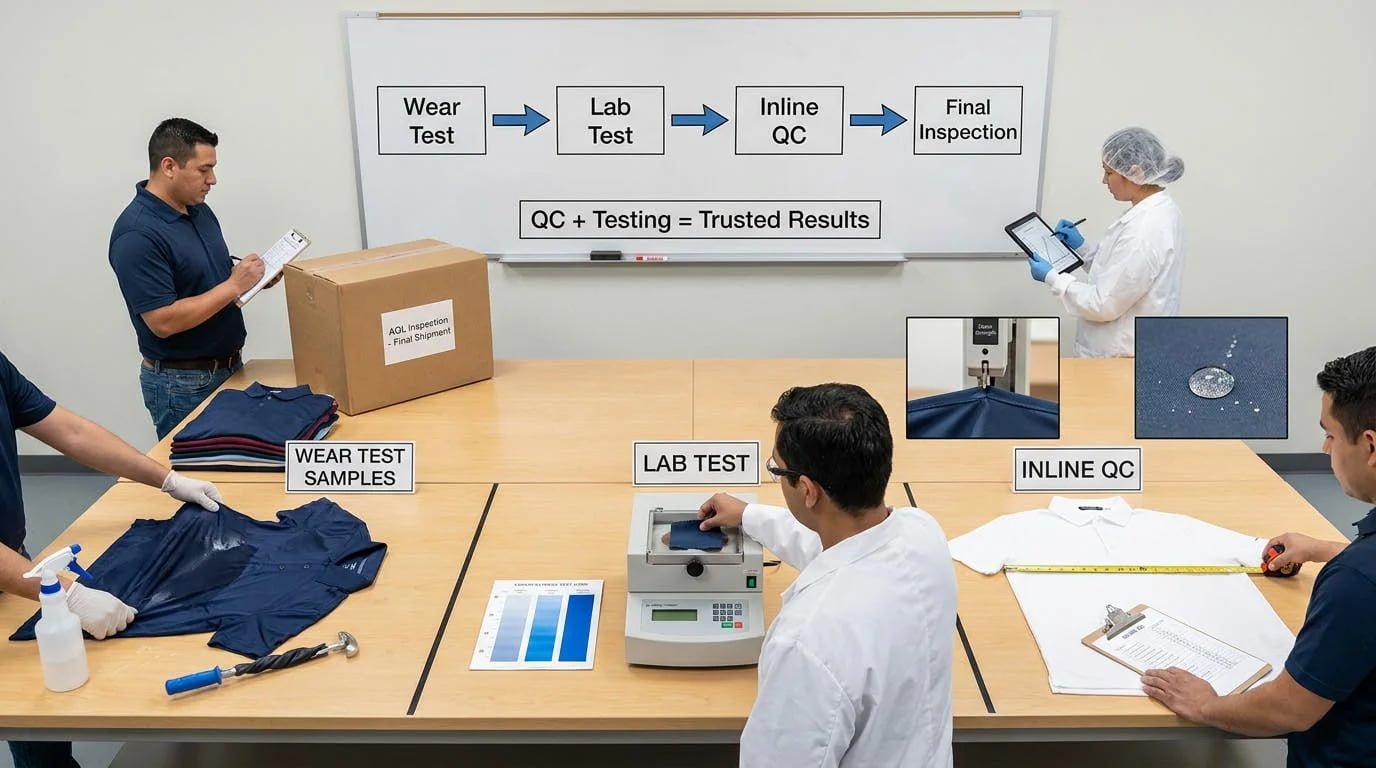
What QC and Lab Tests Golf Brands Should Require
Short answer
Golf brands should use both lab testing and production QC because they solve different problems. Lab tests validate material and construction performance. QC validates whether bulk output matches approved standards.
Why final inspection alone is not enough
A final inspection can catch:
- visible defects
- measurement errors
- sewing issues
- packing mistakes
It does not prove:
- the product survives wear
- the product survives washing
- the fabric finish lasts
- the trim remains stable
- the fit works during play
Recommended testing stages
1. Pre-production wear testing
Use actual samples for:
- movement testing
- wet performance review
- repeated wear
- repeated wash checks
2. Lab testing before bulk authorization
Recommended categories include:
- dimensional stability
- colorfastness
- pilling resistance
- seam strength
- seam slippage
- trim performance where relevant
3. Inline production QC
Check during production:
- measurement consistency
- collar and trim execution
- logo application quality
- seam construction
- fabric appearance
4. Final AQL inspection
Use an agreed AQL standard based on price point and quality expectations.
Suggested validation framework
| Stage | Main Goal | What It Catches |
|---|---|---|
| Wear test | Real-use performance | Fit restriction, wet discomfort, durability concerns |
| Lab test | Performance verification | Shrinkage, pilling, seam strength, fastness |
| Inline QC | Process control during production | Repeated construction or measurement defects |
| Final AQL inspection | Shipment acceptance | Bulk-level defect rate before shipping |
AQL should match market positioning
| Retail Positioning | Suggested AQL Mindset |
|---|---|
| Budget | More tolerant of minor variation |
| Mid-tier | Balanced defect tolerance |
| Premium | Stricter standard expected |
| Luxury | Very low major defect tolerance |
Key principle
QC catches whether the factory made the product correctly.
Testing catches whether the product was designed correctly in the first place.
If you skip validation and rely only on final inspection, you may ship a product that matches the tech pack but still fails the customer.
FAQ: Golf Apparel Development
Why do golf apparel samples pass but bulk production fails?
Because samples are often approved for appearance, while bulk success depends on performance, durability, and consistency. Problems such as wet cling, movement restriction, trim degradation, and color variation often appear only later.
What is the most important test brands skip in golf apparel development?
Wet performance testing is one of the most commonly skipped and most valuable tests. Golf garments need to work when the player is sweating, not only when the fabric is dry.
How should golf apparel fit be tested?
It should be tested both statically and dynamically. The garment should be worn during golf-specific movement such as full swings, reach-across motion, and bent putting posture.
Why do golf polo collars stretch out after washing?
Usually because of trim recovery issues related to rib quality, spandex content, heat exposure, operator tension, and lack of multi-wash durability validation.
Do embroidery and logos affect golf apparel performance?
Yes. Embroidery and print methods can reduce stretch, trap heat, stiffen fabric zones, and affect comfort during movement if not tested properly.
Can two moisture-wicking fabrics with the same spec perform differently?
Yes. The same listed fabric spec can still perform very differently depending on yarn quality, finish chemistry, application method, and wash durability.
What lab tests should golf brands require before bulk production?
At minimum, brands should consider tests for:
- dimensional stability
- colorfastness
- pilling resistance
- seam strength
- seam slippage
- any critical performance finish
Why are grading and size curves important in golf apparel development?
Because even if the base sample fits well, the full size range may fail if grading does not match the target customer’s body shape or if production quantities do not match real demand.
What is the difference between QC and wear testing?
QC checks whether production matches the approved standard. Wear testing checks whether the product actually performs well during use.
Final Takeaway
Golf apparel development problems usually come from one mistake:
brands validate the sample as a visual object instead of validating the garment as a performance product.
That is why so many problems remain hidden until after launch:
- fabric feels fine dry but fails when wet
- fit measures correctly but restricts movement
- collar looks premium new but degrades after washing
- logo placement looks good but affects stretch and comfort
- lab dip matches but bulk color drifts
- medium fits well but grading fails other sizes
- final QC passes but long-term durability disappoints customers
The brands that reduce returns and build stronger product trust usually do these things better:
- test fabric in real wearing conditions
- validate fit during golf-specific movement
- wash-test collars, trims, and finishes before bulk
- control bulk fabric color and finishing, not just sample approval
- use lab tests and QC together, not one instead of the other
If you are developing golf apparel for your brand, the goal is not simply to approve a nice sample.
The goal is to approve a product that can survive:
- real play
- repeated washing
- climate stress
- customer expectations
- bulk production variation
Need Support With Golf Apparel Development?
At FUWAY, we support golf brands with:
- golf polo and golf wear development
- fabric selection and performance review
- fit validation and pattern correction
- logo and trim execution planning
- grading and size curve support
- sample development and pre-production testing
- bulk quality control and inspection coordination
If you already have:
- sketches or tech packs
- fabric direction
- target price
- launch timeline
- sample feedback
- return or quality problems from past orders
send us your project details and we can help you identify the hidden development risks before production starts.