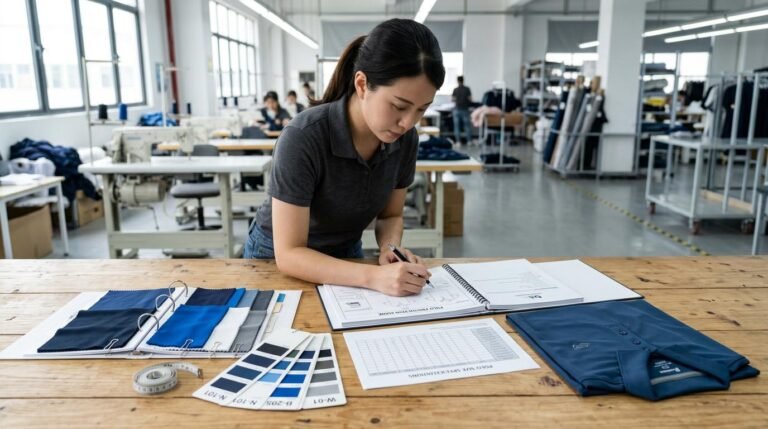
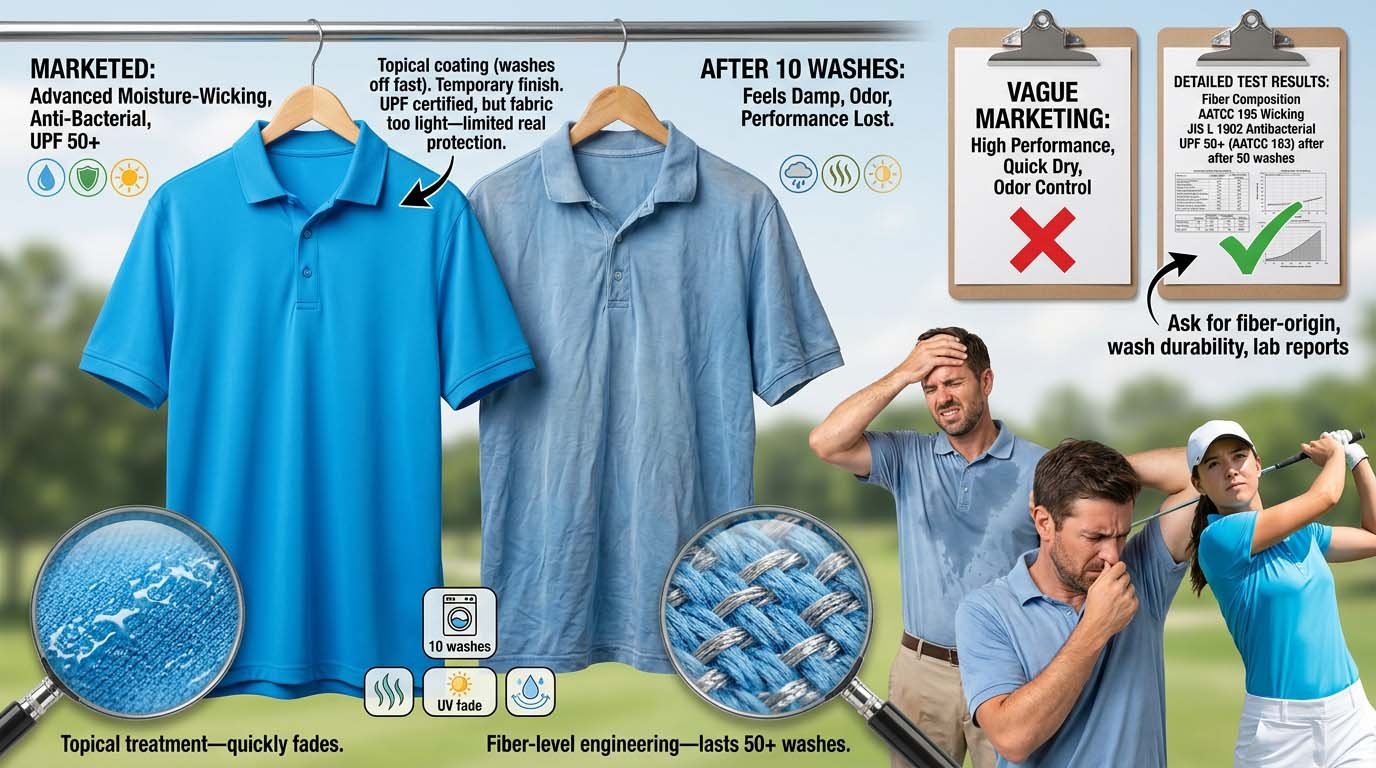
A client ordered 800 golf polos with fabrics marketed as "advanced moisture-wicking and anti-bacterial." The supplier's spec sheet listed impressive features: UPF 50+, silver ion treatment, quick-dry technology. Three months after launch, customer complaints flooded in. The shirts felt damp during play, developed odor after 5-6 wears, and the "anti-bacterial" treatment seemed to vanish after 10 washes. The client asked me why the fabric failed. I reviewed the actual specifications. The moisture-wicking was a basic topical coating that washed off quickly. The anti-bacterial treatment was a surface finish, not fiber-embedded technology. The UPF rating was certified, but the lightweight construction and light color reduced actual sun protection. They had paid for performance features but received marketing claims without durable execution.
Performance fabric features like moisture-wicking, UV protection and anti-bacterial treatments vary dramatically in execution quality and durability—where identical spec sheet claims can hide differences between fiber-level engineering versus temporary chemical coatings, wash-durable treatments versus finishes that fade after 10-20 cycles, and certified ratings that ignore real-world variables like fabric color, density and construction, making feature verification and supplier questioning more critical than accepting marketing language at face value.
I am Will from FUWAY. Over the past 3 years, I have processed 150+ fabric specification inquiries from golf apparel buyers who need to decode performance claims and match technical features to their target market expectations. Most arrive with supplier spec sheets listing impressive features but no understanding of what separates wash-durable performance from temporary marketing claims. This guide shows you how to evaluate moisture-wicking mechanisms, verify UV protection claims, assess anti-bacterial treatment durability, and ask the right supplier questions to ensure performance features deliver actual value rather than inflating costs without corresponding benefits.
Quick Answers: Golf Polo Performance Fabrics
Q: What's the difference between fiber-based and finish-based moisture-wicking?
Fiber-based (e.g. polyester) is permanent—lasts garment's life; finish-based (chemical coating) washes out after 20–40 washes and costs $0.30–0.80/yard more. Always ask your supplier which type they're using.
Q: How can I verify a fabric's UPF rating is real?
Ask for a certified lab report (AATCC 183 or AS/NZS 4399) showing UPF after 40+ washes—never trust "UPF 50+" claims on white, light fabrics without legit documentation.
Q: How long do anti-bacterial treatments last?
Silver ion (in fiber): 80–100+ washes (permanent); zinc: 30–50 washes; QAC: 10–25 washes; cheap ones wear off quickly. Demand agent names and wash test data.
Q: Should a golf polo have wicking, UV, and anti-bacterial all-in-one?
Not always—feature stacking raises fabric cost ($1.20–4.80/yard) and may reduce breathability or softness. Prioritize wicking for hot/humid, UV for desert sun, anti-bacterial for pro/multi-wear needs.
Q: What's the cost difference between basic and performance fabrics?
Basic polyester: $3.00–4.50/yard; full performance: $5.00–8.50/yard (+$3–9 per polo). Only spec all features if your brand/price point supports the added value.
What Defines Performance: Wicking, UV/UPF and Anti-Bacterial
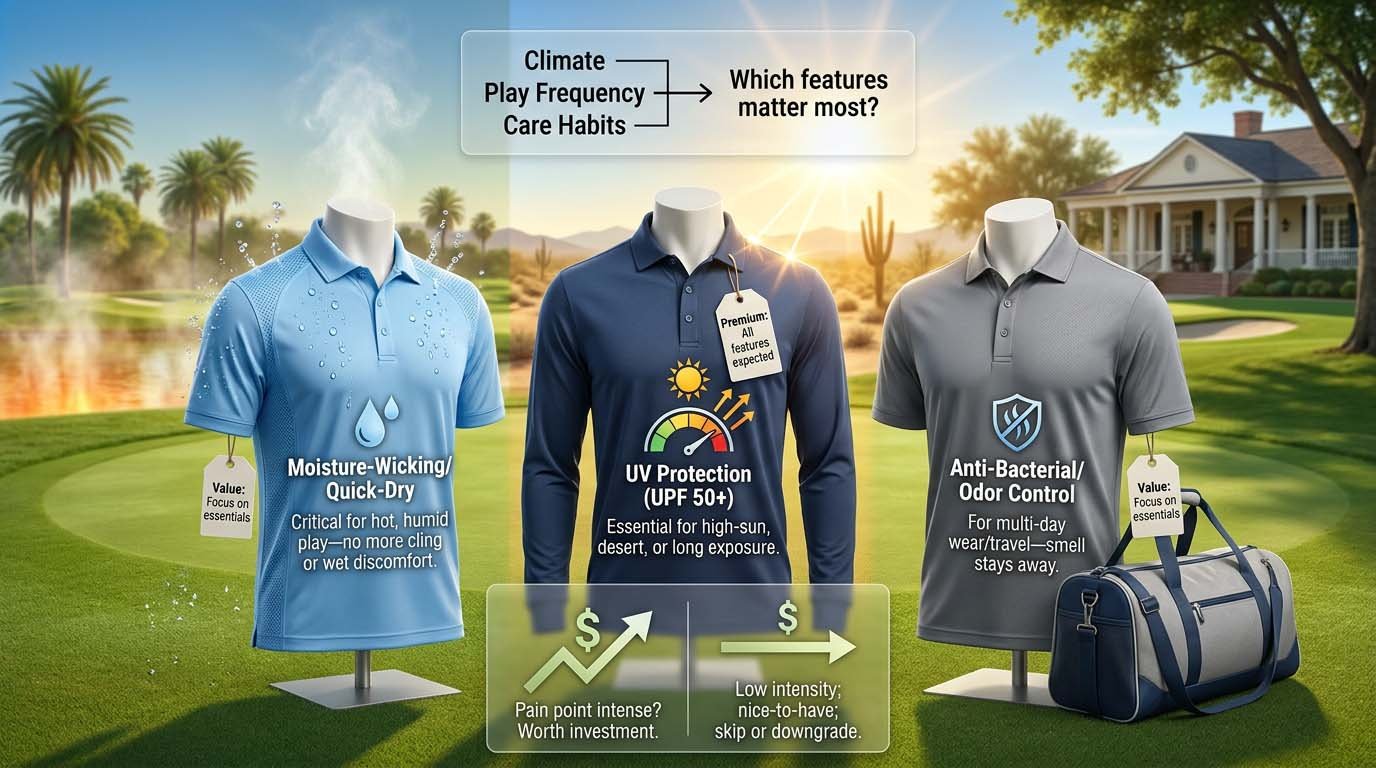
Performance fabric definition depends on matching technical properties to specific activity demands, environmental conditions and user behavior patterns—where moisture-wicking addresses sweat discomfort during play, UV protection mitigates sun exposure risk, and anti-bacterial treatments reduce odor between washings, with optimal specification requiring prioritization based on climate intensity, play frequency, washing habits and customer price sensitivity rather than maximizing feature count regardless of incremental value delivered.
Core Performance Dimensions
Moisture management (wicking and quick-dry):
- Problem addressed: Wet, clingy fabric causing discomfort
- Mechanism: Moving sweat away from skin to fabric surface for evaporation
- When critical: Hot, humid climates; high-intensity play; long rounds (4-5 hours)
- When less important: Cool weather; short sessions; frequent breaks
Thermal regulation (breathability and cooling):
- Problem addressed: Heat buildup causing overheating
- Mechanism: Air permeability, evaporative cooling, heat dissipation
- When critical: Hot environments; direct sun exposure; restricted airflow (full pants, layers)
- When less important: Temperate conditions; partial shade; lightweight clothing
UV protection (blocking harmful radiation):
- Problem addressed: Skin damage, sunburn, long-term cancer risk
- Mechanism: Physical barrier or chemical absorption of UV rays
- When critical: High-altitude courses; desert climates; fair-skinned users; long sun exposure
- When less important: Overcast conditions; heavily treed courses; players using sunscreen religiously
Odor control (anti-bacterial and anti-microbial):
- Problem addressed: Bacterial growth causing smell between washes
- Mechanism: Inhibiting bacteria that break down sweat into odor compounds
- When critical: Multi-day wear; high-sweat activities; travel without laundry access
- When less important: Wash-after-every-use habits; low-sweat activities; short wearing periods
Priority Matrix by Use Case
| Customer Type | Climate | Wicking Priority | UV Priority | Anti-Bacterial Priority |
|---|---|---|---|---|
| Recreational golfer | Hot/humid | Critical | Medium | Low (wash after use) |
| Recreational golfer | Hot/dry | Medium | Critical | Low |
| Tournament player | Any hot | Critical | Critical | Medium (long days, delayed wash) |
| Casual player | Temperate | Low | Low | Low |
| Resort/vacation | Tropical | Critical | Critical | Medium (limited laundry) |
| Private club | Temperate | Low | Low | Low (prestige over function) |
Cost-Benefit Decision Framework
Question 1: What is customer's pain point intensity?
- High intensity (complaints about discomfort): Invest in feature addressing pain
- Low intensity (nice-to-have): Skip feature or use budget treatment
Question 2: Does customer perceive and value feature?
- Visible/noticeable (stays dry, no odor): Customer willing to pay premium
- Invisible (UV protection with sunscreen use): Customer may not value enough to pay more
Question 3: What is competitive landscape?
- Competitors lack feature: Differentiation opportunity (premium justifiable)
- Competitors all have feature: Table stakes (must include to compete)
Question 4: What is your retail price positioning?
- Premium ($70-120): Customer expects performance features
- Mid-tier ($45-70): Select features matching brand positioning
- Value ($25-45): Minimal performance features (cost-prohibitive)
Moisture-Wicking 101: Fibers, Knits, Finishes and Test Metrics
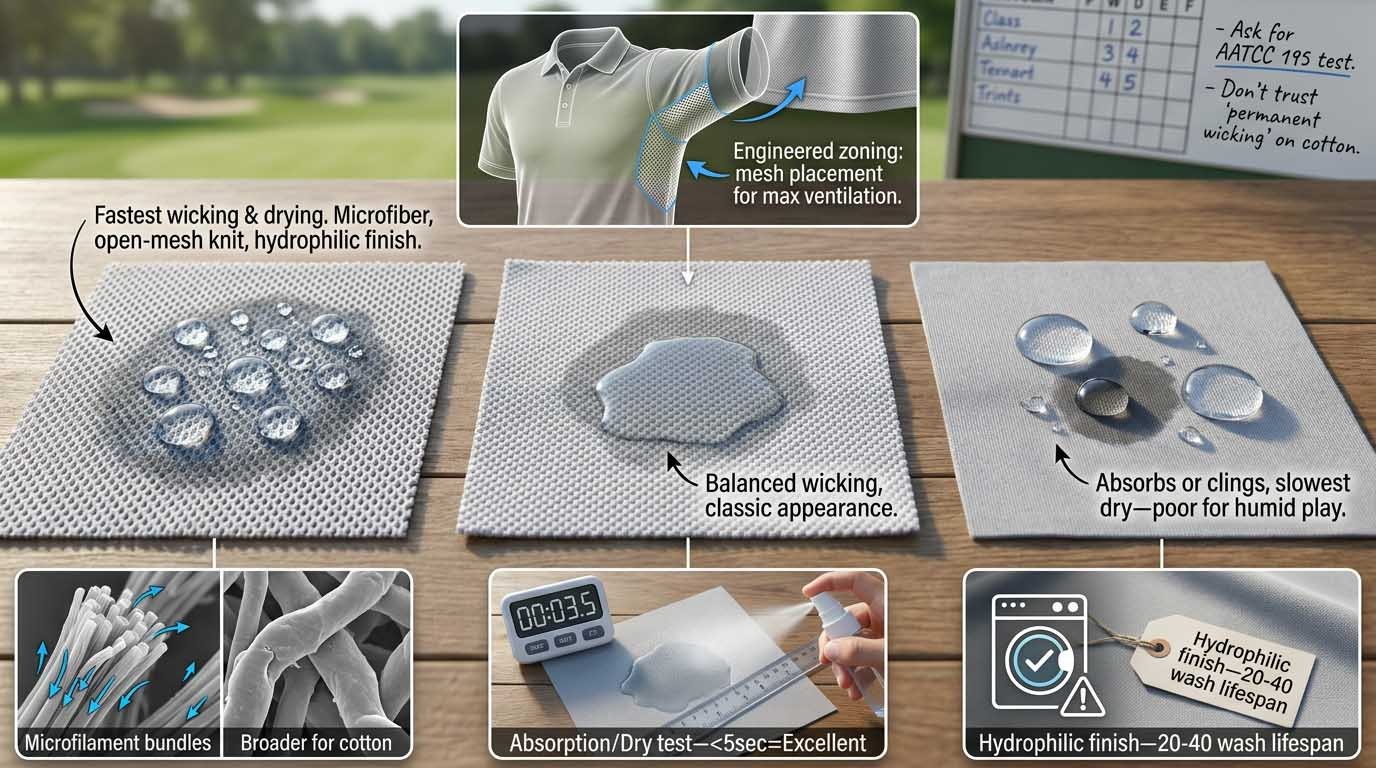
Moisture-wicking effectiveness depends on combined fiber capillary action, knit structure allowing airflow and surface area, and chemical finishes enhancing water spread—where microfiber polyester with open-mesh construction and hydrophilic coating outperforms standard polyester in tight weave despite identical marketing claims, making hands-on testing or detailed specification questioning necessary to verify actual performance rather than relying on generic wicking labels.
Fiber-Level Wicking: Natural vs. Engineered
Polyester (most common golf fabric):
- Natural wicking mechanism: Hydrophobic (water-repelling) fiber pushes moisture along fiber surface through capillary action
- Wicking speed: Moderate to fast depending on fiber cross-section
- Durability: Permanent (fiber structure does not change)
- Cost: Standard polyester $3.00-4.50/yard
Microfiber polyester:
- Ultra-fine fibers (0.7 denier or less) create more surface area
- Enhanced capillary action due to fiber fineness
- Faster wicking and drying than standard polyester
- Cost: $4.00-6.00/yard (premium 30-50%)
Nylon:
- Naturally more hydrophobic than polyester
- Faster wicking in some constructions
- Less common in golf polos (more expensive, less color range)
- Cost: $5.50-8.00/yard
Cotton:
- Absorbs moisture but does not wick effectively
- Holds water in fiber (stays wet)
- No natural wicking without chemical treatment
- Cheap but poor performance for hot/humid conditions
Cotton with wicking finish:
- Chemical coating makes cotton surface hydrophilic (attracts water)
- Moderate wicking (better than untreated, slower than polyester)
- Finish wears off 20-40 washes
- Cost: $4.00-6.00/yard (base cotton + finish treatment)
Knit Structure Impact
Open mesh (maximum breathability):
- Large holes in knit structure allow maximum airflow
- Water evaporates fastest
- Tradeoff: Less coverage, more show-through (white/light colors)
- Best for: Extreme heat, maximum ventilation priority
Pique knit (textured surface):
- Raised texture creates small air pockets
- Moderate breathability and moisture spread
- Traditional golf polo appearance
- Balanced performance-aesthetics
Jersey knit (smooth, dense):
- Flat, tighter knit structure
- Slower drying than mesh or pique
- Better opacity and coverage
- Best for: Dress-casual styles prioritizing appearance
Engineered zoning (hybrid):
- Mesh panels in high-sweat areas (underarms, back)
- Pique or jersey in visible areas (front, sleeves)
- Optimizes performance without sacrificing aesthetics
- More expensive: +$0.80-1.50/yard for multi-knit construction
Chemical Finishes and Treatments
Hydrophilic (water-attracting) finishes:
- Applied to fiber surface
- Spreads moisture across fabric faster
- Wears off gradually: 20-40 washes depending on quality
- Cost: +$0.30-0.80/yard
Hydrophobic (water-repelling) finishes:
- Used on outer surface in some technical fabrics
- Pushes water away from garment to air (sheds rain/splash)
- Less common in golf polos (players want moisture absorption, not repellence)
Durable Water Repellent (DWR):
- Creates water beading on fabric surface
- Not for golf polos (prevents sweat absorption)
- Used in rain jackets
Testing and Verification
Simple field test (no lab required):
-
Absorption test:
- Pour 50ml water on fabric sample
- Time how long water takes to spread across 10cm diameter
- Fast wicking: <5 seconds
- Moderate: 5-15 seconds
- Slow: 15+ seconds
-
Drying test:
- Soak fabric, wring out excess
- Hang in room temperature with fan
- Time until completely dry
- Excellent: <30 minutes
- Good: 30-60 minutes
- Poor: 60+ minutes
-
Wash durability test:
- Test wicking before washing (baseline)
- Wash 10 times in standard detergent
- Re-test wicking
- Good finish: <20% performance drop
- Poor finish: 30%+ drop after 10 washes
Lab testing (request from suppliers):
- AATCC 195 (Liquid Moisture Management)
- Measures: Wetting time, absorption rate, spreading speed, drying rate
- Request test report with before/after washing comparison
Questions to ask suppliers:
- "Is wicking fiber-based or finish-applied?"
- "If finish, what is expected wash durability?"
- "Can you provide AATCC 195 test report?"
- "What is dry time for this fabric in standard conditions?"
Red flags:
- Supplier cannot explain wicking mechanism
- No test reports available
- Claims "permanent wicking" on cotton fabric (impossible without finish that wears off)
- Refuses to provide sample for your own testing
UV Protection Explained: UPF Ratings, Constructions and Treatments
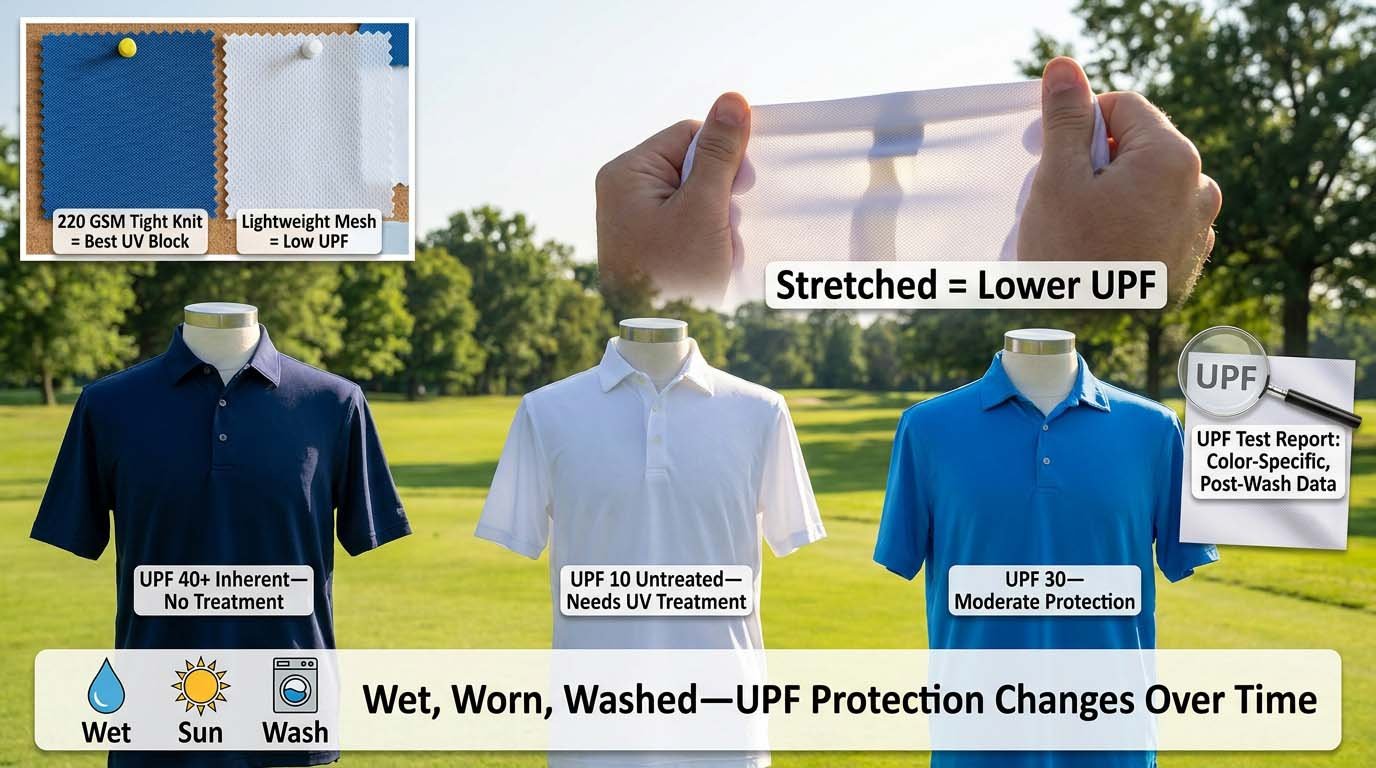
UPF ratings indicate fabric's UV-blocking capacity under controlled lab conditions but do not account for real-world variables like fabric stretch during wear, color's impact on UV absorption, moisture effects on chemical treatments, and gradual degradation through washing and sun exposure—making fabric density, color selection, fit looseness and treatment durability equally important to certification numbers for ensuring consistent sun protection throughout garment lifespan.
Understanding UPF Numbers
UPF scale and meaning:
-
UPF 15-24: Good protection
- Blocks 93.3-95.9% UV radiation
- Allows 1/15 to 1/24 of UV through
-
UPF 25-39: Very good protection
- Blocks 96.0-97.4% UV radiation
- Allows 1/25 to 1/39 of UV through
-
UPF 40-50+: Excellent protection
- Blocks 97.5%+ UV radiation
- Allows less than 1/40 of UV through
- UPF 50+ is maximum rated (diminishing returns above 50)
Context: SPF (sunscreen) measures only UVB. UPF measures both UVA and UVB protection from fabric.
Factors Affecting UV Protection
Fabric color (major impact):
- Dark colors (navy, black, dark gray): Block more UV naturally
- Darker dyes absorb UV radiation
- Can achieve UPF 30-50 without treatment
- Bright colors (red, royal blue): Moderate UV blocking
- UPF 20-35 range typical
- Light colors (white, pastels, light gray): Block less UV
- UPF 5-15 without treatment
- Require chemical UV treatment for higher ratings
Practical implication: Same fabric in white may be UPF 10 while same fabric in navy is UPF 40+ without any treatment difference.
Fabric weight and density:
- Heavier fabrics (220+ GSM) block more UV (more material)
- Tighter weaves reduce gaps where UV penetrates
- Lightweight performance fabrics (140-180 GSM) require treatments or tight knit to achieve high UPF
Fabric stretch (during wear):
- Tight-fitting garments stretch fabric, opening knit structure
- Stretched fabric can lose 30-50% UPF compared to flat state
- Looser fits maintain closer to rated UPF
Moisture effects:
- Some chemical UV treatments lose effectiveness when wet
- Water can change fabric's light transmission (sometimes higher UV penetration)
- Synthetic fibers (polyester) maintain UPF better when wet than cotton
Washing and wear degradation:
- Chemical UV treatments (titanium dioxide, zinc oxide coatings) can wash off gradually
- Fiber-based protection (inherent to polyester, UPF-enhanced fibers) lasts longer
- Sun exposure itself can degrade some chemical treatments over time
Treatment Types and Durability
Inherent/fiber-based protection (most durable):
- Polyester naturally blocks UV (aromatic rings in polymer structure)
- Nylon blocks UV moderately
- Dark-dyed fibers have UV-absorbing colorants throughout
- Durability: Life of garment (100+ washes)
- Cost: No added cost (inherent to material choice)
Chemical UV-absorber treatments:
- Titanium dioxide, zinc oxide particles bonded to fabric
- UV-absorbing chemicals that convert UV to heat
- Durability: 40-80 washes depending on bonding quality
- Cost: +$0.40-1.00/yard
Ceramic/mineral coatings:
- Permanent mineral particles in fabric
- Very durable (80-100+ washes)
- More expensive (+$0.80-1.50/yard)
- Used in premium performance lines
Verification and Testing
Request from supplier:
-
UPF test report:
- AATCC 183 or AS/NZS 4399 standard
- Shows UPF rating for specific color (not just one color tested)
- Includes after-wash testing (25, 50 washes)
-
Color-specific ratings:
- Request UPF for actual colors you're producing
- White/light colors may need additional treatment
-
Wash durability data:
- UPF after 25 washes (should remain ≥90% of original)
- If significant drop, treatment is low-durability
Questions to ask:
- "Is UV protection inherent to fiber or treatment-based?"
- "What is UPF rating for white/light colors specifically?"
- "What is UPF retention after 25 and 50 washes?"
- "Does UPF rating apply to fabric when stretched (worn)?"
Red flags:
- Supplier claims UPF 50+ on white lightweight fabric without chemical treatment (unlikely)
- Cannot provide color-specific UPF data
- No wash durability testing available
- Claims permanent UPF from chemical coating (coatings wear off)
Practical Selection Guidelines
For maximum real-world UV protection:
- Choose darker colors (navy, black, charcoal)
- Specify tighter knit structures (less gap between yarns)
- Request chemical UV treatment for light colors
- Use medium to heavy weight fabrics (180+ GSM)
- Design looser fits (less fabric stretch)
For budget-conscious UV protection:
- Rely on fiber-inherent protection (dark polyester)
- Skip chemical treatments if dark colors used
- Educate customers: darker colors = better UV protection
For maximum durability:
- Specify fiber-based or ceramic treatments over chemical coatings
- Request wash test documentation
- Choose polyester over cotton (better inherent UV blocking)
Anti-Bacterial & Odor Control: Technologies, Efficacy and Compliance
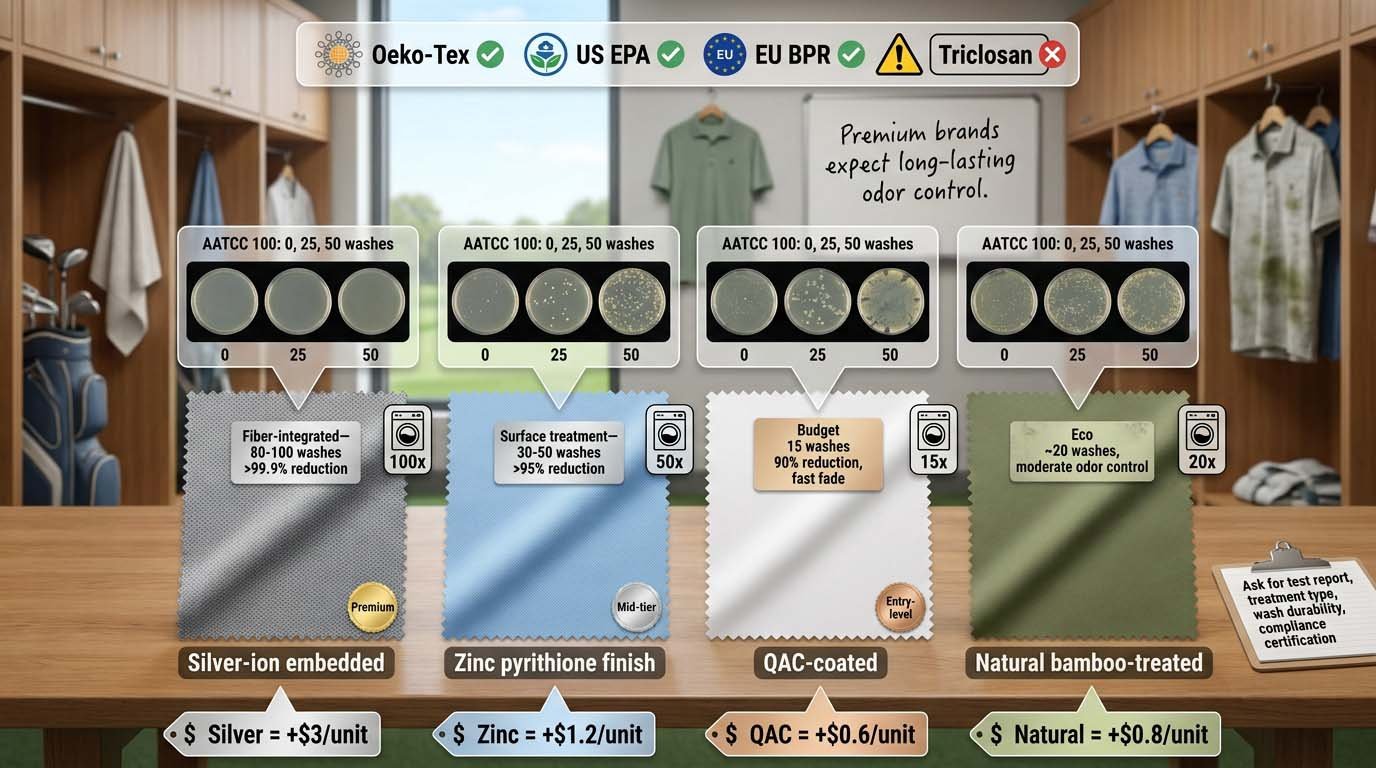
Anti-bacterial treatments range from wash-durable fiber-embedded technologies lasting 80-100+ cycles to surface finishes fading after 10-20 washes—where specific treatment chemistry, application method and testing standards determine actual odor control efficacy and cost-effectiveness, making blanket claims like "anti-bacterial fabric" insufficient without verification of treatment type, test method results, wash durability data and regulatory compliance status in target markets.
Treatment Technologies and Mechanisms
Silver ion (Ag+) embedded in fiber:
How it works:
- Silver nanoparticles integrated into fiber during extrusion
- Silver ions released slowly, disrupting bacterial cell membranes
- Inhibits bacterial growth (prevents odor-causing bacteria)
Durability:
- 80-100+ washes before significant reduction
- Most permanent method (silver embedded throughout fiber)
Cost:
- +$1.50-3.00/yard (most expensive)
Effectiveness:
- 99.9% bacterial reduction (when tested properly)
- Works continuously (not depleted quickly)
Best for:
- Premium performance lines ($80-150 retail)
- Multi-day wear expectations
- Customers prioritizing odor control
Zinc pyrithione (common alternative):
How it works:
- Zinc-based compound applied as finish treatment
- Anti-fungal and anti-bacterial properties
Durability:
- 30-50 washes before notable reduction
- Moderate longevity
Cost:
- +$0.50-1.20/yard (mid-range)
Effectiveness:
- 95-99% bacterial reduction initially
- Degrades more quickly than silver
Best for:
- Mid-tier performance positioning
- Moderate odor control needs
Quaternary ammonium compounds (QAC/Quat):
How it works:
- Positively-charged molecules bond to fabric surface
- Attract and rupture negatively-charged bacterial cells
Durability:
- 10-25 washes effective lifespan
- Surface coating washes off gradually
Cost:
- +$0.20-0.60/yard (lowest cost)
Effectiveness:
- 90-95% bacterial reduction initially
- Significant performance drop after 15 washes
Best for:
- Budget performance lines
- Short-term odor control
- Testing market response before investing in durable treatments
Natural treatments (chitosan, bamboo charcoal):
Performance:
- Varies widely (often overstated in marketing)
- Limited wash durability (10-30 washes typical)
- Moderate effectiveness (70-90% reduction)
Cost:
- +$0.40-1.00/yard
Marketing value:
- Appeals to eco-conscious buyers
- Natural/sustainable positioning
Reality check:
- Less effective than silver or zinc chemically
- Useful for brand positioning more than technical performance
Testing and Verification
Standard test methods:
- Measures percentage bacterial reduction
- Inoculates fabric with bacteria, counts survivors after incubation
- Target: >99% reduction for effective treatment
- Can test at 0, 25, 50+ washes to verify durability
JIS L 1902 (Japanese standard):
- Similar to AATCC 100
- Common in Asian manufacturing
ISO 20743:
- International standard
- Comparable to AATCC 100
What to request from suppliers:
-
Test report showing:
- Bacterial reduction percentage (>99% for premium, >95% acceptable for budget)
- Wash cycle testing (0, 25, 50 washes minimum)
- Accredited lab name and date
-
Treatment specification:
- Exact chemical/technology used (not just "anti-bacterial")
- Application method (fiber-embedded vs. finish)
- Expected wash durability
-
Safety and compliance:
- Oeko-Tex certification (proves no harmful chemicals)
- EPA/EU compliance for specific agents (some banned in regions)
Questions to ask:
- "What specific anti-bacterial agent is used?"
- "Is treatment fiber-embedded or surface-applied?"
- "What is bacterial reduction percentage after 25, 50 washes?"
- "Do you have AATCC 100 test reports?"
- "Is treatment compliant in US/EU/target markets?"
Red flags:
- Supplier cannot name specific treatment chemistry
- Claims "permanent anti-bacterial" from coating (coatings always wear off eventually)
- No test reports available
- Uses Triclosan (banned in US/EU personal care products, avoid)
Regulatory Compliance
US EPA requirements:
- Anti-bacterial agents are pesticides under EPA regulation
- Manufacturers must register treatments with EPA
- Some older agents now banned (Triclosan, Triclocarban)
EU Biocidal Products Regulation (BPR):
- Requires authorization for biocidal products
- Silver and zinc treatments generally permitted
- Some QAC compounds restricted
Compliance verification:
- Request EPA registration number (US sales)
- Request EU BPR compliance documentation (EU sales)
- Avoid suppliers using unregistered/banned agents
Practical reality: Many Asian manufacturers use agents not approved in US/EU. If selling in regulated markets, verify compliance before production—recall/seizure risk otherwise.
Cost-Benefit Analysis
Scenario 1: Premium golf brand, $100+ retail, long-term performance:
- Invest in silver ion embedded: +$3-6 per garment
- Justifies higher retail price
- Customer expectation for durability
- ROI: Reduced returns, positive reviews, premium positioning
Scenario 2: Mid-tier brand, $50-75 retail, balanced performance:
- Use zinc pyrithione: +$1-2.50 per garment
- Moderate durability acceptable
- Competitive advantage without excessive cost
- ROI: Differentiation at reasonable investment
Scenario 3: Value brand, $30-45 retail, testing market:
- Use QAC or skip treatment: +$0.50-1.50 or $0
- Customers may not notice or value odor control
- Prioritize cost over technical features
- ROI: Questionable—may not be worth investment at this price point
Calculation example (500-piece order):
- Silver ion treatment: +$3.50/unit × 500 = $1,750 total
- Zinc pyrithione: +$1.20/unit × 500 = $600 total
- QAC: +$0.60/unit × 500 = $300 total
If treatment allows you to charge $10 more retail, gross margin improvement may justify premium treatment investment. If price-constrained market, skip or use budget option.
Fabric Choices: Polyester, Nylon, Cotton Blends, Recycled and Bio-Based
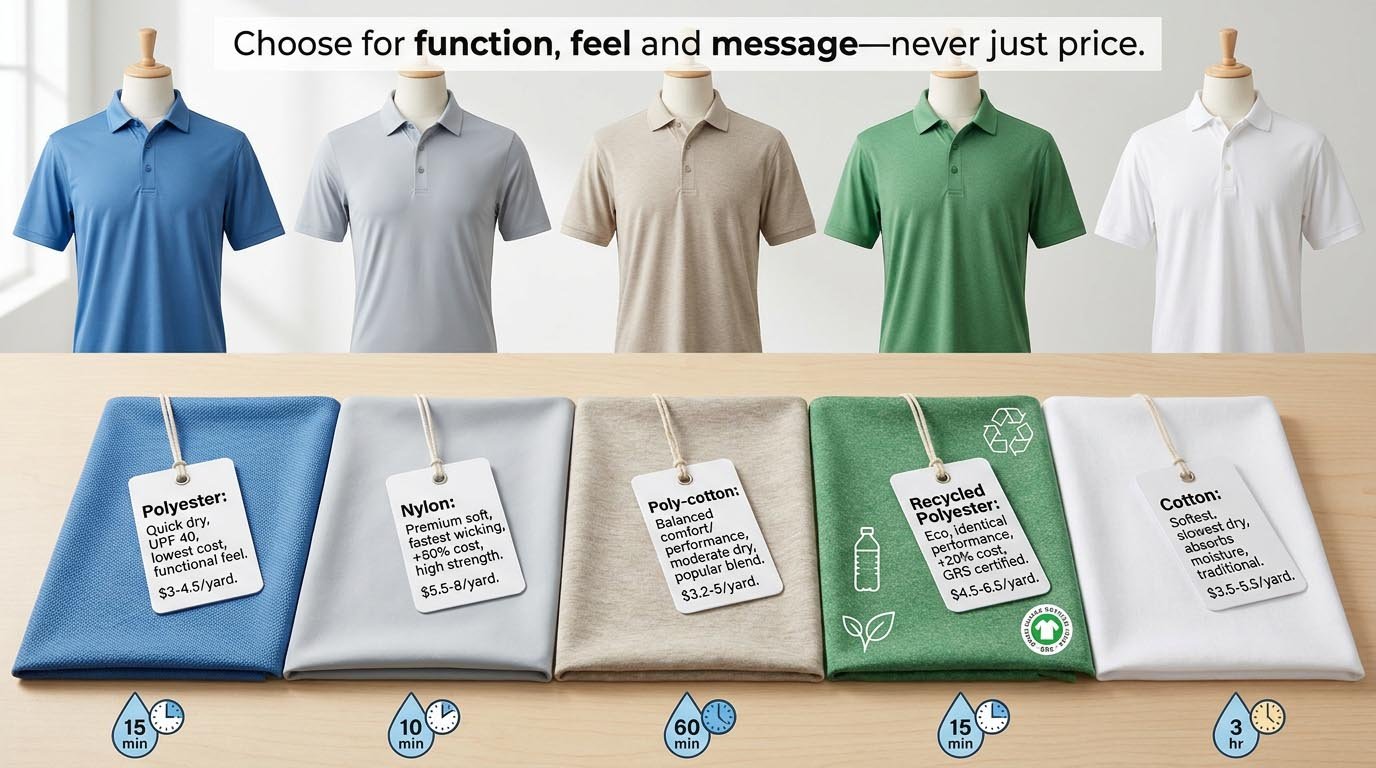
Fiber selection for performance golf fabrics requires balancing moisture management needs, cost constraints, sustainability positioning and customer feel preferences—where 100% polyester maximizes wicking and quick-dry at lowest cost, nylon offers premium performance at higher expense, cotton sacrifices function for softness, and strategic blends like 65/35 poly-cotton deliver adequate performance with improved hand feel for price-conscious customers who want both comfort and function rather than optimizing single dimension.
Polyester: The Performance Workhorse
Why polyester dominates performance fabrics:
- Hydrophobic (water-repelling): Pushes moisture to surface
- Quick-dry: Water evaporates 3-5x faster than cotton
- Shape retention: No shrinkage, maintains fit through washing
- Low cost: $3.00-4.50/yard for standard quality
- Lightweight: Can achieve 140-180 GSM without thinness
Performance advantages:
- UPF 20-40 inherent (higher than cotton)
- Excellent for hot/humid climates
- Minimal care requirements (no ironing)
Disadvantages:
- Synthetic hand feel (less soft than cotton initially)
- Can retain odor more than cotton (bacteria in synthetic fibers)
- Lower breathability than cotton in some constructions
When polyester wins:
- Performance-first positioning ($50-90 retail)
- Hot, humid climates
- Customers prioritizing function over traditional feel
- Budget constraints (lowest cost performance fabric)
Nylon: Premium Performance
Properties:
- More hydrophobic than polyester
- Faster wicking in some constructions
- Softer hand feel than polyester (closer to cotton)
- Higher strength (more abrasion-resistant)
Cost:
- $5.50-8.00/yard (premium 50-80% over polyester)
Performance comparison to polyester:
- Slightly faster drying
- Softer feel initially
- More durable (longer lifespan)
- Color fading slower than polyester
When nylon justifies premium:
- High-end performance lines ($100-150+ retail)
- Customers who notice and pay for hand-feel differences
- Premium brand positioning requiring material differentiation
When nylon wastes money:
- Value/mid-tier positioning (customers do not perceive difference)
- Cost-constrained projects
- Performance difference versus polyester insufficient to justify +$3-5 per garment
Cotton and Cotton Blends: Comfort Compromise
100% cotton:
- Softness: Best initial hand feel
- Breathability: Excellent air permeability
- Moisture absorption: Absorbs sweat from skin
- Moisture retention: Holds water (stays wet)
- Slow drying: 3-5 hours in humid conditions
Unsuitable for: Hot/humid climates, high-sweat activities
Suitable for: Temperate climates, traditional club dress codes, customers prioritizing natural fibers
Cotton-polyester blends:
65% Polyester / 35% Cotton (most popular):
- Quick-dry: 60-90 minutes (faster than pure cotton, slower than pure polyester)
- Soft hand: Cotton adds comfort to polyester
- Cost: $3.20-5.00/yard (comparable to cotton)
- Best use: Balanced performance and feel for general golf wear
50/50 Poly-Cotton:
- More cotton feel
- Moderate performance (90-120 minute dry time)
- Good for temperate climates
Performance enhancement:
- Add moisture-wicking finish to blends (improves performance to near-polyester levels)
- Cost: +$0.30-0.80/yard for treatment
Recycled Polyester: Sustainability Without Compromise
What it is:
- Polyester fiber from post-consumer plastic bottles or textile waste
- Identical performance to virgin polyester (wicking, quick-dry, durability)
Cost:
- $4.50-6.50/yard (premium 20-40% over virgin polyester)
Certification:
- GRS (Global Recycled Standard) verifies recycled content
- Request certification documentation
When recycled works:
- Sustainability positioning (brand value proposition)
- Eco-conscious target market (millennial/Gen-Z golfers)
- EU/US markets (higher environmental awareness)
- Retail $65-120 where sustainability messaging reinforces price
When recycled fails:
- Price-sensitive markets (customers prioritize cost)
- Sustainability not core to brand
- Performance-only buyers (no advantage over virgin)
Marketing value:
- "Made from X recycled bottles per shirt" (tangible message)
- Appeals to corporate buyers (ESG requirements)
Bio-Based and Alternative Fibers
Modal (semi-synthetic from beech trees):
- Softer than cotton
- Better moisture absorption than cotton
- Still retains moisture (does not wick like synthetics)
- Expensive: $6.00-9.00/yard
- Best for: Premium traditional positioning, not performance
Bamboo rayon (cellulose-based):
- Marketing appeal: Natural, sustainable
- Reality: Chemically processed (like rayon)
- Performance similar to cotton (absorbs, slow-dry)
- Cost: $5.00-7.50/yard
- Value depends on customer belief in eco-claims
Merino wool (for cool weather):
- Naturally odor-resistant
- Excellent temperature regulation
- Very expensive: $12-20/yard
- Rare in golf polos (niche cool-climate market)
Selection Decision Matrix
| Priority | Fiber Choice | Why | Cost/Yard |
|---|---|---|---|
| Maximum wicking + budget | 100% polyester | Best performance per dollar | $3.00-4.50 |
| Premium performance | Nylon or microfiber polyester | Superior feel and performance | $5.50-8.00 |
| Performance + soft feel | 65/35 poly-cotton | Balanced compromise | $3.20-5.00 |
| Sustainability positioning | Recycled polyester | Identical performance, eco-appeal | $4.50-6.50 |
| Traditional club market | 100% cotton or 50/50 blend | Natural feel expected | $3.50-5.50 |
| Maximum softness (premium) | Modal blend | Luxury hand, poor performance | $6.00-9.00 |
Design, Fit and Care: Breathability, Stretch, Drape and Maintenance
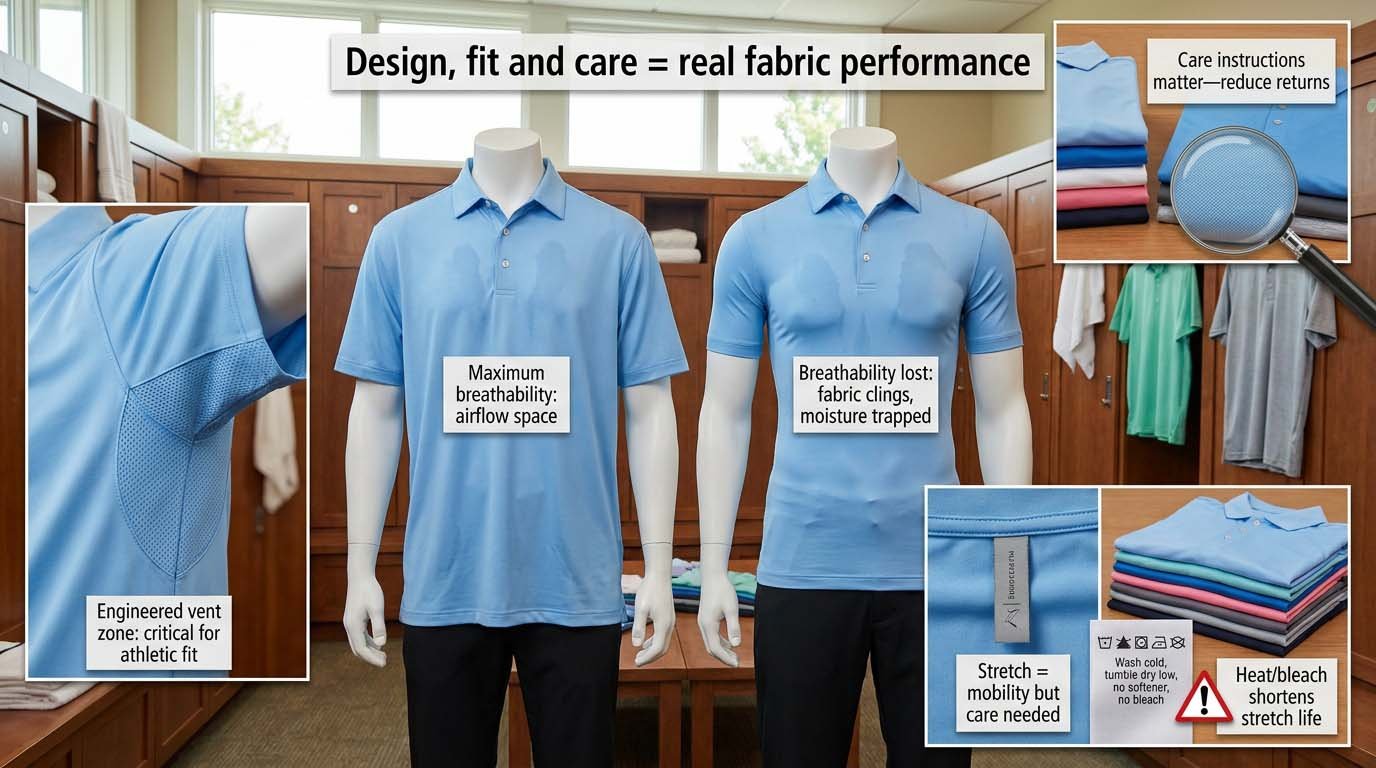
Performance fabric effectiveness depends on garment design enabling its properties—where moisture-wicking requires airflow space between fabric and skin for evaporation, UV protection degrades when fabric stretches in tight fits, and breathability depends on both fiber permeability and fit looseness, making pattern design, stretch integration and care instruction clarity as critical to real-world performance as fabric specification alone.
Breathability: Beyond Fiber Choice
What determines breathability:
-
Air permeability of fabric:
- Open knit structures (mesh, loose pique)
- Fiber type (cotton more breathable than tight polyester)
- Fabric weight (lighter = more breathable typically)
-
Garment fit (equally important):
- Loose fit: Air circulates between skin and fabric
- Tight fit: Fabric clings, blocks air movement
- Critical: Torso and back need airflow space
-
Design features:
- Mesh panels in high-heat zones (underarms, back yoke)
- Vented seams or gussets
- Raglan sleeves (less restriction than set-in)
Common mistake:
Buyers choose "breathable fabric" then design skin-tight fit, negating fabric's breathability through design.
Best practice:
- If using tight/athletic fit, require engineered ventilation (mesh panels)
- If using standard performance fabric, design slightly loose torso (1-2 inches ease)
- Test samples during actual golf rounds, not just static fitting
Stretch: Mobility vs. Durability
Why add stretch (spandex/elastane):
- Freedom of movement during golf swing
- Form-fitting styles that maintain shape
- Modern customer expectation (many expect some stretch)
Typical formulations:
- 95% polyester / 5% spandex: Maximum stretch
- 92% polyester / 8% spandex: Extreme mobility (athletes)
- 60% poly / 35% cotton / 5% spandex: Stretch with soft feel
Tradeoffs:
Advantages:
- Unrestricted swing motion
- Fitted aesthetic without tightness
- Shape recovery (returns to original form)
Disadvantages:
- Spandex degrades with heat, chlorine, time (shorter lifespan)
- More expensive: +$1.00-2.50/yard for stretch fabrics
- Care-sensitive: Cannot use high heat, bleach, fabric softener
- Reduces UPF when stretched (opens knit structure)
When stretch justifies cost:
- Performance-athletic positioning
- Younger demographic (expects stretch)
- Fitted/tailored styles (stretch enables comfort)
When stretch wastes money:
- Classic/traditional fits (loose enough without stretch)
- Value positioning (customers prioritize cost)
- Customer base does not notice or value stretch
Drape and Hand Feel
Drape: How fabric hangs and moves on body
Affected by:
- Fiber type: Nylon drapes better than polyester; Modal best of all
- Fabric weight: Heavier fabrics drape more substantially
- Knit tightness: Looser knits drape more fluidly
- Finish treatments: Softening treatments improve drape
Hand feel: How fabric feels to touch
Affected by:
- Fiber fineness: Microfiber softer than standard
- Finish treatments: Peaching, brushing, enzyme washing
- Blend composition: Cotton adds softness to synthetics
Balancing drape and performance:
- Challenge: Lightweight performance fabrics (140-160 GSM) can lack drape
- Solution: Use microfiber or nylon for better drape at low weight
- Alternative: Slightly heavier weight (180-200 GSM) improves drape without sacrificing much performance
Care and Maintenance
Washing instructions critical for performance fabrics:
Polyester/performance fabrics:
- Wash cold or warm (hot unnecessary and wastes energy)
- Tumble dry low or hang (dries quickly naturally)
- No fabric softener (reduces moisture-wicking effectiveness)
- No bleach (damages synthetic fibers)
Cotton blends:
- Wash cold (reduces shrinkage)
- Tumble dry low (high heat causes shrinkage)
- May need ironing (more than pure polyester)
Stretch fabrics (spandex):
- Wash cold always (heat degrades spandex)
- No chlorine bleach (destroys elastane)
- No fabric softener (breaks down stretch)
- Air dry preferred (heat shortens spandex lifespan)
Anti-bacterial treated fabrics:
- Follow standard washing (treatment designed to withstand normal washing)
- Avoid harsh detergents (can degrade treatments faster)
Care instruction implications:
For e-commerce/direct-to-consumer:
- Include care cards in packaging
- Email care instructions after purchase
- Reduces returns from customer misuse (washing too hot, wrong drying)
For retail/wholesale:
- Ensure sewn-in care labels accurate and clear
- Retailers expect professional care labeling
- Compliance with FTC requirements (US) or local regulations
Common customer mistakes:
- High heat drying (causes shrinkage even in "no-shrink" fabrics if excessive)
- Fabric softener on performance fabrics (kills wicking)
- Bleach on colors (fades colors, damages fibers)
Prevention: Clear, specific care instructions reduce complaints and returns
FAQ: Golf Polo Performance Fabrics
Can I add performance features to existing fabric designs?
Partially—depends on feature:
Possible additions (post-production):
-
Moisture-wicking finish: Can be applied to existing cotton/blend fabrics
- Cost: +$0.30-0.80/yard
- Durability: 20-40 washes
- Must be applied before garment construction (fabric finishing stage)
-
UV-protective treatment: Can be added to most fabrics
- Cost: +$0.40-1.00/yard
- Durability: 40-80 washes (varies by treatment quality)
- Applied at fabric finishing
-
Anti-bacterial treatment: Can be applied at finishing
- Cost: +$0.20-3.00/yard (depends on technology)
- Durability: 10-100 washes (depends on treatment type)
Cannot add retroactively:
- Fiber-based wicking: Requires specific fiber types (cannot change fiber after fabric made)
- Inherent UV protection: Natural to fiber structure (cannot add after)
- Fiber-embedded anti-bacterial: Requires treatment during fiber extrusion
Important: Treatments added at finishing stage generally less durable than fiber-integrated properties. Budget for gradual performance reduction over garment lifespan.
How do I know if performance claims are real or just marketing?
Five-step verification:
-
Request technical specifications:
- Exact treatment name/chemical (not just "moisture-wicking")
- Application method (fiber, finish, coating)
-
Ask for test reports:
- AATCC standards (moisture-wicking: 195, UV: 183, anti-bacterial: 100)
- Lab name and test date visible
- Wash durability results (not just initial performance)
-
Request physical samples:
- 2-3 yards to conduct own testing
- Wash samples 10+ times, re-test performance
- Compare to baseline (before washing)
-
Check treatment cost:
- Real treatments have real cost (+$0.30-3.00/yard typically)
- If fabric price identical to non-performance version, claim suspicious
-
Ask specific questions:
- "What happens to wicking after 30 washes?"
- "What is UPF for white color specifically?"
- "Which bacteria does anti-bacterial target and what is reduction percentage?"
- Vague answers = weak claims
Red flags:
- Supplier cannot name specific treatment chemistry
- No test reports available
- No cost difference between performance and standard fabric
- Generic marketing language ("advanced technology") without specifics
What is the best combination of features for hot, humid climates?
Priority-ranked features for hot/humid (Southeast US, tropical regions):
-
Moisture-wicking: CRITICAL
- Fiber-based wicking (polyester/nylon) preferred
- If budget allows, add wicking finish for enhancement
- Without this: Shirts stay wet, uncomfortable
-
Quick-dry: CRITICAL
- Lightweight fabric (140-180 GSM)
- Open knit structure (mesh panels if possible)
- Without this: Shirts don't dry during round
-
Breathability: VERY IMPORTANT
- Loose fit or engineered ventilation zones
- Avoid tight knits
- Without this: Heat builds up despite wicking
-
Anti-bacterial: HELPFUL
- Reduces odor from sweat/bacteria interaction
- Especially if multi-wear between washes
- Not critical: Most wash after every use
-
UV protection: MODERATE
- Sun exposure but often overcast in humid regions
- Beneficial but lower priority than moisture management
- Can substitute: Sunscreen works
Recommended fabric specification:
- 100% polyester or 65/35 poly-cotton with wicking finish
- 160-180 GSM (lightweight)
- Mesh pique or engineered ventilation (breathability)
- Zinc pyrithione anti-bacterial (moderate cost/durability)
- Dark colors (inherent UV protection, skip UV treatment)
Cost range: $4.00-6.50/yard (all features included)
Should I offer different fabric options within the same product line?
Pros of multiple fabric options:
Market segmentation:
- Performance version (polyester, all features) for athletes
- Comfort version (cotton blend, softer) for casual players
- Captures wider customer base
Price tiering:
- Premium ($80+): Full performance features
- Standard ($55-75): Basic performance
- Value ($35-50): Minimal performance
Climate differentiation:
- Hot-weather version: Lightweight, maximum wicking
- All-season version: Medium weight, balanced
Cons of multiple options:
Inventory complexity:
- Separate SKUs for each fabric version
- Higher MOQs (need minimum per fabric type)
- More complicated forecasting
Customer confusion:
- May not understand fabric differences
- Requires education and clear marketing
Development cost:
- Sample and test each fabric version
- Multiple pattern adjustments (different fabrics drape differently)
Recommendation:
Small/new brands: Start with single versatile fabric (65/35 poly-cotton with wicking)
- Simplifies inventory and production
- Covers most use cases adequately
Established brands: Offer 2-3 fabric options by collection
- Performance line: Full technical features
- Classic line: Traditional cotton blend
- Sustainability line: Recycled materials
E-commerce/DTC: Multiple options work well
- Easy to present choices online
- Made-to-order model reduces inventory risk
Wholesale/retail: Limit to 1-2 options per style
- Retailers resist carrying multiple fabric versions of same design
- Inventory burden on retail partners
How much should I budget for performance fabric testing?
Testing budget ranges:
Basic verification (in-house):
- Fabric samples: $15-50 per supplier (2-3 yards)
- Wear testing: $30-80 for sample garments (3-5 pieces)
- Simple tests: Pour water, time drying, wash multiple times
- Total: $45-130 per fabric option
Third-party lab testing (professional):
- Moisture-wicking (AATCC 195): $150-300 per sample
- UPF rating (AATCC 183): $200-400 per sample
- Anti-bacterial (AATCC 100): $250-450 per sample
- Wash durability: +$100-200 (multiple wash cycles)
- Total: $700-1,350 for comprehensive testing per fabric
When to invest in lab testing:
Skip lab testing:
- Small orders (under 500 pieces) where cost prohibitive
- Budget positioning (customers don't demand verification)
- Rely on supplier-provided reports (verify lab credentials)
Invest in lab testing:
- Premium positioning ($80+ retail) where claims must be bulletproof
- Large orders (1,000+ pieces) where fabric failure costly
- Medical/institutional buyers requiring verified specs
- Marketing claims requiring substantiation (FTC compliance)
Practical approach for most buyers:
- Request supplier's existing test reports (ask for lab name, date, specific results)
- Conduct in-house wear testing (cost-effective validation)
- Reserve lab testing for claims disputes or premium positioning requiring independent verification
Cost as percentage of order:
- $800 lab testing on 1,000-piece order = $0.80 per unit (minimal)
- $800 lab testing on 100-piece order = $8.00 per unit (prohibitive)
Budget $0.50-1.00 per unit for testing if order size supports it; otherwise rely on supplier reports and samples.
Conclusion
Choosing performance fabrics for golf polos requires verifying moisture-wicking mechanisms, UV protection durability and anti-bacterial treatment longevity rather than accepting spec sheet claims at face value—where fiber-based wicking in polyester or nylon delivers permanent performance across 100+ washes versus finish-applied treatments fading after 20-40 cycles, UPF ratings certified under lab conditions may drop 30-50% in real-world wear due to fabric stretch and color effects, and anti-bacterial efficacy ranges from 10-wash surface coatings to 80+ wash fiber-embedded silver ion technologies, making supplier questioning about specific treatment chemistry, test method results and wash durability data more critical than generic performance claims, with optimal fabric selection balancing actual customer priorities (hot/humid moisture management versus temperate comfort preferences), cost constraints (premium silver ion treatments at +$3-6 per garment versus budget QAC finishes at +$0.60), and brand positioning (performance athletes requiring fiber-level engineering versus casual players accepting finish-based enhancements) to ensure technical features deliver measurable value rather than inflating costs through feature stacking disconnected from target market expectations and willingness to pay for durable performance benefits.