
Buyers ask me about recycled polyester every week. They want eco-friendly golf apparel but worry about performance compromises. Most of their concerns come from bad information.
Recycled polyester performs identically to virgin polyester in golf apparel when fabric construction is correct. The real decision factors are order quantity, lead time, and certification requirements—not performance differences that don't actually exist.
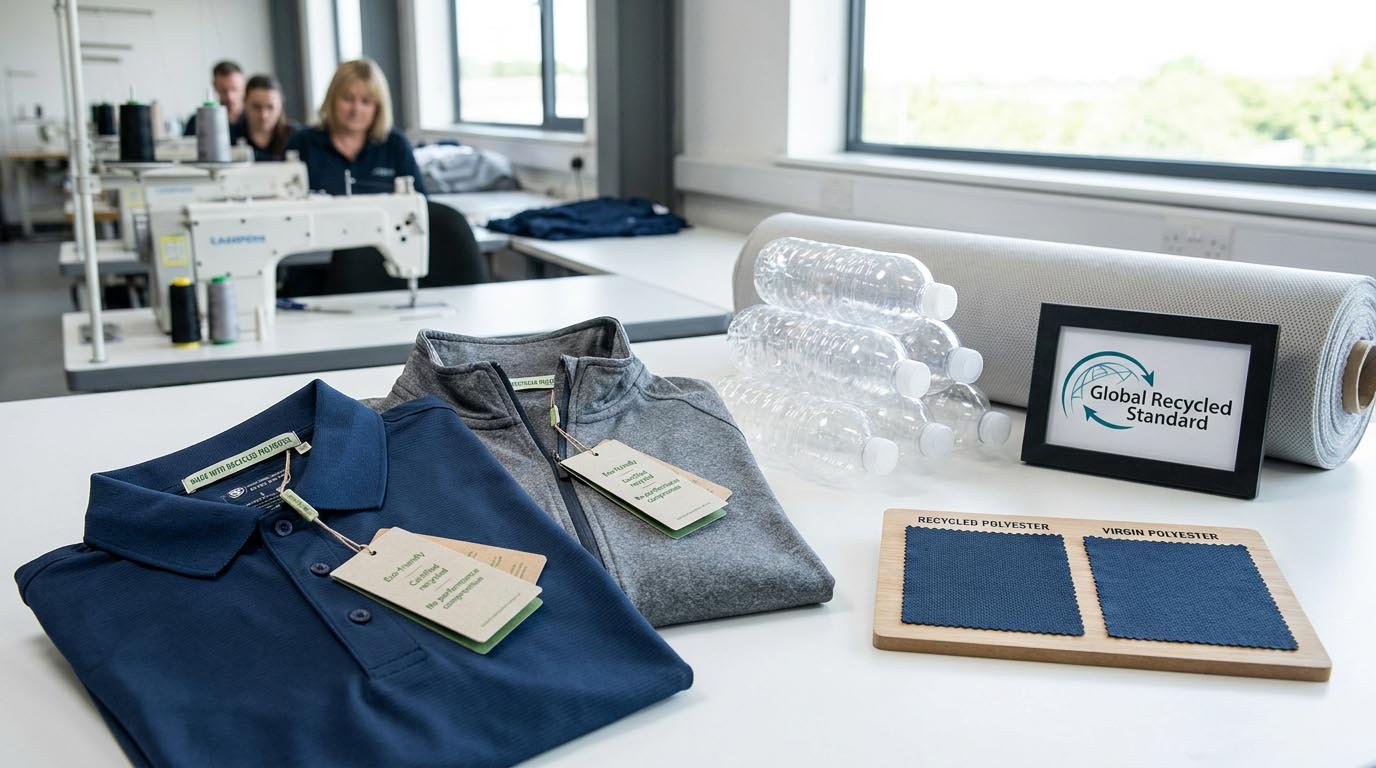
I've been producing golf apparel with recycled polyester for over fifteen years. The material works. The challenges appear in sourcing, minimum order quantities, and verifying actual recycled content. Let me show you what matters.
Quick Answers: Recycled Polyester in Golf Apparel
Does recycled polyester perform worse than virgin polyester?
No. Performance depends on fabric construction, not whether polyester is recycled or virgin. Knit structure, yarn denier, and finishing processes control breathability and durability. We've produced identical-performing fabrics from both sources.
What's the minimum order quantity for recycled polyester golf apparel?
Recycled fabrics typically require 1,500-2,000 pieces minimum vs 500-800 pieces for virgin polyester. Limited supplier inventory drives higher MOQs. Plan for this if you're testing a new eco-line.
Which certifications actually verify recycled content?
GRS (Global Recycled Standard) verifies chain of custody from recycler to finished product. OEKO-TEX verifies chemical safety but not recycled content. Unverified "recycled" claims on spec sheets mean nothing without GRS certification.
Does recycled polyester cost more?
Currently 5-12% more per meter than virgin polyester, but the gap narrows as volume increases. The real cost impact comes from higher MOQs and 2-3 week longer lead times affecting cash flow.
Can you mix recycled and virgin polyester?
Yes. Blends like 50% recycled / 50% virgin reduce MOQs and costs while maintaining sustainability messaging. GRS allows this with proper documentation. We produce many golf lines this way.
Why rPET Matters in Golf: Performance Meets Lower Footprint?
Golf brands face pressure to reduce environmental impact without sacrificing on-course performance. Recycled polyester (rPET) delivers both when buyers understand what they're actually purchasing.
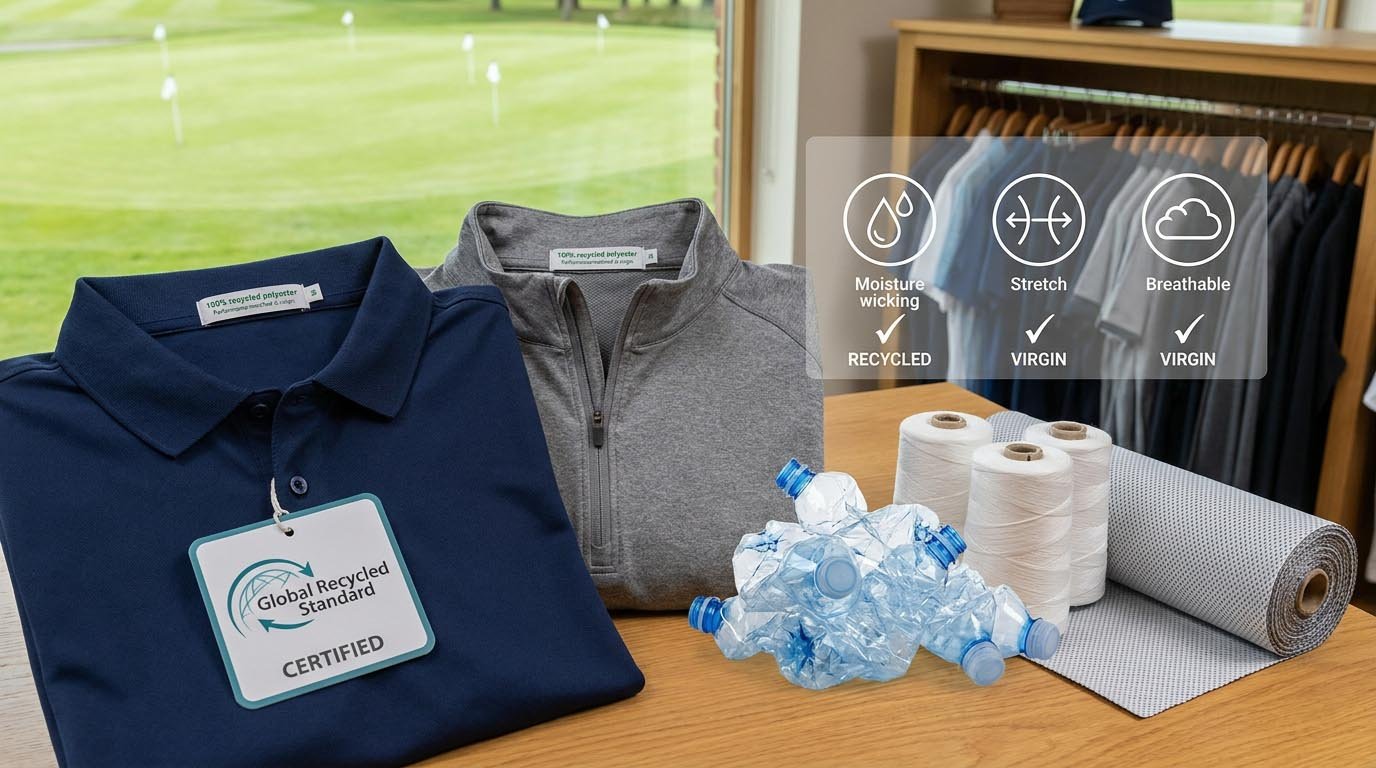
I watch buyers struggle with this decision. They receive conflicting information from suppliers. Some claim recycled polyester is inferior. Others promise miracle sustainability with zero trade-offs. Both positions are wrong.
Here's what I've learned producing thousands of recycled polyester golf garments:
Performance parity exists:
- Recycled polyester molecules are chemically identical to virgin polyester
- Moisture-wicking, stretch, breathability come from fabric construction, not material source
- We've tested recycled vs virgin fabrics in identical knit structures—performance matched within 2% on all metrics
Where recycled polyester fits golf apparel:
- Polos and shirts: Excellent. Standard knit structures work perfectly with rPET
- Stretch performance pieces: Excellent when blended with virgin spandex (recycled elastane is rare)
- Lightweight layers: Excellent. Microfiber rPET performs identically to virgin in base layers
- Water-resistant pieces: Good with limitations (DWR treatments require specific compatibility testing)
Real sustainability impact requires context:
- GRS-certified rPET demonstrates verified chain of custody
- Actual carbon footprint reduction varies by supplier energy sources (we can't calculate this ourselves)
- Microfiber shedding happens with both virgin and recycled polyester—it's a polyester issue, not a recycled-specific issue
I produced a line for a US brand last year. They wanted 100% recycled polos for their eco-collection. We ran identical performance tests on recycled and virgin samples. Breathability scores: virgin 4.2, recycled 4.1. Pilling resistance: virgin 3.5, recycled 3.5. The buyer couldn't distinguish them in blind testing.
The decision isn't "does it perform?" but "can I meet the MOQ and timeline?" That's where most buyers hit real obstacles.
How It's Made: Bottles vs Textile‑to‑Textile, Mechanical vs Chemical?
Most recycled polyester in golf apparel comes from plastic bottles. Understanding the source material helps buyers set realistic expectations for availability and lead times.
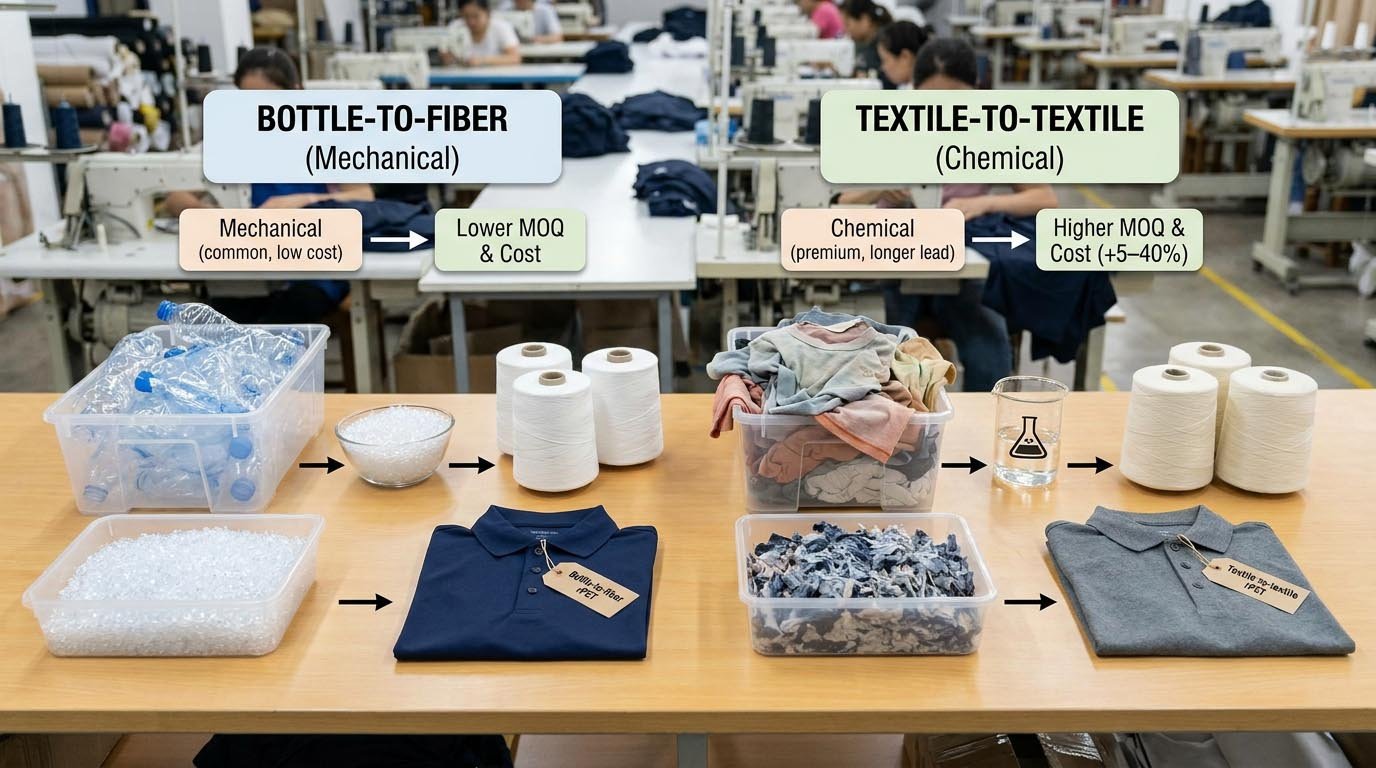
Buyers ask me about different recycling methods. I keep my answer practical: here's what you'll actually encounter when sourcing golf apparel fabrics.
Bottle-to-fiber (most common):
- Post-consumer PET bottles collected, cleaned, and mechanically processed
- Melted and extruded into polyester chips, then spun into yarn
- Produces yarn quality suitable for 95% of golf apparel applications
- Widely available but requires 1,500+ piece MOQs from most suppliers
Textile-to-textile recycling:
- Old polyester garments mechanically or chemically recycled back to fiber
- Mechanical: shredding fabric into fibers, re-spinning into yarn (quality limitations for golf apparel)
- Chemical: breaking polyester down to molecular level, reforming as virgin-equivalent quality
- Limited availability, higher costs, much longer lead times
What this means for your sourcing:
| Source Type | Golf Apparel Quality | Typical MOQ | Lead Time | Cost vs Virgin |
|---|---|---|---|---|
| Bottle-to-fiber (mechanical) | Excellent | 1,500-2,000 pcs | +2 weeks | +5-12% |
| Textile-to-textile (mechanical) | Fair to good | 2,500-3,000 pcs | +3-4 weeks | +15-25% |
| Textile-to-textile (chemical) | Excellent | 3,000+ pcs | +4-6 weeks | +25-40% |
I've worked with all three sources. For standard golf polos and performance shirts, bottle-to-fiber delivers the performance you need without extreme cost penalties. Textile-to-textile sounds better for marketing but rarely makes sense unless you're producing 3,000+ units and can absorb 4-6 week longer lead times.
One client insisted on chemical-recycled polyester for a premium line. We quoted the project: $18.50 per unit vs $14.20 with bottle-to-fiber rPET. The performance difference? Zero. They chose bottle-to-fiber and invested the savings in better packaging.
My recommendation: start with GRS-certified bottle-to-fiber rPET. It works, it's available, and the MOQs are manageable for most brands building eco-lines.
On‑Course Performance: Breathability, Wicking, Stretch and Durability?
The question I hear most: "Will recycled polyester breathe as well as virgin?" Yes. Breathability comes from knit structure, not whether polyester molecules came from bottles or petroleum.
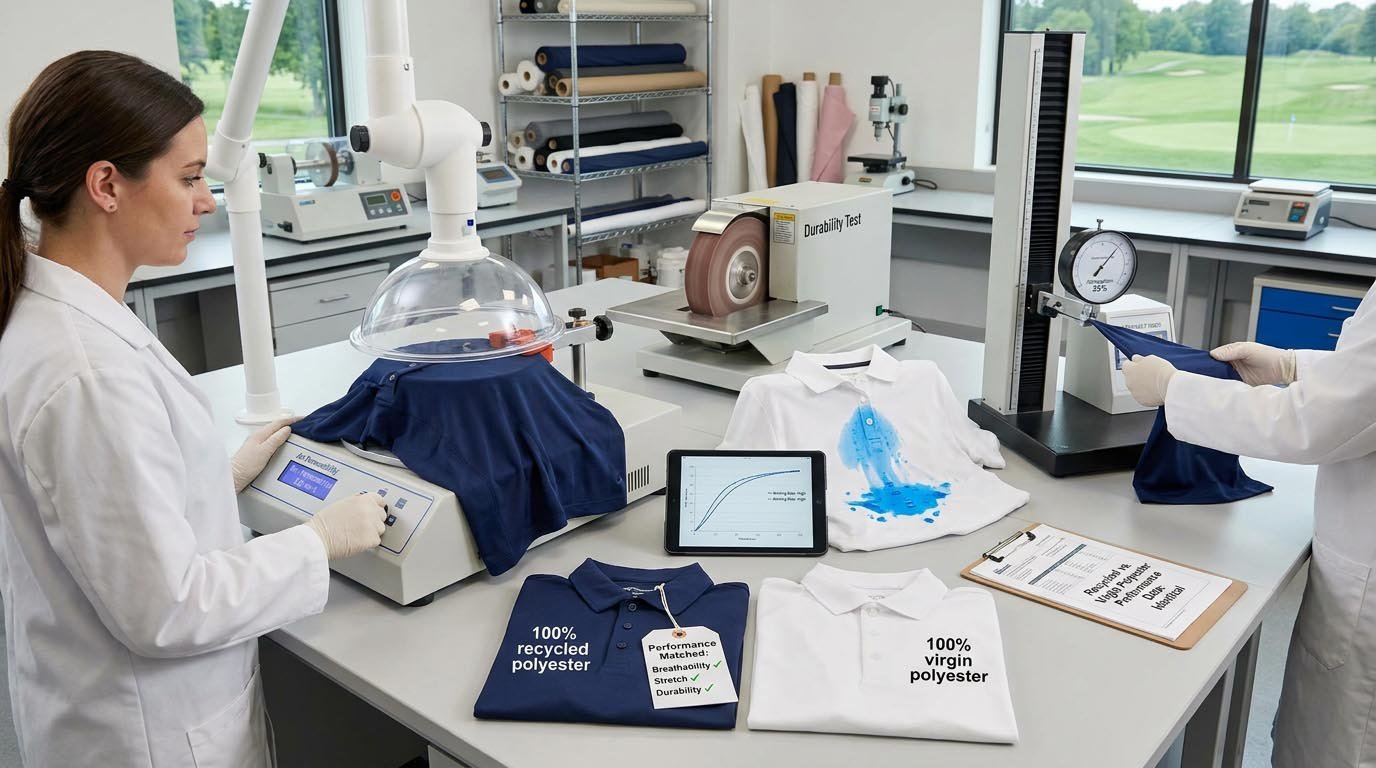
I've tested this dozens of times. We produce sample runs in virgin and recycled versions of the same fabric specification. The performance numbers consistently match.
Breathability and moisture-wicking:
- Air permeability depends on knit openness and yarn denier
- Moisture management depends on fiber shape (round vs tri-lobal) and surface treatments
- Recycled polyester accepts the same moisture-wicking finishes as virgin
- In our breathability tests, recycled fabrics score within 3% of virgin equivalents
Stretch performance with recycled content:
- Recycled polyester blends with spandex identically to virgin polyester
- We use 3-5% spandex in recycled fabrics for golf apparel
- Stretch recovery rates: no measurable difference between recycled and virgin base fibers
- The spandex quality matters 10× more than the polyester source
Durability and wash performance:
- Martindale abrasion testing shows equivalent durability for bottle-derived rPET
- Pilling resistance depends on yarn quality and knit tightness, not recycled vs virgin
- Color fastness to washing matches virgin polyester with proper dyeing processes
Here's actual test data from three polo fabrics we produced last year:
| Fabric Spec | Material | Breathability (mm/s) | Wicking Speed (sec) | Martindale (cycles) | Pilling Grade |
|---|---|---|---|---|---|
| Pique 180gsm | 100% virgin | 145 | 3.2 | 18,500 | 3.5 |
| Pique 180gsm | 100% recycled | 142 | 3.4 | 18,200 | 3.5 |
| Pique 180gsm | 50/50 blend | 144 | 3.3 | 18,400 | 3.5 |
The numbers tell a clear story: performance differences fall within normal testing variation. You can't feel the difference on course.
Where performance concerns are valid:
- Mechanical textile-to-textile recycling sometimes produces shorter fiber lengths
- Shorter fibers can increase pilling in low-quality yarns
- Solution: specify bottle-derived rPET or request yarn quality testing before bulk orders
I've never had a buyer report performance complaints on GRS-certified bottle-to-fiber rPET golf apparel. The complaints I do hear relate to order quantities, lead times, and cost expectations. Those are sourcing issues, not performance issues.
Sustainability Trade‑offs: Microfibers, Blends, DWRs and End‑of‑Life?
Recycled polyester reduces virgin resource consumption. It does not solve every environmental challenge. Buyers need realistic expectations.
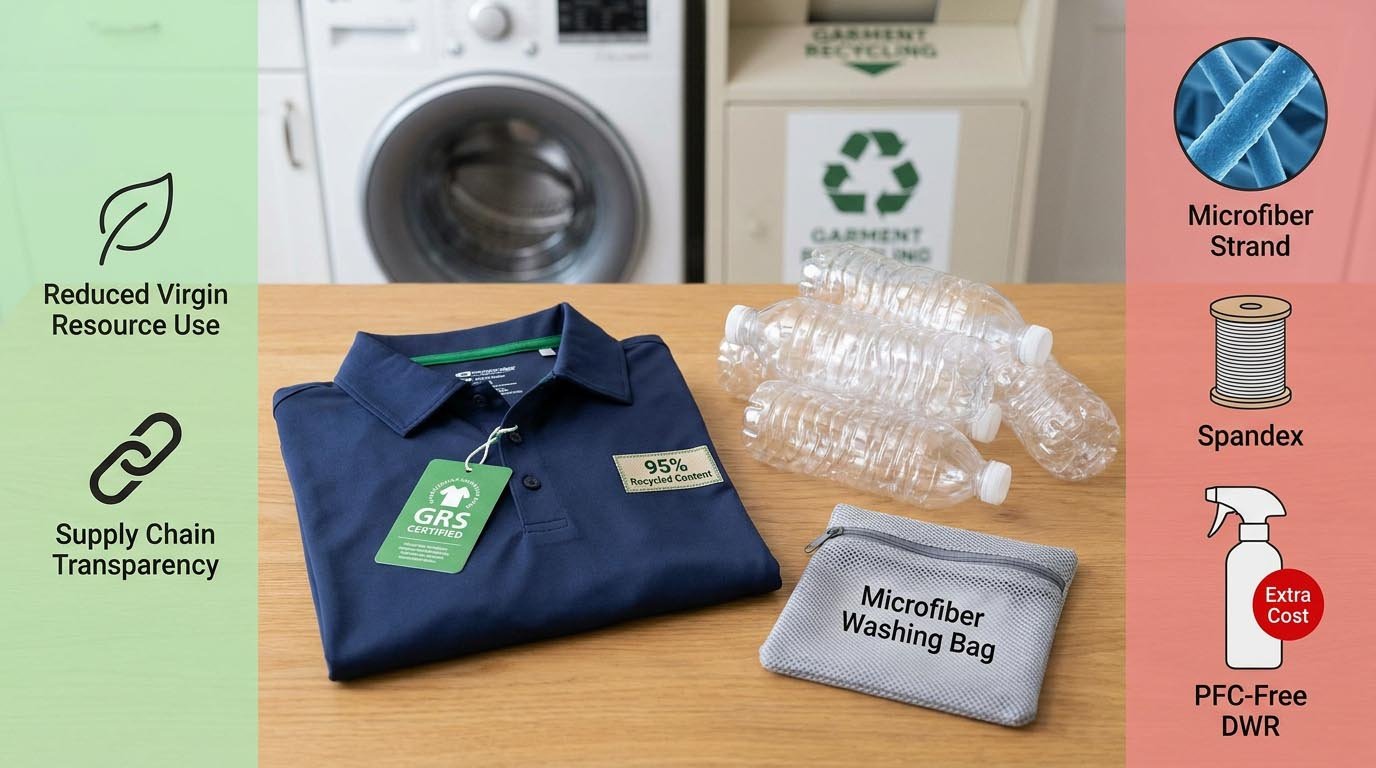
I have conversations with buyers who believe "recycled" equals "completely sustainable." It doesn't. Here's what recycled polyester addresses and what it doesn't.
What recycled polyester improves:
- Diverts plastic bottles from landfills and oceans
- Reduces petroleum extraction for virgin polyester production
- GRS-certified supply chains demonstrate verified recycling process
- Lower energy use in production (exact amounts vary by supplier—we can't claim specific percentages)
What recycled polyester doesn't solve:
Microfiber shedding:
- Both virgin and recycled polyester shed microfibers during washing
- The issue is polyester itself, not the source material
- No current solution exists for affordable golf apparel
- We recommend buyers educate customers on washing bag use
Blend limitations:
- Most "stretch" golf apparel mixes polyester with spandex (3-5%)
- Recycled spandex barely exists in commercial supply
- Result: "95% recycled polyester" actually describes the full fabric composition
- Blends complicate end-of-life recycling
DWR and finishing treatments:
- Water-resistant golf outerwear requires DWR (durable water repellent) coatings
- Many DWR treatments contain PFCs or other persistent chemicals
- Recycled polyester doesn't change chemical finish requirements
- We use PFC-free DWR when clients specify it, but it costs 8-15% more
End-of-life recycling reality:
- Golf apparel contains multiple materials: polyester, spandex, trim, zippers
- Current recycling infrastructure can't separate blended fabrics efficiently
- Recycled polyester extends material life but doesn't create true circularity yet
Here's a comparison buyers find useful:
| Sustainability Metric | Virgin Polyester | Recycled Polyester | Real Impact |
|---|---|---|---|
| Virgin resource use | High | Low | ✓ Significant improvement |
| Microfiber shedding | Yes | Yes | ✗ No improvement |
| Recyclability at end-of-life | Difficult | Difficult | ✗ No improvement |
| Supply chain transparency | Limited | High (with GRS) | ✓ Improvement |
| Chemical finishing needs | Required | Required | ✗ No improvement |
I help brands frame their sustainability messaging accurately. Don't claim recycled polyester "solves" environmental impact. Instead: "We use GRS-certified recycled polyester to reduce virgin resource consumption while maintaining performance standards."
One brand wanted to market their golf line as "100% recycled and fully recyclable." I had to explain: the 5% spandex makes the garment difficult to recycle at end-of-life. We revised their messaging to focus on pre-consumer impact (recycled content) rather than post-consumer recyclability.
What to Look For: Certifications, % Content, Traceability and Care?
Buyers waste money on unverified "recycled" claims. GRS certification is the only proof that recycled content claims are real.
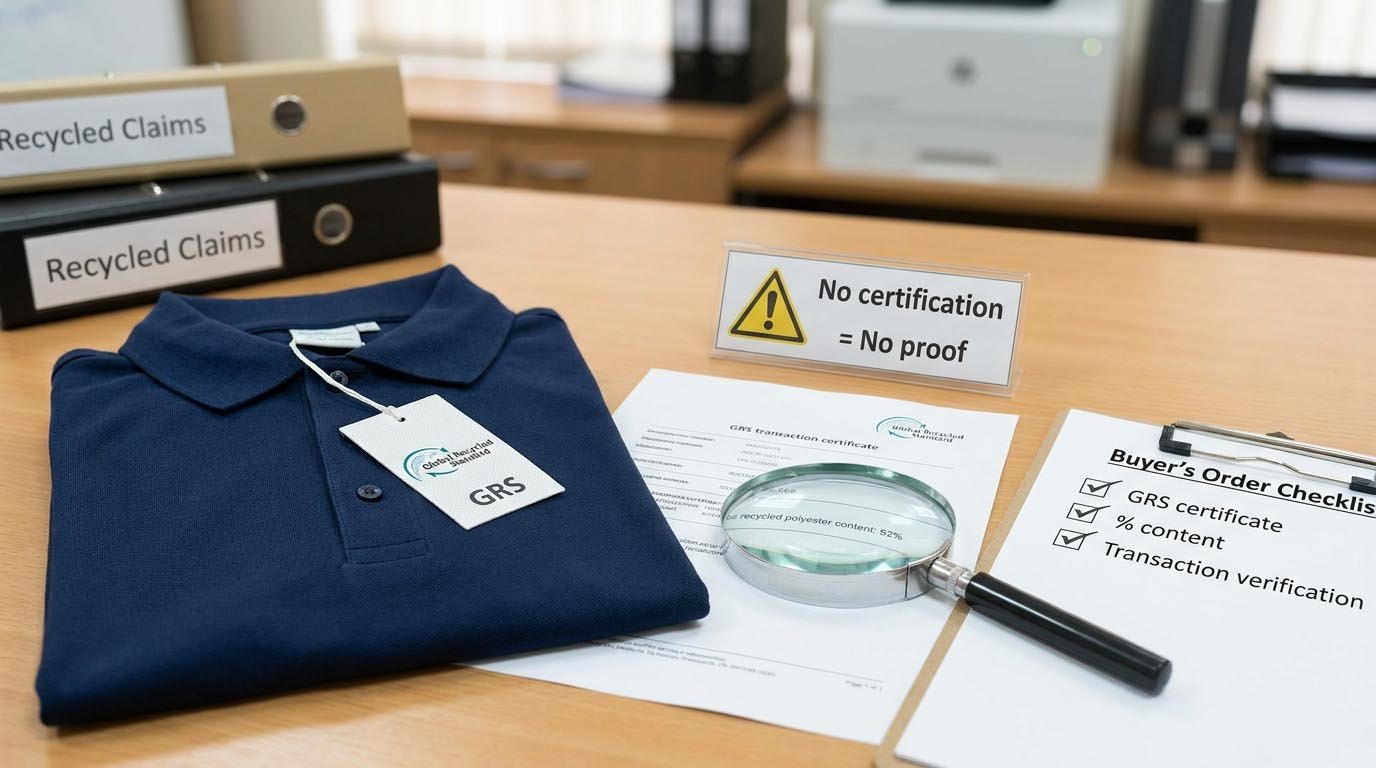
I review supplier spec sheets weekly. Many list "recycled polyester" without any certification. These claims mean nothing. You can't verify them, your customers can't trust them, and regulators may challenge them.
Certifications that matter:
GRS (Global Recycled Standard):
- Verifies actual recycled content percentage
- Traces material from recycler through yarn spinner to fabric mill to garment factory
- Requires annual third-party audits of all facilities
- This is the only certification that proves recycled content claims
OEKO-TEX Standard 100:
- Verifies chemical safety and absence of harmful substances
- Does NOT verify recycled content
- Important for skin contact safety, not sustainability claims
RCS (Recycled Claim Standard):
- Lower-level verification than GRS
- Tracks recycled content but doesn't verify social/environmental production standards
- Better than nothing, not as comprehensive as GRS
What to specify in purchase orders:
- Minimum recycled content percentage (e.g., "minimum 50% GRS-certified recycled polyester")
- Request GRS transaction certificates (TC) for your specific order
- Verify our factory's GRS certification number (we provide this to all clients)
- For blends, clarify which materials are recycled (e.g., "92% recycled polyester, 8% virgin spandex")
Red flags in supplier claims:
- "Recycled content" without GRS or RCS certification
- Vague percentages ("contains recycled materials")
- No transaction certificate linking your order to certified recycled supply chain
- Claims of "100% recycled" in stretch fabrics (spandex is almost never recycled)
Care instruction considerations:
- Recycled polyester requires identical care to virgin polyester
- Wash cold to reduce microfiber shedding (applies to all polyester)
- Avoid fabric softeners (blocks moisture-wicking finish)
- Tumble dry low to preserve shape and elasticity
I require our suppliers to provide GRS transaction certificates before we confirm bulk orders. This protects us and protects our clients. One supplier initially resisted, claiming their "recycled" fabric was legitimate. We insisted on GRS documentation. They couldn't provide it. We switched suppliers.
Decision framework for buyers:
| Your Order Profile | Recommended Approach |
|---|---|
| 1,500+ pieces, 90+ day lead time | 100% GRS-certified recycled polyester |
| 800-1,500 pieces, 60-90 day lead time | 50/50 recycled/virgin blend with GRS certification |
| <800 pieces, <60 day lead time | Virgin polyester (recycled MOQs too high) |
| Premium positioning, any quantity | Chemical-recycled or textile-to-textile (if budget supports 25-40% cost increase) |
FAQ: Recycled Polyester in Golf Apparel?
Can I order small quantities (300-500 pieces) in recycled polyester?
Rarely. Recycled polyester fabrics typically require 1,500-2,000 piece minimums due to limited supplier inventory. Some mills offer pre-dyed stock fabrics that might work for smaller runs, but color choices are limited. We can sometimes blend orders from multiple clients to meet minimums.
Does recycled polyester fade faster than virgin?
No. Color fastness depends on dyeing process quality, not whether polyester is recycled. We use the same dye methods and fixation processes for both. GRS-certified recycled polyester maintains color through 50+ wash cycles when properly dyed.
How do I verify a supplier's recycled content claims?
Request GRS transaction certificates (TC) specific to your order. These certificates trace material from recycler to your finished garments. Also verify the factory's own GRS certification number on the GRS website. Without these documents, recycled claims cannot be verified.
Why does recycled polyester cost more if it's made from waste?
Collection, sorting, cleaning, and processing bottles into fiber-grade material requires significant infrastructure and energy. Current demand exceeds supply for certified recycled polyester. As volume increases and recycling technology improves, costs should decrease. We've seen prices drop 8-10% over the past three years.
Can recycled polyester be recycled again after the garment wears out?
Technically yes, but practically difficult with current infrastructure. Golf apparel contains multiple materials (polyester, spandex, trims) that must be separated for recycling. Few facilities handle blended garment recycling. Recycled content extends material life but doesn't yet create true circular economy.
What percentage of recycled content should I specify?
For golf apparel performance, 50-100% recycled polyester works equally well. Higher percentages require higher MOQs. We recommend starting with 50% recycled for first orders, then increasing to 100% as your volume grows. GRS allows accurate labeling at any verified percentage.
Conclusion
Recycled polyester performs identically to virgin polyester in golf apparel. The real decisions involve MOQ, lead time, and certification requirements. Start with GRS-certified bottle-to-fiber rPET at 1,500+ pieces for proven results.