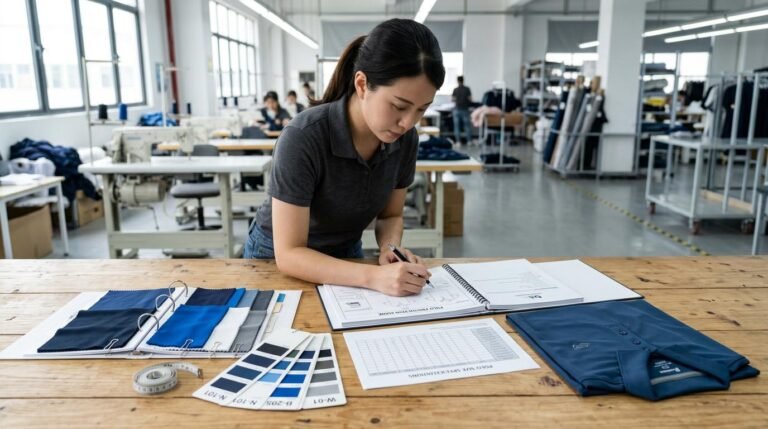
A client ordered 1,000 piqué polos because their competitor used piqué. They said piqué meant "premium quality." I asked where their customers played golf. They said Florida and Southeast Asia—hot, humid climates. Six months later, they complained about slow sales and returns. Customers said the shirts felt "too thick" and "didn't breathe enough." Meanwhile, competitors selling jersey knit polos dominated those markets. The client had chosen fabric based on "premium" perception rather than climate reality. Piqué works beautifully for temperate clubs and traditional markets. It fails in tropical heat where jersey's lighter, faster-wicking structure performs better. The fabric was not bad—it was wrong for the market.
Choosing between piqué mesh and jersey knit for golf polos depends on matching fabric structure to target market climate, customer activity level and price positioning—where piqué's textured surface and structured appearance suit temperate traditional markets but trap heat in humid conditions, while jersey's smooth lightweight construction excels in hot climates and athletic positioning but lacks the formal structure expected by country club customers, making the decision inseparable from answering whether your customers prioritize traditional appearance versus moisture management performance.
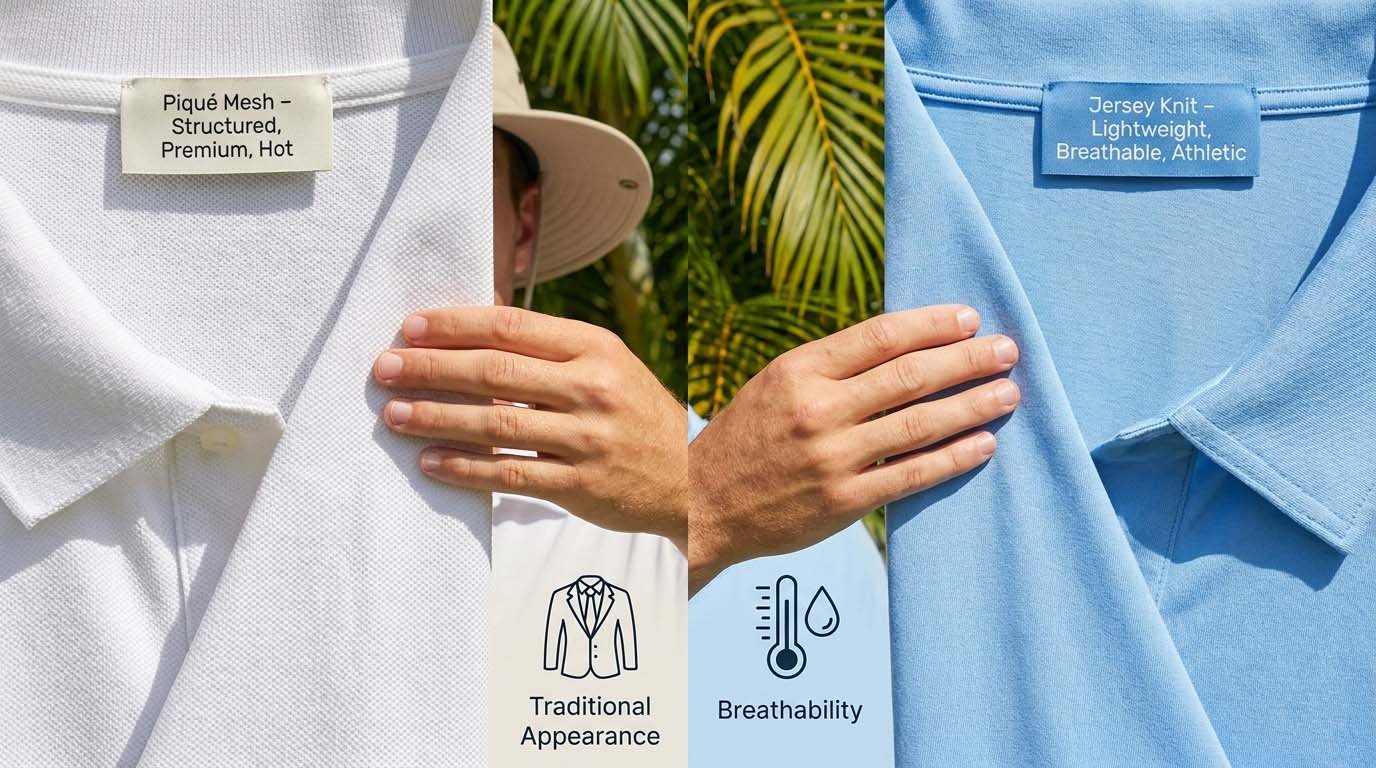
I am Will from FUWAY. Over the past 15 years, I have guided 500+ fabric selection decisions for golf apparel buyers. Most arrive asking "which is better?" without first telling me their target climate or customer profile. This guide helps you match fabric structure to your actual market conditions—playing environment, customer expectations, price positioning—rather than copying competitors or chasing abstract "quality" claims that mean nothing without context.
Quick Answers: Piqué Mesh vs Jersey Knit Selection
Q: Which is more breathable for hot weather golf?
Jersey—thinner, smoother, 15–25% faster evaporation in humidity. Piqué’s air pockets help in dry heat but hold more moisture in humidity.
Q: Which looks more premium or professional?
For traditional/professional (older, country club): piqué.
For technical/performance (younger, athletic, resort): jersey.
“Premium” = yarn/finish/fit, not surface alone.
Q: Which wicks moisture better?
Jersey dries/wicks faster (especially in humid play). Both depend more on fiber & finish (polyester, wicking treatment) than structure.
Piqué can compete if lightweight + technical yarn.
Q: Which costs more to manufacture?
Base cost similar; jersey slightly cheaper if basic.
Technical jersey (microfiber, finishes) costs more than basic piqué.
Yarn/finish choices drive price, not just structure.
Q: Which lasts longer or pills less?
Both can last 80–120 washes if using premium, combed yarn and anti-pilling treatment.
Piqué hides slight pilling better due to texture; jersey shows it sooner unless yarn/treatment is high grade.
What's the Difference: Piqué Mesh vs Jersey Knit Basics
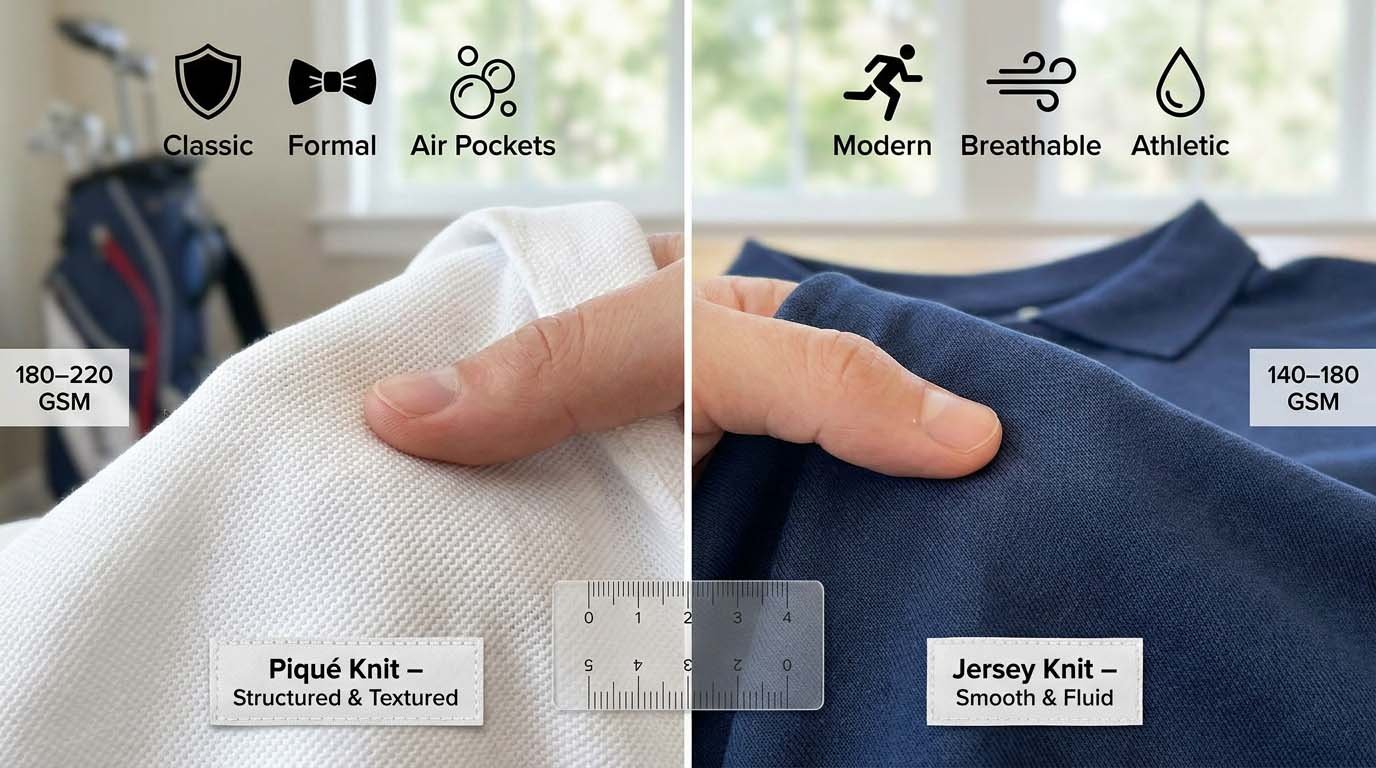
Piqué and jersey represent fundamentally different knit architectures—where piqué uses alternating tight and loose stitches creating raised textured patterns with air pockets between wales and courses, while jersey uses consistent single-direction knitting producing smooth flat surfaces with natural stretch, making piqué structured and textured versus jersey lightweight and fluid, with these structural differences affecting breathability, moisture spread, drape, collar stability and visual formality independent of fiber type or weight specifications.
Piqué Construction: Textured Raised Pattern
What defines piqué knit:
Knitting technique:
- Alternating stitches: Tight stitches create recessed areas, loose stitches create raised areas
- Geometric pattern: Usually diamond, honeycomb or square texture
- Wales and courses visible: Creates 3D surface texture
Structural characteristics:
- Thicker fabric profile: More material in raised pattern
- Less stretch than jersey (structure restricts elasticity)
- Air pockets trapped in recessed areas
- More rigid drape (fabric holds shape)
Visual appearance:
- Textured surface: Visible from distance
- Traditional polo aesthetic: Classic golf/tennis look
- Formal appearance: Structured, deliberate
- Hides minor wrinkles: Texture masks creases
Common variations:
Traditional piqué (classic diamond or honeycomb):
- 180-220 GSM typical weight
- Most common in golf polos
- Best for: Traditional country club markets
Mini-piqué (smaller texture scale):
- Finer, more subtle texture
- 160-190 GSM lighter construction
- Best for: Modern casual-business crossover
Waffle piqué (larger square pattern):
- More pronounced texture
- 200-240 GSM heavier construction
- Best for: Cool weather, premium positioning
Jersey Construction: Smooth Single Knit
What defines jersey knit:
Knitting technique:
- Single-direction loops: All stitches face same direction
- No pattern: Uniform smooth surface
- Continuous knit: Creates flat, even fabric
Structural characteristics:
- Thinner fabric profile: Less material (no raised areas)
- High stretch: Natural elasticity from loop structure
- No air pockets: Smooth contact with skin
- Fluid drape: Fabric moves with body
Visual appearance:
- Smooth surface: Clean, modern look
- Athletic aesthetic: Performance/technical positioning
- Casual appearance: Less formal than piqué
- Shows wrinkles: Smooth surface reveals creases
Common variations:
Single jersey (standard):
- 140-180 GSM typical weight
- Most breathable version
- Best for: Hot climate performance wear
Interlock jersey (double-knit):
- Two jersey layers knitted together
- 180-220 GSM heavier, more structured
- Best for: Balancing jersey smoothness with piqué-like structure
Slub jersey (varied yarn thickness):
- Textured appearance from thick-thin yarns
- 160-190 GSM
- Best for: Casual, fashion-forward positioning
Side-by-Side Structure Comparison
| Feature | Piqué | Jersey |
|---|---|---|
| Surface texture | Raised 3D pattern | Flat smooth |
| Typical weight | 180-220 GSM | 140-180 GSM |
| Natural stretch | Low to moderate | Moderate to high |
| Drape | Structured, holds shape | Fluid, follows body |
| Breathability | Moderate (air pockets) | High (less material) |
| Formality | Traditional, formal | Casual, athletic |
| Wrinkle resistance | Texture hides wrinkles | Shows wrinkles more |
| Collar structure | Naturally firm | Needs reinforcement |
Common Terminology Confusion
"Mesh piqué" (industry shorthand):
- Not actual mesh (no ventilation holes)
- Means textured piqué with air pockets
- True mesh = open knit with holes
"Performance jersey" (marketing term):
- Jersey structure with technical treatments
- Moisture-wicking, anti-microbial, etc.
- Not a different knit type—same jersey with finishes
"Cotton piqué" vs "Polyester piqué":
- Fiber type, not knit structure
- Both use same piqué construction
- Fiber affects performance (wicking, dry-time)
"Stretch piqué" vs "Stretch jersey":
- Both can incorporate spandex/elastane (5-8%)
- Jersey naturally stretchier even without added spandex
- Stretch piqué adds elastane to rigid structure
I clarify for buyers: Piqué and jersey describe knit structure only. Weight, fiber, finish treatments are separate decisions that apply to either fabric.
Breathability & Wicking: Yarn, Gauge and Knit Architecture
Breathability and moisture-wicking depend on combined effects of fabric weight, fiber hydrophobicity, knit tightness and finish treatments—where piqué's air pockets provide minor breathability advantage when comparing identical weights and fibers, but jersey's typically lighter construction and smoother surface create faster evaporation in real-world use, making yarn gauge, material thickness and fiber selection more important than knit structure alone for determining whether moisture management meets hot-climate performance needs.
Piqué Breathability Mechanisms
How air pockets function:
Raised texture creates space:
- Small gaps between fabric and skin (recessed areas)
- Air circulates in these micro-pockets
- Advantage in dry heat: Insulating air layer reduces direct sun contact
- Disadvantage in humidity: Trapped air becomes saturated, slows evaporation
When piqué breathability works:
- Hot/dry climates (Southwest US, Middle East deserts)
- Light activity (cart golf, minimal sweating)
- Moderate temperatures (20-28°C / 68-82°F)
When piqué breathability fails:
- Hot/humid climates (Southeast Asia, Gulf Coast)
- High-intensity play (walking 18 holes, fast pace)
- Heavy fabric (220+ GSM traps heat regardless of texture)
Knit tightness impact:
- Tight piqué: Air pockets smaller, less breathability benefit
- Open piqué: Larger air pockets, better ventilation
- Same texture, different yarn spacing creates different performance
Jersey Breathability Mechanisms
How smooth structure functions:
Less material barrier:
- Thinner profile (typically 40-60 GSM lighter than piqué)
- Direct airflow across smooth surface
- No trapped air pockets (good for humidity—no saturation zones)
When jersey breathability works:
- Hot/humid climates (moisture evaporates faster)
- High-intensity activity (sweat management critical)
- Lightweight construction (140-170 GSM maximum airflow)
When jersey breathability limitations:
- Cold/windy conditions (no insulation, wind passes through)
- Very light colors (thin fabric may feel exposed)
Knit tightness impact:
- Tight jersey: Reduced airflow but better opacity
- Loose jersey: Maximum breathability but transparency risk
- Stretch jersey (5% spandex): Slightly less breathable (denser knit)
Moisture-Wicking Comparison
How each fabric spreads moisture:
Piqué wicking characteristics:
- Textured surface increases surface area for moisture spread
- Water wicks along raised patterns (capillary action)
- More material to saturate before appearing dry
- Slower overall dry-time (more fabric to dry)
Jersey wicking characteristics:
- Smooth surface allows faster lateral moisture spread
- Water spreads in all directions evenly
- Less material to saturate (thinner fabric)
- Faster overall dry-time (less volume to evaporate)
Fiber type dominates wicking (applies to both fabrics):
Polyester/nylon (synthetic):
- Hydrophobic (water-repelling) naturally
- Pushes moisture to surface quickly
- Fast dry: 30-50 minutes in humid conditions
Cotton (natural):
- Hydrophilic (water-absorbing) naturally
- Holds moisture in fiber
- Slow dry: 90-180 minutes in humid conditions
Cotton-poly blends (65/35):
- Moderate wicking (polyester portion moves moisture)
- Cotton portion holds some moisture
- Medium dry: 50-80 minutes
- Benefits from moisture-wicking finish (+30-40% improvement)
Yarn Gauge and Knit Density
Yarn gauge: Thickness of yarn used in knitting
Fine gauge (thin yarns):
- Creates lighter fabrics (140-180 GSM)
- More breathable (larger holes between yarns relative to yarn size)
- Best for: Hot climate performance
- Cost: Slightly higher (more yarns needed for coverage)
Medium gauge (standard yarns):
- Versatile weight (180-200 GSM)
- Balanced breathability and structure
- Best for: General recreational golf
- Cost: Standard baseline
Heavy gauge (thick yarns):
- Creates heavier fabrics (200-240+ GSM)
- Less breathable (more material density)
- Best for: Traditional club wear, cool climates
- Cost: Lower per-yard (less yarn processing)
Knit density (stitches per inch):
Tight knit:
- Advantages: Better opacity, more durable, holds shape
- Disadvantages: Less breathable, slower drying
- Good for light colors or traditional positioning
Open knit:
- Advantages: Maximum breathability, faster drying
- Disadvantages: Transparency in light colors, less structure
- Good for hot climates or performance positioning
Practical Breathability Testing
Simple field comparison (no lab):
Test setup:
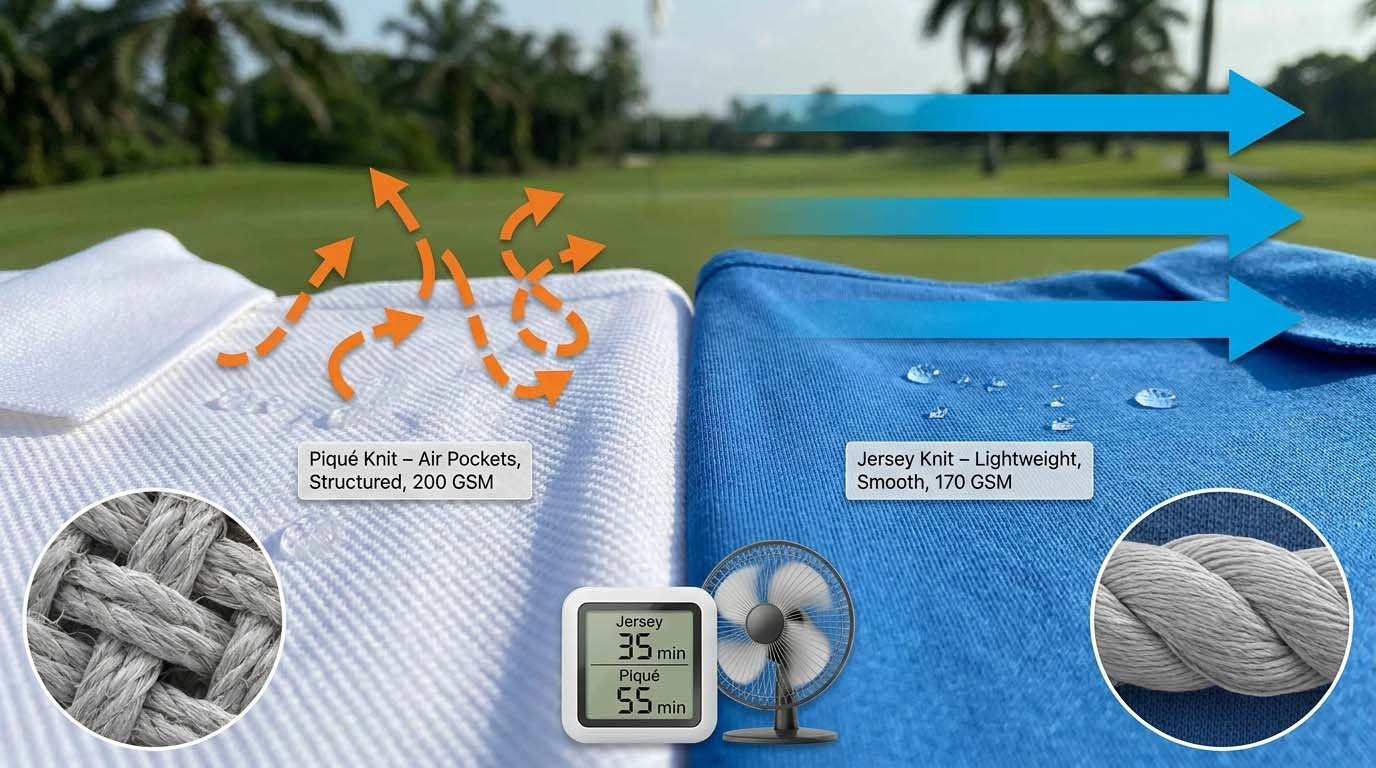
- Piqué sample: 200 GSM polyester
- Jersey sample: 170 GSM polyester
- Same fiber, different structure
Test 1: Airflow
- Hold fabric to mouth, blow through
- Jersey: Easier airflow (less resistance)
- Piqué: Moderate resistance (texture + weight)
Test 2: Moisture evaporation
- Wet both samples equally
- Hang in 25°C room with fan
- Jersey dry time: 35 minutes
- Piqué dry time: 55 minutes
Test 3: Wear comfort
- Wear each during actual golf round
- Jersey feel: Lighter, drier sensation
- Piqué feel: Slightly damper, more structured
Results show:
- At comparable fiber/finish, jersey structurally more breathable
- Weight difference (30 GSM) contributes significantly
- Texture provides minor advantage but not enough to overcome weight/structure
I have observed: When buyers compare equal-weight piqué and jersey (both 180 GSM, same fiber), breathability difference is minimal (10-15%). But real-world piqué is usually 30-50 GSM heavier, making jersey the clear breathability winner in typical specifications.
Fit, Drape & Look: Handfeel, Opacity and Collar Structure
Fabric drape, stretch and collar performance vary fundamentally between piqué and jersey—where piqué's textured structure creates natural rigidity supporting traditional collars and structured silhouettes but restricting slim-fit mobility, while jersey's smooth elasticity enables athletic fits and fluid movement but requires collar reinforcement to maintain shape, making fit style selection inseparable from fabric choice since slim-fit designs demand jersey's stretch while classic silhouettes benefit from piqué's structure regardless of other performance priorities.
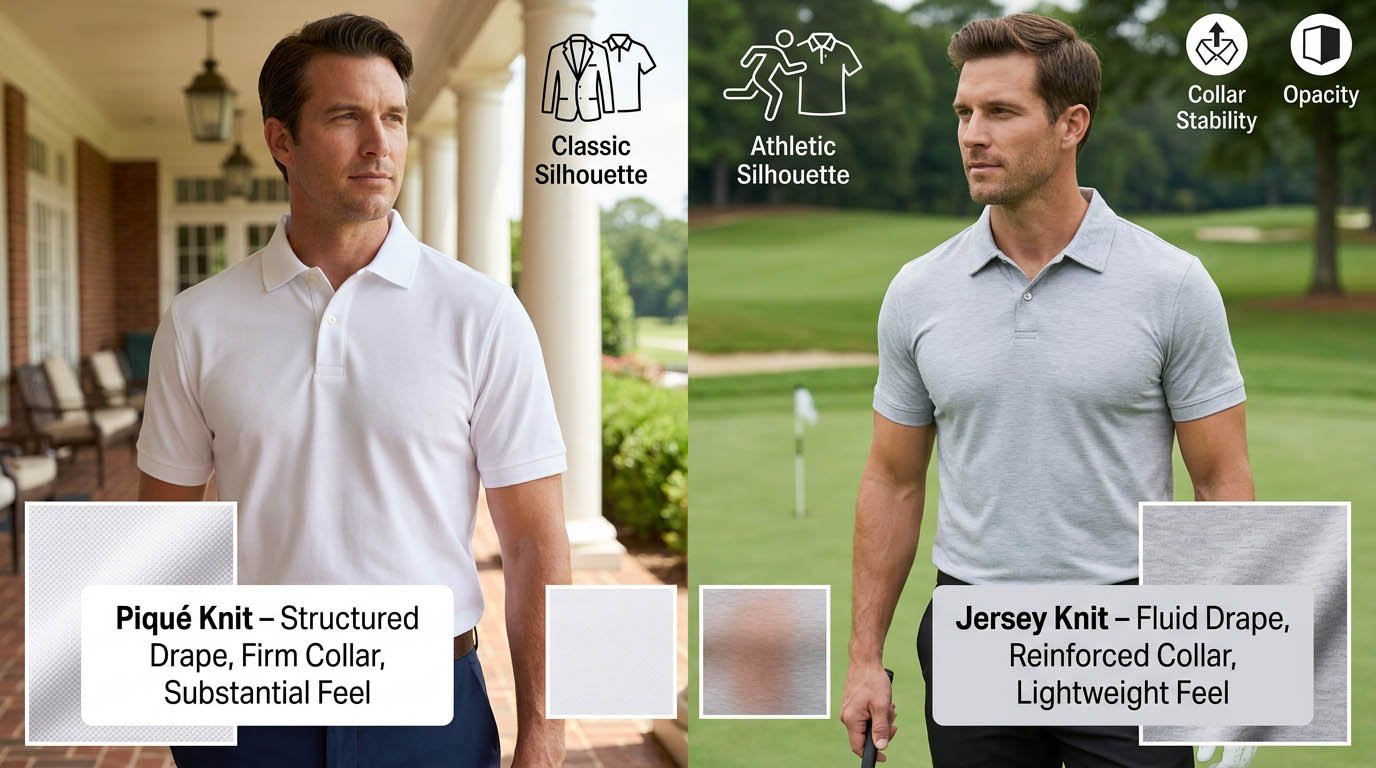
Drape Characteristics
Piqué drape (structured):
How it hangs:
- Holds shape away from body (more rigid structure)
- Creates classic polo silhouette (recognizable from distance)
- Less movement when walking/swinging
- Fabric maintains form even when sitting
Best fit styles:
- Regular/modern fit: Fabric drapes naturally without clinging
- Relaxed/classic fit: Structure fills out looser cut
- Avoid: Ultra-slim fits (fabric fights close pattern)
Visual impact:
- Traditional appearance (country club appropriate)
- Substantial presence (fabric has weight on body)
- Professional look (maintains crisp lines)
Customer feedback patterns:
- Older buyers: "Feels like quality" (weight + structure)
- Athletic buyers: "Feels stiff" (restricts movement)
Jersey drape (fluid):
How it hangs:
- Follows body contours (smooth, elastic)
- Creates modern athletic silhouette (fitted appearance)
- Moves with body during activity
- Fabric conforms when sitting/bending
Best fit styles:
- Slim/athletic fit: Jersey stretches to accommodate without binding
- Modern fit: Fluid drape creates clean lines
- Works with relaxed fit (but may look too casual)
Visual impact:
- Contemporary appearance (performance positioning)
- Lightweight presence (less visual weight)
- Casual-athletic look (less formal than piqué)
Customer feedback patterns:
- Younger buyers: "Comfortable and mobile" (stretch + lightness)
- Traditional buyers: "Feels thin" (expects more substance)
Handfeel and Tactile Perception
Piqué handfeel:
Touch characteristics:
- Textured surface (bumps and valleys)
- Firm hand (structure resists compression)
- Substantial weight (fabric has heft)
- Cool to touch (texture reduces direct skin contact)
Premium perception drivers:
- Traditional markets: Texture signals quality
- Older demographic: Weight equals value
- Corporate buyers: Structure = professionalism
When handfeel works:
- Customer handles merchandise before buying (retail)
- Premium positioning targeting traditional golfers
- Cool/temperate climates (substantial feel appropriate)
Jersey handfeel:
Touch characteristics:
- Smooth surface (sleek, even)
- Soft hand (fabric compresses easily)
- Lighter weight (less heft)
- Warm to touch (direct skin contact)
Premium perception drivers:
- Performance markets: Softness signals technical advancement
- Younger demographic: Lightness equals innovation
- Athletic positioning: Smooth = aerodynamic/modern
When handfeel works:
- E-commerce sales (customers prioritize function over touch)
- Performance positioning targeting active players
- Hot climates (lightweight feel desired)
Opacity and Show-Through
Light color challenges:
Piqué in white/light colors:
- Texture helps hide show-through (pattern breaks up visibility)
- Thicker construction (180-220 GSM) provides coverage
- Adequate opacity at 200+ GSM
- Risk at <180 GSM: Undershirt visible in recessed texture areas
Jersey in white/light colors:
- Smooth surface shows everything (no texture to hide)
- Thinner construction (140-180 GSM) more transparent
- Requires 180-200 GSM for adequate white coverage
- High risk at <170 GSM: Skin tone, nipples visible
Solution strategies:
For piqué:
- White/light colors: 190-220 GSM minimum
- Maintain texture advantage
- Slightly heavier than dark colors
For jersey:
- White/light colors: 180-200 GSM minimum (heavier than piqué equivalent)
- Consider double-layer construction (two jersey layers)
- Or limit light color offerings to avoid issue
Dark color advantages (both fabrics):
- Navy, black, charcoal: Adequate opacity at 160-180 GSM
- Can use lighter weights without transparency
- Cost savings from lighter fabric acceptable
Collar Structure and Stability
Piqué collar performance:
Natural advantages:
- Texture provides structure (collar stands without fusing)
- Weight supports shape (200+ GSM maintains firmness)
- Less reinforcement needed (fabric self-supporting)
Typical construction:
- Same fabric as body (knit collar, not ribbed)
- Minimal to no interfacing required
- Maintains shape through 60-80 washes
When piqué collar excels:
- Traditional markets expecting crisp, structured collar
- Heavier fabrics (200+ GSM) providing natural support
- Classic fit styles (less neck movement = less collar stress)
Jersey collar challenges:
Natural disadvantages:
- Smooth, stretchy fabric (collar wants to curl/flatten)
- Lightweight (140-180 GSM) lacks structure
- Requires reinforcement to maintain shape
Typical construction solutions:
Option 1: Ribbed collar (different knit):
- Rib knit structure adds natural stiffness
- Independent of body fabric
- Cost: +$0.30-0.50 per unit
Option 2: Fused interfacing:
- Adhesive stiffener bonded to collar fabric
- Can use same jersey fabric as body
- Cost: +$0.20-0.40 per unit
- Risk: Poor fusing creates bubbling after washing
Option 3: Heavier jersey for collar area:
- Collar uses 200 GSM while body uses 170 GSM
- Complex construction
- Cost: +$0.80-1.20 per unit
When jersey collar fails:
- Budget construction (no reinforcement)
- Collar softens and curls after 20-30 washes
- Customer complaint: "Collar won't stay flat"
I recommend: If using jersey for hot-climate breathability, invest in proper collar construction to avoid structural failure ruining the garment's appearance.
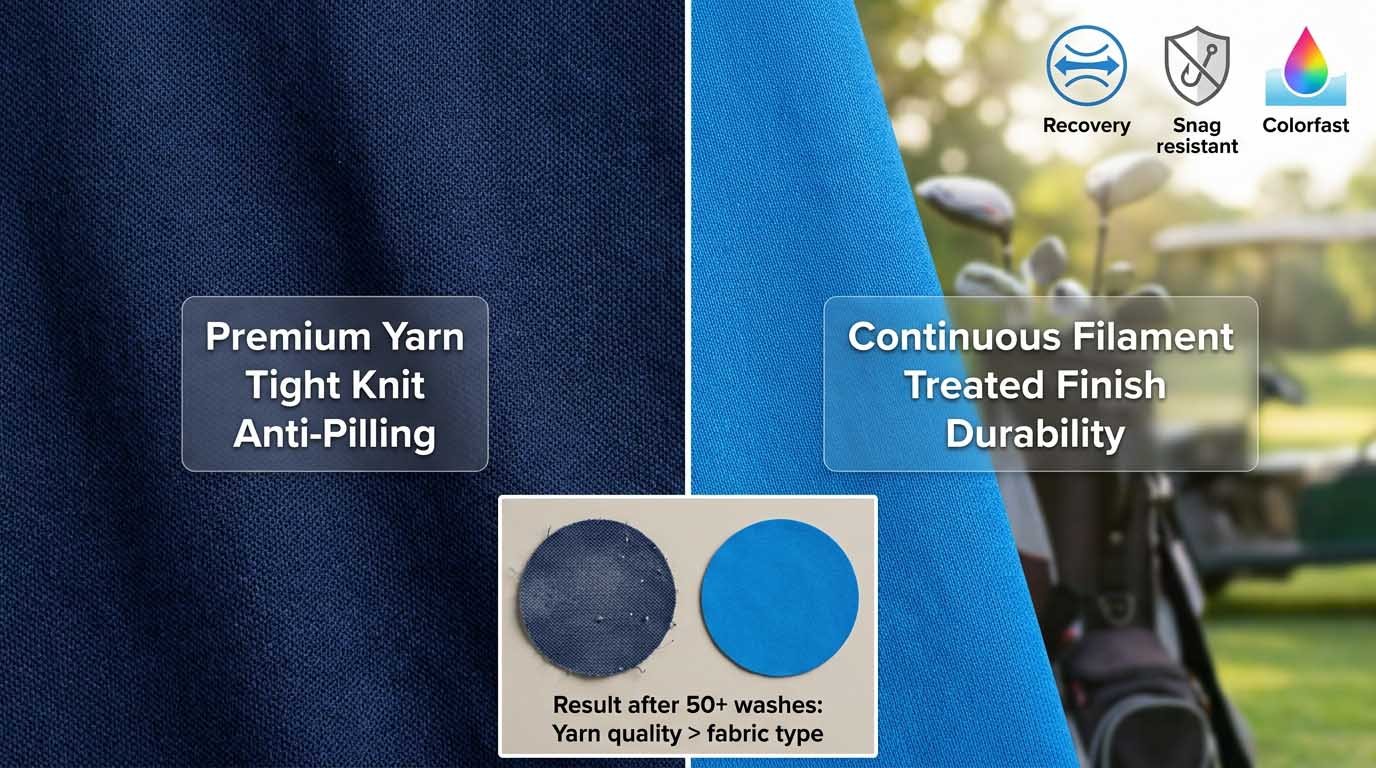
Performance & Durability: Stretch, Pilling, Snagging and Colorfastness
Durability performance in pilling resistance, snagging vulnerability, stretch retention and color fastness depends more on yarn construction quality, anti-pilling treatments and knit density than fabric type—where budget piqué with staple fibers pills faster than premium jersey with continuous filament yarns, making yarn specifications and finish treatments the critical variables determining whether polos last 40 washes or 120 washes regardless of whether you choose piqué or jersey base structure.
Stretch and Recovery
Natural stretch characteristics:
Piqué stretch (limited):
- 5-10% stretch naturally (from knit structure)
- Minimal recovery (fabric stays stretched)
- Requires spandex (5-8% elastane) for significant stretch
- With spandex: 20-30% stretch in both directions
Jersey stretch (inherent):
- 15-25% stretch naturally (from loop structure)
- Good recovery (fabric returns to shape)
- Can add spandex for additional stretch (30-40% total)
- Stretch primarily in width direction (across body)
Stretch impact on performance:
Golf swing motion:
- Piqué without stretch: Can restrict backswing if fitted close
- Jersey without stretch: Adequate for most fits
- Both with 5% spandex: Unrestricted movement
Garment lifespan:
- Piqué with spandex: Elastane degrades first (80-100 washes)
- Jersey with spandex: Similar degradation timeline
- Jersey without spandex: Natural stretch reduces spandex need
When stretch matters:
- Slim/athletic fits: Stretch essential for comfort
- Active/competitive golfers: Movement priority
- Younger demographic: Expects stretch (modern expectation)
When stretch wastes money:
- Relaxed fits: Loose enough without stretch
- Traditional markets: Stretch not valued
- Value positioning: Cost premium not justified
Pilling Resistance Reality
Pilling visibility differences:
Piqué pilling:
- Texture hides pilling in early stages
- Pills form in recessed areas first (less visible)
- Customer notices pilling later (20-30 washes before complaint)
- Perception advantage: Appears more durable than actual performance
Jersey pilling:
- Smooth surface shows pilling immediately
- Pills visible on entire surface (no hiding)
- Customer notices pilling earlier (15-20 washes before complaint)
- Perception disadvantage: Appears less durable even if similar to piqué
Actual pilling drivers (both fabrics):
Yarn type (biggest factor):
- Continuous filament polyester: Minimal pilling (fibers have no loose ends)
- Staple polyester: Moderate pilling (short fibers ball up)
- Cotton/cotton blends: Higher pilling (short natural fibers)
- Chemical finish bonds surface fibers
- Mechanical singeing burns off loose fiber ends
- Enzyme treatment digests short fibers
- Impact: Reduces pilling 50-70%
- Cost: +$0.20-0.50 per yard
Knit tightness:
- Tight knit: Less fiber movement, less pilling
- Loose knit: More surface abrasion, faster pilling
Real-world pilling timeline:
Budget: No treatment, staple yarn
- Piqué: Customer notices 25-35 washes
- Jersey: Customer notices 15-25 washes
- Both unacceptable by 40-50 washes
Mid-tier: Basic treatment OR combed yarn
- Piqué: Minimal visible 50-70 washes
- Jersey: Noticeable 35-50 washes, acceptable to 70-90 washes
- Adequate for price point
Premium: Treatment AND quality yarn
- Piqué: Barely visible through 100+ washes
- Jersey: Minimal through 80-100 washes
- Excellent long-term appearance
I emphasize: Do not choose piqué to "solve pilling"—piqué just hides it longer. Specify yarn quality and anti-pilling treatment for either fabric.
Snagging and Abrasion
Snagging vulnerability:
Piqué snagging resistance:
- Textured structure deflects sharp objects
- Loose threads less likely to pull
- More forgiving of rough handling
- Better for: Golf bags, cart storage, course obstacles
Jersey snagging vulnerability:
- Smooth surface catches on zippers, jewelry, Velcro
- Pulled threads create visible runs
- Requires care in handling
- Risk areas: Locker rooms, golf bag contact, metal cart components
Mitigation for jersey:
- Tighter knit reduces snagging
- Quality yarn less likely to pull
- Customer education: Care instructions emphasizing gentle handling
Abrasion resistance:
Piqué abrasion:
- Texture distributes wear across raised areas
- Even wear pattern over time
- Rarely develops thin spots
Jersey abrasion:
- Smooth surface wears uniformly
- Can develop thin areas at stress points (elbows, collar edges)
- More visible in light colors
Both fabrics:
- Abrasion resistance depends on yarn tensile strength
- Polyester better than cotton (stronger fiber)
- Tight knit wears longer than loose
Colorfastness Comparison
Color retention factors:
Fabric structure impact (minimal):
- Piqué vs jersey has negligible effect on dye retention
- Dye quality and process dominate outcomes
Actual colorfastness drivers:
Dye quality:
- Reactive dyes (cotton): Grade 4-5 fastness
- Disperse dyes (polyester): Excellent fastness
- Low-quality dyes: Fade in 15-30 washes
Dye process:
- Proper fixation: Dye bonds to fiber chemically
- Rushed process: Dye sits on surface, washes off
Fiber type:
- Polyester: Excellent color retention (dye trapped in fiber)
- Cotton: Good with proper dyes
- Cotton blends: Moderate (depends on poly percentage)
Color-specific fading:
Fast-fading colors (both fabrics):
- Bright red, royal blue, bright green: Fade 20-30% in 40 washes (typical)
- Requires UV inhibitors for outdoor sport use
Fade-resistant colors:
- Navy, black, charcoal, burgundy: Minimal fading (80-120 washes)
- Best for: Long-term appearance retention
Testing recommendation:
- Request AATCC 61 (laundering) and AATCC 16 (light) test reports
- Target: Grade 4-5 (minimal color change)
I have seen: Buyers blame fabric type for fading when issue is cheap dyes or poor fixation process. Structure does not cause fading—chemistry does.
Climate, Use Cases & Brand Positioning
Fabric structure choice determines whether polos succeed in target markets—where piqué's structured appearance and traditional aesthetic serve temperate country clubs and corporate golf events but generate returns in tropical resort courses demanding lightweight breathability, while jersey's smooth performance character captures hot-climate recreational golfers and athletic-positioning customers but fails to meet traditional club dress expectations, making climate matching and brand positioning alignment more critical than abstract fabric superiority claims.
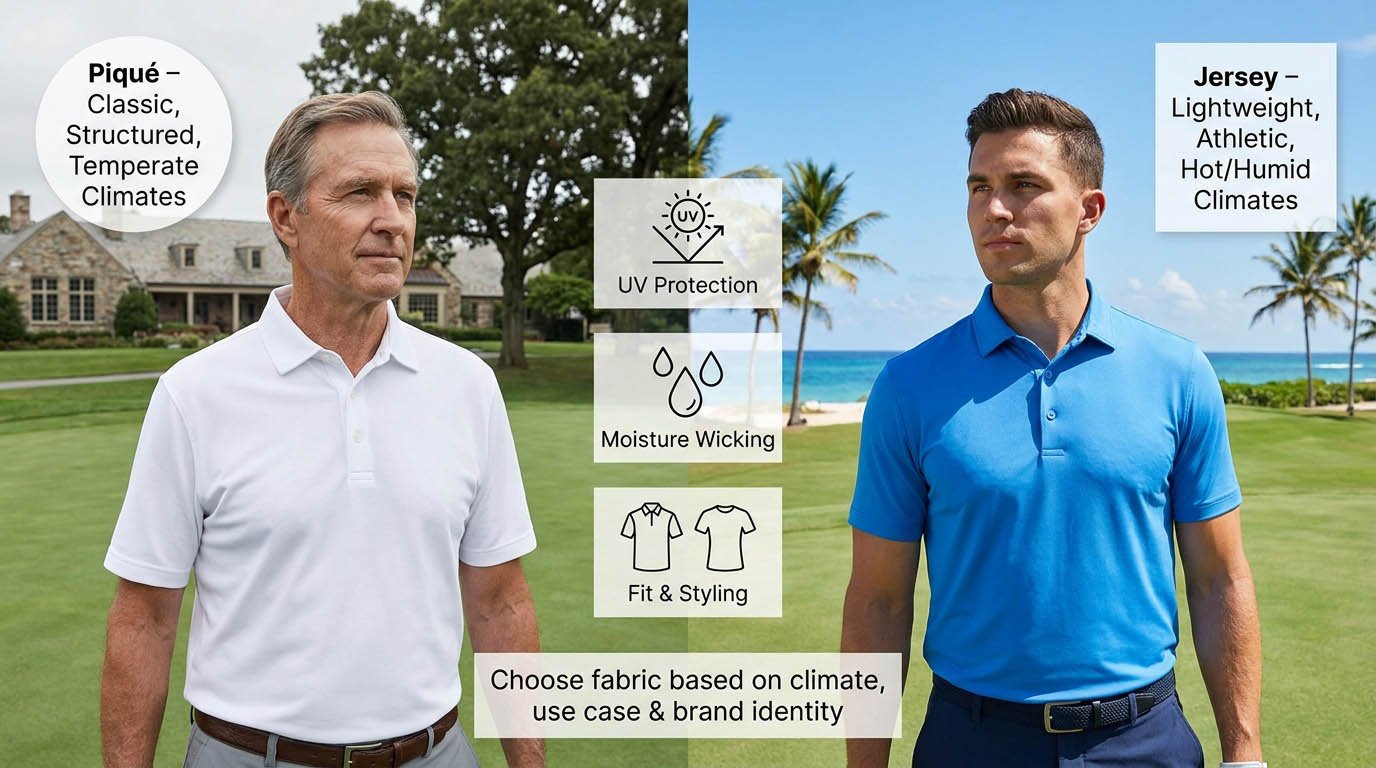
Hot & Humid Climate Performance
Climate profile: Southeast Asia, Gulf Coast US, Caribbean
- Temperature: 28-38°C (82-100°F)
- Humidity: 65-90%
- Sweat evaporation: Slow (saturated air)
Piqué performance in hot/humid:
When piqué works (with qualifications):
- Lightweight versions: 170-180 GSM maximum
- Open knit construction: Larger air pockets
- Polyester or poly-blend: Natural wicking
- Light colors: Reflect heat (offset opacity loss)
When piqué fails:
- Traditional weight: 200+ GSM too heavy
- Cotton construction: Absorbs and holds moisture
- Tight knit: Reduces breathability advantage
- Customer complaint: "Too warm, stays wet"
Jersey performance in hot/humid:
Why jersey succeeds:
- Lightweight: 160-180 GSM typical (less material)
- Fast drying: Thinner fabric dries 30-40% faster
- Smooth surface: Efficient moisture evaporation
- Less heat retention: Minimal insulation effect
Optimal jersey specification:
- 160-170 GSM polyester
- Moisture-wicking finish
- Engineered mesh zones (optional enhancement)
- Customer feedback: "Comfortable, stays dry"
Market positioning:
- Resort courses: Jersey dominates (vacation/casual play)
- Private clubs: May still expect piqué (tradition over function)
- Public courses: Jersey gaining market share (younger demographic)
Hot & Dry Climate Performance
Climate profile: Southwest US, Middle East, inland Australia
- Temperature: 35-45°C (95-113°F)
- Humidity: 10-30%
- Sweat evaporation: Fast (dry air)
- UV exposure: Intense (sun protection critical)
Piqué performance in hot/dry:
Why piqué works here:
- Air pockets provide sun insulation (reduces direct heat)
- Medium weight acceptable: 180-200 GSM (coverage for UV)
- Sweat evaporates naturally (dry air compensates for heavier fabric)
- Customers willing to accept slight weight for sun protection
Optimal piqué specification:
- 180-190 GSM polyester
- UPF 40-50 treatment
- Medium to dark colors (better UV blocking)
Jersey performance in hot/dry:
Why jersey also works:
- Lighter weight reduces heat (less material)
- Fast drying (though less critical in dry air)
- Requires UPF treatment (thinner fabric = less UV protection)
Trade-off consideration:
- Jersey: Better breathability but needs UV coating (+$0.50-1.00/yard)
- Piqué: Natural UV coverage from weight but slightly warmer
Market split:
- Performance-focused golfers: Prefer jersey (comfort priority)
- Traditional club members: Prefer piqué (sun coverage + classic look)
- Both viable in this climate (customer preference drives choice)
Temperate Climate Versatility
Climate profile: Europe, Northeast US, Pacific Northwest
- Temperature: 10-28°C (50-82°F)
- Humidity: 40-70%
- Seasonality: Significant (spring/summer/fall play)
Piqué performance in temperate:
Why piqué dominates:
- Moderate breathability sufficient (not extreme heat)
- Traditional aesthetic matches market (country clubs, heritage)
- Structured appearance valued (quality perception)
- Year-round acceptable: 190-220 GSM works spring through fall
Market positioning:
- Country clubs: Piqué expected (dress code standard)
- Corporate golf: Piqué preferred (professional appearance)
- Public courses: Both acceptable (customer choice)
Jersey performance in temperate:
Why jersey is niche:
- Athletic positioning required to justify smooth structure
- Younger demographic (more accepting of casual aesthetic)
- Performance branding (technical features highlighted)
When jersey works:
- Marketed as "performance line" versus classic line
- Athletic fit styles (slim, modern silhouette)
- Active recreational golfers (prioritize comfort over tradition)
Seasonal strategy:
- Spring/Fall: Piqué 200-220 GSM dominates
- Summer: Jersey 170-190 GSM gains acceptance
- Some brands offer both: Traditional (piqué) + Performance (jersey) lines
Brand Positioning Alignment
Traditional/Heritage brands:
Fabric choice: Piqué
- Reinforces classic positioning
- Texture = quality signal to target demographic
- Structured appearance = professionalism
- Examples: Country club pro shops, corporate golf gifts
Construction specs:
- 200-220 GSM substantial weight
- Cotton or cotton-blend (natural fiber heritage)
- Classic piqué texture (diamond or honeycomb)
- Colors: Navy, white, classic golf colors
Performance/Athletic brands:
Fabric choice: Jersey
- Communicates technical innovation
- Smooth surface = engineered/modern
- Lightweight = advanced materials
- Examples: Competitive golfers, active recreational market
Construction specs:
- 160-180 GSM lightweight
- Polyester or technical blends (moisture-wicking)
- Smooth jersey with technical finishes
- Colors: Performance colors (bright, modern palette)
Lifestyle/Resort brands:
Fabric choice: Both (segmented)
- Piqué for classic styles (traditional resort settings)
- Jersey for active/vacation styles (beach-to-course positioning)
- Fabric choice follows style line, not brand-wide
Construction specs:
- Piqué: 180-200 GSM (moderate weight)
- Jersey: 160-180 GSM (packable, quick-dry)
- Both optimized for tropical/resort climates
Value/Budget brands:
Fabric choice: Cost-driven
- Piqué if weight = value perception (more material)
- Jersey if efficiency = value (less material, faster production)
- Fabric matters less than price hitting target
I advise buyers: Your fabric choice communicates brand positioning whether you intend it or not. Match structure to target customer's quality expectations for your price tier.
Cost, Care & Sustainability: Fiber Choices and Finishes
Fabric cost comparison between piqué and jersey must account for fiber quality, finish treatments and sustainability certifications—where base structure price differences are minimal but yarn specifications, anti-pilling treatments, moisture-wicking finishes and recycled fiber premiums create 40-80% cost ranges within each fabric type, making detailed specification more critical than choosing piqué versus jersey for controlling per-unit costs and ensuring longevity matches retail price positioning.
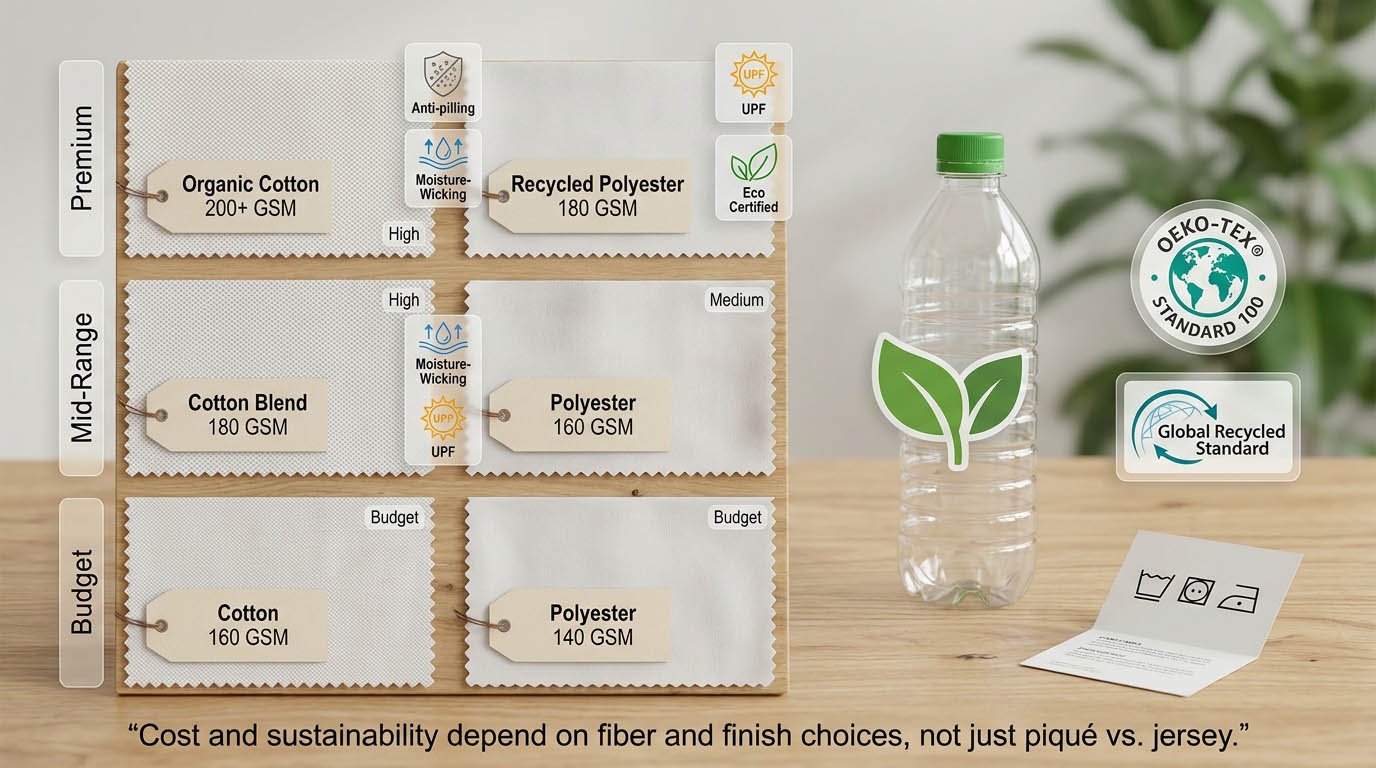
Base Cost Comparison by Specification
Budget tier construction:
Piqué budget:
- 180-200 GSM standard polyester or cotton-poly
- Staple yarn, no combing
- No anti-pilling or finish treatments
- Cost: $3.20-4.50/yard
Jersey budget:
- 160-180 GSM standard polyester or cotton-poly
- Staple yarn, no combing
- No anti-pilling or finish treatments
- Cost: $3.00-4.20/yard
Difference: Jersey $0.20-0.60/yard cheaper (lighter weight)
Expected performance:
- Lifespan: 30-50 washes before significant appearance degradation
- Acceptable for $30-45 retail positioning
Mid-tier construction:
Piqué mid-tier:
- 180-220 GSM combed yarn or microfiber
- Anti-pilling treatment
- Optional moisture-wicking finish
- Cost: $4.80-6.80/yard
Jersey mid-tier:
- 160-190 GSM combed yarn or microfiber
- Anti-pilling treatment
- Moisture-wicking finish (more common)
- Cost: $5.00-7.00/yard
Difference: Similar costs (treatments offset weight savings)
Expected performance:
- Lifespan: 70-100 washes
- Appropriate for $50-80 retail positioning
Premium tier construction:
Piqué premium:
- 190-220 GSM long-staple cotton, microfiber, or premium blends
- Multiple treatments (anti-pill, wicking, UPF, anti-microbial)
- Superior finish (peaching, enzyme wash)
- Cost: $7.00-10.00+/yard
Jersey premium:
- 160-180 GSM microfiber or technical blends
- Multiple treatments (anti-pill, wicking, anti-microbial)
- Advanced finishes (cooling, odor-control)
- Cost: $7.50-11.00+/yard
Difference: Jersey often MORE expensive (technical features prioritized)
Expected performance:
- Lifespan: 100-150+ washes
- Justifies $85-150 retail positioning
Fiber Choice Cost Impact
Virgin polyester (standard):
- Cost: $3.00-4.50/yard (baseline)
- Good performance (wicking, durability)
- No sustainability premium
Microfiber polyester:
- Cost: $5.00-7.00/yard (+$1.50-2.50)
- Superior softness and drape
- Better moisture management
- Best for: Premium smooth feel (jersey) or luxury piqué
Recycled polyester (rPET):
- Cost: $4.50-6.50/yard (+$1.00-2.00)
- Identical performance to virgin
- Sustainability positioning value
- Best for: Eco-conscious brand messaging
Pima/Supima cotton:
- Cost: $6.50-9.00/yard (+$3.00-4.50)
- Luxury softness
- Poor wicking (needs treatment)
- Best for: Traditional premium piqué (country club market)
Cotton-poly blends (65/35):
- Cost: $3.50-5.50/yard
- Moderate performance (better with wicking finish)
- Softer than 100% poly
- Best for: Balanced comfort-performance at mid-tier price
Nylon:
- Cost: $6.00-8.50/yard (+$2.50-4.00)
- Superior drape and softness
- Faster wicking than polyester
- Rare in golf polos (cost prohibitive for most brands)
Finish Treatment Cost Additions
Anti-pilling treatment:
- Cost: +$0.20-0.50/yard
- Impact: 50-70% pilling reduction
- ROI: High (reduces returns significantly)
- Recommend: Essential for mid-tier and above
Moisture-wicking finish:
- Cost: +$0.30-0.80/yard
- Impact: 30-50% faster drying
- ROI: High in hot climates, moderate in temperate
- Recommend: Jersey (reinforces performance positioning), optional piqué
UPF treatment:
- Cost: +$0.40-1.00/yard
- Impact: UV protection (UPF 40-50)
- ROI: Moderate (customers may not perceive benefit)
- Recommend: Hot/sunny climates, light-colored fabrics
Anti-microbial (silver ion):
- Cost: +$1.50-3.00/yard
- Impact: Odor control, 80-100+ wash durability
- ROI: High for premium positioning, low for budget
- Recommend: Premium lines only (cost significant)
Peaching/sueding (hand-feel enhancement):
- Cost: +$0.40-0.80/yard
- Impact: Softer touch, luxury feel
- ROI: High for premium, unnecessary for performance
- Recommend: Premium piqué (enhances traditional quality), optional jersey
Care Requirements and Customer Communication
Piqué care (both cotton and polyester):
Washing:
- Cold to warm water (hot unnecessary)
- Tumble dry low or hang (dries quickly if polyester)
- Avoid fabric softener on wicking-treated fabrics
Ironing:
- Cotton piqué: May need light ironing (texture hides wrinkles somewhat)
- Polyester piqué: Minimal to no ironing needed
Durability in care:
- Texture hides wear (appears newer longer)
- Structure maintains through multiple washes
Jersey care (both cotton and polyester):
Washing:
- Cold water (reduces shrinkage, preserves stretch if spandex)
- Tumble dry low or hang (air-dry faster than piqué)
- No fabric softener (reduces wicking, damages spandex)
Ironing:
- Cotton jersey: Needs ironing (shows wrinkles)
- Polyester jersey: Minimal ironing (wrinkle-resistant)
Durability in care:
- Smooth surface shows wear faster (pilling, snagging visible)
- Stretch may relax over time (especially if spandex)
Customer education importance:
Care label requirements:
- US FTC compliance: Washing, drying, ironing, bleaching symbols
- EU/International: Similar labeling requirements
Additional care cards/instructions:
- Reduces returns from customer misuse (washing too hot, wrong drying)
- Extends garment life (proper care maintains appearance)
- Cost: $0.05-0.15 per unit for printed cards
I have seen: Brands skip care instructions, customers wash at high heat, garments shrink or degrade, returns spike. Proper care communication is part of total cost management.
Sustainability and Certifications
Recycled polyester (rPET):
Source: Post-consumer plastic bottles or textile waste
Certifications:
- GRS (Global Recycled Standard): Verifies recycled content
- OEKO-TEX: Confirms no harmful chemicals
Cost premium: +$1.00-2.00/yard versus virgin
Marketing value:
- "X bottles per shirt" (tangible message)
- Appeals to eco-conscious consumers
- Required for corporate ESG buyers
Performance:
- Identical to virgin (wicking, durability, hand-feel)
- No trade-offs
When to use:
- Sustainability positioning (brand value proposition)
- Premium tier ($70+ retail) where cost absorbed
- Corporate/institutional buyers requiring recycled content
Organic cotton:
Source: Cotton grown without synthetic pesticides/fertilizers
Certifications:
Cost premium: +$2.50-4.50/yard versus standard cotton
Performance:
- Same as standard cotton (poor wicking without treatment)
- Requires moisture-wicking finish for golf use
When to use:
- Luxury traditional positioning (premium cotton story)
- Eco-premium market segment
- Niche appeal (limited to specific customer base)
Low-impact dyes:
Description: Dyes requiring less water/energy, no heavy metals
Certifications:
- OEKO-TEX Standard 100
- bluesign®
Cost impact: +$0.20-0.60/yard
Marketing value:
- Appeals to sustainability-focused customers
- Required for EU markets (stricter chemical regulations)
When to use:
- Any premium positioning (certification expected)
- European sales (compliance advantage)
- US eco-positioning (differentiator)
I advise: Sustainability certifications add minor cost but significant marketing value at premium tiers. For budget tiers, skip certifications—customers prioritize price over environmental claims.
FAQ: Choosing Between Piqué and Jersey for Golf Polos
Can I mix piqué body with jersey sleeves or vice versa?
Yes, but requires careful design consideration:
Common hybrid approaches:
Piqué body + Jersey sleeves:
- Goal: Combine traditional appearance with arm mobility
- Works when: Sleeves use similar weight jersey (within 20 GSM)
- Risk: Visual contrast may look like design flaw vs. intentional
- Cost: +$0.80-1.50 per unit (multi-fabric construction)
Jersey body + Piqué yoke/shoulders:
- Goal: Add structured detail to smooth performance fabric
- Works when: Piqué is lightweight (170-180 GSM) matching jersey drape
- Risk: Heavier piqué panel restricts movement
- Cost: +$0.80-1.50 per unit
Engineered zoning (better approach):
- Jersey body with mesh jersey panels (not piqué)
- Piqué body with open-knit piqué zones (same structure, different density)
- More cohesive appearance
- Cost: +$1.20-2.00 per unit
When hybrid makes sense:
- Premium positioning ($85+ retail) where design detail valued
- Performance emphasis (zoned construction communicates technical design)
- Unique brand identity (design signature)
When to avoid:
- Mid-tier or budget (complexity not valued at price point)
- Traditional markets (mixed fabrics confuse classic aesthetic)
- First product launch (simpler construction reduces risk)
I recommend: If considering hybrid, test samples during actual golf rounds. Fabric transitions must feel seamless in motion, not just look interesting on hanger.
Does jersey work for traditional country club dress codes?
Depends on club culture and how jersey is styled:
Where jersey is acceptable:
Modern/progressive clubs:
- Athletic-fit jersey accepted if styled appropriately
- Darker colors (navy, black) read as formal
- Collared and structured (proper collar construction essential)
- Younger membership base more accepting
Performance-oriented clubs:
- Technical jersey welcomed (function valued)
- Moisture-wicking messaging resonates with active members
- Multi-round tournament play (lightweight appreciated)
Where jersey often fails:
Traditional/heritage clubs:
- Piqué expected (smooth jersey reads as "undershirt")
- Older membership (associates texture with quality)
- Formal dining dress code (jersey too casual)
Conservative corporate events:
- Business-golf settings expect structured appearance
- Jersey perceived as "workout wear" not business-casual
Solutions to make jersey acceptable:
Design choices:
- Heavier jersey (190-200 GSM) provides substance
- Interlock jersey (double-knit) more structured than single
- Ribbed collar adds formality
- Classic colors (white, navy, not bright performance colors)
Marketing positioning:
- Market as "performance piqué alternative" not "jersey"
- Emphasize technical benefits to justify smooth structure
- Position as modern update to tradition
I have seen: Brands succeed selling jersey to traditional markets when they don't call it jersey—they market it as "advanced comfort weave" or "technical knit" and style it formally (classic colors, structured collar, conservative fit).
Which fabric is better for embroidery and logo decoration?
Piqué and jersey have different embroidery characteristics:
Piqué embroidery (easier):
Advantages:
- Stable structure (texture prevents fabric shifting)
- Embroidery sits on raised surface (more visible)
- Less puckering around stitches (fabric absorbs tension)
- Can use standard stabilizer (backing material)
Challenges:
- Texture requires coverage: Small text may get lost in piqué pattern
- Recessed areas in texture may shadow embroidery
Best practices:
- Larger logos/designs: 3+ inch width (visible over texture)
- Bold fonts: Avoid thin serif fonts
- Standard embroidery: No special techniques required
Jersey embroidery (requires care):
Advantages:
- Smooth surface (embroidery details show clearly)
- Better for fine detail: Text and small elements more legible
- Cleaner appearance: No texture competing with design
Challenges:
- Fabric stretches (registration/alignment difficult)
- Puckering risk (smooth fabric shows tension)
- Requires special stabilizer: Cut-away or tear-away backing essential
Best practices:
- Use cut-away stabilizer: Permanently supports embroidery
- Reduce tension: Lighter embroidery pressure
- Test first: Run samples before production
- Consider weight: Heavier jersey (180-190 GSM) embroiders better than lightweight
Alternative decoration methods:
Heat transfer (both fabrics):
- Works well on both piqué and jersey
- Jersey may be better: Smooth surface = better adhesion
- Lower cost for small quantities (<100 pieces)
Screen printing (both fabrics):
- Works on both with proper ink selection
- Piqué texture shows through print (may be desirable effect)
- Jersey gives cleaner print appearance
Cost comparison:
- Embroidery on piqué: Standard pricing
- Embroidery on jersey: May be +$0.50-1.00/unit due to stabilizer and careful setup
I recommend: If your brand relies heavily on embroidered logos (corporate, club pro shops), piqué is safer choice (less production risk). If using heat transfer or large embroidery, either fabric works.
Can I use the same sizing/pattern for piqué and jersey versions?
No—fabric structure affects fit significantly:
Stretch differences:
Piqué fit:
- 5-10% natural stretch (minimal)
- Patterns must include wearing ease (extra room for movement)
- Sizing runs true or slightly generous
Jersey fit:
- 15-25% natural stretch (significant)
- Can use tighter base pattern (fabric stretches to fit)
- Sizing may run small (stretch compensates)
Fit adjustments needed:
If converting piqué pattern to jersey:
- Reduce body width by 1-2 inches (jersey stretch provides ease)
- Tighten armhole (jersey conforms to shoulder)
- Consider slimmer fit (jersey drapes closer naturally)
If converting jersey pattern to piqué:
- Add 1-2 inches body width (piqué needs mechanical ease)
- Lower armhole slightly (more movement room needed)
- Looser fit required (piqué does not stretch much)
Collar pattern differences:
Piqué collar:
- Same fabric as body works well
- Minimal to no interfacing (self-supporting)
Jersey collar:
- Requires different collar knit (ribbing) or heavy interfacing
- Pattern must account for collar construction difference
Practical approach:
Option 1: Separate patterns per fabric
- Most accurate fit for each fabric
- Higher development cost (sample twice)
- Best for: Brands offering both as ongoing lines
Option 2: Universal "safe" pattern
- Slightly looser fit that works for both
- Compromises jersey's potential for athletic fit
- Lower development cost (one pattern)
- Best for: Brands testing market with small run
Option 3: Fit-specific fabric choice
- Slim fit = jersey only (needs stretch)
- Regular fit = either fabric (both work)
- Relaxed fit = piqué preferred (structure fills loose cut)
I have seen: Buyers assume patterns transfer between fabrics, then face fit complaints—piqué version fits well, jersey version too tight or looks baggy. Pattern adjustment is mandatory when switching fabrics.
How do I decide between piqué and jersey for a new product line launch?
Use this decision framework:
Step 1: Define target climate (most important):
Hot & humid majority of sales:
- Choose jersey: 160-180 GSM polyester with wicking
- Piqué will generate returns (heat retention)
Temperate majority of sales:
- Choose piqué: 190-220 GSM versatile weight
- Jersey acceptable but not necessary
Hot & dry majority of sales:
- Either works: Customer preference drives choice
- Piqué for traditional, jersey for performance positioning
Step 2: Identify target customer priority:
Performance/function priority:
- Choose jersey: Reinforces technical positioning
- Lightweight, moisture-management emphasis
Traditional appearance priority:
- Choose piqué: Meets classic expectations
- Structured, formal aesthetic
Budget/value priority:
- Either works: Choose based on cost at your quality level
- Piqué may signal "more fabric = more value"
Step 3: Assess retail price positioning:
$30-50 retail (value):
- Either fabric acceptable
- Choose based on target climate
- Avoid expensive technical features (not valued at price point)
$55-85 retail (mid-tier):
- Fabric defines positioning:
- Piqué = traditional quality
- Jersey = modern performance
- Include some treatments (anti-pill, wicking)
$90-150 retail (premium):
- Both viable with quality execution
- Fabric choice less important than yarn quality and finish
- Multiple lines possible (traditional piqué + performance jersey)
Step 4: Consider distribution complexity:
Single SKU simplicity (new brand, limited capital):
- Choose one fabric that covers largest addressable market
- Jersey 170-180 GSM most versatile if hot climates included
- Piqué 190-200 GSM most versatile if temperate markets only
Multi-SKU strategy (established brand, sufficient volume):
- Offer both as separate lines or seasonal options
- Capture customers unwilling to compromise
- Requires higher MOQs per variant
Decision tree summary:
| Primary Factor | Choose Jersey If | Choose Piqué If |
|---|---|---|
| Climate | Hot/humid dominance | Temperate/cool dominance |
| Customer | Performance-focused golfers | Traditional club members |
| Price | $60-100 performance positioning | $60-100 traditional positioning OR $30-50 value |
| Brand | Modern/athletic identity | Classic/heritage identity |
| Simplicity | Hot climate single-market focus | Temperate single-market focus |
I advise: Most buyers overthink this decision. Start by answering "Where is it hot when customers play golf?" Climate eliminates 50% of wrong choices immediately.
Conclusion
Choosing between piqué and jersey depends on target climate and customer expectations—piqué works for temperate traditional markets valuing structured appearance, jersey suits hot/humid conditions prioritizing breathability and quick-dry performance. Answer where customers play and what they expect before comparing fabrics, since yarn quality and finish treatments affect durability more than structure type alone.