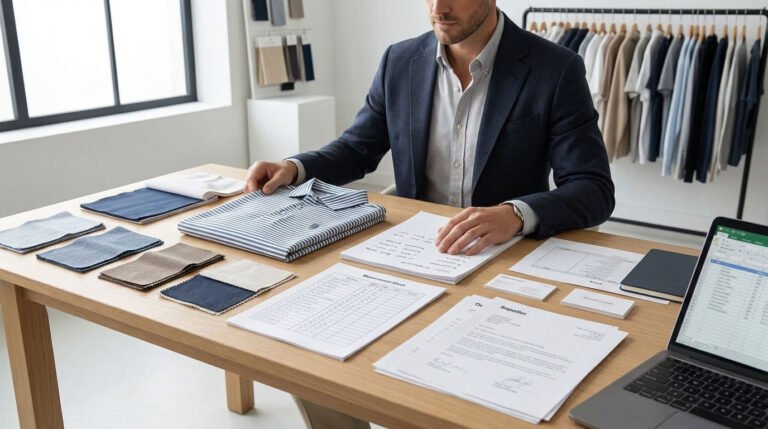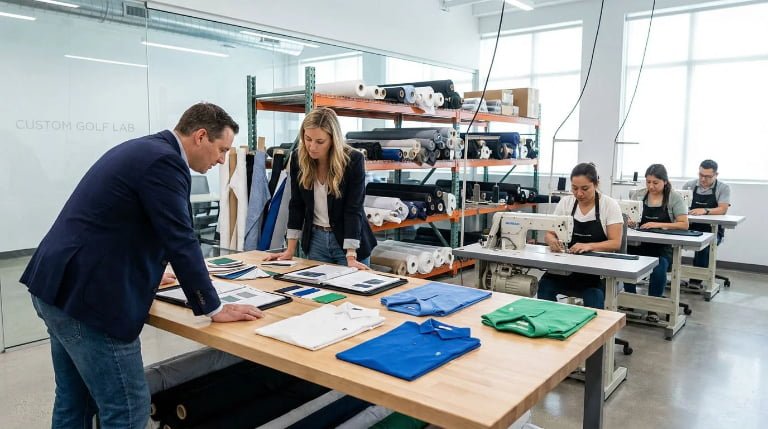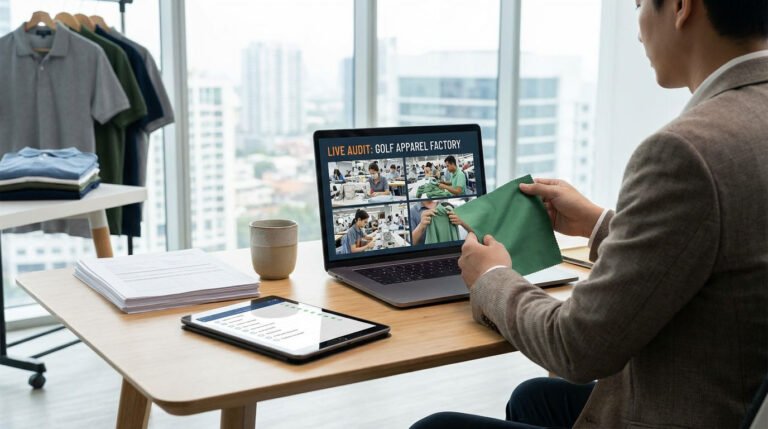
Choosing between a local golf apparel manufacturer and an overseas factory is a sourcing decision that affects more than production cost. It influences how much inventory you commit to, how quickly you can respond to customers, and how consistently your brand can grow.
Neither local nor overseas manufacturing is always better. A local manufacturer may suit urgent orders, hands-on development, and brands built around domestic production. An overseas factory may be a better fit for specialized golf apparel development, broader material sourcing, and planned repeat production.
For some brands, combining both options is the most practical strategy.
This guide compares the three sourcing models so you can choose based on your order requirements, working capital, and long-term business plans.
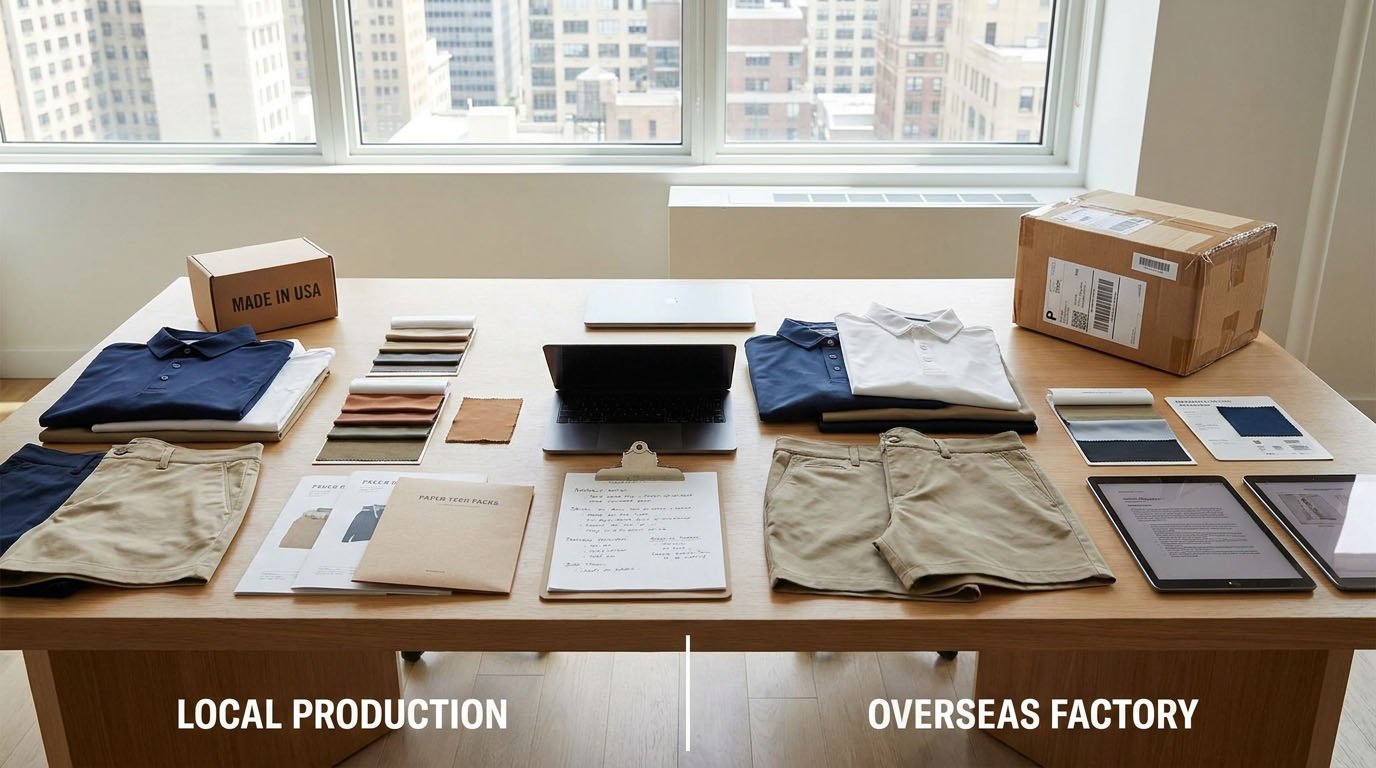
Quick Answer: Local vs Overseas Golf Apparel Manufacturing
The best manufacturing model depends on what your brand needs most.
| Your Priority | Local Manufacturer | Overseas Factory |
|---|---|---|
| Very small test orders | Often a good fit | Depends on MOQ and available materials |
| In-person sample reviews | Easier to arrange | Requires remote coordination or travel |
| Specialized fabric sourcing | Depends on supplier network | Can offer broader options in established manufacturing regions |
| Custom golf apparel development | Depends on factory specialization | Strong option with experienced OEM/ODM partners |
| International shipping | Usually simpler for domestic delivery | Requires freight and import planning |
| Planned bulk production | Depends on capacity and pricing | Often competitive with suitable volumes |
| Urgent replenishment | Advantage when materials are available | Requires advance planning or expedited shipping |
| Domestic-origin branding | May support origin requirements | Generally unsuitable for claiming domestic manufacture |
| Long-term repeat production | Possible with qualified partners | Possible with qualified partners |
The key is to compare manufacturing capability, total financial commitment, and delivery reliability—not geography alone.
A local factory with limited technical experience may be less suitable than a specialized overseas manufacturer. Likewise, a capable domestic producer may outperform an overseas supplier when small quantities and urgent delivery matter most.
Key 1. What Are the Main Differences Between Local and Overseas Manufacturers?
The biggest difference is not necessarily the quality of the finished garment. It is how each manufacturing model supports product development, production coordination, and supply chain management.
Local Manufacturing: Proximity and Responsiveness
A local golf apparel manufacturer operates in your domestic market.
Potential advantages include:
- Easier factory visits and face-to-face communication
- Shorter finished-goods transportation distances
- Convenient physical sample reviews
- Potential flexibility for small, frequent orders
- Support for legitimate domestic-origin positioning
These advantages are useful for brands that frequently revise designs, operate with uncertain demand, or need physical production oversight.
However, proximity does not guarantee fast production.
A local factory may still depend on imported performance fabrics, specialized trims, or external embroidery suppliers. These requirements can affect cost and lead time.
Overseas Manufacturing: Sourcing Depth and Production Planning
Overseas manufacturing means working with a factory outside your domestic market.
Established apparel manufacturing regions may offer access to specialized suppliers for performance fabrics, custom trims, printing, embroidery, and garment finishing.
For golf apparel brands, this can be particularly useful when developing coordinated collections rather than purchasing standard blank garments.
The trade-offs include international transportation, customs procedures, time-zone differences, and potentially longer physical sample delivery times.
The capabilities of individual factories still vary significantly.
For a country-specific comparison, our USA vs China Golf Apparel Manufacturing Guide explains the differences between these two production markets.
The purpose of this guide is broader: choosing the sourcing model that fits your business.
Key 2. Which Option Has a Lower Total Cost and Inventory Risk?
Overseas manufacturers may offer lower production prices, but the cheapest unit price does not necessarily produce the lowest business risk.
The more useful comparison is total landed cost, cash exposure, and inventory flexibility.
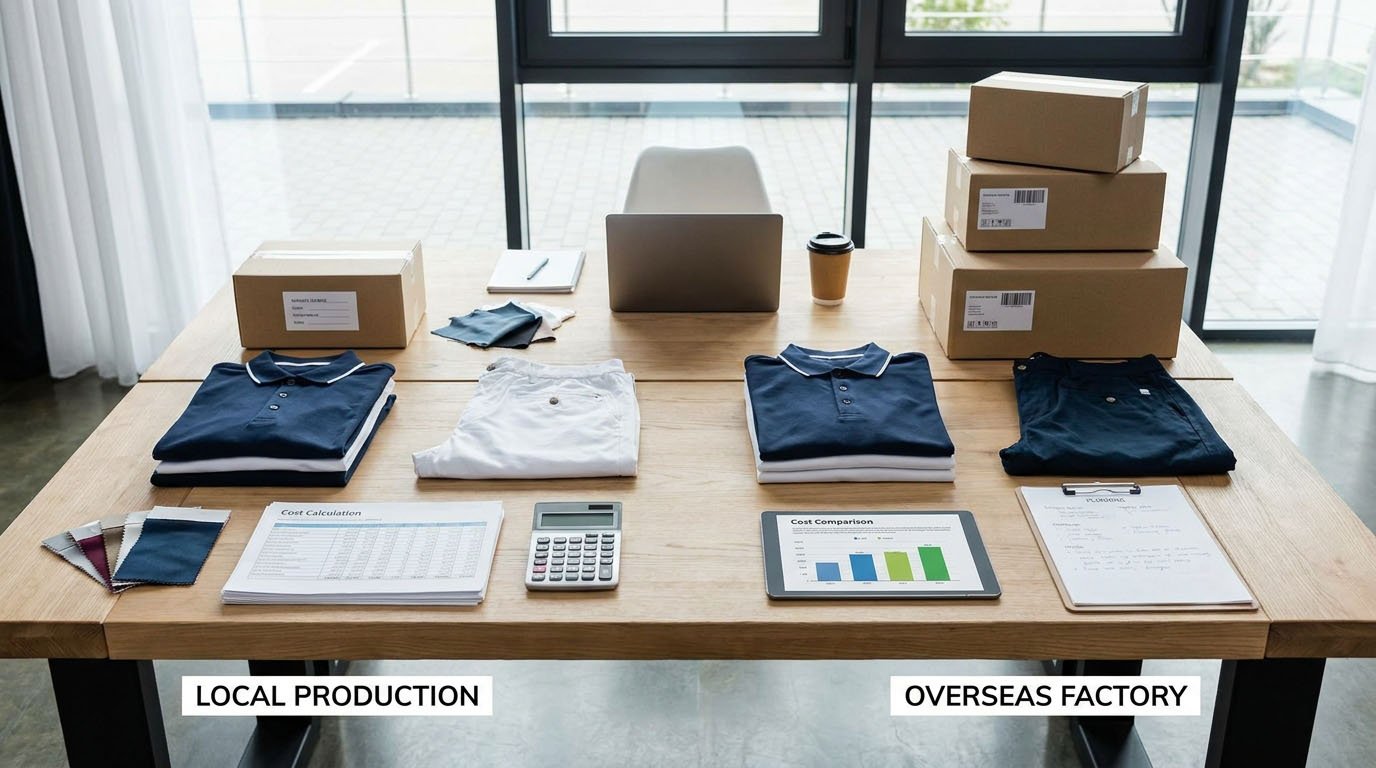
Compare Total Landed Cost, Not Just Factory Price
A landed-cost comparison should include all relevant expenses required to bring sellable garments to your warehouse.
| Cost Component | What to Evaluate |
|---|---|
| Garment production | Quoted unit price and included materials |
| Sampling and development | Pattern fees, revisions, and sample shipping |
| Customization | Labels, logos, packaging, and setup charges |
| Inspection | Factory QC and independent inspection where needed |
| Transportation | International or domestic freight |
| Import-related expenses | Applicable duties, taxes, customs clearance, and brokerage |
| Domestic delivery | Transport from port or factory to warehouse |
| Quality and delay risk | Potential rework, replacement, or missed sales |
Compare quotes using equivalent product specifications and delivery terms.
Import-related costs depend on the product classification, country of origin, destination, and applicable rules. Do not assume a fixed duty percentage without checking the actual shipment.
Why Cash Exposure Matters for Small Brands
Consider two hypothetical sourcing options:
Option A: Local production
- A higher unit price
- A smaller initial order
- Less money committed to untested inventory
- More flexibility for frequent replenishment
Option B: Overseas production
- A lower quoted unit price
- A larger minimum order
- More capital committed before the products sell
- Potential savings when demand is predictable
Even if Option B has a lower landed cost per garment, Option A may be more appropriate for a startup that has not validated customer demand.
A useful calculation is:
Initial Inventory Commitment = Order Quantity × Expected Landed Cost per Unit
Add any separate, non-recoverable development or setup costs to evaluate the overall commitment.
Then consider your deposit schedule, final payment date, and expected inventory turnover.
When Does Overseas Manufacturing Become More Economical?
There is no universal order quantity at which overseas manufacturing becomes cheaper.
The crossover point depends on:
- Garment complexity and material consumption
- Factory pricing and minimum quantities
- Freight method and destination
- Applicable import costs
- Reorder frequency
- Inventory holding costs
For an established brand with predictable sales, a larger overseas order may improve production efficiency.
For an untested collection, paying more per piece can sometimes be the safer decision if it reduces unsold inventory.
Compare the total cost of meeting your actual sales demand—not simply the price of producing more garments.
Key 3. How Do MOQ and Order Flexibility Compare?
Minimum order quantity (MOQ) is an important consideration, but buyers should distinguish between a factory's stated minimum and the minimum needed for their specific design.
Local Manufacturing for Small Orders
Some local manufacturers specialize in small-batch production, especially when using stock fabrics, existing patterns, or standard garments.
This can be useful for:
- Testing a new golf clothing concept
- Producing a limited collection
- Fulfilling small corporate or tournament orders
- Experimenting with fit before investing in a larger run
However, a supplier offering a very low MOQ may be using blank garments rather than fully custom cut-and-sew production.
Confirm exactly what is included before comparing quotations.
Overseas Manufacturing Is Not Always High-MOQ
Some overseas OEM/ODM manufacturers can support smaller orders when designs use available materials and practical construction methods.
At FUWAY, our typical starting MOQ is approximately 100 pieces per style, with flexibility depending on fabric availability, customization, and production requirements.
MOQ conditions may differ by style, color, fabric, or configuration.
Custom-dyed fabrics, specialized trims, and new developments can introduce additional minimums.
If quantity is a major concern, our Golf Apparel MOQ Negotiation Guide explains how to discuss smaller orders without compromising product requirements.
Consider Reorder Flexibility Too
A low first-order MOQ is helpful, but it should not be the only factor.
Before placing an order, clarify whether the manufacturer can reproduce the same fabric, colors, patterns, and trims later.
A slightly larger initial order may be reasonable if the factory can deliver stable repeat production. Conversely, a smaller initial order may be preferable when demand is highly uncertain.
Key 4. Which Is Faster for Sampling, Bulk Production, and Reorders?
Local manufacturers generally have a transportation advantage for domestic deliveries.
However, total time to market includes more than shipping.
It involves material sourcing, sample development, revisions, production scheduling, quality inspection, and final delivery.
Compare the Complete Production Timeline
| Production Stage | Local Manufacturer | Overseas Factory |
|---|---|---|
| Fabric sourcing | Fast if materials are stocked locally | Fast if materials are available through the supplier network |
| Sample development | Convenient for in-person changes | Depends on development team and specifications |
| Sample transportation | Usually shorter domestically | International courier may be needed |
| Bulk scheduling | Depends on production capacity | Depends on capacity and material readiness |
| Final inspection | Buyer visits may be easier | Remote reporting or third-party inspection |
| Shipping | Shorter domestic transportation | International freight and customs clearance |
| Reorders | Potential advantage for urgent small runs | Effective when materials and capacity are planned |
At FUWAY, typical custom sample development takes approximately 7–10 working days, while bulk manufacturing generally takes 3–4 weeks, depending on the design, order quantity, approved specifications, and material readiness.
These are production planning references, not guaranteed door-to-door delivery times. International transit and customs clearance must be considered separately.
Plan for the Actual Launch Date
Suppose a golf apparel brand wants inventory available before its seasonal launch.
The buyer should work backward from the required warehouse arrival date, accounting for:
- Product and sample approval
- Fabric and trim availability
- Confirmed production capacity
- Inspection and packaging
- Transportation and customs clearance
- A reasonable contingency allowance
This approach is more reliable than comparing advertised factory lead times alone.
For repeat orders, the most important question is whether the manufacturer can reserve or source the same approved materials and reproduce the previous order consistently.
An overseas supplier may work well for planned seasonal inventory, while a local partner may provide additional flexibility for unexpected demand.
Key 5. How Do Golf Apparel Quality and Technical Capabilities Compare?
Manufacturing location does not determine garment quality.
A reliable local factory can produce excellent golf apparel, while an unsuitable overseas factory can produce inconsistent results—and vice versa.
The important question is whether the manufacturer understands your products and can demonstrate appropriate production controls.
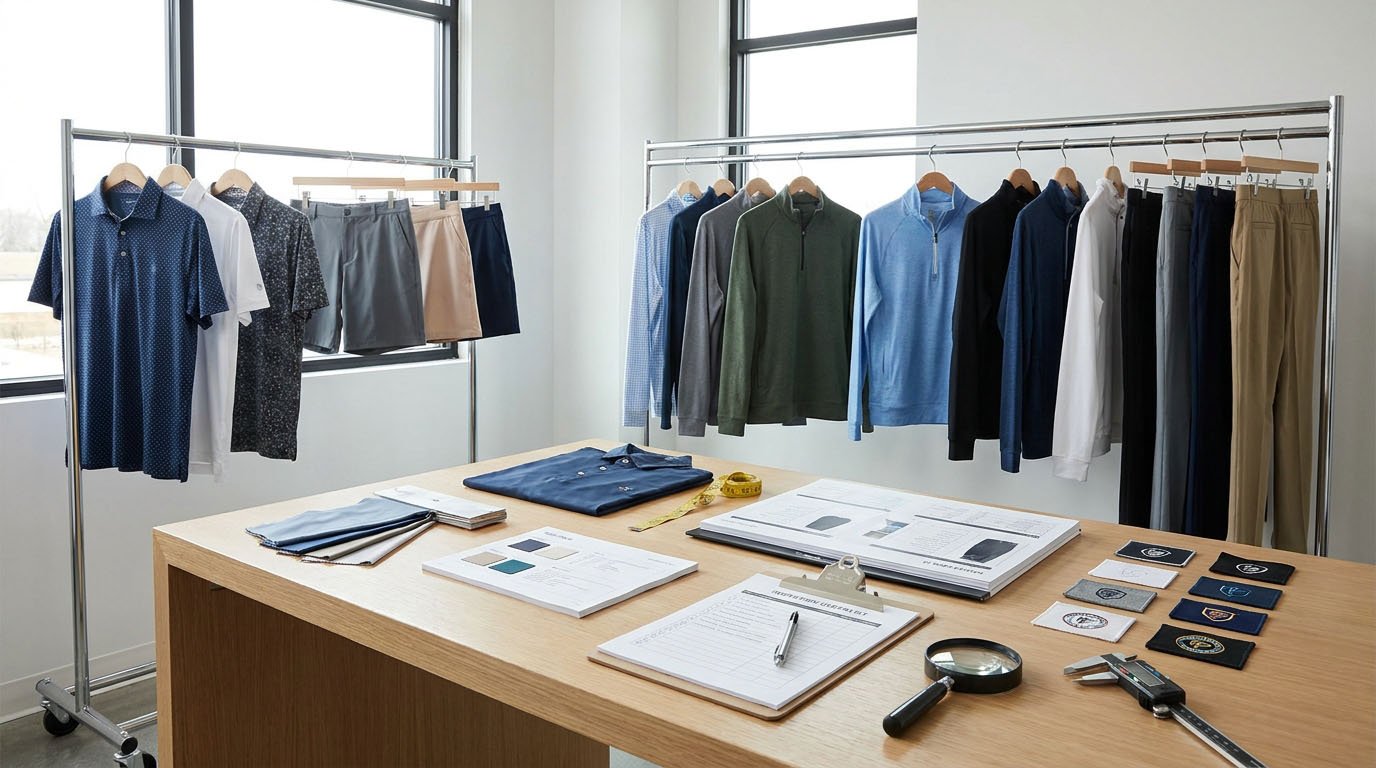
Golf Apparel Requires Product-Specific Experience
Different golf garments create different technical challenges.
| Product | Important Manufacturing Considerations |
|---|---|
| Golf Polo Shirts | Collar stability, placket alignment, fit, logo finishing |
| Golf Shorts | Waistband construction, pocket placement, stretch recovery |
| Golf Skorts | Outer-skirt fit, liner comfort, coverage, opacity |
| Quarter-Zips | Zipper alignment, collar shape, seam comfort |
| Golf Pants | Fit consistency, fabric recovery, pocket construction |
These requirements should influence factory selection.
For example, a factory experienced in basic cotton T-shirts may not have the same expertise in developing stretch golf shorts or performance skorts.
Likewise, not every large overseas supplier specializes in golf apparel.
Fabric Sourcing Can Be a Deciding Factor
If your collection requires moisture management, four-way stretch, UV protection, or specific fabric weights, compare the manufacturer's ability to source and validate appropriate materials.
A supplier with a reliable textile network may simplify development, regardless of location.
FUWAY's Golf Apparel Fabric Sourcing service covers performance fabric selection and material development for custom collections.
Quality Control Matters More Than Distance
Before committing to either manufacturing model, ask how the factory manages:
- Approved samples and specifications
- Incoming fabric and trim inspection
- In-line production checks
- Finished garment measurements
- Logo and workmanship consistency
- Final inspection and corrective actions
At FUWAY, finished garment measurements at specified measurement points must remain within ±1.0 cm of approved target dimensions, with tighter tolerances where agreed in the Tech Pack.
For a more detailed explanation of production inspections and AQL procedures, see our Golf Apparel Quality Control Guide.
The goal is not to choose a factory because it is nearby or overseas. It is to choose one that can deliver consistent, verifiable results.
Key 6. Local, Overseas, or Hybrid: Which Model Fits Your Brand?
Manufacturing does not always need to be an either-or decision.
Some growing golf apparel brands benefit from using different suppliers for different production requirements.
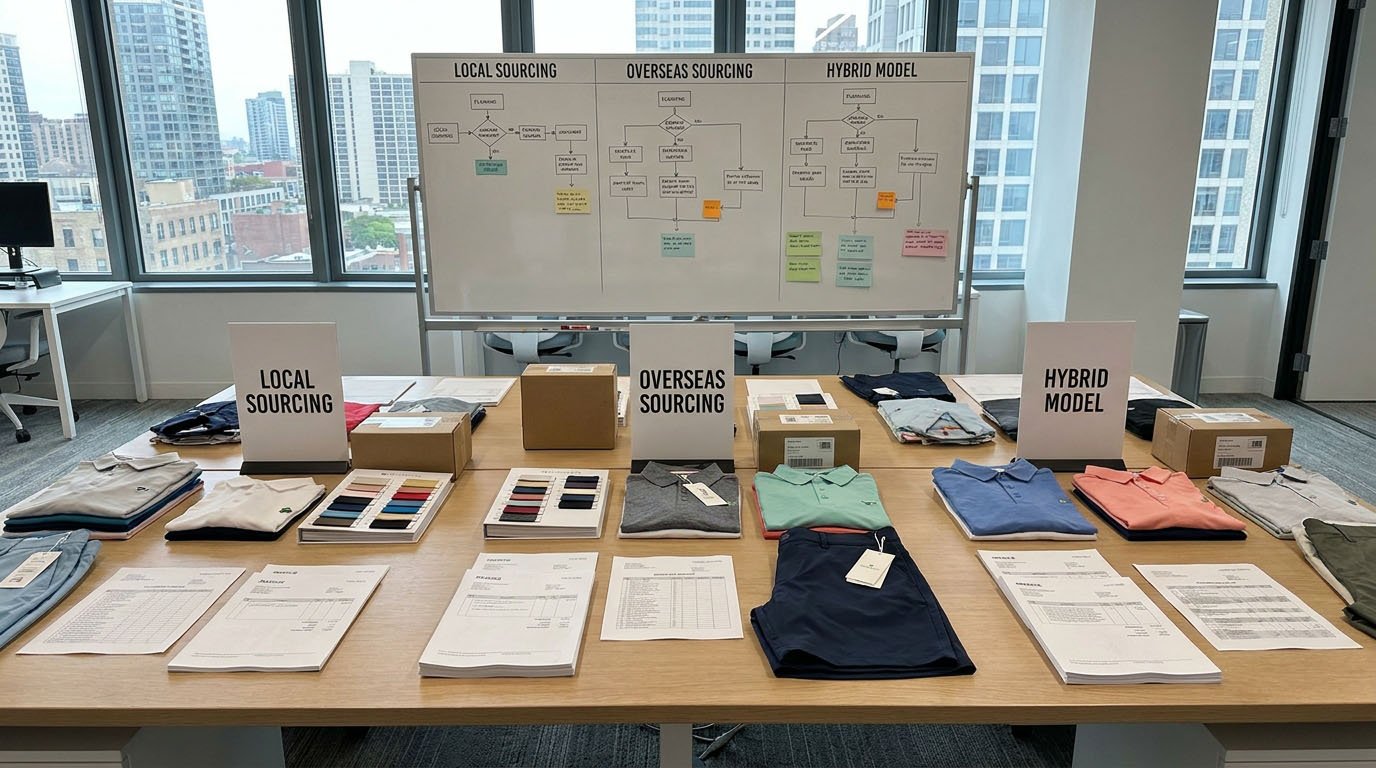
Option A: Choose Local Manufacturing
Local production may be the better choice when:
- Your order is too small for suitable overseas factories
- You need frequent physical fitting sessions
- You require urgent domestic replenishment
- Domestic manufacturing is central to your brand positioning
- You want to limit inventory exposure during early product testing
The biggest advantage is often flexibility rather than guaranteed lower cost.
Option B: Choose Overseas Manufacturing
Overseas production may be more appropriate when:
- Your products require specialized performance materials
- You need coordinated custom garments and trims
- You have validated demand for repeatable production
- Your order volume supports competitive landed costs
- You can plan inventory around international shipping
A specialized overseas manufacturer may also help coordinate fabric sourcing, sampling, garment construction, decoration, and packaging.
For brands developing fully customized products, FUWAY offers Private Label Golf Apparel Manufacturing services covering product development and branded production.
Option C: Consider Hybrid Manufacturing
A hybrid model combines local and overseas suppliers.
For example, a golf brand might use:
Overseas factory: Planned production of core golf polos, shorts, and skorts.
Local manufacturer: Urgent small-batch replenishment or selected short-run products.
This approach can balance production efficiency with responsiveness, but it introduces additional coordination.
The Biggest Risk of Hybrid Manufacturing
Two factories may interpret the same design differently.
Differences in fabric, patterns, construction methods, and finishing can result in inconsistent garments sold under the same brand.
Before splitting production, establish:
- One approved technical specification for each product
- Consistent measurements and grading rules
- Agreed fabric and color references
- Approved samples for each supplier
- Comparable quality acceptance criteria
- Clear inventory and reorder responsibilities
Also verify product-origin labeling requirements. Adding a logo or performing finishing work locally does not automatically make an overseas-manufactured garment eligible for a domestic-origin claim.
Hybrid manufacturing works best when the benefits of flexibility justify the additional supplier-management effort.
For early-stage brands with limited resources, working with one capable manufacturer may be simpler.
Key 7. How to Make the Final Manufacturing Decision
Before requesting quotations, define what matters most to your brand.
A startup testing its first collection may prioritize low financial exposure. A growing wholesale brand may prioritize repeat-order consistency and predictable landed costs.
The following decision matrix can help.

Golf Apparel Manufacturing Decision Matrix
| Your Business Situation | Model to Evaluate First | Main Reason |
|---|---|---|
| New brand testing unproven products | Local or flexible overseas | Limit initial inventory exposure |
| Around 100 custom golf polos | Local or low-MOQ overseas | Compare customization and landed cost |
| Complex performance golf collection | Specialized local or overseas | Technical capability matters most |
| Stable core products with predictable demand | Overseas or hybrid | Production efficiency and replenishment planning |
| Frequent urgent small restocks | Local | Domestic delivery flexibility |
| Seasonal wholesale orders | Overseas or hybrid | Planned production and inventory coordination |
| Domestic-made brand positioning | Qualified local manufacturer | Origin requirements |
| Established brand with varied order needs | Hybrid | Separate planned volume from urgent demand |
This table is a starting point—not a substitute for evaluating individual factories.
Compare Suppliers Using the Same RFQ
For a fair comparison, send each shortlisted manufacturer the same requirements:
| RFQ Information | What to Specify |
|---|---|
| Product | Golf polo, shorts, skort, jacket, or other style |
| Quantity | Units per style, color, and size |
| Material | Composition, weight, performance requirements |
| Customization | Labels, logos, trims, packaging |
| Quality | Approved sample, measurements, inspection requirements |
| Timeline | Required warehouse arrival date |
| Delivery | Destination and shipping terms |
| Reorders | Expected frequency and quantity |
Then compare qualified suppliers across five criteria:
- Total financial commitment: How much cash must you commit before inventory sells?
- Technical fit: Can the factory produce your specific golf apparel designs?
- Delivery reliability: Can it meet your required arrival date with a realistic schedule?
- Quality evidence: Can it demonstrate consistent specifications and production controls?
- Future flexibility: Can it support repeat orders, design changes, and growth?
Assign each criterion an importance level based on your business priorities, rather than treating all five as equally important.
The best supplier is the one that meets your highest-priority requirements at an acceptable total cost and risk.
Frequently Asked Questions
Is Overseas Golf Apparel Manufacturing Always Cheaper?
No. Overseas factories may offer competitive production prices, but freight, import costs, order quantity, and inventory risk affect the final cost.
Compare equivalent products using total landed cost and realistic order volumes.
Can I Start a Golf Clothing Brand With an Overseas Manufacturer?
Yes. Some overseas manufacturers support small or startup orders.
At FUWAY, the typical starting MOQ is approximately 100 pieces per style, subject to the design, fabric, and customization requirements.
Is Local Manufacturing Better for Premium Golf Apparel?
Not necessarily. Premium quality depends on materials, product development, construction, and inspection—not the factory's location.
A specialized overseas factory may outperform a local general-purpose apparel workshop, while an experienced local manufacturer may deliver excellent results.
Which Manufacturing Model Is Better for Fast Reorders?
Local production may be advantageous for urgent small orders if fabrics and production capacity are available.
Overseas production can work well for planned replenishment when materials, schedules, and transportation are coordinated in advance.
Should a New Golf Apparel Brand Use Two Manufacturers?
Usually, one suitable manufacturing partner is simpler for an early-stage brand.
A hybrid model becomes more useful when your sales volume and replenishment requirements justify managing multiple suppliers.
Can I Use Overseas Production and Still Build a Premium Local Brand?
Yes. Brand identity, design, product quality, and customer experience are separate from manufacturing location.
However, product-origin claims must accurately reflect the applicable legal requirements and actual manufacturing operations.
Conclusion: Choose the Manufacturing Model That Matches Your Business
Choosing between a local golf apparel manufacturer and an overseas factory is not simply about finding the lowest price.
Local production may provide advantages in physical collaboration, smaller orders, and urgent replenishment.
Overseas manufacturing can offer access to specialized sourcing networks, custom development capabilities, and competitive planned production.
For established brands, a hybrid model may combine both advantages.
The best decision is to match your manufacturing strategy to your product complexity, cash flow, delivery requirements, and expected reorder volume.
At FUWAY, we support golf apparel brands with OEM/ODM manufacturing, fabric sourcing, sampling, custom branding, and bulk production.
If you are considering overseas manufacturing for your next golf apparel collection, contact FUWAY to discuss your designs, expected quantities, and production requirements. We can help you evaluate whether our manufacturing capabilities fit your project.