
Two factories can quote different prices for golf pants that look almost identical. One may have allowed for a different fabric, simpler pockets, or fewer colors. Even with matching specifications, purchasing conditions, production efficiency, and commercial margins can produce different prices.
A golf pants cost breakdown includes fabric consumption, trims, cutting and sewing, finishing, packaging, and the factory's operating costs and margin. Development, testing, and delivery charges may be included or billed separately. Order quantity matters, but so do units per color, size distribution, and construction details.
The useful question is not just “What is your price?” It is “What does this price include, and which product decisions change it?”
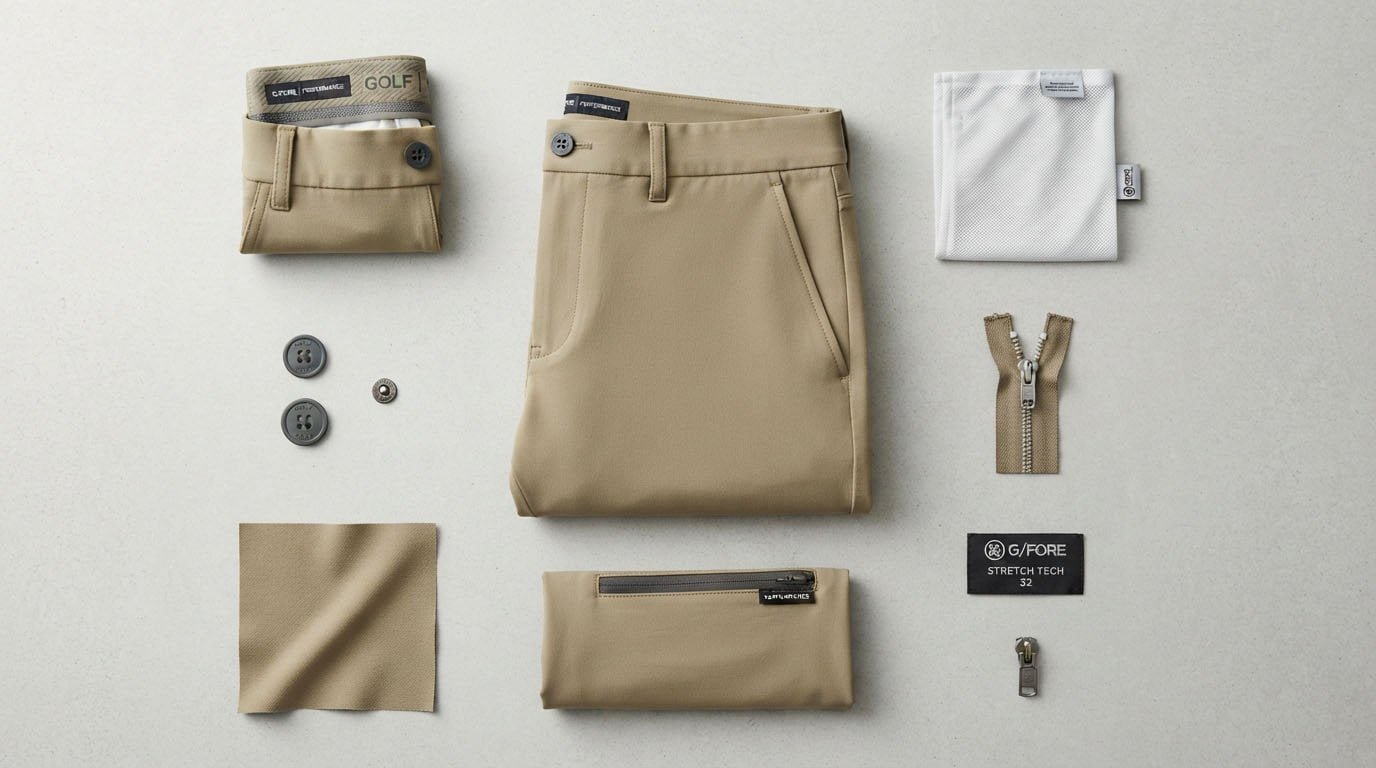
1. What Goes Into a Golf Pants Factory Price?
Start by separating costs that recur on every garment from charges associated with developing or preparing an order.
| Cost component | What drives it | What to confirm |
|---|---|---|
| Main fabric | Price per meter or kilogram, usable width, garment consumption | Fabric reference and consumption basis |
| Trims and secondary materials | Pocketing, zipper, buttons, elastic, gripper tape, labels | Exact components and quantities |
| Cutting, sewing and finishing | Construction, handling, pressing and agreed checks | Included operations and workmanship |
| Branding and packaging | Logo method, placement, hangtags, bags and cartons | Standard inclusions versus upgrades |
| Factory overhead and margin | Operating expenses and commercial pricing | Normally embedded in the quoted price |
| Development and setup | Patterns, samples, grading and custom component preparation | Separate, credited or amortized charges |
| Additional testing or inspection | Agreed tests, sample scope and inspection arrangements | Included services and separately billed work |
Factories do not necessarily disclose their internal labor rates or profit. Buyers can still request a clear product specification, inclusions, exclusions, and prices for optional changes.
Do not add a charge twice. If packaging or routine QC is already included in the unit price, it is not an additional budget line. The same applies to development costs already amortized into that price.
2. Fabric Cost Depends on Price and Consumption
Comparing fabric prices alone can be misleading. A cheaper material may require more meters per garment because of its usable width, shrinkage allowance, defects, or cutting layout.
For fabric quoted by the meter:
Main fabric cost per pair = costed fabric consumption per pair × price per meter.
Use matching units. A price per kilogram cannot be multiplied directly by consumption in meters.
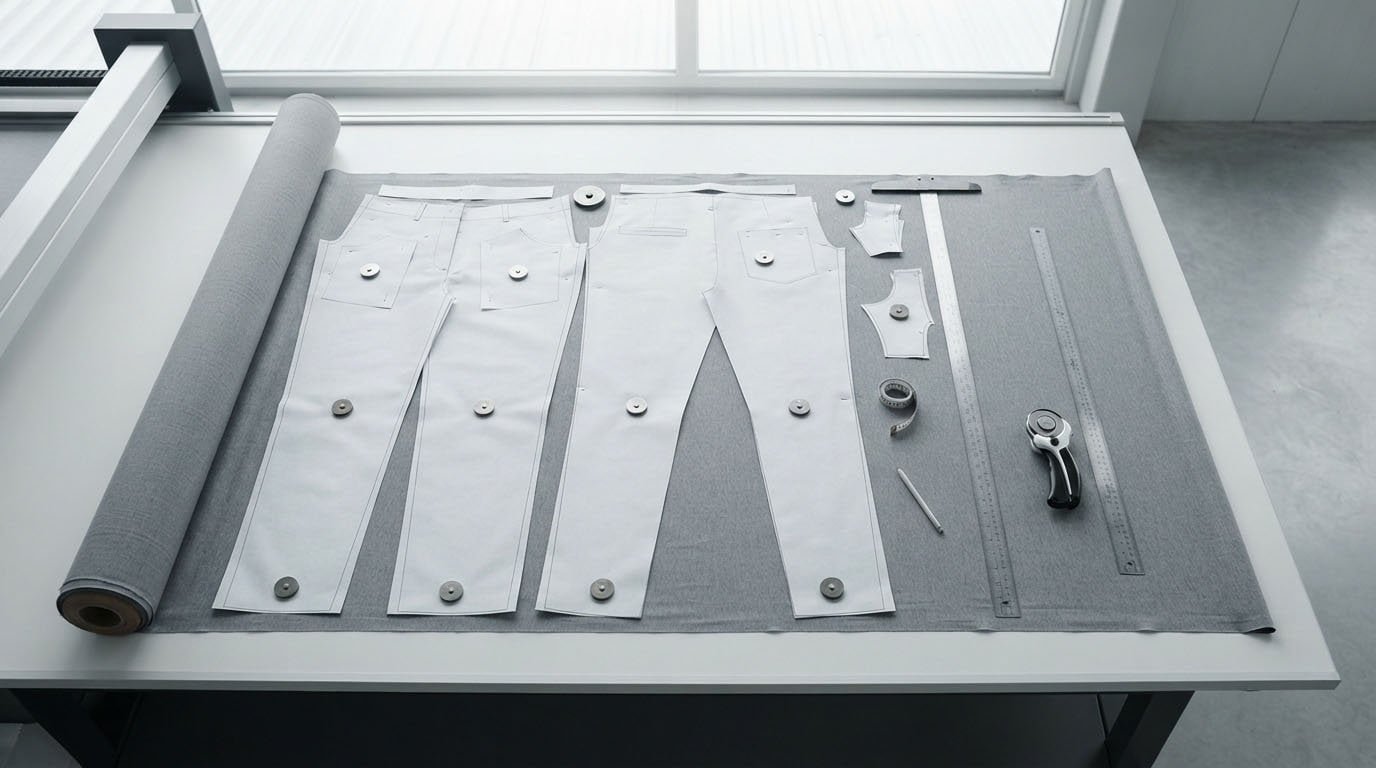
What Changes Fabric Consumption?
For golf trousers, relevant variables include:
- Usable width: Determines how trouser panels fit into the cutting layout.
- Size and inseam mix: Larger sizes and longer legs can change average consumption.
- Pattern shape: Leg width, rise, gussets and additional panels affect layout efficiency.
- Appearance requirements: Directional textures and pattern matching may restrict placement.
- Production allowances: Shrinkage and expected cutting losses must be accounted for consistently.
A narrower hem does not automatically produce a proportional fabric saving. The complete cutting layout determines whether the revised pattern uses fewer meters.
Ask whether quoted consumption already includes shrinkage and cutting allowances before adding them again.
Compare Complete Fabric Specifications
“Polyester-spandex” is not a complete cost specification. Composition, woven or knitted construction, weight, width, stretch recovery, surface finish, and color requirements all influence the material selected.
Performance properties may come from the yarn, fabric construction, finishing, or a combination. Moisture management or stretch does not automatically mean a separate finishing charge. If a specific performance claim is required, agree how it will be verified and whether testing is included.
Compare candidate materials using the same intended fit and performance requirements. A lower fabric price is only useful if the finished pants still meet the brief.
3. Waistbands, Pockets and Construction Change the Price
Golf pants may look simple externally while requiring several internal components and assembly operations.
The most useful comparison keeps the base style constant and changes one feature at a time.
| Proposed change | Why the price may change | Buyer decision |
|---|---|---|
| Add shirt-gripper tape | Additional material, application and checking | Does the customer need shirt retention? |
| Add a zippered security pocket | Zipper, pocket components and sewing operations | Is secure storage part of the product brief? |
| Use a shaped, multi-part waistband | More pattern pieces and assembly work | Does it improve the intended fit? |
| Add custom branded hardware | Component development and supplier minimums | Is the branding benefit worth the commitment? |
| Add articulated panels or gussets | Cutting layout and seam operations change | Is the movement benefit demonstrated in samples? |
| Require pattern matching | More controlled cutting and alignment | Is visual continuity essential? |
These changes do not have universal price premiums. Request an option price against the same base specification, quantity, and delivery terms.
Pocket Count Is Not Enough
Four straightforward pockets can require a different amount of work from four pockets that include welt openings, concealed zippers, or separate compartments. Pocket-bag material, depth, reinforcement, and finishing also matter.
Similarly, an elastic waistband is not always cheaper than a structured waistband. The result depends on elastic quality, channel construction, attached panels, closures, and finishing requirements.
4. How Quantity, Colors and Size Runs Affect Unit Cost
Higher volume can spread development and preparation charges over more garments. However, the total number of pieces does not describe the whole order.
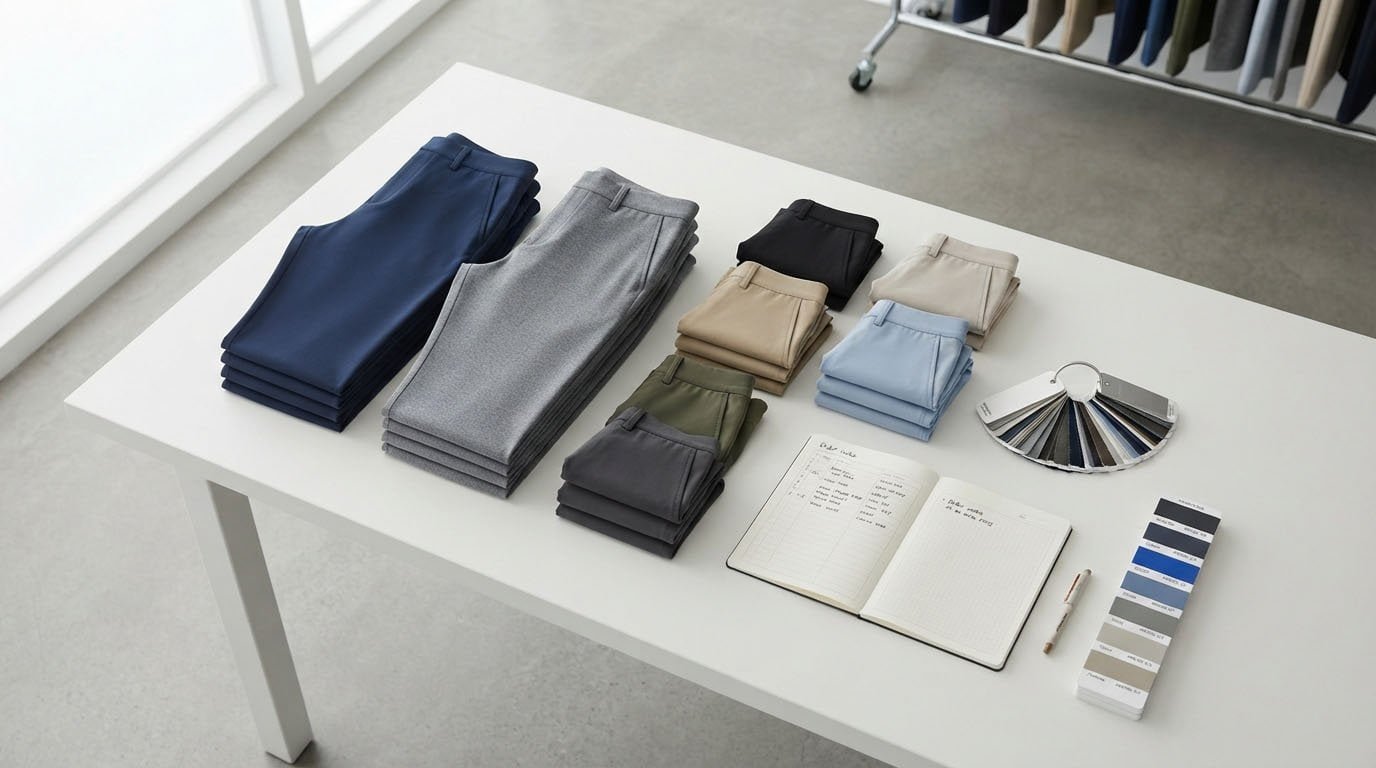
Quantity per Color Matters
Consider two hypothetical orders for the same style:
| Order | Total quantity | Color allocation |
|---|---|---|
| A | 600 pairs | 2 colors × 300 pairs |
| B | 600 pairs | 6 colors × 100 pairs |
Order B may require more dye lots, color approvals, trim matching, or separate production handling. Stock fabrics could reduce some of those differences. The factory needs the allocation before confirming whether the two orders receive the same price.
Size and Inseam Distribution Matter Too
A waist-and-inseam range can create more combinations than a single-inseam collection. That may affect pattern preparation, cutting markers, labels, sorting, and packing. It does not mean every added size automatically receives a surcharge.
Provide the planned size ratio and ask whether pricing uses average consumption or specified size surcharges. Keep that ratio tied to customer demand: changing it solely to improve cutting efficiency can create shortages in popular sizes and surplus stock elsewhere.
Separate Allocation Savings From Production Savings
For an illustrative $300 one-time development fee—not a FUWAY fee schedule—allocation across 100 pairs adds $3.00 per pair to your internal budget; across 300 pairs, it adds $1.00. Confirm which styles or quantities each charge applies to.
That arithmetic does not prove the sewing price will fall by the same amount. It only explains how one fixed charge is distributed. Material purchasing and production efficiency must be evaluated separately.
5. Hypothetical Cost Example: Calculating a Per-Pair Budget
The following figures are invented solely to demonstrate the calculation. They are not FUWAY quotations, market averages, or standard fabric-consumption benchmarks.
Assume a hypothetical order of 300 pairs: one woven stretch style, two stock colors, a defined size ratio and one inseam. The style has a zipper fly, belt loops, two front pockets, two back welt pockets, standard labels, and basic packaging. No logo decoration is included.
For this example, the product price excludes development, additional laboratory testing, and all collection, freight, insurance, customs, tax, and destination charges. An actual quotation must state the applicable delivery terms and named place.
| Hypothetical price component—not a FUWAY quote | Assumed calculation | USD per pair |
|---|---|---|
| Main fabric | 1.45 m × $4.20/m | $6.09 |
| Pocketing, closure, labels and other trims | Assumed component total | $1.60 |
| Cutting, sewing, finishing and routine QC | Assumed production allowance | $4.80 |
| Basic packaging | Assumed allowance | $0.40 |
| Factory overhead and margin | Assumed combined allowance | $2.10 |
| Hypothetical product price—not a FUWAY quote | Sum; excludes development, extra testing and all delivery/import costs | $14.99 |
Here, the 1.45-meter figure already includes the example's costed allowances. No additional fabric-waste charge is added.
Using the same hypothetical inputs and a separately billed development fee of $300:
- Product order: 300 × $14.99 = $4,497.
- Product order plus development: $4,497 + $300 = $4,797.
- Hypothetical budget per pair, including development but excluding additional testing and all delivery/import costs: $4,797 ÷ 300 = $15.99. This is not a FUWAY quotation.
Hypothetical Sensitivity Check: What If Consumption Increases?
Keep the same hypothetical fabric price, but increase costed consumption from 1.45 to 1.60 meters:
Additional material cost = (1.60 − 1.45) × $4.20 = $0.63 per pair.
Across 300 pairs, that is $189 in additional modeled fabric cost. This illustrates why usable width, pattern layout, and size mix deserve attention alongside price per meter.
It does not predict the exact revised selling price: the factory may also need to revise purchasing allowances or other quote components.
6. How to Reduce Cost Without Losing Required Performance
Ask the factory to price specific alternatives rather than requesting an unexplained discount.
| Possible adjustment | Potential benefit | What must remain acceptable |
|---|---|---|
| Consolidate launch colors | Fewer small material and component purchases | Customer demand and assortment |
| Use suitable stock fabric | May avoid custom development or dyeing minimums | Performance, color availability and reorder consistency |
| Share trims across styles | Larger combined component orders | Function and branding |
| Remove an unnecessary pocket or decorative seam | Fewer materials and operations | Storage, appearance and durability |
| Review marker efficiency | Lower consumption where layout permits | Grain direction, stretch orientation and fit |
| Simplify retail packaging | Lower packaging and handling expense | Protection and retail requirements |
Do not reduce fabric weight, seam reinforcement, stretch recovery, or inspection scope without checking the consequences. A cheaper construction that causes fit complaints or failures can undermine the saving.
Approve changed materials and construction through appropriate samples. For the development sequence, see our Golf Pants OEM Process guide.
Also consider total cash exposure. Ordering more solely to achieve a lower unit price can leave a brand with excess inventory.
7. Factory Price vs. Landed Cost
The factory quotation and the cost of getting goods into your inventory are different figures.
For budgeting, start with the quoted order value and add only the applicable costs it excludes: development, additional testing or inspection, freight, insurance, customs-related charges, and final delivery. Divide by the corresponding order quantity for a per-pair view.
Delivery terms determine which responsibilities are already included. Confirm the Incoterm, named place or port, and exclusions before comparing suppliers. Avoid adding freight or other charges again when they are already covered.
Use shipment-specific estimates for transport and import expenses rather than applying a universal percentage. If a required cost remains unknown, mark the budget incomplete instead of treating that item as zero.
8. A Short Checklist for Comparing Golf Pants Quotes
Before comparing prices, confirm that each supplier has quoted the same:
- Fabric reference, performance requirements, and substitution rules.
- Waistband, pockets, closure, branding, and packaging.
- Quantity by color, size ratio, and inseam options.
- Development charges and agreed testing or inspection scope.
- Currency, delivery terms, payment terms, and quote validity.
Ask suppliers to list optional upgrades and unresolved assumptions separately. A preliminary estimate is useful for planning, but it should be updated when the specification changes.
Use our Golf Apparel RFQ Template for the full inquiry format. If you are still choosing a supplier, refer to the Golf Pants Manufacturer Sourcing Guide.
Frequently Asked Questions
How Much Does It Cost to Manufacture Golf Pants?
There is no single price that applies across fabrics, constructions, quantities, and delivery terms. Request a quote for a defined style and order allocation. The worked example above explains costing arithmetic; it is not a price benchmark.
Can a Factory Estimate the Price From a Photo?
Yes, with stated assumptions. A photo can support an initial discussion, but it rarely shows fabric specifications, internal construction, or the order structure. Treat the result as indicative until those details are confirmed.
Why Can Prices Differ Even When Specifications Match?
Factories may have different material purchasing terms, equipment, production efficiency, capacity, overhead, and margins. First confirm that the scope matches, then evaluate the price alongside sample quality and delivery capability.
Are Sampling Fees Included in the Unit Price?
They may be separate, partly credited, or amortized into bulk pricing. Ask for the arrangement in writing and avoid counting the same fee twice in your budget.
Discuss Your Golf Pants Project With FUWAY
FUWAY supports custom golf bottoms manufacturing, including product development, material selection, sampling, and bulk production.
Share your reference style, fabric preferences, quantities by color, size range, and delivery requirements. Identify any features you would like priced as alternatives so the quotation can support a practical budget decision.
Contact FUWAY to discuss your golf pants specifications and quotation requirements.