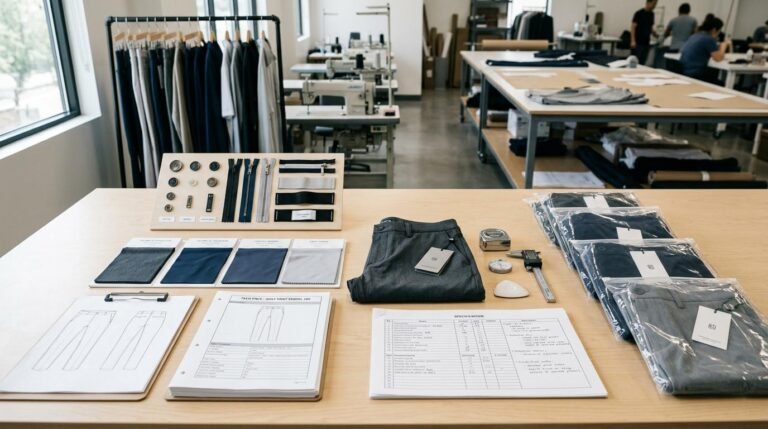
I watched a buyer approve a sample with perfect specs, then reject 3,000 pieces in bulk because the fabric lost stretch after washing. The selling points looked identical on paper. The real difference was hidden in production consistency.
The five critical evaluation areas are performance fabric verification beyond spec sheets, collar construction wash testing, fit consistency across size runs, durability proof through batch history, and sustainable material traceability—but most buyers assess these using samples alone, missing the production-scale risks that cause returns and reorders.
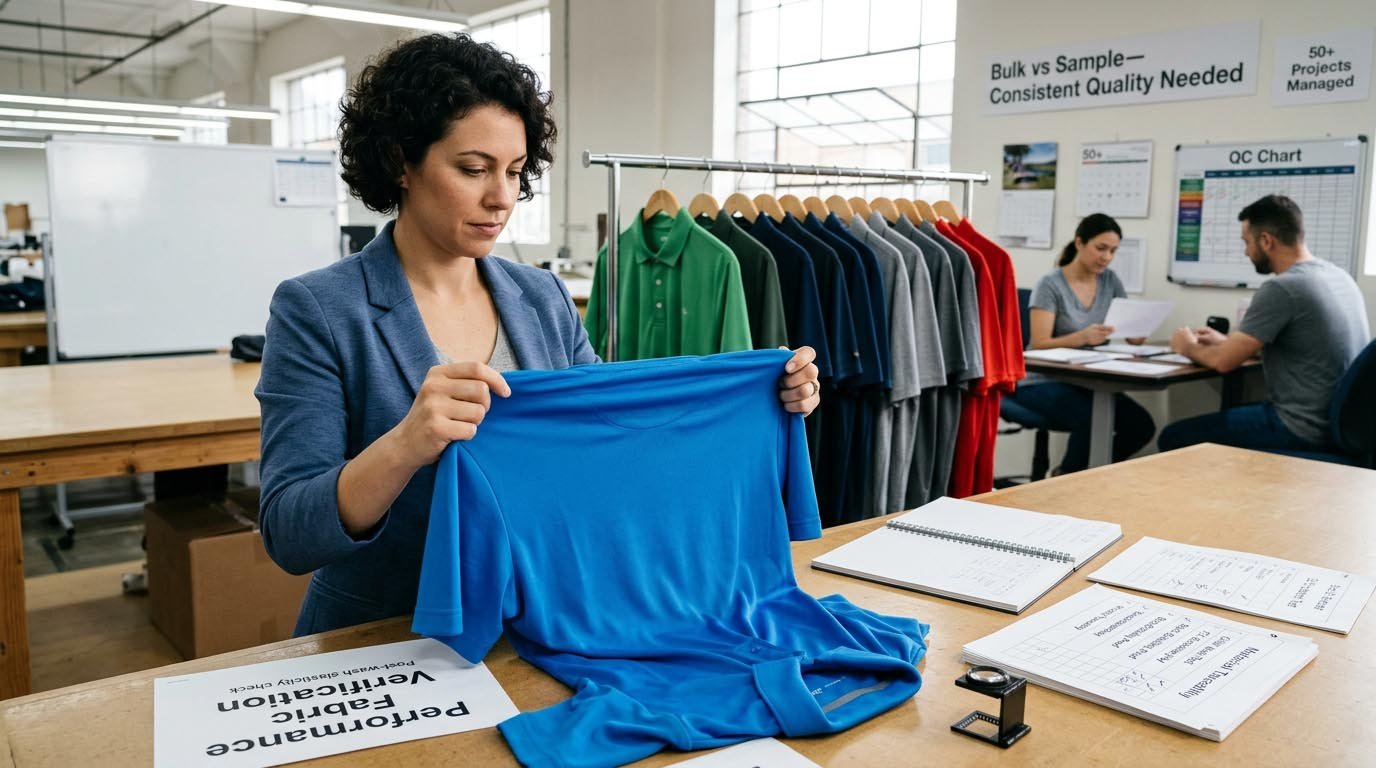
The gap between a beautiful sample and reliable bulk production is where most sourcing decisions go wrong. I have managed over 50 golf polo projects where buyers focused on price quotes, MOQ flexibility, and sampling speed. Then delays hit. Quality slipped. Reorders became complicated. The suppliers who delivered perfect samples could not maintain those standards at scale. This guide shows you what to verify beyond the sample stage—the production-level variables that predict whether your 2,000-piece order arrives on time, on spec, and ready for retail.
Quick Answers: What Brand Buyers Miss When Sourcing Golf Polos
1. Fabric Performance Claims Without Wash Testing
Suppliers list "moisture-wicking" and "UPF50+" in spec sheets, but these properties degrade differently across fabric qualities. Request 10-wash test results showing performance retention—not just virgin fabric specs. We have seen moisture-wicking effectiveness drop by 40% after five washes in lower-grade polyester blends.
2. Sample Collars That Perform Differently in Bulk
Sample collars often use hand-pressed interfacing and extra care that bulk production does not replicate. The real test: wash three bulk pieces from the middle of production and check for collar curling. One European golf brand faced 15% returns because bulk collars rolled after the first customer wash, even though samples stayed flat.
3. Size Consistency Across the Production Run
Buyers measure samples but rarely verify that piece #100 and piece #2,000 match the same specs. Pattern drift during production causes size variation that customers notice. Request measurement logs from different production batches—acceptable variance is ±2cm, but poor process control produces ±4cm swings within a single order.
4. "Eco-Friendly" Claims Without Material Traceability
Many suppliers claim recycled polyester without providing fiber certificates or audit trails. If you plan to market sustainability, demand GRS certification or equivalent documentation. We tracked a case where a buyer's "recycled content" claim was challenged because the supplier could not provide upstream material verification.
5. MOQ and Lead Time Trade-Offs That Delay Your Launch
Suppliers quote attractive MOQs but fail to mention that pattern adjustments trigger re-sampling cycles that add 2-3 weeks. The real timeline depends on customization complexity. Factories without ODM experience will either rush (causing quality drops) or delay (missing your market window).
Performance Fabric Package: Cooling, Moisture‑Wicking, UPF50+ and Odor Control?
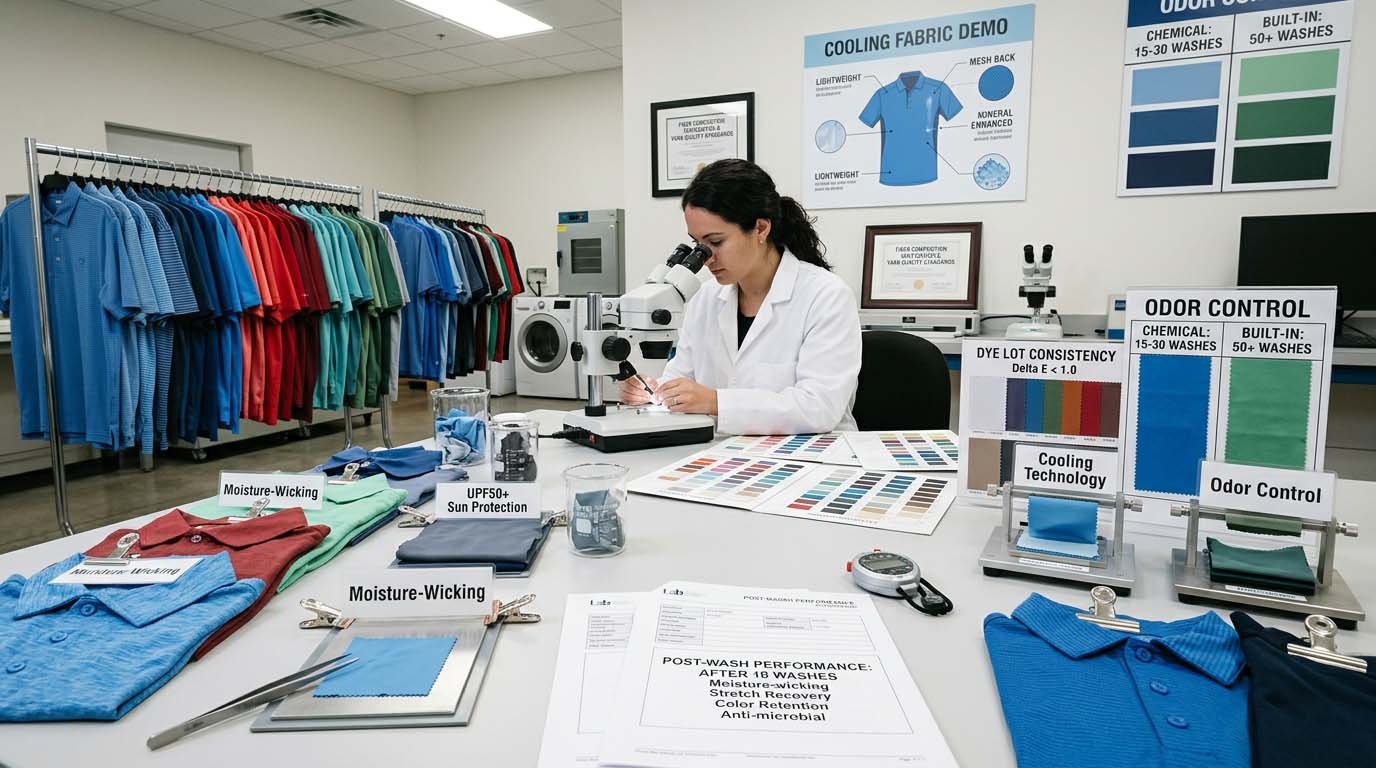
Verify fabric performance through post-wash retention testing and bulk production consistency checks—spec sheet claims tell you what the fabric can do when new, but buyers need to know what happens after 20 customer washes and whether the factory maintains fiber quality across different dye lots.
Most sourcing decisions fail at this first checkpoint. Last year, I worked with a buyer who approved a sample based on touch feel and listed specs. The sample fabric felt premium—soft, cool, with excellent stretch recovery. The bulk order arrived using the same fiber type on paper, but the hand feel changed. The moisture-wicking performance dropped noticeably. Why? The factory switched to a lower-grade yarn supplier mid-production to protect their margin when raw material prices increased.
The Spec Sheet Gap: What Claims Miss
Suppliers list these features on every quote:
- Moisture-wicking: Polyester with hydrophobic treatment
- Quick-dry: Lightweight construction, typically 140-180 GSM
- UPF50+: Tight knit structure blocks UV rays
- Odor control: Anti-microbial finishing treatment
- 4-way stretch: Polyester-spandex blend, usually 95/5 or 92/8 ratio
These claims describe the fabric's intended properties. They do not predict performance durability or production consistency. Here is what actually matters for brand buyers:
Performance Retention After Washing
Request wash test reports showing these metrics after 10 wash cycles (AATCC standards):
| Performance Feature | Virgin Fabric | After 10 Washes (Acceptable) | Red Flag |
|---|---|---|---|
| Moisture-wicking rate | Dries in 2-3 hours | Dries in 3-4 hours | Dries in 5+ hours |
| Stretch recovery | Returns to 100% within 60 seconds | Returns to 95%+ within 60 seconds | Permanent stretch beyond 5% |
| Color retention | Grade 4-5 on Grey Scale | Grade 3-4 minimum | Grade 2 or lower |
| Anti-microbial activity | 99%+ bacterial reduction | 90%+ reduction maintained | Below 80% reduction |
Suppliers who cannot provide these post-wash reports are guessing about their fabric's retail performance. The difference becomes visible in customer reviews: "Great fit initially but lost shape after a few washes" or "Fabric feels different after washing."
Fabric Consistency Across Production Batches
This is where ODM capability separates reliable suppliers from risky ones. The sample you approve comes from a controlled fabric lot. Your 5,000-piece bulk order may use fabric from 3-4 different dye lots spanning several production weeks. We learned to check:
Dye Lot Variation Control
Ask potential suppliers:
- How do you ensure shade consistency across multiple dye lots?
- What is your acceptable Delta E tolerance? (We maintain Delta E < 1.0 between lots)
- Can you show batch records from a previous order demonstrating color consistency?
Factories without disciplined inventory management will mix dye lots within a single order. The result: customers see visible shade differences between polos purchased from the same product listing. Returns follow.
Yarn Quality Verification
Premium moisture-wicking polyester costs $3.50-4.20 per kg. Standard polyester costs $2.10-2.80 per kg. The $1.40 per kg difference creates pressure for factories to substitute cheaper yarn in bulk production while maintaining the sample's spec sheet description. Both are "polyester," but they perform differently.
I recommend requesting fiber test certificates for bulk production, not just samples. Third-party fiber testing reveals:
- Actual fiber composition (catches undisclosed blends)
- Moisture absorption rates (predicts wicking performance)
- Tensile strength (indicates durability under stress)
The Cooling Effect Reality Check
"Cooling fabric" has become a marketing term that means different things to different suppliers. The actual mechanisms:
- Lightweight construction: Less fabric mass means faster heat dissipation—but also less durability and higher transparency
- Open knit structure: More air circulation but lower UPF protection (the two features trade off)
- Wicking treatment: Moves moisture from skin to fabric surface where evaporation cools the wearer
- Conductive minerals: Some premium fabrics embed cooling minerals, but these add $1.50-2.00 per piece to the cost
When evaluating cooling claims, ask: "What specific mechanism creates the cooling effect, and does that mechanism persist after washing?" A supplier who can answer technically demonstrates real fabric knowledge. Vague answers like "advanced cooling technology" signal marketing without substance.
Based on orders we have managed, here is the breakdown of actual cooling performance:
- Lightweight polyester (140-150 GSM): Provides 15-20% better cooling than standard cotton polos
- Mesh-back construction: Adds another 10-15% cooling improvement but limits printable decoration area
- Mineral-enhanced fabrics: Show 20-25% improvement in lab tests but require proper washing care to maintain
Odor Control That Actually Works
Anti-microbial treatments fall into two categories:
Chemical Finishes (Silver ions, quaternary compounds)
- Applied as a surface treatment during fabric finishing
- Gradually wash out over 15-30 wash cycles
- Cost-effective but requires re-application for long-term effectiveness
Built-In Technology (Embedded fibers, yarn treatment)
- Integrated into the fiber structure during yarn production
- Maintains effectiveness through 50+ wash cycles
- Adds $2.50-3.50 per piece to production cost
The mistake buyers make: assuming "odor control" means permanent effectiveness. For golf polos marketed to serious players, I recommend verifying that the anti-microbial treatment survives at least 30 washes with 80%+ effectiveness retention. Recreational-focused brands can accept shorter-duration treatments to hit lower price points.
Collar & Placket Integrity: Roll‑Proof Shape, Quiet Construction and Wash Durability?
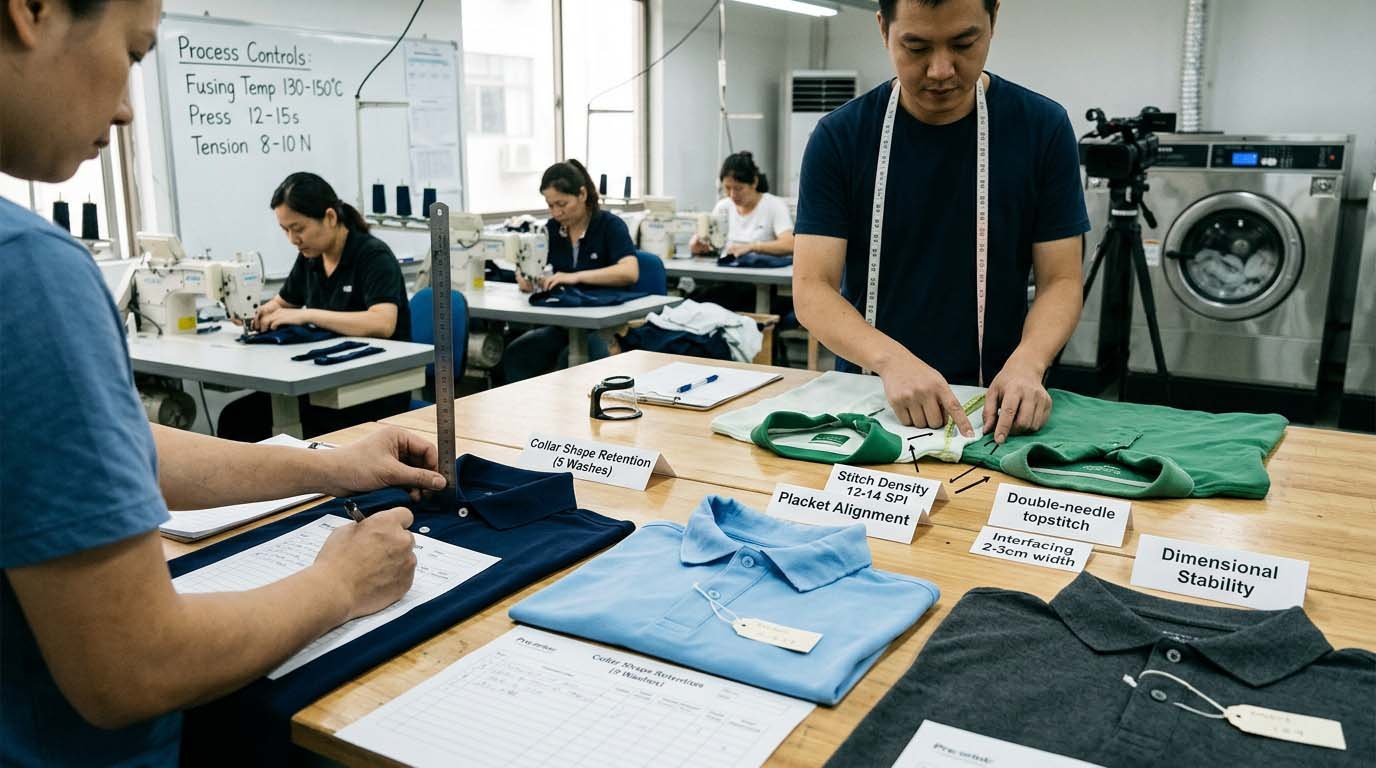
Evaluate collar construction through post-wash shape retention testing and bulk production attachment consistency—sample collars receive individual attention that bulk production cannot replicate, making collar performance the most common gap between sample approval and customer complaints.
Collar problems generate more returns than any other single defect in golf polos. I have seen this pattern repeatedly: buyers approve samples with perfectly flat, crisp collars. Bulk production arrives. First customer washes happen. The collars curl, twist, or lose shape. Returns spike. The supplier blames "improper customer washing." The buyer blames "quality drop in bulk."
The Sample-to-Bulk Collar Gap
Here is what happens in sample production versus bulk production:
Sample Production (First 5-10 pieces)
- Experienced operator handles collar attachment manually
- Interfacing is carefully aligned and pressed with attention
- Quality inspector checks collar symmetry on every piece
- Extra pressing and finishing make collars perfectly flat
Bulk Production (Thousands of pieces)
- Multiple operators with varying skill levels work simultaneously
- Interfacing application becomes semi-automated for speed
- Inspection samples 5-10% of output rather than every piece
- Standard pressing may not fully bond interfacing in all pieces
This explains why sample collars often outperform bulk collars. The solution is not demanding "same quality as sample"—that is economically unrealistic. The solution is verifying that the supplier has process controls that deliver acceptable collar performance at scale.
Collar Construction Elements That Predict Durability
Ask potential suppliers to explain their collar construction process. Strong technical answers demonstrate real capability:
Interfacing Selection and Application
- Fusible interfacing weight: We use 40-60 GSM woven fusible for golf polo collars
- Fusing temperature and pressure: Proper bonding requires 130-150°C at controlled pressure for 12-15 seconds
- Adhesive pattern: Better interfacing uses dot or paste adhesive rather than solid coating (improves wash durability)
Suppliers who cannot discuss these technical details likely lack process control. They will produce collars that look good initially but fail after customer washing.
Collar Band Stitching
The collar attaches to the body through the collar band. This seam takes stress when customers put on and remove the polo. Check these construction details:
| Construction Element | Acceptable Standard | Weak Construction Risk |
|---|---|---|
| Stitch density | 12-14 stitches per 3cm | Below 10 stitches creates pulling |
| Seam type | Double-needle or reinforced | Single-needle stretches over time |
| Thread tension | Balanced (no puckering) | Tight tension causes collar to curl |
| Topstitching distance | 1-2mm from edge | Inconsistent distance looks amateur |
I recommend requesting 3 bulk pieces from the middle of a previous production run. Wash them 3 times according to care label instructions. If the collars stay flat and retain shape, the factory has reliable process control. If collars curl or twist, the sample approval does not predict bulk performance.
The Placket Construction That Buyers Miss
The center front placket receives less attention than collars during inspection, but poor placket construction causes these problems:
- Gaping: Fabric pulls apart between buttons, exposing the wearer's chest
- Wavy placket: The stitched placket does not lie flat, creating visible ripples
- Button misalignment: Buttons do not align with buttonholes, creating an off-center appearance
- Edge rolling: The placket edge rolls under or outward after washing
Strong placket construction requires:
Proper Stabilization
The placket fabric needs interfacing or a folded self-fabric layer for stability. Without stabilization, the placket stretches differently than the main body fabric, causing gaping and misalignment. We use 2-3cm wide interfacing strips along each placket edge.
Controlled Stitching Tension
The stitching that creates and attaches the placket must use consistent tension. Too tight and the placket puckers. Too loose and it waves. Suppliers should demonstrate they monitor thread tension settings across all machines running your order.
Buttonhole Placement Accuracy
Buttonholes must align vertically within ±1mm tolerance. Greater variance creates a crooked appearance when buttoned. The placket marking and buttonhole sewing should use the same reference points to ensure alignment.
Wash Durability Testing You Can Request
Do not rely on supplier claims alone. Request these specific tests:
Dimensional Stability After Washing
- Measure collar width, collar height, and placket length before washing
- Wash 5 times following care label instructions
- Re-measure the same points
- Acceptable change: ±3% maximum
Collar Shape Retention
- Place the washed polo on a flat surface
- The collar should lie flat without curling edges
- Measure any curl height with a ruler—acceptable: under 5mm at collar points
Button and Buttonhole Integrity
- All buttons should remain securely attached after 5 washes
- Buttonholes should show no fraying or enlarged holes
- The placket should button smoothly without fabric stress
One supplier I worked with provided video documentation of their post-wash testing process. That transparency demonstrated process confidence. Suppliers who resist providing washed samples or test documentation are hiding performance gaps.
Swing‑Ready Fit & Mobility: 4‑Way Stretch, Pattern Mapping and Size Consistency?
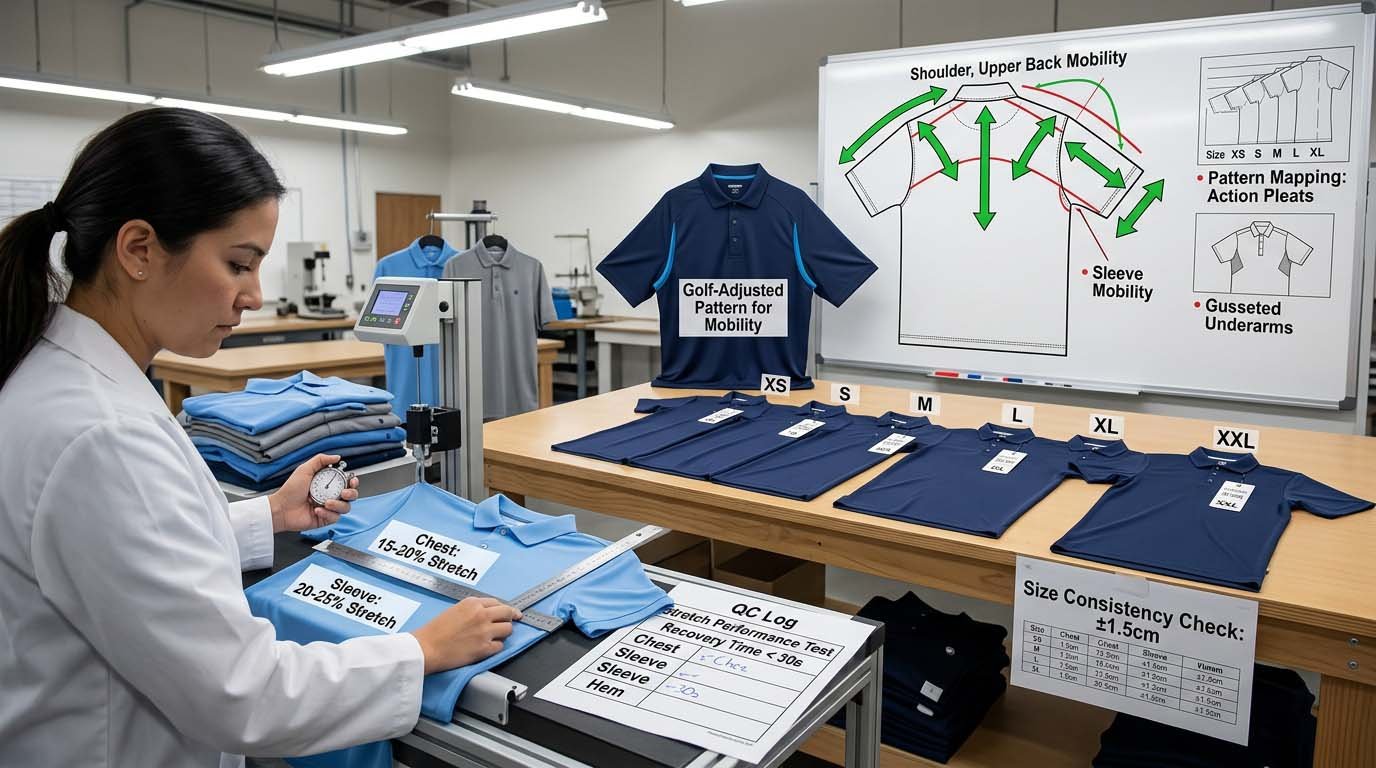
Assess fit performance through stretch recovery testing across different body zones and verify measurement consistency by requesting data logs from previous production runs—achieving the right fit on samples is easy, but maintaining that fit across 3,000 pieces with 6 sizes requires pattern precision and process discipline that most factories cannot demonstrate.
Fit problems emerge gradually. The sample fits perfectly. The first bulk pieces fit well. Then customers start reporting: "Runs small," "Too tight in shoulders," "Length is inconsistent." These complaints point to pattern drift during production—a problem that spec sheets and sample approval cannot catch.
The 4-Way Stretch Reality
"4-way stretch" appears on almost every golf polo spec sheet. But stretch amount and recovery speed vary dramatically based on:
Spandex Content and Quality
- 2-3% spandex: Minimal stretch, mostly for shape retention
- 5-8% spandex: Moderate stretch suitable for golf movement
- 10-12% spandex: High stretch but risks sagging over time
More spandex does not automatically mean better performance. The spandex quality matters more than the percentage. Premium spandex (like LYCRA® branded fiber) costs $12-15 per kg. Generic spandex costs $6-8 per kg. The price difference creates substitution pressure.
Stretch Recovery Speed
Pull the fabric to 120% of resting width and release. Quality stretch fabric returns to within 5% of original dimensions within 30 seconds. Slower recovery or permanent stretch indicates:
- Low-quality spandex that degrades quickly
- Insufficient spandex content for the fabric weight
- Loose knitting tension that allows permanent distortion
Based on orders we have managed, acceptable stretch performance for golf polos:
| Body Zone | Minimum Stretch | Recovery Time | Purpose |
|---|---|---|---|
| Chest/shoulders | 15-20% | Under 30 seconds | Allows full backswing rotation |
| Sleeves | 20-25% | Under 20 seconds | Prevents restriction during swing |
| Side seams | 15-20% | Under 30 seconds | Accommodates torso rotation |
| Hem | 10-15% | Under 40 seconds | Stays tucked during movement |
Pattern Mapping for Golf-Specific Movement
Standard polo patterns do not account for golf swing biomechanics. Golfers need freedom in specific zones:
Shoulder and Upper Back Expansion
During the backswing, the lead shoulder rotates forward while the trailing shoulder pulls back. This motion can stress standard raglan or set-in sleeve patterns. ODM-capable suppliers offer:
- Action pleats at the upper back for expansion room
- Gusseted underarms to eliminate pulling sensation
- Extended shoulder seams positioned to reduce restriction
These modifications add $0.80-1.50 per piece to production cost but significantly improve wear comfort for active golfers.
Sleeve Length and Armhole Depth
Golf swings reveal poor fit immediately. Sleeves that fit fine while standing become too short or tight during the swing. We recommend:
- Sleeve length: Add 1-2cm beyond standard polo length for golf-specific patterns
- Armhole depth: Drop the armhole 1cm deeper than casual polos to prevent restriction
Buyers who do not specify these golf-specific adjustments receive standard casual polo patterns. The fit works for standing but fails during swing motion.
Size Consistency—The Production Challenge
This is where I see most sourcing relationships break down. The sample size M measures perfectly. The bulk production includes 6 sizes (XS, S, M, L, XL, XXL) produced across 2-3 weeks with multiple cutting batches. Pattern drift happens:
Common Causes of Size Inconsistency
- Fabric relaxation: Cut pieces relax differently depending on storage time before sewing
- Operator variation: Different skill levels produce different stitch tension and dimensional accuracy
- Pattern wear: Physical pattern pieces degrade over thousands of cuts
- Fabric stretch during cutting: Improper fabric handling stretches material before cutting
Ask potential suppliers:
"Can you provide measurement logs from a previous order showing chest width variance across the production run?"
Suppliers with disciplined process control can show data like this:
- Size M chest width: 52cm ± 1.5cm across 1,000 pieces
- 90% of pieces fall within ±1cm of target
- Zero pieces outside ±2cm tolerance
Suppliers without this data cannot prove they control size consistency. You are relying on luck.
The Grade Rule Problem
Size grading is how patterns scale between sizes. Poor grading creates these problems:
- Proportional issues: XL fits well, but XXL has too-long sleeves relative to body length
- Asymmetric scaling: The jump from M to L is 5cm in chest width, but from L to XL is 7cm—inconsistent increments
I recommend requesting a full size run sample (one piece of each size) before bulk production. Lay them in sequence and verify:
- Proportions scale consistently across all sizes
- Measurement increments between sizes follow a logical pattern
- The smallest and largest sizes maintain the same style appearance
This check catches grading errors before 20% of your order (the XXL quantities) becomes unsellable due to poor proportion.
Proven Durability & Easy Care: Anti‑Pill/Snag, Colorfast and Shrink‑Resistant?
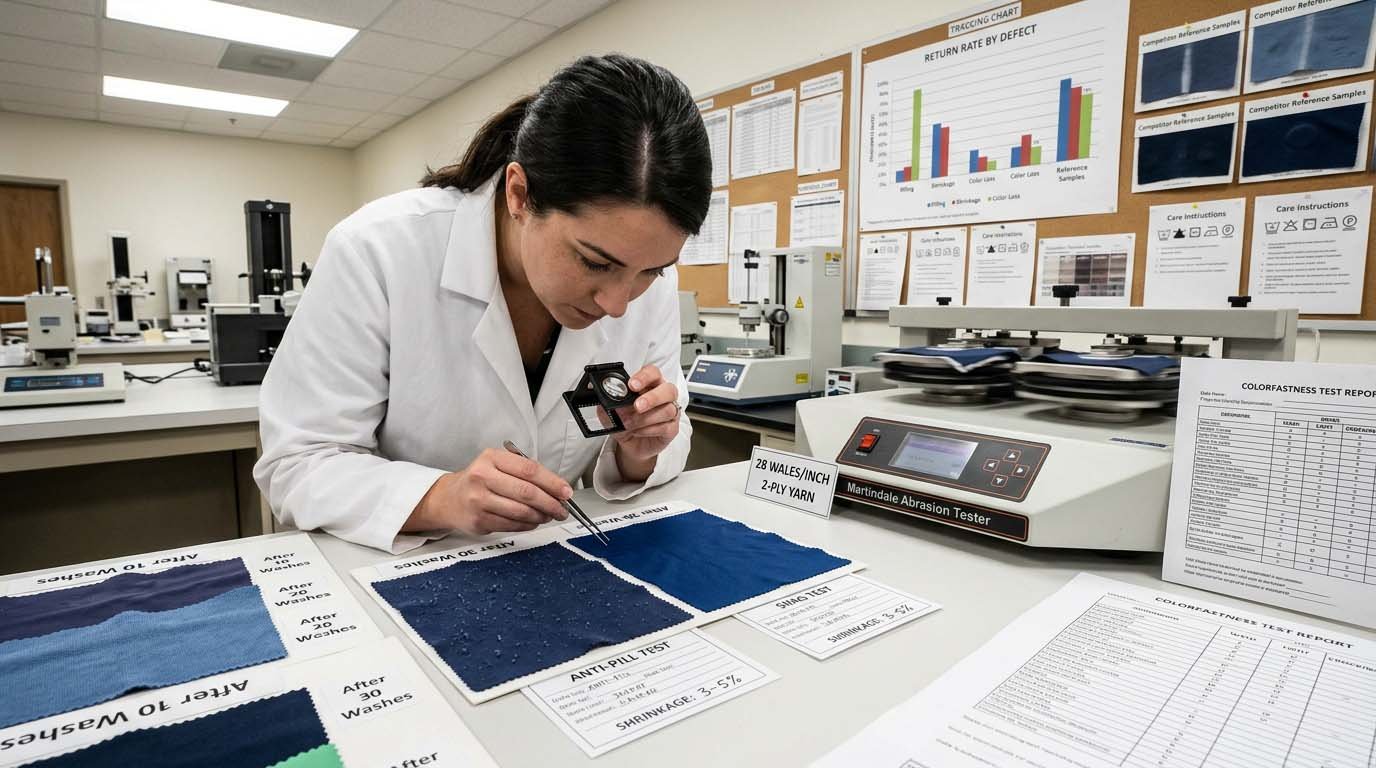
Verify durability through batch history data and accelerated wear testing rather than relying on fabric mill certifications—durability defects appear after 20-30 customer wears, long after purchase, making this the hardest selling point to evaluate during sourcing but the most critical for brand reputation and repeat purchase rates.
Durability problems cost more than returns. They damage brand reputation in ways that one-time defects do not. A customer who receives a polo with a loose button complains once and gets a replacement. A customer whose polo pills heavily after five washes writes negative reviews, stops buying, and warns friends. The cost difference is 3-5X in customer lifetime value.
The Anti-Pilling Challenge
Pilling happens when fiber ends work their way to the fabric surface and tangle into small balls. All polyester fabrics pill to some degree—the question is how quickly and how severely. Suppliers claim "anti-pill finish" but this means different things:
Chemical Anti-Pill Treatments
- Applied during fabric finishing as a surface coating
- Reduces pilling for 10-20 washes then effectiveness drops
- Adds $0.15-0.30 per piece to fabric cost
- Works best on lower-quality base yarns where pilling would otherwise be severe
Fiber Quality Approach
- Uses longer-staple polyester fibers that naturally resist pilling
- Tighter knit construction reduces fiber migration to surface
- Maintains anti-pill performance through 50+ washes
- Adds $0.80-1.20 per piece but provides lasting performance
The evaluation question: "Can you show me a piece from a previous order after 20+ customer washes?"
Suppliers confident in their durability can provide washed samples or reference customers who can verify long-term performance. We keep samples from each production batch and wash-test them at 10-wash intervals up to 30 washes to track performance degradation.
Snag Resistance and Abrasion Testing
Golf polos face specific durability stresses:
- Golf bag contact: The polo rubs against bag dividers and zippers
- Golf cart friction: Constant contact with cart seats and safety straps
- Range ball baskets: Brushing against wire baskets causes snags
- Velcro closures: Golf gloves and accessories with velcro catch fabric
Standard casual polos do not face these conditions. Golf-specific durability requires:
Tighter Knit Construction
- We maintain minimum 28-30 wales per inch for snag resistance
- Lower knit density (24-26 wales) costs less but snags more easily
- The density difference adds $0.40-0.70 per piece
Yarn Twist and Ply
- Single-ply yarn snags more easily than two-ply construction
- Yarn twist level affects snag resistance—we specify minimum 3.5 turns per inch
Ask suppliers about their knit specifications. Vague answers indicate they source fabric opportunistically rather than controlling spec requirements.
Colorfastness—The Three Types That Matter
"Colorfast" covers several different tests:
| Colorfastness Type | What It Tests | Acceptable Grade | Business Impact if It Fails |
|---|---|---|---|
| Wash fastness | Color bleeding during washing | Grade 4 minimum | Customer returns, color transfer complaints |
| Light fastness | UV degradation during display/wear | Grade 4-5 | Faded appearance after few wears, retail display degradation |
| Crocking | Color transfer when rubbed | Grade 3-4 | Color transfers to skin, especially when sweating |
I worked on a project where the buyer focused only on wash fastness testing. The bulk order passed wash tests but failed light fastness—the polos faded noticeably after 8-10 wears during summer golf. The supplier was technically compliant with the requested test but the product failed in actual use conditions.
Specify all three colorfastness tests for golf polos. The testing cost is $150-250 per color but prevents problems that cost thousands in returns and brand damage.
Shrinkage Control Reality
Suppliers claim "pre-shrunk fabric" but shrinkage still happens. The question is whether shrinkage falls within acceptable limits:
Acceptable Shrinkage Standards
- Length shrinkage: 3-5% maximum after first wash
- Width shrinkage: 2-4% maximum after first wash
- Differential shrinkage: Length and width should shrink at similar rates (within 1-2% of each other)
Differential shrinkage is what buyers miss. A polo that shrinks 4% in length but only 2% in width changes proportion—it becomes shorter and relatively wider, altering the intended fit. This proportion shift looks like a quality defect even though both dimensions fall within individual tolerance.
I recommend requesting dimensional stability testing that measures shrinkage after 3 consecutive washes using customer care instructions (not lab standards that may differ). The third wash reveals whether shrinkage stabilizes or continues progressively.
Durability Data You Should Demand
Move beyond "trust the sample" and request:
Batch Performance History
"Show me quality data from a similar order you produced in the past 6 months, including return rate and specific defect breakdown."
Suppliers with confidence in their durability track this data. We maintain records showing:
- Return rate by defect type (pilling, shrinkage, color loss, etc.)
- Defect emergence timeline (how many issues appeared within 30 days versus 60+ days)
- Corrective actions taken when defect rates exceeded targets
Accelerated Wear Testing
Request that the supplier perform:
- 20-30 wash cycles on sample pieces before bulk production approval
- Abrasion testing using standardized equipment if available (Martindale or similar)
- Comparative testing against a known reference product in the same quality tier
One buyer I worked with provided us with a competitor's golf polo as the durability benchmark. We tested our samples and their reference sample through identical wash and wear cycles. That data-driven comparison demonstrated our durability advantage objectively rather than through claims.
Sustainable Design & Brandable Details: Recycled/Bio Materials, Textures and Decoration Options?
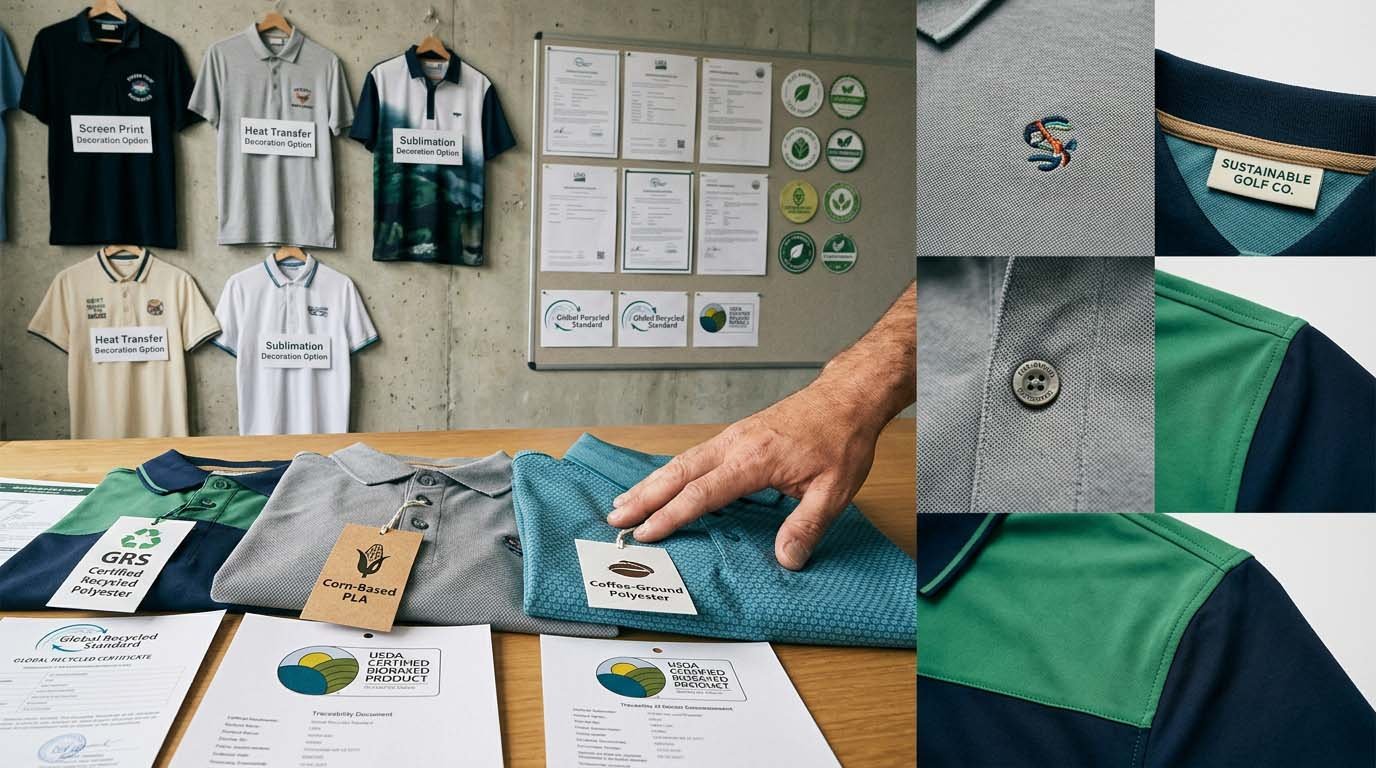
Verify sustainability claims through upstream material traceability and independent certifications rather than accepting supplier statements—eco-friendly marketing carries legal and reputational risk if material sourcing cannot be documented, making third-party verification essential for brand protection.
Sustainability has shifted from optional differentiation to expected standard in many markets. But "sustainable" means different things across suppliers, and false claims create legal exposure. Last year, a buyer faced regulatory scrutiny when their "recycled polyester" claim could not be verified through supply chain documentation. The issue was not intentional fraud—the buyer trusted their supplier's word without requesting proof.
The Recycled Material Verification Gap
Suppliers offer "recycled polyester" at various prices. The material composition may be identical but the documentation and traceability differ dramatically:
Levels of Recycled Material Verification
-
Supplier claim only (No documentation)
- Lowest cost, adds $0.10-0.30 per piece
- No audit trail or material tracking
- Risky for brand buyers making public sustainability claims
-
Material certificates from yarn supplier
- Moderate cost, adds $0.40-0.70 per piece
- Shows recycled content but does not verify chain of custody
- Acceptable for basic eco-marketing
-
GRS (Global Recycled Standard) or RCS (Recycled Claim Standard) certification
- Higher cost, adds $1.20-1.80 per piece
- Third-party verified from recycled input through finished product
- Required for serious sustainability positioning
I recommend asking: "Can you provide GRS or RCS transaction certificates that trace material from this specific production batch?"
Suppliers with real sustainability infrastructure can provide these documents. Suppliers who hesitate or offer only mill certificates may be blending certified and non-certified materials or making unverifiable claims.
Bio-Based and Alternative Materials
Beyond recycled polyester, the golf apparel market now includes:
Plant-Based Performance Fabrics
- Corn-based polyester (PLA): Renewable but requires industrial composting (not home compostable)
- Bamboo viscose: Renewable but processing involves heavy chemicals
- Coffee ground polyester: Recycled coffee waste embedded in yarn for odor control
Each material has performance trade-offs:
| Material Type | Performance Advantage | Performance Limitation | Cost Premium |
|---|---|---|---|
| Recycled PET | Identical to virgin polyester | None if properly processed | +$0.40-0.70 |
| Corn-based PLA | Renewable, lower carbon footprint | Lower heat resistance, careful washing required | +$2.50-3.50 |
| Coffee-ground polyester | Natural odor control | Slightly rougher hand feel | +$1.80-2.50 |
| Tencel/Lyocell | Excellent drape, soft feel | Less elastic, requires blending | +$3.00-4.00 |
Buyers need to match material choice with performance requirements and price positioning. We have seen projects fail when buyers chose trendy materials without considering whether the performance matched customer expectations.
Texture and Visual Interest Options
Beyond sustainability, brand differentiation comes through visual and tactile details:
Structured Knit Patterns
- Pique knit: Classic polo texture, provides better breathability than flat knit
- Honeycomb patterns: Enhanced texture without adding weight
- Stripe knits: Integrated visual interest without printing
- Jacquard patterns: Complex woven patterns for premium positioning
Each knit structure affects:
- Production speed: Complex patterns take 15-25% longer to knit
- Minimum order quantity: Jacquard patterns often require 1,000+ pieces per color
- Fabric cost: Structured knits add $0.60-1.50 per piece versus flat knit
Color Blocking and Panel Construction
Multi-color designs create visual interest but impact production:
- Two-color blocking: Adds $1.50-2.20 per piece for cutting and assembly complexity
- Three+ colors: Adds $2.80-3.80 per piece plus higher MOQ requirements
- Pattern matching at seams: Requires skill and slows production by 20-30%
I worked with a buyer who designed a striking three-color blocked polo but did not anticipate that the pattern matching requirement would extend lead time by 2 weeks and increase the defect rate by 8%. The design worked, but the production complexity needed to factor into timeline and pricing from the start.
Decoration Capabilities and Limitations
Logo and design application affects brand presentation:
Embroidery Pros and Cons
- Advantages: Premium appearance, excellent wash durability, tactile quality signal
- Limitations: Costly for large designs ($2.50-4.00 per logo), limited fine detail, adds stiffness to fabric
- Best for: Small chest logos, golf brand crests, premium positioning
Screen Printing Considerations
- Advantages: Low cost for simple designs ($0.40-0.80 per print), allows large graphics
- Limitations: Lower perceived quality, can crack with washing, feels heavy on lightweight fabric
- Best for: Back graphics, large logos, price-sensitive positioning
Heat Transfer Evolution
- Traditional transfers: Rubber-like feel, obvious on fabric surface
- Modern transfers: Thin, flexible, nearly invisible to touch
- Cost range: $0.60-1.80 depending on complexity and quality
- Best for: Full-color logos, complex graphics, areas where embroidery is not suitable
Sublimation Printing
- Advantages: Unlimited colors, photographic quality, very lightweight (becomes part of fabric)
- Limitations: Only works on 100% polyester white fabric, cannot print on dark colors
- Cost: $2.00-3.50 per piece for all-over designs
- Best for: Bold patterns, all-over prints, modern aesthetic brands
The decoration choice should match your brand positioning and price tier. We see buyers choose embroidery for premium lines ($50-80 retail) and heat transfer for value lines ($25-40 retail).
Brandable Details Beyond Logos
Small customization options create differentiation:
- Custom buttons: Engraved or colored buttons add $0.15-0.40 per piece
- Contrast tipping: Different color on collar and cuff edges, adds $0.30-0.60 per piece
- Woven labels: Custom neck labels cost $0.20-0.45 each versus printed labels at $0.05-0.10
- Hem tags: Small woven or printed tags at side hem, $0.10-0.25 per piece
- Custom packaging: Branded polybags or hang tags, $0.30-0.80 per piece
These details compound—a fully customized polo with branded buttons, contrast tipping, woven labels, and custom packaging adds $1.50-2.50 per piece to base cost. Buyers need to select which details deliver brand value worth the investment.
FAQ: Golf Polo Shirt Selling Points for Brand Buyers
How can I verify a supplier's moisture-wicking claims without laboratory testing?
Request washed samples from previous bulk production and perform a simple water absorption test. Place 5-10 drops of water on the fabric surface and time how long it takes for complete absorption. Quality moisture-wicking fabric should absorb within 3-5 seconds. Then check the back side—water should spread across the fabric rather than soaking through in one spot. This indicates proper wicking action. Also request that the supplier provide AATCC test reports from their fabric mill showing wicking performance retention after 10+ washes—not just virgin fabric specs.
What MOQ should I expect for custom golf polos with my logo?
Most reliable golf apparel suppliers work with 300-500 pieces minimum per design for basic embroidered logos. If you want multiple colors, expect 150-200 pieces per color minimum. Suppliers advertising "50-piece MOQ" either charge premium pricing that offsets the low volume or lack the production scale to deliver consistent quality. Based on orders we have managed, the production sweet spot for cost-efficient quality is 800-1,200 pieces total across 2-3 colors. Below this volume, you pay 20-40% premium for setup and small-run inefficiency.
How do I evaluate a supplier's size consistency without inspecting the entire production run?
Request measurement data logs from a previous production batch of similar quantity. Look for these indicators of process control: the chest width variance across all measured pieces should fall within ±2cm, at least 90% of pieces should cluster within ±1.5cm of target, and no outliers beyond ±2.5cm should appear. Also ask the supplier to explain their measurement inspection protocol—how many pieces per size do they measure, at what production stages, and what actions they take when measurements drift. Suppliers with disciplined processes can answer these questions with specific numbers and procedures.
What documentation should I request to verify recycled polyester claims?
Demand transaction certificates from either GRS (Global Recycled Standard) or RCS (Recycled Claim Standard) certification bodies. These certificates must show: your specific order number or batch ID, the percentage of recycled content by weight, the name of the certified fiber supplier, and the chain of custody from recycled input material through finished garment. Generic "recycled polyester" certificates from yarn mills without transaction traceability are insufficient for serious sustainability marketing. Suppliers with proper documentation can provide this within 3-5 business days of request.
How long should golf polo production take from confirmed order to shipment?
Standard timeline for orders 1,000-3,000 pieces with basic customization (logo embroidery or printing): 35-45 days from deposit payment to shipment. This includes 7-10 days for fabric procurement and pre-treatment, 15-20 days for cutting and sewing, 5-7 days for decoration application, 3-5 days for quality inspection and packing. Suppliers promising 20-25 day lead times are either holding fabric inventory (limiting your customization options) or rushing production (increasing defect risk). Add 10-15 days if your design requires custom pattern development or multiple sampling rounds.
What is the cost difference between basic and premium golf polo construction?
Basic golf polo construction (standard polyester, simple embroidery, standard collar) costs $8.50-11.00 per piece at 1,000-piece order volumes. Premium construction adds these increments: +$1.20-1.80 for quality 4-way stretch fabric with proper spandex content, +$0.80-1.20 for reinforced collar with premium interfacing, +$0.60-1.00 for golf-specific pattern adjustments (action pleats, deeper armholes), +$1.00-1.50 for verified recycled materials with certification. Total premium construction: $12.10-15.50 per piece. The $3.60-4.50 difference reflects actual quality improvements, not just branding markup.
Should I approve production based on a pre-production sample or wait for bulk sampling?
Never approve bulk production based only on the initial pre-production sample (sometimes called "salesman sample" or "proto sample"). This sample often receives special attention that bulk production cannot replicate. Instead, request a TOP sample (Top of Production) after the factory completes the first 50-100 pieces of actual bulk production. This TOP sample reveals whether the factory maintains quality standards when transitioning from sample-making to volume production. We have seen 30-40% of TOP samples require adjustments versus pre-production samples—catching these issues before completing 2,000+ pieces saves rejection costs.
How do I protect my custom design if the supplier also works with my competitors?
Include a non-disclosure and non-compete clause in your purchase agreement specifying that the supplier cannot produce your exact design (specific pattern, color combination, trim details) for other customers for 12-24 months. However, recognize that this protection is limited—suppliers cannot be prevented from using similar construction techniques or general design trends. The real protection comes from working with suppliers who have enough business that they do not need to steal designs. Ask potential suppliers about their customer confidentiality policies and request references from other brand buyers who can verify the supplier's trustworthiness.
Conclusion
The five selling points matter only when backed by verifiable production consistency and process controls. Focus your supplier evaluation on post-wash performance testing, measurement variance data from previous batches, durability track records, and independently certified material traceability. This approach separates samples from scalable production reality.