Choosing the wrong golf apparel manufacturer can drain your budget, delay your launch, and create quality problems before your collection reaches customers. Most supplier risks, however, leave warning signs long before bulk production begins.
The biggest red flags include vague quotations before specifications are clear, unsupported fabric-performance claims, weak quality-control procedures, a disconnect between samples and bulk production, unrealistic promises, hidden subcontracting, and a factory that is difficult to verify. A red flag is usually a reason to investigate further—not automatically a reason to reject a supplier.
These warning signs are especially important to check before approving final samples, paying a deposit, or placing your first bulk order.

When evaluating a manufacturer, the goal is not simply to find the lowest price.
You are trying to answer a more important question:
Can this supplier reproduce your approved product consistently, communicate clearly, and solve problems before they affect your bulk order?
Here are 15 warning signs worth checking before you commit.
Quick Answer: What Are the Biggest Golf Apparel Manufacturer Red Flags?
The most important warning signs are quotations made before product specifications are clear, excellent samples without a documented bulk-production process, unsupported performance claims, hidden subcontracting, weak in-line quality control, unrealistic lead times, unclear defect terms, and difficulty verifying the actual factory. The safest response is to ask for evidence before placing a bulk order.
15 Red Flags at a Glance
Watch carefully if a golf apparel manufacturer:
- Quotes before understanding your specifications.
- Offers an unusually low price without explaining why.
- Gives unclear MOQ or surcharge information.
- Communicates slowly or answers important questions vaguely.
- Cannot give you a clear point of contact.
- Produces a good sample but cannot explain bulk-production controls.
- Wants to skip the pre-production sample.
- Cannot clearly explain whether production is subcontracted.
- Makes performance claims without evidence.
- Cannot provide relevant fabric or testing documentation.
- Relies mainly on final inspection instead of in-process QC.
- Cannot clearly document the fabric, trims, measurements, or approved specifications.
- Promises lead times without explaining the production process.
- Uses vague payment, defect, or rework terms.
- Makes it difficult to verify where and how your products will actually be manufactured.
None of these automatically proves that a supplier is bad.
The important question is whether the manufacturer can provide a reasonable explanation and supporting evidence.
Red Flag Verification Matrix
Use this table during your first supplier screening.
| Red Flag | What to Ask | What Proof to Request |
|---|---|---|
| Quote before specifications | What assumptions is this price based on? | Detailed quotation |
| Very low price | What is included and excluded? | Fabric, trims, decoration and packaging details |
| Unclear MOQ | Is MOQ per style, color or fabric? | Written MOQ structure |
| Good sample only | How will bulk match this sample? | PP sample and QC process |
| No PP sample | What is approved before bulk cutting? | Pre-production approval procedure |
| Hidden subcontracting | Where will my order actually be made? | Factory video, address or production evidence |
| Performance claims | How was this function verified? | Relevant test reports |
| Weak QC | At what production stages do you inspect? | QC checklist or process |
| Fast lead-time promise | What stages are included? | Production schedule |
| Unclear defect terms | What happens if bulk does not match approval? | Written remediation terms |
This matrix turns vague concerns into specific verification actions.
Are Quotation and MOQ Problems Early Warning Signs?
Yes—especially when a supplier gives you a firm quotation before understanding what you are actually making.
Red Flag 1: Quoting Before Your Specifications Are Clear

A photo alone is rarely enough for accurate custom-apparel pricing.
A manufacturer normally needs details such as:
- Fabric composition
- Fabric weight
- Order quantity
- Number of colors
- Garment construction
- Embroidery or printing requirements
- Labels and trims
- Packaging requirements
- Testing requirements
A supplier can give you an early estimate, but it should be clearly identified as an estimate.
The warning sign is when an incomplete brief receives a very precise price with no explanation of what assumptions were used.
Red Flag 2: A Very Low Price With No Explanation
A low price is not automatically a problem.
Sometimes a manufacturer has better fabric access, more efficient production, existing materials, or a simpler construction method.
The red flag appears when the supplier cannot explain why its quote is significantly cheaper.
Ask what has changed:
- Fabric specification?
- Fabric weight?
- Decoration method?
- Packaging?
- Testing?
- QC?
- Construction details?
Compare manufacturers against the same specification instead of comparing headline unit prices alone.
Red Flag 3: Unclear MOQ or Surcharge Structure
MOQ can mean different things.
A factory may have:
- MOQ per style
- MOQ per color
- Fabric-mill minimums
- Dye-house minimums
- Decoration setup minimums
- Trim minimums
Ask the manufacturer to separate these requirements.
For custom golf apparel, a clear MOQ structure is usually more useful than a supplier simply saying, “Our MOQ is 100 pieces.”
Are Communication Problems a Serious Manufacturer Red Flag?
They can be.
Poor communication during sampling often becomes much more expensive during bulk production.
Red Flag 4: Slow or Vague Answers to Important Questions

Do not judge a factory because one email took longer than expected.
Instead, look for patterns.
Be cautious when the supplier repeatedly avoids questions about:
- Fabric specifications
- Measurement tolerances
- Sampling
- Production schedule
- QC
- Testing
- Defect handling
A useful supplier does not need to know every answer immediately, but they should be willing to investigate and come back with a clear response.
Red Flag 5: No Clear Person Responsible for Your Project
Custom apparel involves many moving parts.
If your project repeatedly moves between salespeople, merchandisers and production staff without clear ownership, details can easily be lost.
Ask:
- Who manages my project?
- Who confirms technical details?
- Who updates me during bulk production?
- Who handles a problem if something goes wrong?
Clear responsibility usually makes production easier to manage.
Can a Great Sample Still Hide Production Problems?
Absolutely.
One well-made sample proves that one garment can be produced.
It does not automatically prove that hundreds or thousands of garments can be reproduced consistently.
Red Flag 6: A Great Sample but No Bulk-Control Process
Ask the manufacturer how the approved sample is translated into production.
Important controls may include:
- Approved measurements
- Fabric confirmation
- Color approval
- Print or embroidery approval
- Trim approval
- Pattern and grading confirmation
- Production instructions
- In-line inspection
The supplier should be able to explain the process.
Red Flag 7: No Pre-Production Sample Before Bulk
For a customized product, moving directly from an early development sample into full production can create unnecessary risk.
A pre-production sample helps confirm the final combination of:
- Fabric
- Color
- Construction
- Measurements
- Branding
- Trims
- Labels
- Packaging details
Before bulk cutting begins, both sides should know exactly what version has been approved.
Red Flag 8: Unclear or Hidden Subcontracting
Subcontracting is not automatically bad.
Many apparel supply chains involve specialist embroidery, printing, dyeing, or other external processes.
The real problem is undisclosed subcontracting that changes your production risk.
Ask:
Where will my garments actually be cut, sewn, decorated, and inspected?
Warning signs may include unexplained production-location changes, inconsistent workmanship, or reluctance to show where production is taking place.
If you want to go beyond warning signs and conduct a more structured supplier review, use our Golf Apparel Manufacturer Factory Audit Checklist.
What Fabric and Performance Claims Should You Verify?
Golf apparel often includes claims around moisture management, stretch, UV protection, colorfastness, and other performance characteristics.
Those claims should be treated as specifications that need evidence.
Red Flag 9: Performance Claims Without Supporting Evidence

A supplier saying:
“This fabric is moisture-wicking.”
is not the same as proving performance.
Ask:
- What exactly was tested?
- Which fabric code was tested?
- Which standard or method was used?
- Does the report match the fabric being proposed for your order?
This is especially important when performance claims will later appear in your own product marketing.
Red Flag 10: No Relevant Fabric or Testing Documentation
Not every garment requires every possible laboratory test.
Testing should match the product, market, and claims you intend to make.
Depending on the project, useful evidence might relate to:
- Colorfastness
- Dimensional stability
- Moisture management
- Fabric composition
- UV performance
- Restricted substances
FUWAY publishes examples of available testing documentation on our Test Reports page.
The important principle is simple:
Verify the relevant claim instead of relying only on supplier descriptions.
What QC Problems Should Buyers Watch For?
Quality control should not begin after every garment has already been packed.
Red Flag 11: QC Happens Only at Final Inspection
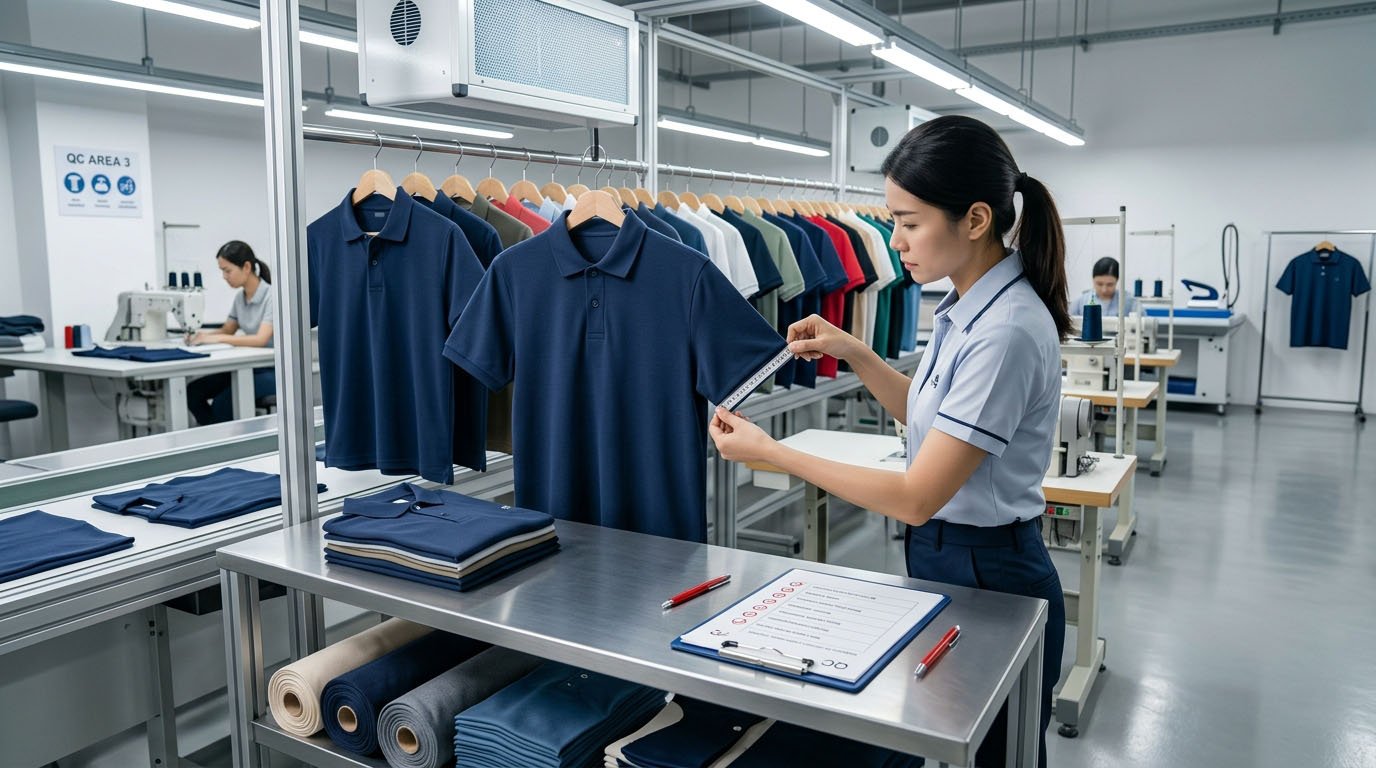
Final inspection is important, but it cannot efficiently prevent every production problem.
If the same defect is repeated through an entire sewing run, discovering it at the end may be too late.
Ask whether the factory checks quality during important stages such as:
- Incoming fabric
- Cutting
- Printing or embroidery
- Sewing
- Measurements
- Finishing
- Final packing
The goal is not simply to identify bad products.
It is to identify problems early enough to correct the process.
Red Flag 12: No Clear Approved Product Specification
A factory cannot consistently reproduce a product if nobody has clearly documented what “correct” means.
For a golf polo, for example, both sides may need to agree on:
- Fabric
- Color
- Measurements
- Tolerances
- Collar construction
- Placket construction
- Logo size and placement
- Labels
- Packaging
Without clear approval records, disagreements later become difficult to resolve.
Also Check Reorder Consistency
A successful first order does not automatically guarantee that the next order will match it.
Ask how the manufacturer records approved fabric codes, colors, patterns, measurements, trims, artwork, labels, and packaging specifications for future production.
This becomes especially important when you reorder the same golf polo or bottom several months later.
A reliable manufacturing system should help reproduce the approved product rather than forcing your team to restart the development process with every order.
Are Fast Lead Times and Flexible Payment Always Good Signs?
Not necessarily.
Flexibility is useful, but promises still need to match the actual project.
Red Flag 13: Lead Times That Are Difficult to Explain
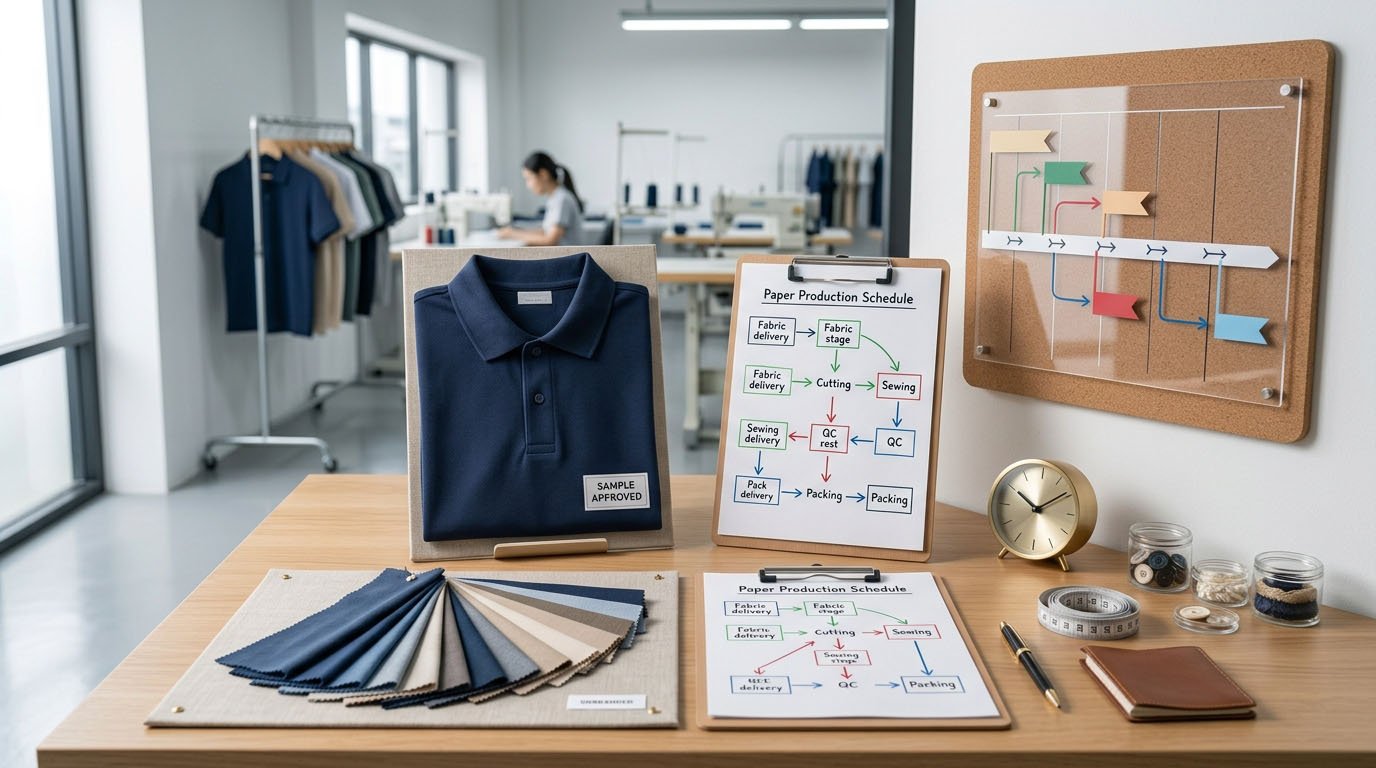
A short lead time is not automatically suspicious.
A supplier may already have your fabric available or may have open production capacity.
Instead of assuming fast means bad, ask for the production sequence.
For example:
Material confirmation → Pre-production approval → Cutting → Decoration → Sewing → QC → Packing
A believable timeline should reflect what your particular order actually requires.
Red Flag 14: Unclear Payment, Defect or Rework Terms
Production problems can happen even with experienced manufacturers.
The question is what happens next.
Before paying a deposit, clarify:
- Payment milestones
- What counts as an approved sample
- How defects are handled
- Who pays for agreed rework
- What happens if goods do not match approved specifications
- When final payment is due
A professional manufacturing relationship depends on clear expectations, not assumptions.
How Do You Know Whether the Factory Is Real?
This is one of the most important checks before paying a deposit.
Red Flag 15: The Factory Is Difficult to Verify
Be cautious when a supplier will not clearly show:
- Business identity
- Factory location
- Production facilities
- Relevant machinery
- Production process
- QC procedures
Remote buyers can request a live video walkthrough, production photos, or other evidence.
Larger projects may justify an independent factory audit or third-party inspection.
Do not rely on one polished website or one certificate alone.
Verification works best when several pieces of evidence point to the same conclusion.
What Should You Check Before Paying a Deposit?
Before releasing a deposit, confirm at least these areas:
- Supplier identity
- Product specifications
- Quotation scope
- MOQ
- Sampling process
- PP approval
- Production location
- Lead time
- QC procedure
- Testing requirements
- Payment terms
- Defect-handling procedure
You do not need a huge procurement department to do this.
You simply need a documented process.
FAQ: Red Flags When Choosing a Golf Apparel Manufacturer
Is a very low price always a sign of a bad manufacturer?
No.
Ask why the price is lower and compare suppliers using the same fabric, construction, decoration, packaging, and QC requirements.
Does a good sample prove the factory can handle bulk production?
No.
A sample proves that the product can be made once.
Bulk production requires repeatability, material control, production instructions, and quality checks.
Should I avoid factories that subcontract some processes?
Not automatically.
Specialist processes such as printing, embroidery, or fabric finishing may be performed by external partners.
The important issue is transparency and control.
What is the biggest red flag before paying a deposit?
A combination of unclear specifications, unverifiable production capability, and vague commercial terms creates much more risk than any single warning sign.
Verify the factory, the product requirements, and the production process before paying.
How should I verify performance-fabric claims?
Ask for relevant test evidence and confirm that the documentation corresponds to the material you intend to purchase.
You can also review examples on FUWAY's Test Reports page.
Final Checklist
A strong golf apparel manufacturer should not simply tell you:
“Don't worry. We can do it.”
They should be able to show you how the product will be developed, approved, produced, and inspected.
Treat red flags as signals to investigate.
Ask for specifications.
Ask for evidence.
Ask how bulk production will reproduce your approved sample.
And ask how those approved specifications will be maintained when you reorder.
Most importantly, compare manufacturers based on process reliability and total project risk, not unit price alone.
If you are currently evaluating a manufacturer for golf polos, bottoms, skorts, outerwear, or another golf apparel collection, contact FUWAY and send us your tech pack, reference garment, or design concept.
We can review the project requirements with you before you move into sampling or bulk production.