You found a factory, the samples looked perfect, and the price was right. But the first bulk order was late, the quality was inconsistent, and key performance features were missing.
A proper 10-point factory audit goes beyond samples—it's a risk assessment tool. It forces you to verify a manufacturer's true production capability, quality systems, and supply chain stability, preventing costly surprises after you’ve placed your order.
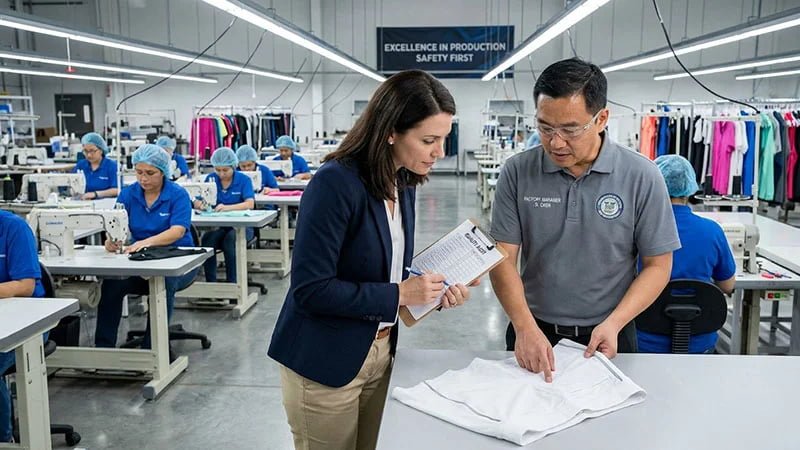
I handle factory visit inquiries all the time, and I've seen where things go wrong. Many brand owners who switch to us were burned because their previous audit was too superficial. They looked at shiny certificates and beautiful samples, but they didn't ask the tough questions that expose hidden risks. This checklist isn't just about ticking boxes; it's about learning what to ask to find a true partner.
How Do You Verify Product Fit and True Golf Expertise?
Many factories can make a polo shirt, but few understand the specific needs of golf. A generic manufacturer won't know the difference, and you'll pay the price in endless sample revisions.
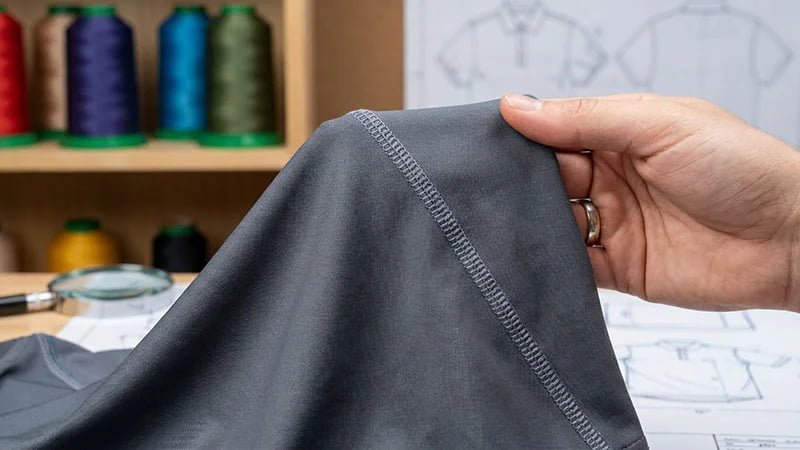
Check their actual category coverage, like polos, outerwear, and skorts. Examine their technical capabilities, such as flatlock stitching for comfort. Finally, look at their client list and test the speed of their sample room.
I once saw a sample from a new client's old supplier where the "golf polo" was made from a basic t-shirt pattern—it had no room for a swing. This is a classic red flag.
Category coverage (polo, outerwear, skort, bottoms)
Do they have separate, dedicated patterns and expertise for different golf apparel? Ask to see examples of each. A factory that specializes in golf wear will have a much deeper catalog than one that just makes t-shirts.
Process capability (flatlock, seam taping, laser perforation)
High-performance golf apparel requires specific technology. Do they have 4-needle 6-thread (flatlock) machines for chafe-free seams, or bonding and seam taping equipment for waterproof jackets? This machinery is expensive and shows a real commitment to the sport.
Reference clients and sample room agility
Who else do they work with? While they might not name big brands, they should be able to show you a quality level that matches your goals. More importantly, how fast can their sample room turn around a revision? A slow sample room is a major bottleneck.
How Do You Assess True Capacity & Lead Time Control?
A huge factory floor is a vanity metric; empty machines don't ship orders. You need to know a factory's true output and its ability to deliver on time, especially during peak season.
Ask about their production line setup and daily output per line. Probe their flexibility for peak season and what backup capacity they have. Most importantly, verify how they manage fabric lead times, which is the biggest cause of delays.
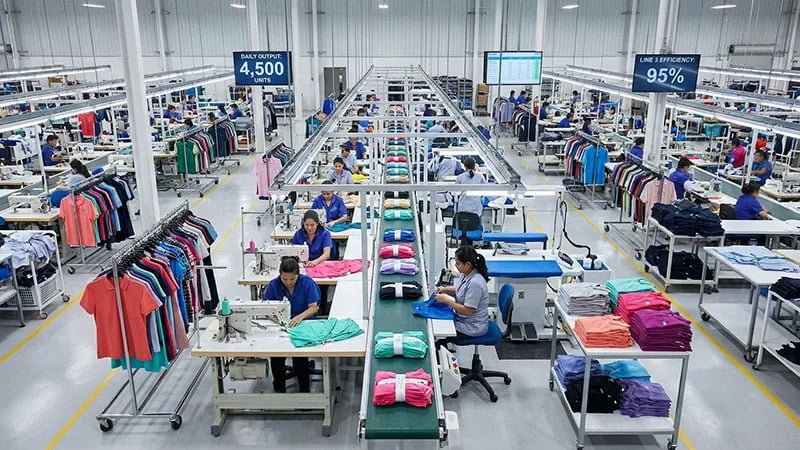
Clients who switch to us often complain that their previous supplier was great with the first small order, but their second, larger order was suddenly delayed by months. This happens when a factory over-promises its capacity.
Line setup and takt time
How many sewing lines do they have, and how many are dedicated to products like yours? Ask for the daily output per line for a comparable garment. This simple number tells you more than a factory's total square footage.
Peak/valley flexibility and backup lines
What happens when a huge brand places an order right before yours? Ask how they manage production surges and if they have pre-vetted backup lines for overflow. A factory without a plan for this will always prioritize its biggest clients first.
Fabric/trims lead times and greige/loom booking
The real lead time is often determined by the fabric mill, not the sewing factory. A sophisticated manufacturer has strategies for this, like pre-booking production slots at the mill or holding stock of undyed "greige" fabric to shorten lead times.
How Do You Judge Their Quality System & Process Control?
A beautiful sample doesn't predict bulk quality. The sample was made by a small team of experts; your order will be made by a production line. The only thing ensuring consistency is the factory's quality system.
Verify their quality system by asking about their AQL standard and their IQC, Inline, and FQC inspection processes. A serious factory will have a strict needle-breakage policy and be able to show you data on their rework rates and customer complaint resolution.
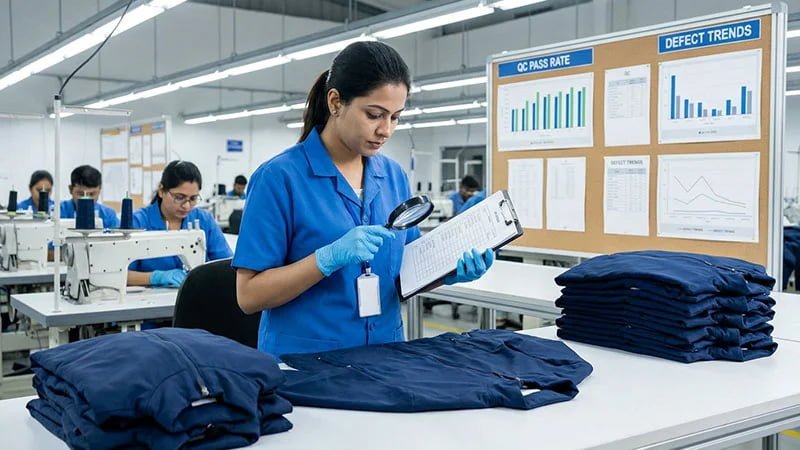
The most important question you can ask isn't "Can you make a good sample?" but "Show me your quality inspection records from last week's production." The answer will tell you everything.
AQL, IQC/inline/FQC flow
AQL (Acceptable Quality Limit) is the standard for inspections. Ask what level they use. They must have a clear process for checking incoming materials (IQC), inspecting garments during production (Inline), and checking them before they ship (FQC).
Needle policy and metal detection
A broken needle fragment in a garment can cause injury and a massive recall. Ask to see their broken needle log and their metal detection protocol. This is a non-negotiable sign of a professional operation.
Rework rate, CAPA and complaint closure
Every factory has defects. Great factories track them. Ask for their monthly rework rate. Also, ask to see a Corrective Action Preventive Action (CAPA) report. This shows they have a system for fixing problems, not just hiding them.
How Do You Validate Their Fabric & Performance Capabilities?
Any supplier can claim their fabric has "performance" features. A true partner can prove it with data. Your brand's reputation depends on these claims being true.
Ensure they can produce core performance features like moisture-wicking and UPF 50+. Ask how they handle DWR finishes, especially PFAS-free options. Verify if they have an in-house testing lab or strong relationships with third-party labs like SGS or Intertek.
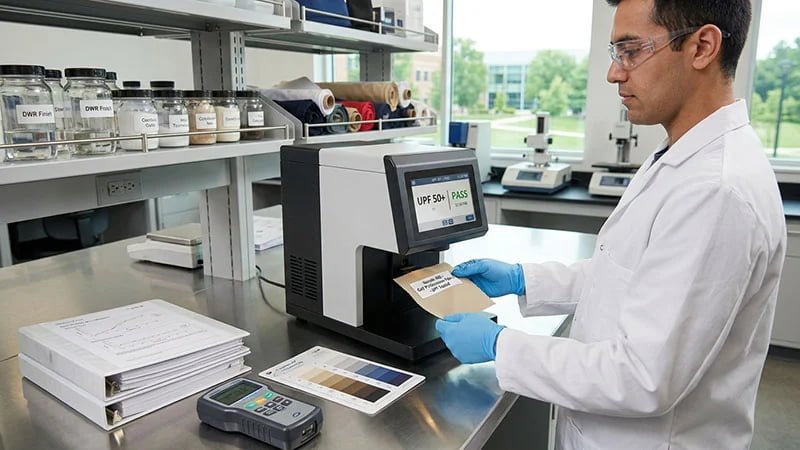
We often get requests for "UPF 50+." Our first step is not to just say yes, but to confirm the fabric construction and finishing needed to actually pass the lab test. A good factory protects you by ensuring claims are verifiable.
Wicking, UPF, snag/pilling
Don't just accept these terms. For a fabric you like, ask for the test reports. A good factory should be able to provide recent reports for these key performance metrics.
DWR and PFAS-free options
Durable Water Repellency (DWR) is a key feature for outerwear, but traditional "C8" chemicals are being banned. Ask what PFAS-free (or C0) DWR options they have and what the performance trade-offs are. This shows they are current with environmental regulations.
In-house lab and 3rd-party testing
Does the factory have its own small lab to do basic tests for shrinkage or colorfastness? This shows a commitment to quality. For formal claims like UPF, they must use a certified third-party lab. Ask to see sample reports.
How Do You Evaluate Their Sampling & Industrialization Process?
A pattern that looks good on a computer screen can be a disaster in production. The process of turning a design into a mass-producible garment is called industrialization, and it's where many projects fail.
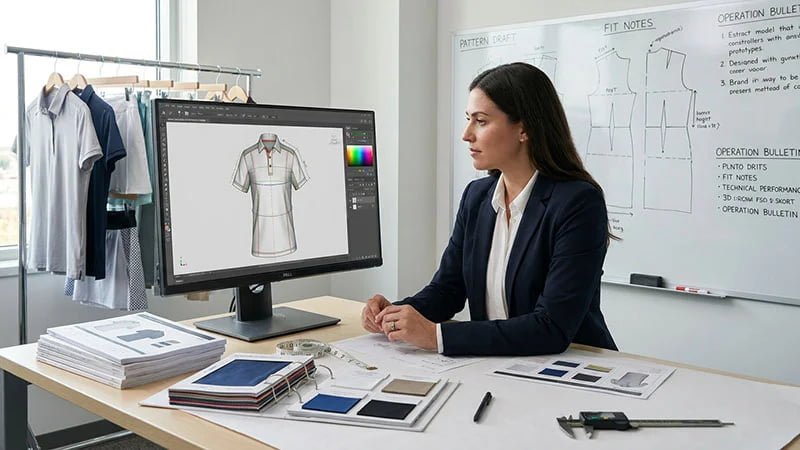
Review their technical design process, from the pattern and grading rules to the final sewing instructions (Operation Bulletin). Understand their sampling stages (Proto, PP, etc.) and ask about their feedback loop, including 3D sampling and wear-testing.
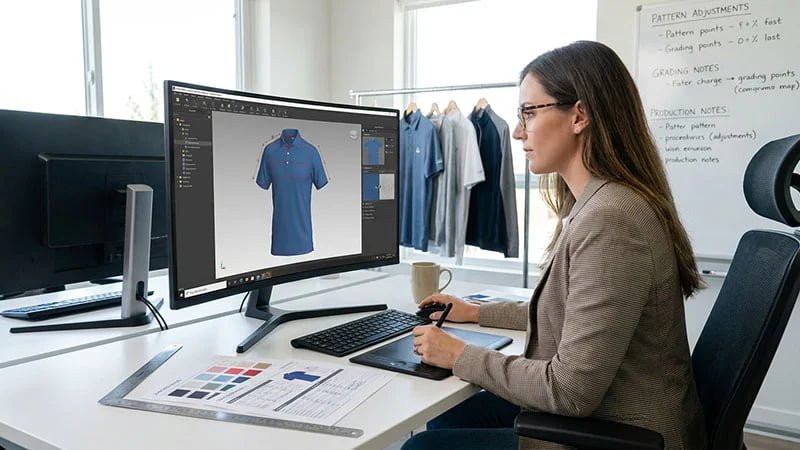
A brand owner once showed me a beautiful sketch that was physically impossible to sew efficiently. Their previous supplier just said "okay" and delivered a hugely expensive, problematic sample. Our job as a manufacturer is to use our expertise to make a design not just beautiful, but
producible at scale.
Pattern, grading, operation bulletin
A professional factory's tech pack goes deep. It includes the pattern, the "grade rules" for creating different sizes, and a detailed Operation Bulletin (OB) that tells the sewing line exactly how to construct the garment, step by step.
Proto, SMS, PP, size set
Understand the purpose of each sample: The Proto is for fit and concept. The Salesman Sample (SMS) is for your marketing. The Pre-Production (PP) sample is the "golden sample" you sign off on for bulk production. A Size Set verifies the grading is correct across sizes.
3D sampling and wear-test loop
Modern factories use 3D sampling to check fit and design much faster than physical samples. But nothing replaces real-world feedback. Ask what their process is for wear-testing garments to check for things like pocket function or inner-short ride-up before finalizing a design.
Are They Compliant With Social & Ethical Responsibilities?
A low-cost quote might be subsidized by poor working conditions. Partnering with a non-compliant factory poses a huge risk to your brand's reputation. This is not an area to cut corners.
Ask to see their social compliance audit certificates, like BSCI, SMETA, or WRAP, and check the expiration dates. During your visit, observe the general working conditions, and for US-bound goods, ask about their security certifications like C-TPAT.
A certificate on the wall is a starting point, not the final word. When clients visit us, we encourage them to look at the actual audit report, which includes details we are working to improve. Transparency is the key marker of a responsible partner.
Social audit certificates and validity
Don't just accept a "yes." Ask for a copy of the full audit report. Check the date to ensure it's current. Look at the findings and the factory's Corrective Action Plan (CAP). This shows they are actively engaged in the process.
Working hours, wages and EHS
As you walk the factory floor, look around. Is the space well-lit and ventilated? Do workers have proper safety gear (EHS - Environment, Health, and Safety)? Are fire exits clear? These visual cues tell a powerful story.
Security programs (e.g., C-TPAT)
For brands shipping to the United States, a C-TPAT (Customs-Trade Partnership Against Terrorism) certification is a huge advantage. It shows the factory has secure supply chain practices, which can lead to faster customs clearance.
How Do They Manage Chemicals & Environmental Impact?
What happens to the dye and chemicals used to make your apparel? Regulators and consumers are asking this question more and more. Your factory must have a clear and compliant answer.
You need to verify their chemical management system. Ask if they work with RSL/MRSL lists and ZDHC. Inquire about how they and their dyeing partners handle wastewater. Specifically, confirm their control of substances like PFAS.
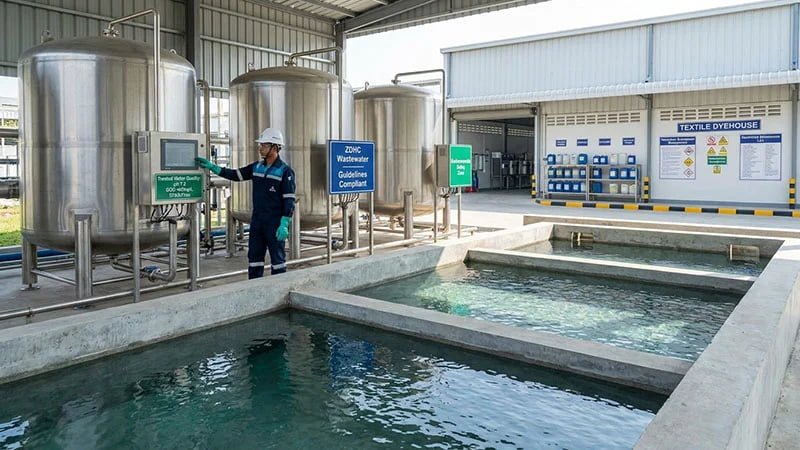
This is an area of massive risk. We have seen brands forced to destroy inventory because a restricted substance was found. This is why our process includes getting chemical compliance declarations from our fabric mills before production even begins.
RSL/MRSL and ZDHC alignment
An RSL (Restricted Substances List) applies to the finished product, while an MRSL (Manufacturing RSL) applies to chemicals used during manufacturing. Ask how the factory tracks and ensures compliance. Alignment with ZDHC (Zero Discharge of Hazardous Chemicals) is the gold standard.
Wastewater/emissions; wet-processing partners
The sewing factory itself is usually "dry." The big environmental impact comes from its partners—the dyehouses and fabric mills. Ask which mills they work with and what proof of environmental compliance those mills provide.
Control of PFAS, phthalates, nickel etc.
Beyond broad compliance, a good factory understands the specific risks for apparel, like ensuring zippers and snaps are nickel-free or that any water-repellent finishes are PFAS-free, as required by law in many places.
What is Their Approach to Cost Transparency & MOQ Flexibility?
A low price is tempting, but an opaque one is dangerous. You need to understand what you are paying for. Similarly, a low MOQ (Minimum Order Quantity) can be a red flag if it means your order will constantly be pushed aside.
Ask for a cost breakdown that separates the Bill of Materials (BOM) from the Cut & Make (CM) cost. To test their flexibility, ask about their strategies for small-batch dyeing and mixed-size orders, not just their headline MOQ number.
New brands often fixate on the lowest possible MOQ. A better question to ask is, "How do you prioritize your production schedule, and where would my 300-piece order fit in?" A good partner will have an honest answer and a system for handling smaller orders without compromising delivery.
BOM vs CM, yield and wastage
A transparent factory will break down your cost into Materials (BOM) and Labor (CM). This lets you make smarter decisions. For example, you can see how choosing a more expensive fabric directly impacts the price.
Small-batch dyeing and size-color mix
A high MOQ is often driven by fabric minimums. Ask if the factory's mill partners offer small-batch dyeing or if they can pool your order with others. True flexibility is about finding creative solutions.
Payment terms, price locks, FX clauses
These are critical business terms. Are payment terms negotiable? Can they lock in a price for a season? How do they handle currency fluctuations? Discussing this upfront prevents major disagreements later.
Do They Use Digital Systems for Management & Traceability?
In today's world, a factory running on spreadsheets and paper is a high-risk partner. Modern manufacturing relies on data to ensure consistency, efficiency, and traceability.
Check if the factory uses an ERP or PLM system to manage orders. Look for barcodes on the production floor used for WIP (Work-in-Process) tracking. Ask them how they would trace a fabric defect back to its original batch.
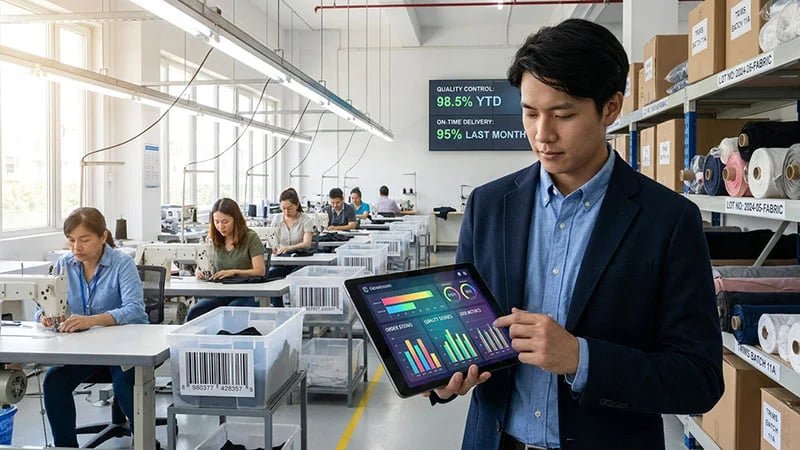
When a client asks for a status update, we don't have to walk to the production floor and count garments. We check our ERP system. This digital backbone is what allows us to give reliable delivery dates and quickly troubleshoot any production issues.
ERP/PLM, barcoding and WIP tracking
Do they have a central system (ERP) for managing the entire order from start to finish? Tracking Work-in-Process (WIP) with barcodes gives real-time visibility and helps identify bottlenecks before they cause delays.
Yarn/fabric/trims lot traceability
If a quality issue arises, can they trace the problem back to the specific roll of fabric or box of zippers? This is critical for isolating a problem and is a hallmark of a well-managed factory.
Visual KPIs for quality and OTD
Look for dashboards or whiteboards on the factory floor displaying metrics for Quality and On-Time Delivery (OTD). This shows that the entire team, not just management, is focused on performance.
How Do They Handle Packaging, Regulatory & Logistics?
Your audit isn't finished until the product is on its way to your warehouse. A factory's responsibility extends to ensuring the final package is compliant, correctly labeled, and shipped on time.
Confirm they understand the packaging, labeling, and fiber content rules for your specific destination country. Review their pre-shipment inspection process and their historical On-Time Delivery (OTD) performance. Clarify all shipping terms upfront.
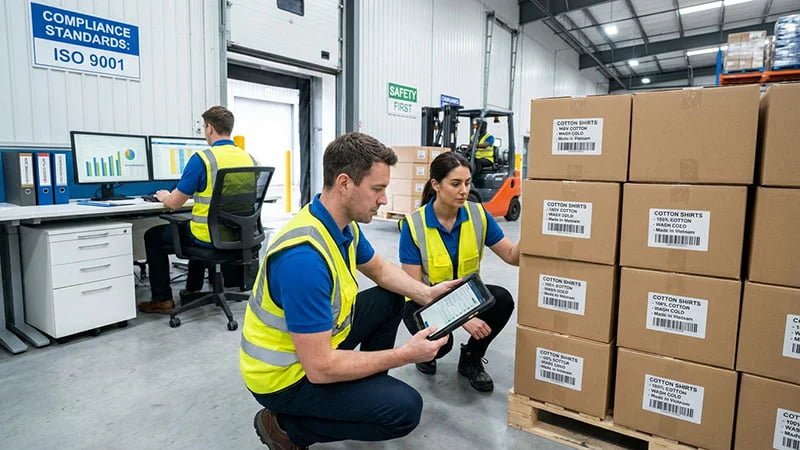
We've seen clients come to us after their shipments were held up in customs for weeks because of a simple label error. Part of our job is to act as a compliance check, ensuring everything from the fiber content on the care label to the carton markings meets your market's requirements.
Packaging/labeling/fiber content compliance
Each country has different rules. A "Made in" label, fiber content percentages, and care symbols must be correct. Your factory should be asking you for these details to ensure they get it right.
Pre-shipment checks and on-time delivery
Before goods leave, who does the final check? Does the factory perform its own final audit? Ask for their recent OTD percentage. A factory proud of its performance will have this data ready.
Incoterms, carriers and contingency
Clarify the shipping terms (e.g., FOB, EXW). Who books the freight? What is the contingency plan if a shipment misses the boat? A good partner has thought through these "what if" scenarios.
Frequently Asked Questions About Factory Audits?
This checklist can feel overwhelming, especially for new brands. After countless factory tours, I've found these are the questions that come up most often. The answers separate a good audit from a great one.
I can't visit the factory in person. How can I audit them remotely?
Start with a highly detailed video call tour where you direct the camera operator. Ask them to show you specific things from the checklist, like the IQC area, a running production line, and the broken needle logbook. Supplement this with requests for documentation: send us your latest social audit report, a sample CAPA report for a quality issue, and technical data sheets for a fabric you're considering. It's not perfect, but a well-prepared remote audit is far better than no audit at all.
What is the single biggest red flag I should watch out for?
A lack of transparency. If a factory is evasive or gives vague answers to specific questions, it's a huge red flag. If you ask "What is your on-time delivery rate?" and the answer is "Very good," instead of "It was 97.5% last quarter," you should be concerned. If you ask to see the CAPA report and they say it's "internal," that's a problem. A great partner is proud of their systems and willing to show you how they work, even the parts they are still improving.
Do I really need to hire a professional third-party auditor?
For your first few orders with a new supplier, it's a very good idea, especially for social compliance and final quality inspection. However, you should still conduct your own business and technical audit. A third-party auditor is great at checking against a standard, but they aren't you. They don't know your brand's specific needs, your target cost, or your long-term goals. Use them as a tool, but don't outsource your own judgment.
The factories that pass this checklist seem more expensive. Is it worth it?
Yes. You are not paying for the garment; you are paying for reliability. The small premium you might pay for a compliant, high-quality factory is insurance. It's insurance against delayed shipments that make you miss a selling season, against quality issues that lead to costly returns and bad reviews, and against compliance failures that can get your product seized at customs. The "cheaper" factory often ends up being far more expensive in the long run.
What should I prepare before I even contact a factory for an audit?
Have a clear definition of your product and your business goals. The more professional and prepared you are, the more seriously a good factory will take you. At a minimum, you should have:
- A target customer profile and price point.
- Detailed design sketches or a professional tech pack.
- A realistic forecast of your first year's order volume.
Factories are auditing you, too. Showing them you've done your homework proves you're a serious potential partner.
Conclusion
This 10-point audit transforms you from a simple buyer into a knowledgeable partner. It helps you see past the sales pitch and find a manufacturer truly capable of building your brand alongside you.