You have a vision for an amazing golf shirt, but the path from idea to product is full of confusing choices. Fabric, fit, and branding options can feel overwhelming.
The "perfect" golf shirt depends entirely on your brand's priority. The key is understanding how each decision—from fabric to logo—creates trade-offs in cost, lead time, and minimum order quantity (MOQ).
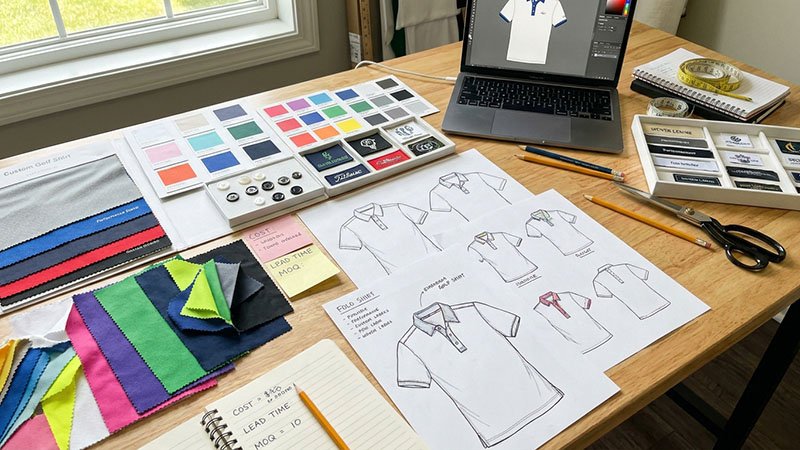
I'm Will, the founder of Fuway. Over the years, I've seen countless brand founders get stuck in the development process. They often focus on one detail, like a specific look, without realizing how it impacts everything else. The secret isn't finding a magic formula; it's about making decisions in the right order. This guide will walk you through that sequence, helping you understand the trade-offs so you can build the exact shirt your customers will love.
How do you lock in the design and fit fundamentals?
You have a great idea for a shirt, but turning that vision into a real product requires specific technical choices. Every seam and collar style affects cost, comfort, and production complexity.
Start by defining your target customer and use case. This first decision will guide all subsequent choices on fit, construction, and style, ensuring the final product is built for its intended purpose.
Use cases and style direction
The first question shouldn't be about fabric, but about who will wear the shirt and where. Is it for a professional tour player needing maximum performance, a corporate event prioritizing brand visibility, a team needing durable uniforms, or a lifestyle piece meant for on and off the course? This answer sets your design priorities. A tour polo needs engineered ventilation, while a lifestyle polo might focus more on a refined, classic look.
Fits and silhouettes
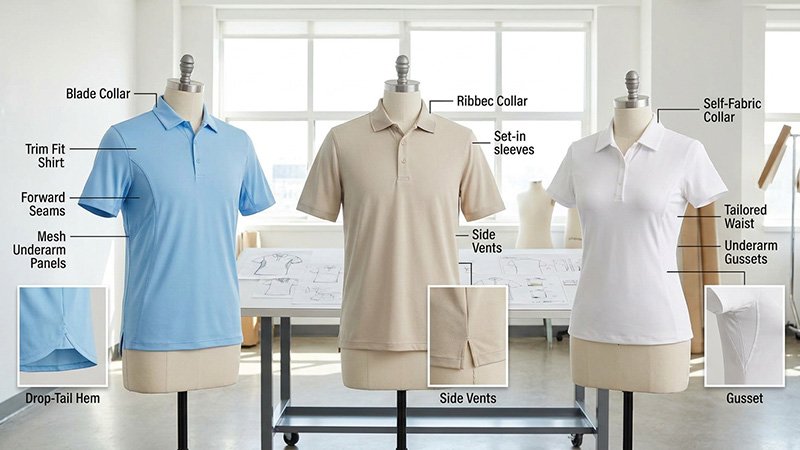
With your use case defined, you can choose the fit. An athletic/trim fit is tailored for performance, reducing drag during a swing. A classic/relaxed fit offers more comfort for a casual round. We also develop specific women’s fit blocks that account for different proportions and offer inclusive sizing to ensure your brand can serve a wider audience.
Key construction
These details bring your fit to life. We use forward shoulder seams to prevent chafing during a swing, offer raglan or set-in sleeves for different mobility needs, and can add underarm gussets for a greater range of motion. Details like a drop-tail hem for coverage and side vents for breathability are standard functional elements.
Collars and plackets
The collar is a key style element. Options range from classic ribbed collars (with tipped or jacquard patterns), modern self-fabric collars, or minimalist blade collars. The placket can be a standard 2-4 button style, or a sleek hidden or zip placket.
Venting and comfort
For high-performance shirts, we integrate mesh yokes or panels for breathability. Laser perforation in high-sweat zones provides targeted airflow, while taped seams at rub points like the neck and shoulders eliminate chafing entirely.
How do you choose the right fabric and performance features?
You know fabric is important, but the sheer number of options is confusing. Choosing the wrong one can lead to poor performance, blown budgets, or impossibly high MOQs.
Your fabric choice forces a trade-off between performance, price, and MOQ. A premium, high-stretch, moisture-wicking fabric is fantastic, but it may require a higher order quantity than a standard jersey.
Yarns and knit structures
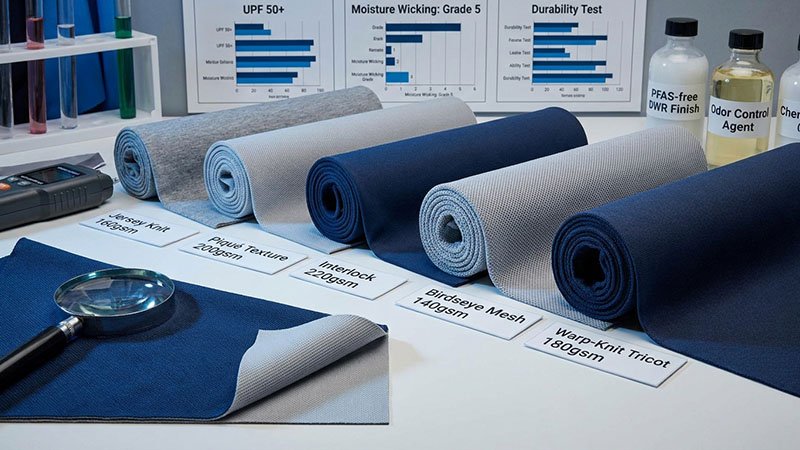
The foundation of your fabric is its structure. A jersey is a soft, common choice. Interlock is a premium, smoother double-knit. Piqué offers that classic textured look. Technical options like birdseye mesh or warp-knit tricot provide excellent durability and snag resistance. The choice impacts the hand-feel, look, and cost.
GSM by climate
Fabric weight, measured in Grams per Square Meter (GSM), should match the climate your golfer plays in.
- Hot (140–170 gsm): Lightweight and highly breathable.
- Temperate (160–190 gsm): The versatile sweet spot for most conditions.
- Cool/Windy (180–220 gsm): Heavier double-knits or fabrics meant for layering.
Performance targets
We don't just say a fabric works; we test it. For a true performance polo, we aim for these benchmarks:
- Sun Protection: UPF ≥50 (AATCC 183 / AS NZS 4399)
- Moisture Wicking: Wicking rate ≥3.5 (AATCC 195)
- Air Permeability: Measured per ASTM D737 to ensure breathability.
Durability and appearance
A golf shirt needs to last. We test for pilling (≥3.5), snagging (≥4), and shrinkage (≤5%) to ensure your shirt looks great wash after wash.
Finishes and chemistry
Modern finishes add function. We offer [PFAS-free DWR](https://en.wikipedia.org/wiki/Durable_water_repellent) for water resistance and non-biocidal odor control treatments. We also ensure any fabric softeners used are compatible with printing and heat transfers to prevent adhesion issues.
What's the best way to apply your brand's decoration?
You want your logo to look amazing, but the wrong application method can crack, peel, feel heavy, or damage the performance fabric underneath. It's a common point of anxiety for new brands.
The best branding method depends on your design's complexity, your order quantity, and the fabric you've chosen. An intricate, multi-color logo for a small batch has a very different solution than a simple logo for a large run.
Method selection and use cases
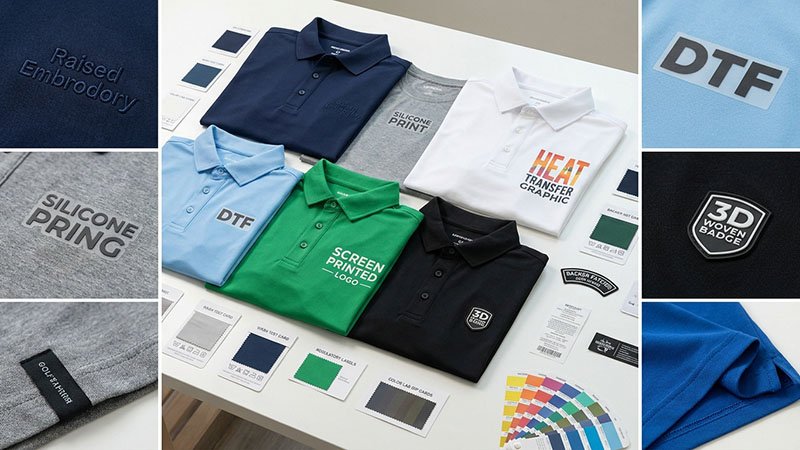
Each method has pros and cons. Embroidery offers a classic, premium feel. Screen print and silicone print are great for bold graphics. Heat transfer allows for fine detail. Direct-to-Film (DTF) and sublimation are excellent for small batches with complex colors. Woven or 3D badges offer a modern, technical look. We help you choose based on your specific needs.
Process parameters and testing
Applying branding to performance fabrics requires expertise. We use [low-temperature anti-bleed films](https://www.instagram.com/reel/DP3uyrHkWgn/) (140-160°C) to prevent polyester dye from migrating into your logo. We then wash-test every new application for 5–10 cycles to guarantee adhesion.
Placement and comfort
A big, heavy logo on the back can create a sweat patch and ruin the shirt's breathability. We guide you on smart placement, avoiding high-sweat zones. For transfers or embroidery, we can use soft backers or cover films to ensure next-to-skin comfort.
Neck label and compliance
Labels are a key part of your brand presentation, but they must also be legally compliant. We ensure all neck, care, and content labels meet regulations like 16 CFR 303 in the US and ISO 3758 globally.
Color and artwork management
To guarantee color accuracy, we get your sign-off on physical lab dips for fabric and print strike-offs for graphics before starting bulk production. This eliminates any surprises with color.
How can you manage MOQs and production timelines?
For an e-commerce brand owner like Bobby, high MOQs and long, uncertain lead times are the biggest fears. They can tie up cash and make it impossible to react to the market.
A smart production strategy matches the manufacturing process to your batch size. We offer flexible options and plan ahead to give you the speed and agility you need without demanding huge orders.

Sampling and production TNA
We provide a clear Time and Needle (TNA) schedule for every order:
- Salesman/Fit Samples: 2–3 weeks
- Pre-Production (PP) Sample: 1–2 weeks after approval
- Bulk Production: 30–45 days for standard knits, 45–60 days for more complex styles.
MOQ strategy and flexibility
Your fabric choice heavily influences your MOQ. [Piece-dyeing](https://en.wikipedia.org/wiki/Textile_manufacturing) a solid color fabric allows for lower MOQs. Custom yarn-dyed stripes or jacquards require much larger orders. For small batches, sublimation or digital transfer printing are often the most cost-effective and flexible options.
Long-lead mitigation
We help you get ahead of supply chain delays. For key partners, we can do [greige fabric booking](https://en.wikipedia.org/wiki/Greige_goods) (reserving raw, un-dyed fabric) or make a color library of pre-dyed fabrics to shorten lead times. Booking trims like custom zippers early is another key strategy.
Costing and quote essentials
We believe in transparent pricing. We can break down the Bill of Materials (BOM) and Cut & Make (CM) costs. Your final price depends on fabric, complexity, marker efficiency, wastage, and any decoration upcharges. We can also discuss price-lock clauses for long-term partnerships.
Pilot runs and reorders
To help you test the market without massive risk, we offer pilot runs of just 100–300 pieces. Once you have a successful product, we can work with you on rolling reorders and safety stock programs to ensure you never run out of your best-sellers.
How do you ensure your shirts consistently meet quality standards?
You've approved the perfect sample, but now you're worried: will all 500 shirts in the bulk order look and feel this good? This is where a systematic quality process becomes critical.
Quality isn't a final inspection; it's a series of checkpoints and tests built into every stage of production. We use a transparent system based on global standards to ensure consistency from the first shirt to the last.
Laboratory test matrix
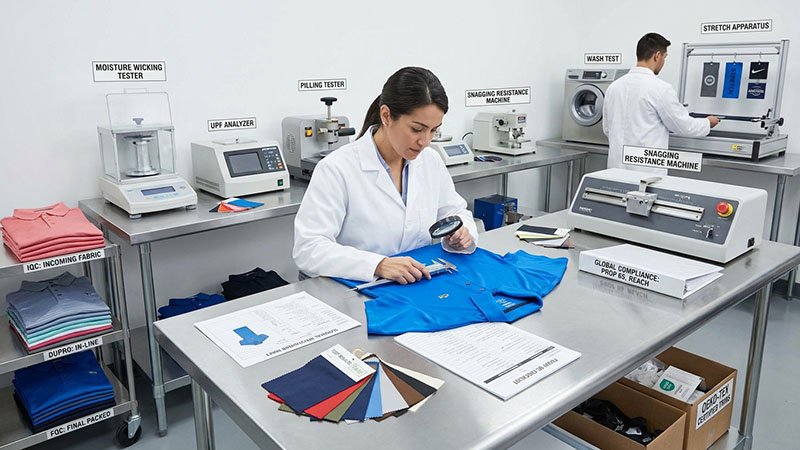
Before production begins, we run a battery of lab tests on the approved fabric. This includes everything from UPF and wicking to pilling, snagging, dimensional change (shrinkage), and colorfastness to light, wash, and even perspiration. These tests establish an objective quality standard.
In-process control and AQL
We have multiple inspection gates: IQC for raw materials, DUPRO checks on the sewing line, and FQC for a final internal review. We operate on a strict [AQL (Acceptable Quality Limit) of Critical 0/Major 2.5/Minor 4.0](https://www.onesilq.com/blog/apparel-aql-inspection) and target a DHU (Defects per Hundred Units) below 2%.
Size and measurement control
We audit measurements against your approved size specs throughout production. Key points of measure (POMs) typically have a tolerance of ±1 cm. We conduct full measurement audits on the TOP (Top of Production) sample and during the final inspection.
Chemical and RSL/MRSL compliance
We ensure your product is safe and compliant. We align with the [ZDHC MRSL](https://en.wikipedia.org/wiki/Oeko-Tex), use OEKO-TEX or bluesign certified components where possible, and run checks for restricted substances lists like California's Prop 65 and Europe's REACH.
Decoration durability validation
Your logo is part of your brand's promise. We perform specific durability tests on all branding applications, including wash, stretch, crocking (color rub-off), and dye-bleed tests to guarantee it holds up.
What trends are shaping golf shirts in 2026, and how can you get started?
You don't want to launch a product that already feels outdated. Staying ahead of design, fabric, and sustainability trends is key to capturing the attention of modern golfers.
The future of golf shirts is about combining refined aesthetics with responsible manufacturing. We track these trends to help you innovate and provide a clear checklist to get your project off the ground.
Design and fit trends
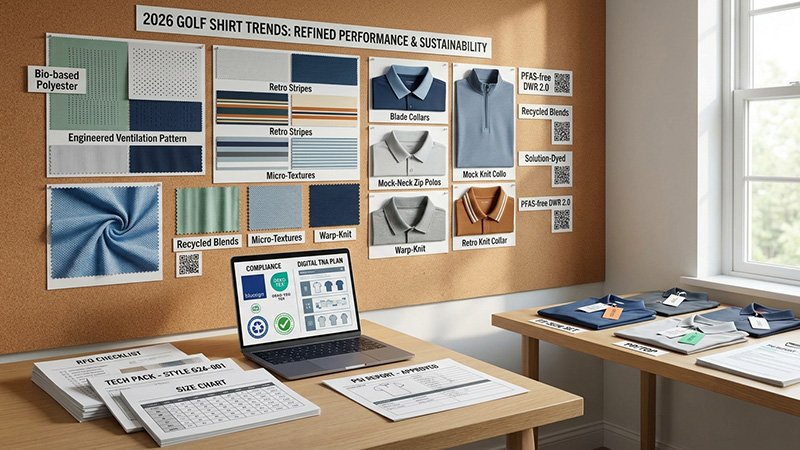
Looking ahead to 2026, we see a move towards refined and versatile styles. Expect more blade and retro-inspired knit collars, mock-neck zip polos, and shirts with engineered ventilation. Visuals are shifting from loud patterns to retro stripes and subtle, minimal micro-textures.
Fabric and technology trends
Core colors are moving toward solution-dyed yarns to save water. Warp-knit fabrics will become more popular for their superior snag control. In terms of materials, expect a rise in bio-based polyester and certified recycled blends, along with the next generation of high-performance PFAS-free DWR 2.0 finishes.
Sustainability and compliance trends
Traceability is becoming non-negotiable. The EU Green Claims Directive will punish vague marketing, and PFAS restrictions will continue expanding globally. Brands will need to provide material traceability through QR codes or sourcing platforms.
RFQ essentials checklist
Ready to start? Here is what you need to provide and what you should ask for:
- You send: A detailed tech pack, size chart, target FOB price, required test matrix, and target launch date.
- You request: A production TNA, factory capacity info, detailed MOQ/surcharge policies, available fabric/finish options, and copies of compliance certificates.
Verification and go-live milestones
The best way to start is with a paid development project. This allows you to verify our process through fit size sets, PP/TOP sample approvals, and independent 3rd-party tests. A final pre-shipment inspection (PSI) gives you the ultimate green light before your product ships.
Frequently Asked Questions?
How finalized does my design need to be before I approach you? I only have a concept and some reference images.
This is a question I get all the time, and the answer is simple: your concept is the perfect starting point. You don't need a professional "tech pack" or technical drawing to begin a conversation with us. Bring us your sketches (even rough ones), your reference images, and a clear description of who your customer is and what you want to achieve. My team's job is to act as your technical partner, taking your vision and translating it into a production-ready design. We'll help you build the official tech pack that we'll use for sampling and bulk production.
The article mentions sustainability trends. What is the most accessible eco-friendly option for a new brand with a small budget?
Sustainability can feel complex, but there are two very accessible starting points. First is using recycled polyester from certified sources like Repreve. The performance is identical to virgin polyester, the cost is only marginally higher now, and it gives you a powerful story to tell your customers. Second, for your core colors like black or navy, choosing a solution-dyed fabric is a great option. This method dyes the polymer before it's even made into yarn, saving a huge amount of water and energy. Both are fantastic, practical first steps into building a more responsible brand.
You talk about 2026 trends. How do I create a shirt that feels modern without going out of style in one season?
This is a very smart way to think about building a collection. The strategy I recommend to all my brand partners is to balance "core" with "fashion." Create your core polo styles—the timeless fits in classic colors like navy, white, black, and grey—using high-quality, durable materials. Then, introduce the trends in small, targeted ways. For an upcoming season, you might take your core polo body and simply update it with a trendy blade collar or offer it in a new seasonal colorway. This way, your core products have longevity, and you can stay current without having to reinvent your entire line every year.
What if I love a custom fabric but can't meet the high Minimum Order Quantity (MOQ) for dyeing?
This is the single biggest challenge for new brands, and we have several ways to solve it. First, we can show you our library of "in-stock" or "running" fabrics. These are high-quality materials we stock continuously in popular colors, which have very low MOQs. Second, for complex graphics and multiple colors on a small run, digital sublimation printing is the perfect solution. We print your design onto a white, in-stock polyester fabric. This allows for unlimited colors with an MOQ as low as 100-200 pieces, giving you incredible visual impact without the huge fabric commitment.
Can you replicate a shirt I like from another brand as a starting point?
While we can never make an exact copy of another brand's copyrighted design, we can absolutely use an existing garment as a technical reference. This is actually a very effective way to communicate your vision. You can send us a shirt you love and tell us, "I like the fit of this one, the feel of this fabric, and the construction of this collar." We can then deconstruct it—measuring the exact fit block, analyzing the fabric composition, and sourcing a material with similar performance to create your brand's version. Our goal is to understand the elements you admire and use them to build your unique product.
Conclusion
Creating a custom golf shirt is a journey of choices and trade-offs. By understanding the right sequence and having a transparent partner, you can navigate that journey with confidence. We're here to help you make the right moves at every step.