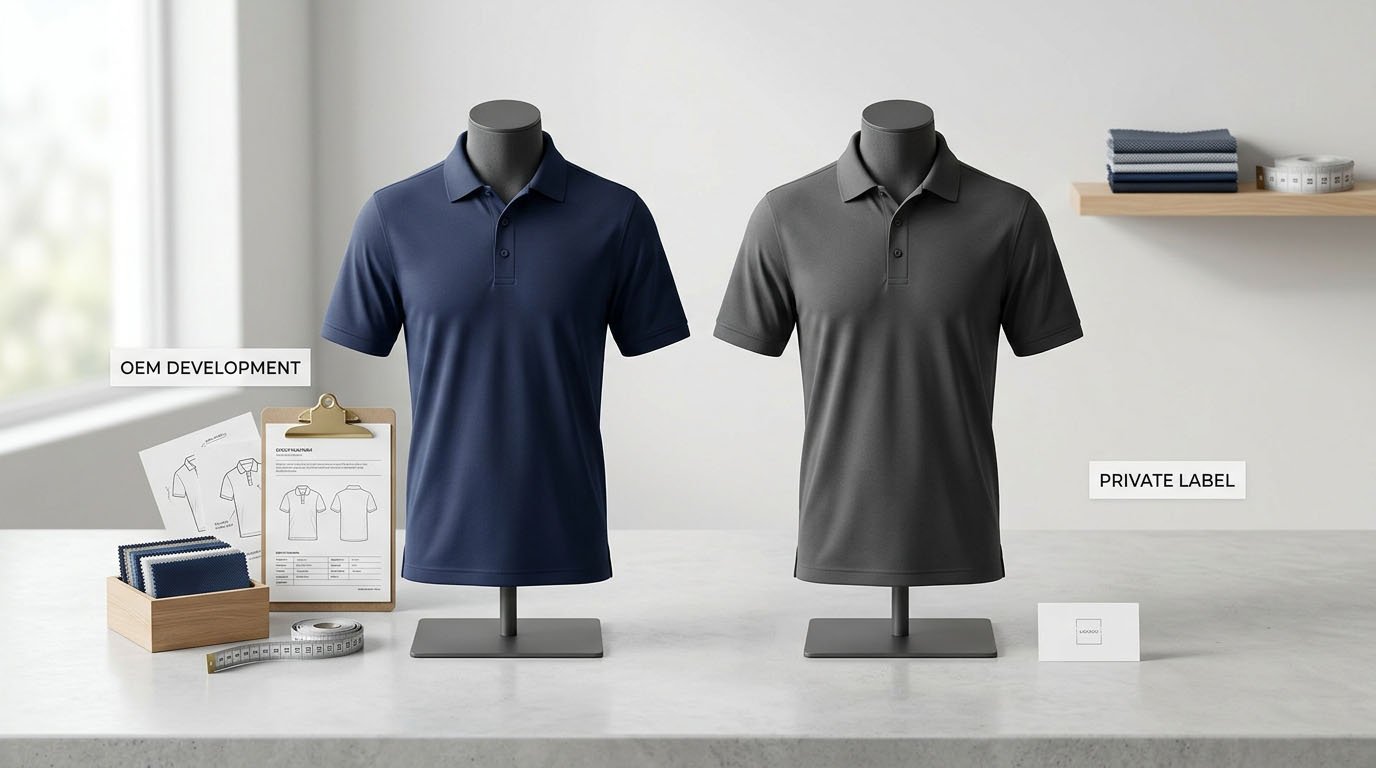

Launching a golf apparel brand usually brings up one important question early:
Should you choose OEM or private label golf shirts?
The answer depends on how much control you need over the product.
Private label is usually better when you want to launch faster using an existing or semi-custom product base. OEM makes more sense when your brand needs a unique fit, fabric, construction, or design developed around your own specifications.
Neither model is automatically better. The right choice depends on your budget, timeline, order quantity, technical readiness, and how different your product needs to be from what already exists in the market.
At FUWAY, we work with both startup and growing golf brands. Some buyers arrive with complete tech packs and very specific performance requirements. Others have a logo, reference products, and an idea of the look they want.
Those two buyers usually need very different manufacturing models.
This guide explains the difference so you can decide which route fits your brand.
Quick Answer: OEM vs Private Label Golf Shirts
Here is the short version.
| Factor | Private Label | OEM |
|---|---|---|
| Product starting point | Existing or proven product/platform | Your specifications or custom concept |
| Design freedom | Low to medium | High |
| Fabric flexibility | Usually stock or existing options | Stock or custom-developed options |
| Pattern & fit | Existing pattern or modified pattern | Custom pattern possible |
| Development work | Lower | Higher |
| Sampling complexity | Lower | Higher |
| Time to market | Usually faster | Usually longer |
| Upfront commitment | Usually lower | Usually higher |
| Product differentiation | Moderate | High |
| Technical knowledge needed | Lower | Higher |
| Best suited for | Testing and early-stage launches | Differentiated and established product programs |
Private label works well when speed, simplicity, and market validation matter most.
OEM works well when product differentiation, proprietary specifications, and greater design control matter most.
But these terms are not always used consistently by clothing manufacturers.
That is why you should look beyond the words OEM and private label and ask exactly what the factory allows you to customize.
What Is the Difference Between OEM and Private Label Golf Shirts?
The practical difference comes down to one question:
Are you adapting an existing product, or are you asking the factory to build your product around your specifications?
What Are Private Label Golf Shirts?
Private label golf shirts usually begin with a product platform the manufacturer already knows how to produce.
Depending on the supplier, you may be able to customize:
- Logo
- Neck label
- Care label
- Hangtag
- Packaging
- Available colors
- Existing fabric options
- Buttons
- Logo placement
- Selected trims
- Minor design details
The basic pattern, construction, or fabric platform may already exist.
This reduces development work.
For a new golf brand that wants to test the market without developing every element from scratch, private label can therefore be a practical starting point.
If you want to understand how FUWAY handles this type of project, see our Private Label Golf Apparel service.
What Are OEM Golf Shirts?
OEM — Original Equipment Manufacturer — generally means the manufacturer produces the shirt according to your product requirements.
Those specifications may include:
- Custom tech pack
- Custom measurements
- Your own size chart
- Unique pattern
- Custom collar construction
- Custom placket
- Specific fabric composition
- Specific GSM
- Pantone colors
- Custom prints
- Branded buttons
- Custom labels
- Special trims
- Performance finishes
- Custom packaging
An OEM project therefore gives you more control over the final product.
For example, instead of saying:
“I want a navy performance polo with my logo.”
you may specify:
“I need a lightweight stretch polo with this exact measurement chart, collar shape, side vent construction, Pantone color, print repeat, button design, and branding placement.”
That is a very different manufacturing project.
You can see more examples of customization options on our Custom Golf Shirts page.
Why Can OEM and Private Label Terminology Be Confusing?
This is an important point.
There is no single universal definition that every apparel factory uses in exactly the same way.
One supplier may call a product “private label” even when they allow changes to the fabric, color, collar, labels, and packaging.
Another may call the same level of customization “OEM.”
Some manufacturers also use terms such as:
- ODM
- Semi-custom
- Full custom
- Made-to-order
- White label
- Private label
- OEM
So do not choose a supplier simply because the website says “OEM.”
Ask what you can actually change.
Ask the Factory These Questions
Before deciding which manufacturing model you need, ask:
- Can I change the pattern?
- Can I provide my own size chart?
- Can I specify my own fabric?
- Can I match my own Pantone color?
- Can I customize the collar, placket, buttons, labels, and trims?
- Can you work from my tech pack?
The scope matters more than the terminology.
OEM vs Private Label Golf Shirts: Detailed Comparison
Here is a practical comparison from a buyer's point of view.
| Decision Factor | Private Label | OEM |
|---|---|---|
| Existing design available | Usually yes | Not required |
| Custom pattern | Limited or optional | Yes |
| Custom fit | Limited to moderate | High |
| Stock fabric | Common | Possible |
| Custom fabric | Less common | Possible |
| Custom Pantone colors | Depends on quantity/material | Common when feasible |
| Logo customization | Yes | Yes |
| Custom labels | Yes | Yes |
| Custom packaging | Yes | Yes |
| Sampling rounds | Usually fewer | Often more |
| Development complexity | Lower | Higher |
| Launch speed | Faster in many cases | Usually slower |
| Brand differentiation | Medium | High |
| Product development risk | Lower | Higher |
| Technical input from buyer | Lower | Higher |
This table should be used as a guideline rather than a rigid industry rule.
Every project is different.
Which Manufacturing Path Fits Your Brand?
Many golf apparel projects do not fit neatly into only two boxes.
In practice, brands often choose between private label, semi-custom, and full OEM.
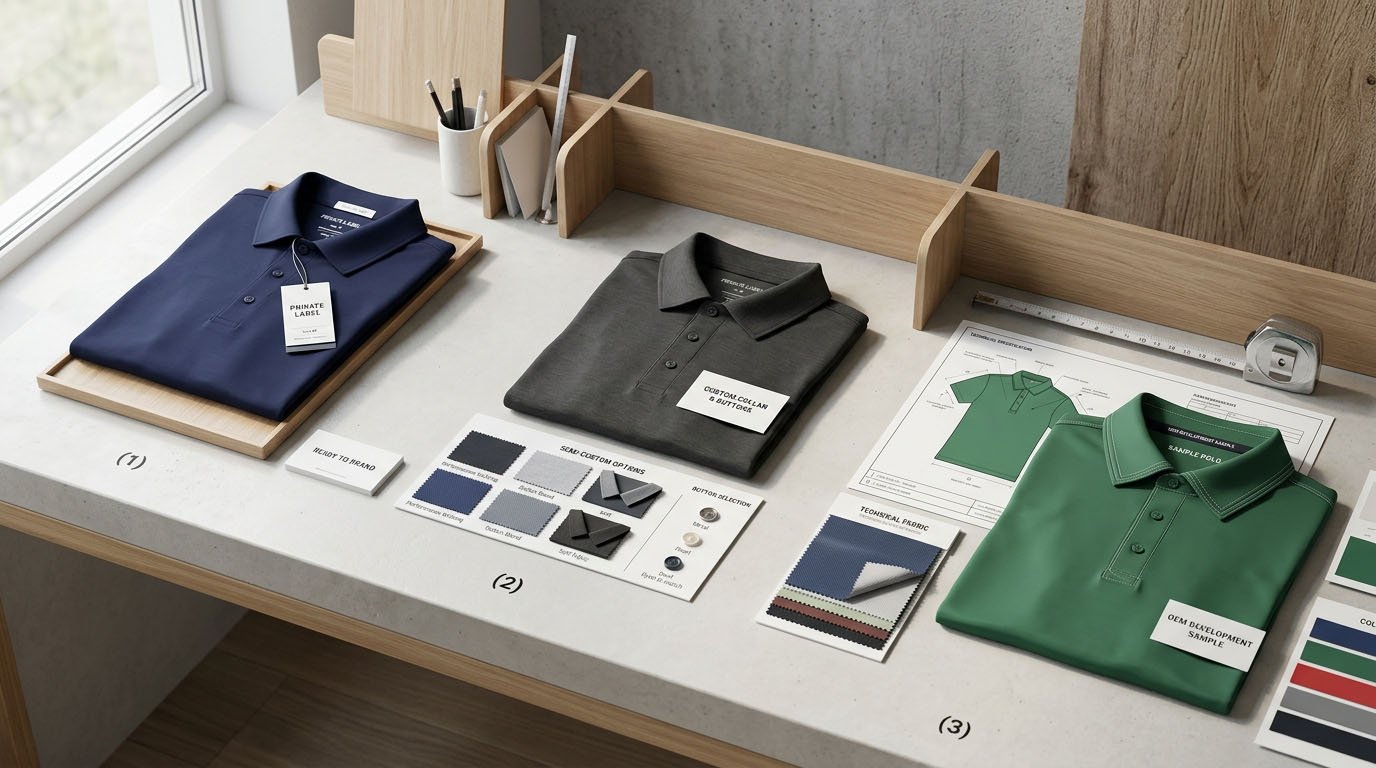
Step 1: Do You Mainly Need Branding on an Existing Product?
Do you mainly want to add:
- Your logo
- Neck labels
- Hangtags
- Packaging
- Existing fabric colors
while keeping the factory's current fit and construction?
If yes, private label may be the most practical route.
This keeps development simple and can help you test the market before investing in deeper customization.
Step 2: Do You Like the Existing Product but Want to Change Some Details?
Maybe the factory's existing polo fit works well, but you want to change:
- Fabric
- Collar
- Buttons
- Sleeve details
- Colors
- Printing
- Labels
- Packaging
while keeping most of the existing pattern.
If yes, a semi-custom approach may fit your project better.
This middle option can be useful for growing brands that want more differentiation without developing every element from scratch.
Step 3: Do You Need Your Own Product Architecture?
Do you need:
- Your own pattern
- Your own measurement chart
- Custom fit
- Custom fabric
- Unique collar construction
- Unique placket
- Proprietary trims
- Full technical specifications
If yes, OEM is likely the better route.
Simple Decision Tree
Do you mainly need logo + labels + packaging?
                |
              YES
                ↓
         PRIVATE LABEL

If NO:

Do you like an existing fit but want to change
fabric, colors, collar, trims, or branding?
                |
              YES
                ↓
          SEMI-CUSTOM

If NO:

Do you need your own fit, pattern, fabric,
construction, or complete technical specification?
                |
              YES
                ↓
               OEM
The advantage of this three-path model is that you do not have to over-customize too early.
For many brands, semi-custom is the bridge between private label and full OEM.
When Should You Choose Private Label Golf Shirts?
Private label is often a good option when your biggest priorities are:
- Getting to market quickly
- Controlling early development costs
- Testing your brand concept
- Testing customer demand
- Learning which sizes sell
- Testing price points
- Avoiding unnecessary product development
- Launching a small initial collection
Imagine you are starting a golf brand for the first time.
You have strong branding, a website, and an audience, but you do not yet know whether customers will prefer:
- Athletic fit or regular fit
- Lightweight or heavier fabric
- Solid polos or printed polos
- Four colors or two colors
Building a completely proprietary product before answering those questions can increase your risk.
Private label lets you learn first.
Private Label Does Not Mean “Just Add a Logo”
Private label customization can exist at different levels.
A simple program might include:
Existing polo + logo + neck label + packaging
A more advanced project could include:
Existing pattern + selected fabric + custom color + embroidery + custom labels + branded packaging
That is why private label should be viewed as a spectrum of customization, rather than one fixed product model.
When Should You Choose OEM Golf Shirts?
OEM becomes more attractive when your product itself is part of your competitive advantage.
For example, your brand may need:
- A distinctive athletic fit
- A proprietary collar shape
- A specific sleeve length
- A unique placket construction
- Custom jacquard fabric
- A specific fabric weight
- Special stretch requirements
- Custom printed patterns
- Custom trims
- Performance finishes
- Precise branding details
In that situation, using the same base polo available to other brands may not be enough.
OEM Works Best When You Know What You Want
Before moving into full custom development, ask yourself:
Do we understand our target customer?
A custom product becomes easier to justify when you already know what your buyer values.
Can we describe the difference clearly?
“Premium” is not a specification.
But:
- lighter fabric,
- stronger stretch,
- firmer collar,
- shorter body,
- larger arm opening,
- custom print,
- different placket,
are specifications.
Are we prepared to approve samples carefully?
The more decisions you make, the more decisions you need to approve.
OEM gives your brand more control, but that control also creates responsibility.
How Do MOQ Requirements Differ Between OEM and Private Label?
This is one area where buyers should be careful with online guides.
You may see statements such as:
Private label MOQ is 100 pieces.
or:
OEM always requires 1,000 pieces.
Those statements are too simple.
MOQ is usually determined by the components of the project—not only by whether someone calls the project OEM or private label.
Important factors include:
- Fabric availability
- Custom dyeing
- Fabric mill MOQ
- Number of colors
- Number of styles
- Number of sizes
- Printing method
- Embroidery requirements
- Custom buttons
- Custom labels
- Special trims
- Packaging
- Production complexity
Example
Consider two projects.
Project A
- Existing performance fabric
- Existing polo pattern
- One logo
- Standard buttons
- Standard colors
This may support a more flexible MOQ.
Now consider:
Project B
- Custom knitted fabric
- Exclusive Pantone dye
- Custom collar construction
- Custom molded buttons
- Custom size chart
- Multiple trims
Even if both are described as “golf polos,” Project B may require a larger production commitment.
The correct question is therefore not:
“What is your OEM MOQ?”
Ask:
“What is the MOQ for this exact fabric, color, pattern, branding method, and design?”
For more detail about how fabric availability affects manufacturing decisions, see our Fabric Sourcing service.
How Do Costs Compare Between OEM and Private Label Golf Shirts?
Many founders focus first on unit price.
That is understandable, but it can be misleading.
The cheapest shirt is not always the lowest-risk option.
Look at Total Project Cost
Your real cost may include:
- Sampling
- Pattern development
- Fabric development
- Lab dips
- Printing setup
- Embroidery setup
- Custom trims
- Labels
- Packaging
- Bulk production
- Inspection
- Shipping
- Duties
- Inventory holding
- Revisions
- Unsold products
Private label generally reduces some development costs because more of the product already exists.
OEM can require more upfront work because the factory may need to develop patterns, measurements, fabrics, colors, construction details, and samples.
The important question is:
Is the additional customization creating enough value for your customer to justify the additional development?
Do Not Compare Only the Price Per Shirt
You also need to consider:
- Inventory exposure
- Sell-through risk
- Size curve risk
- Development risk
- Reorder flexibility
This is why I usually tell new brands:
Compare the cost of the decision, not just the cost of the garment.
How Does Lead Time Differ Between OEM and Private Label?
Private label projects can often move faster because fewer things need to be developed.
If the manufacturer already has:
- The pattern
- The fabric
- The construction method
- The size grading
then development can be relatively straightforward.
OEM generally requires more steps.
A custom golf polo project may include:
- Requirement review
- Tech pack review
- Fabric sourcing
- Color development
- Pattern development
- Sample production
- Fit review
- Sample revision
- Pre-production approval
- Bulk production
- Quality control
- Packing and shipping
For that reason, do not build your launch calendar around an industry average found online.
Ask your factory for a timeline based on your actual specifications.
What Technical Files Do You Need for OEM Golf Shirts?
You do not always need a perfect tech pack before speaking with a manufacturer.
But better information usually produces a better quotation and a better first sample.
Useful information includes:
Design Drawing
Front and back views showing major design details.
Measurement Specification
Important measurements such as:
- Chest
- Body length
- Shoulder
- Sleeve length
- Bottom opening
- Collar measurements
Fabric Requirements
For example:
- Composition
- GSM
- Stretch
- Texture
- Moisture management
- UV requirements
- Hand feel
If you are unsure which fabric is appropriate, a manufacturer can help you evaluate options through Fabric Sourcing.
Color Information
Pantone references are useful when exact brand colors matter.
Branding Artwork
Depending on the design, you might choose:
Trim Details
Specify important components such as:
- Buttons
- Labels
- Tapes
- Packaging
The more clearly these details are communicated, the less the factory needs to guess.
Real RFQ Example: What Should You Send a Golf Shirt Manufacturer?
A vague inquiry usually produces a vague quotation.
Instead of sending:
“Hi, how much for 300 custom golf shirts?”
send the basic information the factory needs to understand your project.

Simple RFQ Example
Product: Men's performance golf polo
Quantity: 300 pieces
Colors: Navy, White, Sage Green
Sizes: S–XXL
Fabric: Lightweight polyester-spandex, 4-way stretch, moisture-wicking
Fit: Athletic fit; reference sample available
Branding: Left-chest embroidery + heat-transfer neck label
Customization: Custom collar tipping and branded buttons
Packaging: Individual polybag + hangtag
Target Market: United States
Target Delivery: [Month / Year]
Also attach any available:
- Logo artwork
- Reference photos
- Measurement chart
- Pantone colors
This gives the manufacturer enough information to identify:
- Whether stock fabric is suitable
- Whether custom dyeing is needed
- Whether a new pattern is required
- Which branding processes are involved
- Which details may affect MOQ or lead time
If you do not have a full tech pack yet, reference photos, target fit, fabric preference, quantity, and branding requirements are still much better than asking only for a unit price.
Which Model Gives You Better Product Differentiation?
OEM usually offers more opportunities for product differentiation.
But more customization does not automatically create a better product.
A startup may spend heavily developing:
- A new fabric
- A special collar
- Custom buttons
- Complicated packaging
without knowing whether customers care about those features.
Meanwhile, another brand may use a proven polo and differentiate through:
- Strong branding
- Excellent fit selection
- Better photography
- Clear positioning
- Community
- Customer service
- Distribution
So ask:
Which parts of this golf shirt actually need to be unique for our brand to win?
If the answer is primarily the logo, color direction, and brand identity, private label may be enough.
If the answer is the fit, fabric performance, construction, and technical design, OEM may be worth the additional development.
What Are the Main Risks of OEM?
OEM creates more control, but also more variables.
1. Fabric Risk
Custom fabrics may involve minimum production quantities, dye-lot variation, longer sourcing cycles, or reorder challenges.
2. Fit Risk
If you create your own pattern and measurement chart, you need to validate it properly.
3. Development Risk
More design decisions create more opportunities for revisions.
4. Component Risk
Custom buttons, labels, collar materials, and other trims may come from different suppliers.
5. Inventory Risk
Deeper customization can sometimes require larger commitments to materials or components.
What Are the Main Risks of Private Label?
Private label reduces some development risk, but it comes with different trade-offs.
1. Lower Product Exclusivity
Other brands may have access to a similar base product.
2. Limited Fit Control
You may need to work within an existing pattern.
3. Limited Fabric Choices
Some programs rely heavily on available stock fabrics.
4. Less Technical Differentiation
If your brand promise depends on a unique product feature, standard options may not be enough.
This does not make private label inferior.
It simply means its advantages are different.
Can You Start With Private Label and Move to OEM Later?
Yes.
In fact, thinking about manufacturing as a progression rather than a permanent decision can reduce risk.
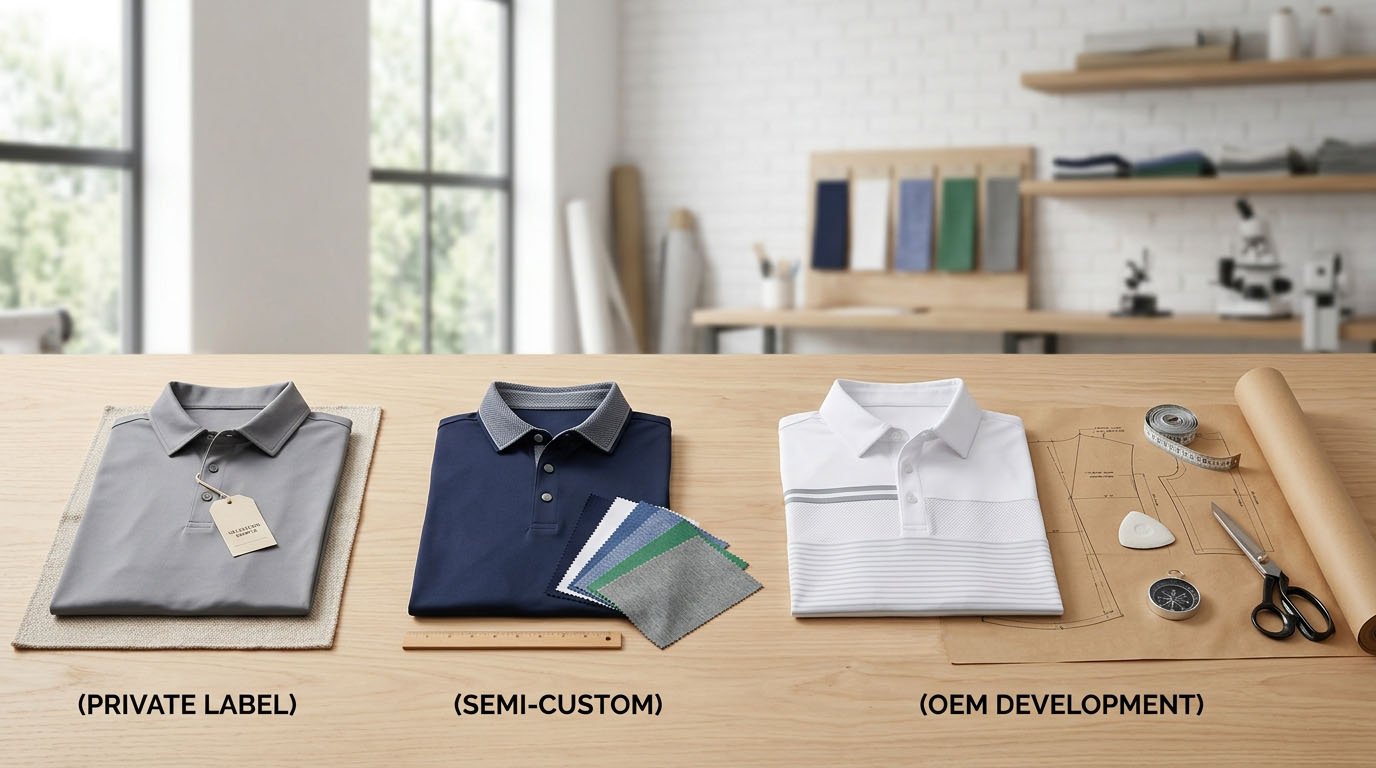
A practical path might look like this:
Phase 1: Validate — Private Label
Your goal is to learn:
- Which styles sell
- Which colors sell
- Which sizes sell
- What customers think about fit
- What price customers accept
Keep unnecessary complexity low.
Phase 2: Differentiate — Semi-Custom
Once you have sales data, improve the areas customers care about most.
For example:
- Modify the collar
- Adjust sleeve length
- Improve fit
- Add exclusive colors
- Change buttons
- Upgrade fabric
- Introduce custom prints
You do not necessarily need to redesign everything.
Phase 3: Build Proprietary Products — OEM
Once demand becomes more predictable, deeper product development becomes easier to justify.
You may develop:
- Exclusive fabrics
- Proprietary fits
- Custom patterns
- Unique construction
- Exclusive trims
- Signature performance features
At this point, OEM becomes part of your product strategy instead of simply being a manufacturing choice.
OEM vs Private Label Golf Shirts Decision Checklist
Use this checklist before contacting a manufacturer.
| Question | If YES, It Points More Toward |
|---|---|
| Do you already have a detailed tech pack? | OEM |
| Do you need your own pattern or fit? | OEM |
| Is a unique fabric central to the product? | OEM |
| Do you need special construction or trims? | OEM |
| Have you already validated demand? | OEM |
| Is launching quickly more important than full customization? | Private Label |
| Are you still testing market demand? | Private Label |
| Do you want to reduce development complexity? | Private Label |
| Are you comfortable using a proven existing pattern? | Private Label |
| Do you mainly need branding, colors, labels, and packaging? | Private Label |
A Simple Rule
If most of your answers are on the Private Label side, start simple and learn from the market.
If most of your answers are on the OEM side, deeper custom development may be justified.
If your answers are mixed, consider a semi-custom approach.
Before Choosing a Supplier, Verify These 5 Things
Choosing OEM or private label is only half the decision.
You also need to confirm that the manufacturer can actually execute the project.
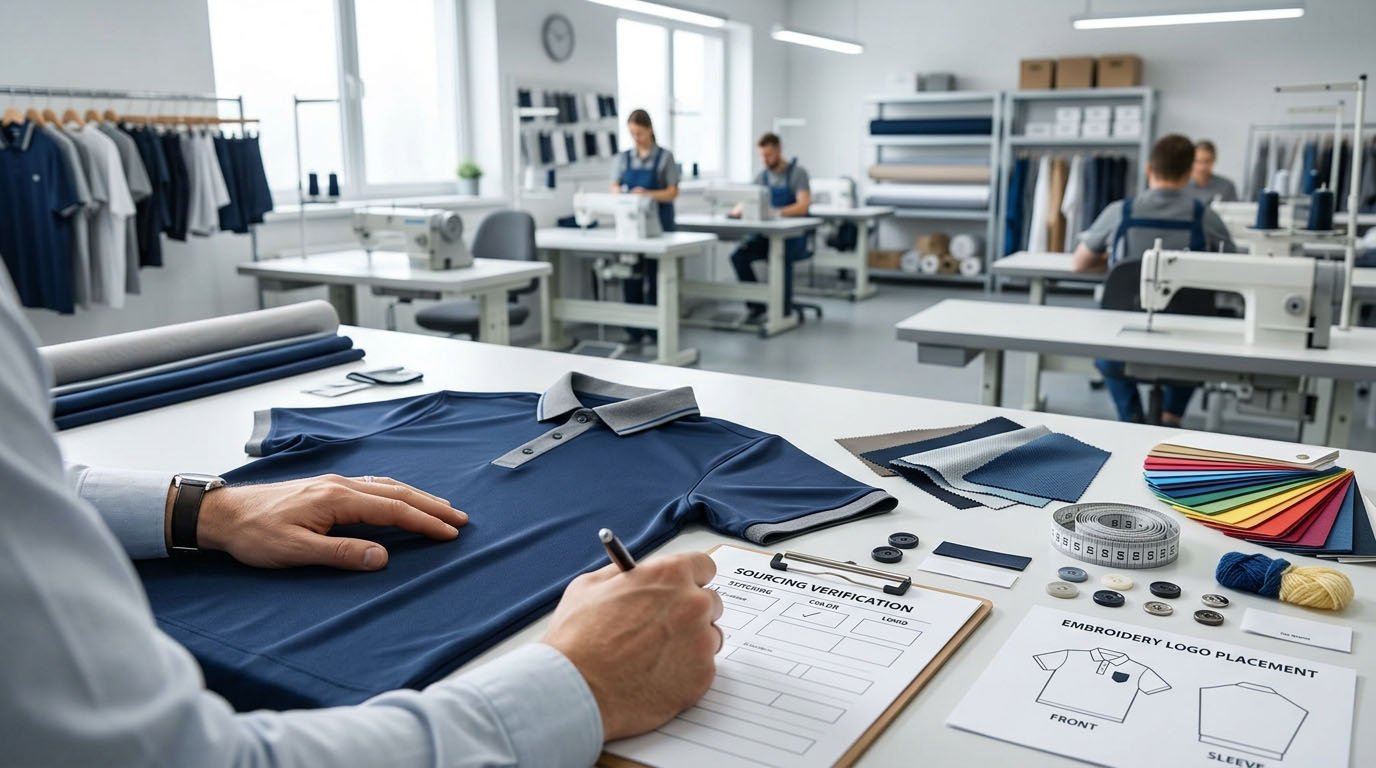
1. Can the Factory Make a Relevant Sample?
Ask whether the sample can use the intended or closest available fabric, fit, construction, and branding method.
2. Can the Factory Develop or Modify Patterns?
If you need OEM or semi-custom production, confirm whether the supplier can work from your size chart, modify an existing fit, or develop a new pattern.
3. What Actually Determines the MOQ?
Ask whether the minimum is driven by:
- Fabric
- Custom dyeing
- Printing
- Embroidery
- Buttons
- Labels
- Packaging
The garment MOQ alone may not tell the full story.
4. How Is Bulk Production Checked Against the Approved Sample?
Confirm how the factory checks:
- Measurements
- Color
- Logo placement
- Printing or embroidery
- Construction
- Visible defects
5. Can Relevant Production or Test Evidence Be Provided?
If performance claims matter, ask what relevant test information is available.
You can also review available FUWAY test reports when evaluating materials and product requirements.
For a deeper supplier-audit process, read our full guide:
How to Verify a Golf Apparel Factory in China Before Paying a Deposit
This type of verification should happen before you commit to bulk production.
FAQ: OEM vs Private Label Golf Shirts
Is OEM More Expensive Than Private Label?
OEM usually involves more development work, so initial development costs can be higher.
However, there is no universal price difference.
Final cost depends on:
- Fabric
- Quantity
- Construction
- Trims
- Branding
- Sampling
- Packaging
- Production complexity
Compare the complete project rather than only the unit price.
Does Private Label Mean Lower Quality?
No.
Private label describes a manufacturing model, not a quality level.
A private label golf polo can use excellent fabric, strong stitching, durable embroidery, and professional quality control.
Likewise, a fully custom OEM shirt can still be poor quality if the specifications or manufacturing execution are poor.
Quality and customization are separate questions.
Which Model Usually Has a Lower MOQ?
Private label can often support more flexible quantities because existing patterns, fabrics, or components may already be available.
However, this is not guaranteed.
Always ask for the MOQ of your actual specification.
Do I Need a Tech Pack for Private Label Golf Shirts?
Not always.
If you are selecting an existing style and only adding branding, logo artwork and branding instructions may be enough.
For more complex customization, clearer technical specifications will improve communication.
Do I Need a Tech Pack for OEM Golf Shirts?
A proper tech pack becomes increasingly important as customization increases.
At minimum, clearly communicate:
- Measurements
- Fabric
- Colors
- Construction
- Logo
- Trims
- Labels
- Packaging
Can I Use Custom Embroidery With Private Label Golf Shirts?
Yes.
Logo decoration is one of the most common private label customization options.
You can learn more on our Golf Polo Embroidery page.
Can I Use Sublimation for Custom Golf Shirts?
Yes, where the fabric and design are suitable.
Sublimation is particularly useful for all-over graphics, repeated patterns, gradients, and multi-color designs.
See our Sublimation Printing service for more information.
Can I Switch From Private Label to OEM Later?
Yes.
Your first production model does not need to become your permanent model.
Many brands benefit from moving through:
Private Label → Semi-Custom → OEM
as their sales data, technical knowledge, and purchasing volume grow.
Final Thoughts: Which Should Your Golf Brand Choose?
OEM and private label are not competing definitions of “good” and “bad” manufacturing.
They solve different problems.
Choose private label when you need speed, flexibility, simpler development, and a practical way to validate demand.
Choose OEM when your product needs a unique fit, fabric, construction, or technical specification that forms an important part of your brand differentiation.
And remember that you do not have to make one permanent choice.
For many brands, the strongest path is:
Start simple → collect customer data → improve the product → invest in deeper customization where it creates real value.
That approach helps avoid spending money on features customers may never notice while still giving you a path toward a more proprietary product as your brand grows.
If you are currently comparing OEM, private label, or semi-custom golf apparel, explore FUWAY's Custom Golf Shirts and Private Label capabilities.
Or contact FUWAY with your design, target quantity, fabric requirements, and launch timeline. We can help you determine which manufacturing route fits your project before you move into sampling.