
The golf market is crowded. Your new private label brand is just a drop in the ocean. How do you get noticed? I’ll show you how true performance is your key.
To stand out, move beyond just picking a fabric. Define a specific golfer niche, and then build a complete performance system for them—from unique fabric technologies and an ergonomic fit to a compelling brand story. This authenticity is what builds a loyal following.

I've seen so many private label brands fail, and it's rarely because they couldn't find a decent moisture-wicking fabric. They fail because they can't find a factory partner who can truly translate a brand idea into a high-quality, producible garment. They get trapped looking at fabric catalogs instead of asking the right questions. Let's start with the first and most important question.
How Do You Define Your Brand Positioning and Consumer Insight?
Feeling lost in a sea of golf brands? A fuzzy brand identity leads to generic products that no one gets excited about. Let's define your unique space in the market first.
Start by identifying your target customer segment and their specific needs. Analyze competitors to find a gap in the market. Use this insight to create a clear value proposition, whether it's superior performance, unique style, or sustainability. This focus guides every decision.
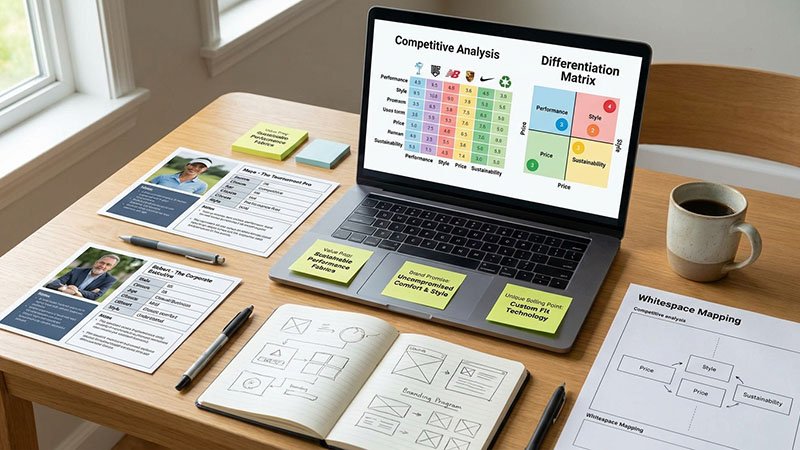
Before you even think about fabrics or factories, you need a rock-solid plan. Your brand can't be everything to everyone. The most successful brands I've worked with are the ones who know exactly who they are and who they are serving. This clarity makes every other decision easier. Let’s break down how to get that clarity for your brand.
Segments & value proposition
First, decide which part of the market you want to own. Are you targeting serious tournament players, club members, corporate clients, or the lifestyle golfer? You can also position your brand as "good," "better," or "best" in terms of quality and price. Your value proposition is your promise: what unique benefit do you offer this specific segment?
Personas & use cases
Create detailed profiles of your ideal customers. A 25-year-old female golfer who plays in hot, humid weather has very different needs from a 50-year-old male executive who wears polos for corporate events. Define their age, gender, playing habits, and the climates they play in. This will directly inform your design and fabric choices.
Differentiation matrix
You need to stand out. A matrix helps you decide how. Will you compete on pure performance, sustainability, unique style, or a superior fit? You likely can't be the best at all four, so pick one or two areas to truly own.
| Differentiation Axis | Our Brand Focus | Competitor A Focus | Competitor B Focus |
|---|---|---|---|
| Performance | High Priority | High Priority | Medium Priority |
| Sustainability | Medium Priority | Low Priority | High Priority |
| Style | High Priority | Medium Priority | Medium Priority |
| Fit | Medium Priority | Low Priority | High Priority |
Competitive audit & whitespace mapping
Look at what other brands are doing. Analyze their products, pricing, and marketing. More importantly, look at what they are not doing. This "whitespace" is your opportunity. Maybe no one is making high-performance, sustainably sourced golf apparel for tall players. That could be your niche.
What Are the Performance and Fabric Differentiators?
Your fabric choice is a core part of your brand story. But with so many technical options, how do you choose one that truly makes your brand different and better?
Go beyond basic moisture-wicking. Differentiate with fabrics that offer superior snag resistance, four-way stretch with high recovery, and advanced sustainable features like solution-dyed colors or PFAS-free water repellency. Back your choices with certified lab test data.
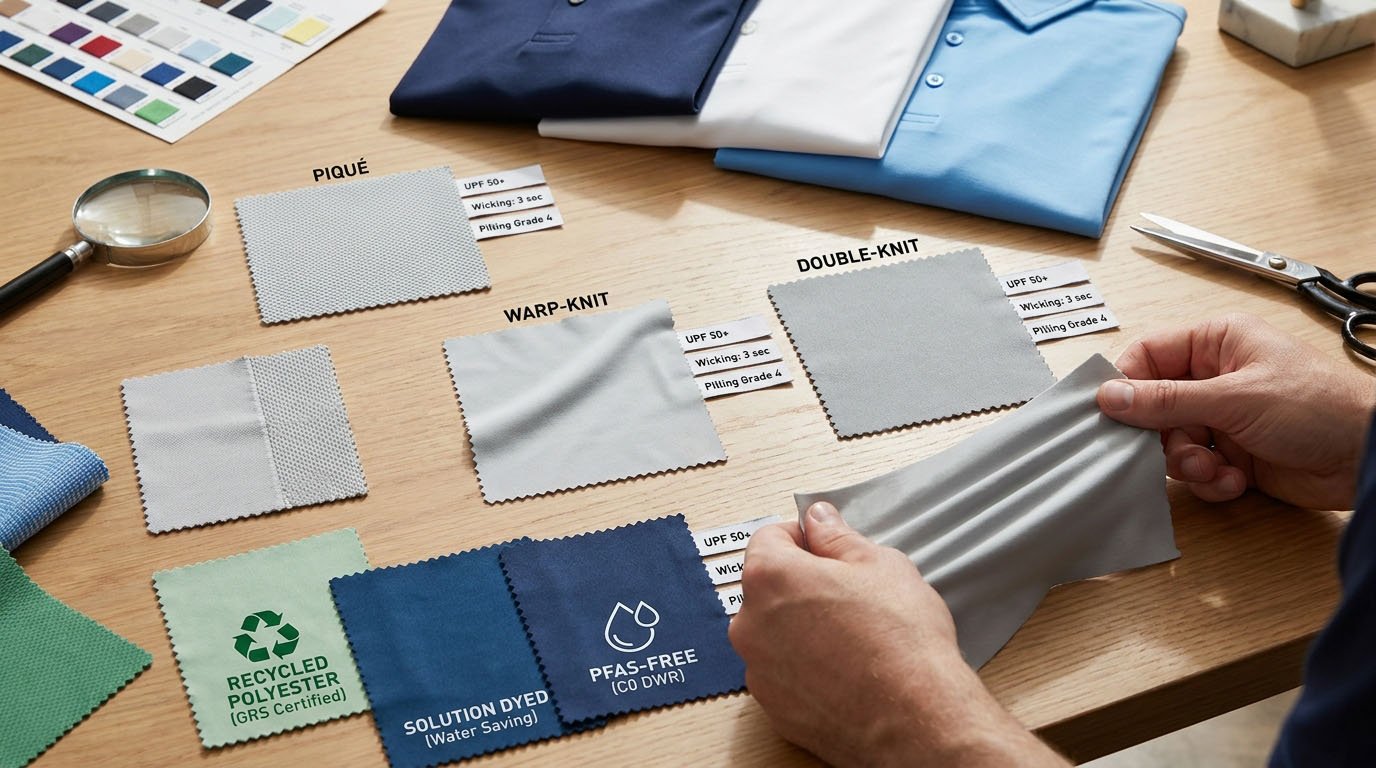
Every brand says their shirts are "performance." To stand out, you have to prove it. This isn't just about picking a fabric from a catalog; it's about understanding the specific knit structures, fibers, and chemical finishes that deliver on your brand promise. Let’s dive into the details that will set your product apart from the competition.
Knit structures & fibers
The right structure can improve durability and feel. While piqué is classic, consider warp-knits for superior snag control. A double-knit provides a smoother, more substantial feel. For sustainability, look for GRS-certified recycled polyester, resource-saving solution-dyed yarns, and bio-based spandex alternatives.
Core KPI benchmarks
Your fabric must perform. Demand third-party lab reports for key performance indicators (KPIs):
- UPF: Should be 50+ (AATCC 183).
- Wicking: A vertical wicking rate of ≥3.5 is excellent (AATCC 195).
- Breathability: Air permeability should be matched to the climate and use case.
Stretch & recovery
A golfer's shirt needs to move with them and snap back into shape. True four-way stretch is non-negotiable. Look for a recovery rate of 85% or more after being stretched (ASTM D3107). This ensures the shirt doesn't bag out after a long day on the course.
Durability & appearance
A premium shirt must look good for a long time. Insist on these minimums: a pilling grade of 3.5 or higher, a snag resistance grade of 4 or higher, shrinkage of less than 5%, and a colorfastness rating of grade 4 or higher.
Chemistry & functional finishes
Responsible chemistry is a major differentiator. Ask for PFAS-free DWR (water-repellent) finishes, non-biocidal odor control treatments, and components that are OEKO-TEX or bluesign certified. Ensure your supplier complies with major chemical regulations like REACH and Prop 65.
How Can You Create a Signature Design Language and Fit System?
A great fabric is only half the battle. Your shirt's design and fit are what customers will see and feel first. How do you create a look that is instantly recognizable as your brand?
Develop signature design elements and a consistent, ergonomic fit system. This isn't about unlimited design freedom. It's about working with a factory's proven solutions—their pattern libraries and construction methods—to create a unique product that is both distinctive and producible.
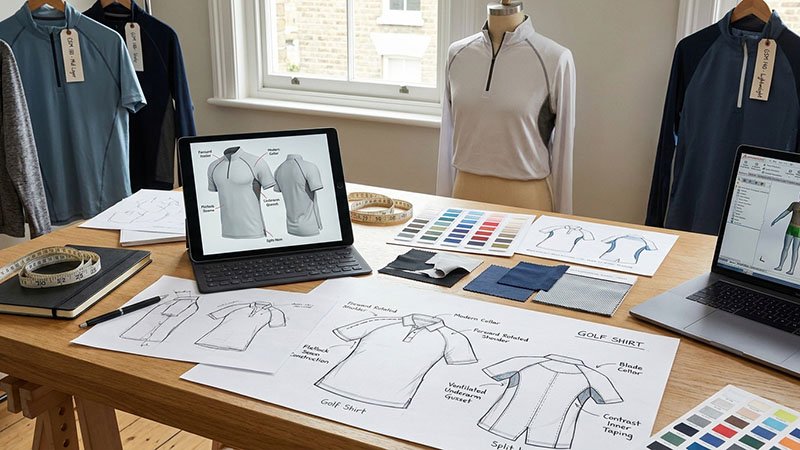
Many new brands fall into the "customization trap." They think it means they can design anything from scratch. This leads to high costs and production headaches. The smartest brands I know work with their factory's existing expertise. They find a factory with great pattern blocks and proven techniques, and then they innovate from there.
Signature design cues
Make your shirt identifiable without a logo. This could be a unique blade collar, a jacquard pattern knit into the collar, contrast tape inside the placket, or engineered ventilation patterns. Even a subtle micro-texture on a solid-color fabric can become a signature element.
Patterning & ergonomics
The fit must be built for the golf swing. This means using forward-shifted shoulder seams or raglan sleeves for better mobility, adding gussets under the arms to prevent the shirt from lifting, and including a split hem with a longer back to keep it tucked in.
Seams & comfort details
Premium means paying attention to the small things. Use flatlock or soft coverstitching to eliminate chafing. Use low-friction taping around the neck. A small fabric "garage" at the top of a zipper placket prevents it from scratching the chin. These details signal quality to the discerning golfer.
Fit blocks & size inclusivity
Develop a consistent fit block for your brand (e.g., "Athletic Fit," "Classic Fit") so customers can buy with confidence. Offer an inclusive range of sizes, including plus, tall, or petite options if that serves your target audience. Using 3D fitting software can help perfect your grading across all sizes.
Climate layering & GSM
Organize your collection by climate. Use fabric weight (GSM) to create a system:
- Hot (140–170 GSM): Lightweight, maximum breathability.
- Temperate (160–190 GSM): The versatile all-rounder.
- Cool/Windy (180–220 GSM): A heavier polo, sometimes with a brushed back for warmth.
How Do You Manage Branding, Decoration, and Compliance?
Your logo and labels are your brand's signature. But a poor application can crack, fade, or irritate the skin, undermining the quality you've worked so hard to build.
Select a decoration method that matches your fabric's properties and brand aesthetic. Insist on rigorous testing for durability and color migration. Pay close attention to label compliance and ergonomic placement to ensure a professional and comfortable final product.
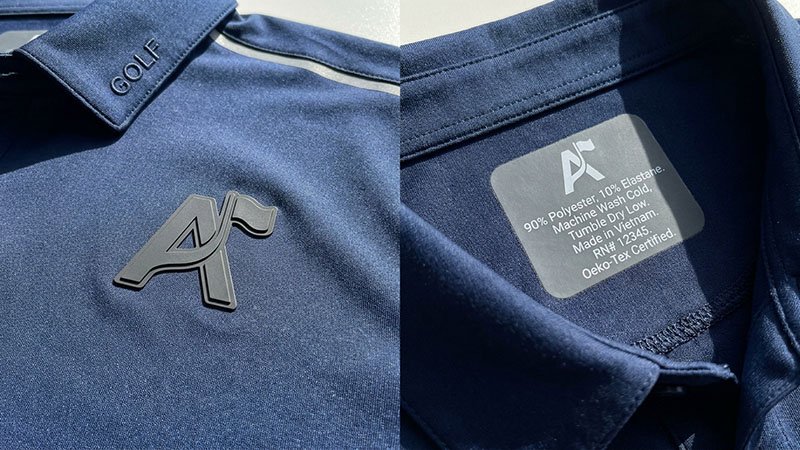
A crisp, durable logo says "premium." A peeling, faded one says "cheap." This part of the process is full of technical traps, especially with performance fabrics. For example, using a standard high-temperature heat transfer on polyester will cause the fabric dye to "migrate" or bleed into your light-colored logo. A good manufacturing partner knows how to avoid this.
Decoration method selection
Choose the right tool for the job. Silicone prints offer a modern, flexible 3D look. Low-temperature heat transfers are essential for preventing dye migration on polyester. Welded or radio-frequency (RF) logos provide a seamless, technical aesthetic. Traditional embroidery remains a durable classic, but make sure the stitch density is right for the fabric.
Process controls & validation
Trust, but verify. For any decoration on polyester, demand a process that uses anti-migration films or inks. Your manufacturer must perform wash tests (at least 5-10 cycles) to check for peeling, cracking, and color bleeding. They should also test for color fastness to sweat.
Placement & comfort
Where you put the logo matters. Avoid placing large, non-breathable decorations in high-sweat or high-friction areas like the center back or under the arms. For any embroidery or interior heat-sealed logos, insist on a soft backing so it doesn't irritate the skin. Lighter is often better.
Labeling & regulations
This is non-negotiable. Your labels must comply with regulations in your target markets, including fiber content (e.g., 16 CFR 303 in the US), care instructions (ISO 3758), and country of origin. If you add reflective elements for low-light visibility, ensure they meet regional safety standards.
Social & chemical compliance
Modern brands are held to a high standard. Work with factories that can provide proof of social compliance audits like BSCI, SMETA, or WRAP. They should also manage a Restricted Substances List (RSL) and be able to provide third-party test reports to show they meet chemical safety standards.
How Do You Optimize Supply Chain, Costing, and Speed to Market?
A great product idea is worthless if you can't get it made reliably, on time, and at a cost that works for your business. This is where most new brands get stuck.
Focus on finding a supplier's "sweet spot" volume. This is where you get reliability and good pricing without over-investing. Secure key fabrics early and work with your factory to build a lean, repeatable production calendar. This is the key to speed and dependability.

New brand owners often get attracted to promises of very low MOQs. But this can be a trap. Low-volume orders often get pushed to the back of the line, have fewer fabric choices, and come with higher piece costs. I always tell my clients to ask a potential partner, "What's your ideal order size? Where do we become an important customer to you?" The answer reveals a lot about their business and whether they are the right fit for you.
Fabric & exclusivity strategy
To ensure speed and consistency, partner with your factory to book "greige" fabric (undyed, unfinished fabric) in advance. For true differentiation, you can co-develop a unique fabric with a mill and sign an NDA to make it exclusive to your brand.
TNA & capacity management
A Time and Action (TNA) calendar is your production roadmap. A good knitwear factory should offer a timeline like this: SMS (salesman samples) in 2-3 weeks, bulk production in 30-45 days. Ask about their self-inspection processes and how quickly they can switch between production styles.
MOQs & cost structure
Understand what drives your costs. The Bill of Materials (BOM) and Cut-Make (CM) labor are the two biggest parts. A more complex design uses fabric less efficiently, increasing cost. Yarn-dyed stripes or custom-ribbed collars will have higher MOQs than solid colors. Lock in your FOB price to protect against currency changes.
Replenishment models
How will you manage inventory? You could pre-order based on a forecast, or use a "quick response" model to place smaller, faster re-orders on popular items. Rolling out new colors in a core style is a great way to keep your collection fresh without redesigning everything.
Quality gates & AQL
Implement strict quality checkpoints. Inspect materials when they arrive (IQC), during production (DUPRO), and before they ship (PSI). Use an AQL standard (e.g., AQL 2.5) to define what is acceptable. Track your Defect Rate per Hundred Units (DHU); it should be consistently low.
What's Your Go-to-Market Story and How Do You Reflect 2026 Trends?
You've built an amazing product. Now, how do you convince customers to believe in it? Your marketing story can't just be words; it must be backed by the product itself.
Use data to support your performance claims. Let real golfers validate your product's quality through reviews and content. Be transparent and honest in your sustainability narrative. And finally, weave in forward-looking design trends to show your brand is modern and relevant.
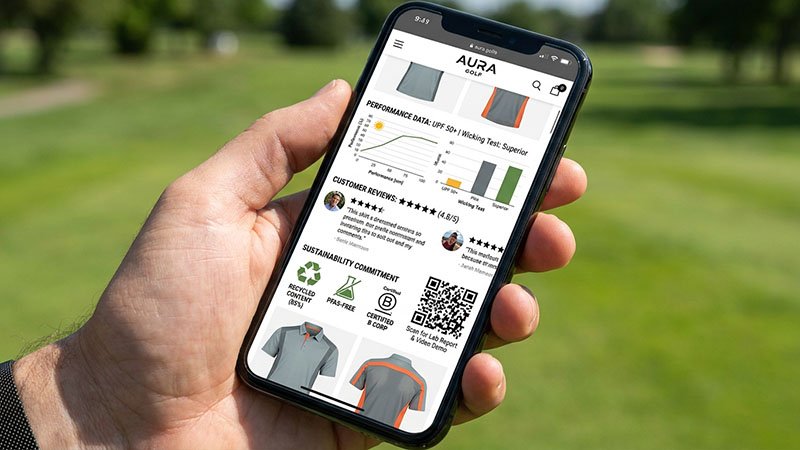
Your launch is not the end of the process; it's the beginning of a conversation with your customer. The best brands bring their customers along on the journey. They share the 'why' behind their design choices and prove their claims with real data and authentic stories. This builds trust, which is the most valuable asset a private label brand can have.
Evidence-based claims
Don't just say your shirt is "breathable." Show the data. Announce the UPF 50+ rating. Market the lab-tested wicking speed. You can even add a QR code to the hangtag that links to the test reports or explains the fabric technology. This transparency builds credibility.
Validation & content
Get your shirts on real golfers, club pros, and coaches. Their authentic testimonials are your most powerful marketing tool. Encourage user-generated content (UGC) and create helpful guides about fit and care. Short videos comparing your shirt's performance to a competitor's can be very effective.
Compliant sustainability narrative
If you claim to be sustainable, be prepared to prove it. If you use recycled content, have the GRS transaction certificates ready. If you use a PFAS-free finish, say so. Be specific and honest, following guidelines like the EU's Green Claims Directive to avoid "greenwashing."
2026 design & color trends
Stay ahead of the curve. We are seeing a move towards blade and retro-inspired collars, mock-neck zippered styles, and engineered ventilation patterns. Micro-textures on solid colors are replacing loud prints. Palettes are focusing on sophisticated mineral neutral colors accented with single bright, energetic hues.
Launch checklist & RFQ
As you prepare to launch your next collection, use a checklist. Your RFQ to potential suppliers should be comprehensive: include your tech pack, size curve, target price, and required test matrix. In return, demand their TNA calendar, capacity info, MOQs, and all compliance certificates. Set clear milestones for PP sample, TOP sample, and final inspection approvals.
Frequently Asked Questions
1. How do I stop a factory from stealing my unique design and selling it to others?
This is a common and valid fear for new brands. The best way to protect yourself is with a formal Non-Disclosure Agreement (NDA) before you share any designs. For a truly unique product, especially if you co-develop a specific fabric, you can also sign a manufacturing exclusivity agreement. However, I’ve found that the best protection is a strong relationship. Good factories value long-term partners and won't risk a lucrative, ongoing relationship for one quick sale.
2. All the big brands claim "high performance." How can my small brand prove our shirts are better?
You don't need a massive marketing budget; you need transparency. You are already paying for lab tests to ensure quality (like UPF 50+, wicking speed, and pilling resistance). Don't just file those reports away—use them as marketing tools! Publish the data on your product pages. Put a QR code on your hangtags that links directly to the test results. When big brands make vague claims, you can show specific, verifiable proof. This builds incredible trust and credibility.
3. As a new brand, should I work directly with a factory or use a trading company/sourcing agent?
There are pros and cons to both. Working directly with a factory like mine can give you better pricing and more control. However, it requires you to be more involved in managing communication and details. A trading company or agent acts as a middleman. They cost more, but they handle communication, find factories for you, and manage quality control. My advice: If you're a complete beginner and feel overwhelmed, an agent can be a good starting point. If you've done your homework and have a clear vision, working directly with a factory partner will be more profitable in the long run.
4. I see some factories offering custom polos for $5 and others for $15. What's the real difference?
The price difference almost always reflects what you can't see. A $5 polo likely cuts corners on everything: cheaper thread that breaks, no interfacing in the collar so it curls after one wash, no lab testing for performance claims, and no social or chemical compliance audits. The $15 polo from a quality partner includes the cost of durable construction, certified performance fabrics, rigorous quality control, and the peace of mind that it was made responsibly. You aren't just buying a shirt; you are investing in your brand's reputation.
5. I want my brand to be sustainable, but it seems expensive. Is it possible for a startup?
Yes, absolutely. You don't have to do everything at once. The easiest and most impactful place to start is with your fabric. Ask your supplier for options made from GRS-certified recycled polyester. This is becoming a standard offering and the cost difference is minimal. The next step is to ensure they use modern, compliant chemistry, like PFAS-free water-repellent finishes. Most importantly, focus on durability. A well-made shirt that lasts for years is far more sustainable than a cheap one that ends up in a landfill after one season.
Conclusion
Standing out means finding a partner, not just a supplier. They help translate your unique brand vision into high-performance apparel that connects with your specific customer base.