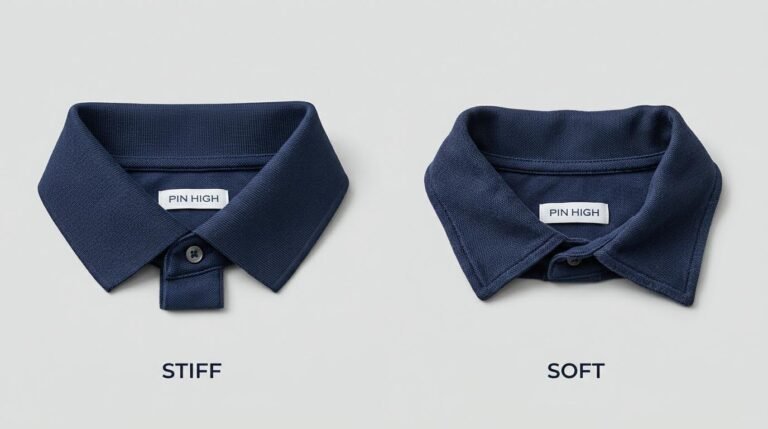
Choosing the right golf polo MOQ is not simply about finding the factory with the lowest minimum order quantity.
Order too many, and your cash may sit in unsold inventory. Order too few, and your cost per polo can rise while popular sizes sell out too quickly.
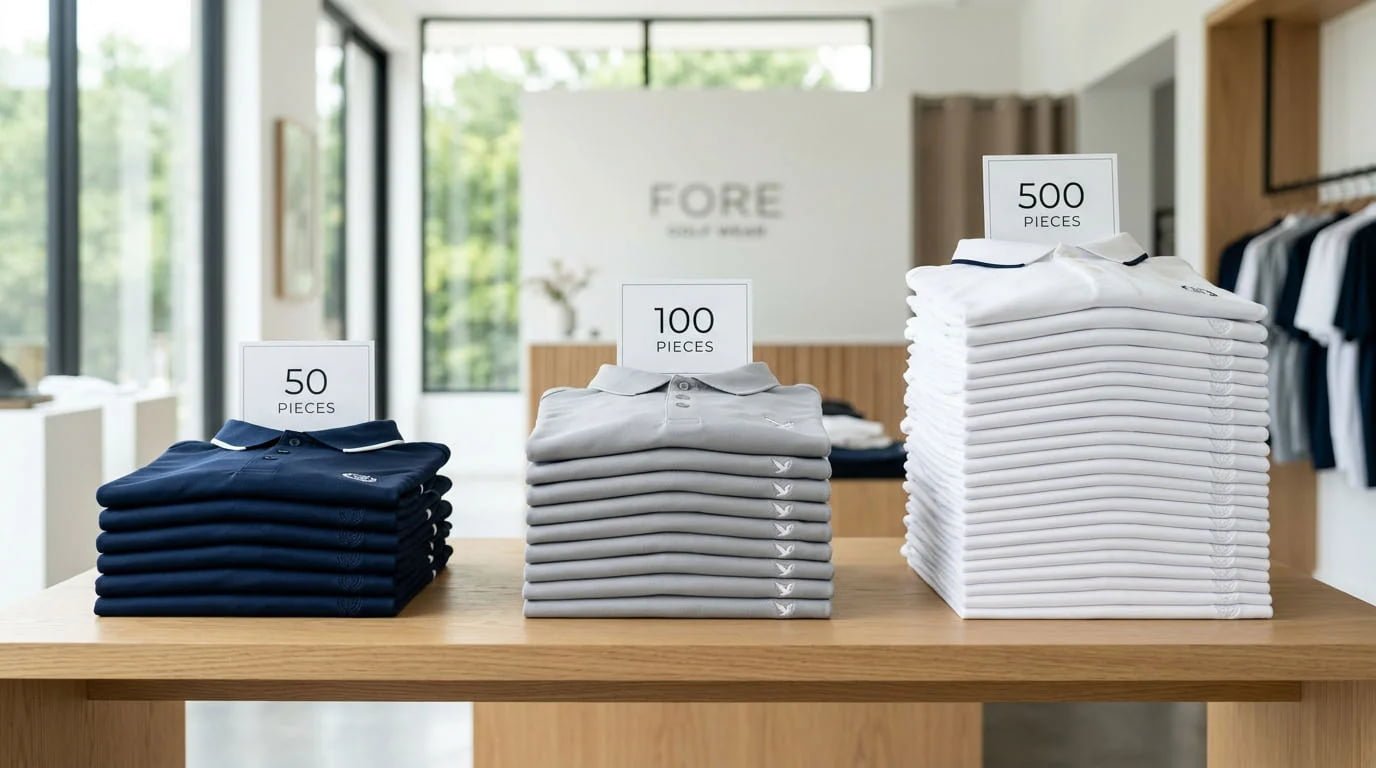
There is no single best MOQ between 50, 100, and 500 golf polos. The right quantity depends on your sales stage, number of colors, size breakdown, customization requirements, budget, and—most importantly—how many sellable units remain in each SKU after the order is divided.
At FUWAY, we regularly speak with golf brands that begin by asking:
“What is your MOQ?”
That is an important question, but it is not the only one you should ask.
A better question is:
“After I divide my order across colors and sizes, will I still have enough units in each SKU to sell effectively?”
That is where MOQ planning really begins.
What Are the Quick Answers to Golf Polo MOQ?
If you need a fast comparison before going deeper, here is the basic idea.
| Order Quantity | Usually Best For | Main Advantage | Main Risk |
|---|---|---|---|
| 50 pieces | New brands and market testing | Lower inventory commitment | Higher unit cost and thin SKU depth |
| 100 pieces | Early-stage and growing brands | Better balance of cost and inventory | Too many colors can still spread stock too thin |
| 500 pieces | Proven products and scaling brands | Better production efficiency and customization flexibility | Higher cash and inventory exposure |
In simple terms:
- 50 pieces: Test an idea.
- 100 pieces: Build useful stock depth.
- 500 pieces: Scale something that already works.
However, these numbers should never be viewed in isolation.
A 100-piece order can be very healthy if it covers one style and one or two colors.
The same 100 pieces can become commercially difficult if you divide them across several designs, colors, and sizes.
What Does MOQ Mean in Golf Polo Manufacturing?
MOQ stands for Minimum Order Quantity.
It is the smallest production quantity a manufacturer is normally willing or able to produce under a particular set of specifications.
But MOQ is not always a random factory rule.
It can be affected by:
- Fabric availability
- Fabric dyeing requirements
- Cutting efficiency
- Sewing line setup
- Embroidery or printing setup
- Custom trims
- Labels and packaging
- Number of colors
- Number of sizes
- Overall product complexity
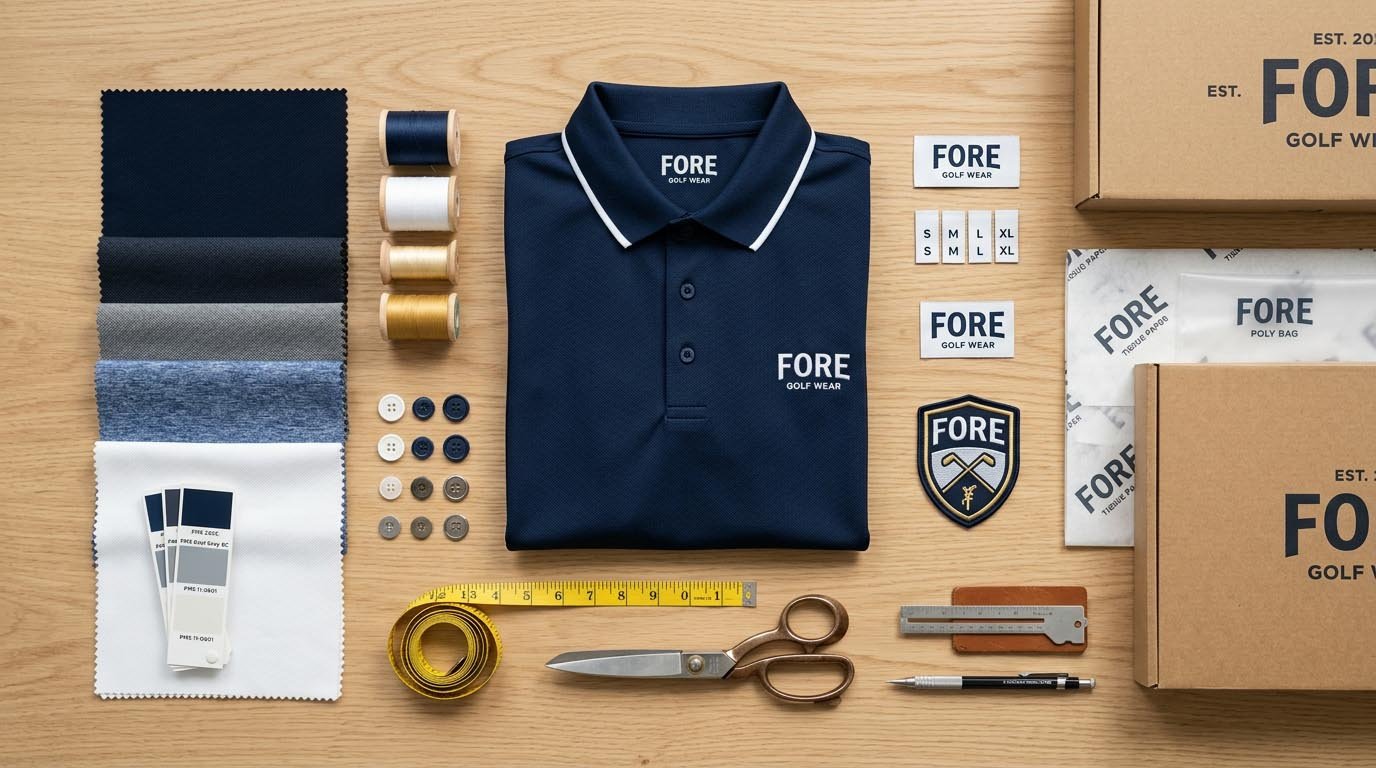
For a basic golf polo using an available performance fabric, the practical production requirements may be very different from a polo that requires:
- A custom fabric composition
- Exact Pantone dyeing
- Jacquard collars
- Custom buttons
- Multiple embroidery locations
- Special labels
- Unique packaging
If you are developing a fully customized product, our Custom Golf Shirts page explains more about the types of golf polo customization that can be built around your brand.
This is why asking only:
“What is your MOQ?”
does not always tell you enough.
You should also ask:
“MOQ for what specification?”
Why Is SKU Depth More Important Than Total MOQ?
This is one of the most important ideas for any new golf apparel brand.
MOQ tells you the total number of garments. SKU depth tells you how many sellable units remain in each style, color, and size combination.
Imagine you order 100 golf polos.
Scenario A: Simple Collection
- 1 style
- 1 color
- 5 sizes
- 100 total pieces
You may have roughly:
| Size | Example Quantity |
|---|---|
| S | 10 |
| M | 25 |
| L | 30 |
| XL | 25 |
| XXL | 10 |
You have useful stock depth.
Now consider another order.
Scenario B: Too Many Variations
- 2 styles
- 3 colors
- 5 sizes
- 100 total pieces
That creates:
2 × 3 × 5 = 30 SKUs
100 pieces divided across 30 SKUs gives an average of only around three pieces per SKU.
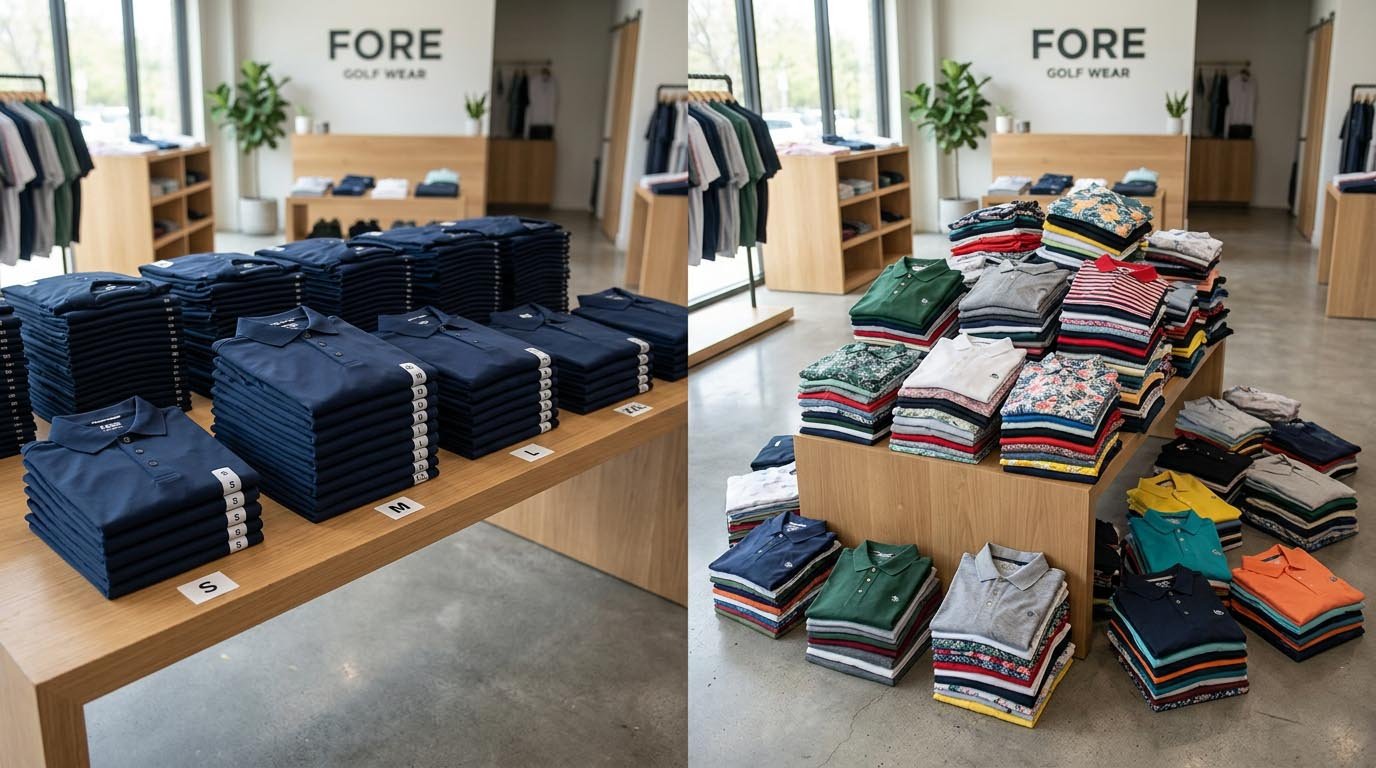
The total MOQ is still 100 pieces.
But the commercial result is completely different.
You may quickly sell out of a popular Medium or Large while still holding inventory in slower sizes.
This is why brands should not ask:
“Can I order only 100 pieces?”
Ask:
“How many usable pieces will I have in each SKU after I divide my order?”
That question gives you a much clearer view of inventory risk.
When Is a 50-Piece Golf Polo MOQ the Right Choice?
A 50-piece order is mainly useful when your priority is reducing initial inventory exposure rather than achieving the lowest possible cost per polo.
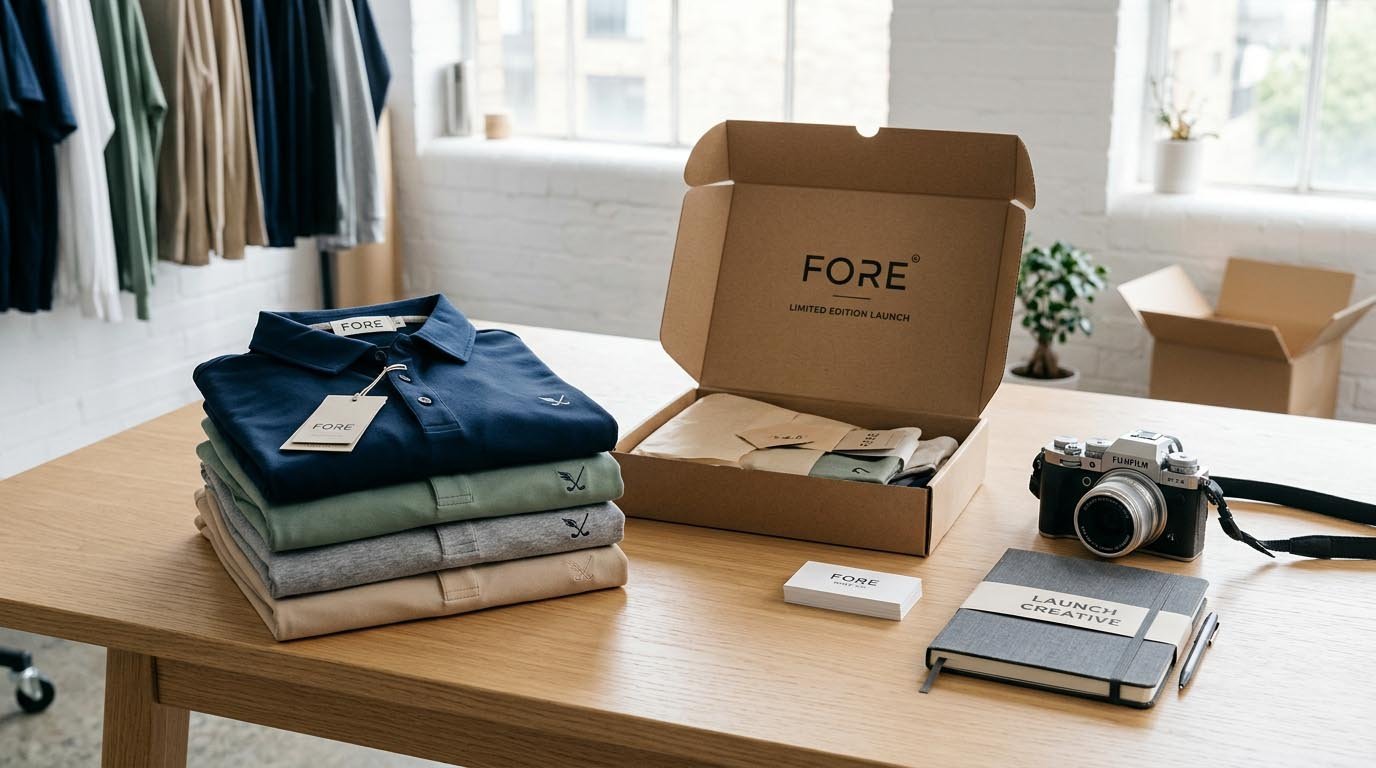
It can make sense for:
- A first product launch
- A new golf brand
- Testing a new fit
- Testing a new design
- Photography and content creation
- Small membership programs
- Local events or tournaments
- VIP or limited drops
- Early customer validation
If you are building your own label rather than buying generic blanks, it is also useful to understand how Private Label golf apparel affects labels, branding, packaging, trims, and production planning.
What Are the Advantages of 50 Pieces?
The biggest advantage is flexibility.
Instead of committing large amounts of cash to an unproven product, you can test:
- Fit
- Collar construction
- Fabric feel
- Sleeve length
- Branding
- Color preference
- Customer response
Then you can improve the next production run.
For example, customer feedback may tell you:
- The sleeves should be slightly shorter.
- The collar needs more structure.
- Large sells faster than Small.
- Navy performs better than a fashion color.
- Customers prefer a lighter fabric.
Those lessons can be very valuable before scaling.
What Are the Limitations of a 50-Piece Order?
Low MOQ does not mean there are no trade-offs.
1. Higher Unit Cost
Pattern development, embroidery digitizing, cutting preparation, machine setup, labels, and other production tasks do not disappear simply because you order fewer pieces.
Those costs are spread across fewer garments.
As a result:
A 50-piece order will normally cost more per unit than a larger production run with the same specification.
2. Limited Color Selection
Suppose you order 50 pieces but want:
- 3 colors
- 5 sizes
That creates 15 SKUs.
Your stock becomes very thin.
For first orders, concentrating your quantity into fewer colors is often more practical.
3. Fabric Choices May Be More Limited
Small production runs usually work more easily with available fabrics.
A completely custom fabric construction or custom dyeing program may require higher fabric mill minimums.
If fabric is one of the most important parts of your product, see our Fabric Sourcing page for more information about performance fabrics, sourcing options, and custom fabric development.
That does not mean every custom detail is impossible at 50 pieces.
It means you should discuss the exact fabric and decoration requirements with the manufacturer before assuming they are available at a low MOQ.
Why Is 100 Pieces Often a Practical MOQ for Growing Brands?
For many small and growing golf brands, 100 pieces can provide a useful middle ground.
You get more inventory depth than a 50-piece test without taking on the same total exposure as a much larger production run.
A 100-piece order may suit brands that:
- Have already tested their design
- Know which colors customers prefer
- Have some existing sales data
- Need more stock in Medium and Large
- Want better production efficiency
- Are preparing for a more serious launch
How Should You Structure a 100-Piece Order?
The biggest mistake is thinking:
“I have twice the quantity, so I can add twice the number of options.”
That is often not the best use of the extra volume.
Instead, use the additional pieces to build depth in your stronger products.
Example A: 1 Color
100 pieces across one color and five sizes gives you substantial depth.
Example B: 2 Colors
100 pieces divided into two colors gives roughly 50 pieces per color.
This can still create a workable size curve.
Example C: 4 Colors
100 pieces divided into four colors leaves only 25 pieces per color.
Once those 25 pieces are split into several sizes, stock becomes thin again.
Better principle:
Add depth before adding unnecessary variety.
If your Navy polo sells well, another 50 units of Navy may create more commercial value than introducing three untested colors.
Should Every Size Receive the Same Quantity?
Usually, no.
An equal size split might look simple:
- S: 20
- M: 20
- L: 20
- XL: 20
- XXL: 20
But actual customer demand is rarely perfectly equal across sizes.
A better approach is to use your own historical sales data.
If you do not yet have sales history, start with a reasonable initial size curve, then adjust future orders based on real customer demand.
For example:
| Size | Example Allocation |
|---|---|
| S | 10% |
| M | 25% |
| L | 30% |
| XL | 25% |
| XXL | 10% |
This is only an example—not a universal formula.
Your real size distribution should reflect your target customer.
When Does a 500-Piece Golf Polo MOQ Make Sense?
A 500-piece order becomes more attractive when a brand has already reduced much of the uncertainty around its product.
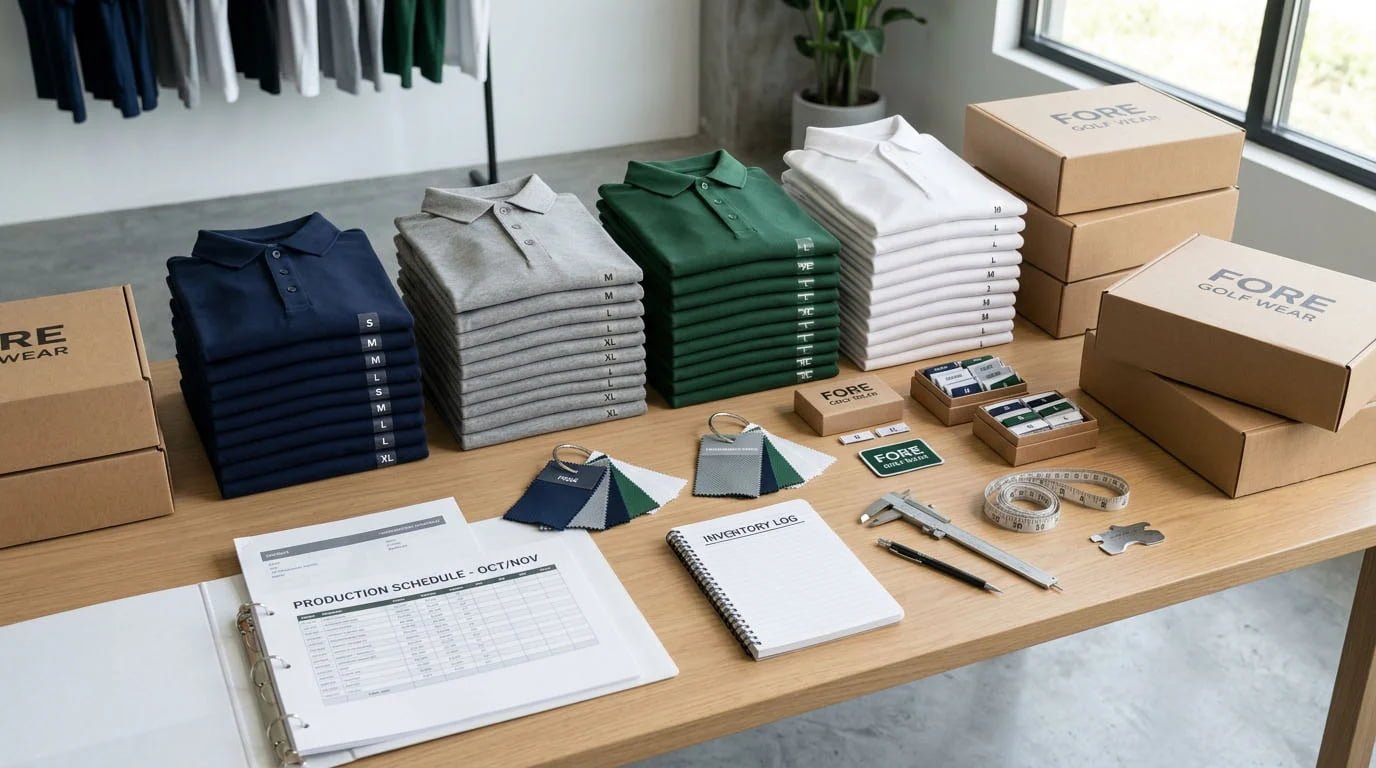
It may make sense when:
- The product already sells consistently
- You know your size ratio
- You understand your strongest colors
- You have predictable sales channels
- You supply retailers or distributors
- You need deeper inventory
- You want more custom development
- You can comfortably manage the additional stock
At this stage, the objective changes.
You are no longer asking:
“Will this product sell?”
You are asking:
“How can I produce this proven product more efficiently and consistently?”
Why Can Larger Orders Reduce Unit Cost?
Manufacturing includes many fixed or semi-fixed activities.
Examples include:
- Pattern preparation
- Size grading
- Fabric cutting setup
- Embroidery setup
- Printing setup
- Sewing line preparation
- Quality control preparation
- Label and packaging setup
When those activities are spread across 500 garments instead of 50, production becomes more efficient.
This is one reason larger orders often achieve a lower manufacturing cost per piece.
However:
Lower unit cost does not automatically mean lower business risk.
You still need to pay for and sell the additional inventory.
Saving a few dollars per unit is not helpful if hundreds of shirts remain unsold.
Does a 500-Piece MOQ Unlock More Customization?
Often, higher production quantities make deeper customization more practical.
Depending on the project and material suppliers, larger programs may provide more flexibility for:
- Custom fabric development
- Pantone color matching
- Custom dyeing
- Special fabric weights
- Custom collars
- Jacquard rib
- Branded buttons
- Silicone or rubber trims
- Custom labels
- Special packaging
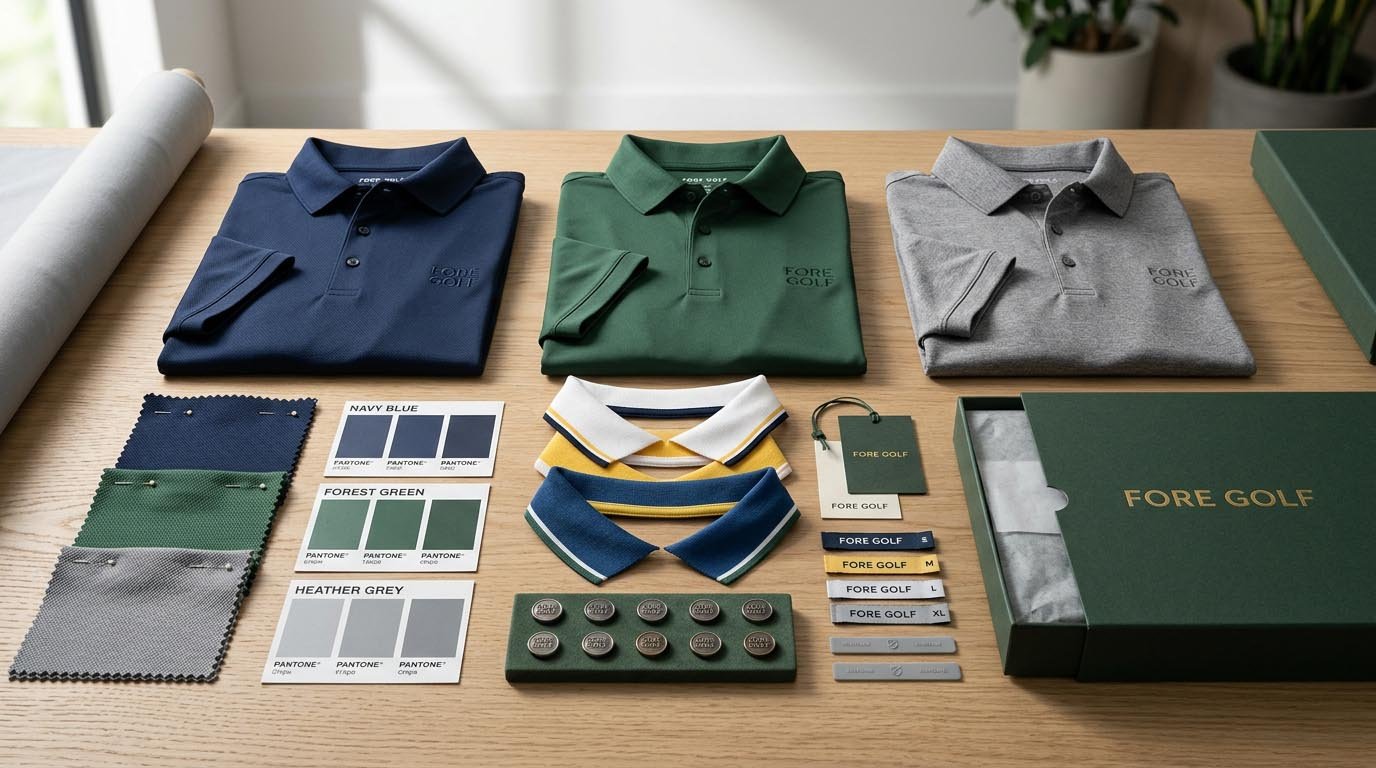
Brands that want their own labels, trims, packaging, and identity rather than standard factory branding can also review our Private Label capabilities.
However, there is no universal rule saying:
“500 pieces automatically unlocks every customization option.”
Actual minimums can depend on:
- Fabric mill
- Yarn type
- Fabric composition
- GSM
- Dyeing method
- Finishing treatment
- Trim supplier
- Logo technique
- Packaging specification
That is why a professional manufacturer should evaluate the complete tech pack before confirming the final MOQ.
50 vs 100 vs 500 Golf Polo MOQ: Quick Comparison
| Factor | 50 Pieces | 100 Pieces | 500 Pieces |
|---|---|---|---|
| Best for | Testing | Early growth | Scaling proven products |
| Initial cash exposure | Lowest | Moderate | Highest |
| Unit cost | Usually highest | More balanced | Usually lower |
| SKU depth | Limited | Moderate | Strong |
| Color flexibility | Keep focused | 1–2 often practical | More flexible |
| Available stock fabric | Practical | Practical | Practical |
| Custom fabric | More difficult | Project-dependent | More practical |
| Custom dyeing | Often limited | Project-dependent | More practical |
| Standard embroidery | Usually possible | Easy | Easy |
| Specialized trims | Limited by supplier MOQ | Moderate | More options |
| Inventory risk | Lower | Moderate | Higher |
| Main goal | Learn | Build depth | Scale |
How Does Fabric Choice Affect Golf Polo MOQ?
Fabric is one of the biggest reasons two golf polo projects can have very different minimum quantities.
Consider the difference between:
Project A
You select an existing polyester-spandex performance fabric already available from a supplier.
Project B
You want:
- A specific polyester/spandex ratio
- Custom GSM
- Custom texture
- Exact Pantone color
- Moisture-wicking finish
- UV performance
- Special hand feel
Project B requires much more development.
The fabric mill itself may have minimum production requirements.
This means:
Your garment manufacturer's sewing MOQ and the fabric mill's MOQ are not always the same thing.
For low-volume launches, choosing a suitable available performance fabric can often make production much easier.
If you want to understand how a manufacturer helps find existing performance fabrics or develop custom options, see our Golf Apparel Fabric Sourcing service.
Once the product proves itself, you can explore more customized fabric development in later orders.
How Do Embroidery and Printing Affect MOQ?
Branding can also influence your production structure.
Common golf polo decoration methods include:
- Embroidery
- Screen printing
- Heat transfer
- Silicone transfer
- Sublimation
- Woven labels
- Printed labels
Standard embroidery or heat transfer can usually be handled more easily at smaller quantities than fully custom fabric or specialized trims.
For classic chest logos, sleeve logos, or other stitched branding, you can review FUWAY's Golf Polo Embroidery options.
For graphic designs, larger artwork, or certain logo applications, Screen Printing may be another option.
For all-over patterns and highly graphic performance golf shirts, Sublimation Printing can be especially useful because the design is transferred directly into suitable polyester fabrics.
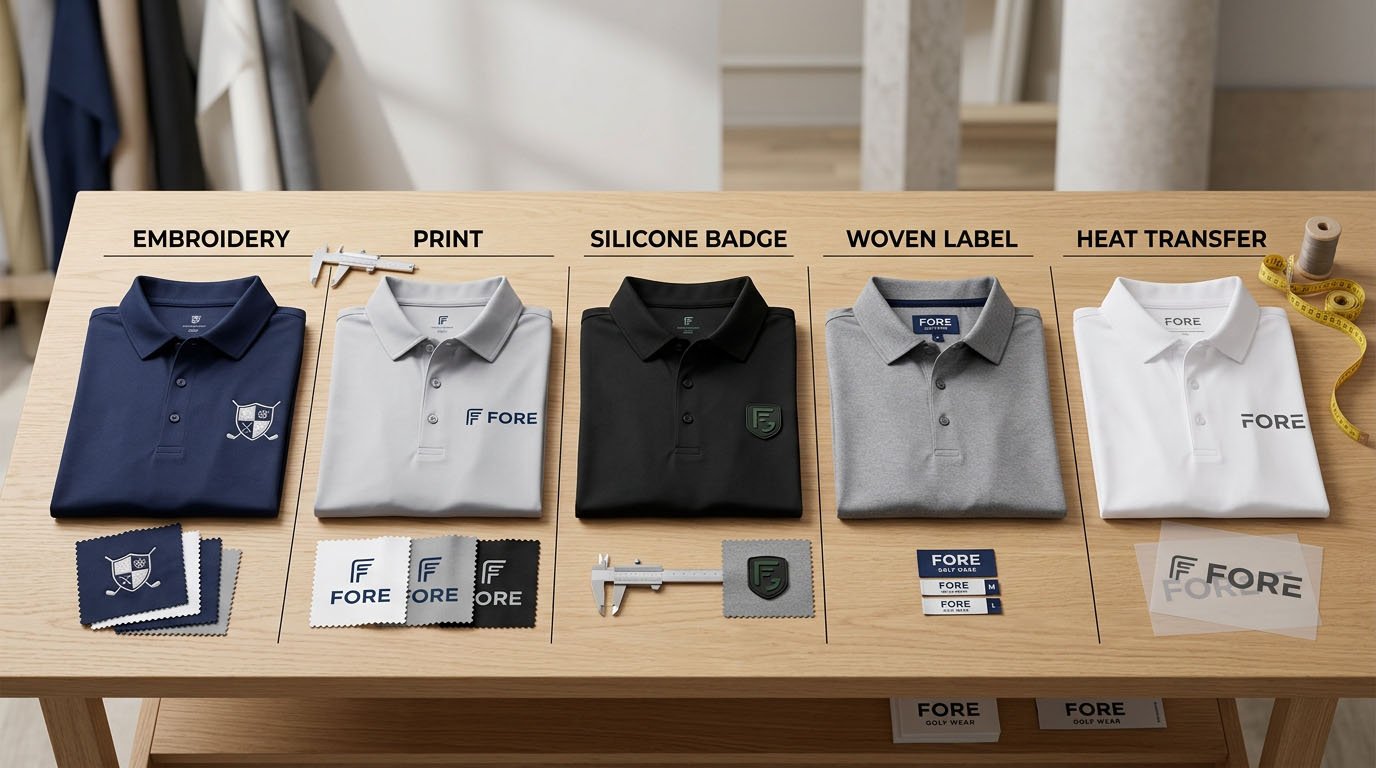
However, setup costs still matter.
For example, embroidery may require digitizing the logo file before production.
Screen printing may require separate screens for different colors.
Custom silicone badges may require molds.
The important question is therefore not simply:
“Can you add my logo?”
Ask:
“Does this branding method create its own setup fee or component MOQ?”
That will help you calculate your true production cost.
How Do Custom Labels and Trims Affect MOQ?
Some accessories have their own supplier minimums.
Examples include:
- Woven neck labels
- Size labels
- Hangtags
- Custom buttons
- Zippers
- Rubber patches
- Silicone logos
- Jacquard collars
- Branded polybags
Imagine you want only 100 golf polos, but your custom button supplier requires a much larger production batch.
You may still be able to manufacture the shirts, but you could need to purchase excess buttons for future orders.
That is not necessarily a problem.
You simply need to know about it before placing your order.
If your goal is to build a complete branded product with custom labels, tags, trims, and packaging, our Private Label Golf Apparel page explains this process in more detail.
How Should a Startup Choose Between 50, 100, and 500 Pieces?
Use your business stage rather than chasing the lowest unit price.
Choose Around 50 Pieces When:
- You are testing a new concept
- You have little sales history
- You want customer feedback
- Inventory risk matters more than unit margin
- You are comfortable paying more per piece to reduce total commitment
Choose Around 100 Pieces When:
- You have early sales evidence
- You know your strongest color
- You need better stock depth
- You are preparing for a proper online launch
- You want a better balance between cost and inventory
Choose Around 500 Pieces When:
- Demand is already proven
- You understand your size curve
- You have reliable sales channels
- You need deeper customization
- You can manage the additional inventory
- Lower unit cost has meaningful commercial value
What Should You Decide Before Asking a Manufacturer About MOQ?
Before contacting a golf polo manufacturer, prepare these six things.
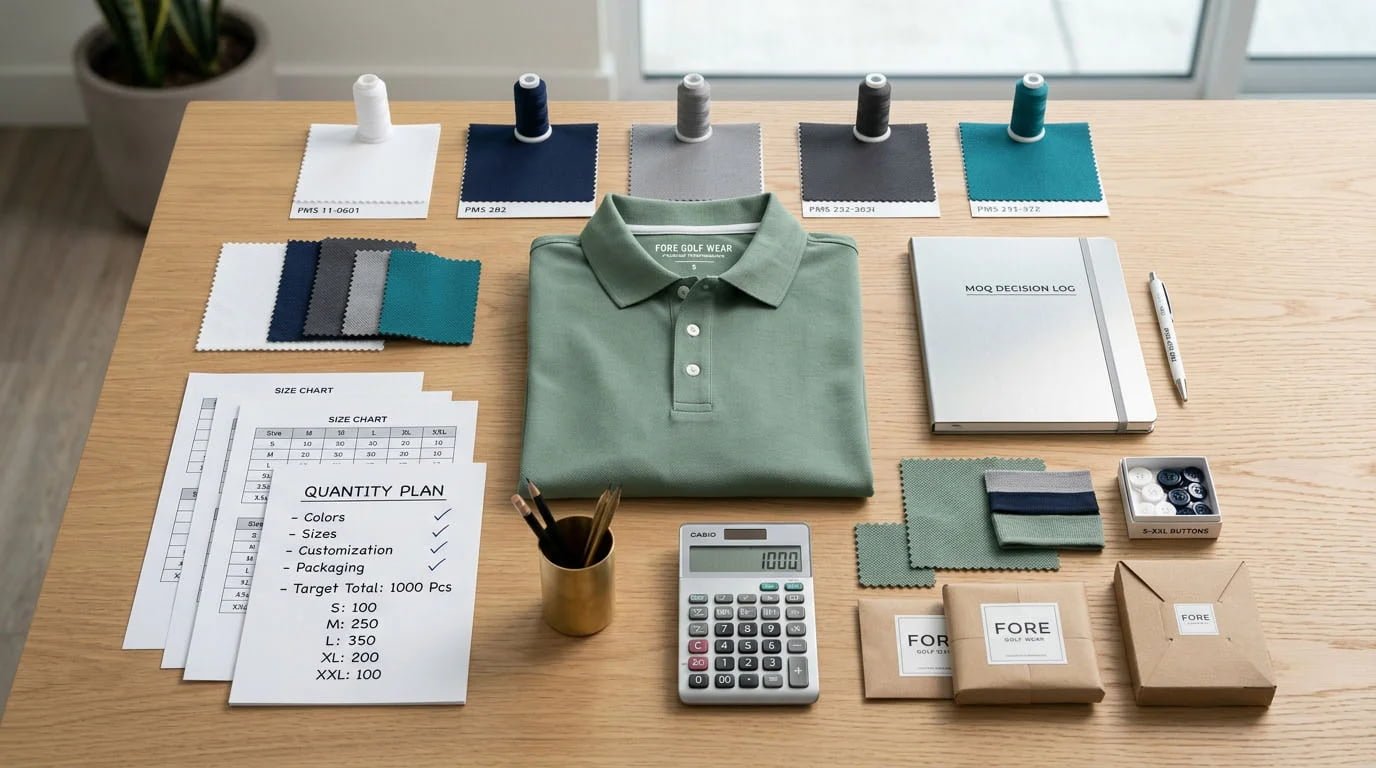
1. Number of Styles
Do you really need three different polo designs at launch?
Or would one strong design be better?
2. Number of Colors
Every additional color divides your order.
Start with your strongest color ideas instead of trying to launch a huge collection immediately.
3. Size Range
Determine which sizes your target customer actually needs.
4. Size Ratio
Do not automatically divide your order evenly.
Think about likely demand for each size.
5. Customization Requirements
List whether you need:
- Embroidery
- Printing
- Custom labels
- Custom buttons
- Custom collar
- Pantone colors
- Custom fabric
- Special packaging
If you are still deciding which manufacturing techniques fit your design, compare FUWAY's Custom Golf Shirts, Embroidery, Screen Printing, and Sublimation Printing capabilities.
6. Your Main Goal
Are you:
- Testing?
- Launching?
- Restocking?
- Scaling?
- Supplying wholesale customers?
Your objective should influence your order quantity.
What Questions Should You Ask a Golf Polo Manufacturer?
Instead of asking only:
“What is your MOQ?”
Ask a more complete set of questions.
1. Is the MOQ per style or per total order?
This is extremely important.
2. Can I split the MOQ across colors?
If yes, ask how many colors are practical.
3. Can I mix sizes freely?
Most production runs allow different sizes, but confirm before ordering.
4. Does the fabric have a separate MOQ?
Especially important for custom fabric or dyeing.
5. Do labels or trims have separate minimum quantities?
Accessory suppliers may have different requirements.
6. Does embroidery or printing have a setup fee?
This matters especially for small orders.
7. What changes if I increase from 50 to 100 or 500 pieces?
Ask about:
- Unit cost
- Fabric options
- Customization
- Production efficiency
8. What sample should I approve before bulk production?
A proper pre-production approval process helps reduce costly mistakes.
You can also review available FUWAY Test Reports when evaluating fabric and product quality requirements before bulk production.
What Is the Biggest MOQ Mistake New Golf Brands Make?
The biggest mistake is usually:
Launching too many SKUs too early.
A founder may want:
- 3 polo designs
- 4 colors each
- 5 sizes
That creates:
3 × 4 × 5 = 60 SKUs
Even a 500-piece order divided across 60 SKUs averages only a little over eight units per SKU.
That may still create poor inventory depth in your most popular sizes.
Instead of trying to look like a large brand immediately, it can be smarter to launch:
- Fewer styles
- Fewer colors
- Better stock depth
- Better photography
- Better marketing
- Better customer feedback loops
Then expand based on actual sales data.
Is a Lower MOQ Always Better?
No.
A lower MOQ reduces your total inventory commitment, which is valuable for testing.
But it can also create:
- Higher unit costs
- Thin stock depth
- Frequent stockouts
- Limited custom fabric options
- Lower production efficiency
There is always a trade-off.
The goal is not:
Find the lowest possible MOQ.
The goal is:
Find the lowest sensible MOQ for your current business stage.
Is a Higher MOQ Always Cheaper?
Not in total.
A larger production order often reduces cost per unit.
But it increases:
- Total cash commitment
- Inventory exposure
- Warehouse requirements
- Risk of unsold stock
For example:
Ordering 500 units because each shirt is cheaper is not a saving if you can only sell 200 of them.
The correct comparison is not simply:
Cost per polo.
You should also look at:
Total inventory investment + expected sell-through + gross margin + cash-flow risk.
Should You Start With 50 Pieces and Scale Later?
For an unproven design, that can be a sensible strategy.
A brand might move through stages such as:
Stage 1 — Validate
50 pieces
Test:
- Fit
- Product quality
- Branding
- Color
- Customer demand
Stage 2 — Build Depth
100 pieces
Use what you learned to improve:
- Size ratio
- Color selection
- Product details
Stage 3 — Scale
500+ pieces
Once demand becomes predictable, consider:
- Better unit economics
- Deeper inventory
- More advanced customization
- Wholesale distribution
This is not a mandatory path.
Some established brands may start much higher.
Some niche brands may stay at lower quantities for years.
The right strategy depends on your sales model.
Frequently Asked Questions About Golf Polo MOQ
What is a typical MOQ for custom golf polos?
There is no universal MOQ.
It depends on the manufacturer, fabric, customization, colors, trims, and production method.
Some projects using available materials can support relatively low quantities, while custom fabric and trim programs often require larger runs.
Is 50 pieces enough to launch a golf polo brand?
It can be enough for a focused market test.
Keep the number of colors and sizes controlled so your inventory is not spread too thin.
Is 100 pieces a good MOQ for a startup?
For many growing brands, 100 pieces can offer a useful balance between inventory exposure and SKU depth.
However, the correct quantity depends on how the order is divided.
Can I split 100 pieces across two colors?
Depending on the manufacturer's production rules, this may be possible.
For example, 50 units in each color can still provide a workable size distribution.
Always confirm the exact color minimum with the manufacturer.
Can I split the MOQ across different polo styles?
This depends on the manufacturer.
Different styles may require separate:
- Patterns
- Cutting layouts
- Fabric consumption
- Sewing operations
Therefore, manufacturers often calculate MOQ by style rather than simply combining every garment in one purchase order.
Why do custom fabrics require higher MOQs?
Custom fabric involves a separate supply chain.
The mill may need to:
- Source yarn
- Knit fabric
- Dye fabric
- Apply finishing
- Conduct testing
Those processes have their own minimum production requirements.
If your product depends heavily on a specific hand feel, stretch level, GSM, or functional finish, you can learn more about our Fabric Sourcing service.
Does embroidery increase the MOQ?
Not necessarily.
Standard embroidery can often be used on relatively small production runs.
However, digitizing and setup costs mean embroidery may cost more per garment on very small orders.
You can see more about logo application on our Golf Polo Embroidery page.
Does a lower MOQ always reduce risk?
It reduces your total inventory exposure, but it can create other risks such as:
- Higher unit cost
- Thin size availability
- Fast stockouts
The best MOQ balances both sides.
Final Thoughts: Which Golf Polo MOQ Is Right for Your Brand?
There is no universal winner between 50, 100, and 500 pieces.
Think about them as different tools.
50 Pieces
Best for learning.
You reduce inventory exposure and gather real customer feedback.
100 Pieces
Best for building useful depth.
You can support a more realistic size curve while keeping inventory relatively controlled.
500 Pieces
Best for scaling proven demand.
You gain stronger production efficiency, deeper inventory, and potentially greater customization flexibility.
But the most important lesson is this:
Do not choose your golf polo MOQ based only on the total number of pieces.
Look at:
- Styles
- Colors
- Sizes
- SKU depth
- Fabric requirements
- Customization
- Unit economics
- Inventory exposure
- Expected sales
A well-planned 100-piece order can be much healthier than a poorly structured 500-piece order.
And a focused 50-piece test can be more valuable than committing too much cash before you know what your customers actually want.
If you are preparing a custom golf polo project, send FUWAY your design, expected quantity, colors, size range, fabric requirements, and branding details. Our team can review the order structure and help you determine a production plan that fits your stage instead of simply pushing you toward the largest possible MOQ.
Contact FUWAY to discuss your golf polo project and get a production recommendation based on your actual design and order structure.