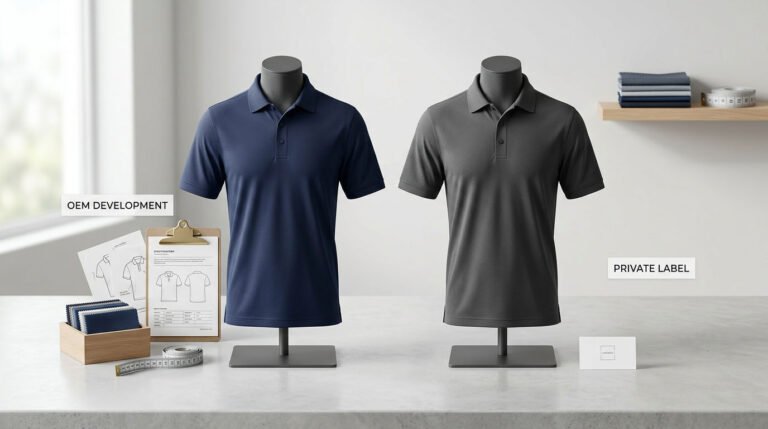
Choosing between OEM and ODM is one of the first important sourcing decisions a golf apparel brand has to make.
The right choice is not simply about whether OEM is “more customized” or ODM is “cheaper.” It depends on your design readiness, required level of customization, launch timeline, order volume, budget, and whether owning the technical product assets matters to your brand.
For some brands, OEM makes sense from the beginning. For others, ODM provides a faster and lower-risk way to test the market before investing in proprietary product development.
This guide explains the practical differences and helps you decide which model fits your brand.
Quick Answer: What Is the Difference Between OEM and ODM Golf Apparel?
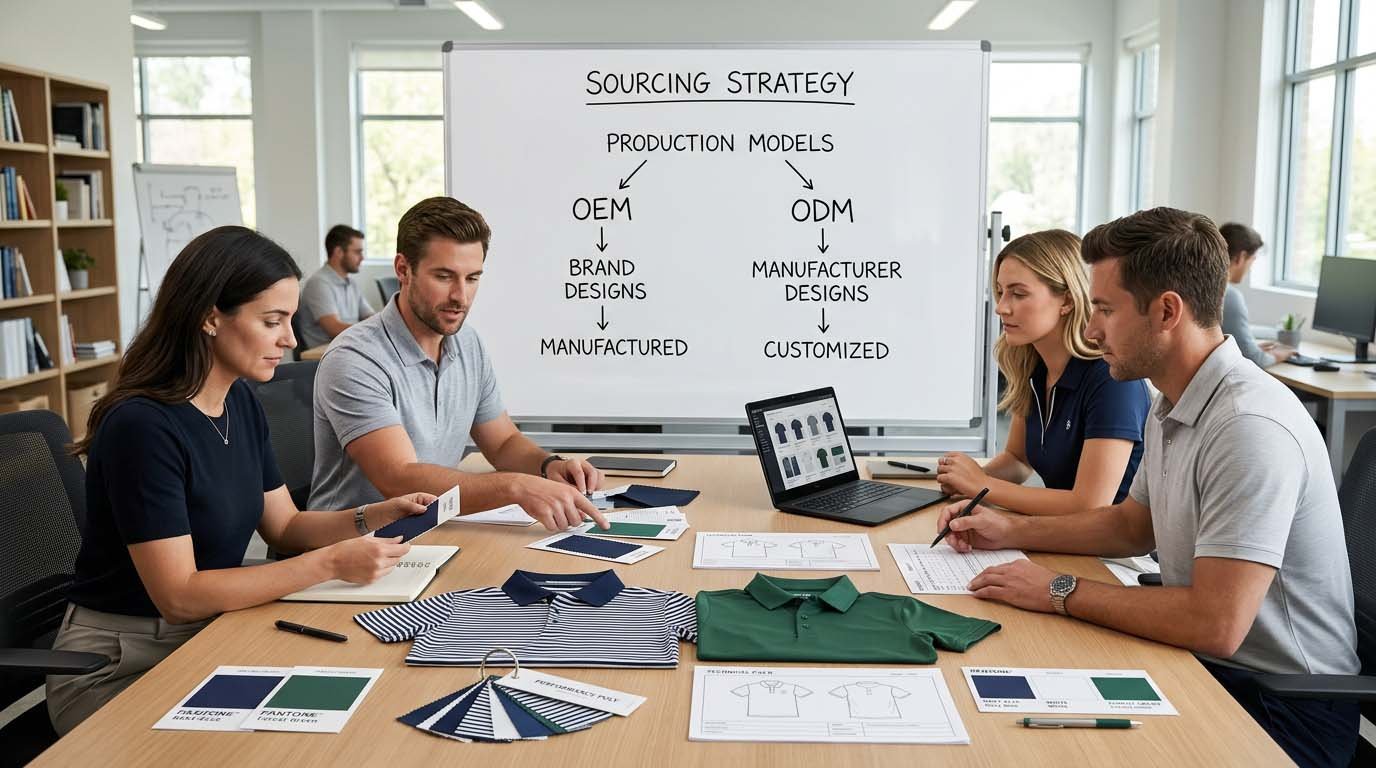
OEM (Original Equipment Manufacturer) generally means the product is developed and manufactured according to your own specifications.
You may provide a tech pack, measurement chart, reference garment, fabric requirements, construction details, artwork, and other product information.
ODM (Original Design Manufacturer) starts from a product, pattern, fit block, or design platform the manufacturer has already developed. You customize selected elements such as fabric, colors, logos, trims, labels, and packaging.
The simplest way to think about it is:
OEM starts with your product specification. ODM starts with the manufacturer's existing product platform.
Neither model is automatically better.
OEM vs ODM Golf Apparel: Quick Comparison
| Factor | OEM | ODM |
|---|---|---|
| Starting point | Your specification or concept | Manufacturer's existing platform |
| Design control | High | Moderate |
| Fit customization | High | Usually limited |
| Product uniqueness | Higher potential | Lower to moderate |
| Development work | More | Less |
| Sampling | More involved | Usually simpler |
| Upfront development cost | Usually higher | Usually lower |
| MOQ | Can be higher | Can be more flexible |
| Launch speed | Usually slower initially | Usually faster |
| Pattern/IP ownership | Can be brand-owned by agreement | Base pattern often manufacturer-owned |
| Best suited for | Proprietary products | Faster testing and simpler customization |
Actual MOQ, cost, and lead time depend on fabric, trims, construction, testing, order quantity, and factory capacity.
OEM or ODM? Use This Decision Tree First
Before looking at every technical difference, use this simple decision framework.
Decision Logic
Do you have production-ready specifications?
YES
↓
Does your product require proprietary fit, construction, or technical features?
YES → Consider OEM
NO
↓
Would an existing product platform meet most requirements?
YES → Compare OEM and ODM based on speed, cost, and IP
Do you have production-ready specifications?
NO
↓
Can your product start from an existing golf apparel style?
YES → Consider ODM or co-development
NO
↓
Develop specifications or tech pack first → OEM development
This decision tree should come before detailed comparisons because it reflects how real projects are usually evaluated.
What Is OEM Golf Apparel Manufacturing?
In an OEM project, the product is built around specifications that are specific to your brand.
You may provide:
- Tech pack
- Measurement chart
- Reference garment
- Technical sketches
- Fabric specifications
- Pantone colors
- Construction details
- Logo artwork
- Labels
- Packaging requirements
The manufacturer may then support:
- Fabric sourcing
- Pattern development
- Sample making
- Fit adjustment
- Grading
- Embroidery or printing
- Trim sourcing
- Bulk production
- Quality control
- Packing and shipping coordination
OEM makes more sense when your product itself is an important part of your competitive advantage.
For example, if your golf polo requires a proprietary athletic fit, custom collar construction, unique panel layout, or specific mobility features, OEM gives you greater control over the final product.
If you are developing custom golf polos, see FUWAY's Custom Golf Shirts capabilities.
What Is ODM Golf Apparel Manufacturing?
ODM starts from a product platform the manufacturer has already developed.
Examples may include:
- Existing golf polo
- Quarter-zip
- Golf shorts
- Golf skort
- Standard fit block
- Existing fabric-and-fit combination
You then customize elements such as:
- Fabric
- Colors
- Logos
- Embroidery
- Printing
- Labels
- Hang tags
- Packaging
- Selected trims
ODM can work well when your brand does not yet need a proprietary pattern or complex construction.
For example, a startup may want a moisture-wicking polo with brand colors, embroidery, custom labels, and branded packaging.
If an existing golf polo block already delivers the required fit and performance, ODM can reduce unnecessary development work.
FUWAY also supports Private Label projects for brands that want strong branding without developing every garment from the beginning.
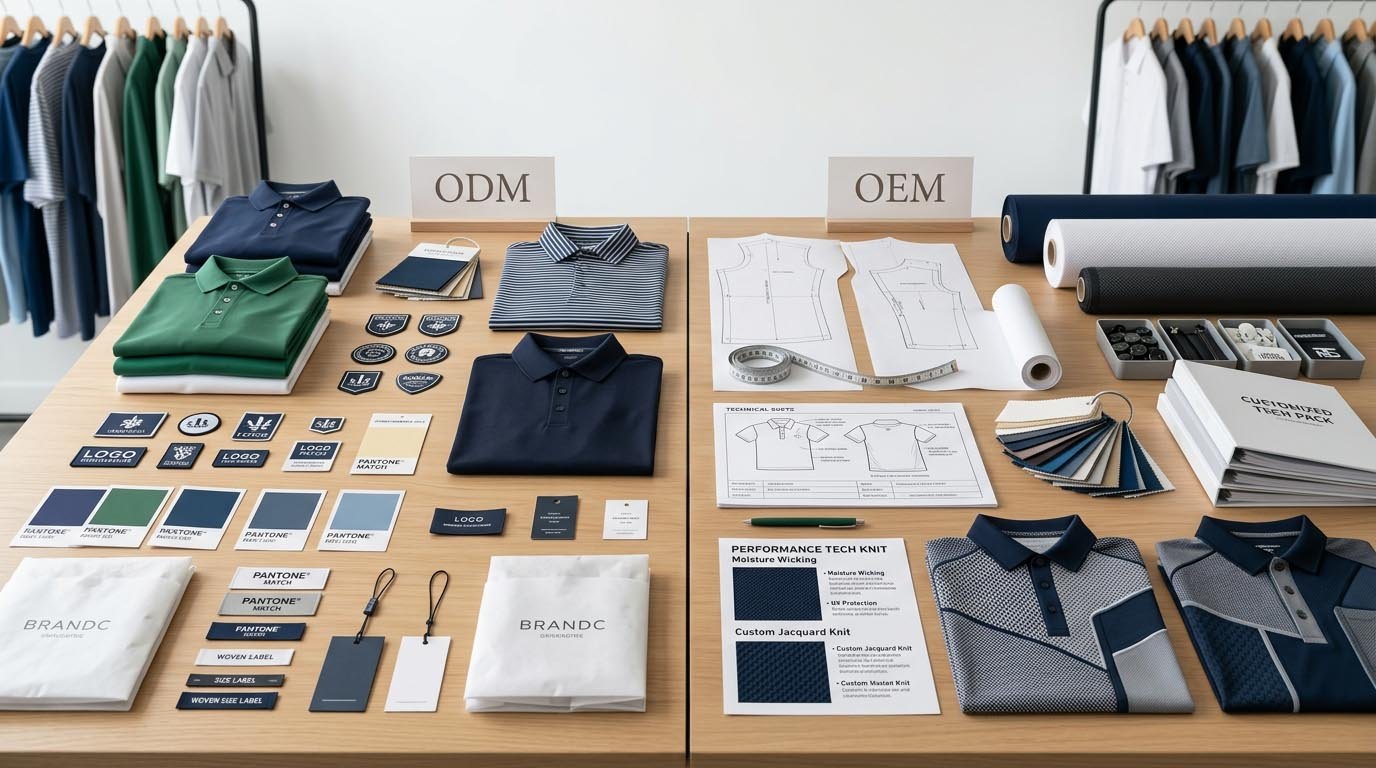
What Can You Customize in OEM vs ODM?
The main difference is not whether customization exists.
It is how deep that customization goes.
| Customization | ODM | OEM |
|---|---|---|
| Logo | ✓ | ✓ |
| Colors | ✓ | ✓ |
| Labels & packaging | ✓ | ✓ |
| Embroidery / printing | ✓ | ✓ |
| Fabric selection | Often | ✓ |
| Trim changes | Often | ✓ |
| Minor fit changes | Sometimes | ✓ |
| Proprietary fit | Limited | ✓ |
| New pattern architecture | Limited | ✓ |
| Custom construction | Limited | ✓ |
| Technical performance features | Limited | ✓ |
ODM is often suitable for brand-level customization.
OEM is usually more appropriate when changes affect:
- Fit
- Pattern
- Construction
- Grading
- Technical features
- Garment architecture
A useful rule is:
If the change affects mainly how the garment looks, ODM may be enough. If it changes how the garment is built, fits, or performs structurally, OEM is more likely to be required.
For branding options, see FUWAY's Embroidery and Screen Printing capabilities.
Does OEM Mean Better Quality Than ODM?
No.
OEM and ODM describe the development model. They do not determine garment quality.
An ODM polo made with good fabric, approved samples, clear specifications, consistent workmanship, and proper inspections can perform very well.
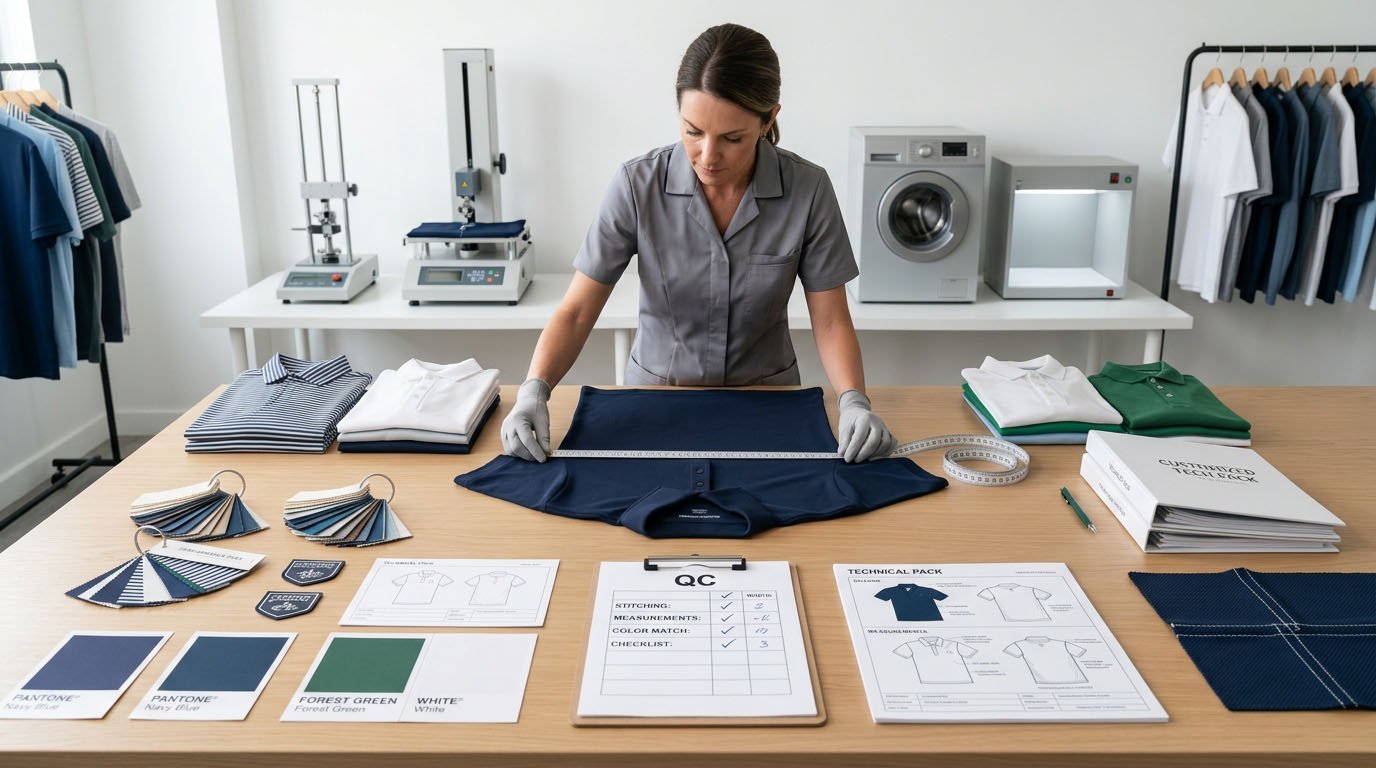
An OEM product can still fail if:
- Specifications are unclear
- Fabric is unsuitable
- Measurements are inconsistent
- Samples are not properly approved
- Bulk quality control is weak
- Changes are introduced without approval
Quality depends on process control.
For both OEM and ODM projects, buyers should define and verify:
- Fabric composition
- Fabric weight
- Stretch and recovery
- Shrinkage
- Colorfastness
- Pilling
- Stitching quality
- Measurement tolerances
- Logo appearance
- Packaging requirements
- Approved sample standards
How Does the Sampling Process Differ Between OEM and ODM?
Sampling is one of the clearest practical differences between the two models.
OEM Sampling Path
Tech Pack → Prototype → Fit Review → PP Sample → Bulk Production
Depending on the project, additional steps may include:
- Revised prototype
- Size set
- Lab dip
- Trim approval
- Artwork approval
- Wash test
OEM usually requires more development because a new combination of pattern, fit, material, and construction must be validated.
ODM Sampling Path
Base Style → Customization → Sample → Approval → Bulk Production
Because the underlying pattern already exists, some early development stages may be reduced.
Suggested graphic content:
OEM
Tech Pack
↓
Prototype
↓
Fit
↓
PP Sample
↓
Bulk
ODM
Base Style
↓
Customization
↓
Sample
↓
Approval
↓
Bulk
Even with ODM, buyers should still check:
- Fit
- Measurements
- Fabric hand feel
- Color
- Logo placement
- Embroidery or print quality
- Labels
- Trims
- Packaging
- Wash performance where relevant
An existing pattern does not eliminate the need for sample approval.
How Do MOQ, Cost, and Lead Time Differ?
There is no universal rule such as:
OEM always requires a specific MOQ.
or:
ODM always costs a fixed percentage less.
The real drivers are usually more important than the OEM or ODM label itself.
OEM
OEM may involve more upfront development because the factory may need to:
- Create or adjust patterns
- Grade sizes
- Source special materials
- Develop custom trims
- Produce multiple sample rounds
- Test unfamiliar construction
- Set up new production procedures
ODM
ODM may reduce some of those development requirements because the base product already exists.
That can sometimes mean:
- Lower initial development cost
- More flexible testing quantities
- Fewer sampling stages
- Faster development
But ODM does not automatically mean low MOQ.
For example, MOQ may still be driven by:
- Custom-dyed fabric
- Knitted collars
- Special zippers
- Custom elastic
- Specialty yarns
- Packaging
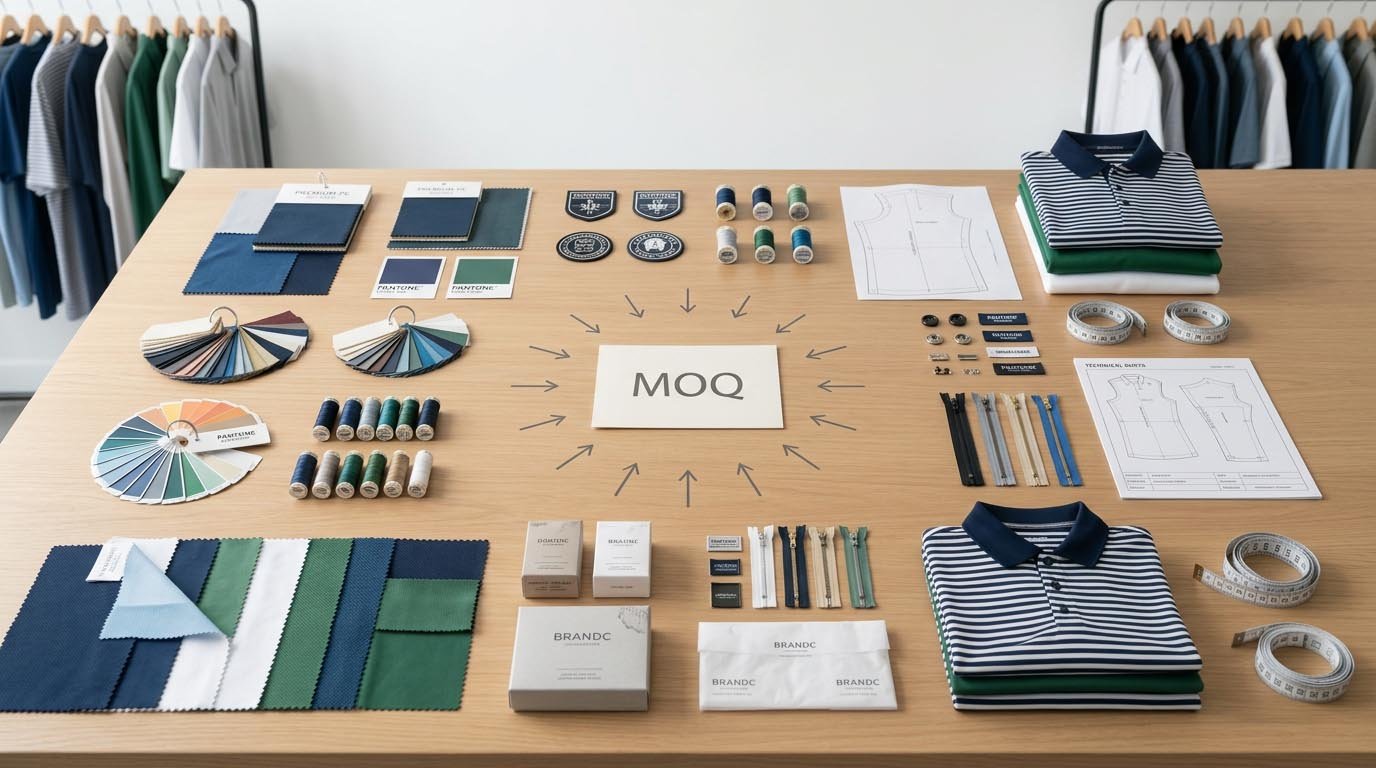
Suggested graphic: Place MOQ in the center, with arrows from:
- Fabric MOQ
- Custom Color
- Trims
- Pattern Development
- Printing / Embroidery
- Order Quantity
A better question than simply asking:
“What is your MOQ?”
is:
“What is driving the MOQ—garment production, fabric, color, trims, or custom development?”
That tells you much more about the real manufacturing constraint.
For more information on material development, see FUWAY's Fabric Sourcing service.
How Should You Think About Intellectual Property?
IP is one of the most important long-term differences between OEM and ODM.
However, brands should not assume ownership simply because a project is called OEM.
Ownership should be defined in writing.
In an OEM project
Clarify ownership of:
- Patterns
- Grading rules
- Tech packs
- Measurement specifications
- Artwork
- Custom trim designs
- Proprietary construction
- Digital development files
In an ODM project
The manufacturer will often retain ownership of the underlying:
- Pattern
- Fit block
- Base design
Your brand would normally retain brand-specific assets such as:
- Logos
- Artwork
- Brand names
- Labels
- Packaging
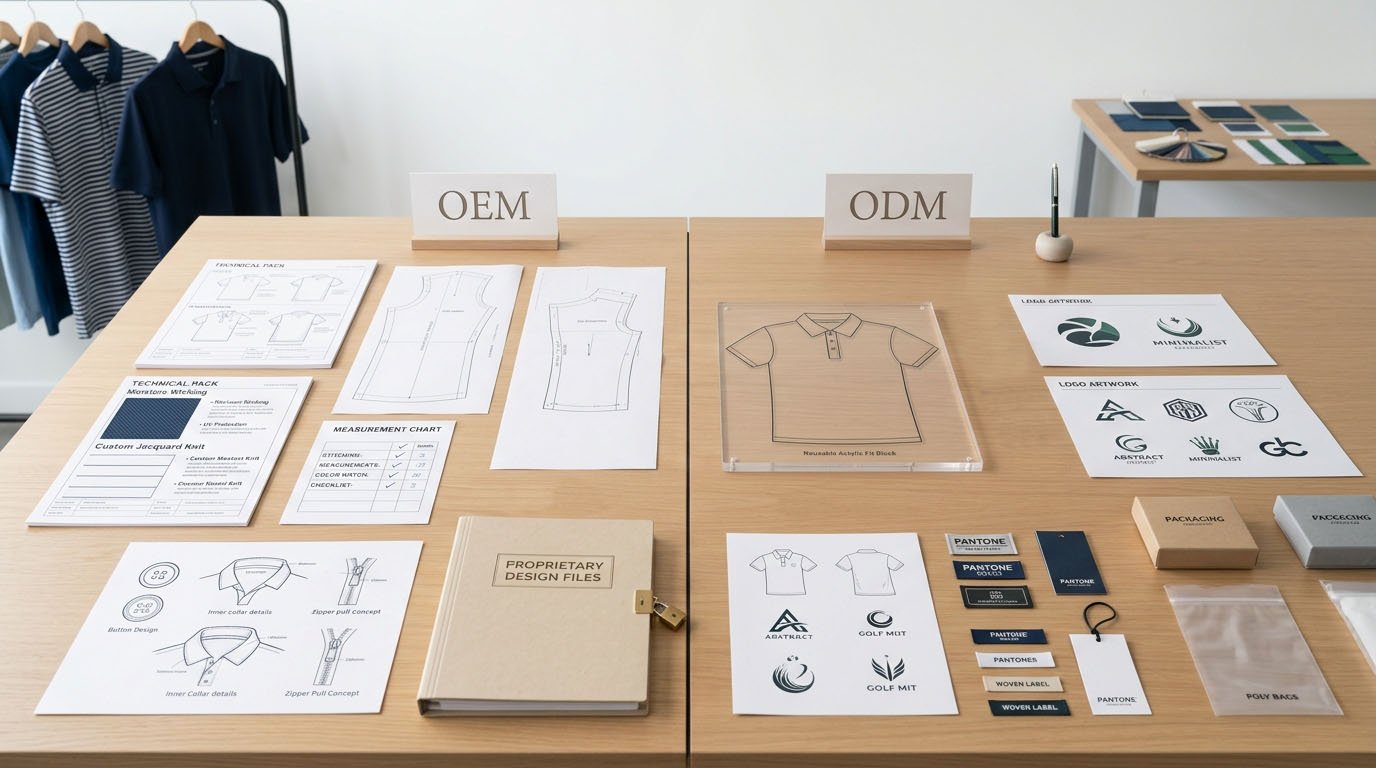
Suggested graphic content:
OEM — Brand-Controlled Assets
Tech Pack
Pattern
Grading
Custom Construction
Brand Artwork
ODM — Shared / Separate Assets
Factory → Base Pattern / Fit Block
Brand → Logo / Artwork / Labels / Packaging
If exclusivity matters, discuss it before production.
Pattern ownership becomes especially important if your brand later wants to move production to another manufacturer or use multiple factories.
How Does Compliance Responsibility Work?
OEM versus ODM does not automatically determine legal compliance responsibility.
Responsibilities depend on:
- Target market
- Brand role
- Importer role
- Product claims
- Materials
- Applicable regulations
- Contract terms
Manufacturers may support buyers with:
- Material documentation
- Supplier declarations
- Test reports
- Sample testing
- Production records
- Quality inspection
But brands and importers still need to identify which requirements apply to their market and verify that the necessary documentation is available.
Compliance should therefore be treated as a separate sourcing requirement rather than a reason by itself to choose OEM or ODM.
Which Model Fits Your Brand? Five Questions
You do not need a complicated scorecard.
These five questions are usually enough.
1. Do You Have Production-Ready Specifications?
If you already have a tech pack, measurement chart, fabric requirements, and construction details, OEM becomes practical.
If you mainly have references, sketches, and branding ideas, ODM or co-development may be easier.
2. Does Your Product Need Proprietary Fit or Construction?
If your competitive advantage depends on fit, pattern, grading, construction, or technical features, OEM is usually more suitable.
If differentiation comes mainly from branding, color, positioning, and marketing, ODM may be sufficient.
3. Are You Still Testing Market Demand?
If you are unsure which products, colors, sizes, or price points will perform, ODM can reduce early development risk.
4. Is Launch Speed More Important Than Maximum Product Uniqueness?
If speed matters more than creating a new pattern, ODM can shorten the development path.
If proprietary construction is essential, OEM may justify the extra development.
5. Do You Need Ownership of the Technical Assets?
If you want portable patterns, product specifications, and long-term control over your core products, OEM deserves stronger consideration.
OEM, ODM, or Hybrid?
The choice does not need to be permanent.
Many brands use different models for different products.
A practical development path may look like this:
ODM → Market Validation → Hybrid → OEM for Core Products
For example:
- Use ODM to test a new category.
- Collect customer feedback.
- Identify the styles worth developing further.
- Move successful core products into proprietary OEM development.
A growing golf brand might use OEM for its signature polo while using ODM for seasonal quarter-zips or secondary categories.
OEM and ODM can be selected SKU by SKU.
What Should You Send a Golf Apparel Manufacturer for a Quote?
A good RFQ produces a much better quotation.
Do not simply ask:
“How much is a custom golf polo?”
The manufacturer needs enough information to understand the project.
If You Are Requesting OEM
Send where possible:
- Tech pack
- Product sketch
- Reference garment
- Measurement chart
- Fabric requirements
- Color requirements
- Logo artwork
- Decoration method
- Label requirements
- Packaging
- Estimated quantity
- Size breakdown
- Target market
- Required testing
- Target delivery date
If You Are Requesting ODM
Send:
- Reference images
- Product category
- Preferred silhouette
- Preferred fabric
- Performance requirements
- Brand colors
- Logo
- Branding locations
- Estimated quantity
- Target customer
- Target price range
- Launch date
Then ask the manufacturer to recommend suitable existing styles.
Suggested graphic content:
OEM RFQ
Tech Pack
Measurements
Fabric
Artwork
Quantity
Testing
Delivery Date
ODM RFQ
Reference Style
Fabric Preference
Colors
Branding
Quantity
Target Price
Launch Date
Also Ask the Supplier
Before moving forward, clarify:
- What is driving the MOQ?
- How many sampling stages are needed?
- Who owns the pattern and technical files?
- Which parts can be customized without creating a new pattern?
- What quality checks are completed before bulk approval?
- What test documentation is available?
- Can the same ODM base design be supplied to other brands?
These questions cover the most important points without requiring a separate long checklist.
Frequently Asked Questions
Is OEM always more expensive than ODM?
Not necessarily on a per-unit basis.
If two garments use similar fabric, trims, decoration, and workmanship, production costs can be similar.
OEM may simply require more development work before bulk production.
Can I change an ODM product?
Yes, within limits.
Colors, branding, labels, packaging, fabrics, and some trims can usually be adjusted.
Once you change the core pattern, fit architecture, or construction, the project may move toward co-development or OEM.
Does ODM mean my golf apparel will look generic?
Not necessarily.
Brands can still differentiate through:
- Fabric
- Color
- Embroidery
- Printing
- Labels
- Packaging
- Merchandising
- Brand positioning
However, if construction itself is central to your product identity, OEM provides greater flexibility.
Can OEM and ODM coexist within the same brand?
Yes.
Many brands use OEM for core proprietary products and ODM for seasonal, secondary, or market-testing styles.
Conclusion: Choose the Model That Fits Your Brand
Choose OEM when your brand needs deeper control over fit, construction, specifications, technical assets, or proprietary product development.
Choose ODM when an existing product platform can achieve your commercial goal with less development work.
And consider a hybrid approach when some products need proprietary development while others mainly require reliable manufacturing and brand customization.
For many growing golf brands, the path may evolve naturally:
ODM to test → customer feedback → proprietary development → OEM for core products.
If you are not sure whether your next golf apparel project should be OEM or ODM, send FUWAY your reference product or tech pack, estimated quantity, customization requirements, target market, and launch date.
We can help evaluate which development path is more suitable before you invest in sampling and bulk production.