
You source a "4-way stretch" fabric for your golf shirt line. The sample arrives. You pull it—only one direction stretches. Your production budget is locked, and you cannot switch suppliers.
4-way stretch fabric stretches in both warp (vertical) and weft (horizontal) directions, with both axes extending ≥30% and recovering ≥90% after release. For golf shirts, verified 4-way stretch delivers unrestricted swing mobility, shape retention after washing, and all-day comfort—but only if you confirm supplier test reports before sampling.
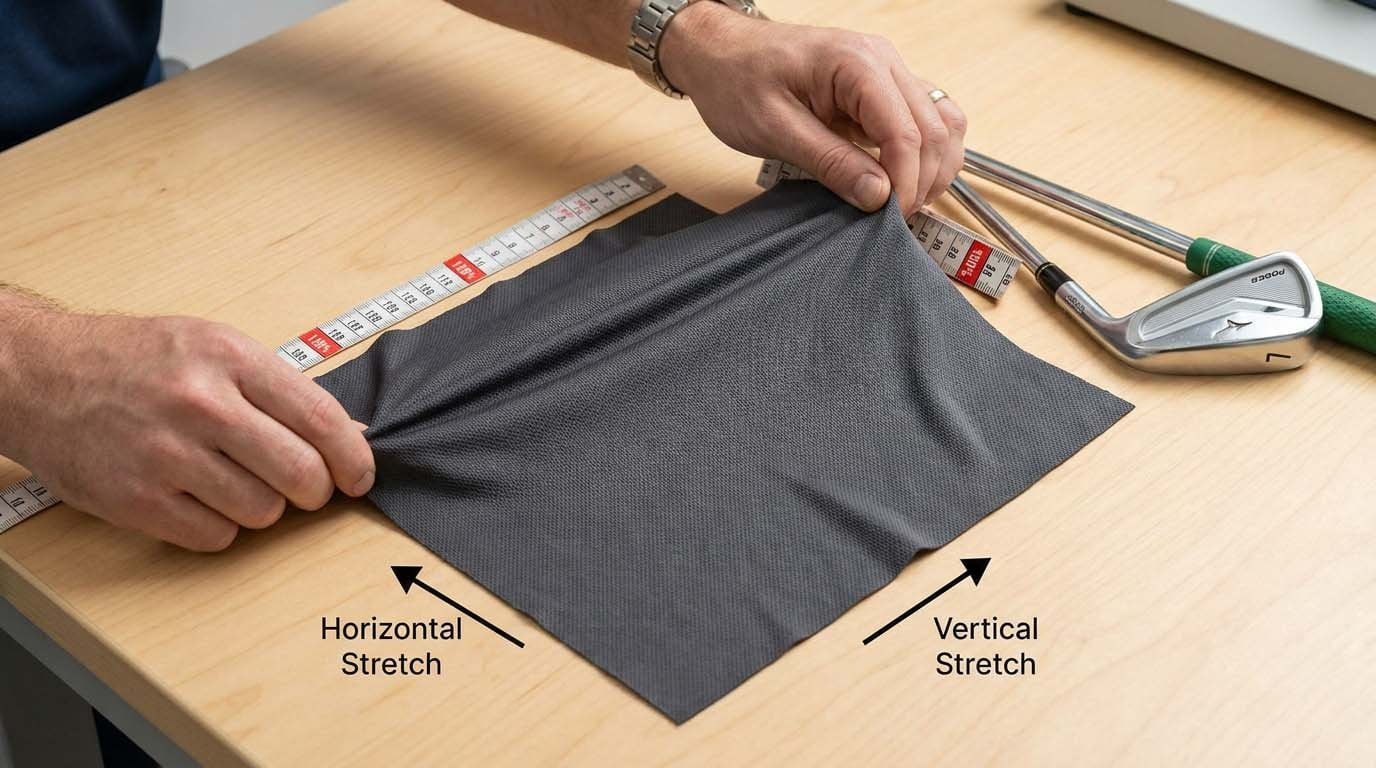
I have worked with dozens of private-label golf brands over the past eight years at FUWAY. The most common mistake I see is buyers approving fabric from a hand-pull test alone, then discovering after 500 pieces that the fabric only stretches horizontally or loses shape after three washes.
Quick Answers: 4-Way Stretch Fabric for Golf Shirts
What does 4-way stretch mean?
Fabric extends in both directions (warp and weft) with ≥30% elongation in each axis and recovers ≥90% after release.
How do I verify it before ordering?
Request supplier test reports showing both warp and weft stretch ≥30%, recovery ≥90%, and explicit test standard (e.g., ASTM D2594).
What is the right spandex percentage for golf shirts?
8–12% spandex for standard performance polos; 12–15% for high-stretch fitted styles. Below 8% often delivers only 2-way stretch.
Why does recovery matter more than stretch percentage?
A fabric that stretches 60% but recovers only 70% will bag at elbows and lose shape after a few rounds. Recovery ≥90% prevents permanent deformation.
What is the typical cost difference between verified and fake 4-way stretch?
Verified 4-way stretch fabric with test reports costs $1.50–$2.50/meter more than single-direction elastic labeled as "4-way," but eliminates return risk and shape-loss complaints.
What 4-Way Stretch Means—and Why It Matters in Golf
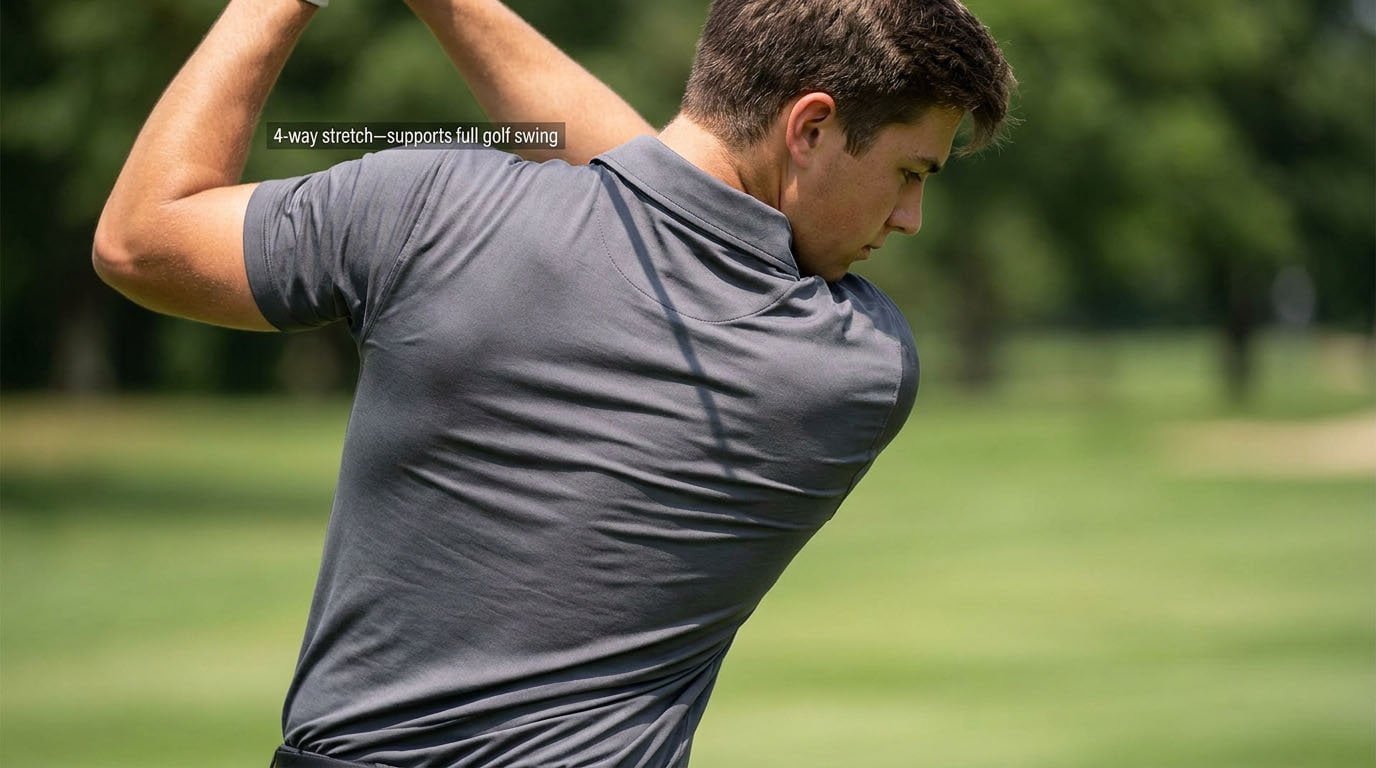
True 4-way stretch means the fabric extends ≥30% in both warp (length) and weft (width) directions and recovers ≥90% to its original dimension after release. For golf shirts, this allows unrestricted shoulder rotation during the backswing, elbow flexion during the downswing, and trunk rotation through impact—without the fabric pulling or restricting.
Why Golf Shirts Need Multi-Directional Stretch
Golf movement is not linear. A full swing demands:
- Shoulder rotation: 90–110° backswing requires fabric to stretch diagonally across the chest and upper back
- Elbow flexion: 30–50% extension at the elbow when reaching for the club at address
- Trunk rotation: 45–60° rotation through the torso during follow-through
A fabric that only stretches horizontally (2-way stretch) will restrict the backswing or create tension across the shoulders. A fabric that stretches in both directions but does not recover will bag at the elbows after nine holes.
The Procurement Trap: Fake 4-Way Stretch
The most common procurement risk is receiving fabric labeled "4-way stretch" that only stretches in one direction. I have reviewed supplier quotations where the fabric composition is listed as 95% polyester / 5% spandex—this percentage typically delivers only 2-way (horizontal) stretch, not true bi-directional elasticity.
| Spandex % | Typical Stretch Direction | Golf Shirt Application |
|---|---|---|
| 3–5% | 2-way (horizontal only) | Casual polos, loose fit |
| 8–12% | True 4-way | Performance polos, standard fit |
| 12–15% | High 4-way | Compression fit, athletic cut |
Without test data, you cannot know if the fabric is real 4-way stretch until you receive the bulk order—by which point your production timeline and budget are locked.
Materials and Knits: Poly/Spandex vs Nylon/Spandex; Jersey, Interlock, Piqué
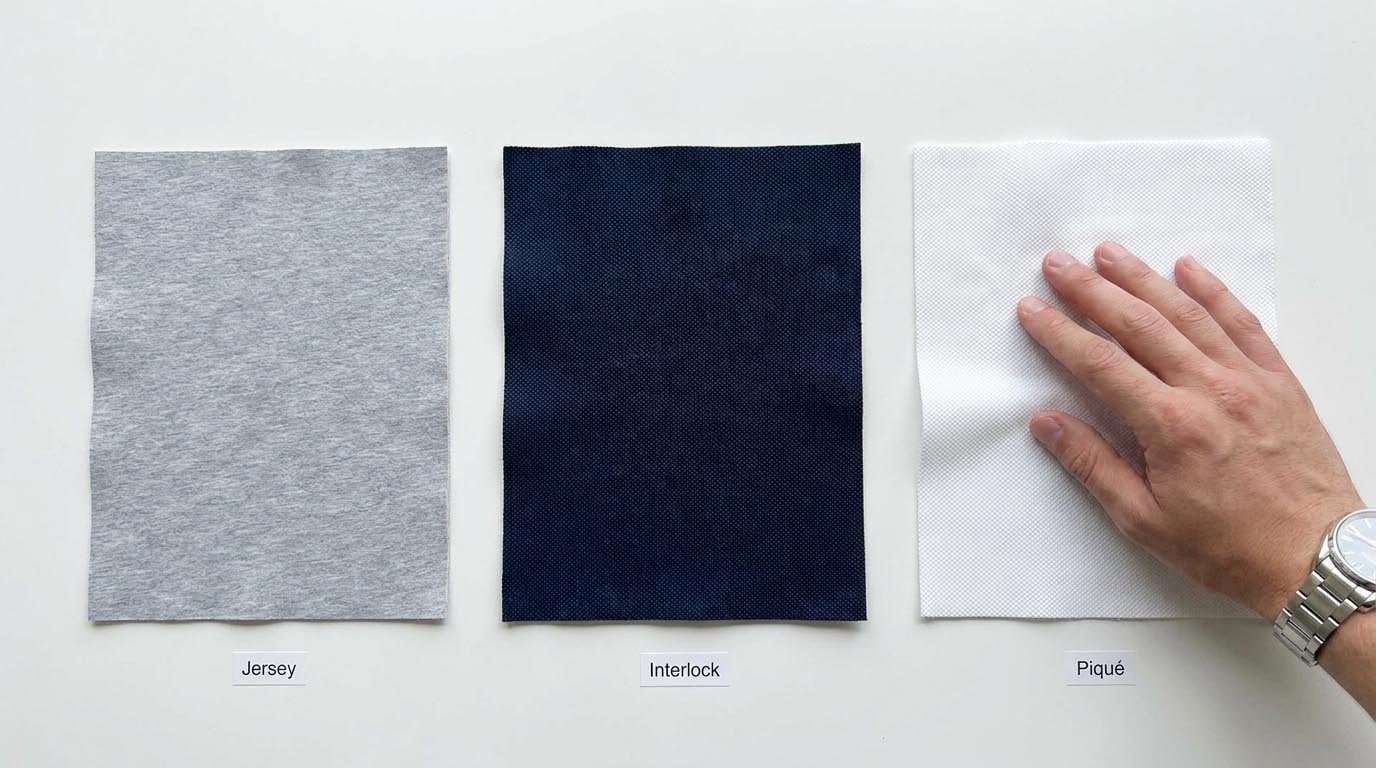
Polyester/spandex blends deliver quick-dry performance and color retention, ideal for printed golf shirts and warm-climate play. Nylon/spandex blends offer a softer hand feel and smoother compression, preferred for premium fitted polos. Knit structure—jersey, interlock, or piqué—affects breathability, texture, and moisture management independent of fiber content.
Polyester/Spandex: The Standard for Golf Performance Shirts
Most golf performance shirts use polyester/spandex because polyester:
- Dries faster than nylon (critical for humid climates)
- Retains color better under UV exposure
- Supports sublimation printing for custom logos
- Costs 15–25% less than nylon at equivalent quality
The tradeoff is that polyester can feel firmer against the skin. For buyers targeting mid-tier retail ($40–$70 per shirt), polyester/spandex is the most cost-effective route.
Nylon/Spandex: Premium Soft Hand Feel
Nylon/spandex is common in premium golf brands ($80–$120 per shirt) because nylon:
- Feels softer and smoother than polyester
- Provides better drape and a more refined appearance
- Works well for fitted, tailored golf shirts
However, nylon absorbs more moisture than polyester and takes longer to dry. It also requires more controlled dyeing and is less suitable for sublimation. I recommend nylon/spandex when your brand positions on premium feel and your customer plays in moderate climates.
Knit Structure: Jersey, Interlock, Piqué
The knit structure affects breathability, texture, and moisture behavior:
| Knit Type | Texture | Breathability | Best Application |
|---|---|---|---|
| Jersey | Smooth, lightweight | High | Warm-climate training shirts, fitted base layers |
| Interlock | Dense, stable | Moderate | Year-round golf shirts, better opacity |
| Piqué | Textured, classic polo look | High (air gaps) | Traditional golf polos, moisture-wicking surface |
Piqué is the most common structure for golf shirts because the raised texture creates air gaps that improve breathability and give the classic polo appearance. However, piqué with low GSM can be semi-transparent—buyers must test opacity under stretch.
Performance Benefits: Mobility, Recovery, Wicking, UPF and Durability
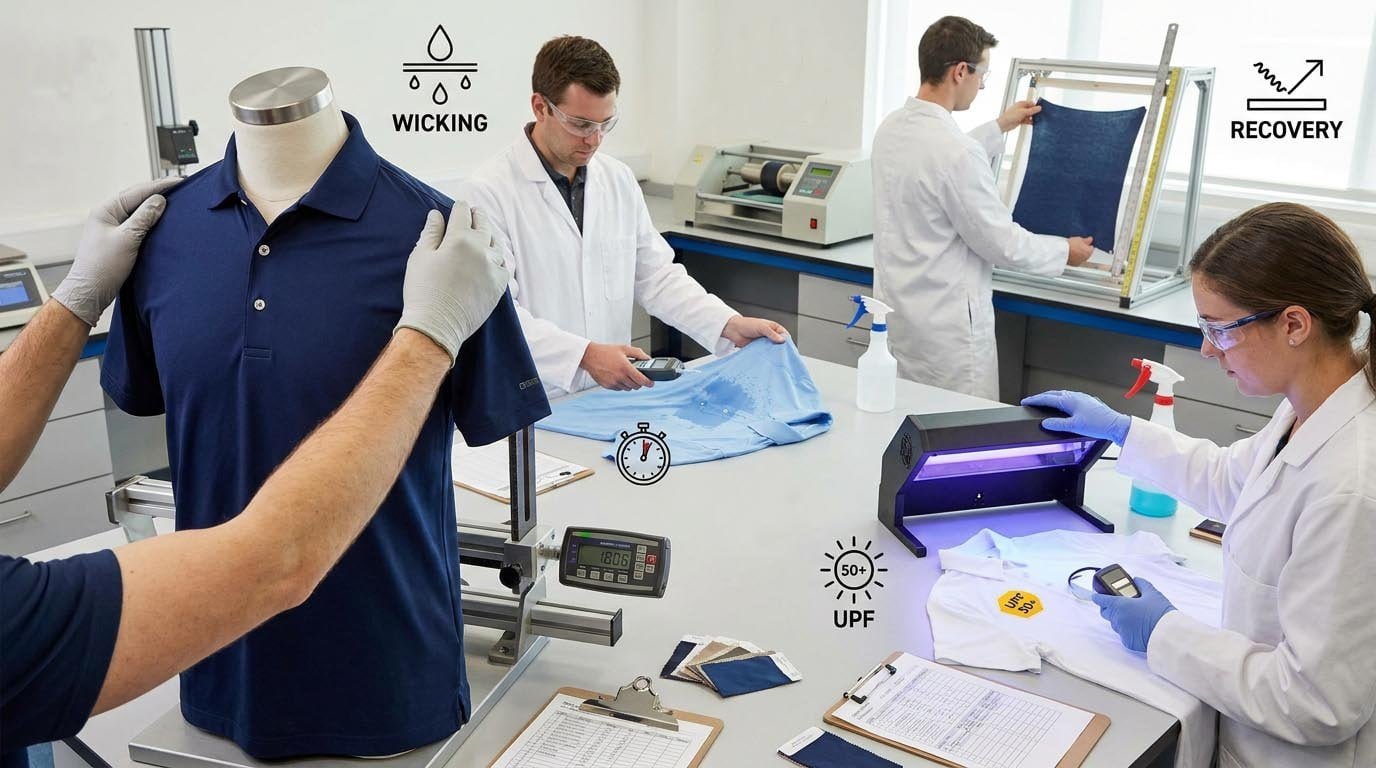
4-way stretch improves golf shirt performance across five dimensions: unrestricted swing mobility, shape retention after repeated wear, moisture-wicking speed, UPF 50+ sun protection, and long-term durability. However, these benefits depend on fabric engineering—not just the "4-way stretch" label.
Mobility: Full Range of Motion
True 4-way stretch allows:
- Backswing: No pulling across shoulders or chest
- Follow-through: No restriction at elbows or torso
- Reaching for the ball: No riding up at the waist
I recommend buyers conduct a wear test with their target customer. Have them swing a club, reach for a tee, and bend to mark a ball. If the fabric restricts any of these movements, the stretch is insufficient.
Recovery: Shape Retention After Washing
Recovery rate matters more than stretch percentage. A fabric that stretches 60% but recovers only 70% will:
- Bag at the elbows after three rounds
- Lose waistband support after five washes
- Create a sloppy appearance after ten wears
I require suppliers to provide ASTM D2594 test data showing recovery ≥90% after 50 cycles at 30% elongation. Missing this data is a red flag.
Moisture-Wicking: Quick-Dry Performance
4-way stretch fabric can be engineered for moisture-wicking through:
- Fiber selection: Polyester wicks faster than nylon
- Knit structure: Piqué and textured surfaces move moisture better than smooth jersey
- Finishing treatments: Hydrophilic coatings improve wicking speed
However, "moisture-wicking" is not automatic with 4-way stretch. Buyers must request wicking rate test data (how many seconds for moisture to spread 10 cm) to verify performance.
UPF 50+ Sun Protection
Many golf shirt buyers now require UPF 50+ certification, especially for EU and Australian markets. UPF 50+ means the fabric blocks >98% of UV radiation.
UPF performance comes from:
- Tight knit density (fewer gaps for UV penetration)
- UV-absorbing chemical finishes
- Dark or saturated colors (lighter colors require denser knits)
I recommend verifying UPF certification through third-party test reports (e.g., AATCC 183), not supplier claims alone.
Durability: Pilling, Snag, and Wash Stability
Long-term durability requires testing:
- Pilling resistance (ASTM D3512 or Martindale): Grade ≥4 after 5,000 rubs
- Snag resistance (ASTM D3939): Grade ≥3 for golf bags and cart abrasion
- Wash stability: <3% shrinkage and no color fading after 25 washes
A fabric that performs well on initial sampling but pills after three washes will generate returns and damage your brand reputation.
Testing Methods and Specs: Elongation, Recovery, Pilling, Snag and Airflow
Professional verification requires three data points: both warp and weft stretch ≥30%, recovery ≥90% after 50 cycles, and explicit test standard notation (e.g., ASTM D2594 with speed and cycle conditions). For buyers without lab access, two field tests can screen out fake 4-way fabrics before sampling.
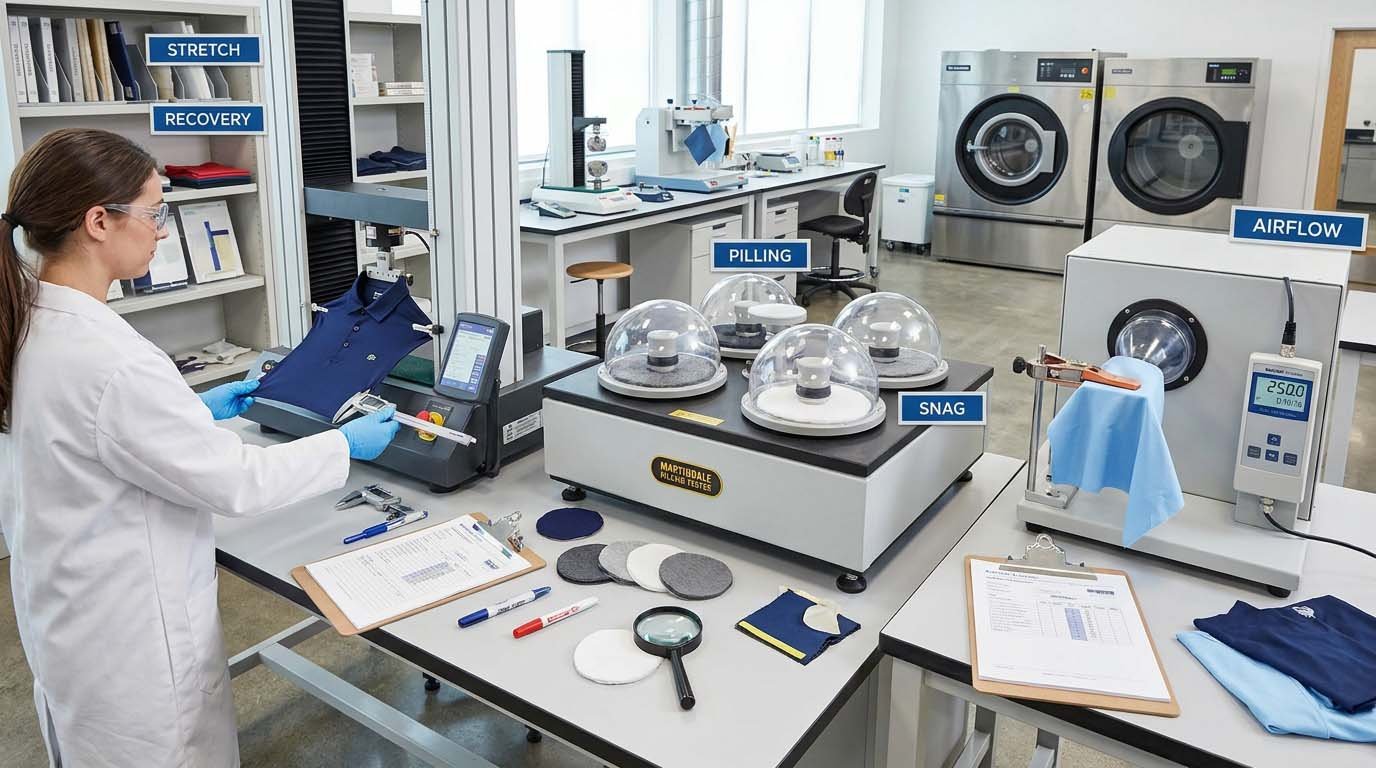
Test #1: Elongation in Both Directions
Request supplier test reports showing:
- Warp stretch: ≥30% (vertical direction)
- Weft stretch: ≥30% (horizontal direction)
- Test standard: ASTM D2594 or ISO 13934-1
- Test conditions: Speed (e.g., 300 mm/min), pre-tension, sample size
If the supplier cannot provide this data, they likely do not have true 4-way stretch fabric. I have reviewed quotations where "4-way stretch" fabric tested at 5% warp stretch and 40% weft stretch—this is 2-way stretch mislabeled as 4-way.
Test #2: Recovery Rate After 50 Cycles
Recovery rate measures how well the fabric returns to its original dimension after repeated stretching. Request:
- Recovery rate: ≥90% after 50 cycles at 30% elongation
- Test standard: ASTM D2594 or EN 14704-1
- Rest period: Fabric should rest 1 hour after cycling before measuring
Low recovery (<85%) creates bagging at elbows, loose waistbands, and shape loss after a few washes.
Test #3: Pilling Resistance
Pilling creates a worn, unprofessional appearance after a few rounds. Request:
- Pilling grade: ≥4 after 5,000 rubs (Martindale or ASTM D3512)
- Fabric sample: Test the actual color and finish you will order
Dark colors often show pilling more than light colors, so test both if you plan multi-color orders.
Test #4: Snag Resistance
Golf bags, cart seats, and Velcro closures create snag risk. Request:
- Snag grade: ≥3 (ASTM D3939)
- Test method: Mace snag tester or nail snag tester
Low snag resistance will create pulled threads and holes after a few rounds.
Test #5: Airflow and Breathability
For warm-climate golf shirts, breathability matters as much as stretch. Request:
- Air permeability: ≥150 CFM (cubic feet per minute) for lightweight polos
- Test standard: ASTM D737
Denser knits (higher GSM) provide better opacity but lower breathability. Buyers must balance coverage with comfort.
Field Test #1: Manual Pull Test (No Lab Required)
If you cannot access a lab, perform this test on supplier samples:
- Mark a 10 cm section on the fabric in both warp and weft directions
- Pull firmly in each direction until you meet resistance
- Measure the new length—if warp and weft both extend ≥13 cm (≥30% stretch), the fabric is likely true 4-way
- Release and check for immediate shape recovery—wrinkles or slack indicate weak recovery
This test cannot replace lab data, but it can screen out obvious fake 4-way stretch before you commit to sampling.
Field Test #2: Post-Wash Shape Retention
Request a pre-production sample and wash it 5 times according to your care label. Compare:
- Length and width before and after washing
- Shape retention at elbows and waist
- Color fading or surface change
A fabric that shrinks >3% or bags after five washes will fail after 20 washes in customer hands.
Design and Sourcing Tips: Fit, Patterning, MOQ, Lead Times and QC
4-way stretch fabric requires adjusted patterning—typically 5–10% reduction in width compared to woven fabrics—to prevent bagging. Minimum order quantities range from 300–1,000 pieces per style, with 45–60 day lead times for custom fabrics. Quality control must verify fabric test reports, pre-production samples, and bulk fabric consistency before cutting.
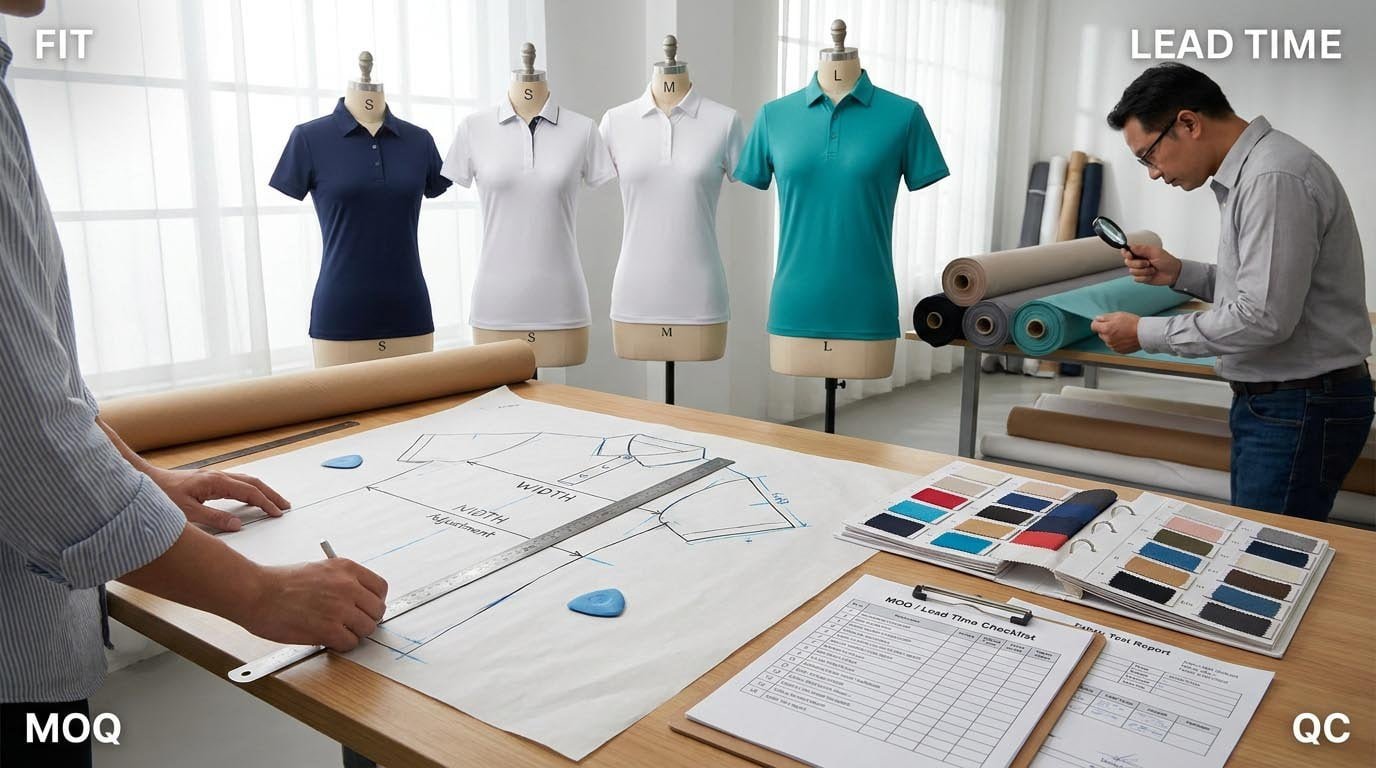
Fit and Patterning: Reduce Width by 5–10%
4-way stretch fabric requires different patterning than woven or 2-way stretch fabrics. Key adjustments:
- Reduce width by 5–10% to account for fabric stretch and body-hugging fit
- Test fit across three sizes (S, M, L) to verify grading consistency
- Check sleeve length after stretching—some fabrics shorten when extended widthwise
I recommend producing a fit sample in the actual 4-way stretch fabric before finalizing patterns. A pattern developed on woven fabric will create a loose, baggy fit when transferred to 4-way stretch.
MOQ: What to Expect for Golf Shirts
Minimum order quantities depend on whether you use stock fabric or custom fabric:
| Fabric Type | MOQ (pieces) | Lead Time | Best For |
|---|---|---|---|
| Stock fabric, stock colors | 300–500 per style | 30–45 days | First-time orders, testing new designs |
| Stock fabric, custom dye | 500–800 per style | 45–60 days | Small brands with specific color needs |
| Custom fabric (custom knit + dye) | 1,000–1,500 per style | 60–75 days | Established brands, exclusive fabrics |
At FUWAY, our standard MOQ for golf shirts using stock 4-way stretch fabric is 500 pieces per style with 3 colors maximum. If you need lower MOQ, expect a 15–20% surcharge.
Lead Times: Plan for 45–60 Days
Typical lead times for golf shirt production:
- Sample development: 10–14 days
- Sample approval and revision: 7–10 days
- Fabric sourcing (if stock): 15–20 days
- Cutting and sewing: 20–25 days
- QC and shipping: 5–7 days
Total: 57–76 days from order confirmation to delivery. Custom fabric adds 15–30 days for knitting and dyeing.
QC: Verify Test Reports Before Bulk Production
Quality control for 4-way stretch golf shirts should verify:
- Fabric test reports: Elongation, recovery, pilling, snag, and airflow data from supplier
- Pre-production sample: Fit, stitching, logo placement, and wash test
- Bulk fabric inspection: Random sampling of 3–5 rolls to check color, GSM, and stretch consistency
- Inline inspection: Check stitching, measurements, and logo quality during production
- Final inspection: Random sampling of 10% of finished units before shipping
I have caught bulk fabric that tested at 15% warp stretch (not 30%) during inline inspection, preventing 800 defective units from shipping. Missing this step would have cost my client $12,000 in returns.
FAQ: 4-Way Stretch Fabric for Golf Shirts
What is the difference between 2-way and 4-way stretch?
2-way stretch extends in one direction (usually horizontal). 4-way stretch extends in both directions (warp and weft) with ≥30% elongation in each axis.
How do I verify that a supplier's 4-way stretch is real?
Request test reports showing both warp and weft stretch ≥30%, recovery ≥90%, and explicit test standard (ASTM D2594). Perform a manual pull test on samples in both directions.
What spandex percentage do I need for golf shirts?
8–12% spandex for standard performance polos. Below 8% often delivers only 2-way stretch. Above 15% creates compression fit, not ideal for casual golf.
Why does recovery rate matter?
A fabric that stretches but does not recover will bag at elbows and lose shape after a few washes. Recovery ≥90% prevents permanent deformation.
What is the typical MOQ for golf shirts with 4-way stretch fabric?
500–800 pieces per style using stock fabric; 1,000–1,500 pieces for custom fabric. Lower MOQ available with surcharge.
How long does production take?
45–60 days for stock fabric; 60–75 days for custom fabric. Add 15–30 days for custom knitting and dyeing.
Can I use the same pattern for 4-way stretch as for woven fabric?
No. Reduce width by 5–10% to account for fabric stretch and body-hugging fit. Test fit samples before bulk production.
What tests should I request from suppliers?
Elongation (warp and weft ≥30%), recovery (≥90%), pilling (grade ≥4), snag (grade ≥3), and airflow (≥150 CFM for lightweight polos).
Conclusion
True 4-way stretch delivers unrestricted golf swing mobility, but only if you verify supplier test reports before ordering. Request warp and weft stretch data, recovery rates, and post-wash samples to avoid procurement traps.