
Your quarter-zip looks great on the hanger but fails on the course. It binds in the shoulders, feels clammy, or snags on everything. This guide fixes that.
Design a perfect golf quarter-zip by balancing four key areas: situation-specific fabrics for thermoregulation, a golf-specific fit for full mobility, smart performance features like chin guards and quiet materials, and a clear set of technical standards for repeatable quality control.
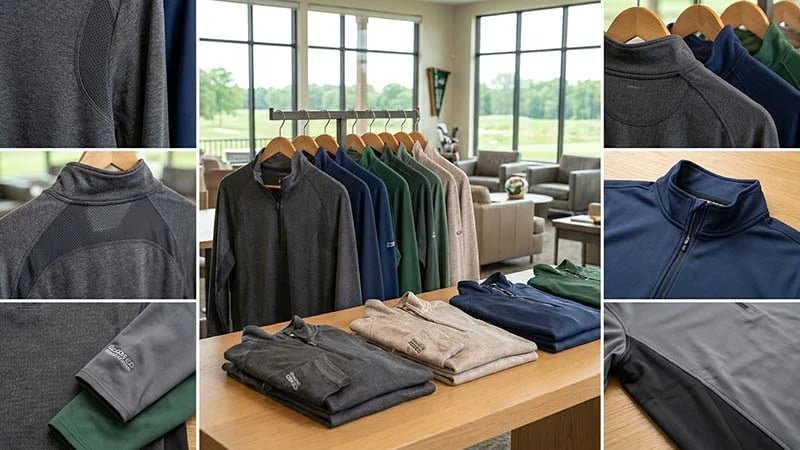
I've helped hundreds of brands like yours develop their golf apparel lines. The quarter-zip is the "mid-layer king." It has to be a technical performance piece on the course and a stylish casual piece off it. Brands that succeed focus on the details that matter to a golfer in motion. Let's break down exactly what those details are so you can build a winner.
How Should You Position Your Quarter-Zip for Different Scenarios?
You're thinking of making just one quarter-zip. This single product can't possibly work for a cool summer morning and a windy autumn afternoon. You need to define its purpose.
Position your quarter-zip by defining its target temperature range, wind resistance, and layering role. A lightweight 150gsm knit for summer evenings is very different from a 240gsm fleece with a windproof front panel for a chilly, breezy day.
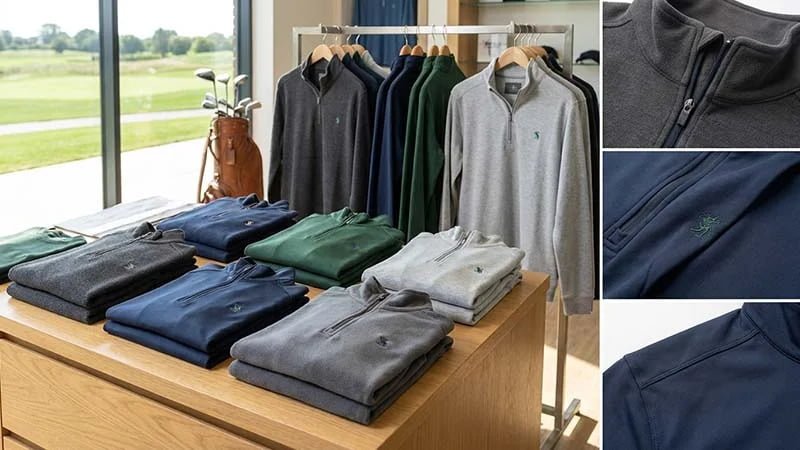
The first question I always ask a brand is, "When and where will your customer wear this?" The answer dictates every design choice that follows.
When to Wear & Layering (Temp/Wind/Humidity)
A quarter-zip's main job is to manage temperature. For early morning or late evening summer rounds, I recommend a light 150–180 gsm knit. For shoulder seasons like spring and fall, a 200–240 gsm micro-fleece or double-knit works best. For cold, windy days, we build hybrid models with a windproof woven front panel and stretch-knit sleeves and back.
Quarter-Zip vs Half-Zip vs Full-Zip: Mobility & Venting
The choice of zipper length affects both movement and temperature control. Here’s how I break it down for brands:
| Zip Style | Length (Approx. % of Garment) | Best For | Wade's Take |
|---|---|---|---|
| Quarter-Zip | 30–40% | Core warmth with some venting, maximum mobility across the chest. | This is the go-to for most golfers. It gives you just enough venting without a long, flapping zipper interfering with your swing. |
| Half-Zip | 50% | Better temperature regulation, easy to pull on over a hat. | A good choice for days with changing weather, but the longer placket can feel stiffer than a quarter-zip. |
| Full-Zip | 100% | The easiest to take on and off, works like a light jacket. | Best for pre-round warm-ups or as an outer layer. The full zipper adds weight and can feel bulky during a full swing. |
Men/Women/Juniors & Teamwear Differences
Fit and features change for different golfers. Women's designs often include princess seams for a more tailored shape. Junior sizes need to be durable and stain-resistant. For club and team apparel, we focus on standardized colors and make sure there are clear, flat areas for logos on the chest, sleeve, and back yoke.
What Key Features Make a Quarter-Zip Perform on the Course?
Your customer expects their golf apparel to work like equipment. It can't just look good; it has to enhance their game by removing distractions like restricted movement or clammy fabric.
True on-course performance comes from five things: unrestricted mobility from 4-way stretch fabrics, effective thermoregulation, quiet and anti-snag materials, reliable UPF sun protection, and in some cases, a hybrid wind and water-resistant design.
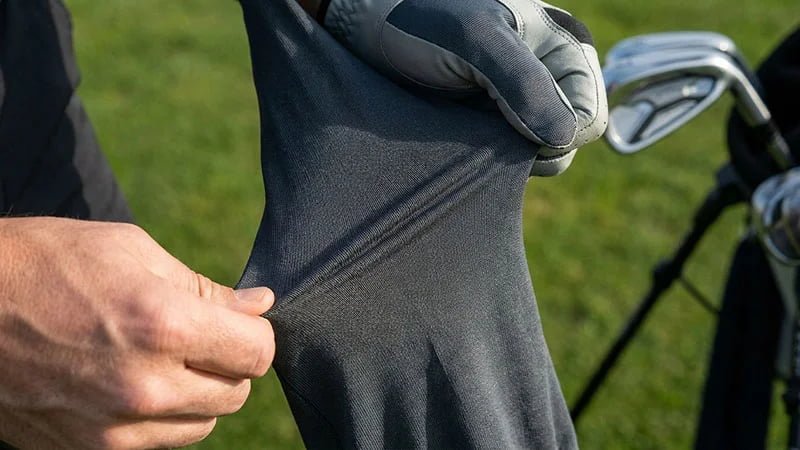
I've seen too many brands pick a fabric based on color alone. That's a mistake. The technical properties of the fabric are what your customer will actually feel during their round.
Mobility (4-Way Stretch, Armhole/Gussets)
A golf swing is a dynamic, powerful motion. The garment must stretch and recover with the body. I always specify fabrics with at least 120% cross-grain stretch and 90% recovery. We also design patterns with gussets under the arms or use raglan sleeves to give the shoulders more room to rotate.
Thermoregulation (Wicking, Breathability, Light Insulation)
The goal is to keep the golfer's microclimate stable. The fabric must pull sweat away from the skin (wicking) and let water vapor escape (breathability). For cooler weather, a lightly brushed or grid-fleece interior can trap air for insulation without adding bulk.
Quiet Hand & Anti-Snag
The "swish-swish" sound of a noisy jacket is a huge distraction. We select fabrics with a soft, quiet hand feel, often by using finer yarns. Snagging is another common problem. I recommend tightly-knit interlock or warp-knit fabrics that resist catching on branches or Velcro.
UPF & Lightfastness
Golfers spend hours in the sun. A UPF rating of 30+ is the minimum I recommend, with 50+ being the standard for high-performance summer pieces. The fabric's color also needs to resist fading from sun exposure (good lightfastness).
Wind/DWR Hybriding
For windy or misty days, a hybrid design is fantastic. We use a lightweight, laminated woven fabric on the chest and shoulders to block wind and shed light rain. The back and sleeves remain a soft, stretch-knit for breathability and mobility. For the water-repellent finish (DWR), we specify a PFAS-free C0 treatment with a spray test rating of at least 70/100.
Which Fabrics and Constructions Work Best for Golf Quarter-Zips?
The fabric is the heart of the garment. The right choice delivers comfort and performance. The wrong choice leads to a product that customers wear once and then leave in their closet.
For a versatile quarter-zip, I recommend a 200–260gsm double-knit or warp-knit polyester/spandex blend. Focus on high recovery, an anti-snag surface, and performance finishes like wicking and anti-odor. For sustainable options, use recycled polyester and dope-dyed yarns.
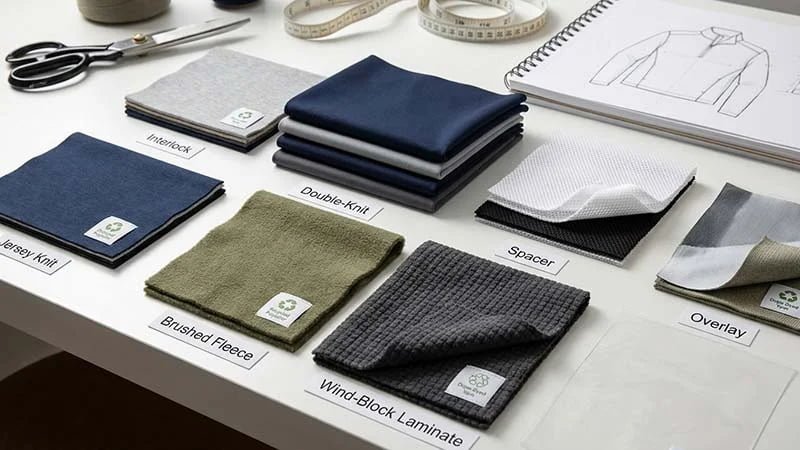
I always tell my clients to think of fabric selection like building a team. You need the right players in the right positions.
Knit Bases: Jersey/Interlock/Spacer
- Jersey: Lightweight and breathable, good for summer layers. Tends to be less stable.
- Interlock/Double-Knit: My preferred choice. It's stable, has a smooth surface on both sides, is naturally less prone to curling, and offers great stretch and recovery.
- Spacer/Air Layer: Creates a lightweight, modern look with good insulation by trapping air between two fabric layers.
Brushed & Grid Fleece
For mid-layer warmth, a fleece back is key. A standard brushed (single-sided fleece) interior is soft and warm. A grid fleece creates channels that improve breathability and reduce weight while still providing excellent insulation.
Wind Panels: Laminates/Overlays
When adding a windproof panel, you have a few options. A laminated fabric (a woven face fabric bonded to a membrane) offers the best protection. For a lighter feel, a simple woven overlay (a second layer of fabric sewn on top) can cut down on wind without the stiffness of a laminate. For high-exertion activities, the membrane's breathability should be RET < 12.
Finishes: Wicking, Anti-odor, PFAS-free DWR
These chemical treatments are applied at the mill and are critical for performance. A good wicking finish spreads moisture for rapid evaporation. An anti-odor treatment (often silver-based or bio-based) prevents the growth of microbes. And as mentioned, a modern DWR finish should be effective and PFAS-free.
Sustainability (Recycled PES, Dope-Dye)
More brands are choosing sustainable materials. Recycled polyester (rPET) made from plastic bottles is widely available and performs identically to virgin polyester. Dope-dyeing (or solution-dyeing) is another great option where the color is added to the polymer before it's extruded into yarn. This process uses far less water and energy than traditional dyeing.
How Should You Approach Fit, Pattern, and Grading?
A quarter-zip that restricts the golf swing is useless. The pattern must be engineered specifically for the rotational movements of the game. It is not just a sized-down casual sweatshirt.
The fit must be "action-oriented." I recommend a pattern with 6–10 cm of ease over the wearer's chest measurement, a dropped rear hem, and either raglan or hybrid sleeves to maximize range of motion in the shoulders.
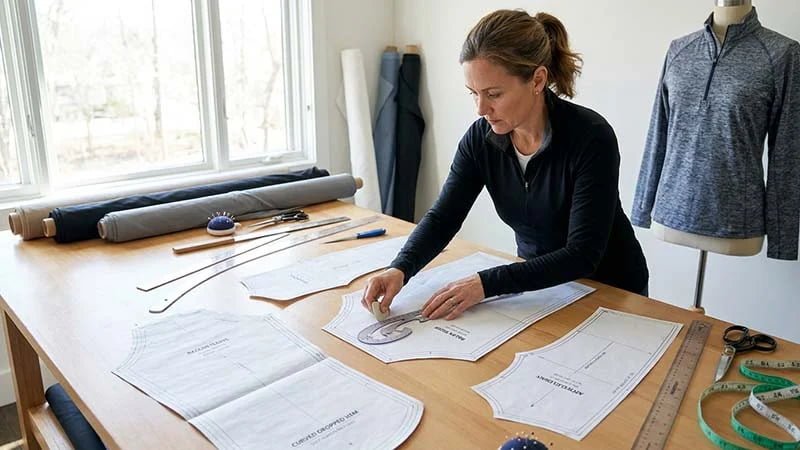
In my experience, the pattern is where a brand's commitment to performance truly shows.
Golf-Specific Ease (Chest/Shoulder/Sleeve)
For a close-to-body athletic fit, I use 6–8 cm of ease over the chest measurement. For a more standard, insulating mid-layer fit, 8–10 cm is better. We also ensure there is enough room across the shoulder blades and in the bicep so the fabric doesn't bind at the top of the backswing.
Raglan, Hybrid, or Set-in
- Set-in Sleeve: The traditional construction. It can be restrictive unless the armhole is shaped perfectly.
- Raglan Sleeve: The seams run from the underarm to the collar. This is my preferred style as it provides the most room for shoulder movement.
- Hybrid Sleeve: A modern combination, often with a raglan construction in the back and a set-in look in the front. It offers a great balance of mobility and a clean aesthetic.
Hem Drop, Curves, Thumbholes
A dropped rear hem (+2–4 cm longer in the back) is essential to keep the golfer covered when they bend over to pick up a ball. An ergonomic sleeve shape that is slightly articulated (pre-bent) feels more natural. Thumbholes are a great feature for cooler weather, helping to keep sleeves in place and hands warm.
Gendered Blocks & Regional Fits
Men's and women's patterns are fundamentally different. A women's pattern will have shaping for the bust (often moved into a princess seam or side panel) and a narrower shoulder. We also develop regional fits. An "Asian Fit" block typically has a shorter body length and narrower shoulders compared to a "US/EU Fit."
Grading Strategies
Grading is how we create the different sizes from the base pattern. We use specific grade rules for golf apparel, ensuring that as the size increases, the sleeve length and body length grow appropriately without making the garment look boxy.
What Details Matter for Zippers, Collars, and Trims?
The small details, or trims, are what elevate a good quarter-zip into a great one. They affect the garment's comfort, durability, and ease of use.
Use a #3 reverse-coil nylon zipper with an auto-locking slider. Include a zipper garage at the top to prevent chin chafe. Design a collar that is 5.5–7.0 cm high and has enough structure to stand up without collapsing.
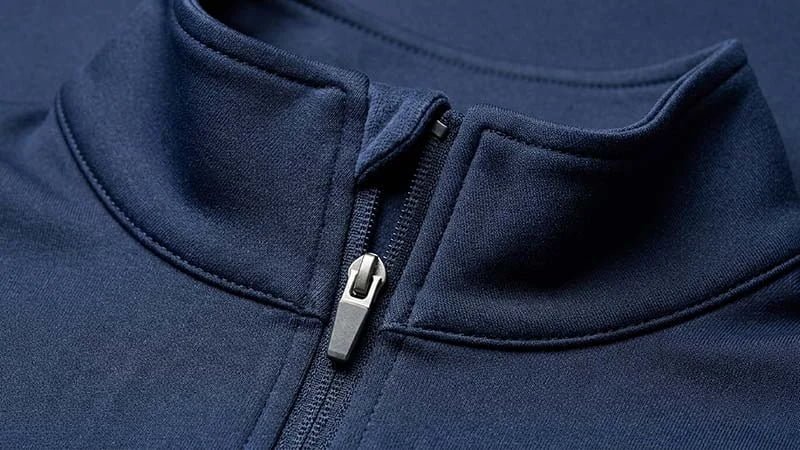
I always tell brands that the customer touches the zipper and collar every time they wear the garment. Getting these details right is a sign of quality.
Zip Spec & Feel (#3/#5 Coil, Auto-lock)
A #3 nylon coil zipper is the standard for most quarter-zips. For heavier fleece or outerwear styles, a #5 zipper can be more durable. The most important feature is an "auto-lock" slider, which prevents the zipper from creeping down during activity. Adding a lightweight, easy-to-grab puller is also a nice touch.
Garage, Chin Guard, Wind Placket
A "zipper garage" is a small fabric hood at the top of the zipper that covers the slider when it's closed, so the cold metal doesn't touch your chin. A "chin guard" is a soft fold of fabric over the top of the zipper seam. A "wind placket" is a thin strip of fabric behind the zipper that blocks wind from getting through the coils. I recommend all three.
Collar Height & Build
The collar needs to look sharp. A height of 5.5 to 7.0 cm is typical. To help it stand up, we often use a slightly stiffer fabric as an internal facing or bond a lightweight interlining inside. The inside of the collar should be a soft, brushed fabric for comfort.
Cuffs & Hem Options
Simple is often best. A soft, elastic-bound cuff provides a clean finish that doesn't interfere with a golf glove. The hem can be finished similarly or with a simple coverstitch. For wind-focused styles, an adjustable drawcord at the hem can help seal out drafts.
Threads & Stitching
We use high-quality polyester thread (Tex 27–30) for durability. Most seams are sewn with a 4-thread overlock stitch. We often add a topstitch (or coverstitch) to help seams lay flat and look clean. At high-stress points like the shoulder, we use a chain stitch or add a reinforcing tape to prevent stretching over time.
How Do You Handle Aesthetics and Branding?
Your quarter-zip needs to perform well, but it also has to look great and represent your brand. The right aesthetic choices can make your product stand out.
Use color-blocking and style lines to create a dynamic look. Choose a logo application method like heat transfer or silicone that won't compromise the fabric's stretch or add uncomfortable bulk. For women's styles, use princess seams to create a flattering silhouette.
Branding should complement the design, not fight against it. A heavy, stiff embroidered logo on a lightweight, stretchy fabric is a common mistake I see.
Color-Blocking & Style Lines
Using different colored panels on the shoulders, side panels, or under the sleeves is a great way to create visual interest. Style lines (seams that are added for shape and aesthetics) can be used to create a more athletic and tailored look.
Logos: Heat Transfer, Silicone, Embroidery
- Heat Transfer: Lightweight, flexible, and cost-effective. The best choice for performance fabrics.
- Silicone: Offers a premium, 3D look with excellent flexibility and durability.
- Embroidery: Can be heavy and stiff, and the backing can be scratchy. I only recommend it for very stable fabrics or for small, simple logos.
Textures & Perfs
Using a fabric with a subtle jacquard texture can add a premium feel. For added breathability, laser-cut perforations can be added in high-heat zones like the back or under the arms. These can be arranged in a pattern to become a design element.
Women’s Styling Options
For women's quarter-zips, we use shaping to create a more feminine fit. Princess seams (long, curved seams from the armhole to the hem) are very effective. We also often use a slightly higher waistline and a curved hem to create a more flattering silhouette.
How Do You Manage Testing and Compliance?
A great design is not enough. You must verify its performance and safety through standardized lab testing. This protects your customers and your brand.
You must test for dimensional stability (shrinkage), pilling and snagging, and colorfastness. You should also get certified reports for any performance claims like UPF. Finally, ensure all materials comply with chemical safety regulations like RSLs and PFAS-free standards.

Testing turns your marketing claims into verifiable facts. It's a non-negotiable step for any serious brand.
Dimensional Stability & Shrinkage
We test to ensure the garment won't shrink or stretch out of shape after a few washes. My standard is a maximum shrinkage of 3% in either direction after a 30°C home laundry cycle.
Pilling, Snagging, Abrasion
These tests measure durability. Pilling (the formation of little balls of fiber) should be a Grade 4 or higher on the Martindale scale. Snagging resistance is critical for golf, and we aim for a grade of 3.5 or higher.
Colorfastness (Perspiration/Rub/Light)
The color can't bleed or fade. We test its fastness to sweat, to rubbing (wet and dry), and to light. All should achieve a Grade 4 or higher (on a 1-5 scale).
UPF, Breathability, Water-Based Finishes
If you claim a UPF rating, you must have a lab report (from a test like AATCC 183) to back it up. We also verify the performance of any DWR or wicking finishes.
Chemical Compliance (RSL, PFAS-free)
Your factory should be able to provide declarations that all materials comply with your Restricted Substances List (RSL), which limits harmful chemicals. If you are claiming your product is PFAS-free, you will need documentation from your fabric mill.
How Do Production and Costing Work?
Understanding what drives cost allows you to design a product that meets your target price without sacrificing quality.
The biggest cost drivers are the fabric (its weight and any special processes like lamination), the zipper quality, and the complexity of the pattern (the number of seams). You can manage MOQs by using stock fabrics and standardizing your trims.
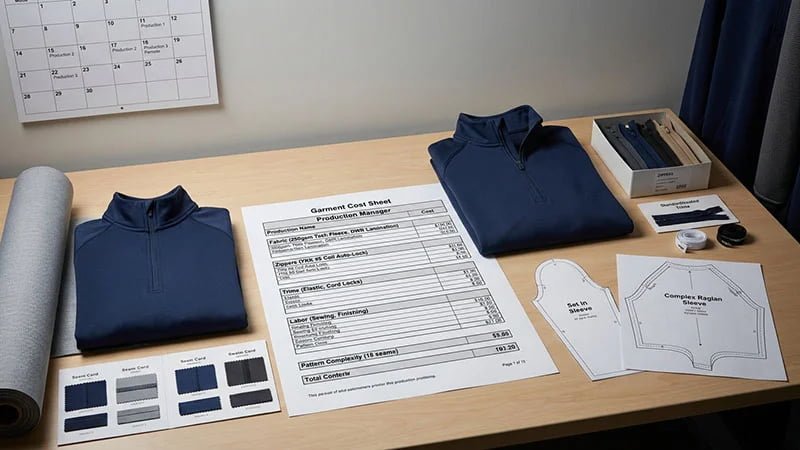
A smart design is one that is not only functional and beautiful but also efficient to produce.
BOM Cost Drivers
The Bill of Materials (BOM) lists every component. Fabric is usually the biggest cost. Heavier fabrics, laminated fabrics, and fabrics with multiple finishes will cost more. The type and length of the zipper are also key drivers.
Pattern Complexity & Seam Count
Every seam requires time and labor. A simple design with set-in sleeves will be cheaper to sew than a complex, multi-panel hybrid design with many topstitched seams.
MOQ Levers (Stock Greige, Std Trims)
Minimum Order Quantities (MOQs) can be a challenge. To lower them, you can choose a stock fabric that the mill produces regularly. You can also combine orders for different styles that use the same fabric and color. Standardizing your trims (like using the same zipper across multiple styles) also helps.
Sampling & Build Calendar
The production process involves several sample stages. The Fit Sample is to check the pattern. The Pre-Production (PP) Sample is made with all the correct fabrics and trims and is the final standard for approval before bulk production begins. A typical calendar from design finalization to shipment can be 3-5 months.
How Should You Conduct Fit Trials and Wear Tests?
Lab tests are important, but nothing beats real-world feedback from actual golfers.
Get 3-5 golfers of different sizes to wear-test your final sample. Have them perform full swings, bend down, and walk the course. Check for any restriction, chafing, or discomfort. Also, put one sample through 5-10 home wash-and-wear cycles to check for durability.
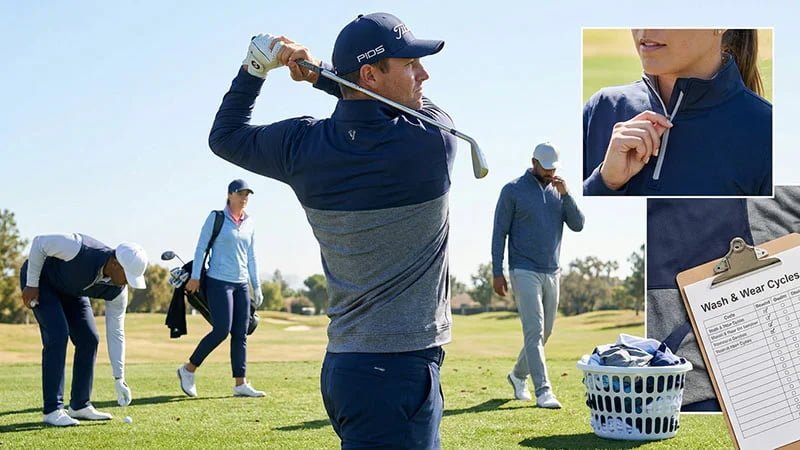
This is the final quality gate before you commit to bulk production.
Range-of-Motion Test
Watch your testers swing. Does the hem ride up significantly? Does the fabric pull tightly across their back or chest? Do the sleeves feel restrictive?
5–10 Wash/Wear Cycles
This simulates the early life of the garment. After 5-10 cycles, check for any pilling, shrinkage, or problems with the zipper or seams. Does it still look and feel like a premium product?
Zip/Collar Comfort Blind Test
Have testers wear the quarter-zip for an extended period. Ask specifically about the collar and zipper area. Is it comfortable against the neck? Does the zipper puller flap around or make noise? Does the chin guard work effectively?
What Are the Common Pitfalls and How Do You Fix Them?
I've seen the same mistakes made by new and experienced brands alike. Knowing what they are is the first step to avoiding them.
The most common problems are noisy fabrics, collars that collapse or chafe the chin, fabrics that snag easily, and seams that stretch out of shape over time. Each of these can be fixed with the right material choice and construction details.
A little foresight goes a long way. Here are the issues I look for and how we prevent them at Fuway.
| Pitfall | Common Cause | How We Fix It |
|---|---|---|
| Noisy Fabric | Stiff yarns or coatings on woven panels. | Use finer denier yarns, warp-knits instead of wovens, or a lightly brushed fabric surface to dampen sound. |
| Collar Collapse / Chin Chafe | No internal structure; no zipper garage. | Add a lightweight interlining to the collar, increase the collar height slightly, and always include a soft zipper garage. |
| Snagging | Loosely knit fabric with long floats. | Choose a tight interlock or high-density warp-knit construction. Use a more durable woven overlay on high-wear areas like the shoulders. |
| Seam Slippage / Stretching | Wrong stitch type or low stitch density on a high-stretch fabric. | Use a chain stitch on the shoulder seam, add reinforcing clear elastic tape inside the seam, and ensure a stitch density of 8-10 stitches per inch. |
What Do Real-World Spec Examples Look Like?
Theory is helpful, but seeing how it all comes together in a real product specification is even better.
Here are three distinct examples of quarter-zip specifications. They show how the fabric, fit, and features change based on the product's intended use, from a lightweight summer layer to a protective hybrid piece.
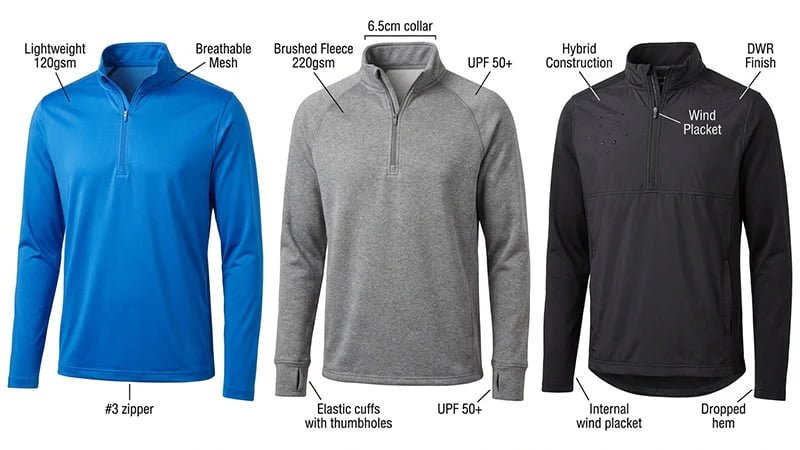
Use these as a starting point for building your own tech pack.
Lightweight Summer QZ
- Fabric: 160–170 gsm polyester/spandex double-knit, 4-way stretch. UPF 30+. A breathable mesh panel on the upper back.
- Zipper: #3 reverse coil with an auto-lock slider. Zipper length of 23 cm on a size M. A simple internal wind placket.
- Fit: Athletic fit with +6–8 cm of ease over chest measurement. Dropped rear hem (+2 cm). The sleeve pattern is rotated slightly forward for a better address position.
Shoulder-Season Midlayer
- Fabric: 210–230 gsm polyester with a brushed fleece back for warmth. Wicking finish. UPF 50+.
- Construction: Raglan sleeves for maximum mobility. Cuffs are finished with a soft elastic binding and integrated thumbholes. Collar height is 6.5 cm.
- Testing: Shrinkage ≤3%, Pilling ≥ Grade 4.
Hybrid Wind-Resistant QZ
- Fabric: Front body and shoulder panels are a 10D nylon woven laminated to a breathable membrane (RET < 10). The rest of the garment is a 220 gsm stretch-knit.
- Features: An internal wind placket behind the zipper and a zipper garage for chin protection. Dropped rear hem (+3 cm) to prevent riding up.
- Performance: PFAS-free DWR finish with a spray rating ≥ 70. Total garment weight is approx. 320–380 g for a size M.
What is the Final Concept-to-Production Checklist?
Are you ready to start development? A checklist ensures that no critical steps are missed as you move from an idea to a finished product in a shipping box.
Follow this checklist through the design, sampling, and production phases. It covers everything from defining your strategy upfront to verifying compliance before you ship. This process will save you time, money, and headaches.
I give a version of this checklist to every brand I work with.
Before Design
- [ ] Define the target temperature range and layering strategy.
- [ ] Determine the required UPF and/or DWR performance level.
- [ ] Decide on the branding locations (chest, sleeve, back yoke).
During Sampling
- [ ] Provide a complete tech pack (flat sketch, spec sheet, BOM, zipper spec, construction details).
- [ ] Review the first fit sample for collar height, zipper garage function, and overall fit.
- [ ] Arrange for initial lab tests on the fabric (shrinkage, colorfastness, pilling).
Before Mass Production
- [ ] Measure the PP (Pre-Production) sample against your spec sheet. Key points are chest, sleeve length, and back length.
- [ ] Approve all incoming trims (check zipper type, slider lock, and garage size).
- [ ] Confirm the folding method and packaging specifications.
Compliance & Testing
- [ ] Get a signed RSL (Restricted Substances List) declaration from your factory.
- [ ] If applicable, get a PFAS-free declaration for your DWR finish.
- [ ] Receive and review final lab reports for UPF, DWR spray test, and breathability.
- [ ] Conduct a final 5-cycle wash test on a PP sample to re-verify dimensions and appearance.
Frequently Asked Questions?
You have questions, and after years in this business, I have the answers. Here are a few of the most common things brand owners ask me.
These are the practical, real-world questions that come up during development. The right answers will help you build a better product and a stronger business.
How can I reduce the cost of my quarter-zip without sacrificing quality?
Focus on simplifying the construction and using stock materials. Quality comes from the fabric and the fit, not necessarily the complexity.
The easiest way to lower cost is to reduce the number of seams and panels, as this directly reduces sewing time. Choose a standard #3 auto-lock zipper instead of a premium waterproof one unless you have a specific weather-resistant design. Using a fabric and color that your supplier holds in stock can also significantly lower costs and minimum order quantities.
When does a hybrid (windproof front) design make the most sense?
A hybrid design is best for shoulder seasons—cool, windy days when a full jacket would be too warm and a standard knit isn't protective enough.
Think of it as a specialized piece for the golfer who often plays in blustery conditions. It strategically blocks wind at your core, where it matters most, while allowing your arms and back to breathe and stretch without restriction. It's a performance layering piece, not an all-purpose pullover.
What is the most important factor for long-term durability?
The fabric's resistance to pilling and snagging is the most critical factor for how a quarter-zip looks and lasts over time.
A golf bag, cart straps, and even course shrubbery can be very abrasive. A tightly constructed fabric, like a high-quality interlock or warp knit, will resist this abuse much better than a loosely constructed single jersey. Good seam construction, like adding reinforcing tape to the shoulder seams, is also crucial for preventing stretching and tearing.
What are the best practices for logo placement?
The three classic, professional-looking logo placements are the left chest, the left sleeve, and the back yoke just below the collar.
I advise my clients to keep logos away from high-stretch or high-friction areas to ensure they last. The left chest is the most traditional spot. A logo on the sleeve offers great visibility during the swing. A logo on the back yoke gives the garment a premium, tour-inspired feel. For all placements on performance knits, I recommend a flexible heat transfer or silicone logo over stiff embroidery.
What are the easiest first steps to make my quarter-zip more sustainable?
The two most impactful and accessible steps are switching to 100% recycled polyester fabric and ensuring any DWR finish is PFAS-free.
Recycled polyester (rPET) performs identically to virgin polyester and is widely available from most quality mills. Specifying a PFAS-free (also called C0) water-repellent finish is a responsible choice that is quickly becoming the industry standard. These two changes make a significant environmental impact without compromising performance.
Conclusion
The perfect golf quarter-zip is a blend of science and art. It demands attention to fabric performance, action-oriented fit, and quality construction details. Follow this guide to make smart choices.