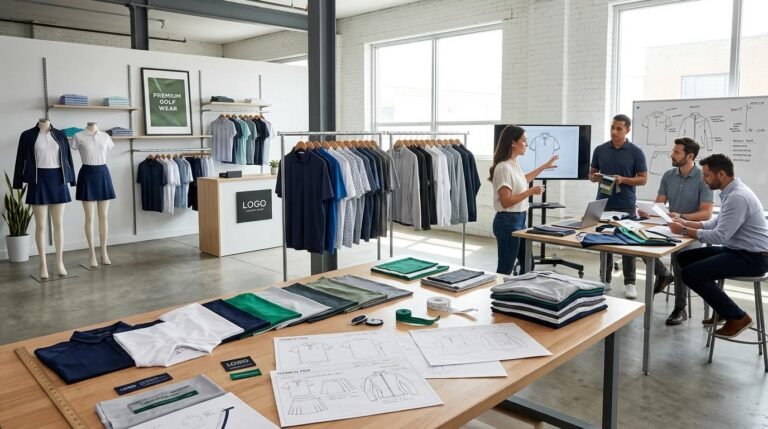
You want to launch a golf brand, but a huge collection feels risky and expensive. You're paralyzed by the thought of unsold inventory and wasted capital.
Launch with a 3-SKU Minimum Viable Product (MVP) capsule: one hero polo, one pair of performance pants, and one pair of shorts. This lets you test core fits and fabrics, sell complete outfits, and manage inventory risk intelligently.
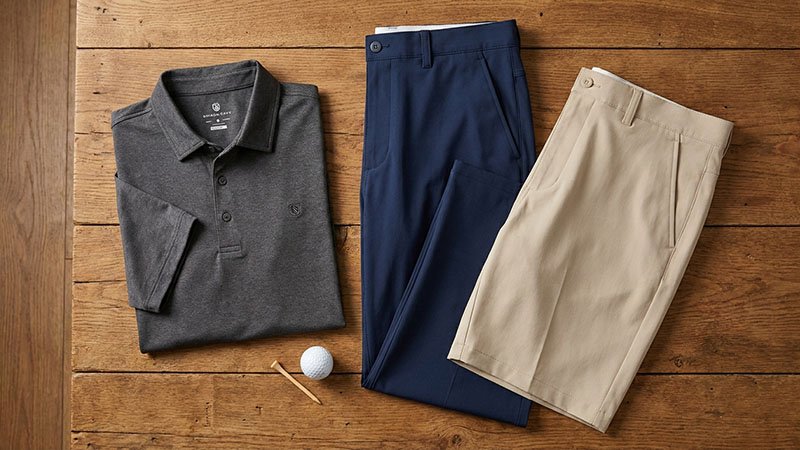
I've seen too many passionate founders try to launch with a 20-piece collection. They believe that more products make them look more professional. In reality, it just creates more ways to fail. You dilute your focus, stretch your capital too thin, and create an operational nightmare. The smartest founders I've worked with do the opposite. They start with a lean, focused, three-piece MVP capsule. This isn't about thinking small; it's about being strategic. It allows you to validate your most important assumptions—fit, fabric, and price—before you scale. This is how you build a lasting brand from a solid foundation.
What Are the Quick Answers for a 3-SKU MVP?
| Question | Quick Answer |
|---|---|
| Why 3 SKUs? | One top (polo) plus two bottoms (pants/shorts) lets you sell full outfits. You can test fits and fabrics for knits and wovens simultaneously, and bundle items to increase your average order value (AOV). |
| Minimum capital? | For a fully custom line, plan for $25k–$80k. You can start leaner at $10k–$30k by using quality private label blanks and running a pre-order campaign to fund your inventory. |
| Typical MOQs/lead times? | For custom manufacturing, expect 200–800 pieces per color. Development takes 4–8 weeks, and bulk production takes 45–75 days, plus shipping time. |
| Fabric specs? | Polo: 150–180 gsm poly/elastane piqué or micro-mesh. Bottoms: 180–220 gsm nylon/elastane or poly/elastane stretch twill, ideally with a PFAS-free DWR water-repellent finish. |
| Must-have tests? | For the polo (knit): wicking, snag, pilling, colorfastness. For the pants/shorts (woven): abrasion, stretch/recovery, seam slippage, colorfastness. Get a lab report for any UPF claims. |
| Sizing to start? | Keep it focused. For men, polos S–XXL and bottoms 28–40 (even sizes). For women, tops XS–XL and bottoms 0–14. Stick to a maximum of 2–3 colors per style for your first run. |
| Pricing targets? | Aim for a Cost of Goods Sold (COGS) that is 25–35% of your Manufacturer's Suggested Retail Price (MSRP). This should allow you to achieve a 60–70% gross margin on your direct-to-consumer (DTC) sales. |
| First buy size pack? | A standard "bell curve" for polos could be S:2, M:3, L:4, XL:3, XXL:1 for every 13 units. For shorts, it might be 30:2, 32:3, 34:3, 36:2, 38:1. Start with industry standards and adjust as you get sales data. |
| Fastest route to market? | Use high-quality ready-made "blanks" from a private label supplier. Add your branding with premium heat-transfer logos. You can launch a pre-order campaign with just photo samples or even 3D renders. |
| Legal/labels? | All garments need proper fiber content, country of origin, and care instruction labels. Only make a UPF 50+ claim if you have a valid lab report to prove it. |
How Do You Make Three Products Feel Like a Full Collection?
You worry that just three products will look incomplete or uninspired. How can you make such a small, focused collection feel cohesive and desirable to your customers?
The key is "outfit logic." Design your pants and shorts in versatile, core neutral colors. Then, use a bolder color or a unique print for your polo. This simple strategy allows for mix-and-match combinations that multiply the value of your small collection.
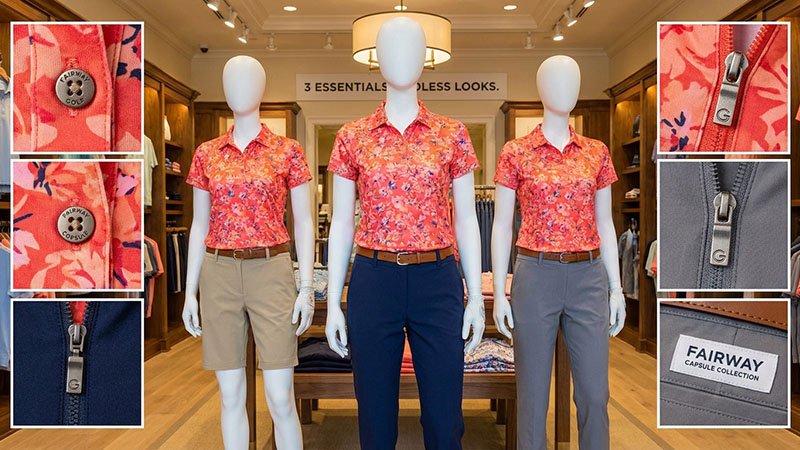
A 3-SKU capsule forces you to be disciplined. You can't hide behind a huge catalog. Every piece has to be perfect, and they have to work together. The goal is to make the customer see not three items, but multiple complete, stylish outfits. This is how you create maximum value with minimum inventory.
Keep it tight
Your MVP consists of just three styles: one polo, one pair of pants, and one pair of shorts. Start with only two or three solid colors total. For example, navy pants, khaki shorts, and a white and a blue polo. This keeps your production simple and your inventory costs down. If you want to add a bit of excitement, you can offer one of the polo colors as a seasonal print.
Outfit logic
The foundation of the capsule is mix-and-match. Your bottoms should be in timeless, neutral colors like navy, black, grey, or khaki. These go with everything. Your polo is where you can inject more personality with a brighter color or a tasteful print. By doing this, your single polo can be paired with both the shorts and the pants, instantly creating two distinct outfits.
Inclusive fits
While you have a limited number of styles, you can still cater to different body types by offering both a "regular" and an "athletic" fit block if your budget allows. For a women's line, this means paying careful attention to the rise, hip curves, and inseam lengths to ensure a flattering and modest fit.
Feature set
Your three items have to be exceptional. Embed high-value features that solve real problems for golfers. These are your non-negotiable must-haves: 4-way stretch, excellent moisture-wicking, a non-slip gripper waistband in the bottoms, and at least one secure, zippered pocket for valuables.
Trim unification
This is a pro tip for managing costs and minimums. Use the same buttons, zippers, and brand labels across all three of your SKUs whenever possible. This allows you to order these trims in larger quantities, reducing their per-unit cost and simplifying your supply chain.
What Makes Your One Polo Shirt an Absolute Must-Have?
Your polo is the hero of your collection and your brand's first impression. You're worried it won't be good enough to carry the brand's reputation on its own.
A winning polo combines a 150-180 gsm anti-snag performance fabric with a fit that is truly engineered for the golf swing. It must feature clean, high-quality construction and pass key lab tests for wicking (AATCC 197), pilling, and shrinkage.
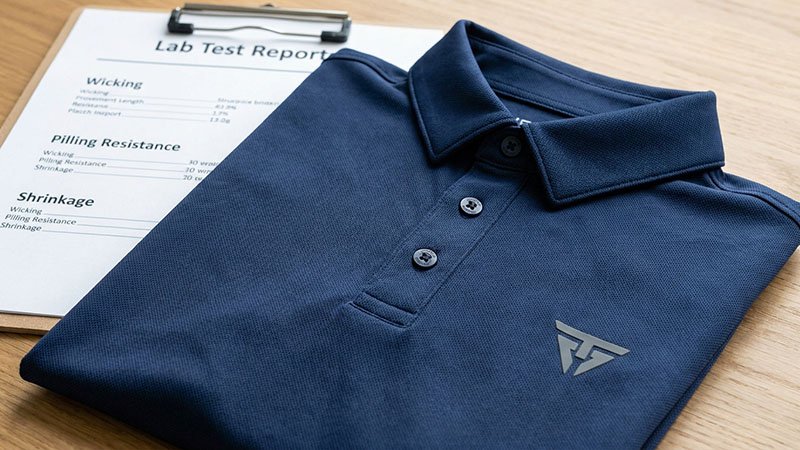
With an MVP capsule, your polo isn't just a shirt; it's a statement. It has to deliver on every promise of performance, fit, and feel. There is no room for error. This is the product that will earn you a second purchase.
Fabrics
The heart of your polo is the fabric. You need a high-performance knit, typically a 150–180 gsm polyester/elastane blend. Choose a structure like a classic piqué or a modern micro-mesh. The fabric must be tested for anti-snag properties, as this is a major customer complaint with cheaper polos. If you plan to market it as sun-protective, it must be capable of achieving a verified UPF 50+ rating.
Fit and pattern
A great fit is about more than just a size chart. The pattern must be designed for swing mobility, with careful attention to the shoulder slope and sleeve shape to prevent pulling and restriction. You can choose between a classic knit collar or a more modern, structured mock collar.
Construction
Quality is in the details. The placket should be straight and clean. The collar should resist curling. The hems should be finished with a durable cover stitch. For your logo, a lightweight silicone heat transfer works best on performance fabrics, offering stretch and breathability. A fine-gauge embroidery is a classic option, but make sure it has a soft backing so it doesn't irritate the skin.
Tests
Do not take your supplier's word for performance. Demand lab reports. Your tech pack should mandate tests for moisture wicking (AATCC 197), air permeability (ASTM D737), snag resistance (ASTM D3939, aim for a rating of 3-4 or higher), pilling, colorfastness, and shrinkage. These tests are your insurance against quality issues and customer returns.
Color control
Provide your factory with a specific Pantone TCX color code for every color you order. You must approve a "lab dip" (a small dyed swatch of your fabric) before they dye the full batch. For prints, demand inks that are tested for anti-migration to ensure the colors don't bleed into each other during washing or wear.
How Do You Design Bottoms That Golfers Will Actually Love?
Bottoms are all about fit, which can be difficult to get right. You're afraid of high return rates from customers who find the pants or shorts uncomfortable or ill-fitting.
Focus on a premium 180–220 gsm stretch twill fabric and a comfortable waistband with a silicone gripper tape to keep shirts tucked in. Functional pockets and reinforced stress points are non-negotiable. The right fit and inseam length are critical for on-course success.
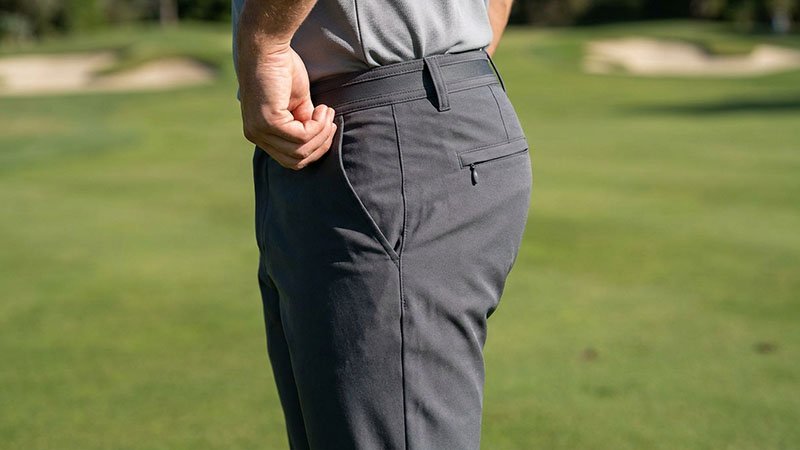
I can tell you from experience: bottoms are often the hardest apparel item to get right. But they also create the most brand loyalty when you do. A golfer who finds a pair of pants that fits perfectly and performs well will come back for more. Your MVP bottoms are your chance to prove you understand fit better than the competition.
Fabrics
Unlike the knit polo, your pants and shorts will be made from a woven fabric. A 180–220 gsm nylon/elastane or polyester/elastane stretch twill is the industry standard. It offers the perfect blend of durability, stretch, and a clean drape. Specifying a PFAS-free DWR (Durable Water Repellent) finish is a great feature that adds protection against light rain or morning dew.
Waistband
The waistband is a critical comfort point. It should have built-in stretch for mobility. A must-have feature is a silicone gripper tape on the inside of the waistband. This simple detail is a game-changer for golfers, as it prevents their polo from becoming untucked during the swing.
Pockets
Pockets must be deep enough to hold a wallet or phone without it falling out. The front pockets should be angled for easy access. At least one back pocket should have a zipper for securing a scorecard or glove. All pocket corners and belt loops—key stress points—must be reinforced with bartack stitching for durability.
Shorts inseams
Inseam length is crucial for meeting dress codes at many golf clubs. For men's shorts, a 7- to 9-inch inseam is a safe and modern length. For women's skorts or shorts, a 4- to 6-inch inseam is standard, often paired with a built-in compression short for coverage.
Tests
Woven fabrics require a different set of tests than knits. Your tech pack should specify tests for abrasion resistance (ASTM D4966), seam slippage (ASTM D434) to ensure the seams don't pull apart, stretch and recovery, colorfastness, and a spray test (AATCC 22) to verify the performance of the DWR finish.
Fit and grading
Pay close attention to the rise (the distance from the crotch to the waistband), thigh ease, and the knee opening to ensure a modern, comfortable fit. Men's pants are typically sized by even waist sizes (28, 30, 32, etc.), while women's are sized with numeric grades (0, 2, 4, etc.).
How Do You Get Your MVP Made Without Breaking the Bank?
You're ready to find a factory but don't know where to start. You are scared that high minimums and long lead times will kill your budget and your timeline.
For maximum speed, use a factory's existing designs (ODM/private label). For a truly unique fit, you must invest in your own patterns (OEM). Plan for MOQs of 200-800 pieces per color, and be strategic by using the same fabric across multiple styles to hit mill minimums.

This is where the 3-SKU MVP approach really shines. It allows you to hit a factory's minimum order thresholds without taking on a massive amount of inventory. Trying to produce tiny batches of 10 different styles is inefficient and expensive; the per-unit cost will be too high. A focused order of three styles is a much more professional and cost-effective way to work with a quality manufacturer.
Supplier routes
You have two main paths. The fastest is ODM (Original Design Manufacturer) or private label. You select from the factory's portfolio of pre-developed styles and add your logo. The more strategic path is OEM (Original Equipment Manufacturer), where you provide a detailed tech pack and the factory creates your unique product from scratch. For an MVP, you might use an OEM polo (for a signature fit) and ODM bottoms (to reduce complexity).
Sampling stages
Never go straight to bulk production. The sampling process is critical. You will go through a proto sample (the first attempt), a fit/size set (to check all your sizes), and finally, a PPS (Pre-Production Sample). The PPS is made with all the final bulk materials and must be perfect. Do not approve bulk production until you have the perfect PPS in your hands.
MOQs
A factory's MOQ is often driven by the fabric mill's minimum. A mill might require a factory to buy enough fabric to make 1000 polos of a single color. By using the same blue fabric for your polo, and maybe as a trim on your shorts, you can more easily meet these minimums. This kind of smart planning is key.
Embellishment
For your polo, a silicone heat transfer is a modern, high-quality choice. For labeling, you can use a woven main label at the neck and a printed pad for the care instructions to avoid a scratchy tag. A crucial rule: always design your logos to avoid crossing a seam. It's very difficult to get a clean application over a bulky seam.
Lead times
Be realistic. From the moment you approve your tech pack, expect 4-8 weeks for development and sampling. Once you approve the PPS and place your bulk order, production will take 45-75 days. Then, add 2-5 weeks for shipping. Always build a few extra weeks into your timeline as a buffer for unexpected delays.
How Do You Price Your 3-SKU Capsule for Profitability?
You have your factory costs, but you're not sure how to set a retail price. You are worried about miscalculating your margins and ending up losing money on every single sale you make.
Calculate your full "landed cost" for each item, then set your retail price to achieve a 60–70% gross margin for your DTC sales. This generally means your total cost of goods should be about 25–35% of your final retail price.
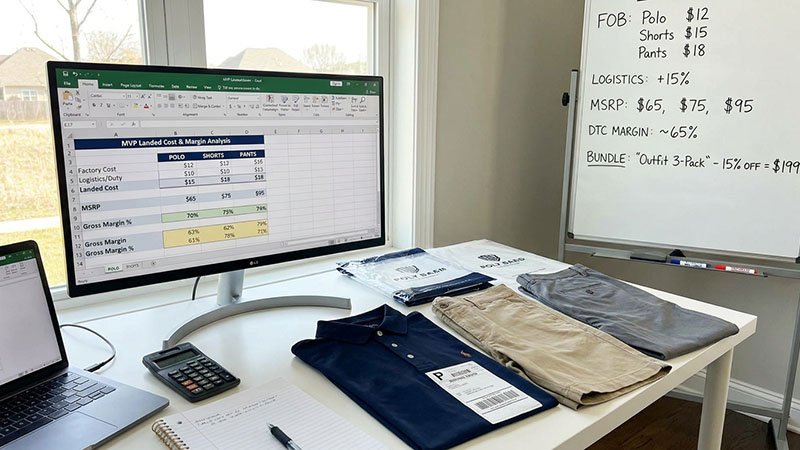
Your MVP launch isn't just a test of your product; it's a test of your business model. If the unit economics don't work on these three core products, they won't work on a larger collection either. Getting your costs and pricing right at this stage is absolutely critical.
Cost breakdown
Your landed cost is the total cost to get one unit into your warehouse, ready to sell. It's not just the factory price. It must include the cost of fabric, trims, labor (CMT), testing, packaging, shipping, insurance, and import duties. Aim to have this total landed cost be no more than 25-35% of your target retail price.
MSRP and margins
Your DTC gross margin is the difference between your retail price and your landed cost. A margin of 60-70% is a healthy target for an e-commerce brand. This gives you enough room to cover marketing, salaries, website costs, and still have a profit. If you plan to sell wholesale, you'll need to use "keystone pricing" (a 50% margin for the retailer), so your own margin will be lower on those sales.
Size curve and buy plan
For your first order, you won't have any sales data. So, you'll rely on a standard industry size curve. For a men's style in the US, this means ordering more Mediums and Larges than you do Smalls or XXLs. A typical 13-piece size pack for a polo would be S(2), M(3), L(4), XL(3), XXL(1). Use this ratio to plan your first buy.
Cash flow
Factories typically require a deposit (usually 30%) to start production and the remaining 70% before they ship your goods. This means your cash is tied up for months. You can manage this by running a pre-order campaign, where customers pay upfront, and you use that cash to fund your production deposit.
Bundles and AOV
The beauty of the 3-SKU capsule is bundling. Encourage customers to buy a complete outfit by offering a discount. For example, "Buy any polo and bottoms for 15% off." You can also offer a 2-pack of polos. These bundles are a powerful way to increase your Average Order Value (AOV) and move inventory faster.
How Do You Launch and Sell Your MVP in Just 90 Days?
Your products are almost ready, but you have no launch plan. The thought of coordinating marketing, sales, and logistics feels overwhelming and chaotic.
Follow a disciplined 30-60-90 day plan. Days 1-30: Finalize assortment and suppliers. Days 31-60: Get photo samples and create all your marketing content. Days 61-90: Launch pre-orders, place your bulk PO, and set up your fulfillment.
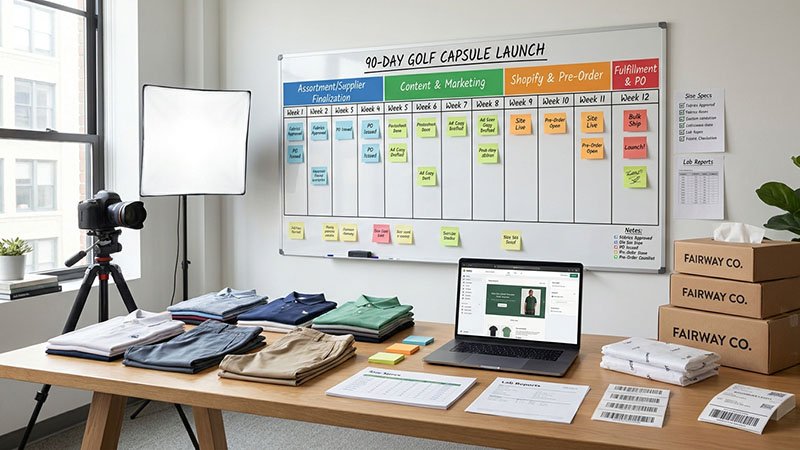
A fast launch is possible only because the MVP capsule keeps things simple. With only three products, you can be incredibly focused and agile. This plan turns a mountain of tasks into a clear, step-by-step roadmap.
30-60-90 plan
- Days 1-30 (Strategy): Finalize your 3-SKU assortment, colors, and pricing. Select your manufacturing partner and get your tech packs finalized.
- Days 31-60 (Content): Your top priority is to get perfect photo samples from your factory. As soon as they arrive, shoot all the photography and video for your website and social media. Write your product descriptions.
- Days 61-90 (Launch): Build your Shopify store. Launch your pre-order campaign. Use the initial sales data to place your bulk purchase order (PO) with the factory. Set up your fulfillment, whether it's with a 3PL or out of your own garage.
PDP essentials
Your Product Detail Pages (PDPs) need to do the selling for you. They must include: detailed fit notes (e.g., "Athletic fit, size up for a relaxed feel"), a clear size chart with measurements, fabric specs, badges for any tests you've passed (like UPF 50+), and stats on the model (e.g., "Model is 6'1" and wearing a size Medium").
Seeding and channels
You don't need a huge marketing budget. Identify 10-20 influential teaching pros or local amateur players. "Seed" them with your product for free. Their feedback and potential social media posts are invaluable. You can also start by approaching local resort pro-shops for small wholesale orders.
Ops
Decide how you will ship orders. A Third-Party Logistics (3PL) company can handle warehousing and shipping for you, but it comes at a cost. Starting out, you can fulfill orders yourself. Make sure every item has a unique barcode (UPC) for inventory tracking. Invest in quality, branded packaging for a professional unboxing experience.
Labels and claims
Compliance is not optional. Ensure every garment has the legally required labels for fiber content, country of origin, and care instructions. If you claim UPF 50+, you must have the lab report from your supplier on file to back it up. Ensure your fabrics meet chemical safety standards like REACH or Prop 65 for your target markets.
Conclusion
Starting with a 3-SKU MVP isn't about thinking small; it's about being smart. You validate your core product, manage your financial risk, and build a profitable foundation for your brand's future.
Notes and Legal
UPF and performance claims must be backed by valid lab reports; avoid medical/therapeutic wording. This guide is educational; consult qualified counsel for legal matters.