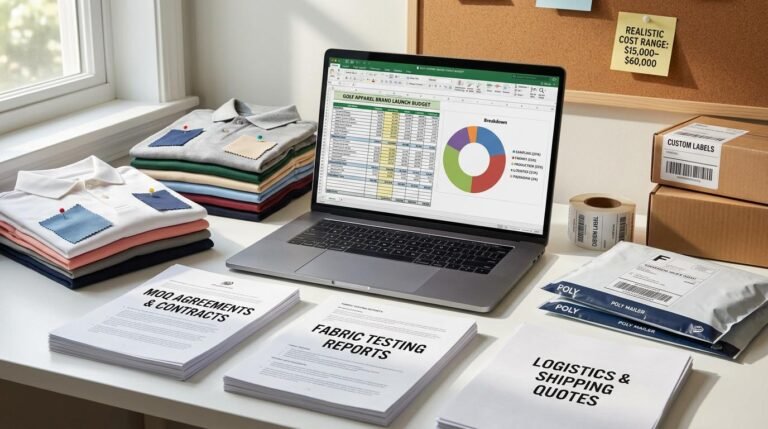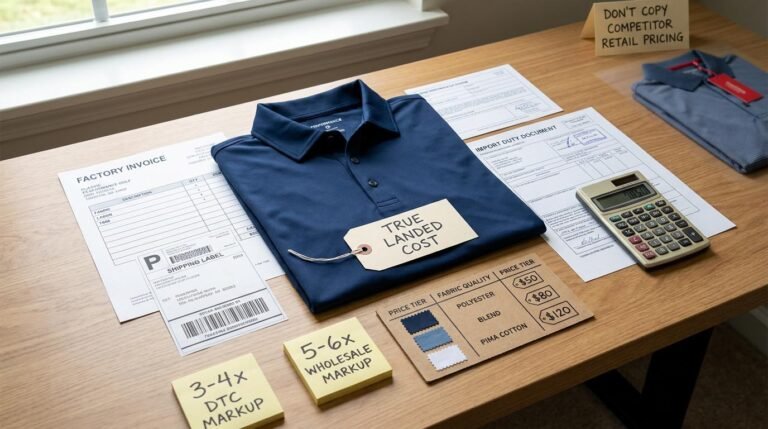
You're ready to make your first golf apparel collection, but the manufacturing world is full of confusing acronyms. The two you hear most are OEM and ODM, and choosing the wrong path can waste months of time and thousands of dollars.
OEM (Original Equipment Manufacturer) is when you provide a unique design to a factory to produce. ODM (Original Design Manufacturer) is when you select and lightly customize a pre-existing design from a factory's catalog. Your choice depends entirely on your brand's resources and goals.
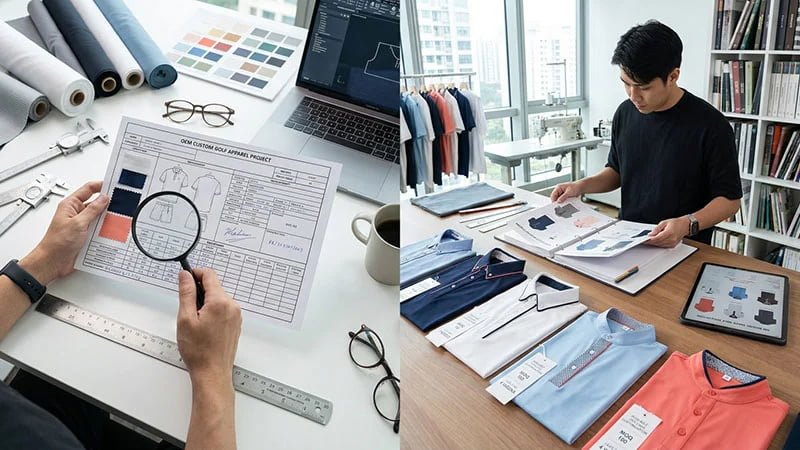
I see this all the time with new brand founders like Bobby. They ask me, "Which is better, OEM or ODM?" This is the wrong question. It’s not about the factory’s capability—any good factory can do both. The right question is, "Which model matches my current design resources, budget, and timeline?" This guide is a self-assessment to help you find the right answer for your brand, right now.
What Do OEM and ODM Mean, and When Should You Use Them?
Understanding the fundamental difference between these two models is the first step in making a smart strategic decision. They represent two very different approaches to bringing a product to market.
OEM gives you total control but requires more upfront work. ODM offers speed and lower entry costs but less uniqueness. The choice depends on your brand's stage, budget, and need for speed.
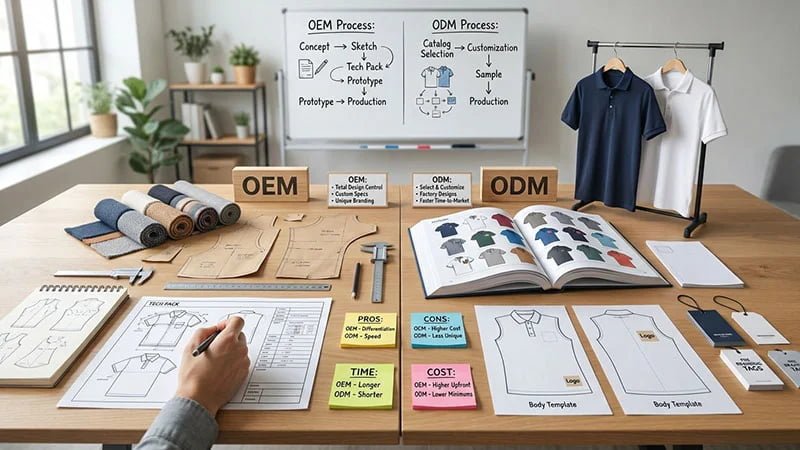
Definitions and boundaries
Let's make this simple. With OEM, you are the architect. You provide the factory with a complete technical package (tech pack), including your unique patterns, material specifications, and branding details. The factory is your builder. With ODM, the factory is both the architect and the builder. They offer you a catalog of ready-made styles ("bodies" or "blocks"), and you act as an interior designer, choosing colors, adding your logo, and maybe changing a trim.
Use-cases by brand stage/budget/speed
Your brand stage is the biggest factor. If you are a startup needing to launch quickly and test the market with a limited budget, ODM is your best friend. It offers speed and efficiency. If you are an established brand, your customers expect unique designs and a signature fit. OEM is necessary for this level of differentiation. Many brands use a hybrid model during their transition, using OEM for their core, hero products and ODM for seasonal or non-essential items.
Pros/cons overview
I encourage clients to look at this simple breakdown to understand the trade-offs:
| Feature | OEM (Original Equipment Manufacturer) | ODM (Original Design Manufacturer) |
|---|---|---|
| Pros | Total design control, unique product, own the IP, high brand differentiation. | Fast time-to-market, lower development cost, lower MOQs, proven designs. |
| Cons | Higher development costs, longer timeline, higher MOQs, requires design expertise. | Limited customization, risk of "me-too" products, you don't own the core design. |
How Do Design Control, Fit Blocks, and IP Differ?
The choice between OEM and ODM has significant implications for your brand's most valuable asset: its intellectual property (IP), especially its unique fit.
OEM means you own your brand's DNA—the patterns, the fit, the unique designs. With ODM, you are essentially licensing these elements from the factory for your collection.
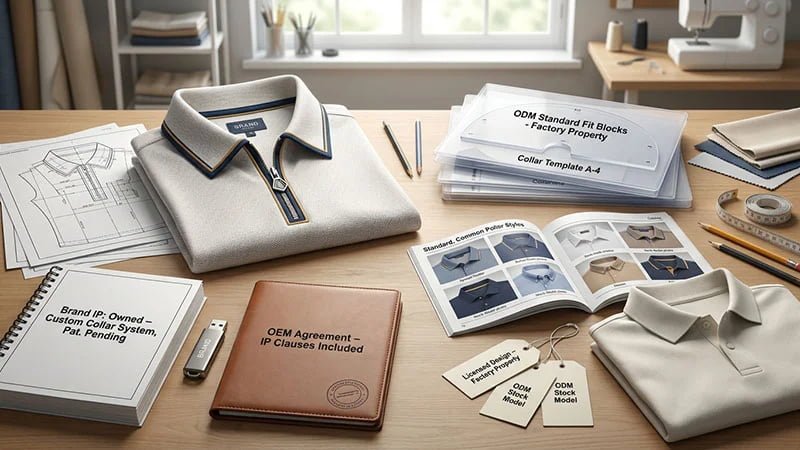
Patterns and fit ownership
This is the most critical difference. With OEM, the patterns and graded size specs we develop are your property. It's your brand’s unique fit DNA. You can take those patterns to another factory if you ever need to. With ODM, the fit block belongs to the factory. You are using their "M" or "L" standard, and your ability to make fit adjustments is very limited. You can’t take their pattern with you.
Branding and embellishments
Brand expression goes beyond a logo. With OEM, you have complete freedom to co-develop custom branding elements: a uniquely shaped zipper pull, a special weave on the collar, or a complex multi-layered heat transfer. With ODM, your branding options are typically limited to surface-level changes—like choosing the logo's placement and the color of the thread or transfer.
Contract/IP clauses
Your manufacturing agreement must reflect your chosen model. For OEM, the contract must explicitly state your ownership of all patterns, tech packs, and 3D digital assets. You can also negotiate exclusivity windows for specific fabrics. For both models, a strong Non-Disclosure Agreement (NDA) and a non-solicitation clause (to prevent the factory from hiring away your key contacts) are essential.
How Do Speed-to-Market and the Sampling Path Compare?
Time is money, especially for a new brand. Your choice between OEM and ODM will have a direct and dramatic impact on your launch calendar.
ODM offers a shortcut to the market, compressing a 24-week process into as little as 6-12 weeks. OEM is a longer, more deliberate process that guarantees a unique product.
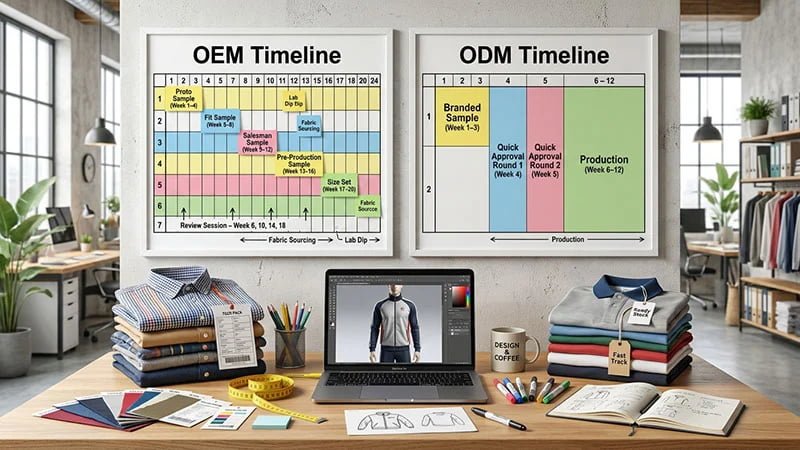
Sampling stages
The standard OEM sampling process is thorough: Proto Sample → Fit Sample → Salesman Sample (SMS) → Pre-Production (PP) Sample → Size Set. Each stage validates a different aspect of the product. With ODM, because you are using a pre-approved design, you can often skip the Proto and Fit stages entirely. You might go straight to a branded sample (similar to an SMS or PP), cutting the sampling time from months to weeks. A real-world example: an ODM sample can often be produced in 7 days, while a full custom OEM sampling cycle can take 30-45 days.
Timeline comparison
Let's put real numbers on it. Starting from a blank slate with OEM, a typical polo shirt can take 12–24 weeks to go from tech pack to bulk shipment. For more complex items like technical outerwear with waterproof zippers, it can be even longer. With ODM, picking a style from a catalog, you could have a bulk order shipping in as little as 6–12 weeks. This speed is ODM's biggest advantage.
3D and remote fit reviews
3D design tools can accelerate the early stages of the OEM process, allowing for quicker iterations on a digital avatar. However, I always caution my clients: for performance golf apparel, the feel, drape, and stretch of the fabric are critical. You must always confirm the fit with a physical sample before approving bulk production.
How Do Costing, MOQs, and Cash Flow Get Affected?
How you pay, how much you have to order, and how much cash you need upfront are all directly tied to your choice between OEM and ODM.
OEM involves higher upfront development costs and larger MOQs. ODM leverages the factory's scale to offer lower MOQs and predictable per-unit pricing.
Cost breakdown (BOM vs CM)
With OEM, you often have higher Non-Recurring Engineering (NRE) costs. This includes paying for pattern making, grading, and multiple rounds of sampling. In an ODM model, the factory has already absorbed these development costs across many clients, so you pay a simple, all-inclusive per-unit price. Regardless of the model, I always request a cost breakdown (fabric, trims, Cut & Make) to ensure pricing is fair.
MOQs and dye/knit constraints
Minimum Order Quantity (MOQ) is a major hurdle for new brands. A typical OEM MOQ might be 500–800 pieces per color per style because the factory is ordering new fabric just for you. With ODM, because the factory buys a popular fabric in huge quantities for multiple customers, they can offer a much lower MOQ, often in the 200–300 piece range. This is a game-changer for cash flow.
Payment terms and price locks
The payment structure is usually similar for both (e.g., 30% deposit, 70% before shipment). However, with OEM, you might have separate milestone payments for development. Advanced strategies, like booking undyed (greige) fabric in advance to lock in prices, are more common in long-term OEM partnerships.
How Is Quality and Performance Assurance Handled?
A common misconception is that ODM means lower quality. This is incorrect. Quality is not a function of the business model; it's a function of the process and standards you enforce.
Whether you choose OEM or ODM, the framework for ensuring quality is the same. You must define your standards for inspection, performance testing, and fit consistency.
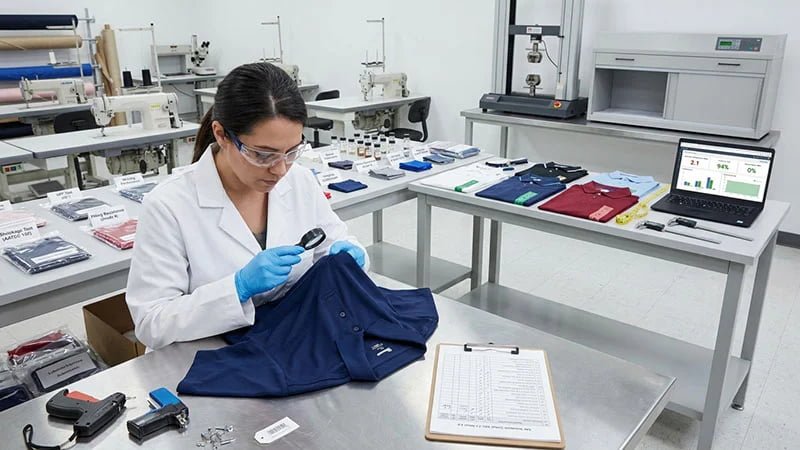
Inspections and AQL
The quality process is non-negotiable. We use the same statistical inspection standard (like ANSI/ASQ Z1.4) for both OEM and ODM products. We agree on the Acceptable Quality Limit (AQL), typically setting Critical defects at 0, Major at 2.5, and Minor at 4.0. These standards are applied during incoming material checks, in-process inspections, and final pre-shipment inspections.
Fabric/garment performance tests
Your performance promise to your customer must be verified. Whether it's an ODM polo or a custom OEM jacket, we send samples from the bulk production lot to a lab for testing.
| Test | Standard | Required Result |
|---|---|---|
| UPF | AATCC 183 | ≥40 |
| Wicking | AATCC 195 | Rating ≥3.5 |
| Pilling | ISO 12945-2 | Grade ≥3.5 |
| Snagging | ASTM D3939 | Grade ≥4 |
| Shrinkage | AATCC 135 | ≤5% |
Fit consistency and DHU
For ODM, we approve the factory's standard fit. For OEM, we approve our custom fit. From that point on, the validation process is the same. We request a Size Set (samples of S, M, L, XL etc.) to verify the grading is correct. For the Pre-Production (PP) sample, we aim for a DHU (Defects per Hundred Units) of ≤2%. In bulk production, our target for First Pass Yield (getting it right the first time) is ≥98%.
How Is Compliance and Chemical Management Tackled?
Regulatory compliance is a ticket to play in the global market. The same rules apply to your product regardless of whether it started as an OEM or ODM design.
From PFAS-free finishes to chemical safety regulations and labeling laws, you, the brand owner, are ultimately responsible for the compliance of your product.
PFAS-free and DWR
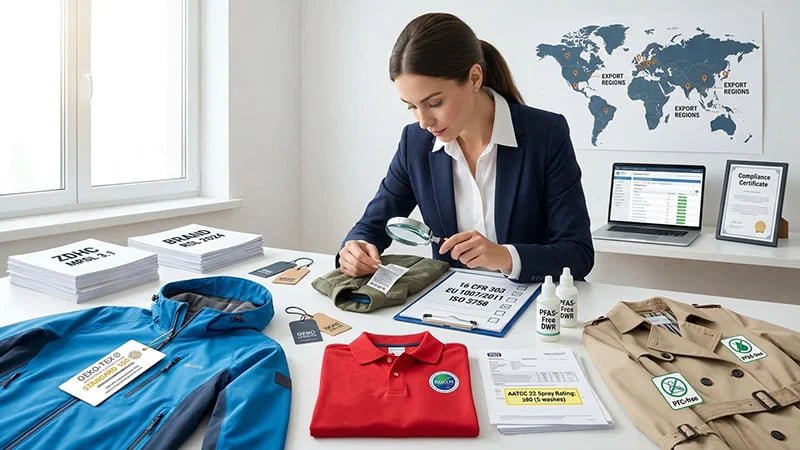
With growing restrictions on "forever chemicals," specifying a PFAS-free DWR finish is now standard practice for any brand focused on responsibility. We specify the performance level (e.g., AATCC 22 spray rating ≥80 after 5 washes) and verify that it's compatible with any laminates or seam-sealing tapes used in the garment's construction.
RSL/MRSL and regulations
Your factory partner must demonstrate compliance with global chemical management standards. This means aligning with the ZDHC MRSL (Manufacturing Restricted Substances List) and ensuring the final product meets your brand's RSL (Restricted Substances List). This is crucial for selling in markets with strict laws like Europe (REACH) and California (Prop 65).
Labeling and Country of Origin
Labeling errors are a costly and avoidable mistake. You must provide the factory with precise instructions for fiber content, care symbols (ISO 3758), and Country of Origin (COO) that comply with the laws in every country you plan to sell in (e.g., US 16 CFR 303, EU 1007/2011).
How Does Supply Flexibility and Risk Control Change?
Your choice affects not just your first collection, but the long-term flexibility and resilience of your supply chain.
OEM fosters a deep, strategic partnership, offering greater flexibility and control. ODM is more transactional, providing speed but less long-term supply chain security.
Capacity and backup
In an OEM partnership, you are often a more significant client to the factory. This gives you more leverage to reserve production capacity and work together to establish backup plants for critical processes. ODM relationships can be more transient; you are one of many customers buying a similar product, and you have less visibility into the factory's overall capacity.
Materials and dye lots
With OEM, you have full control over the supply chain. You can choose to pre-book undyed (greige) fabric to shorten lead times or work with the mill on a split-lot strategy to manage color consistency. With ODM, you are reliant on the factory's material planning and have little to no control over dye lots.
Change control (ECO)
The process for managing changes highlights the difference. With OEM, you have a formal Engineering Change Order (ECO) process. A critical change will trigger a re-sampling and approval cycle. With ODM, your ability to make changes is fundamentally limited. The product is what it is; if you need a significant change, you are effectively moving into an OEM model.
What is The Decision Framework and Scorecard?
So, how do you decide? I tell my clients to stop thinking in binaries and start using a scorecard. This turns a confusing choice into a simple diagnostic.
Score your needs against key criteria like differentiation, speed, and cost. Your final score will point you to the right path for your specific situation.
Weighted criteria
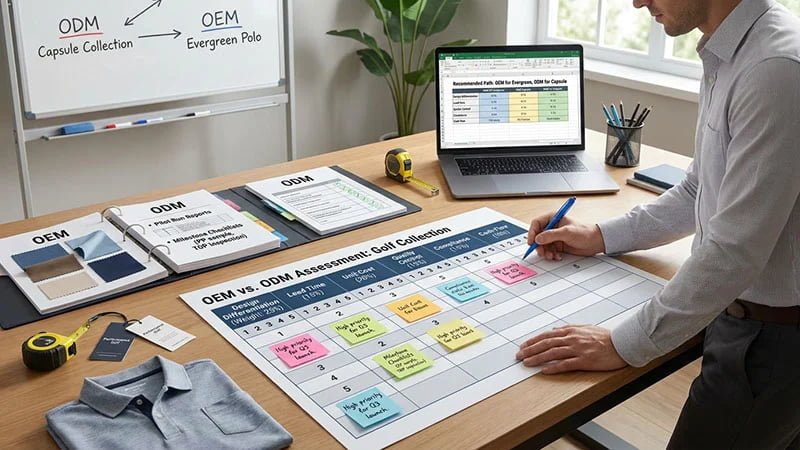
On a scale of 1-5, rate how important each of these is for your upcoming collection. The weights are my general recommendation for a new golf brand.
- Design Differentiation (25%): How unique must this product be?
- Lead Time (20%): How quickly do you need to be in the market?
- Unit Cost & Budget (20%): How tight is your budget and cash flow?
- Quality Control (20%): (This is always important, but do you need to control every detail?)
- Compliance (10%): (Table stakes, but some products are more complex.)
- Cash Flow (5%): What is your tolerance for upfront development costs?
Scenario-based picks
Your score will guide you. If you score high on differentiation and are flexible on lead time, OEM is your path. If you score high on lead time and budget, and can accept a less unique product, ODM is the clear winner. A common scenario: a brand uses ODM for a quick capsule collection to test colors and uses OEM for its core, evergreen polo that defines the brand's fit.
Pilot and milestones
Whichever path you choose, don't bet the farm on your first order. Start with a pilot run of 100–300 pieces. Use this smaller order to test the process, the product, and the market. Set clear approval milestones (PP sample, TOP inspection) to ensure you can stop a problem before it becomes a 1000-piece mistake.
What About a Hybrid Path and Migration Roadmap?
The smartest brand founders I work with know that this isn't a one-time choice. They see OEM and ODM as tools to be used strategically as their brand evolves.
The most successful path is often evolutionary: start with ODM to validate your market, then reinvest your profits and knowledge to migrate to a more unique OEM model over time.
ODM to OEM evolution
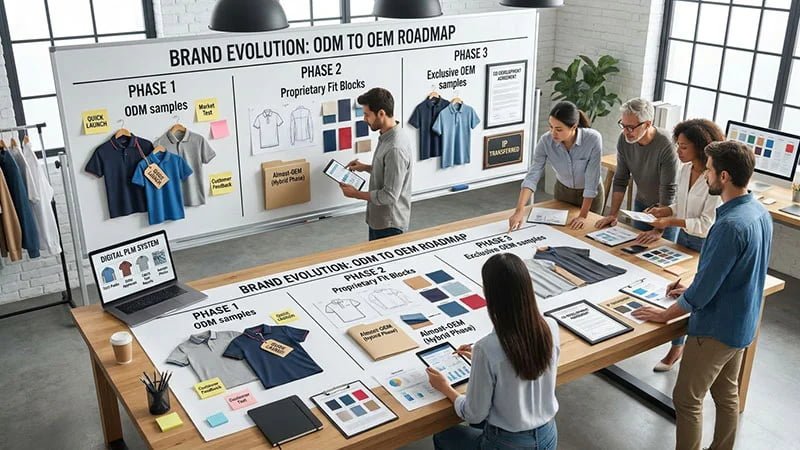
This is the roadmap I recommend for most new brands. Phase 1: Use ODM to launch quickly, prove your concept, and generate cash flow. Listen to customer feedback on colors and features. Phase 2: Use your revenue to invest in building your own proprietary fit block. You can now launch an "almost-OEM" product. Phase 3: With a proven fit and growing brand, you transition fully to exclusive OEM development for your most important products.
Co-development and IP transfer
As you scale, you can negotiate more sophisticated agreements. A co-development deal might state that while you are using a factory's pattern initially, after you purchase a certain volume (e.g., 10,000 units), the intellectual property for that pattern transfers to your brand. This rewards both sides for success.
Data assets and PLM hygiene
From day one, act like an OEM brand. Even if you start with ODM, build your own digital asset library. Get copies of all fabric test reports. Scan and save every approved color lab dip. Photograph and document every approved sample. Store this information in a simple PLM (Product Lifecycle Management) system. This data is the foundation of your brand's value.
What's in the RFQ Checklist, and What are the Next Steps?
You've done your self-assessment and have a direction. Now it's time to engage with potential factory partners. A professional RFQ (Request for Quotation) sets the right tone.
A good RFQ is a two-way street. You provide clear information about your project, and you request specific information about the factory's capabilities and processes.
What you send (the RFQ)
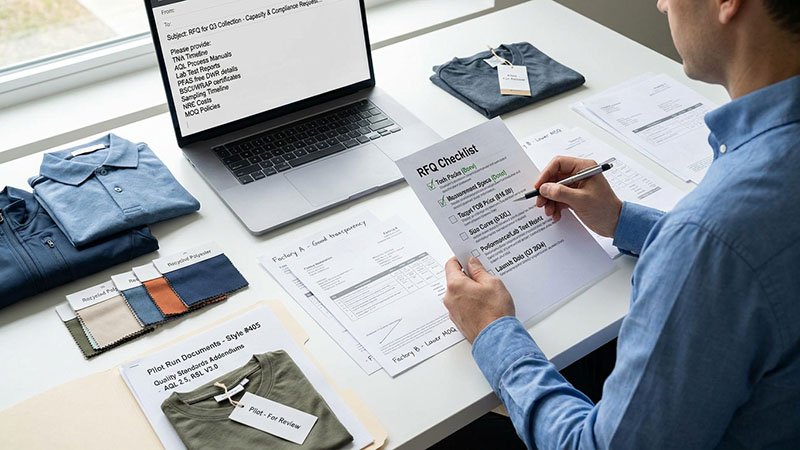
Whether you are pursuing OEM or ODM, you need to provide a clear brief. This should include:
- Your Tech Pack (for OEM) or reference styles (for ODM)
- Detailed measurement specs
- Target FOB price
- Estimated order quantity and size curve
- A matrix of all required performance and lab tests
- Your target launch date
What you request from the supplier
Don't just ask for a price. Ask for:
- Their production capacity and a standard TNA (Time and Needle) timeline
- Their AQL process and quality manual
- Their lab testing capability and recent test reports
- Their PFAS-free DWR solutions
- Their social compliance audit reports (like BSCI or WRAP)
- Their sampling timelines and NRE costs (if any)
- Their MOQ policy, including any surcharges for small orders
Compare and pilot
Never choose a partner based on price alone. Once you have quotes from 2-3 factories, compare their communication, transparency, and process. The best next step is to fund a small pilot run. Have them make one style. Attach your quality and compliance requirements (AQL standards, RSL) as a formal addendum to the pilot order. This real-world test will tell you everything you need to know.
Frequently Asked Questions?
Can I take a factory's ODM style and request major changes?
This is a great question and it highlights the "gray zone" between the two models. The answer is yes, but it changes the rules. If you ask for simple changes like a different color, your logo, or a different zipper pull, you're still in the fast, low-cost ODM world. The moment you ask to change the core pattern, alter the fit, or use a completely different fabric that the factory doesn't stock, you've moved into a "hybrid" or full OEM project. The factory will need to create a new pattern and go through a full sampling process, which means the timeline and costs will start to look much more like an OEM project.
If I use ODM, how do I prevent my brand from looking like everyone else?
This is the key strategic challenge of the ODM model. You have to accept that the physical product might not be 100% unique. Therefore, you must build your brand's differentiation around the product. Your unique value comes from your brand story, your logo and branding execution, your color palette, your marketing, and the community you build. An ODM product gets you into the game, but your brand is what makes customers choose you, stay with you, and tell their friends about you.
Is the final per-shirt cost always cheaper with ODM?
Not necessarily. If two shirts are made with the exact same fabric, trims, and labor, the per-unit cost will be very similar whether it's an OEM or ODM design. The real cost advantage of ODM is the lower total investment required to launch. With ODM, you avoid paying for pattern creation, grading, and multiple rounds of prototype sampling. You can also order a lower MOQ. This dramatically reduces the cash you need to get your first collection to market, even if the final price per shirt is comparable.
Am I still legally responsible for product safety if I use an ODM design?
Yes, absolutely. This is a critical point that many new brand owners miss. As the brand and the importer of record, you are 100% legally responsible for ensuring the product is safe and compliant for the markets you sell in. You cannot delegate this liability to the ODM factory. This is why you must still do your due diligence and request compliance documents like chemical test reports (for REACH or Prop 65) and certificates for any recycled content claims. A good factory partner will provide this documentation proactively.
How do I find a good factory that offers a strong ODM catalog for golf?
Finding the right partner is key. Start by searching sourcing platforms like Alibaba, but be very specific in your search terms—use "performance golf polo" or "golf mid-layer," not just "polo shirt." When you contact a potential factory, ask specifically to see their golf apparel catalog. Many factories will show you a generic activewear catalog that isn't truly designed for a golfer's needs (e.g., the fit isn't right for a swing, the fabrics don't have a high UPF rating). A good ODM partner will have a dedicated collection of styles developed with the golfer in mind.
Conclusion
Choosing between OEM and ODM is one of the first major strategic decisions you'll make. It’s not about which is "better," but which is right for your brand, right now. By honestly assessing your resources and goals, you can choose the path that gets you to market successfully.