
A client sent me a fabric sample with impressive AATCC 195 wicking scores—liquid spread across the surface in under three seconds. Then they wore it for nine holes in Florida summer heat and complained it felt suffocating. When I checked the full test report, the MVTR (moisture vapor transmission rate) was 1800 g/m²/24hr. That fabric trapped vapor like plastic wrap.
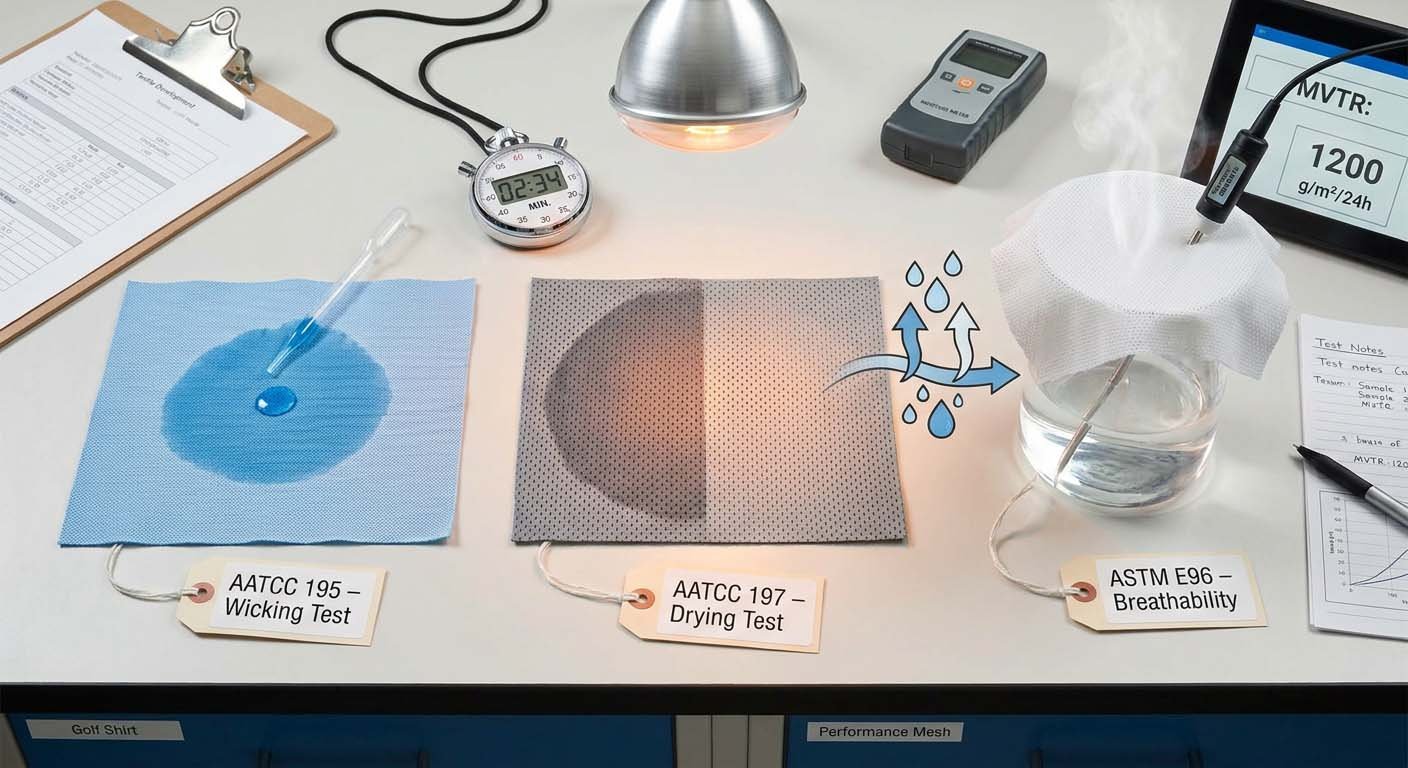
Moisture-wicking performance requires three separate mechanisms: absorbing liquid sweat, transporting it away from skin, and releasing it as vapor. AATCC 195 measures liquid spreading, AATCC 197 measures drying speed, ASTM E96 measures vapor transmission. High scores in one test do not guarantee comfort—you need balanced performance across all three.
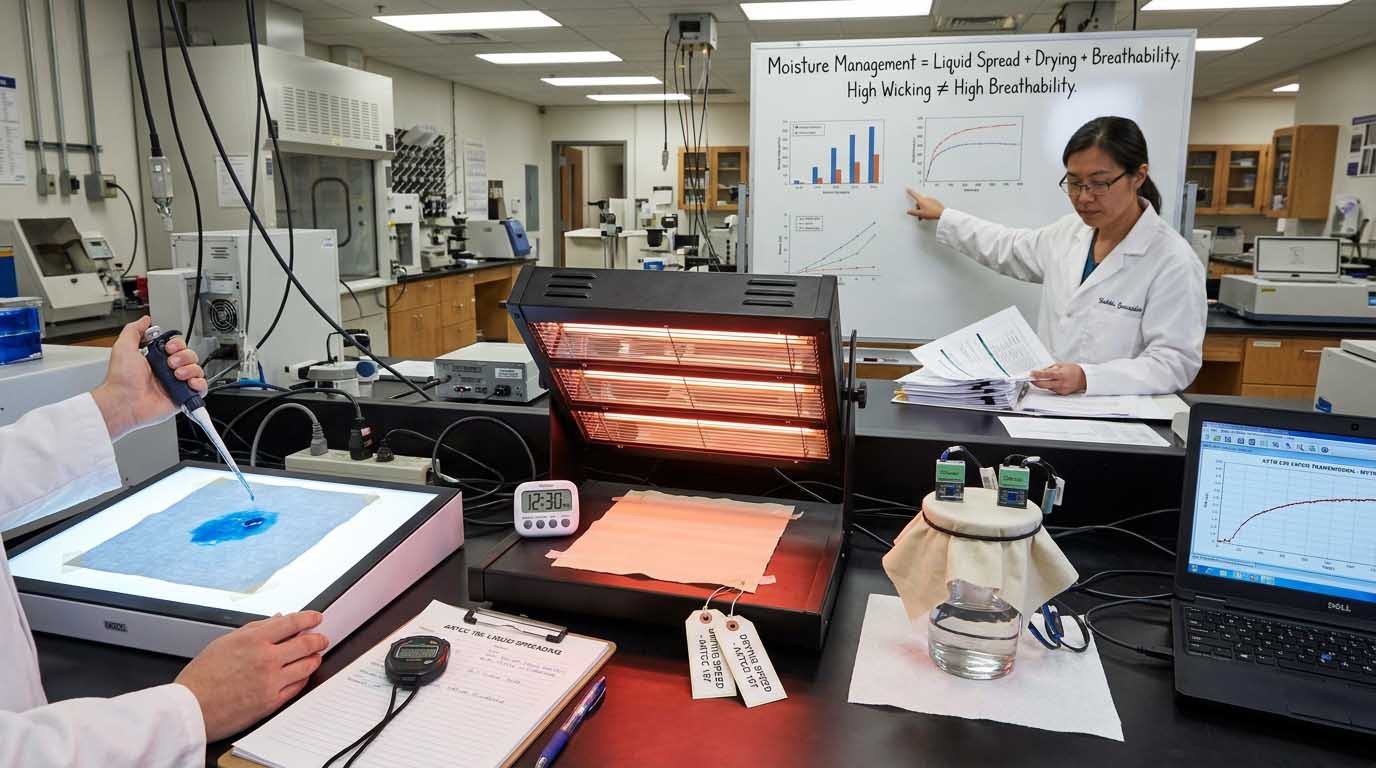
I work as FUWAY's technical liaison. My job is to review fabric test reports from suppliers, explain what the numbers mean to clients, and flag when test data does not match the performance claims being made. Most moisture-wicking confusion I see comes from buyers treating all test methods as interchangeable or assuming higher numbers always mean better. A fabric can score excellent on liquid wicking but terrible on vapor breathability. That combination feels wet and clammy during play. This guide explains which test measures what, how to read the data, and which metrics matter for different golf apparel applications.
Quick Answers: Moisture-Wicking Lab Tests
Is moisture-wicking the same as quick-dry?
No. Wicking is liquid movement through fabric. Drying is liquid evaporation into air. A fabric can wick sweat away from skin quickly but dry slowly if air cannot pass through (poor breathability). Both mechanisms are needed for comfort. AATCC 195 measures wicking. AATCC 197 measures drying.
What is AATCC 195 testing?
AATCC 195 (Liquid Moisture Management Test) measures how fast liquid spreads across and through fabric. It tracks wetting time, absorption rate, spreading speed, and one-way transport (whether liquid moves from inner surface to outer surface). Higher scores indicate faster wicking, but do not measure breathability or drying.
What is MVTR and which test measures it?
MVTR is Moisture Vapor Transmission Rate—how much water vapor can pass through fabric per day. ASTM E96 measures it in grams per square meter per 24 hours (g/m²/24hr). Higher MVTR means better breathability. Cotton is around 3000-4000. High-performance polyester can reach 8000-12000. Below 3000 feels stuffy.
Can a fabric pass all three tests but still feel uncomfortable?
Yes. The tests use controlled lab conditions (specific temperature, humidity, air flow). Real golf course conditions vary. A fabric might perform well in 20°C/65% humidity but fail in 35°C/90% humidity. Test data shows potential, not guaranteed performance in all conditions.
Which test result should you prioritize for summer golf polos?
Prioritize MVTR (breathability) first, then AATCC 197 (drying speed). In hot, humid conditions, vapor removal is more important than liquid wicking speed. Sweat evaporates from skin faster when vapor can escape through the fabric. MVTR above 5000 g/m²/24hr is the minimum target for summer performance fabrics.
Do natural fabrics like cotton need different test interpretation?
Yes. Cotton has high absorption but slow drying. It scores low on AATCC 197 (drying time over 30 minutes) but can feel comfortable because of high MVTR. Polyester wicks and dries faster but may feel stuffy if MVTR is low. The ideal result pattern differs by fiber type.
How do you verify supplier test claims?
Request the full test report, not just summary scores. Check test date, lab name, sample specification, and test conditions. Compare against your reference samples tested at the same lab. I have seen suppliers provide test reports from different fabric batches or outdated versions.
What Is the Difference Between Wicking, Drying and Breathability?
Moisture-wicking, quick-dry, and breathability are three distinct properties controlled by different fabric characteristics. Wicking moves liquid sweat through fabric. Drying evaporates liquid into air. Breathability allows water vapor to pass through. Golf apparel needs all three, but their relative importance depends on climate and activity intensity.
Liquid Wicking: Moving Sweat Away From Skin
Wicking is the process of liquid water moving through fabric by capillary action. When you sweat, the liquid is drawn away from your skin and spreads across the fabric surface or moves from inner layer to outer layer.
What controls it: Fiber absorbency, yarn structure, fabric construction (knit pattern), and chemical finishes.
Why it matters: Fast wicking prevents the wet, sticky feeling of sweat sitting against skin. The liquid spreads over a larger area, which increases the surface available for evaporation.
Test method: AATCC 195 (Liquid Moisture Management Test)
Typical results:
- Poor wicking: Takes 20+ seconds for liquid to spread
- Good wicking: Spreads in 5-10 seconds
- Excellent wicking: Spreads in under 3 seconds
Limitation: Fast wicking alone does not equal comfort. The liquid still needs to evaporate. If the fabric traps moisture, you just spread the sweat over a larger wet area.
Quick-Dry: Evaporating Liquid to Air
Drying is the rate at which liquid water evaporates from the fabric surface into the surrounding air. Even if a fabric wicks sweat quickly, it needs to dry quickly or it will stay wet and heavy.
What controls it: Fabric thickness, fiber absorbency, air permeability, surface area exposed to air, and ambient temperature/humidity.
Why it matters: Wet fabric feels cold and clammy. It adds weight. It can create friction and chafing. Fast drying returns the fabric to a dry state quickly, maintaining comfort.
Test method: AATCC 197 (Vertical Wicking Test) or custom drying time tests
Typical results:
- Cotton: 30-60 minutes to dry
- Polyester: 10-20 minutes to dry
- Nylon: 15-25 minutes to dry
Limitation: Drying speed depends on air flow and humidity. Lab tests use controlled conditions that may not match outdoor golf environments.
Breathability: Transmitting Water Vapor
Breathability is the fabric's ability to allow water vapor (not liquid, but gaseous moisture from evaporating sweat) to pass through. When sweat evaporates from your skin, the vapor needs to escape through the fabric. If it cannot, humidity builds up between skin and fabric, making you feel hot and wet.
What controls it: Fabric porosity, fiber type, coating or laminate structure (for waterproof fabrics), and fabric thickness.
Why it matters: In hot, humid conditions, most sweat evaporates before it even becomes liquid. If vapor cannot escape, you feel suffocated even if the fabric wicks liquid well. This is why cotton (high breathability) can feel more comfortable than some polyesters (low breathability) despite slower wicking.
Test method: ASTM E96 (Water Vapor Transmission)
Typical results:
- Cotton: 3000-4000 g/m²/24hr
- Breathable polyester: 5000-8000 g/m²/24hr
- High-performance synthetics: 8000-12000 g/m²/24hr
- Waterproof membranes: 1000-5000 g/m²/24hr (designed to block liquid, allow vapor)
Limitation: High breathability alone is not enough if the fabric does not wick liquid sweat or dry quickly. All three mechanisms must work together.
How Do You Engineer Moisture Management Into Fabric?
Effective moisture management is built into fabric at multiple levels: fiber type and cross-section, yarn structure, knit pattern, and optional chemical finishes. Surface finishes alone are unreliable and wash out. Structural wicking from fiber geometry and knit design is more durable.
Fiber Type and Cross-Section
Synthetic fibers (polyester, nylon) with modified cross-sections:
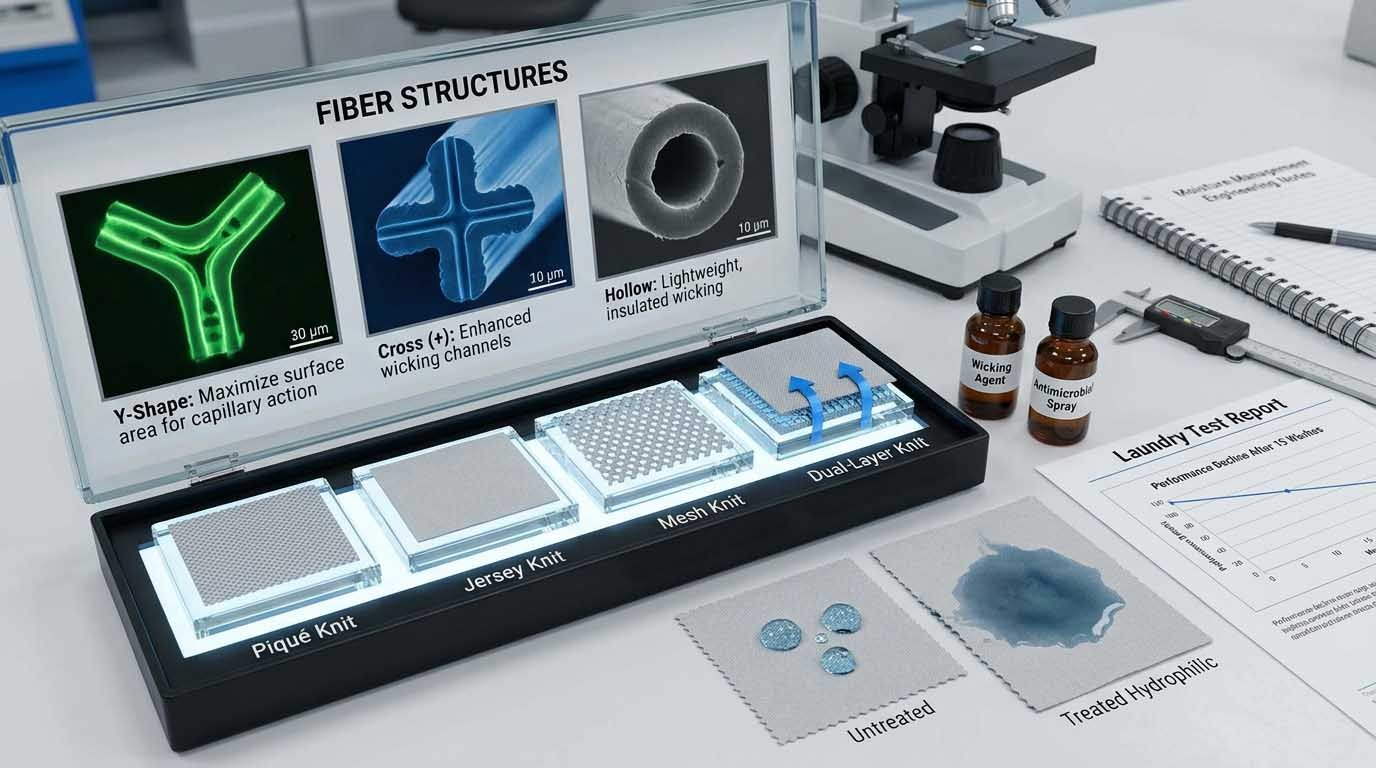
Standard round polyester is hydrophobic—it repels water. To make it wick, manufacturers change the fiber cross-section to create channels that pull liquid by capillary action. Common shapes:
- Y-shape: Creates grooves that draw liquid
- Cross (+) shape: Forms channels along fiber length
- Hollow fiber: Interior channel for liquid transport
These modified fibers wick faster than standard round fibers. The wicking is permanent because it is built into the fiber structure, not added as a finish.
Natural fibers (cotton, bamboo):
Naturally absorbent. Cotton absorbs up to 25% of its weight in water. This creates fast liquid absorption but slow drying. The fiber swells when wet, reducing breathability. Good for casual golf in moderate conditions. Not ideal for hot, humid summer play.
Blends (polyester/cotton, polyester/spandex):
Combine synthetic wicking with natural comfort. For example, 65% polyester / 35% cotton wicks faster than 100% cotton and feels softer than 100% polyester. Elastane (spandex) adds stretch but is hydrophobic—keep it under 10% to maintain moisture management.
Knit Structure
The way yarns are knitted affects air space, liquid spreading, and drying speed.
Piqué knit:
Textured surface with raised patterns. Creates air gaps between fabric and skin, improving ventilation. The texture increases surface area for evaporation. Good balance of wicking and breathability.
Jersey knit:
Flat, smooth surface. Close contact with skin for fast liquid absorption from skin to fabric. Minimal air gaps reduce breathability slightly. Feels soft and comfortable.
Mesh or open knit:
Large holes between yarns. Maximum breathability and fast drying because air flows through easily. Lower liquid wicking because there is less yarn surface to absorb sweat. Best for high-intensity activity where vapor removal is priority.
Double-layer or dual-surface knits:
Inner layer is hydrophilic (attracts water), outer layer is hydrophobic (repels water). Liquid moves from skin to inner layer, then pushed to outer layer where it spreads and evaporates. This creates "one-way transport"—liquid moves outward but does not come back to skin.
Chemical Finishes
Hydrophilic finish:
Applied to hydrophobic fibers (polyester, nylon) to make them attract water. Improves initial wicking speed. The finish can wash out after 20-30 washes unless it is durable.
Wicking agent:
A surface treatment that reduces surface tension, allowing liquid to spread faster. Similar durability concerns as hydrophilic finishes.
Antimicrobial treatment:
Does not improve wicking but reduces odor from bacteria that grow in moist fabric. Common in golf apparel where sweat sits on fabric for hours.
In the test reports I review, fabrics relying only on chemical finishes show performance degradation after 10-15 wash cycles. Fabrics with structural wicking (modified fiber cross-sections, dual-layer knits) maintain performance for the garment's lifetime.
What Do AATCC 195, AATCC 197 and ASTM E96 Actually Measure?
Each test method measures a specific moisture management mechanism and produces different metrics. AATCC 195 measures liquid spreading behavior with scores like OMMC and wetting time. AATCC 197 measures vertical wicking height and drying time. ASTM E96 measures vapor transmission rate in grams per square meter per day. Understanding what each metric means is essential for matching fabric to intended use.
AATCC 195: Liquid Moisture Management Test (LMMT)
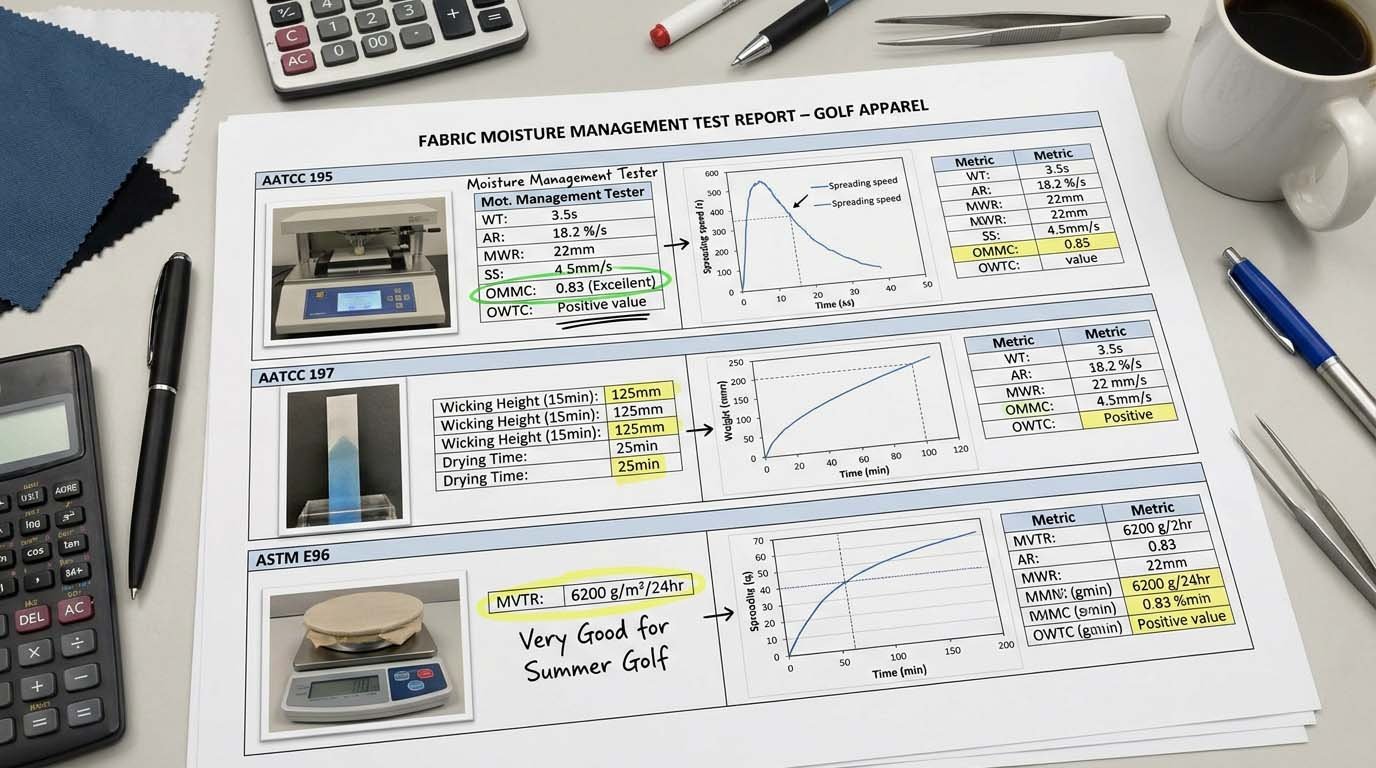
This test uses a device called the Moisture Management Tester (MMT). It places a fabric sample between two sensor plates, drops a controlled amount of liquid on top, and measures how the liquid spreads and moves through the fabric.
Metrics reported:
Wetting Time (WT):
How long it takes for the liquid to first be detected by the sensor. Shorter is better. Under 5 seconds is good. Over 20 seconds is poor.
Absorption Rate (AR):
How fast the fabric absorbs liquid at the beginning. Measured as %/second. Higher is better.
Maximum Wetted Radius (MWR):
How far the liquid spreads across the fabric surface. Larger radius means better spreading. Measured in millimeters.
Spreading Speed (SS):
How fast the liquid spreads from the center point outward. Measured in mm/second. Faster is better.
One-Way Transport Capability (OWTC):
The difference in liquid accumulation between the fabric's inner (skin-side) and outer (air-side) surfaces. Positive values mean liquid moves from inner to outer. This is the key metric for "moisture-wicking" claims.
Overall Moisture Management Capability (OMMC):
A composite score that combines all the above metrics. Ranges from 0 to 1.
- Below 0.2: Very poor
- 0.2-0.4: Poor
- 0.4-0.6: Good
- 0.6-0.8: Very good
- Above 0.8: Excellent
How I use this data: OMMC gives a quick overall assessment, but I always check OWTC separately. A fabric can have high OMMC from fast spreading but low OWTC (liquid does not move through to outer surface), which means it wicks sideways but not away from skin.
AATCC 197: Vertical Wicking
This is a simpler test. A fabric strip is suspended vertically with its bottom edge touching water. The test measures how high the water climbs up the fabric over time (usually 5, 10, 30 minutes) due to capillary action.
Metrics reported:
Wicking Height (cm):
Distance water climbs at specified time intervals. Higher is better, but beyond a certain point, more is not always better. Wicking 15cm in 5 minutes is excellent. Wicking 30cm may mean the fabric absorbs too much water and becomes heavy.
Drying Time (minutes):
Some labs add a drying phase—after wicking, they measure how long the fabric takes to return to dry weight. Faster drying is better. Under 15 minutes is excellent for synthetics. Over 30 minutes is poor.
How I use this data: AATCC 197 is easier to run than AATCC 195 and gives a clear, simple metric. But it does not distinguish between horizontal spreading and vertical movement, and it does not measure vapor transmission. I use it as a secondary check after AATCC 195.
ASTM E96: Water Vapor Transmission
This test measures how much water vapor passes through fabric over 24 hours under controlled temperature and humidity. A dish of water is covered with the fabric sample, sealed, and weighed periodically to measure vapor loss.
Metrics reported:
MVTR (Moisture Vapor Transmission Rate):
Measured in g/m²/24hr. This is the key breathability metric.
Typical ranges I see:
- 1000-2000: Very poor breathability. Feels like wearing plastic.
- 2000-4000: Moderate. Acceptable for casual wear or mild conditions. Cotton falls here.
- 4000-6000: Good. Suitable for summer golf in moderate humidity.
- 6000-10000: Excellent. High-performance synthetics. Feels breathable even in humid heat.
- Above 10000: Outstanding. Used in elite athletic apparel.
How I use this data: For summer golf apparel in humid climates, I set minimum MVTR at 5000 g/m²/24hr. Below that, client feedback consistently includes "felt too hot" or "not breathable enough." For mild climates or spring/fall golf, 4000 is acceptable.
How Do You Interpret Results and Set Specification Targets?
Test results must be translated into specification targets that suppliers understand and buyers can verify. Targets depend on garment type, intended climate, and price positioning. Setting unrealistic targets increases fabric cost or causes supplier failure. Setting targets too low results in poor performance and customer complaints.
Setting Targets by Garment Type
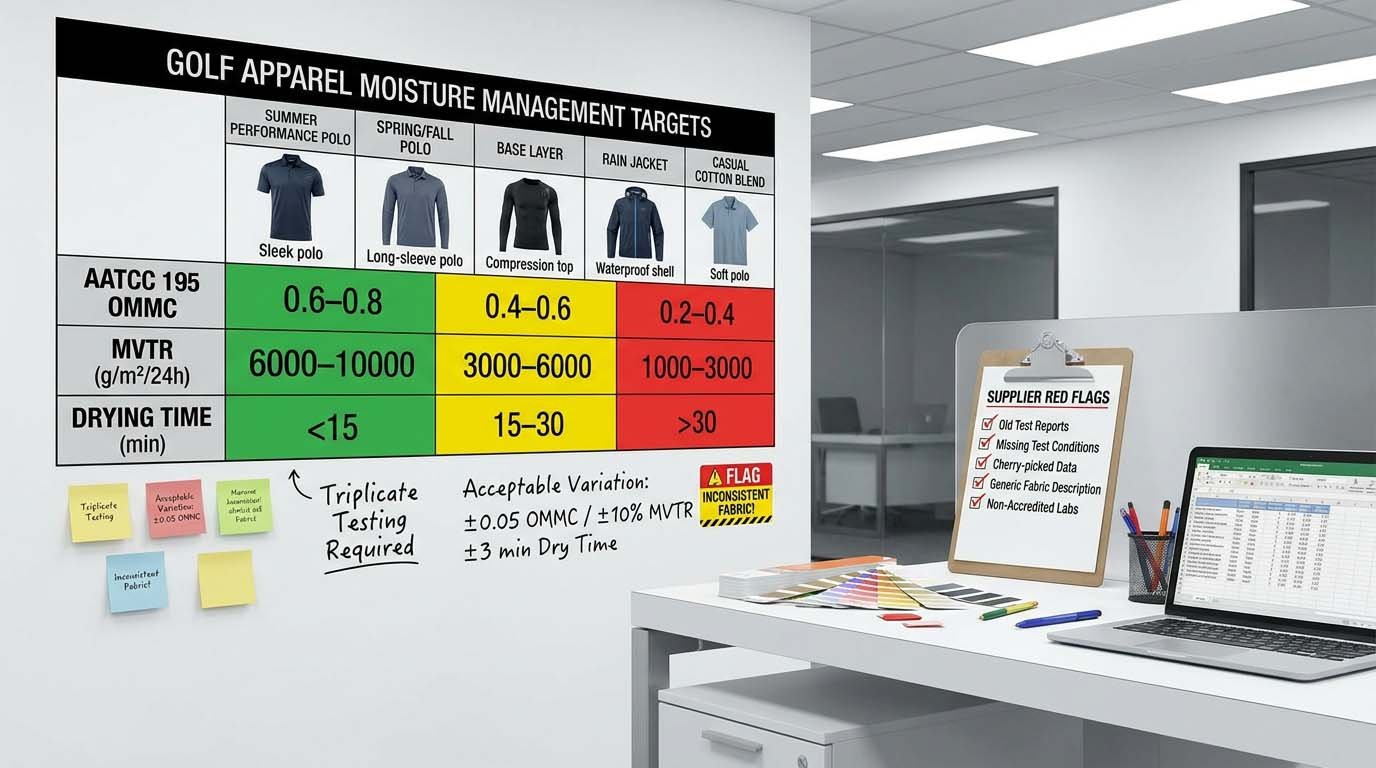
Based on the test reports I review and client feedback, here are the specification ranges I recommend:
| Garment Type | AATCC 195 OMMC | MVTR (g/m²/24hr) | Drying Time (min) | Rationale |
|---|---|---|---|---|
| Summer Performance Polo | 0.6-0.8 | 6000-10000 | <15 | Maximum breathability for hot, humid conditions |
| Spring/Fall Polo | 0.5-0.7 | 4000-6000 | <20 | Balanced wicking and comfort |
| Base Layer | 0.7+ | 8000+ | <10 | Must move sweat away fast and dry quickly |
| Outer Layer (Rain Jacket) | N/A | 3000-8000 | N/A | Waterproof fabric measured for vapor transmission only |
| Casual Cotton Blend | 0.4-0.6 | 3000-4000 | 20-30 | Natural feel prioritized over performance |
Understanding Test Variability
Test results vary by sample location, fabric batch, and testing lab. I always request triplicate testing (three samples from the same fabric) to check consistency.
Acceptable variation:
- AATCC 195 OMMC: ±0.05
- MVTR: ±10%
- Drying time: ±3 minutes
If variation exceeds this, the fabric has inconsistent manufacturing. I flag it and request new samples.
Supplier Red Flags I Watch For
Old test reports: Test date over 12 months old. Fabric formulation may have changed.
Missing test conditions: Lab temperature, humidity, air flow not specified. Results are meaningless without conditions.
Cherry-picked data: Only OMMC reported, without wetting time or OWTC breakdown. Supplier may be hiding poor metrics.
Generic fabric description: "Polyester knit" without specific weight, yarn count, or knit structure. Cannot verify the tested sample matches the production fabric.
Lab not recognized: Test performed at unknown or in-house lab. No third-party verification.
When I see these red flags, I request retesting at an accredited lab or ask for sample swatches to send to our preferred testing facility.
What Real-World Factors Override Lab Test Results?
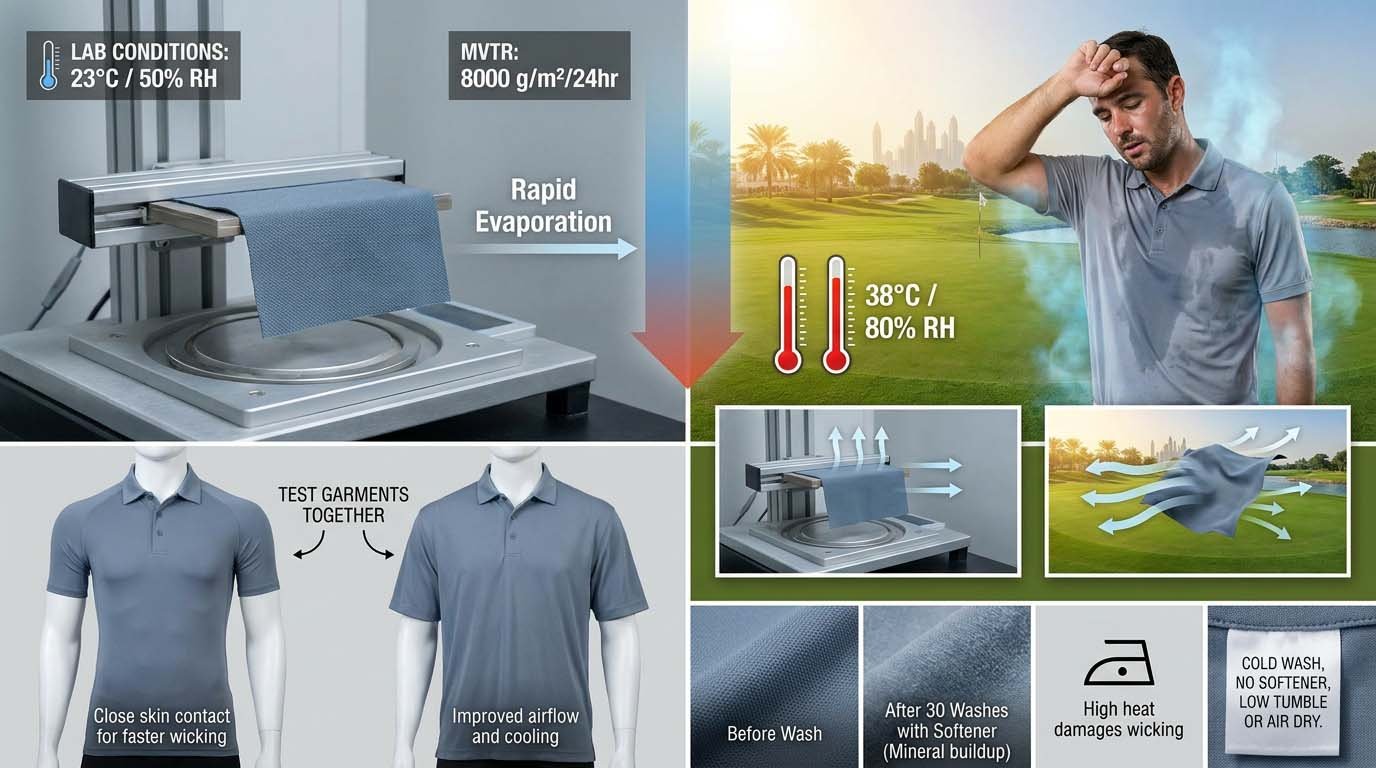
A fabric tested at 20°C and 65% humidity showed excellent MVTR (8000 g/m²/24hr). The client used it for polos in Dubai summer golf—38°C and 80% humidity. Customer feedback was "feels suffocating." I explained lab conditions do not represent extreme heat and humidity. Performance degrades outside test parameters.
Lab tests use controlled conditions that rarely match actual golf course environments. Temperature, humidity, air movement, layering, and fit affect comfort more than fabric specs alone. Test data shows potential under ideal conditions, not guaranteed performance in all situations.
Temperature and Humidity
Lab standard: ASTM E96 uses 23°C / 50% RH (relative humidity). AATCC tests use similar controlled conditions.
Real golf course: Summer heat can be 35-40°C with 70-90% humidity. In these conditions, evaporation slows dramatically. Even high-MVTR fabrics feel less breathable because the air is saturated and cannot accept more vapor.
From client feedback, fabrics that feel excellent in temperate climates feel stuffy in tropical or desert summer conditions. I advise clients targeting hot climates to add 1000-2000 g/m²/24hr to their MVTR target.
Air Movement
Lab tests use minimal air flow (simulating still air). On a golf course, you walk 5-6 km per round, creating air movement that increases evaporation. Standing in windy conditions also improves drying.
Fabrics with moderate wicking and drying performance in lab tests can feel quite comfortable during play because air movement compensates. Conversely, fabrics tested in still air may not feel as good when you stop walking and stand still in humid, windless conditions.
Layering
Wearing a base layer under a polo changes moisture management. The base layer absorbs sweat first, leaving the outer polo drier. If the base layer has poor wicking, it traps sweat and prevents the polo's moisture management from working.
I advise clients designing layered systems to test garments together, not individually. The system performance differs from individual garment performance.
Fit and Contact
Tight-fitting garments maintain constant skin contact, which improves liquid wicking from skin to fabric. Loose-fitting garments have air gaps, which reduce wicking but improve breathability and evaporative cooling.
For hot weather, a slightly looser fit often feels more comfortable despite slower wicking because air circulation is more important than liquid transport. For cool weather or high-intensity activity, a closer fit improves moisture management.
Care and Maintenance
Fabric softeners: Coat fibers with a waxy layer that reduces wicking. I see this frequently—client complains fabric performance degraded after washing, and they used fabric softener.
Hard water minerals: Build up in fabric over time, clogging capillary channels. Performance decreases after 20-30 washes.
High heat drying: Can damage hydrophilic finishes or melt elastane fibers, reducing stretch and wicking.
I always recommend care labels specify: wash cold, no fabric softener, tumble dry low or air dry.
Conclusion
Moisture-wicking requires three mechanisms—liquid absorption, transport through fabric, and vapor transmission. AATCC 195 measures wicking, AATCC 197 measures drying, ASTM E96 measures breathability. Set specification targets based on garment type and target climate. Verify supplier data with accredited lab reports and understand that lab results represent ideal conditions, not guaranteed field performance.