
Sourcing women's golf polos feels like a gamble. You receive samples that are just small men's shirts, disappointing customers and hurting your brand's reputation.
To succeed, B2B buyers must focus on women-specific pattern engineering (bust darts, proper grading), verified fabric performance (UPF 50+, wicking tests), and robust construction quality, especially in the collar. These factors are more critical than price.
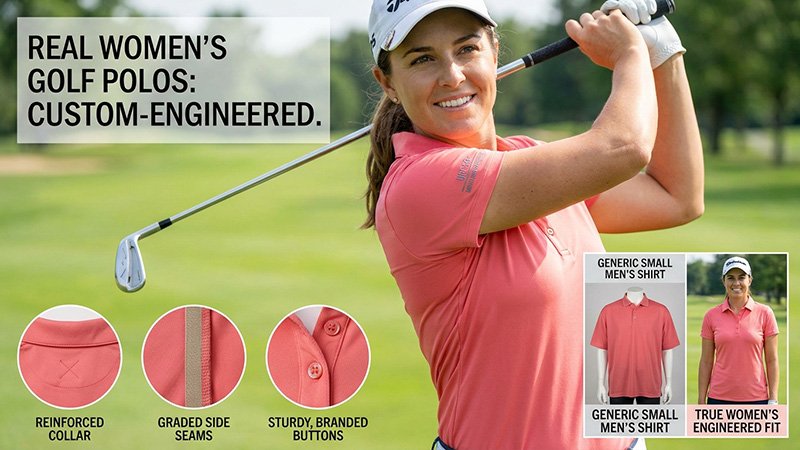
Let me be direct. A women's golf polo is not a "shrink and pink" version of a man's shirt. It is a completely different technical product that demands dedicated pattern makers, specific sewing processes, and stricter testing standards. Over my years in apparel manufacturing, I've seen countless brands fail because they treated their women's line as an afterthought. They focus on finding the lowest price, but the real question they should ask a supplier is: "Can you prove you have expertise in building apparel for the female form?" Let's break down what that proof looks like.
What Quick Answers Do B2B Buyers Need?
- What UPF is acceptable? Insist on a tested UPF 50+ rating. The supplier must provide documented reports from a third-party lab using standards like AS/NZS 4399 or AATCC 183. A simple "UPF 50+" on a spec sheet is not enough—demand the proof.
- Best hot-humid fabric? For peak performance, specify a 140–180 gsm recycled polyester/elastane blend in a piqué or jacquard knit. It must have verified moisture-wicking and quick-dry capabilities.
- Prevent collar curl? This requires specific construction: a heavier rib-knit collar (around 280–320 gsm), proper fusible interlining, and potentially an anti-curl insert.
- Size range to stock? A solid starting point is XS–3X. You must work with a supplier who understands how to grade patterns for a woman's body, accounting for bust, waist, and hip ratios, not just making the whole shirt bigger.
- Sleeveless allowed? Club policies vary, so a smart B2B assortment includes both a sleeveless and a short-sleeve version of key styles.
- Lab tests to require? At a minimum: colorfastness (AATCC 61), pilling (ASTM D4970), snag resistance, and dimensional stability (shrinkage/skew after washing, AATCC 135).
- Typical MOQ/lead time? For a good factory, expect 200–600 pieces per color, with lead times of 45-75 days for bulk production after sample approval.
- AQL level? For a premium program, set an AQL (Acceptance Quality Limit) of 2.5 for major defects and 4.0 for minor defects, with inspections at key stages.
- Best logo method for breathability? For performance fabrics, a lightweight silicone heat transfer is excellent as it stretches with the fabric. A fine-density embroidery with a soft backing can also work if executed properly.
What Fabric and Performance Specifications Actually Matter?
You're comparing two fabric swatches that seem identical. Both are "100% polyester with wicking." Why does one cost 30% more and perform ten times better?
The difference lies in the details of the knit structure, fiber quality, and the durability of the chemical finishes. A supplier's spec sheet is a claim; third-party lab reports are the proof.
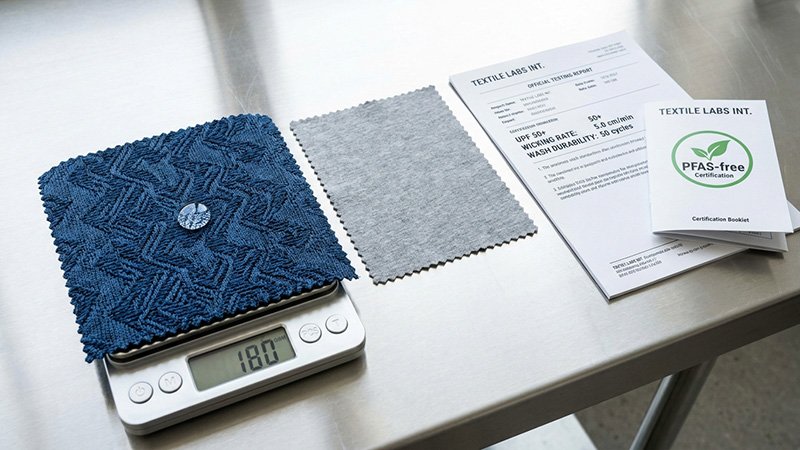
This is the area with the highest risk for B2B buyers. I've seen too many brands get burned by (xū biāo)—false or exaggerated specifications. A factory might use a cheaper, less effective wicking chemical that washes out after three wears. That's why you can't just look at the ingredient list; you have to verify the performance.
Knit structure and GSM: piqué, jacquard, or jersey—handfeel vs drape
Piqué is the classic, textured choice, offering great durability and breathability. Jersey provides a softer handfeel and a more fluid drape, which can be very flattering but may show more lumps and bumps. Jacquard knits allow for patterns to be woven directly into the fabric, offering a premium look without using prints. The GSM (grams per square meter) affects the opacity and perceived quality; for women's tops, 140-180 GSM is a good range for summer, preventing it from being too sheer.
Fiber choices: recycled poly, nylon, cotton blends
Recycled polyester is the workhorse for modern golf polos. Nylon offers a smoother, silkier handfeel and is very durable. Cotton blends offer comfort but will not perform as well in hot, humid conditions as they absorb moisture.
Wicking, breathability, and dry time (AATCC 79/197, ASTM D737)
These are not marketing terms; they are measurable standards. Demand test reports for wicking (how fast it moves moisture), breathability (airflow), and dry time. A good polo should feel dry to the touch minutes after intense activity.
Sun protection: validated UPF ratings and labeling
A UPF 50+ rating means the fabric blocks over 98% of UV radiation. The protection can come from the weave density, fiber type (polyester is naturally good), or specific finishes. This claim has legal implications, so a validated test report is non-negotiable.
Finishes: PFAS-free DWR, stain release, anti-odor and wash durability
Modern finishes add huge value. An anti-odor treatment is a major selling point. A stain-release finish helps with washing out grass or dirt. Crucially, you must ask the supplier about the durability of these finishes. How many home washes can they withstand? Top-tier suppliers can guarantee performance for 20, 30, or even 50 washes.
What Defines Women-Specific Fit and Pattern Engineering?
You gave your supplier a size chart, but the final products have baggy chests, tight hips, and awkward armholes. Why does this keep happening?
The problem is in the 'pattern block'. A factory that lacks dedicated experience in women's apparel will use modified men's patterns, failing to account for bust darts, proper shoulder slope, and the critical bust/waist/hip ratio.
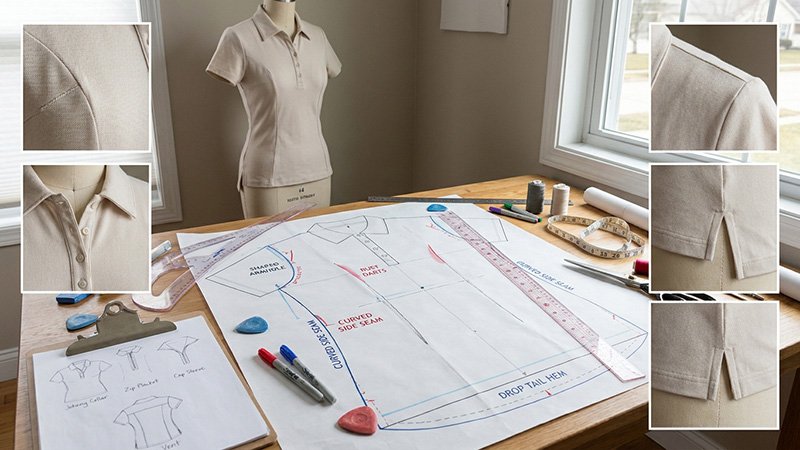
The single biggest factor in the success of a women's polo is the skill of the pattern maker. This is an artisanal skill, and it's not something you can verify by looking at a factory's machinery or its size. A brilliant pattern maker at a small workshop will produce a better-fitting garment than an inexperienced one at a massive factory.
Pattern blocks: bust darts, shoulder slope, armhole, and modesty
A woman's body has curves. The pattern must accommodate them. Bust darts or shaped side seams are essential for preventing fabric from pulling across the chest. The shoulder slope on a woman is typically less steep than on a man, and the armhole needs to be shaped differently to avoid gaping. The neckline and armholes must also provide modesty during a full golf swing.
Necklines and plackets: zips, Johnny collars—club dress codes
While a classic button placket is standard, zip plackets and buttonless Johnny collars offer modern, popular alternatives. However, you must design these with club dress codes in mind—a neckline deemed too deep can get a player sent off the course.
Sleeves and hems: cap vs set-in, drop tail, side vents
A slight cap sleeve can be more flattering than a standard set-in sleeve. A drop tail hem (longer in the back) provides coverage during bending and crouching. Side vents are crucial for allowing the polo to sit cleanly over the hips without bunching.
Stretch and mobility: % stretch, recovery (ASTM D3107), gussets
The fabric needs both stretch and recovery—the ability to return to its original shape. A fabric that stretches out and becomes baggy after one round is a sign of poor quality. Ask for the 4-way stretch percentage and recovery test data.
Size range, grade rules, tolerances; wear tests across body types
"Grading" is the process of creating the different sizes from the base pattern. Bad grading is why a 3X shirt sometimes feels like a blown-up, shapeless version of a Small. A good supplier uses different grade rules for women's apparel and conducts wear tests on real people across the size range to ensure a consistent fit.
What Defines Construction Quality and Durability?
Your sample polo looked great, but the bulk production order has curling collars, puckered seams, and pills after one wash. How do you prevent this inconsistency?
True quality is built on documented process control. Demand clear standards for stitching (SPI), collar construction, and durability testing. Inconsistency between samples and bulk is a direct result of a supplier lacking specific process documents for women's wear.
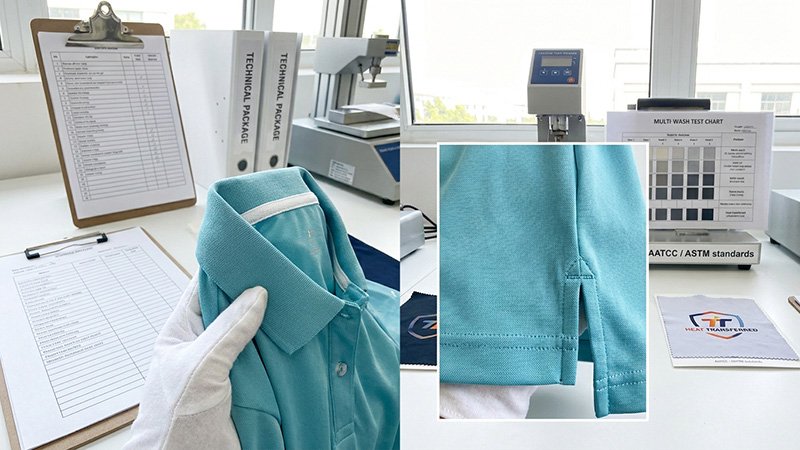
When I see a deviation between a sample and the final product, it’s a massive red flag. It tells me the factory doesn't have robust 'Technical Packages' and process controls. They relied on one skilled sewer for the sample, but couldn't replicate it at scale. You need a partner who documents everything, from stitch density to the exact placement of interlining.
Stitching and seams: SPI targets, coverstitch, bartacks, seam strength
Specify the SPI (stitches per inch); a higher SPI generally means a stronger, more durable seam. A coverstitch on the hem and sleeves provides a clean, professional finish. Bartacks (small, reinforcing stitches) should be present at stress points like the bottom of the placket and side vents.
Collar build: rib weight, fusing, anti-curl tapes, knit balance
A non-curling collar is a feat of engineering. It requires a heavy, balanced rib-knit fabric, the correct type and heat application of fusible interlining, and sometimes a special anti-curl tape stitched into the collar edge. This is a common point of failure for inexperienced factories.
Colorfastness, pilling, snag resistance (AATCC 16/61; ASTM D4970; Mace)
Your polo must look good after many uses. It needs to be tested for colorfastness to light (sun) and laundering. It must resist pilling (those annoying little balls of fabric). And for golf, snag resistance is critical to prevent pulls from jewelry, bags, or branches.
Dimensional stability and skew after 5–10 home washes
Embellishment readiness: anti-pucker backers, heat-transfer windows
The base garment must be ready for your logo. This means using the right stabilizer or "backing" for embroidery to prevent puckering on thin performance fabrics. For heat transfers, the fabric must be tested to ensure it can withstand the heat without discoloration.
How Should You Approach Branding and Merchandising?
Your polo performs well, but it doesn't look like a premium product in the pro shop. How do you translate technical quality into perceived value and brand identity?
Branding is in the details. The choice of logo application, sophisticated color management, and smart merchandising features like collar supports transform a good product into a great one that commands a premium price.
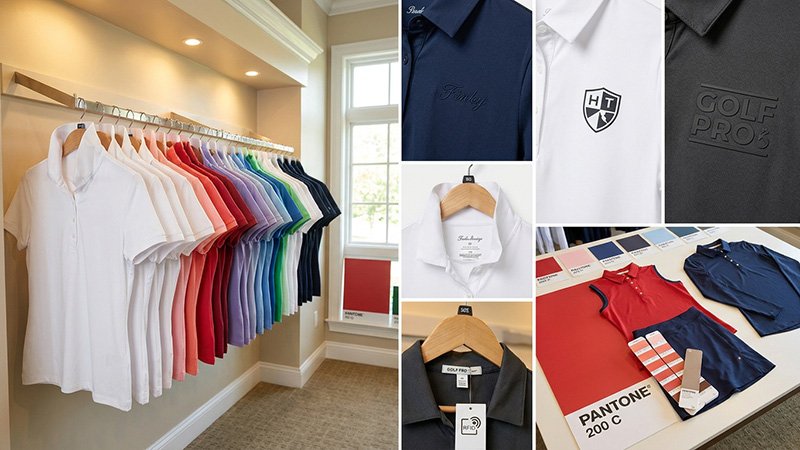
The final product isn't just the shirt; it's the entire presentation. From the moment a customer sees it on the hanger to the unboxing experience, every detail reinforces your brand's position. This is where you move from being a garment buyer to a brand builder.
Embroidery vs heat transfer vs silicone print
- Embroidery: Classic and durable, but can be heavy and pucker on performance fabrics if not done correctly. Needs a soft backing for comfort.
- Heat Transfer: Lightweight and excellent for stretch fabrics. Quality can vary greatly. A cheap transfer will peel or crack.
- Silicone Print: Offers a modern, raised 3D effect. It's flexible and durable, providing a a premium, high-tech look.
Logo placements and women’s chest fit considerations
The standard chest logo position may need to be adjusted higher or more centrally on women's polos to avoid awkward placement relative to the bust. A sleeve logo is often a safer and very popular alternative.
Color management: Pantone, ΔE tolerances, migrate/sublimation risks
Provide specific Pantone (TCX) color codes. Define your color tolerance using Delta E (ΔE) values—a ΔE of 1.0 or less is a good standard for color consistency between batches. You must also test for color migration, especially when using white logos on dark or red fabrics.
Style breadth: sleeveless approvals, long-sleeve variants, uniform sets
A strong women's program offers options. A sleeveless version for high summer, a long-sleeve version for sun protection or cooler weather, and coordinating bottoms can create a powerful uniform story for teams and clubs.
Pro-shop presentation: collar supports, hangers, size labeling, RFID
How will the shirt look after being shipped and hung? Use plastic collar supports to keep the collar pristine. Ensure size labeling is clear and easy to find. For larger operations, integrating RFID tags can streamline inventory management.
What Compliance and Sustainability Factors Should You Verify?
Your brand is being asked about its environmental impact and factory conditions. How do you ensure your supply chain is responsible and your marketing claims are defensible?
You must demand documentation. Certifications like OEKO-TEX for chemical safety, GRS for recycled materials, and social audits like BSCI or SMETA are the industry standards for proving compliance and sustainability.
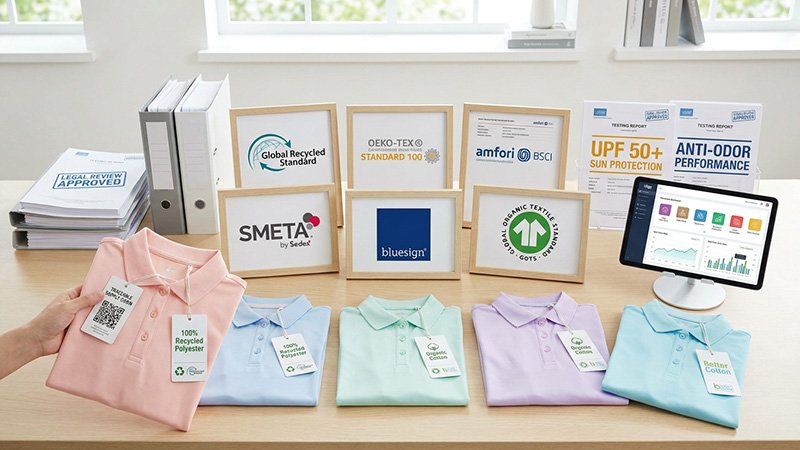
In today's market, sustainability and compliance are not optional. They are core business requirements. Your customers, particularly in the golf community, are educated and have high expectations. Making a claim without robust third-party verification is not only unethical but also a significant legal and brand reputation risk.
Chemical/RSL: REACH, Prop 65, OEKO-TEX, bluesign MRSL
Your supplier must adhere to a Restricted Substances List (RSL) to ensure the product is free from harmful chemicals. Certifications like OEKO-TEX STANDARD 100 or compliance with bluesign's MRSL (Manufacturing Restricted Substances List) provide third-party assurance.
Social audits: amfori BSCI, SMETA, WRAP; living wage pilots
You have a responsibility to know that the workers making your products are treated fairly and work in safe conditions. Demand recent (within the last 12-18 months) social audit reports from recognized schemes like amfori BSCI, SMETA, or WRAP.
Material certifications: GRS recycled poly, Better Cotton, GOTS
If you claim your polo is made from recycled polyester, you must have the Global Recycled Standard (GRS) transaction certificates to prove it. The same goes for organic cotton (GOTS) or Better Cotton. These certifications provide chain-of-custody for the raw materials.
Traceability and transparency: Higg FEM/FSLM, QR product pages
Leading brands are moving towards greater transparency. This can involve using the Higg Index (FEM for environmental, FSLM for social) to measure and report factory performance or adding QR codes to hangtags that link to information about the product's journey.
UPF and anti-odor claims—test reports and legal review
Any performance claim you make on your packaging or marketing must be backed by a valid, recent lab report. These claims can be subject to legal challenges, so it's wise to have them reviewed by legal counsel in your target market.
How Do You Manage the Supply Chain and Program Economics?
You've designed the perfect polo, but high costs, long lead times, and quality control issues are eating your margin. How do you build a profitable and reliable program?
Success requires proactive management of the entire supply chain. This means understanding MOQs, mapping lead times, clarifying costs with Incoterms, and implementing strict QC gates to protect your investment and ensure profitability.
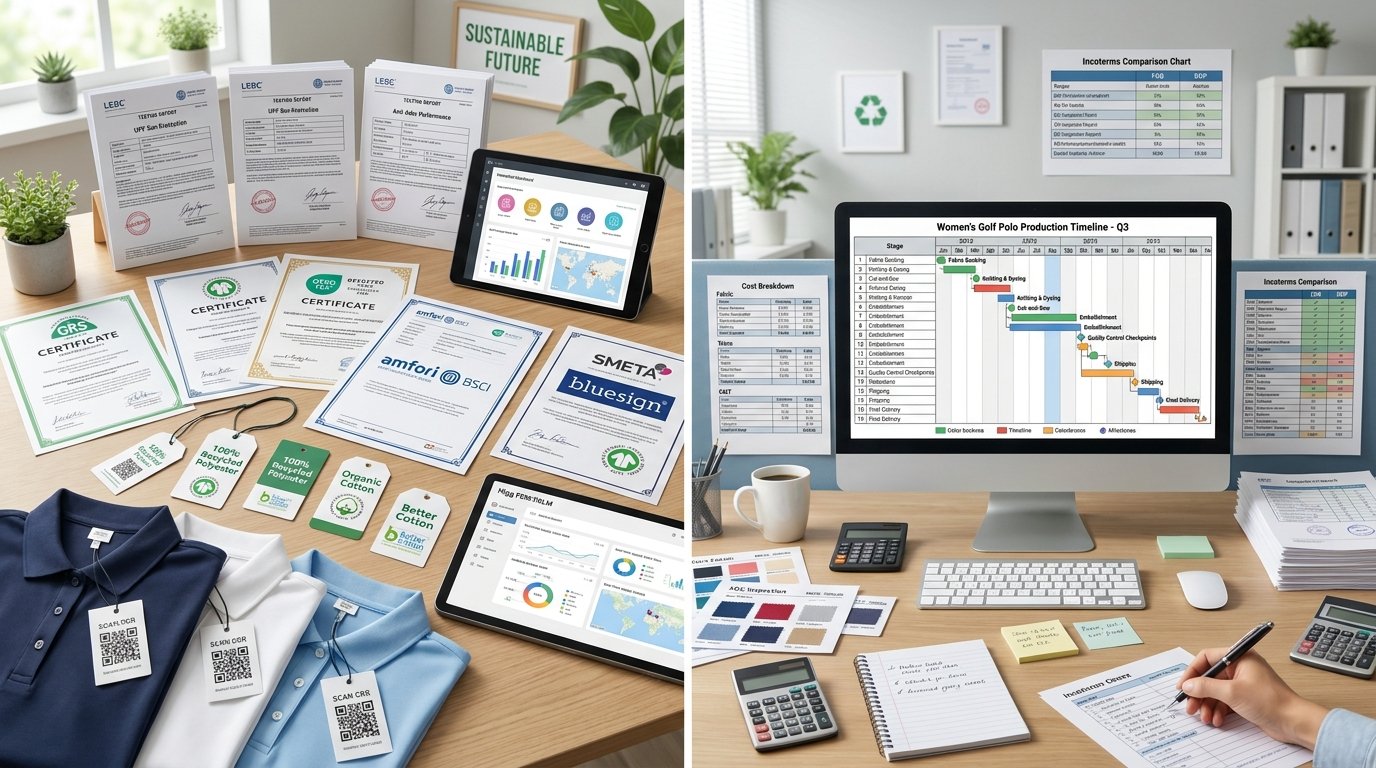
This is where everything comes together. A great product is meaningless if it arrives late, costs too much, or has a high defect rate. As a B2B buyer, your job is not just to select a product, but to manage a complex process. A good manufacturing partner will be transparent and work with you on every step.
MOQs by color/size; small-batch premiums and fabric booking
Understand the Minimum Order Quantities (MOQs). Are they per style, per color, or per size? For smaller brands, it's often strategic to book a larger quantity of a single fabric and use it across multiple styles to meet the factory's fabric MOQ.
Lead time map: knitting/dyeing, cut-and-sew, embellishment, transit
Don't accept a single "lead time" number. Get a breakdown: How long for fabric production? How long for cutting and sewing? How long for shipping? This helps you identify potential bottlenecks and manage your launch calendar.
Incoterms and landed cost: FOB vs DDP, duties/tariffs
Know your Incoterms. FOB (Free On Board) means you are responsible for shipping, insurance, and duties from the origin port. DDP (Delivered Duty Paid) means the supplier handles everything to your warehouse door. DDP is easier but gives you less control and visibility on costs. You must calculate your true landed cost to understand your real margin.
QC gates and AQL: PPS, inline, FRI; defect taxonomy
Implement a multi-stage Quality Control plan. A Pre-Production Sample (PPS) must be approved before cutting. Inline inspections check quality during the sewing process. A Final Random Inspection (FRI) is performed before shipment, using your defined AQL standard.
Cost breakdown and margins: fabric, trims, CMT, testing, compliance, logistics
Ask your supplier for a cost breakdown. Understanding how much you're paying for fabric, trims, and CMT (Cut, Make, Trim) labor gives you leverage for negotiation and helps in value engineering.
Value engineering and KPIs: maintain performance, track OTD, sell-through, return rates
Value engineering is the art of reducing cost without sacrificing quality or performance—for example, switching to a new seam construction that is faster to sew but just as strong. Track your KPIs: On-Time Delivery (OTD), sell-through rates, and, most importantly, return rates, which are often the clearest indicator of a fit or quality problem.
Conclusion
A great women's polo isn't a small men's shirt. Success depends on focusing on female-specific fit, verified fabric performance, and detailed quality control from a capable, expert partner.