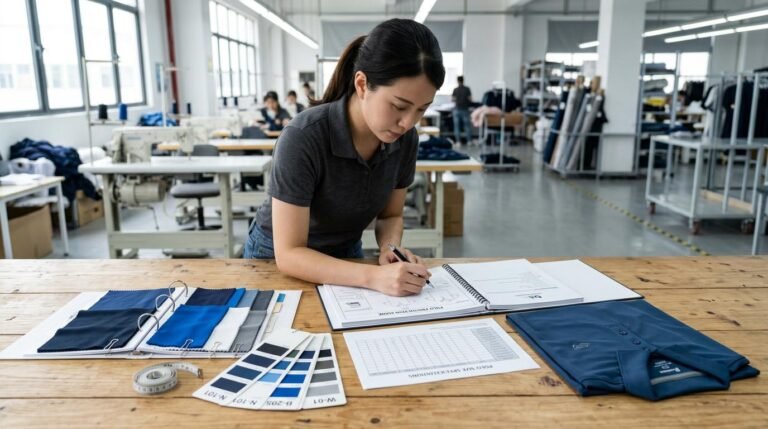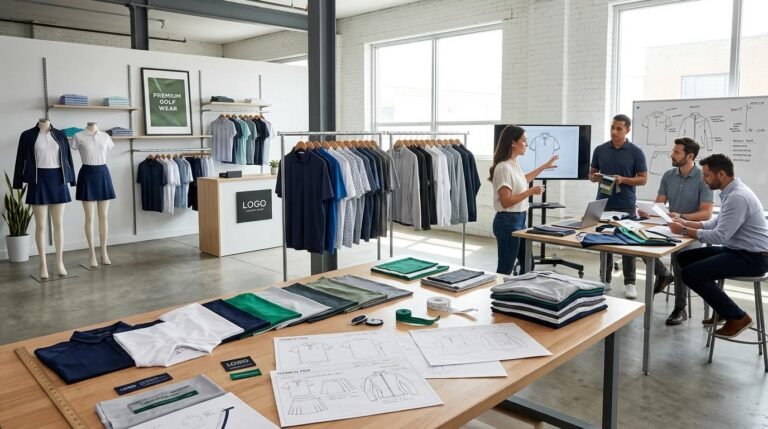
You’ve designed the perfect golf polo, but what happens after you send the tech pack to a factory in China? The process can feel like a black box. How do you ensure your vision doesn't get lost in translation and quality is maintained?
A golf apparel factory transforms your design into a physical product through a systematic process: digital patterning, material testing, scheduled bulk production with quality checkpoints, and finally, compliant packaging and shipping. It’s a disciplined system, not magic, that brings your apparel to life.
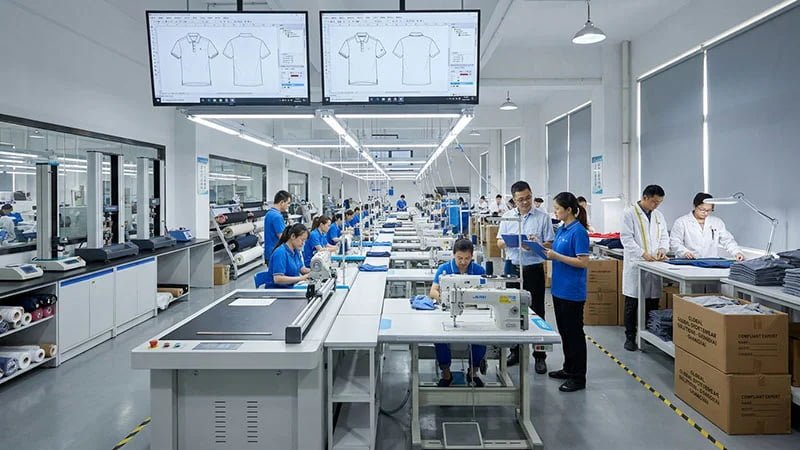
I've walked countless brand founders like Bobby through our factory doors, and their biggest "aha" moment is seeing how structured the entire journey is. It’s not just about sewing; it's about engineering a product for consistency and quality at scale. Understanding these steps demystifies the process and empowers you to be a better partner, ensuring the product you receive is exactly the one you envisioned. Let’s pull back the curtain on that journey.
How Is Your Design Turned into a Production-Ready Pattern?
You send a tech pack with sketches and measurements. But how does that PDF become a physical garment that fits perfectly across a full range of sizes? It all starts with engineering.
A good factory doesn't just trace your sketch. We translate it into a digital pattern, refine the fit on a live model, and engineer the most efficient way to build it.
Digital patterns and fit blocks
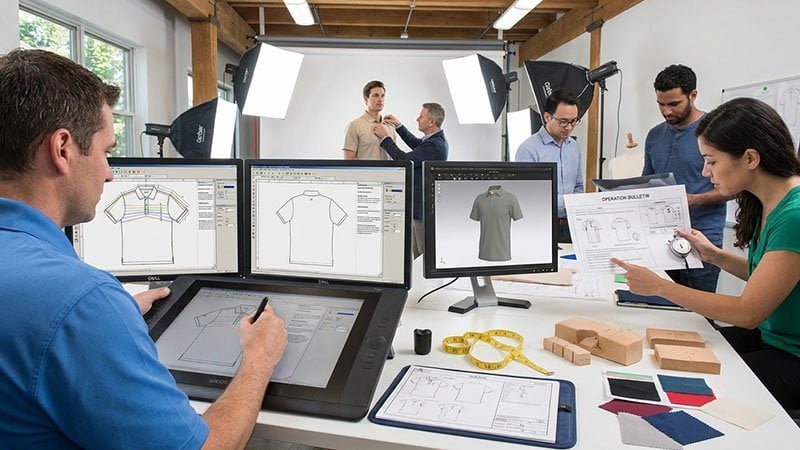
The first thing we do is build your design in a professional CAD system like Gerber or Lectra. This creates a digital master pattern. Over time, we build a core fit block library for you—your brand’s unique polo, outerwear, and skort patterns. This ensures consistency season after season. The first physical prototype sample from this pattern is typically ready in 7 to 10 days.
Fit sessions and size sets
This is where your feedback is critical. I always tell my clients that a spec sheet is a starting point, but the real magic happens in a fit session. We fit the sample on a standard model, but you know your customer's body type. Giving vague feedback like "it's too big" is not helpful. We need specifics like "reduce chest by 1.5 cm." Once the base size is approved, we create a full size set (S, M, L, XL, etc.) to confirm the grading and tolerances (e.g., ±1.0–1.5 cm) are correct before any bulk production starts.
Operation bulletin, SMV, and stitch types
Once the pattern is locked, our engineers create an operation bulletin. This is a step-by-step instruction manual for the sewing line. It defines the Standard Minute Value (SMV) for each task, helping us balance the workload. We also specify the critical stitch types needed for performance apparel, like four-needle six-thread flatlock seams for comfort, durable overlock stitches, and specialized processes like seam taping, laser perforation, or heat bonding.
3D sampling and pre-production review
To speed things up, we often use 3D sampling to review the design and fit digitally, which can save weeks of sending physical samples back and forth. However, before we cut any bulk fabric, we hold a formal Pre-Production Review (PPR) meeting. Here, our engineers, a quality manager, and the sewing line leader review the approved physical sample one last time to identify and solve any potential risks.
How Do We Guarantee Your Fabric Performs on the Course?
The best fit and construction mean nothing if the fabric pills, shrinks, or loses its color. The raw material is the soul of the garment.
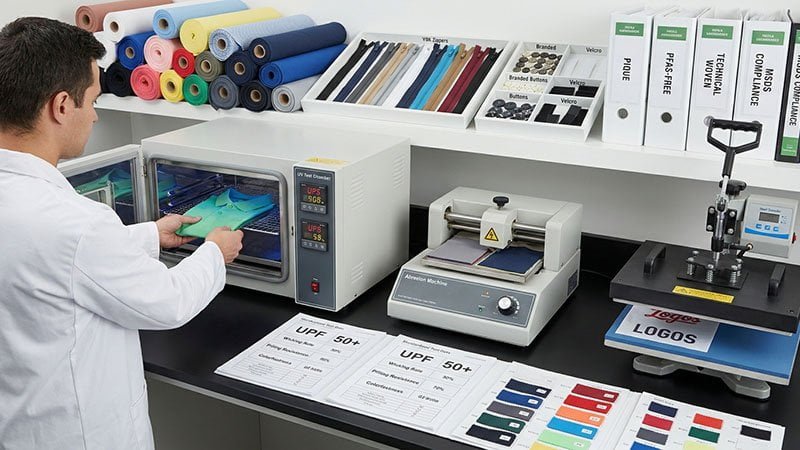
We don't just order fabric; we vet the mill, pre-book materials, and test every single batch against a strict set of performance standards before it's allowed on the cutting table.
Fabric selection and mill vetting
We have a curated network of mills specializing in performance fabrics. For golf, this typically means knits like pique, interlock, and high-stretch jerseys, or technical wovens with 4-way stretch and waterproof membranes. To shorten the long lead times for custom fabrics, we often place advance orders for undyed fabric (greige booking) or reserve capacity on knitting looms.
Key performance KPIs
A "performance" claim must be backed by data. We send samples from every fabric lot to a lab to be tested against agreed-upon standards. Your customer's satisfaction depends on these numbers.
| Test | Standard | Required Result |
|---|---|---|
| UPF Protection | AATCC 183 | ≥40 |
| Wicking Rate | AATCC 195/197 | ≥3.5 or ≥25mm/30min |
| Pilling Resistance | ISO 12945-2 | Grade ≥3.5 |
| Snag Resistance | ASTM D3939 | Grade ≥4 |
| Shrinkage | AATCC 135 | ≤5% |
| Colorfastness | ISO 105 C06 | Grade ≥4 |
PFAS-free DWR and chemical compliance
With growing regulations, compliance is non-negotiable. For water-resistant garments, we use PFAS-free DWR finishes and verify their performance (e.g., AATCC 22 spray test score of ≥80 after 5 washes). We align our entire supply chain with the ZDHC MRSL v3.1 and keep documentation (MSDS, test reports) to prove compliance with rules like REACH and CA Prop 65.
Trims and branding
Every component matters. Zippers, buttons, and even VELCRO® are sourced from reliable suppliers like YKK. For branding, we conduct our own rigorous testing. When developing a new heat transfer or silicone logo, we document the precise application settings—Temperature, Pressure, and Time (T-P-T)—to ensure the logo on the 1,000th shirt looks identical to the first.
How Does Your Order Move Through the Factory Floor?
You've approved the Pre-Production sample and the fabric has passed testing. How does your order transform from rolls of fabric into thousands of finished garments on schedule?
Your order doesn't just get thrown onto the line. It's guided by a master schedule, cut with precision, and sewn on a balanced line with built-in quality checks at every step.
TNA and milestones
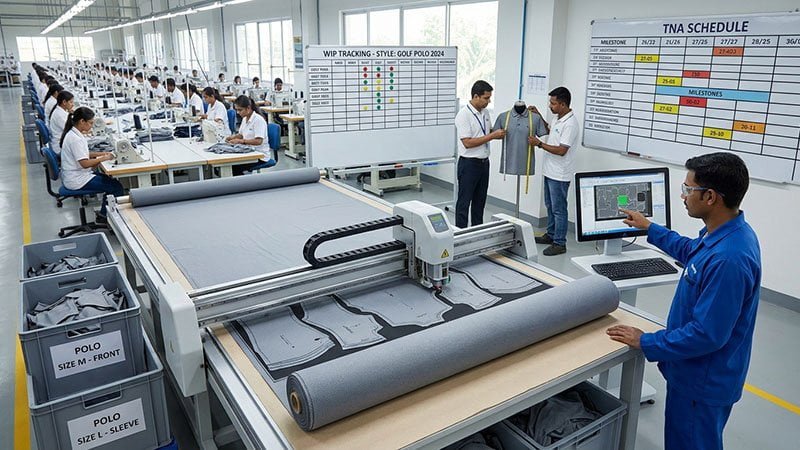
The first thing we do is create a Time and Needle (TNA) plan. This is the master calendar for your order. For a standard knit polo, the timeline after all materials are in our warehouse is typically 30-45 days for the cut-to-pack process. More complex items like jackets may take 45-60 days. This TNA includes key milestones so you know exactly when to expect progress updates.
Markers and auto cutting
Efficiency and consistency start here. We use software to create a digital "marker"—the most efficient layout of pattern pieces on the fabric. This is then sent to an automated spreading and cutting machine. This process ensures every piece is cut perfectly and maximizes fabric utilization, aiming for a yield of ≥82% for knits and ≥78% for wovens. For striped or plaid fabrics, this stage includes a careful strategy to ensure the patterns match up perfectly at the seams.
Line balance and bottleneck control
A sewing line is a team. Based on the SMV for each task, we balance the work so no single operator becomes a bottleneck. We use visual WIP (Work-In-Progress) boards to track the flow of garments down the line and monitor the production rhythm or "takt time." A well-run line can switch from producing one style to another in under 4 hours.
Operator self-check and first-off approval
Quality is built-in, not inspected-in at the end. Before a sewing line starts a new batch, the line leader and a QC inspector must review and sign off on the first-off sample. Then, each machine operator is trained to be their own quality controller, performing a 100% self-check on their specific task before passing the garment to the next station.
What is the End-to-End QC and AQL Process?
How do you know the quality of the 500th piece is as good as the approved sample? This is where a formal, multi-stage quality control system comes in.
Quality is not a single event at the end; it's a series of checkpoints: when materials arrive, during sewing, after sewing, and before shipping, all governed by a statistical standard.
IQC, Inline, FQC, and PSI processes
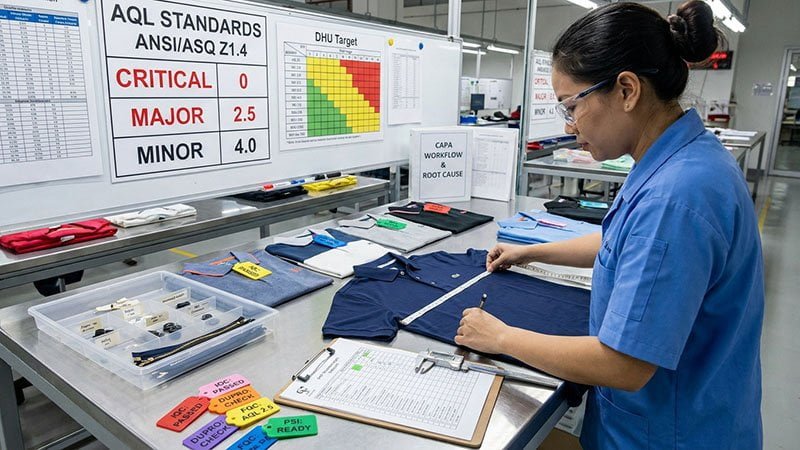
Our QC process has four key stages:
- IQC (Incoming Quality Control): We inspect a sample of all fabrics and trims upon arrival to catch issues early.
- Inline (or DUPRO): Our QC team patrols the sewing lines, inspecting garments at key production milestones (e.g., when 10%, 50%, and 80% of the order is complete). This finds problems while they can still be easily fixed.
- FQC (Final Quality Control): After a garment is fully assembled and ironed, our internal team does a 100% visual inspection and checks the measurements of a sample set.
- PSI (Pre-Shipment Inspection): This is the final audit, conducted by our team or a third-party inspector you hire. This is where the AQL standard is formally applied.
AQL and defect taxonomy
A common mistake I see is brands trying to dispute quality after an order is complete. You must define your standards upfront. We use the ANSI/ASQ Z1.4 (or ISO 2859-1) standard. We agree on an Acceptable Quality Limit (AQL), typically Critical 0, Major 2.5, Minor 4.0. This means if the inspector finds more than the allowed number of major or minor defects in a random sample, the entire batch is held for re-inspection. Our internal goal for DHU (Defects per Hundred Units) is always ≤2%.
Measurement tolerances and function checks
During inspections, we don't just look for visual flaws. We measure a sample of garments against the approved PP sample's measurements and tolerances. We also perform functional checks, like repeatedly zipping and unzipping zippers, testing the stretch of elastic cuffs, and confirming that ventilation panels are open and functional.
CAPA and rework control
When a defect is found, it's not enough to just fix it. We use a formal Corrective Action/Preventive Action (CAPA) process to find the root cause (Was it the person, machine, material, method, or environment?) and prevent it from happening again. We track our rework rate closely, with a goal of keeping it below 3%.
How is Packaging, Labeling, and Compliance Handled?
Getting the garment made correctly is only part of the job. Getting it to your warehouse legally and in pristine condition is the final, critical step.
The details of folding, tagging, bagging, and labeling are not afterthoughts. They are engineered to protect the product, comply with the law, and create a great customer unboxing experience.
Retail packing and sustainability
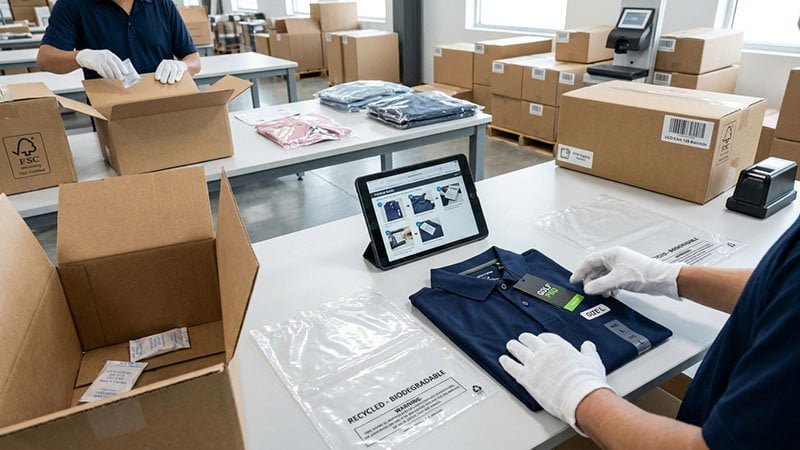
You provide us with a detailed packing guide. This specifies how to fold the garment, where to place hangtags and size stickers, and the type of polybag to use. We are increasingly using recycled or biodegradable bags (typically 30-50 microns thick) with legally required suffocation warnings. We use FSC-certified paper for cartons and place desiccants inside to control humidity during transit.
Label laws
Labeling errors can get your shipment stopped at customs. It is your responsibility to provide us with the correct information for your sales markets. This includes the fiber content label (e.g., per US 16 CFR 303), care symbols (per ISO 3758), and Country of Origin. The rules for the US, EU (1007/2011), UK, and Canada all have slight differences that must be followed.
Cartons and barcoding
We work with you to define the master carton dimensions, the number of units per carton, and the layout of information on the outside. This usually includes a shipping label with a scannable UCC/EAN-128 barcode containing the PO, style, color, and size information. If your logistics provider requires RFID, we can integrate that process at the packing stage.
How Are Export and Logistics Managed?
Your order is packed and ready. How does it get from our factory door in China to your distribution center on the other side of the world?
Shipping is a process of precise coordination. It involves booking space on a vessel, preparing a mountain of paperwork, and tracking the shipment until it clears customs.
Incoterms and booking
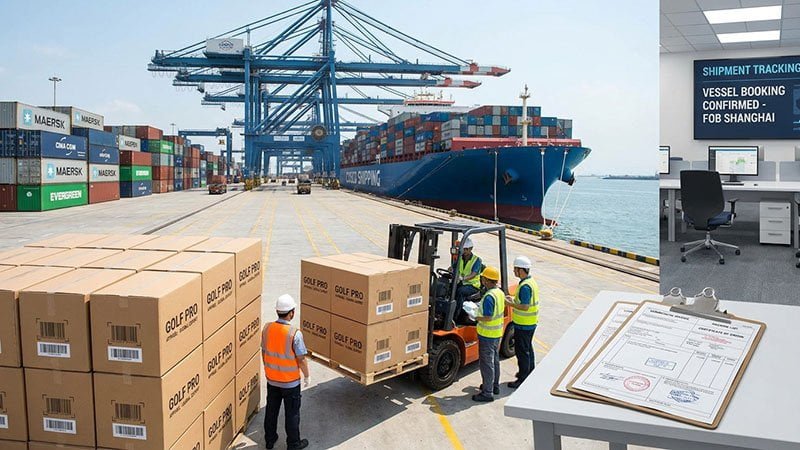
We'll agree on the shipping terms (Incoterms) in our contract—most commonly FOB (Free On Board), where you take over responsibility at the origin port. Our logistics team needs to book space on a container ship 2–3 weeks in advance, especially during peak season. We handle all the local declarations, like the Verified Gross Mass (VGM), to ensure the container is cleared to load.
Customs documentation
A failure here can cause major delays. Our team prepares a complete document package to send to your customs broker. This includes the Commercial Invoice (CI), Packing List (PL), and Certificate of Origin (C/O). We also include copies of key test reports and inspection reports, as customs officials may request them.
Modes and transit
The most common mode is ocean freight, either as a Full Container Load (FCL) or Less than Container Load (LCL). From our facilities in South China, the transit time on the water to the US West Coast is typically 12–18 days, not including the time for trucking on both ends. For urgent needs, air freight is an option but is significantly more expensive.
What About Social and Environmental Compliance?
Modern brands know that their reputation is tied to the ethics of their supply chain. How can you be sure your factory partner is treating its workers and the environment responsibly?
Compliance isn't just a certificate on the wall. It’s a continuous process of audits, corrective actions, and transparent management of chemicals and waste.
Audit frameworks
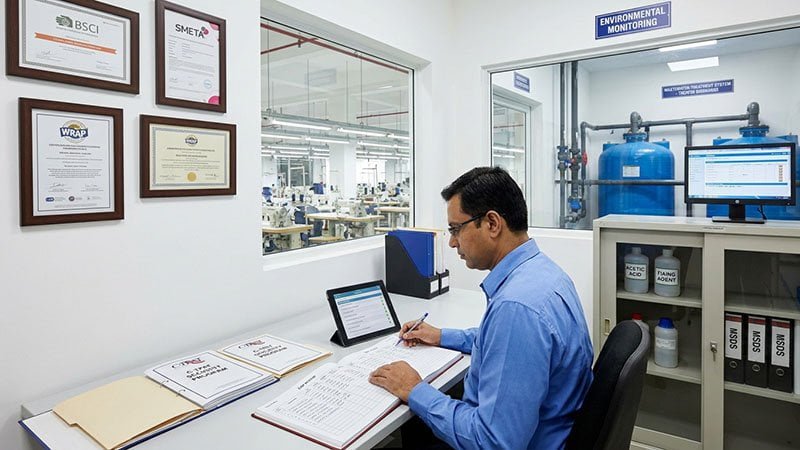
We maintain active certifications from internationally recognized social audit programs like BSCI, SMETA, or WRAP. This isn't a one-time thing. These audits happen regularly, and we maintain a log of any findings and the Corrective Action Plans (CAPs) we've implemented to address them. We also have security programs in place that are similar to C-TPAT to ensure supply chain security.
Chemical and wastewater
Being environmentally responsible means managing what we use and what we dispose of. We maintain a detailed inventory of all chemicals used on-site and ensure they comply with your RSL and our MRSL. For any processes that use water, like in-house washing, we ensure our wastewater is treated to meet local and international standards. For dyeing, we only work with mill partners who can provide proof of their own responsible wastewater management.
How Does Digitalization and Traceability Work?
In a complex operation, how do we keep track of everything? The answer is data. A modern factory runs on information.
From raw materials to finished goods, we use digital systems to track every component, monitor progress in real-time, and measure our performance against key metrics.
ERP/PLM and WIP tracking
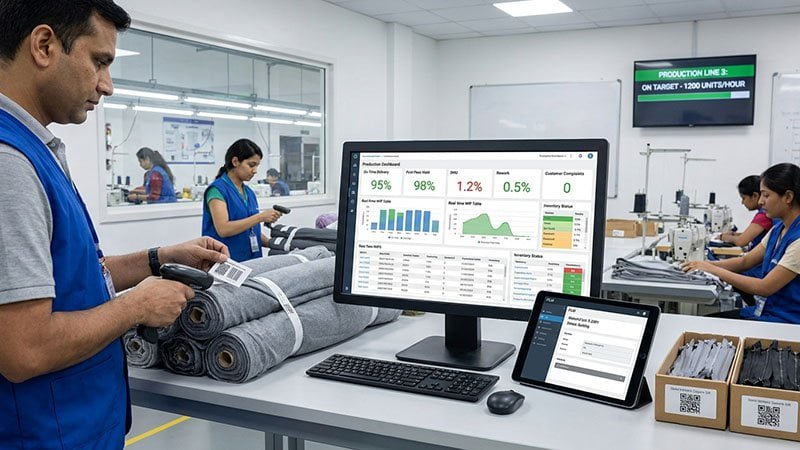
Our ERP and PLM systems are the digital backbone of the factory. Every roll of fabric, every box of zippers, and every spool of thread is assigned a lot number and tracked with a barcode or QR code. On the sewing line, operators scan bundles of cut pieces as they move from one station to the next. This gives us a real-time view of our Work-In-Progress (WIP) and allows us to trace any specific garment back to the exact batch of fabric it was cut from.
Quality and delivery dashboards
You can't improve what you don't measure. We hold monthly review meetings to look at our key performance indicators (KPIs). We track our On-Time Delivery (OTD), First Pass Yield (FPY), Defects per Hundred Units (DHU), rework rate, and any customer complaints. This data helps us spot trends, identify areas for improvement, and be more transparent with you about our performance.
What's on the Factory Tour Checklist?
If you have the chance to visit your factory partner, what should you look for? A tour can tell you more than any audit report.
A good factory is proud to show you its operations. Look for signs of organization, quality control, and investment in technology in every department you visit.
Pattern/sample room
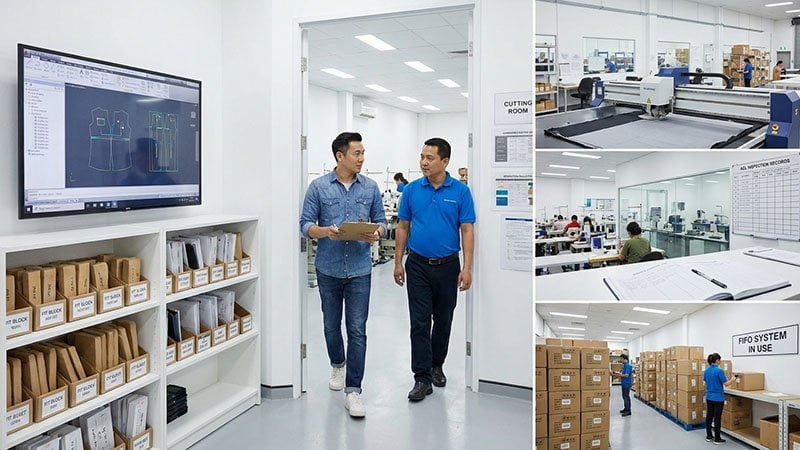
Check their CAD systems. Ask to see how they store approved fit blocks and size sets. A well-organized sample room with clear records shows a respect for precision.
Cutting and sewing
Look at the cutting room. Are they using automated machines for accuracy? On the sewing floor, look for clear work instructions (the operation bulletin) at key stations. Check their needle and blade control policies to prevent broken metal from ending up in garments.
Lab and QC
Ask to see their internal testing lab, even if it's small. Review their AQL inspection records and their CAPA log. A factory that diligently tracks its mistakes is one that is serious about improving.
Packing and warehouse
The warehouse should be clean, organized, and not overly humid. Look for evidence of a First-In, First-Out (FIFO) system for materials. See if they are using barcodes to track inventory movement. This discipline in the warehouse often reflects the discipline of the whole operation.
What's in the RFQ Package and What Are the Next Steps?
You're ready to start a conversation. How do you approach a potential factory partner in a professional way that gets you the information you need?
A professional Request for Quotation (RFQ) is a two-way brief. You give the factory clear instructions, and in return, you ask for specific details about their process and capabilities.
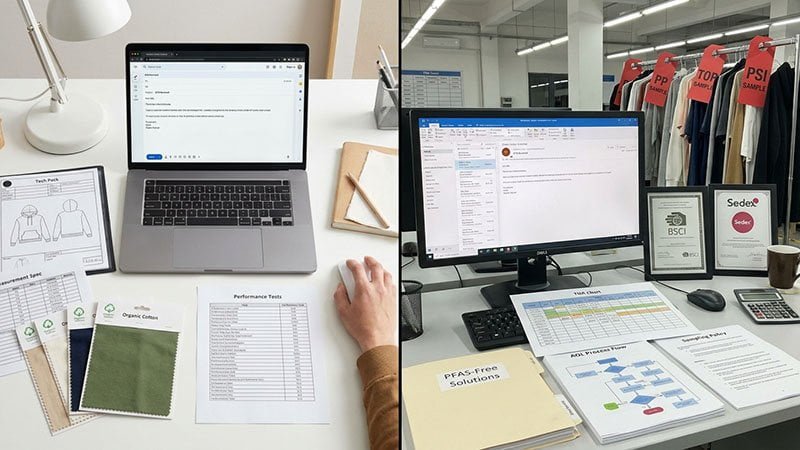
What you provide to the factory
To get an accurate quote, you need to provide a complete package:
- A detailed Tech Pack with construction details
- A complete measurement spec sheet
- Your material preferences (e.g., fabric weight, composition)
- A list of required performance tests
- Your target FOB price and desired launch date
- Your estimated order quantity and size curve
What you request from the factory
Don't just ask for a price. Ask for:
- Their standard TNA timeline and production capacity
- Their AQL and QC process flow documents
- Details on their PFAS-free solutions
- Copies of their social compliance certificates
- Their sampling policy, including timelines and any NRE costs
- Their MOQ policy and any surcharges for smaller orders
Pilot and approvals
The best way to start a partnership is with a small, paid pilot order of 100-300 pieces. This is a real-world test of their communication, quality, and reliability. There are three critical gates to sign off on: the Pre-Production (PP) sample, the Top of Production (TOP) samples, and the final Pre-Shipment Inspection (PSI). Make sure your commercial agreement includes annexes that formally define your AQL, RSL, and MRSL standards.
Frequently Asked Questions?
Who pays for the pattern development and pre-production samples?
This is an excellent question, and it's best to clarify it upfront. For any new custom (OEM) design, there are one-time development costs, often called NRE (Non-Recurring Engineering). This typically includes the initial digital pattern, grading for all sizes, and the first few rounds of physical samples. Most factories, including us, will invoice for these development costs separately before starting the work. However, as a sign of partnership, we will often agree to credit or refund these development fees back to you once you place a sufficiently large bulk order for that style.
What happens if the final Pre-Shipment Inspection (PSI) fails the AQL standard?
This is the question every brand founder fears, and it's where a true partnership is tested. If an inspection fails, the shipment is immediately put on hold. The first step is that we send you the full inspection report with photos so you can see the issues. The responsibility then falls on us, the factory, to fix the problem. This involves creating a corrective action plan, re-screening 100% of the production lot (not just a sample), and either repairing the defective items to meet the standard or remaking them if they can't be repaired. The order will not ship until it passes a new inspection, and a good factory covers the cost of this rework and re-inspection.
You mentioned FOB shipping. Once the goods are on the ship, what do I need to do?
FOB (Free On Board) means we, the factory, are responsible for getting your order packed, through Chinese customs, and loaded onto the ship at the designated port. The moment the goods are on that vessel, the responsibility becomes yours. Here's a simple checklist of what you need to handle next:
- Hire a freight forwarder: This company will manage the ocean transport and insurance for you.
- Hire a customs broker: This person or company is licensed to handle the import declaration in your country.
- Pay for the "landed costs": This includes the ocean freight, insurance, import duties, taxes, and port fees.
- Arrange local trucking: Once the shipment clears customs, you need to arrange for a truck to pick it up and deliver it to your warehouse.
Can I specify a branded fabric like LYCRA® or a specific Polartec® fleece?
Yes, you absolutely can, but it's important to understand how this affects the process. When you "nominate" a specific branded supplier, we will purchase the fabric from them on your behalf. However, we are then subject to their minimum order quantities, pricing, and lead times, which might be longer or larger than our usual stock materials. This can add cost and time to your project. The alternative is to use fabrics from our factory's curated library, which we've already vetted for performance and can often source much faster and with lower minimums.
During the 30-45 day bulk production, how often should I communicate with the factory?
This is a great question about finding the right balance. You don't need to ask for a daily update, but you should expect proactive communication at key milestones outlined in the TNA (Time and Needle) plan. Here's a typical rhythm:
- A confirmation that your bulk fabric has arrived and passed IQC.
- A quick note when your order is scheduled and the cutting has begun.
- An update around the 50% completion mark, perhaps with an inline inspection report or a photo from the production line.
- A final communication to let you know the order is finished and ready to schedule the Pre-Shipment Inspection.
A good factory partner will provide these updates automatically so you never have to wonder about the status of your investment.
Conclusion
The journey from a digital file to a finished golf shirt is a long but logical one. By understanding each step—from patterning to packing—you can work more effectively with your factory partner, prevent costly mistakes, and bring a product to market that you can be truly proud of.