
A startup placed a $12,000 order with a factory that quoted the lowest price. The samples looked perfect. Bulk production arrived six weeks late, with inconsistent collar stiffness and logos placed 2cm off-spec across different sizes. They could not sell 60% of the inventory and missed their season launch.
Choosing a golf apparel manufacturer is about matching your risk tolerance, capital constraints, and product vision to a factory's proven specialization, realistic capacity, and delivery track record—not finding the lowest quote.
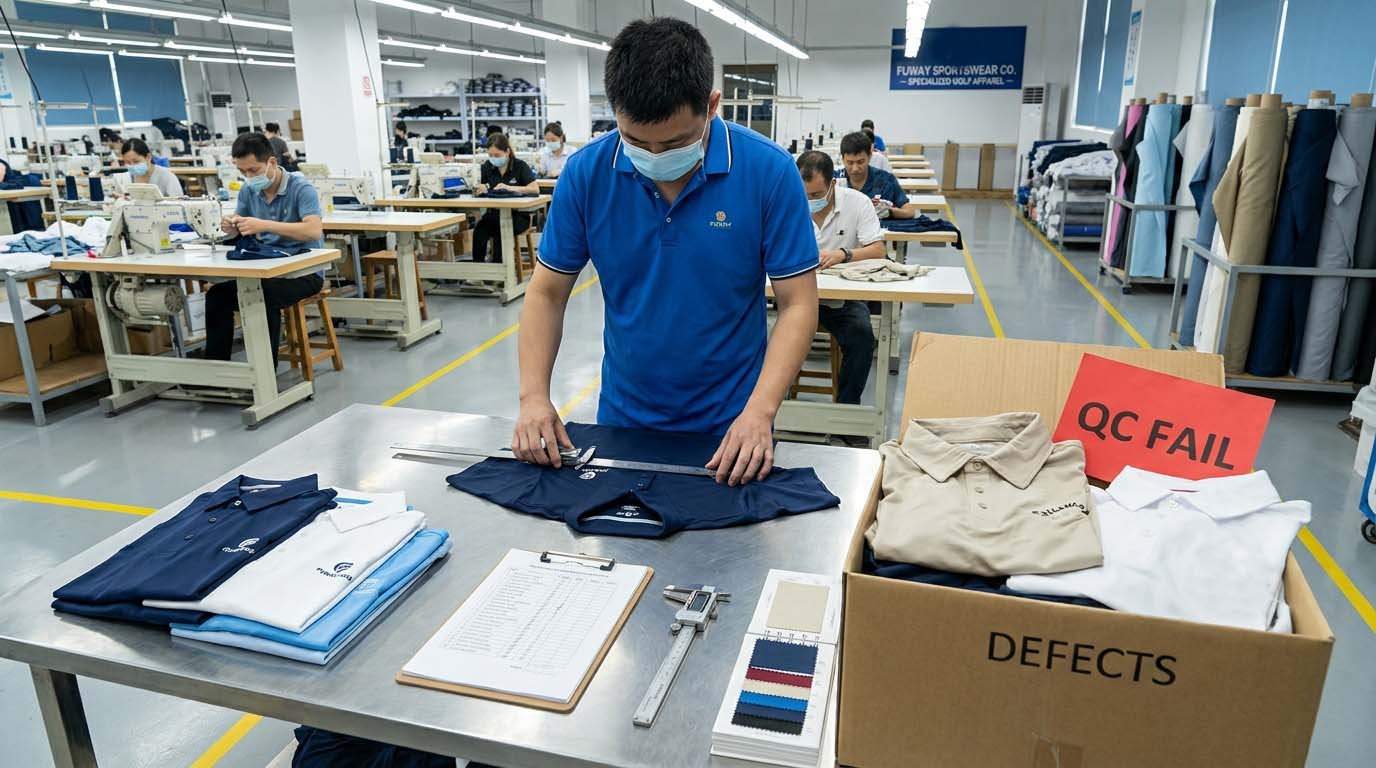
I am Will from FUWAY. I manage OEM projects for golf brands launching their first production runs. My job is translating what clients tell me they want into what we can actually deliver—and telling them upfront when their expectations do not align with production reality. Most factory selection mistakes happen because brands optimize for single variables like lowest price or fastest sampling without understanding the linked risks. A factory quoting $2 less per unit might achieve that price by using thinner interlining that makes collars look cheap after three washes. A factory promising two-week sampling might use stock fabrics that do not match your moisture-wicking specs. This guide shows you how to validate factory capability before committing your capital.
Quick Answers: Choosing Your Golf Apparel Manufacturer
How do I know if a factory specializes in golf apparel?
Ask what percentage of their production is knit golf apparel, request bulk order samples from recent golf clients (not showroom pieces), and verify they conduct performance testing like moisture-wicking rates and colorfastness. Factories that mainly produce woven casual wear will struggle with technical golf fabrics.
What minimum order quantity should I expect?
500-1,000 pieces for fully custom designs with embroidered logos and custom fabric development. 200-300 pieces if you accept in-stock fabric options and heat-transfer logos. Below 200 pieces, expect 40-60% higher unit costs due to setup cost concentration.
How do I verify a factory's quality control process?
Request documentation showing their three inspection checkpoints: pre-production fabric testing (shrinkage, color consistency), in-line monitoring (first 50 pieces off the line), and final AQL 2.5 inspection before shipment. Factories that resist third-party inspection requests have gaps to hide.
What payment terms protect me without being unreasonable?
Standard terms: 30% deposit at order, 40-50% after pre-production sample approval, 20-30% balance after passing final inspection before shipment. Avoid factories demanding 70%+ upfront—that transfers all risk to you.
Should I prioritize certifications or factory samples?
For DTC brands in North America, prioritize fabric performance test reports (moisture-wicking, colorfastness, shrinkage) over compliance certifications initially. If targeting EU markets or U.S. retail chains, verify current OEKO-TEX and REACH compliance before placing orders.
How long should production take from order to delivery?
15-20 days for sampling with 2-3 revision rounds, 30-45 days bulk production after approval, plus 7-30 days shipping depending on method. Rush orders cost 15-25% more and limit fabric/customization options.
What questions reveal factory capability gaps?
Ask: "Do you test shrinkage on bulk fabric before cutting?" "At what production stage do you conduct in-line inspection?" "Can I see your last three bulk order inspection reports?" Vague answers or resistance indicate weak quality systems.
Have You Defined What You Actually Need Before Contacting Factories?
Your product vision, budget ceiling, order volume, and timeline determine which factories can even execute your project. Contacting factories before clarifying these four parameters wastes your time reviewing irrelevant quotes and increases the chance you select the wrong partner.
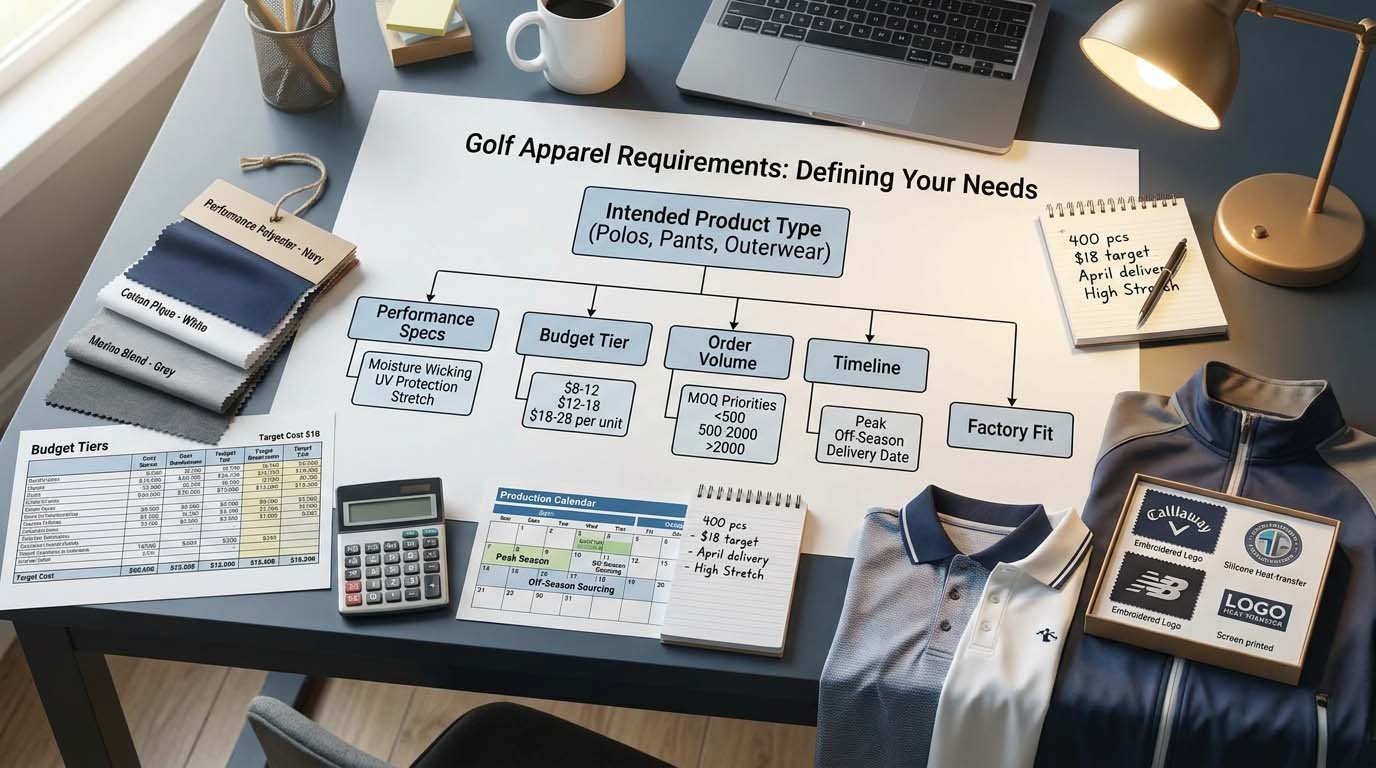
Product Type and Performance Requirements
Different golf apparel categories require different factory expertise.
Performance polos and base layers:
Need factories with knit fabric handling experience, moisture-wicking testing capability, and seaming precision for stretch materials. Standard construction is lightweight pique or jersey (120-180 GSM), polyester or poly-spandex blends, embroidered or heat-transfer logos.
Golf pants and shorts:
Require woven fabric expertise, stretch integration, and functional pocket construction. Different cutting techniques and sewing equipment than knit tops. Some factories specialize in tops, others in bottoms—few excel at both.
Outerwear and windbreakers:
Need waterproof/water-resistant fabric sourcing, seam sealing equipment, and zipper/trim quality control. Significantly different from apparel-focused factories.
I see brands try to source their entire line from one factory to simplify management. This often fails because most factories specialize in 1-2 product categories. At FUWAY, we excel at knit golf tops—polos, quarter-zips, base layers. We work with reliable partners for bottoms and outerwear rather than claiming we do everything.
Budget and Pricing Reality
Your per-unit budget ceiling determines feasible fabric-logo-construction combinations.
Budget tier: $8-12 per unit
You are limited to cotton-poly pique or basic jersey, heat-transfer or simple screen-print logos, standard collar construction, and minimal customization. This suits value-positioned brands targeting $35-50 retail.
Mid-market tier: $12-18 per unit
Allows performance polyester blends with moisture-wicking, embroidered logos, contrast details like tipping or piping, and semi-custom fabric selection from mill options. Supports $50-80 retail positioning.
Premium tier: $18-28 per unit
Enables technical 4-way stretch fabrics, multi-position embroidery, custom trim development, and premium finishes like anti-microbial treatment. Justifies $80-120+ retail pricing.
Clients often want premium specs at mid-market pricing. I explain the math does not work. If your retail target is $60 and you need 3x markup to cover costs and margin, your manufacturing cost ceiling is $20. We work backward from that number to identify which features fit.
Order Volume and Reorder Frequency
Order size affects MOQ negotiation power and factory interest level.
Test launch: 200-500 pieces
You need MOQ flexibility more than optimal unit cost. Expect to pay premium pricing ($14-20 per unit for polos) and accept in-stock fabric options. Your order is small for most factories, so delivery priority will be lower during peak season.
Established brand: 800-2,000 pieces
This volume justifies embroidery setup costs and semi-custom fabric selection from mill stock options. Factories give you reasonable attention and pricing drops to $10-15 per unit range.
Volume production: 3,000+ pieces
Full customization becomes available—custom fabric development, complex construction details, favorable payment terms. Unit cost drops to $8-12 for standard specs or $14-18 for premium.
If you plan quarterly reorders totaling 2,000+ pieces annually, mention this upfront. Factories prioritize clients with repeat business and offer better pricing when they see long-term volume potential.
Timeline and Seasonality
Golf apparel has seasonal demand that affects factory availability.
Peak season: March-June for North America/Europe
Factories book production lines 8-12 weeks ahead. If you place orders in January-March for spring delivery, you compete with every brand launching spring collections. Expect longer lead times and less negotiation flexibility on rush orders.
Off-season: August-November
Lower factory loading creates opportunities for faster turnarounds, better unit pricing, and more attention to new clients. If your launch timing allows, off-season production reduces risk.
Rush orders:
Possible if fabric is in stock and production capacity exists, but cost 15-25% more and limit customization options. I cannot compress 45-day production to 20 days without sacrificing either quality checkpoints or using stock materials instead of your preferred fabric.
Does This Factory Have Real Golf Apparel Expertise?
Technical capability is not about owning the right machines—it is about proven execution of specific constructions, fabric handling expertise, and quality standards appropriate for golf apparel performance and appearance expectations. A factory that produces 500,000 units monthly of casual wear cannot necessarily deliver the precision required for technical golf polos.
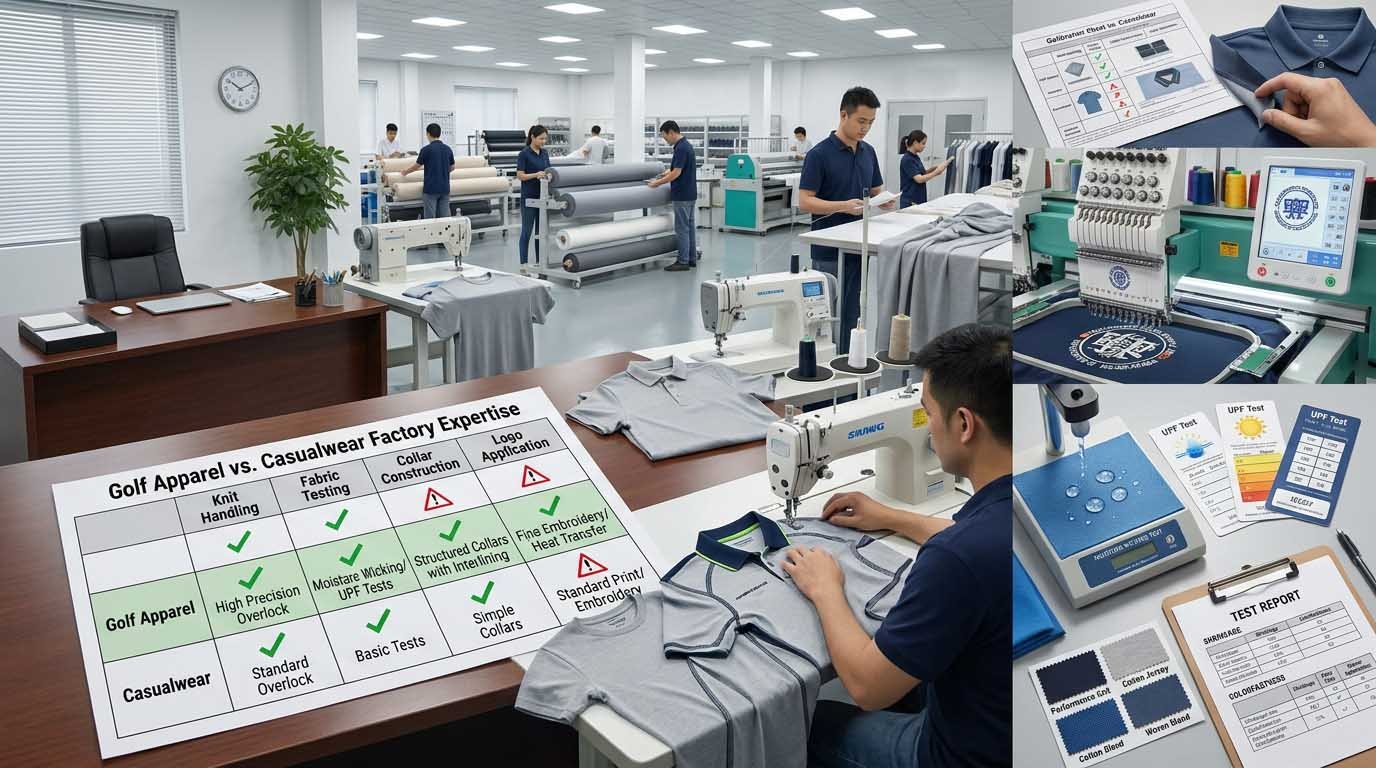
Golf Apparel Technical Requirements
Golf apparel requires capabilities that general apparel factories often lack.
Knit fabric handling:
Polos, quarter-zips, and base layers use jersey, pique, or interlock knits that stretch. These fabrics require different cutting allowances (to prevent stretching during cutting), specialized needle types (ballpoint instead of sharp), and overlock seams (instead of lockstitch). Factories that mainly handle woven fabrics struggle with these materials—you will see wavy hems, stretched necklines, and puckered seams.
Performance fabric testing:
Golf apparel needs validation beyond visual inspection. Moisture-wicking efficiency (how fast fabric pulls sweat away), UV protection levels (UPF rating), colorfastness to perspiration and washing, and shrinkage after five washes. Factories without testing partnerships cannot verify these claims—they rely on mill certificates that might not reflect bulk fabric performance.
Collar and placket construction:
Golf polos are judged by collar stiffness and appearance retention. This requires proper interlining weight selection (1.0-1.5mm), fused application under controlled heat and pressure, and reinforcement behind button areas. Budget factories skip reinforcement or use adhesive instead of proper fusing, creating collars that look cheap after three washes.
Logo application quality:
Embroidery requires digitizing expertise (converting artwork to stitch files without distortion), proper backing material selection (cutaway for knits, tearaway for wovens), and tension calibration to prevent puckering. Screen printing needs precise registration for multi-color logos. Factories that outsource logo work to subcontractors lose quality control.
How to Verify Technical Capability
Request bulk production samples, not showroom pieces:
Ask for 5-10 samples randomly pulled from recent bulk shipments of golf polos. Examine collar consistency, logo placement accuracy, and seam quality across multiple pieces. Inconsistency reveals quality control gaps.
Ask about fabric sourcing relationships:
Direct mill partnerships give factories better fabric pricing, faster delivery, and technical support when dye lot issues arise. If they source through traders, they lose control over specifications and lead times.
Request test reports from previous orders:
Ask to see shrinkage test results, colorfastness ratings (grade 4 minimum), and moisture-wicking data from their last three golf apparel orders. Factories that conduct regular testing have documented procedures. Factories that cannot produce reports are not testing.
Inquire about equipment and processes:
Do they have overlock machines for knit seams? What interlining suppliers do they use? How do they calibrate embroidery tension for different fabric weights? Specific answers indicate expertise. Vague responses like "we have all necessary equipment" indicate they are guessing.
At FUWAY, we handle about 200,000 golf polo units annually, with 70% of our production in performance knits. We test every bulk fabric lot for shrinkage before cutting and maintain documented embroidery standards for different logo sizes. But we do not handle leather trim work or waterproof seam sealing—I refer those projects to specialized factories rather than promising capability we lack.
Can They Source the Right Materials and Meet Compliance Requirements?
Material sourcing capability determines whether your specifications remain consistent across orders. Factories with direct mill relationships, documented fabric specifications, and transparent traceability can maintain quality. Factories sourcing opportunistically through traders create batch-to-batch variations that damage your brand.
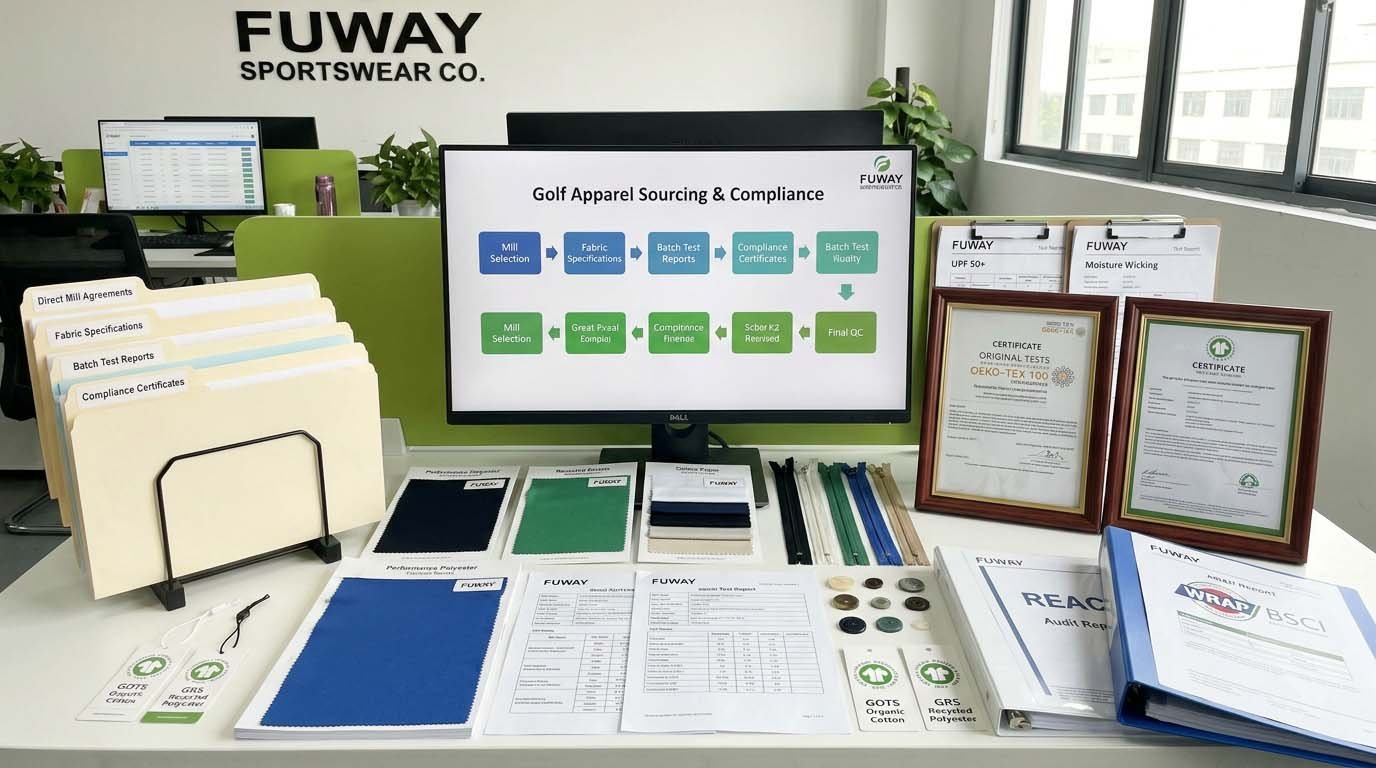
Fabric Sourcing and Consistency
Direct mill partnerships vs trader sourcing:
Factories with direct relationships to 3-5 textile mills get priority allocation during fabric shortages, better pricing, and technical support for dye matching or finishing adjustments. They can also reorder the exact same fabric specification for your repeat orders.
Factories sourcing through traders lose this control. Traders buy opportunistically based on what mills want to clear. Your "same fabric" in the second order might come from a different mill with slightly different hand feel or shrinkage characteristics.
Fabric specification documentation:
Proper factories maintain detailed specs for every fabric: mill name, article number, composition percentages, weight (GSM), finish treatments, dye formulation, and shrinkage test results. This creates traceability. If an issue arises in bulk, they can trace back to the specific fabric lot and mill batch.
Ask potential factories: "If I reorder in six months, how do you ensure fabric consistency?" Strong answers reference documented specs and mill relationships. Weak answers say "we will find similar fabric."
In-stock fabric options:
Many factories maintain 500-2,000 meters of 20-30 popular fabrics in inventory. If your fabric needs match their stock options, you can reduce MOQ (no mill roll minimum) and lead time (no waiting for fabric production). Ask what fabrics they currently stock before finalizing your design.
Trims, Labels, and Packaging Materials
Fabric is not the only material that affects quality.
Trim quality:
Buttons, zippers, and drawcords vary widely in durability. Cheap resin buttons crack after repeated washing. Low-quality zipper tape separates under stress. Factories using budget trim suppliers create quality problems in areas you might not initially inspect.
Labeling and branding:
Woven labels, hang tags, and care labels require separate suppliers. Factories with established label vendors can execute custom branding efficiently. Factories that treat labels as an afterthought will deliver inconsistent sizing tags or misspelled brand names.
Packaging:
Polybags, tissue paper, stickers, and shipping cartons all need coordination. If your brand requires premium packaging, verify the factory has experience with this. Budget factories familiar with basic polybag-only packaging may struggle with complex unboxing experiences.
Compliance and Sustainability Requirements
Compliance needs depend on your target market.
For EU markets:
REACH compliance (chemical restriction) and OEKO-TEX certification (harmful substance testing) are often mandatory for retail partners. Verify the factory holds current certificates covering knit apparel—not just borrowed certificates from their fabric supplier.
For U.S. retail chains:
Major retailers (Dick's Sporting Goods, Nordstrom) require social compliance audits like WRAP or BSCI proving ethical labor practices. DTC brands can often skip this initially, but need it for scaling to wholesale.
For performance claims:
If you market products as "UPF 50+" or "moisture-wicking," you need test reports validating these claims. Factories without testing partnerships cannot provide this documentation, leaving you exposed to false advertising claims.
Sustainability certifications:
Organic cotton (GOTS), recycled polyester (GRS), or Fair Trade certifications add $2-5 per unit to costs and limit fabric supplier options. If sustainability is core to your brand positioning, verify the factory has experience with certified materials before designing products that require it.
I tell clients: if you are launching DTC in North America with performance positioning, prioritize fabric test reports over compliance paperwork initially. If you are targeting EU markets or U.S. retail chains, verify compliance documentation before placing your first order—retrofitting compliance later costs more.
Can They Execute Your Brand Vision with Consistency?
Customization capability is not just technical—it is about understanding brand positioning, translating design intent into production specs, and maintaining consistency across sizes and production batches. Factories that treat every order as generic production cannot execute the details that differentiate your brand.
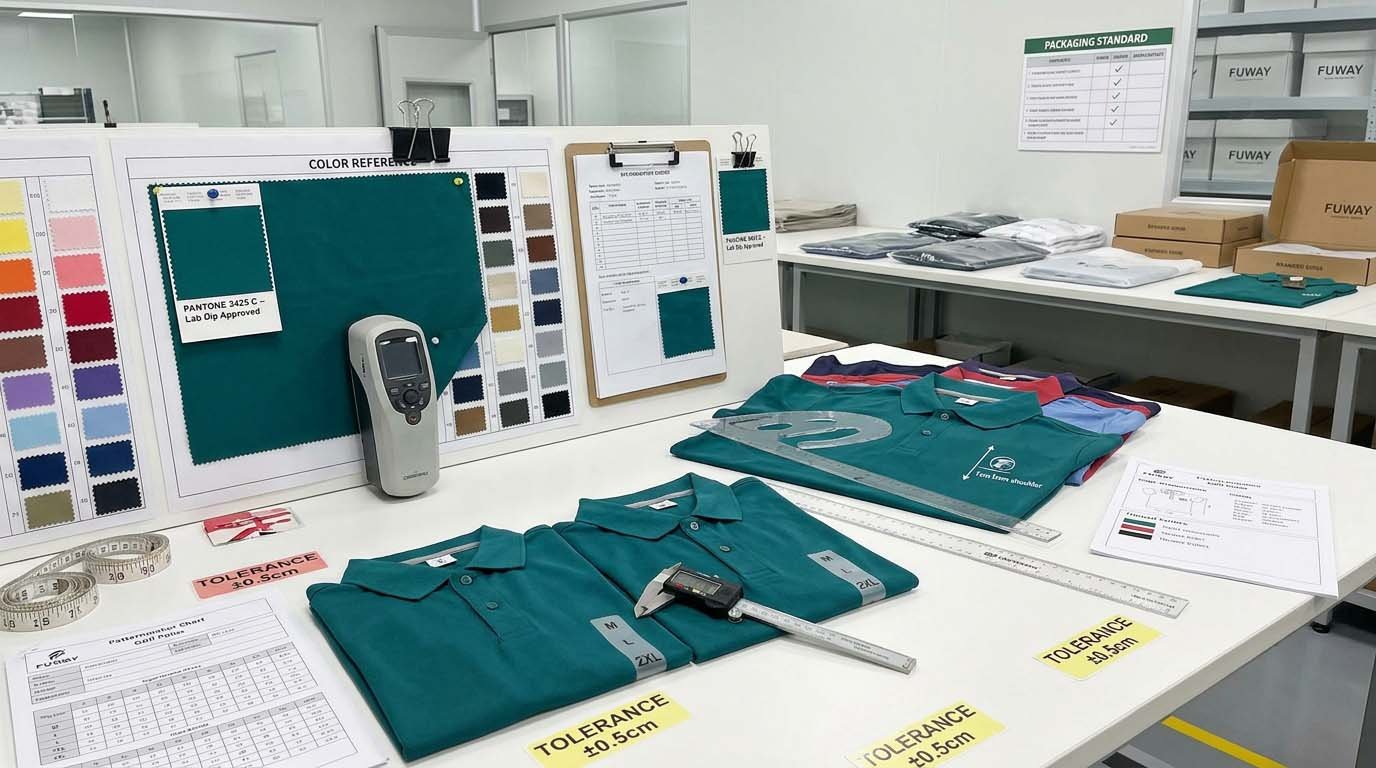
Pattern Making and Fit Development
Fit consistency across sizes:
Your size chart defines one target measurement for each size. But garment construction creates natural variation—fabric stretch, seam allowance tolerance, and washing shrinkage all affect final dimensions. Proper factories establish grade rules (how each size increases/decreases from the base size) and tolerance ranges (acceptable deviation).
A medium polo chest measurement of 108cm with ±2cm tolerance means 106-110cm is acceptable. Without documented tolerances, the factory does not know if 105cm is a defect or acceptable.
Fit adjustments based on fabric:
A slim-fit pattern developed for a stretch poly-spandex blend will not fit the same if produced in non-stretch cotton-poly. Factories with pattern-making expertise adjust seam allowances and dart shaping when fabric changes. Factories that treat patterns as fixed create fit failures.
Grading accuracy:
Grading is scaling the base pattern across sizes. Poor grading creates disproportionate sizing—small sizes fit well but 2XL looks boxy. Ask to see their grading charts and sample one size above and below your core size to verify proportions scale correctly.
Color Matching and Consistency
Pantone vs production reality:
You specify Pantone 3425 C (a specific green). But Pantone is a printing standard, not a fabric dyeing standard. Fabric dyes cannot replicate every Pantone color exactly, and different fabric types (cotton vs polyester) dye differently even with the same formula.
Proper factories dye lab dips (small fabric swatches) for approval before bulk dyeing. They also explain when your target color is difficult to achieve or maintain across batches. Factories that promise exact Pantone matching without qualification are setting false expectations.
Dye lot management:
Even when you approve a bulk fabric color, the next order might come from a different dye lot with slight variation. This is industry normal—dye lot variation of 1-2 shades on a standard color card is acceptable. But if you do not specify tolerances, you might reject bulk that is technically within standard.
Ask factories: "How do you manage color consistency across reorders?" Strong answers discuss dye formulation records, reference swatches archived from previous orders, and lab dip approval processes.
Logo and Branding Execution
Logo method selection:
Your logo complexity, order quantity, and budget determine feasible methods. Embroidery works for 1-4 color logos on orders over 500 pieces. Heat transfer suits multi-color complex designs or orders under 500 pieces. Sublimation enables all-over patterns but only works on polyester.
Factories experienced in golf apparel guide you toward the method that balances quality, cost, and your order parameters. Factories without this expertise either quote the wrong method or execute poorly.
Placement accuracy and consistency:
Logo position must be specified with measurements from reference points (e.g., "7cm down from shoulder seam, centered on chest"). Without documented placement specs, logos will vary by 2-3cm across production batches as different operators interpret "centered" differently.
Packaging and presentation:
How products are folded, tagged, and packed affects brand perception. If you need specific folding styles, hang tags, tissue paper, or custom shipping boxes, verify the factory has experience with this level of detail. Budget factories treat packaging as an afterthought.
At FUWAY, we maintain color reference swatches from every order in a physical library. When clients reorder, we pull the previous swatch and dye new lab dips for comparison before bulk dyeing. This costs us extra storage and labor, but prevents the color drift that happens when factories rely on memory or digital records that display differently on screens.
What Are the Real Costs and Lead Times for Your Project?
A factory quoted $11.50 per unit for 500 polos with embroidered logos. Another factory quoted $13.00 for the same specs. The client chose the lower price. Four weeks into production, the cheaper factory said they needed an additional $1.20 per unit for "special embroidery backing" that was not included in the original quote. Total cost ended up at $12.70—higher than the transparent factory—plus two weeks of delay negotiating the surcharge.
Transparent pricing separates fixed costs (setup, sampling, tooling) from variable costs (materials, labor, logos) so you can predict how price scales with quantity and spec changes. Opaque pricing hides cost drivers, creating surprise charges and making it impossible to evaluate trade-offs.
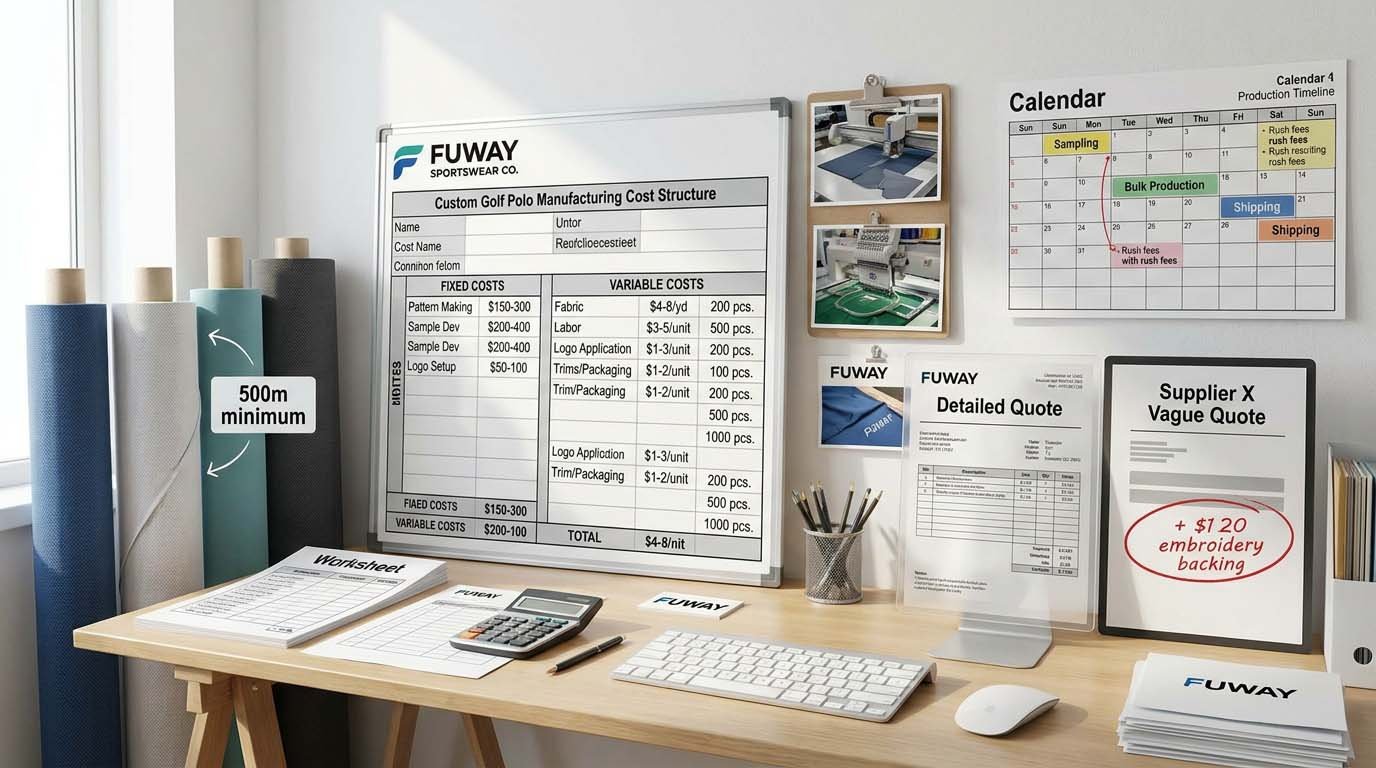
Understanding Cost Structure
Fixed costs do not scale with quantity:
Pattern making and grading: $100-200
Sample development (2-3 rounds): $150-300
Logo digitizing or screen setup: $150-300
Fabric dye lab dips: $80-150
Total fixed costs: $480-950 depending on complexity.
At 200 pieces, fixed cost per unit = $2.40-4.75
At 500 pieces, fixed cost per unit = $0.96-1.90
At 1,000 pieces, fixed cost per unit = $0.48-0.95
This is why unit price drops significantly from 200 to 500 pieces, then plateaus.
Variable costs scale with quantity:
Fabric: $4-9 per meter × 1.3 meters per polo = $5-12 per unit
Logo application: $0.80-5.00 per unit depending on method
Labor and overhead: $2-4 per unit
Trims (buttons, labels, packaging): $0.50-1.50 per unit
Total variable cost per unit: $8-22 depending on specs.
How to use this framework:
If a factory quotes $14 per unit for 500 pieces, ask for the breakdown. If they say "$1.20 fixed cost and $12.80 variable," you can calculate that 1,000 pieces should cost around $13.40 per unit ($0.60 fixed + $12.80 variable). If they quote $13.90 instead, the variable cost is rising—meaning their efficiency does not improve with volume.
MOQ Negotiation Reality
MOQ is driven by fabric roll minimums and production efficiency, not arbitrary factory policies.
Fabric roll minimums:
Mills sell fabric in 500-1,500 meter rolls. A polo uses 1.2-1.4 meters per piece. For 500 polos (650-700 meters), we buy one full roll. For 200 polos (240-280 meters), we still buy a minimum 500-meter roll and absorb waste or carry inventory risk.
Cutting and sewing efficiency:
Cutting tables work in lays (fabric layers stacked and cut simultaneously). Minimum efficient lay is 50-100 layers. Cutting 200 pieces across five sizes (40 per size) means less than one full lay per size—cutting efficiency drops and waste increases.
How to lower MOQ without killing unit economics:
Accept in-stock fabrics the factory already holds, eliminating roll minimum issues.
Use heat-transfer logos instead of embroidery to reduce setup costs.
Pay a higher per-unit price (20-40% premium) to compensate for inefficiency.
Commit to reorder volume—some factories will run 200 pieces now at 500-piece pricing if you commit to 500 total pieces across two orders within six months.
At FUWAY, our standard MOQ is 500 pieces for fully custom golf polos with embroidered logos. We can go down to 300 pieces if clients accept our in-stock performance fabrics and pay $2-3 more per unit. Below 300 pieces, we refer clients to trading companies that aggregate small orders.
Lead Time Components and Rush Options
Standard timeline (60-75 days total):
Sampling phase: 15-20 days for 2-3 sample rounds
Bulk production: 30-45 days after sample approval
Shipping: 7-10 days by air or 20-30 days by sea
What delays timelines:
Fabric procurement: If your specified fabric needs to be ordered from a mill, add 10-15 days.
Complex logo work: Multi-position embroidery or sublimation adds 5-7 days vs simple logos.
Peak season loading: March-June orders compete for capacity, adding 7-14 days.
Rush production options:
If fabric is in stock and production capacity exists, we can compress bulk production to 15-20 days. This costs 15-20% more because we pay overtime, prioritize your order over others, and reduce batch sizes for faster line changeovers. We cannot compress sampling—quality checkpoints take time regardless.
I tell clients to add 15% buffer time to quoted lead times for first orders. Established relationships with proven specs hit timelines more reliably. First orders encounter specification clarifications, sample revisions, and quality checkpoint discussions that extend timelines.
How Will Communication and Quality Control Actually Work?
Communication failures cause more launch delays and quality issues than technical capability gaps. Factories that proactively report problems, document specifications, and welcome quality checkpoints prevent costly surprises. Factories that go silent under pressure or resist inspection create crises.
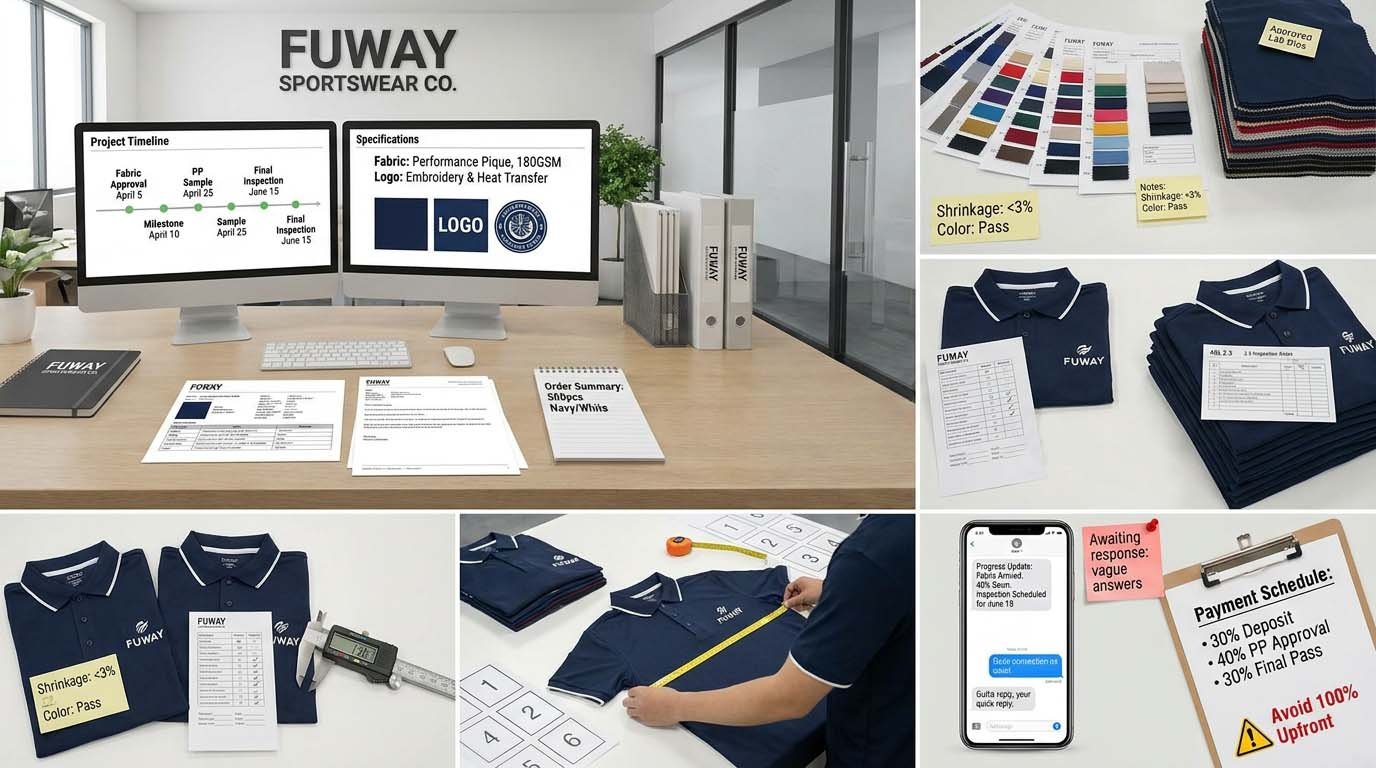
Communication Standards and Project Management
What good communication looks like:
Documented specifications after initial discussions:
After you describe your requirements, the factory sends a written summary of fabric specs, construction details, logo methods, pricing breakdown, timeline, and payment terms. This prevents misunderstandings and creates mutual accountability.
Proactive problem reporting:
When issues arise—fabric arrives late from mill, color matching difficulty, sizing discrepancy in pre-production—the factory contacts you immediately with the problem, impact on timeline, and proposed solutions. You make informed decisions instead of discovering problems three weeks later.
Regular production updates without chasing:
During bulk production, you receive updates at key milestones: fabric arrived, cutting completed, sewing 40% done, inspection scheduled for [specific date]. You should not need to send three emails asking for status.
Specific answers to technical questions:
When you ask "What GSM is this fabric?" the answer is "165 GSM" not "good quality weight." When you ask about shrinkage, the answer is "2.3% after five washes at 40°C" not "normal shrinkage."
Red Flags in Factory Communication
Vague responses to direct questions:
You ask about MOQ flexibility. They say "we can discuss." You ask if they test shrinkage before cutting bulk. They say "we have good quality control." Specificity matters. Vagueness hides lack of knowledge or unwillingness to commit.
Over-promising without caveats:
"Yes, we can do anything." "No problem, very easy." "We guarantee perfect quality." Real manufacturing has constraints and trade-offs. Factories that promise everything without discussing limitations are either inexperienced or setting false expectations.
Slow response times during negotiation:
If a factory takes 4-5 days to respond to technical questions before you place an order, expect worse during production when they are managing multiple clients. Reasonable response time is 24 hours for most inquiries.
Quality Control Checkpoints
Quality does not maintain itself. You need three documented checkpoints.
Checkpoint 1: Bulk fabric approval before cutting
Before the factory cuts bulk fabric, they send a swatch from the actual bulk roll for your approval. You compare color, hand feel, and weight to your approved sample. You test shrinkage by washing the swatch. This prevents mass cutting of incorrect fabric.
Ask factories: "Do you test shrinkage on bulk fabric before cutting patterns?" Strong factories say yes and show you documented test results. Weak factories skip this step to save time.
Checkpoint 2: Pre-production sample from bulk materials
After fabric is cut but before mass sewing begins, the factory produces 1-2 samples using actual bulk fabric, trim, and logos. This validates that bulk materials and production processes match your approved sample. This is your last chance to catch problems before 500 pieces are sewn.
Ask factories: "Do you provide a pre-production sample before starting bulk sewing?" Many factories skip this to save cost, creating risk.
Checkpoint 3: Final inspection before shipment
After production completes, conduct random sampling inspection (industry standard is AQL 2.5). Inspect measurements, construction quality, logo accuracy, and fabric defects. Acceptable limits: 2.5% major defects, 4% minor defects.
Ask factories: "What AQL standard do you use and can I hire third-party inspection?" Reliable factories welcome independent inspection. Factories that resist inspection have quality gaps to hide.
Contract and Payment Protection
Standard payment terms:
30% deposit at order confirmation (covers fabric procurement)
40-50% after pre-production sample approval (releases production)
20-30% balance after passing final inspection before shipment
These terms protect both parties. You maintain leverage at quality checkpoints. The factory receives funds at key cost points.
Red flags in payment terms:
Demanding 70-100% deposit upfront transfers all risk to you. If quality fails, you have no payment leverage.
Requesting balance before production completes (instead of after inspection) suggests cash flow problems. Your materials might be used as collateral for other orders.
Sudden changes to agreed terms midway through production indicate financial instability that will affect your quality and delivery.
Conclusion
Choosing a golf apparel manufacturer requires validating specialization through bulk samples and test reports, verifying material sourcing relationships and compliance documentation, confirming communication standards and quality checkpoints, and understanding transparent cost structures with realistic MOQs and lead times—before committing capital to bulk production.