A client ordered 500 slim-fit pants based on a competitor sample they liked. When we produced them, their return rate was 40%. The competitor's "slim fit" had 4cm more thigh room than ours. Fit labels mean nothing without actual measurements.
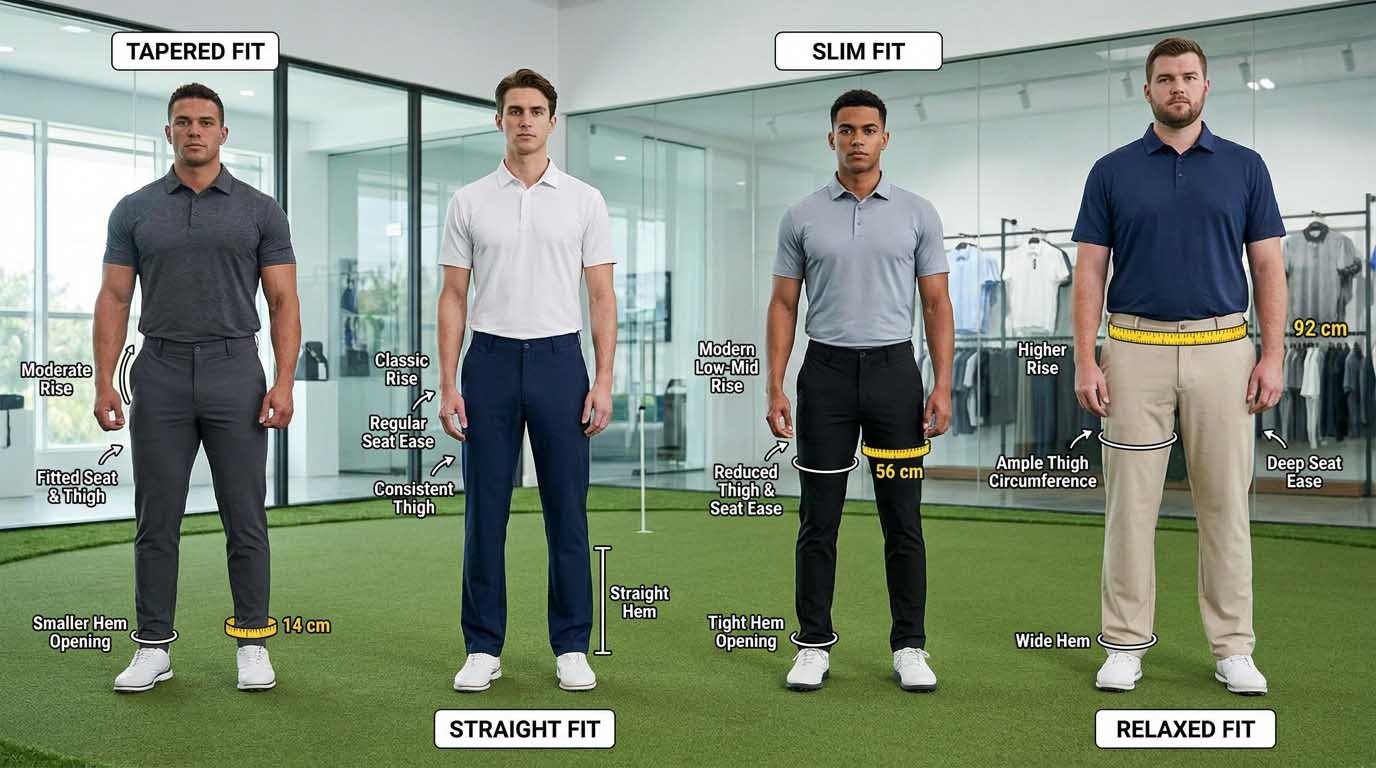
The best golf pants fit is determined by your target customer's body distribution, your inventory structure, and your price positioning. Tapered, straight, slim, and relaxed are unreliable labels—you must specify rise depth, seat ease, thigh circumference, and hem opening to match your buyer profile and reduce return risk.
I work in FUWAY's technical development team. My role covers pattern development, sample approval, and handling post-production fit complaints. Most fit problems I see happen before production starts—buyers select a fit name without verifying the measurements that create it. A brand orders "slim fit" from us, then complains the thighs are too tight. When I check their size chart against our specs, their chart is built for relaxed fit dimensions. The label did not match the numbers. This guide explains how to choose fit parameters that align with your customer base and minimize returns.
Quick Answers: Choosing Golf Pants Fit
What is the difference between tapered and slim fit?
Tapered refers to the leg shape—wider at the thigh, narrower at the hem. Slim refers to overall tightness—less ease throughout. A pant can be tapered but not slim (relaxed thigh with narrow hem), or slim but not tapered (tight throughout with minimal taper). You must specify both the overall ease and the taper profile separately.
Which fit is most popular for golf pants?
In our production data, straight and tapered fits account for 70% of orders. Slim fit makes up about 20%, relaxed about 10%. But this varies by region—North American buyers order more relaxed and straight fits; European and Asian buyers order more tapered and slim fits.
Can a slim fit pant allow full golf swing mobility?
Yes, if rise depth is adequate (28cm+ front rise) and the fabric has 5-8% elastane. The problem is not the slim fit itself—it is when buyers specify slim fit with short rise and no stretch. That combination restricts movement.
How much room should golf pants have at the thigh?
For non-stretch fabric, add 4-6cm ease above the actual thigh measurement. For stretch fabric (5-8% elastane), 3-4cm ease is sufficient. Less than this creates pull lines and restricts squatting. More than 6cm starts to look baggy.
What hem opening size prevents the pant from catching on shoes?
Minimum 36-38cm for spikeless golf shoes, 38-40cm for spiked shoes. Anything narrower creates difficulty putting the pant on. This is the most common fit complaint I handle—brands request narrow hems for aesthetics, then customers cannot get the pant over their shoes.
Should you stock multiple fits or just one versatile fit?
Stock 2-3 fits minimum. One fit cannot serve all body types and style preferences. We see the lowest return rates from brands that offer a primary fit (straight or tapered) plus one alternative (slim or relaxed). Single-fit brands always have higher returns.
How do you translate a competitor's fit into your own spec?
Measure the competitor sample flat—waist, seat, thigh, knee, hem opening, rise depth. Do not trust the fit label. I have measured "slim fit" pants with 70cm thigh circumference and "straight fit" pants with 64cm thigh. The label tells you nothing.
What Do Fit Labels Actually Mean and How Reliable Are They?
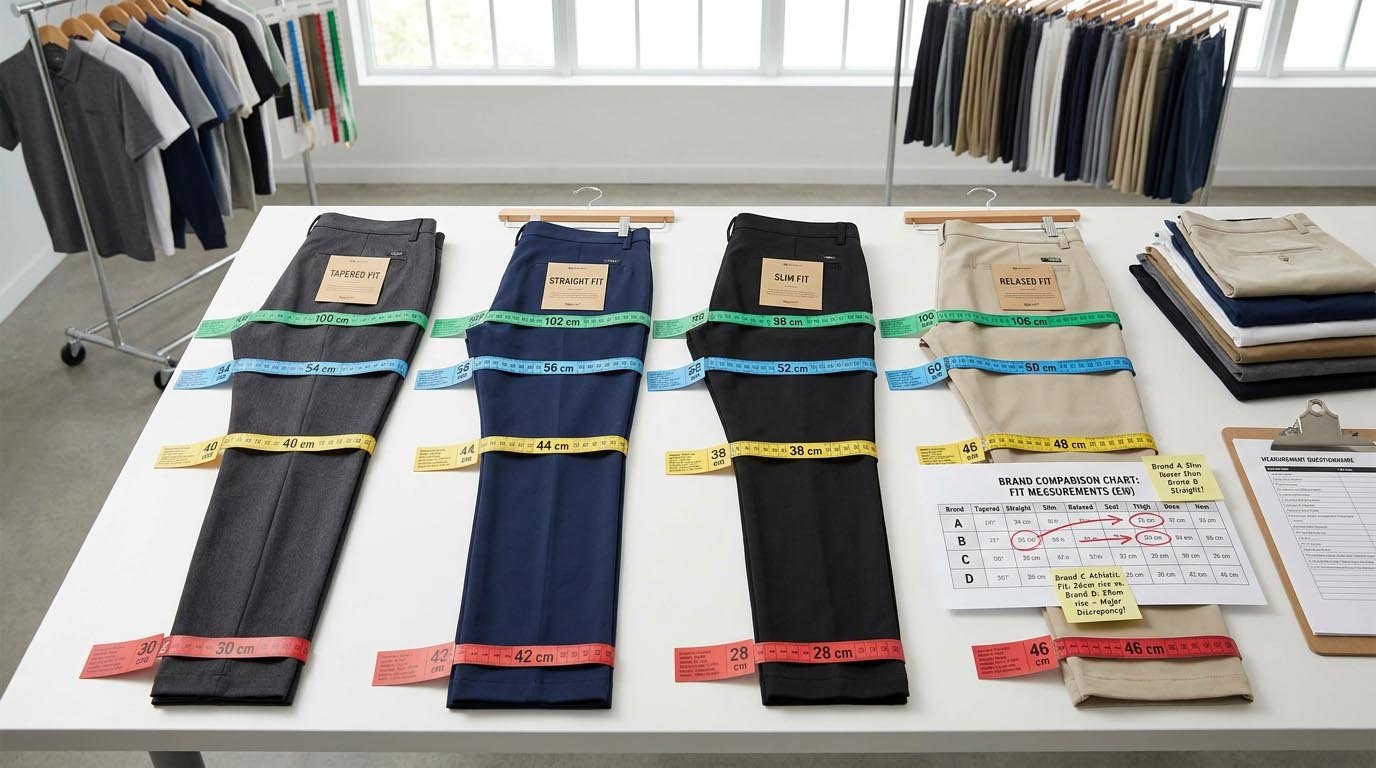
Fit labels—tapered, straight, slim, relaxed—have no standardized definitions across manufacturers. One brand's slim fit may have looser measurements than another's straight fit. You must specify the actual measurements at key points: seat, thigh, knee, and hem opening.
The Four Common Fit Labels
When clients request a fit by name, I always send back a measurement questionnaire. Here is how I define each category in our factory, but I emphasize these are our definitions—not universal rules.
Tapered Fit
The leg is wider at the thigh and narrows toward the hem. The taper creates a modern, streamlined look without being skin-tight. In our specs, tapered fit typically has:
- Seat ease: 5-6cm above body measurement
- Thigh ease: 4-5cm above body measurement
- Knee point: 60-62cm from waist (high position creates defined taper)
- Hem opening: 38-40cm (narrow but functional)
Straight Fit
The leg maintains relatively consistent width from thigh to hem. Minimal taper. Traditional, classic look. In our specs:
- Seat ease: 5-6cm
- Thigh ease: 4-6cm
- Knee point: 58-60cm from waist (lower position, gentle taper)
- Hem opening: 40-42cm (wider than tapered)
Slim Fit
Closer to the body throughout. Less ease at all points. Modern, fitted appearance. Requires stretch fabric for mobility. In our specs:
- Seat ease: 3-4cm (requires 5-8% elastane)
- Thigh ease: 2-3cm (stretch fabric essential)
- Knee point: 62-64cm from waist (high, aggressive taper)
- Hem opening: 36-38cm (minimum for shoe clearance)
Relaxed Fit
Generous ease throughout for comfort and traditional style. Common in North American market and for older demographic. In our specs:
- Seat ease: 6-8cm
- Thigh ease: 6-8cm
- Knee point: 56-58cm from waist (low, minimal taper)
- Hem opening: 42-44cm (very wide)
Why Fit Labels Fail
I keep a file of measurement mismatches from client complaints. Here are the patterns I see:
Brand A's "slim fit" thigh: 66cm
Brand B's "straight fit" thigh: 64cm
Brand B's straight fit is tighter than Brand A's slim fit. A customer who wears Brand A slim might find Brand B straight too tight. The labels are meaningless.
Brand C's "athletic fit" has 26cm front rise
Brand D's "athletic fit" has 29cm front rise
Same label, 3cm rise difference. That is the difference between restricted mobility and comfortable movement. The customer ordering based on the label will be wrong 50% of the time.
Which Measurements Actually Determine Fit and Mobility?
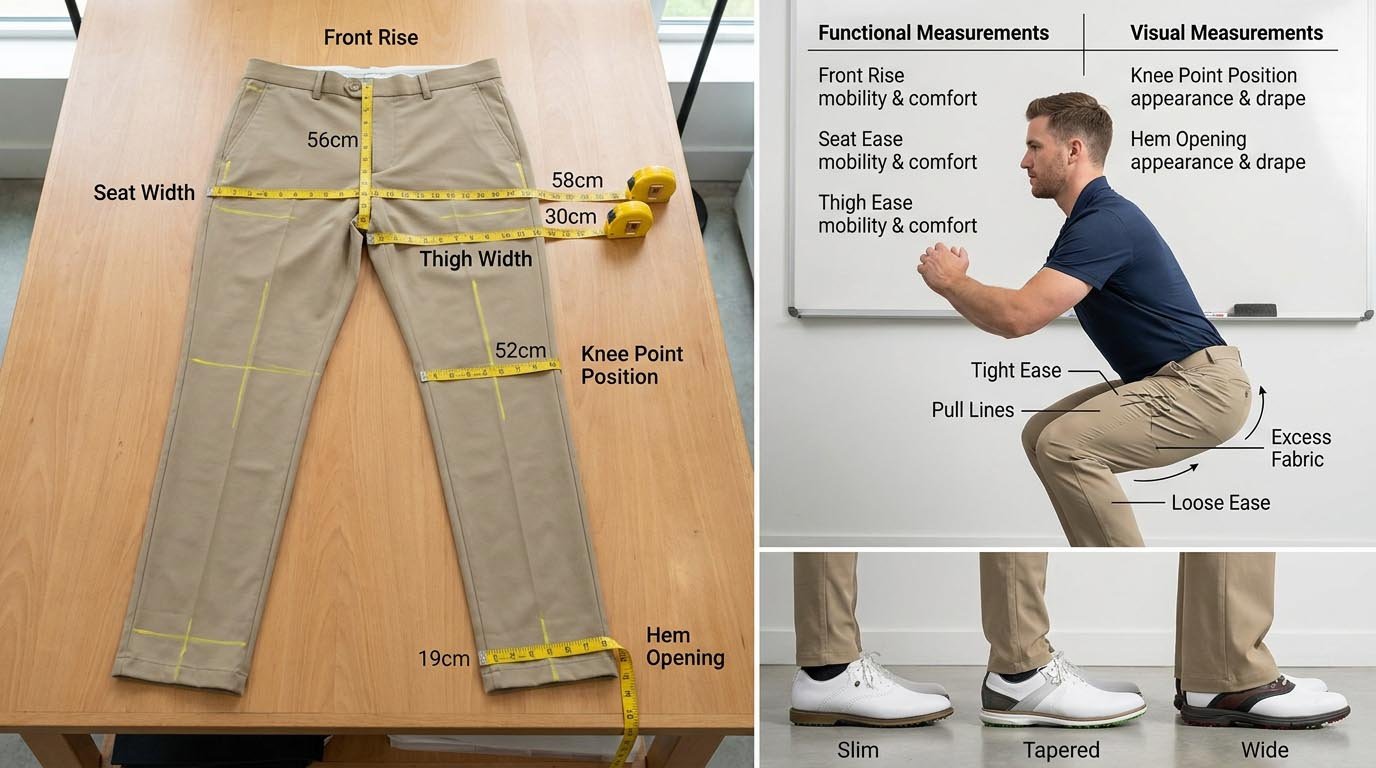
Rise depth, seat ease, and thigh ease determine mobility and comfort. Knee point position and hem opening control visual appearance. Buyers often focus on the visual elements while ignoring the functional measurements, creating pants that look right but do not perform.
The Functional Measurements
These measurements control whether the pant is comfortable and allows movement.
Front Rise
This is the distance from the waistband, through the crotch, back to the front waistband. It controls how high the pant sits and how much room exists for leg movement.
In our sampling experience:
- Under 27cm: Modern, low-rise look. Limits squat depth. Not suitable for customers who need full crouch mobility.
- 27-29cm: Standard range. Works for most body types with adequate mobility.
- Over 29cm: High-rise. Maximum mobility but can look dated or "dad pants" on younger customers.
Most mobility complaints come from pants with front rise under 27cm. If your customer needs to squat frequently (reading putts, picking up balls), specify at least 28cm front rise.
Seat Ease
The difference between the customer's actual hip measurement and the pant's seat measurement. This controls whether the pant pulls tight when walking, sitting, or swinging.
In non-stretch fabric, I recommend minimum 5cm ease. Less than that creates pull lines across the seat and restricts the backswing. In stretch fabric (5-8% elastane), you can reduce to 3-4cm ease because the fabric gives.
Thigh Ease
Controls whether the pant feels restrictive during stride and squat. This is the measurement that most affects perceived tightness.
From client feedback:
- Under 3cm ease: Customer will describe the pant as "tight" or "restrictive" unless the fabric has significant stretch
- 3-4cm ease with stretch: Feels fitted but mobile
- 4-6cm ease without stretch: Comfortable, classic feel
- Over 6cm ease: Starts to look baggy
If you are targeting athletic or younger customers who expect a modern look, 3-4cm thigh ease with stretch fabric is the sweet spot. If you are targeting recreational or older customers, 5-6cm ease in non-stretch is safer.
The Visual Measurements
These measurements control how the pant looks, not how it feels.
Knee Point Position
The location where the leg begins to taper from thigh width to hem width. High knee point (far from the waist) creates a long, straight thigh line and short taper. Low knee point creates early taper and a slim appearance.
In our pattern development, knee point is measured as distance from the waistband:
- 56-58cm: Low knee point, gentle taper, classic look
- 60-62cm: Mid knee point, moderate taper, most versatile
- 62-64cm: High knee point, aggressive taper, modern look
Changing knee point by 2-4cm dramatically changes the visual profile without affecting comfort.
Hem Opening
The circumference at the pant leg bottom. This is the measurement customers see first and often judge the entire fit by.
Functional minimums:
- 36-38cm: Absolute minimum for spikeless shoes. Tight, modern look. High risk of customer complaints about difficulty putting pants on.
- 38-40cm: Safe minimum for most golf shoes. Still looks tapered but functional.
- 40-42cm: Standard straight fit. Easy on/off, works with all shoe types.
- Over 42cm: Wide, traditional. Preferred by older customers.
I see brands request 34-36cm hem openings for slim aesthetics, then face returns because customers cannot get the pant over their shoes. Always test hem opening with the actual shoe type your customer wears.
How Does Fabric Stretch Change Fit Requirements?
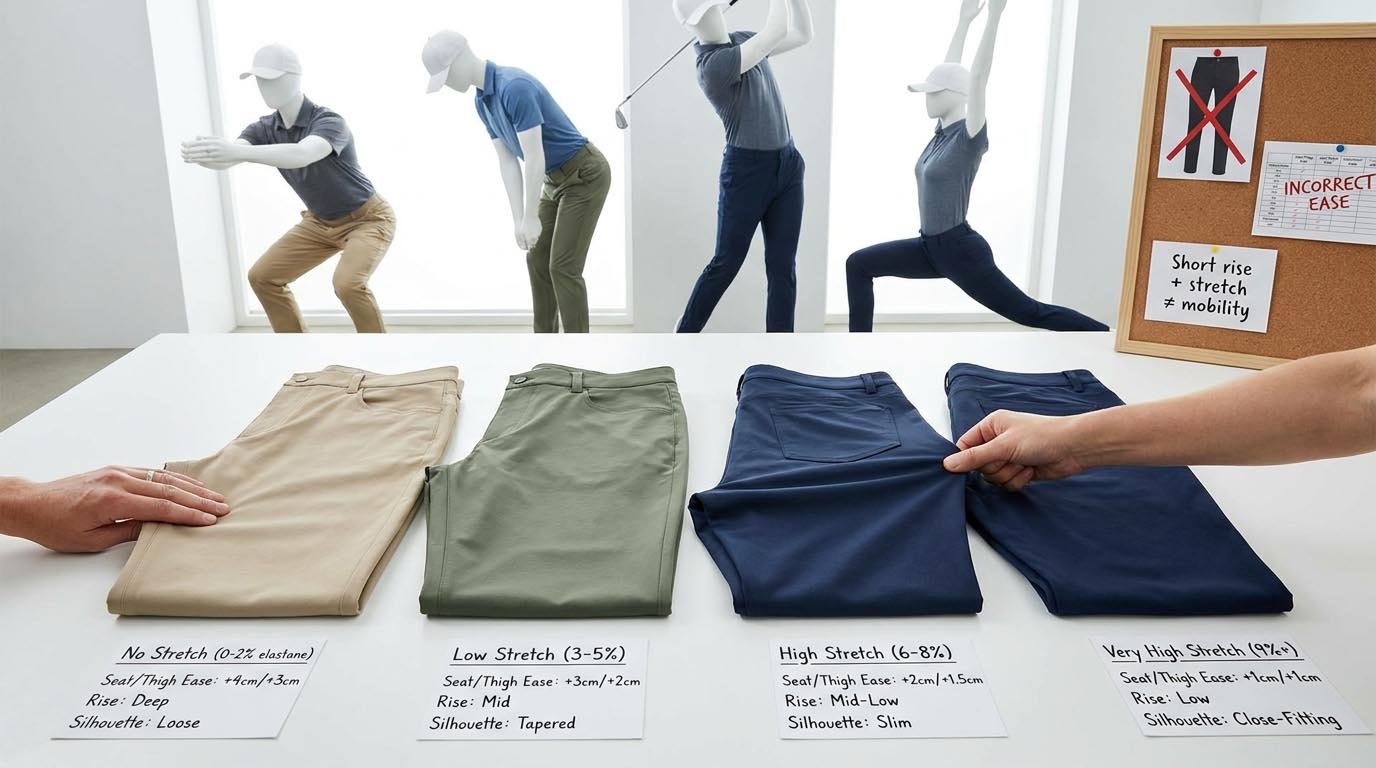
Elastane content changes how much ease you need at every measurement point. Non-stretch fabric requires 4-6cm ease for mobility. Stretch fabric with 5-8% elastane reduces required ease to 3-4cm. You cannot use the same fit specifications across different stretch levels.
Stretch Categories and Ease Adjustments
In our technical specs, I categorize fabric by stretch level and adjust ease requirements accordingly.
No Stretch (0-2% elastane):
The fabric has minimal give. All mobility must come from built-in ease.
- Seat ease: 6cm minimum
- Thigh ease: 5-6cm minimum
- Rise depth: 28cm+ front rise for mobility
These measurements create a looser appearance, but without stretch, there is no other way to ensure mobility.
Low Stretch (3-5% elastane):
Some give, but not enough to rely on fabric alone.
- Seat ease: 5cm minimum
- Thigh ease: 4-5cm
- Rise depth: 27-28cm acceptable
This is the compromise range—slightly closer fit than non-stretch, but not as close as high-stretch.
High Stretch (6-8% elastane):
Significant fabric give. Can reduce ease substantially while maintaining mobility.
- Seat ease: 3-4cm
- Thigh ease: 3-4cm
- Rise depth: 27cm acceptable if customer mobility is moderate
This is where slim fits become functional. Without stretch, most slim fit specs are too tight for golf movement.
Very High Stretch (9%+ elastane):
Extreme stretch, often used in yoga pants or extreme performance apparel. Rare in golf pants except ultra-performance lines.
- Can use very close fit (2-3cm ease)
- Risk of looking too casual or athletic for traditional golf settings
Common Fabric-Fit Mismatches
Mistake 1: Copying stretch-fit measurements into non-stretch fabric
Client sees a slim fit pant they like, measures it, and specs that for their non-stretch fabric line. The result is unwearably tight. I reject these specs at sampling and send back revised measurements with added ease.
Mistake 2: Adding the same ease percentage to all points
Client says "add 10% ease to all measurements." This does not work because different body parts need different ease amounts. The seat needs more ease than the waist. The thigh needs more than the knee. I send back a measurement-by-measurement breakdown.
Mistake 3: Over-relying on stretch to compensate for poor rise depth
Client specs short rise (26cm) with high stretch fabric, assuming the stretch will solve the mobility problem. It does not. Rise depth is a structural dimension—stretch cannot add length. The pant still rides down during squatting.
How Do You Match Fit to Your Target Customer Profile?
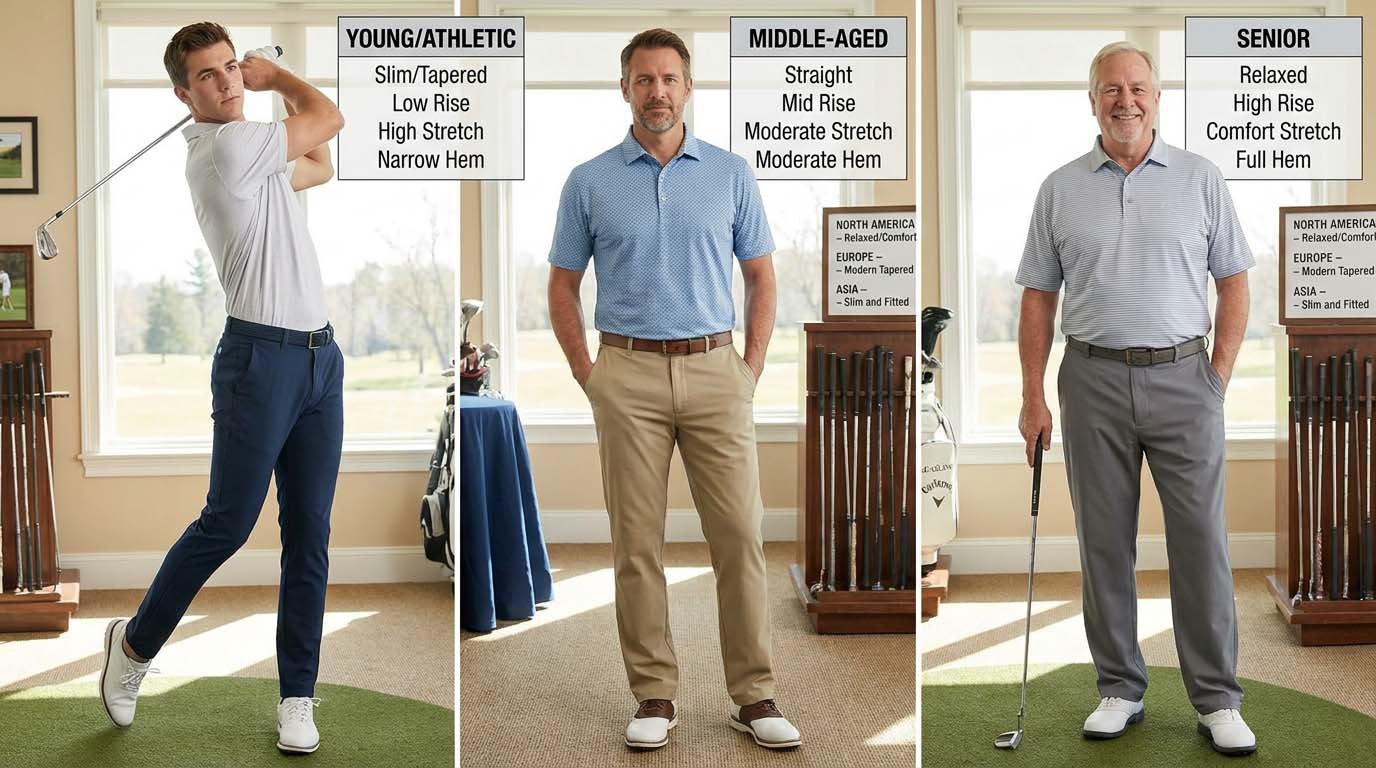
Fit selection depends on your target demographic's body distribution, style preferences, and activity level. Younger, athletic customers prefer tapered and slim fits. Older, recreational customers prefer straight and relaxed fits. Height, build, and shoe type also affect which fit works best for your customer base.
Demographic-Based Fit Selection
From our order patterns and client feedback, here are the customer profiles that guide fit selection:
Young, Athletic, Competitive (Ages 20-35)
Body characteristics: Lean to athletic build, typically taller, low body fat
Style preference: Modern, fitted, fashion-forward
Activity level: Full swings, frequent squatting, fast pace
Recommended fit: Tapered or slim with 5-8% stretch
Key specs: Front rise 27-28cm, thigh ease 3-4cm, hem opening 38-40cm, high knee point (62cm)
Mid-Age, Active, Regular Players (Ages 35-55)
Body characteristics: Variable build, average height, some weight around midsection
Style preference: Balance of modern and traditional, not too tight
Activity level: Full swings, moderate squatting, steady pace
Recommended fit: Straight or tapered with moderate stretch (3-5%)
Key specs: Front rise 28-29cm, thigh ease 4-5cm, hem opening 40-42cm, mid knee point (60cm)
Senior, Recreational, Social Players (Ages 55+)
Body characteristics: Fuller build, shorter legs, weight around waist
Style preference: Traditional, comfortable, not fashion-driven
Activity level: Moderate swings, minimal squatting, slower pace
Recommended fit: Relaxed or straight with minimal stretch (0-3%)
Key specs: Front rise 29-30cm, thigh ease 5-6cm, hem opening 42-44cm, low knee point (58cm)
Build-Specific Adjustments
Body shape affects fit differently than age. A tall, thin 50-year-old needs different specs than a short, heavy 50-year-old.
Tall and Thin (Over 185cm, lean build)
Longer inseam (86-91cm), narrower thigh (58-62cm body measurement), can wear slim or tapered fits without restriction.
Short and Heavy (Under 175cm, larger midsection)
Shorter inseam (76-81cm), wider seat and thigh, needs higher rise (29-30cm) to avoid the pant sliding down. Relaxed or straight fit required.
Athletic Build (Muscular legs and glutes)
Standard height but thicker thighs. Needs more thigh ease (5-6cm) even in tapered fits. Cannot wear true slim fit unless fabric has high stretch.
Regional Market Differences
In our production data, fit preferences vary significantly by region:
North America: 60% straight and relaxed, 30% tapered, 10% slim. Customers prioritize comfort over fitted appearance.
Europe: 50% tapered, 30% slim, 20% straight. Customers expect more fitted, modern styling.
Asia: 40% slim, 40% tapered, 20% straight. Customers have smaller frame sizes and prefer closer fits.
If you are selling globally, you need different fit mixes for different regions. A one-fit-all approach will have high return rates in at least one market.
What Try-On and Tailoring Options Should You Plan For?
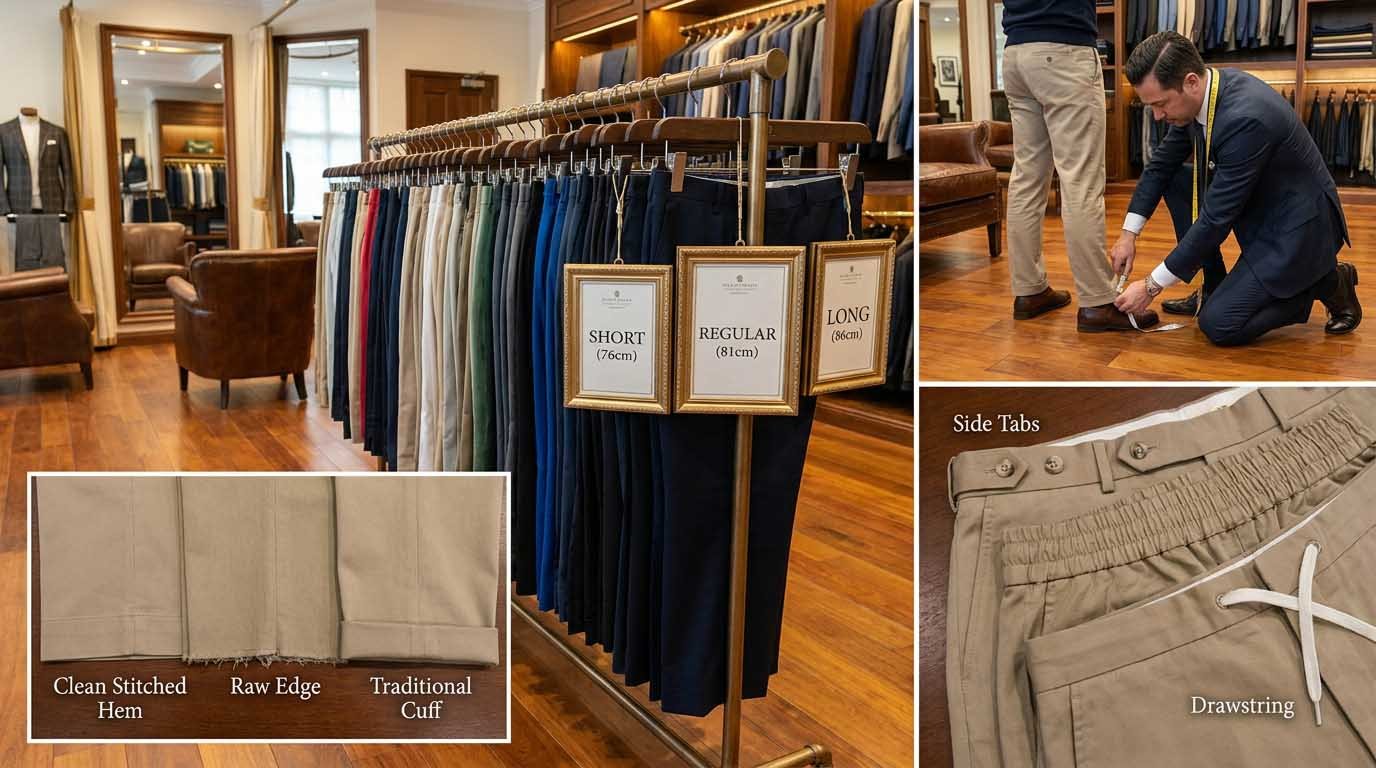
Offering multiple inseam lengths or easy tailoring options reduces returns significantly. Waist adjustability (side tabs, elastic inserts) accommodates body variation within a size. Hem finish options (raw edge, cuffed, tapered) allow customers to customize appearance.
Inseam Length Strategy
In our experience, brands that offer multiple inseam options see 15-20% fewer returns than brands that offer one length.
Single inseam approach:
Choose 81cm for men's medium as a compromise length. Works for average height (175-180cm) with slight break. Too short for tall customers, too long for short customers. Expect 20-25% length-related returns.
Two inseam approach (recommended minimum):
Short (76cm) and Regular (81cm). Covers 80% of customers. Reduces returns to 10-15%.
Three inseam approach (optimal):
Short (76cm), Regular (81cm), Long (86cm). Covers 90% of customers. Returns under 10%.
From a production standpoint, each additional inseam adds complexity—separate cutting, separate inventory. But the return reduction justifies the cost.
Waist Adjustability
Fixed waistbands create fit problems when a customer is between sizes. I recommend at least one adjustability feature:
Side tabs: Elastic tabs with button or snap adjustment. Adds 2-4cm waist adjustment range. Low cost, traditional look.
Elastic inserts: Hidden elastic panels at side seams. Provides 3-5cm stretch without visible hardware. Comfortable but can look less structured.
Drawstring or internal elastic: Common in performance pants. Maximum adjustability but casual appearance.
From client feedback, side tabs are the most popular for traditional golf pants. Elastic inserts work well for performance styles.
Hem Finishing Options
Finished hem (standard):
Clean, folded, and stitched. Looks professional, requires hemming service to adjust length.
Raw edge or unfinished hem:
Customer can hem to exact length at home or with local tailor. Reduces your production cost slightly but transfers work to customer. Works for casual styles, not premium.
Cuffed hem:
Folded and stitched cuff at bottom. Adds visual weight, prevents break, traditional style. Not adjustable.
I see brands offer finished hem as standard, with hemming service available for a small fee. This reduces returns while providing customization.
What Common Fit Problems Should You Watch For?
Most fit failures are predictable and preventable. Grinning through (pull lines from short rise), pocket bulk (thick wallet outlines), belt bunching, and shirt pull-out happen when specs do not account for real-world use. Testing samples during actual golf movement reveals these problems before production.

Grinning Through
This is the most common fit complaint I handle. Horizontal pull lines appear across the front crotch and thigh area, visible when the customer stands or walks. It looks like the fabric is smiling.
Cause: Front rise too short for the customer's body. The fabric pulls tight between waist and crotch, creating stress lines.
Prevention: Specify adequate front rise (28cm minimum for athletic customers, 29cm for recreational). Test samples in a golf stance with slight knee bend. If pull lines appear, increase rise by 1-2cm.
Common mistake: Brands copy competitor samples that look good on a fit model standing still but create grinning through during movement. Always test in motion.
Pocket Bulk
When a customer puts a phone, wallet, or tees in the pocket, the fabric bulges outward, distorting the leg line.
Cause: Pocket positioned too far forward or pocket bag made from thick lining fabric. The pocket contents sit directly on the front thigh.
Prevention: Position pockets slightly toward the side seam rather than directly on the front. Use thin lining fabric (cotton lawn or lightweight polyester). Test with actual items the customer will carry.
Belt and Waistband Issues
Belt loops too wide or narrow: Loops should accommodate standard belt width (3.5-4cm). Too narrow and belts do not fit; too wide and the belt slides around.
Waistband gaps: The waistband stands away from the body at the back when the customer bends forward. Caused by inadequate waistband curve or too much ease at the waist relative to the seat.
Prevention: Waistband must follow body curve. Specify waist-to-seat ratio: typically seat is 20-24cm larger than waist. If the difference is too small, the waistband gaps.
Shirt Pull-Out
The shirt pulls out of the pant waistband during the golf swing, requiring constant tucking.
Cause: Waist sits too low (short rise) or waistband is too loose, allowing it to slide down during rotation.
Prevention: Adequate rise depth (28-29cm front) keeps the waist position stable. Waistband should fit snugly—1-2cm ease maximum—without relying on a belt to hold position.
Knee Bag
The fabric bags out at the knees after wearing for a few holes, looking sloppy.
Cause: Too much knee ease or fabric without recovery. The fabric stretches during movement but does not return to shape.
Prevention: Use fabric with good stretch recovery (requires elastane or mechanical stretch). Do not over-ease the knee—keep it 2-3cm wider than the actual knee measurement, no more.
Conclusion
Best fit is not a single pants type but a specification decision based on your target customer's body distribution and style expectations. Verify measurements, not fit labels. Stock 2-3 fit options matched to your demographic. Test samples during movement to catch grinning through and pocket bulk before production.