A client budgeted $12,000 for their first production run. They designed three polo styles across four colors each. I quoted them $24,500 because their SKU allocation required 12 separate fabric orders, 12 logo setups, and small-batch pricing penalties. They were shocked. They had only calculated garment unit prices times quantity.
Starting a golf clothing brand in 2026 requires $8,000-$50,000 depending on how you allocate budget across SKU count, production volume, customization depth, and hidden non-production costs that typically add 25-40% beyond factory garment pricing.
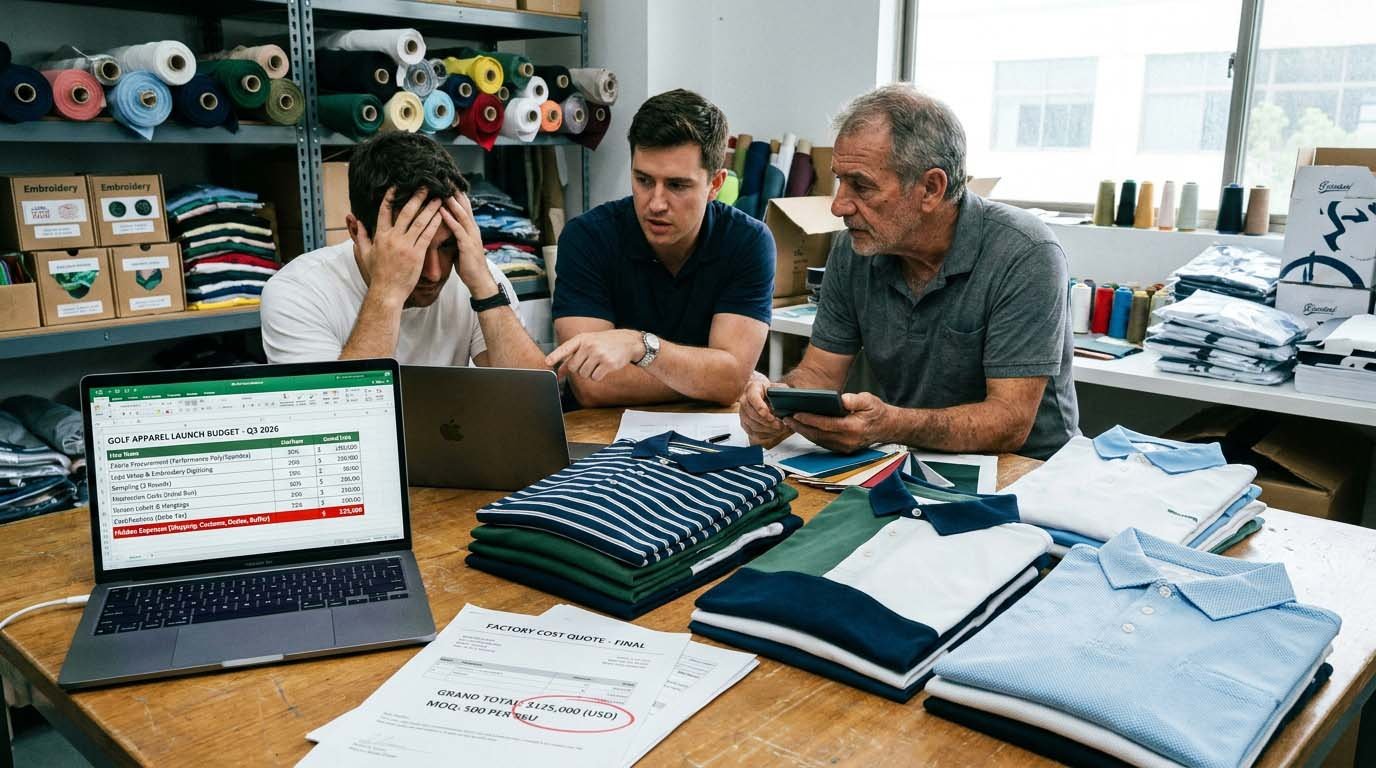
I am Will from FUWAY. I prepare cost quotes for 60-90 startup golf brands annually. Most arrive with unrealistic budget expectations because they researched "polo manufacturing cost" and saw $10-15 per unit. They do not realize that number applies to 3,000-piece reorders with established patterns, not first orders with sampling, custom labels, certifications, and 500-piece minimums split across multiple styles. My job is showing them the real numbers before they commit capital to order structures that will fail. This guide breaks down 2026 startup costs from the factory planning perspective—not generic business advice, but the actual money you will spend getting inventory into your hands.
Quick Answers: Golf Clothing Brand Startup Costs 2026
What is the minimum budget to start a golf clothing brand?
$8,000-$12,000 for a lean DTC launch: one style (performance polo), two colors, 500 total pieces using in-stock fabrics, heat-transfer logos, basic packaging. This leaves minimal room for marketing or photography but gets you sellable inventory.
How much does manufacturing cost per unit for first orders?
$12-$18 per polo for 500-piece orders with moderate customization (in-stock performance fabric, embroidered logo, standard trim). $10-$14 per polo for 1,000-piece orders. But add $4-8 per unit for packaging, labels, certifications, and freight to calculate true landed cost.
What are the hidden costs most startups forget to budget?
Hang tags and care labels ($0.40-$1.20 per unit), custom packaging beyond polybags ($1.50-$4.00 per unit), performance fabric testing ($200-$500 per fabric type), OEKO-TEX certification ($800-$1,500 annually), customs duties (15-30% of FOB value), freight and logistics ($2-6 per unit depending on method).
Should I start with one style or multiple styles?
One style in 2-3 colors (500-800 total pieces) maximizes unit economics and quality consistency for limited budgets under $15,000. Multiple styles require $25,000+ to maintain efficient MOQ per style. Splitting 500 pieces across three styles (167 per style) increases per-unit cost by 30-50%.
How much should I budget for sampling before bulk production?
$500-$1,200 per style including pattern development, 2-3 sample rounds with revisions, and pre-production samples. Brands designing 3-4 styles need $2,000-$4,000 in sampling budget before placing any bulk orders.
What realistic total budget do I need for wholesale readiness?
$25,000-$40,000 to produce 1,000-1,500 units across 2-3 styles with wholesale-required elements: OEKO-TEX certification, retail-ready packaging, product photography, and compliance documentation. Wholesale buyers expect this infrastructure before placing orders.
How does SKU allocation affect my budget?
500 pieces in one style across two colors: $12-$14 per unit. Same 500 pieces split across three styles in two colors each (83 per SKU): $17-$22 per unit. SKU proliferation destroys economies of scale and increases fabric waste, logo setup duplication, and batch inefficiency penalties.
What Assumptions Drive 2026 Cost Calculations?
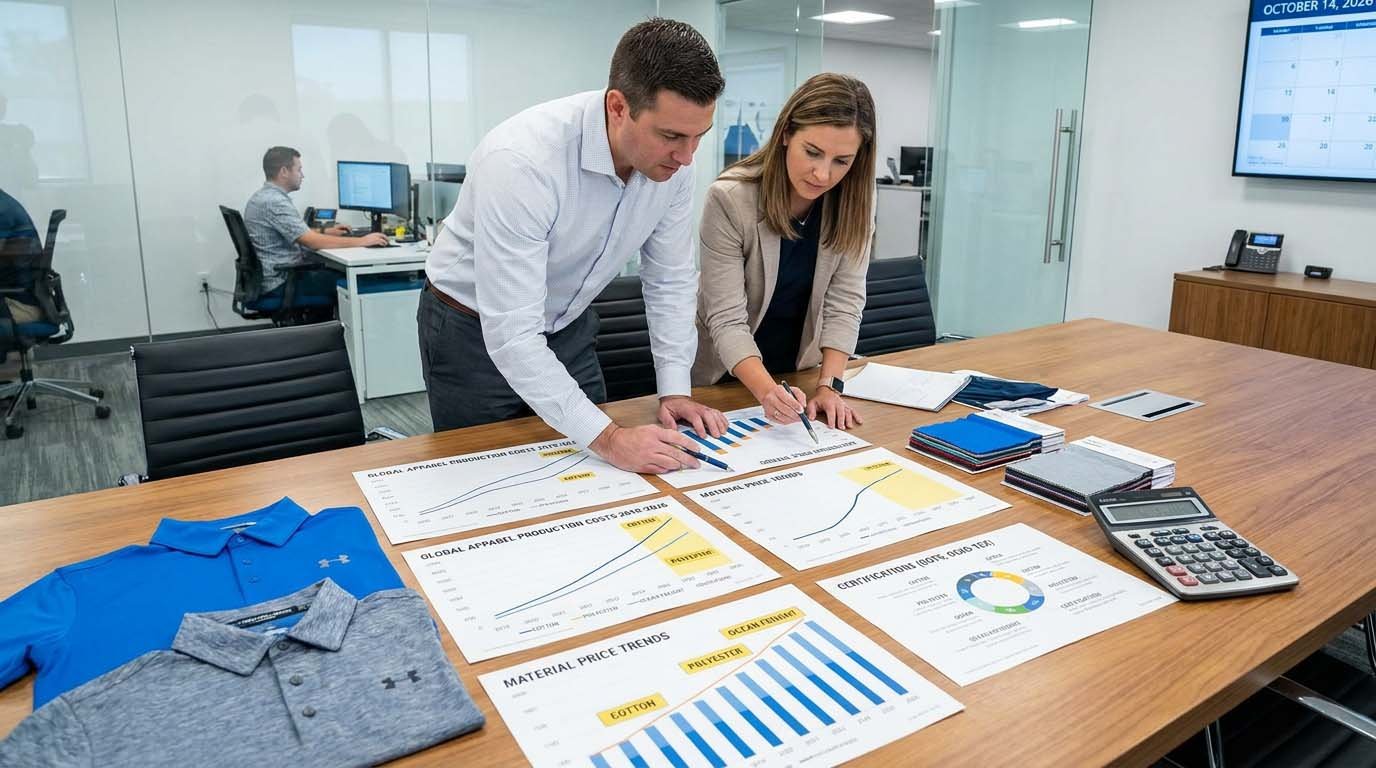
2026 cost calculations assume post-pandemic manufacturing cost stabilization but reflect permanent increases in raw materials, labor, and compliance requirements. Understanding what drives current pricing prevents using outdated benchmarks that underestimate your actual capital needs.
2026 Manufacturing Cost Environment
Raw material pricing:
Polyester fiber costs stabilized at 30-35% above 2019 levels. Cotton prices remain volatile but average 20-25% higher than pre-pandemic. Spandex and elastane blends carry 15-20% premiums. This affects performance fabrics more than basic cotton polos.
Labor and overhead:
Major manufacturing regions (Vietnam, Bangladesh, China, India) saw 15-25% wage increases from 2019-2025. Factory overhead costs increased 12-18% due to energy, compliance, and equipment maintenance. These are permanent structural changes, not temporary inflation.
Freight and logistics:
Container shipping normalized from 2021 peaks ($12,000-$18,000 per container) to current $2,500-$4,500 per container—still double 2019 rates. Air freight remains 60-80% higher than 2019. Domestic logistics and warehousing costs increased 20-30%.
Compliance and testing:
OEKO-TEX certification costs rose 10-15%. Performance fabric testing increased 8-12% due to expanded protocols. New California Proposition 65 requirements and EU microplastics regulations add $300-800 in testing per product line.
Key Assumptions for This Guide
Order volume: 500-1,500 pieces for first production run. Below 500 pieces, costs increase dramatically. Above 2,000 pieces, costs decline but capital risk increases.
Product type: Focus on performance golf polos as baseline. Shorts, pants, and outerwear have different cost structures but similar MOQ dynamics.
Customization level: Moderate customization—using in-stock or semi-custom fabrics, embroidered or heat-transfer logos, standard construction with minor modifications. Not stock service (factory's existing designs) or full custom development (proprietary fabrics and construction).
Geographic focus: Manufacturing in Asia (Vietnam, China, Bangladesh) with import to U.S. market. Domestic U.S. manufacturing costs 2.5-4x higher and requires different analysis.
Business model: Direct-to-consumer (DTC) launch via own website as primary channel. Wholesale-ready budgets are noted separately due to higher packaging and compliance requirements.
What Does Product Development Actually Cost Before Production?
Development costs are fixed per style, not per unit. Brands designing multiple styles pay these costs repeatedly but often budget as if they are one-time expenses. This is why single-style launches maximize capital efficiency for limited budgets.
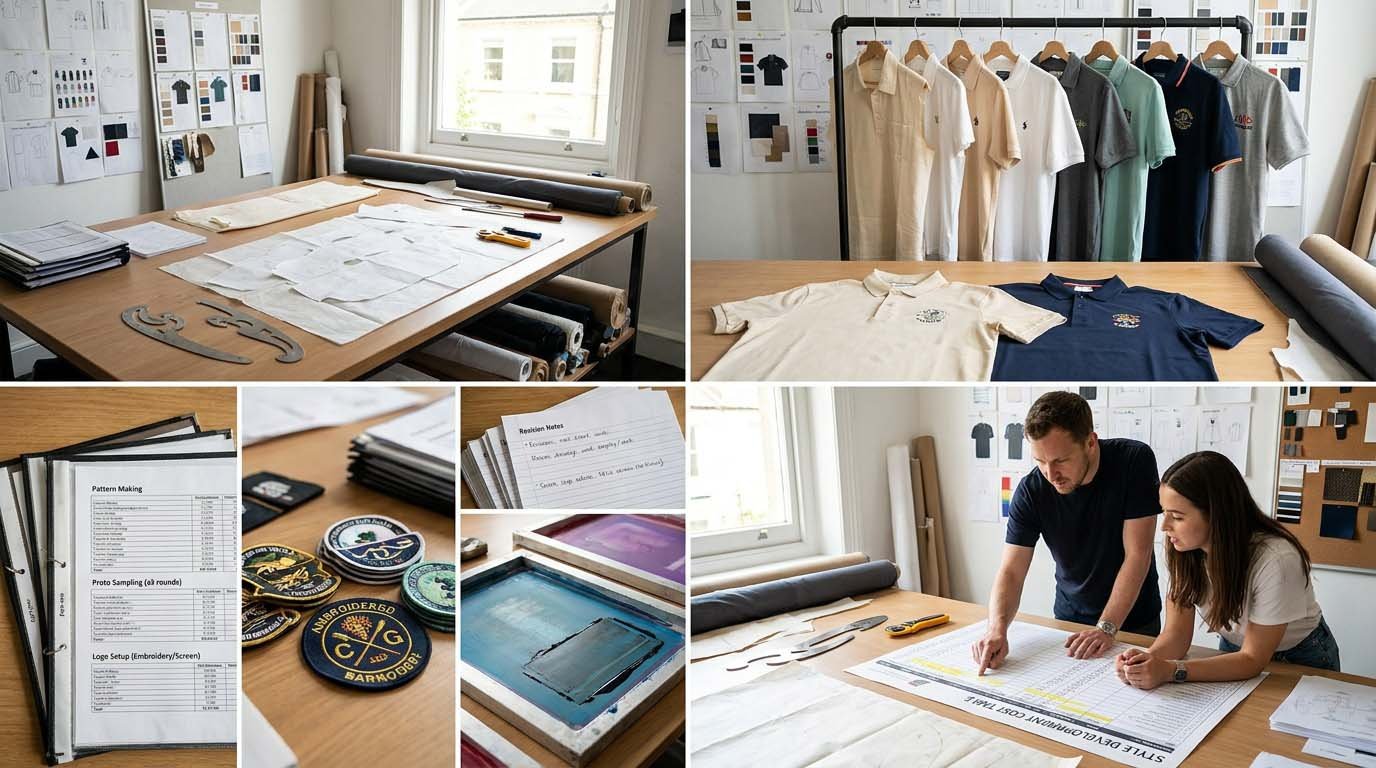
Pattern Making and Technical Development
Pattern development per style:
$150-$300 depending on complexity. This includes drafting cutting patterns for your design based on tech pack specifications and grading across sizes (typically 5 sizes: S, M, L, XL, XXL). Simple polos with standard collars cost $150-200. Polos with contrast panels, unique plackets, or complex construction cost $250-300.
Tech pack creation:
If you provide complete tech packs with specifications, no additional cost. If factory creates tech packs from your sketches and descriptions, add $150-250 per style. This includes translating design vision into production-ready specifications with measurements, construction notes, and material callouts.
Fit adjustment and grading revisions:
First pattern rarely fits perfectly. Budget for 1-2 pattern revisions at $80-120 per revision. If you need significant fit changes (adjusting armhole depth, shoulder slope, torso length), expect 2-3 revision rounds.
Sampling Cycles and Costs
Proto samples (initial concept validation):
$40-$80 per sample. Produce 2-3 samples per style for design validation and initial fit testing. These use approximate fabrics and basic construction to prove concept. Total: $120-240 per style.
Fit samples (pattern refinement):
$50-$90 per sample. After initial feedback, factory produces samples with pattern adjustments. Typically 2-4 samples per style across revision rounds. Total: $100-360 per style.
Pre-production samples (bulk material validation):
$60-$100 per sample. Produced using actual bulk fabric, trim, and logo methods to validate production quality before authorizing bulk run. Critical checkpoint. Total: $60-100 per style.
Complete sampling budget per style: $280-$700 depending on revision complexity.
Logo Development and Setup
Logo digitizing for embroidery:
$100-$200 per logo design. Converts artwork into stitch files that embroidery machines read. Includes test stitching on scrap fabric and tension adjustments. One-time cost per logo, reusable for future orders.
Logo placement testing:
$80-$150 for creating test samples with logos in different positions, sizes, or techniques. Necessary if you are uncertain about optimal logo placement or want to test heat-transfer versus embroidery.
Screen setup (if using screen printing):
$80-$150 per color. If your logo has three colors, that is $240-$450 in screen costs. Embroidery avoids this but has higher per-unit execution cost.
Development Cost Example Table
| Style Count | Pattern Development | Sampling Cycles | Logo Setup | Total Development |
|---|---|---|---|---|
| 1 style | $150-$300 | $280-$700 | $100-$200 | $530-$1,200 |
| 2 styles | $300-$600 | $560-$1,400 | $200-$400 | $1,060-$2,400 |
| 3 styles | $450-$900 | $840-$2,100 | $300-$600 | $1,590-$3,600 |
| 4 styles | $600-$1,200 | $1,120-$2,800 | $400-$800 | $2,120-$4,800 |
I tell clients that development costs are why experienced brands launch with 1-2 hero styles, prove demand, then expand. New brands designing 4-6 styles simultaneously spend $3,000-$6,000 in development before producing any sellable inventory—capital that generates zero revenue.
How Much Does Manufacturing Actually Cost Per Unit in 2026?
A client compared my quote ($13.50 per polo at 500 pieces) with another factory quoting $10.80 for "the same product." I asked for their quote details. The $10.80 included only the basic garment—no embroidered logo (add $1.80), no custom labels (add $0.60), no hang tags (add $0.40), no inner neck printing (add $0.50). Once we aligned specifications, both quotes were $13.80-$14.20. The cheaper quote hid costs in separate line items.
Manufacturing cost per unit depends on order volume, fabric selection, logo method, trim specifications, and packaging requirements. Factory-door garment price is only 60-75% of true landed cost after adding all required components.
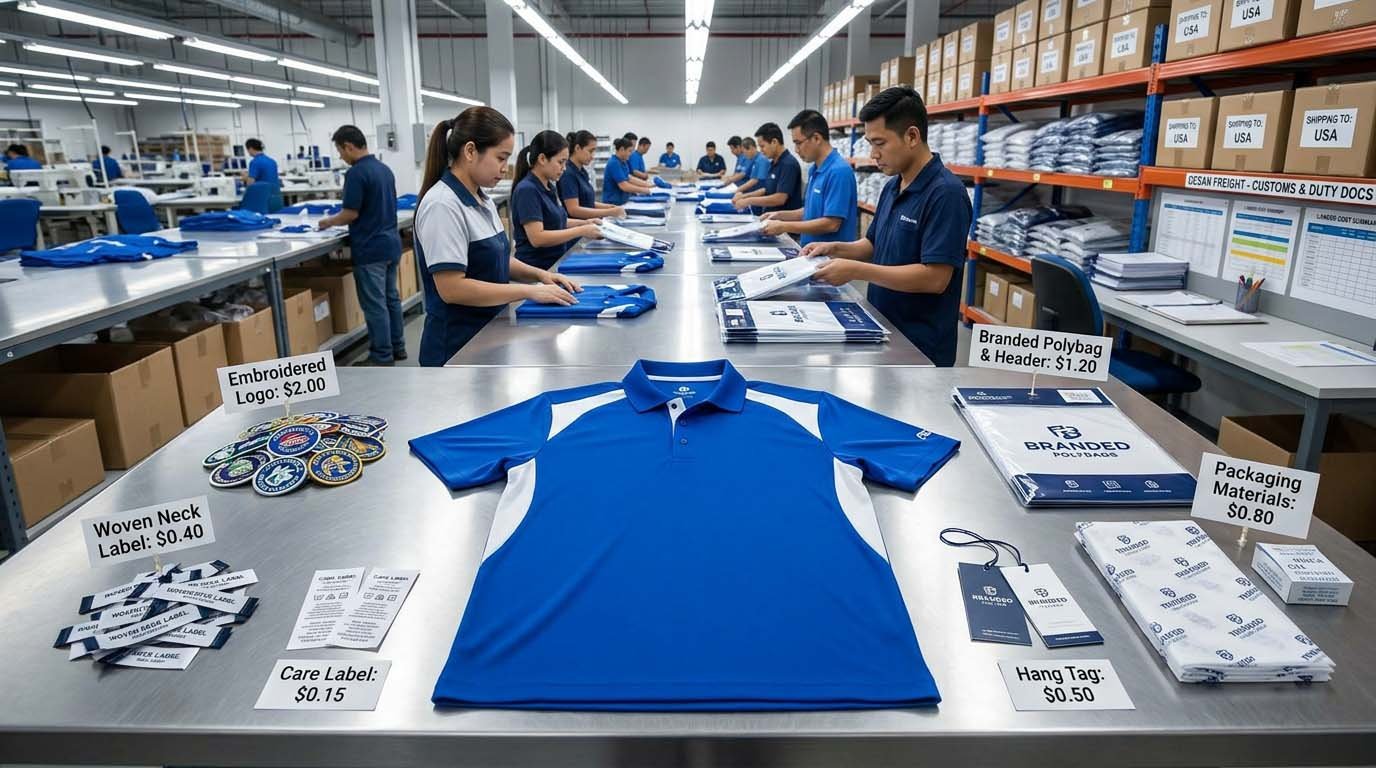
Base Garment Cost by Volume
Performance polo with in-stock fabric, standard construction:
At 200-300 pieces: $16-$20 per unit (high MOQ penalty)
At 500 pieces: $12-$15 per unit (standard startup volume)
At 1,000 pieces: $10-$13 per unit (improved efficiency)
At 2,000 pieces: $9-$11 per unit (bulk discount)
At 5,000+ pieces: $7.50-$9.50 per unit (volume production)
Custom fabric or complex construction adds:
Semi-custom fabric selection: +$1.00-$2.50 per unit
Fully custom fabric development: +$2.50-$5.00 per unit
Contrast details (tipping, panels): +$1.50-$3.50 per unit
Complex construction (welded seams, special finishing): +$2.00-$4.00 per unit
Logo Execution Costs Per Unit
Embroidery (left chest placement):
$1.50-$2.50 per unit at 500+ pieces
$2.00-$3.20 per unit at 200-300 pieces
Larger logos or multiple placements add $0.80-$1.50 per additional position
Heat-transfer logos:
$0.60-$1.20 per unit at 500+ pieces
$0.80-$1.60 per unit at 200-300 pieces
Works well for complex multi-color designs
Screen printing:
$0.80-$1.50 per unit for simple 1-2 color logos at 500+ pieces
Setup cost amortizes across quantity
Labels, Tags, and Branding Components
Woven brand labels (neck label):
$0.20-$0.40 per unit (MOQ 1,000 labels, $200-$400 upfront)
$0.35-$0.60 per unit (MOQ 500 labels)
Printed care labels:
$0.10-$0.25 per unit
Hang tags:
$0.30-$0.80 per unit depending on design complexity and printing method
Custom die-cut hang tags: $0.60-$1.50 per unit
Inner neck printing (heat-transfer brand label):
$0.30-$0.60 per unit
Packaging Costs Per Unit
Basic polybag:
$0.12-$0.25 per unit
Polybag with branded header card:
$0.30-$0.60 per unit
Tissue paper and stickers:
$0.25-$0.50 per unit
Custom folded boxes:
$1.50-$4.00 per unit depending on size and printing complexity
Complete Landed Cost Calculation
Let me show you real numbers for 500-piece polo order:
Base garment: $13.00
Embroidered logo: $2.00
Woven neck label: $0.35
Printed care label: $0.15
Hang tag: $0.50
Polybag with header: $0.40
Inner neck print: $0.40
= $16.80 per unit factory-packaged price
Plus logistics and compliance:
Air freight: $3.50 per unit
Customs duty (18% of FOB): $3.02
Customs broker: $0.60 per unit
Performance fabric testing: $0.80 per unit (amortized)
= $24.72 per unit landed cost
This is the real number you divide into your inventory investment, not the $13 base garment cost.
What Do Brand Launch and Marketing Foundations Cost?
Marketing and brand infrastructure costs often equal or exceed manufacturing investment for DTC launches. Brands that allocate 80% to production and 20% to marketing struggle to generate sales velocity that justifies their inventory investment.
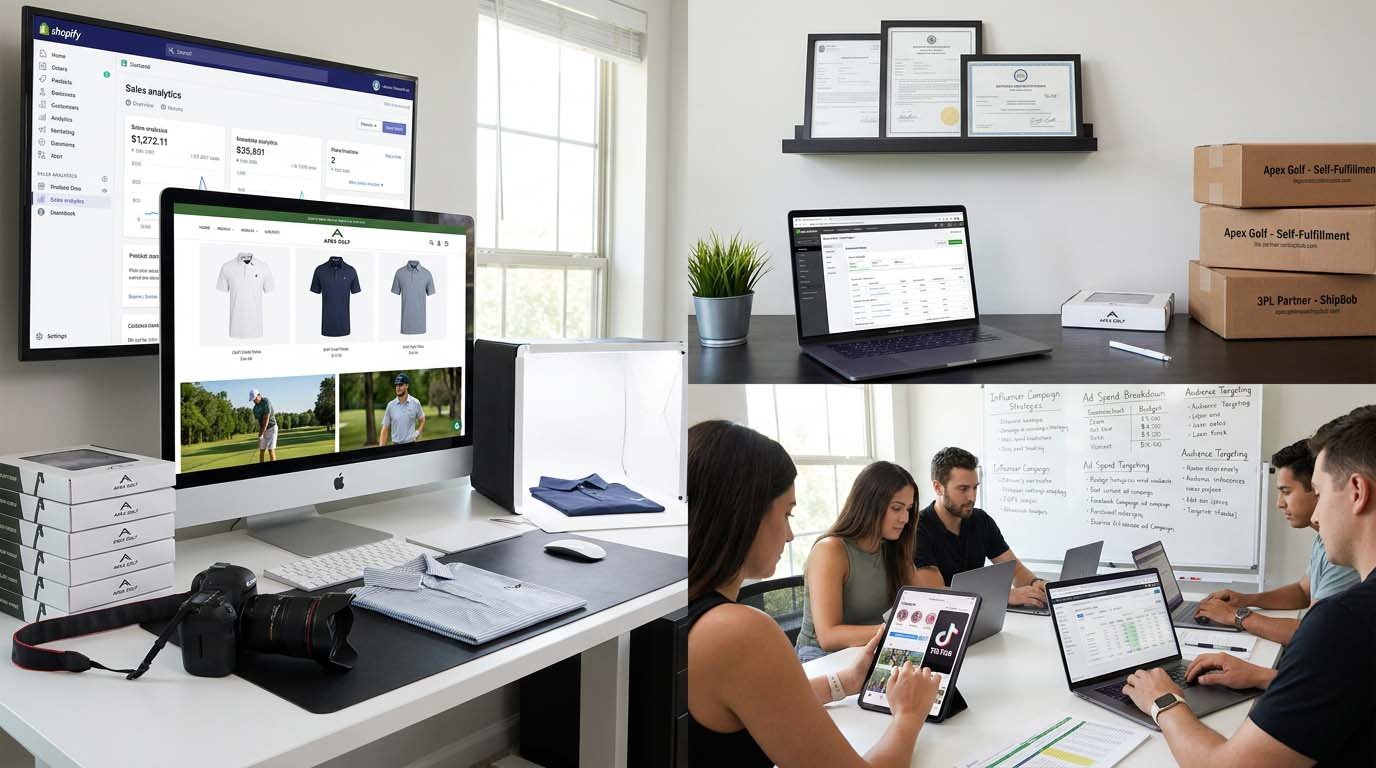
E-commerce Platform and Website
Shopify or similar platform:
$29-$79 monthly for basic to standard plans
$299 monthly for advanced plans with better analytics
Apps and plugins: $30-$150 monthly (email marketing, reviews, inventory management)
Annual total: $700-$2,500
Website design and setup:
DIY with template: $0-$200 (your time investment)
Freelance designer: $500-$2,000
Professional agency: $3,000-$8,000
Domain and hosting: $50-$150 annually
Product photography:
Basic white background shots: $100-$300 per style
Lifestyle/action photography: $800-$2,500 per shoot
Models and location fees: $500-$1,500 per shoot
Marketing and Customer Acquisition
Pre-launch audience building (60-90 days):
Social media content creation: $0-$500 monthly (DIY) or $800-$2,000 (freelancer)
Paid social ads for audience growth: $500-$1,500
Landing page for email collection: $200-$800
Launch week marketing:
Email marketing platform: $20-$100 monthly
Paid advertising budget: $1,000-$3,000 for launch week
Influencer partnerships: $500-$2,000 for micro-influencers
PR outreach: $0-$1,500
First 90-day marketing budget:
Ongoing paid advertising: $1,500-$4,000 monthly
Content creation: $500-$1,500 monthly
Email marketing: $100-$300 monthly
Operations and Tools
Business registration and legal:
LLC formation: $100-$500
Trademark filing: $250-$350 per class
Business insurance: $500-$1,200 annually
Accounting and tax:
Accounting software: $20-$50 monthly
Bookkeeper/accountant: $150-$500 monthly or $1,200-$3,000 annually
Inventory and fulfillment:
If self-fulfilling: packaging materials $500-$1,200, shipping scale and labels $200-$400
3PL fulfillment: $2-$5 per order pick/pack plus storage fees
How Much Do Compliance and Testing Add to Your Budget?
Performance claims require documented validation. Certifications and testing add $1,200-$3,500 to first-year costs but are non-negotiable for wholesale channels and increasingly important for DTC credibility.
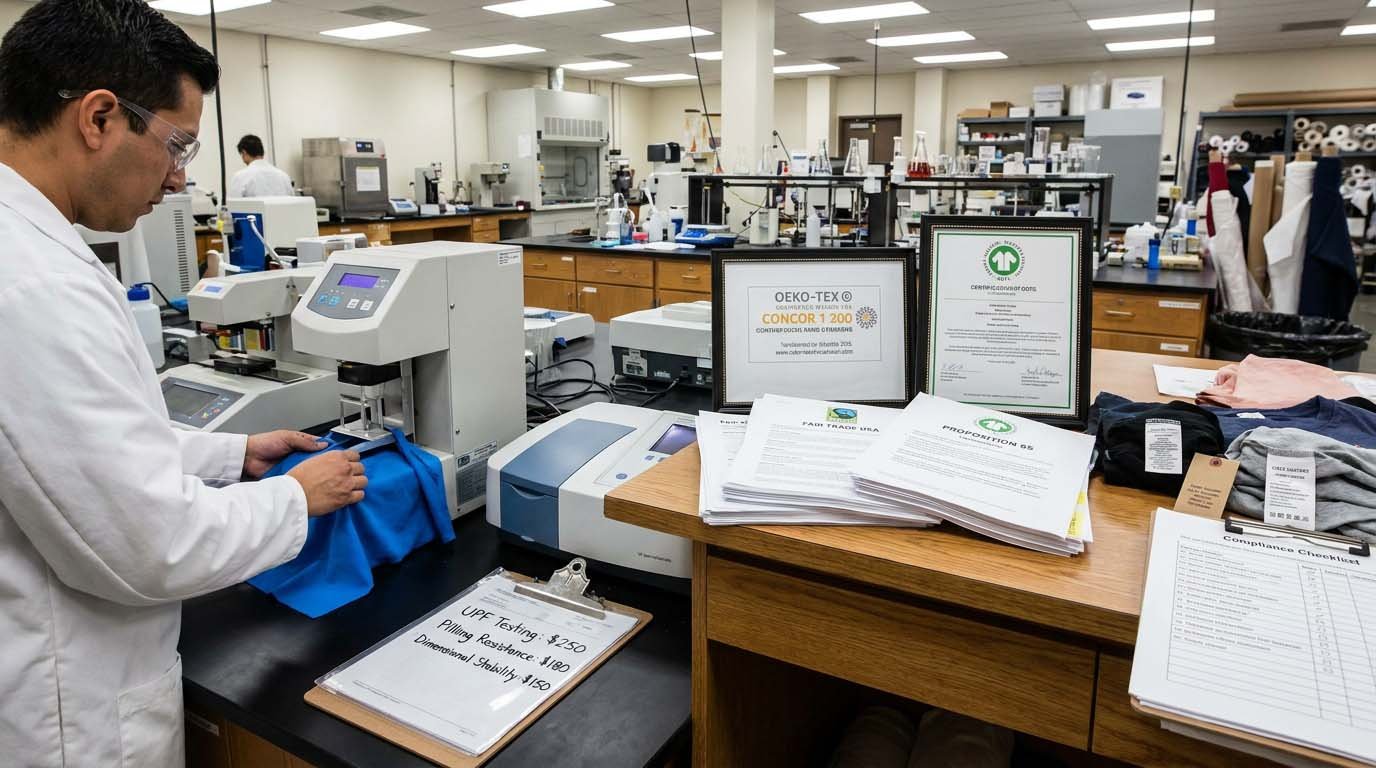
Performance Fabric Testing
Moisture-wicking efficiency:
$150-$280 per fabric type
Tests how fast fabric moves perspiration away from skin
Required if you claim "moisture-wicking" or "quick-dry"
UV protection (UPF rating):
$180-$320 per fabric type
Validates sun protection claims (UPF 30, UPF 50+)
Increasingly important for outdoor athletic apparel
Colorfastness testing:
$120-$220 per colorway
Tests resistance to washing, perspiration, and light exposure
Critical for quality assurance and reducing returns
Shrinkage testing:
$100-$180 per fabric type
Validates dimensional stability after washing
Prevents sizing complaints and returns
Pilling resistance:
$140-$240 per fabric type
Tests fabric durability and surface appearance retention
Important for premium positioning
Certifications and Compliance
OEKO-TEX Standard 100:
$800-$1,500 annually for small brands
Certifies absence of harmful substances in textiles
Often required by wholesale buyers and EU markets
GOTS (Global Organic Textile Standard):
$2,000-$4,000 annually
Required if using organic cotton and marketing organic claims
Supply chain verification and annual audits
Fair Trade or social compliance:
$1,500-$3,500 annually
Required by some retailers
Factory audits and ongoing monitoring
Product testing for retail compliance:
$500-$1,200 for lead, phthalates, and other restricted substances
Required by major U.S. retailers (Target, Nordstrom)
Labeling and Regulatory Compliance
FTC labeling requirements:
No direct cost but requires proper label design
Fiber content, country of origin, care instructions mandatory
Non-compliance risks fines and retailer rejection
California Proposition 65:
$300-$800 for chemical testing per product line
Required warnings if products contain listed chemicals
Increasingly enforced with penalties for non-compliance
I recommend new DTC brands budget $1,200-$2,000 for basic testing and compliance in year one—fabric performance validation and basic chemical testing. Wholesale-focused brands need $3,000-$5,000 to include OEKO-TEX and retailer-required compliance documentation.
What Do Complete Budget Examples Look Like Across Different Launch Strategies?
Real budgets require choosing between capital efficiency (smaller orders, higher per-unit cost, lower risk) and unit economics (larger orders, lower per-unit cost, higher capital commitment). Your growth strategy and risk tolerance determine the right path.
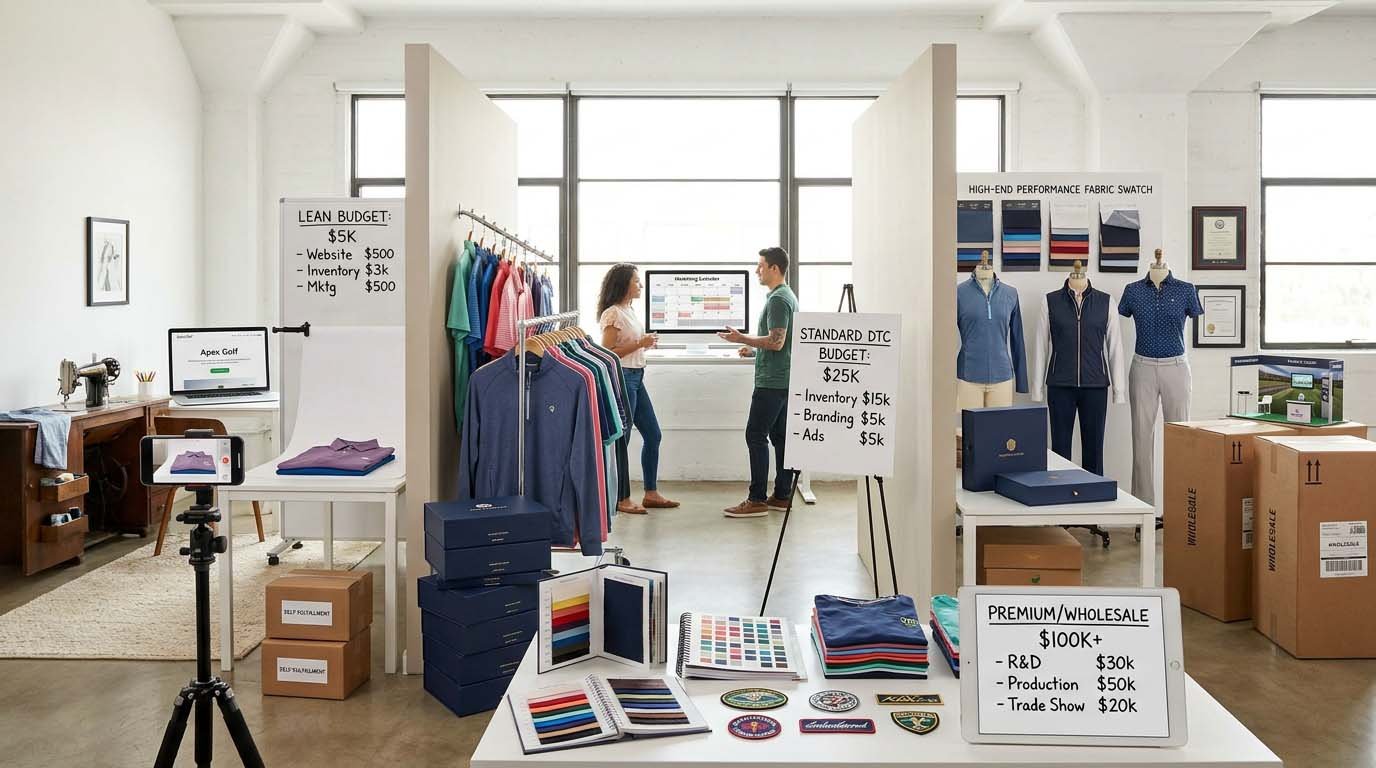
Lean DTC Launch: $8,000-$12,000
Target: Test market with minimal viable product, self-fulfill orders, bootstrap marketing
Production allocation:
- 1 style (performance polo)
- 2 colorways
- 500 total pieces
- In-stock fabric, heat-transfer logo, basic packaging
Development costs: $600-$900
Pattern and sampling: $400-$600
Logo setup: $100-$150
Pre-production samples: $100-$150
Manufacturing costs: $5,500-$7,500
Base garment: $11.00 × 500 = $5,500
Heat-transfer logo: $0.80 × 500 = $400
Basic labels and tags: $0.40 × 500 = $200
Basic polybag: $0.15 × 500 = $75
Total FOB: $6,175
Logistics: $1,100-$1,800
Sea freight: $1.50 × 500 = $750
Customs duty (18%): $1,112
Broker and handling: $250
Landed cost per unit: $16.80
Total production investment: $8,375
Brand and marketing: $1,500-$3,000
Website setup: $500-$1,000
Basic product photos: $300-$600
Initial marketing: $700-$1,400
Total lean launch budget: $9,875-$11,375
Standard DTC Launch: $20,000-$30,000
Target: Professional launch with 2 styles, wholesale-ready quality, moderate marketing
Production allocation:
- 2 styles (polo and quarter-zip)
- 2-3 colorways per style
- 1,000 total pieces (600 polos, 400 quarter-zips)
- Semi-custom fabric selection, embroidered logos, branded packaging
Development costs: $1,800-$2,800
Pattern and sampling: $1,200-$1,800 (two styles)
Logo setup: $300-$500
Pre-production samples: $300-$500
Manufacturing costs: $13,500-$17,000
Polos: $13.50 × 600 = $8,100
Quarter-zips: $16.50 × 400 = $6,600
Embroidered logos: $2.00 × 1,000 = $2,000
Woven labels and tags: $0.60 × 1,000 = $600
Branded packaging: $0.80 × 1,000 = $800
Total FOB: $18,100
Logistics: $3,500-$4,800
Air freight: $3.50 × 1,000 = $3,500
Customs duty (18%): $3,258
Broker and handling: $400
Testing and compliance: $1,200-$1,800
Fabric performance testing: $600-$900
Basic chemical testing: $600-$900
Landed cost per unit: $24.60
Total production investment: $24,600
Brand and marketing: $4,000-$6,000
Professional website: $1,500-$2,500
Product photography: $1,200-$2,000
Launch marketing: $1,300-$1,500
Total standard launch budget: $28,600-$30,600
Premium/Wholesale Launch: $45,000-$60,000
Target: Differentiated positioning, wholesale-ready, multi-channel distribution
Production allocation:
- 3 styles (2 polos, 1 shorts)
- 3-4 colorways per style
- 1,800 total pieces
- Custom fabric development, premium construction, retail packaging
Development costs: $3,500-$5,000
Pattern and sampling: $2,500-$3,500 (three styles)
Logo setup: $500-$800
Pre-production samples: $500-$700
Manufacturing costs: $32,000-$42,000
Premium polos: $18.00 × 1,000 = $18,000
Performance shorts: $22.00 × 800 = $17,600
Premium embroidery: $2.50 × 1,800 = $4,500
Custom labels and packaging: $2.00 × 1,800 = $3,600
Total FOB: $43,700
Logistics: $7,500-$9,500
Air freight: $4.50 × 1,800 = $8,100
Customs duty: $7,866
Broker and handling: $600
Testing and compliance: $3,500-$5,000
Complete fabric testing: $1,500-$2,000
OEKO-TEX certification: $1,200-$1,500
Chemical compliance: $800-$1,500
Landed cost per unit: $31.80
Total production investment: $57,240
Brand and marketing: $6,000-$10,000
Professional website and branding: $3,000-$5,000
Complete photo/video shoots: $2,500-$4,000
Launch marketing and trade show: $2,500-$3,000
Total premium launch budget: $63,240-$67,240
Conclusion
Starting a golf clothing brand in 2026 requires $8,000-$60,000 depending on launch strategy: lean DTC launches need $8,000-$12,000 for 500 pieces in simplified configurations, standard professional launches require $20,000-$30,000 for 1,000 pieces across 2 styles with moderate customization, and wholesale-ready premium launches need $45,000-$60,000 for differentiated products with certifications and retail infrastructure—with hidden costs (packaging, testing, logistics) adding 25-40% beyond base garment pricing.