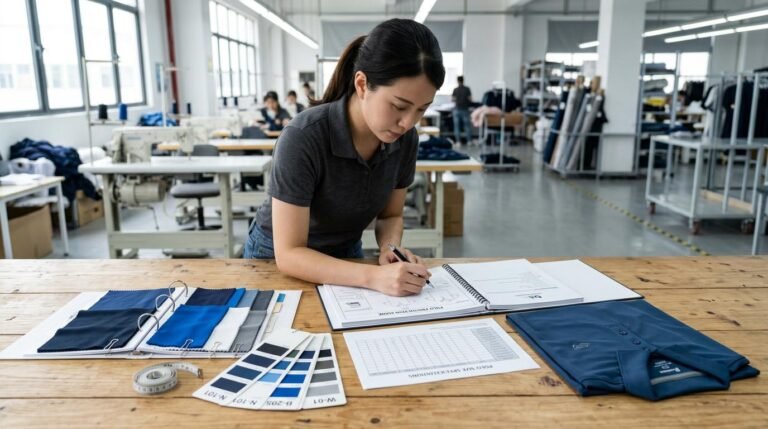
A client sent me a tech pack last week with three requests: low-rise waistband, slim leg profile, and full squat mobility. I had to send it back. Those three requirements create a geometric conflict that no pattern maker can resolve without knowing which one matters most.
Rise, knee point, and hem opening form an interdependent measurement system. Specifying one without considering its effect on the others produces unexecutable patterns or samples that do not match your visual intention. You must define measurement posture, mobility allowance, and tolerance ranges for each point before pattern making begins.
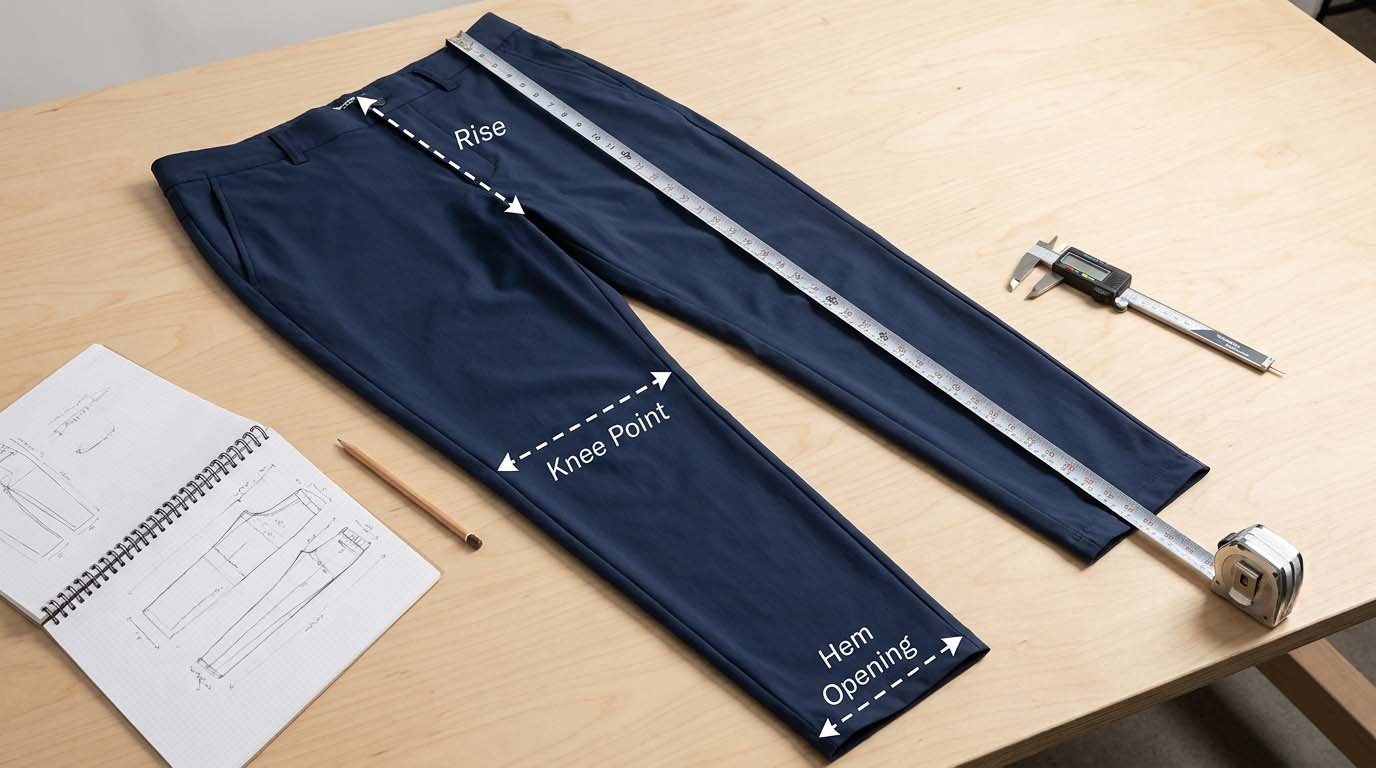
I review tech packs before they go to production. My job is to identify the gaps and conflicts that will cause sampling failures. The most common problem I see is clients describing appearance without specifying the measurements that create it. They say "I want it to look athletic" without defining whether that means narrow hem opening, high knee point, or specific thigh width. A pattern maker cannot execute "athletic"—they need numbers, postures, and tolerance ranges. This guide translates appearance requests into executable specifications.
Quick Answers: Golf Pants Rise, Knee Point & Hem Specs
What is the difference between front rise and back rise?
Front rise measures from the waistband, down through the crotch, to the front waistband at center front. Back rise measures the same path but to the back waistband at center back. Back rise is always longer than front rise to accommodate the curve of the body. The difference between them (typically 5-8cm) controls how the pant sits on the body.
What is a knee point and why does it matter?
The knee point is the horizontal position where the pant leg begins to taper from the thigh width toward the hem. It is measured as a distance down from the waistband or up from the hem. If you specify knee point too low, you get a straight-leg look. Too high, and you get an exaggerated taper that can restrict movement.
What hem opening size works for golf shoes?
It depends on shoe type. Spikeless golf shoes (similar to sneakers) need a minimum 36-38cm hem opening for easy on/off. Spiked shoes with thicker soles and ankle support need 38-40cm. Anything narrower creates a struggle getting the pant over the shoe.
How much ease (extra room) do you need for golf swing mobility?
At minimum, add 4-6cm to the actual body measurement at the seat and 3-4cm at the thigh. This is static ease. For dynamic movement (squat, swing), you may need an additional 2-3cm or a stretch fabric with 5-8% elastane. Without this, the pant pulls tight during the swing.
Can you make a pant both slim-fitting and have full squat mobility?
Yes, but you must specify which measurement creates the "slim" appearance and which provides the mobility. Typically, slim look comes from narrow hem and high knee point. Squat mobility comes from adequate rise depth and thigh width. You cannot make everything tight and expect full movement.
What is the most common measurement conflict you see?
Short rise (under 26cm front) combined with a request for "no visible seam stress during squat." Short rise physically limits how much the fabric can accommodate a deep knee bend. If squat mobility is required, front rise must be at least 27-28cm for most body types.
How do you measure rise correctly?
You must specify the posture. Standing upright with legs together produces one measurement. Standing with a natural stance (slight gap between legs) produces another. If you want the pant to fit during a golf stance (legs apart, slight knee bend), measure in that posture and specify it in the tech pack.
How Do Motion Requirements Shape Golf Pant Patterns?
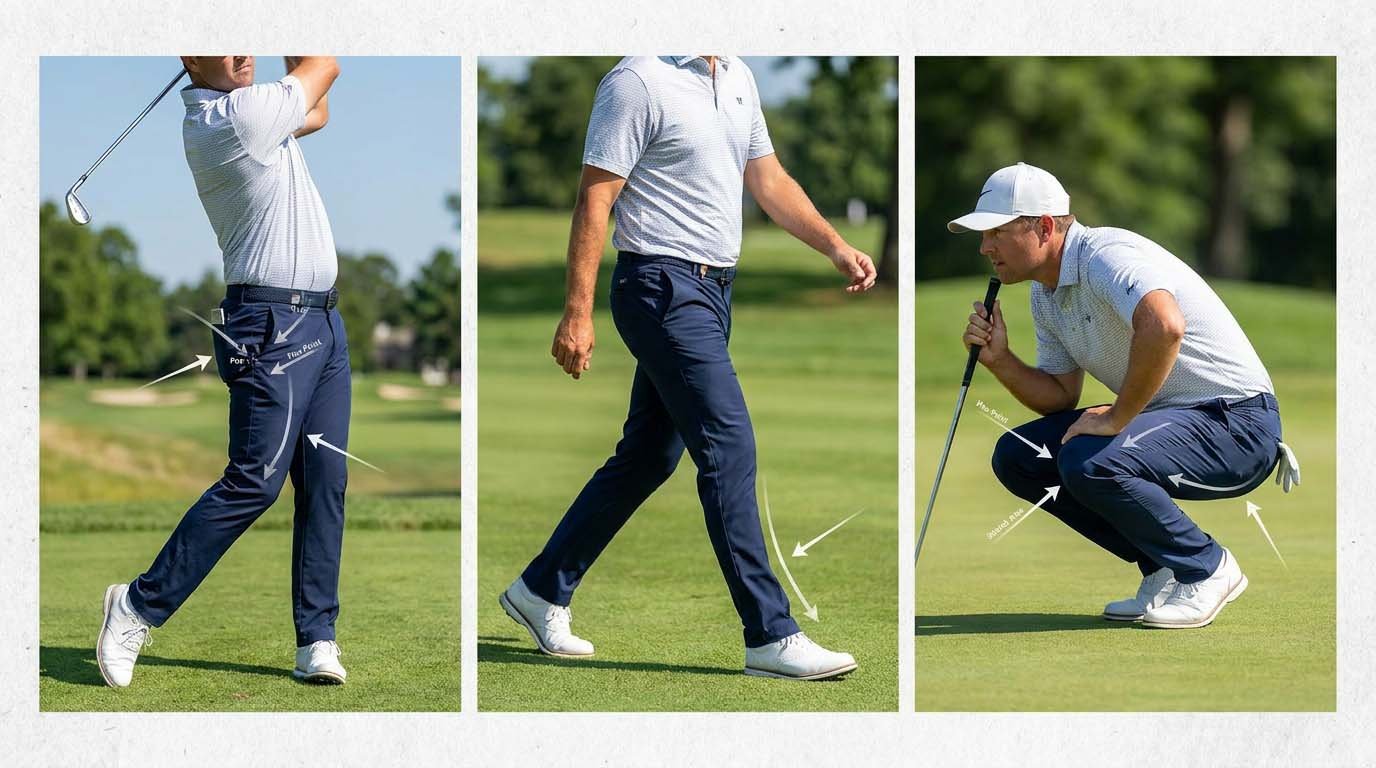
Golf pants must accommodate three motion patterns: the rotational swing (hip and shoulder rotation), the stride (walking 7-10km per round), and the crouch (squatting to read putts and pick up balls). Each motion constrains different measurement points. You must prioritize which motion matters most for your target customer.
The Three Motion Requirements
When I review a tech pack, the first question I ask is: which movement is the priority? Different customers have different needs. A young, athletic golfer doing deep squats on every green needs more mobility than an older recreational player who uses a ball retriever and avoids squatting.
Rotational Swing Motion
The golf swing rotates the hips and torso while keeping the lower body relatively stable. The back leg straightens and the front knee bends. This motion pulls fabric at the back rise and inner thigh on the back leg, and at the front rise and outer thigh on the front leg. If these areas are too tight, the fabric restricts the swing or the seams fail.
From a spec perspective, this motion demands:
- Adequate back rise depth (typically 38-42cm for men's medium)
- Thigh width with at least 4cm ease above the actual body measurement
- Seat width with 5-6cm ease
- Either stretch fabric (5-8% elastane) or additional ease in non-stretch fabric
Stride and Walking
Walking 18 holes means thousands of steps. The pant must not bind at the crotch (fork point) or chafe at the inner thigh. The hem must not catch on shoes or drag on the ground.
Spec requirements:
- Fork length (the distance from the crotch point to the waistband) must be sufficient to prevent pulling when taking a full stride
- Inseam length must be tested with the actual shoes the customer will wear
- Hem opening must clear the shoe without dragging
Crouch and Squat
Squatting to read a putt or pick up a ball requires the most mobility. The knees bend deeply, pulling the front rise and thigh fabric tight. If the rise is too short or the thigh too narrow, the pant rides down or the fabric becomes transparent from stretching.
Spec requirements:
- Front rise minimum 27-28cm (men's medium)
- Additional thigh and knee ease, or articulated knee construction
- Possible gusset at the crotch to add fabric without bulk
Translating Motion Into Spec Priorities
Here is the conflict I explain to clients: you cannot maximize all three motions equally in a single pant without making it baggy. You must rank them.
| Customer Profile | Primary Motion | Secondary Motion | Spec Priority | Common Conflict |
|---|---|---|---|---|
| Young, athletic, competitive | Swing + Squat | Stride | Prioritize rise depth, thigh ease, stretch fabric | Client requests slim leg, which limits ease |
| Recreational, moderate activity | Stride | Swing | Prioritize comfortable fit, fork length | Client requests performance features they do not need |
| Senior, limited mobility | Stride | Minimal squat | Prioritize easy on/off (wide hem), comfort | Client copies athletic pant specs, which create excess fabric |
I see this in tech packs constantly: clients request "full mobility" but also "slim fit." These are not automatically compatible. I send back a questionnaire: which motion is most important? Do you need deep squat capability, or just comfortable walking? The answer changes the specs.
What Are the Critical Measurement Points and How Do You Specify Them?
A tech pack came in with "waist 34 inches" as the only waist measurement. I had to ask: is that the finished garment waist, the wearer's body waist, or the waistband exterior circumference? And where is the waist measured—natural waist or belt line? Same number, three completely different garments.
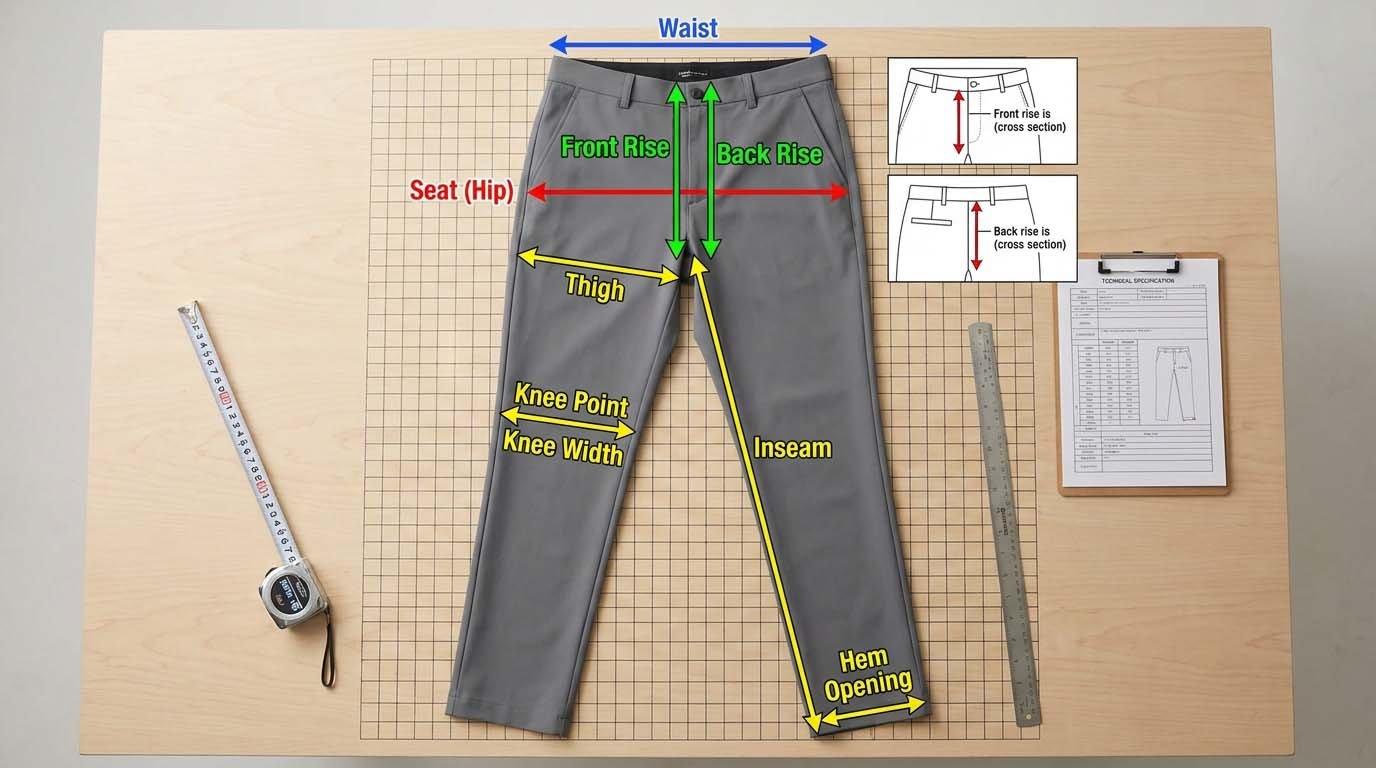
Every measurement point requires three pieces of information: the anatomical or garment location, the measurement posture (flat, on body, in motion), and whether the number is the body measurement or the finished garment measurement with ease included. Missing any of these creates ambiguity.
The Measurement Checklist
When I audit a tech pack, I use a checklist to confirm each measurement has the necessary context. Here are the critical points for golf pants.
Waist
- Location: Natural waist (narrowest point of torso) or belt line (where the pant actually sits, usually 2-3cm below natural waist)
- Posture: Flat lay (garment laid flat, measured across) or on-body (measured around the wearer)
- Ease: Specify if the number is body measurement or finished garment. Finished garment usually includes 2-3cm ease.
- Example conflict: Client specifies "34-inch waist" but does not clarify if that is the wearer's body size or the finished waistband dimension. A 34-inch body needs a 35-36 inch waistband for ease.
Seat (Hip)
- Location: The fullest part of the hips and buttocks, usually 18-22cm down from the waistband
- Posture: Flat lay, measured straight across the pant at the widest point
- Ease: Add 5-6cm to the body measurement for non-stretch fabric, 3-4cm for stretch
- Example conflict: Client measures their sample pant flat and specifies that exact number, forgetting that the original pant was designed with ease already built in. This creates a pant that is too tight.
Front Rise
- Location: From the waistband, through the crotch seam, back up to the front waistband at center front
- Posture: Critical—specify standing, natural stance, or golf stance (legs apart, slight bend)
- Ease: This is a body-following measurement; ease is built into the depth, not added on top
- Example conflict: Client specifies 26cm front rise (a short, modern look) but also requests full squat mobility. These conflict. For squat, front rise needs to be at least 27-28cm.
Back Rise
- Location: From the waistband, through the crotch seam, back up to the back waistband at center back
- Posture: Same as front rise—critical to specify
- Relationship: Back rise is always longer than front rise. The difference (typically 5-8cm) controls the pant's pitch (how it sits on the body). Too small a difference makes the pant feel like it is sliding forward; too large makes it feel like it is pulling back.
- Example conflict: Client specifies front and back rise independently without checking the difference. A 3cm difference is too small for most bodies; a 10cm difference is too large.
Thigh
- Location: Measured across the pant 2-3cm below the crotch point, or at a specified distance down from the waistband (often 8-10cm)
- Posture: Flat lay
- Ease: Add 3-4cm to body measurement for non-stretch, 2-3cm for stretch
- Example conflict: Client requests "slim thigh" without specifying a number. Slim for an athletic build is different from slim for a slim build. I need a target dimension.
Knee Point Position
- Location: This is where the taper begins. It can be specified as a distance down from the waistband (e.g., 60cm down) or up from the hem (e.g., 15cm up)
- Purpose: Controls the visual line of the leg. High knee point (far from the waist) creates a long, straight thigh and short taper. Low knee point creates early taper and a more aggressive slim look.
- Example conflict: Client specifies knee point at 65cm from waist on a pant with a 78cm inseam. This leaves only 13cm for the taper from knee to hem, creating an extreme narrow leg that may not fit over shoes.
Knee Width
- Location: Measured across the pant at the knee point position
- Ease: Should be 2-3cm wider than the knee joint for mobility
- Example conflict: Client specifies narrow knee width for slim appearance but also wants articulated knee construction (a curved seam for mobility). These conflict—articulated knees need extra fabric.
Inseam
- Location: From the crotch seam to the hem, measured along the inner leg seam
- Posture: Flat lay or on-body with shoes
- Shoe consideration: Must be tested with the actual golf shoes to determine correct break (how the pant hem sits on the shoe)
- Example conflict: Client specifies inseam based on their dress pant length, forgetting that golf shoes have thicker soles. The pant ends up too short.
Hem Opening
- Location: The circumference of the pant leg at the hem, measured flat (and then doubled)
- Posture: Flat lay
- Shoe clearance: Minimum 36cm for spikeless, 38cm for spiked shoes
- Example conflict: Client requests 34cm hem for a "modern slim look" but the target customer wears high-top spiked shoes. The pant cannot be put on.
The Spec Sheet Must State Measurement Context
I reject tech packs that only list numbers without context. Here is the format I require:
| Measurement Point | Size M Target | Measurement Method | Posture | Ease Included? |
|---|---|---|---|---|
| Waist | 86cm | Flat lay x 2 | Garment flat, no stretch | Yes, 2cm ease |
| Seat | 108cm | Flat lay x 2 | Garment flat | Yes, 5cm ease |
| Front Rise | 28cm | Tape measure following seam | Natural stance | Built in |
| Back Rise | 40cm | Tape measure following seam | Natural stance | Built in |
| Thigh | 66cm | Flat lay x 2, 3cm below crotch | Garment flat | Yes, 4cm ease |
| Knee Point Position | 62cm | From waist down | N/A | N/A |
| Knee Width | 46cm | Flat lay x 2 at knee point | Garment flat | Yes, 3cm ease |
| Inseam | 81cm | Crotch to hem, inner seam | Garment flat | N/A |
| Hem Opening | 38cm | Flat lay x 2 | Garment flat | N/A |
Without this level of detail, the pattern maker has to guess.
What Are the Spec Ranges for Classic, Athletic and Slim Fits?
A client requested an "athletic fit" tech pack. I asked them to define athletic. They said "not baggy, but not tight." That is not a spec. I sent them three reference ranges—classic, athletic, slim—and asked which measurements matched their vision.
Fit categories are not universal standards—they are relative descriptions. To make them executable, you must specify the actual measurements for key points. Classic, athletic, and slim differ primarily in thigh width, knee point position, and hem opening. Rise depth usually stays similar across fits.
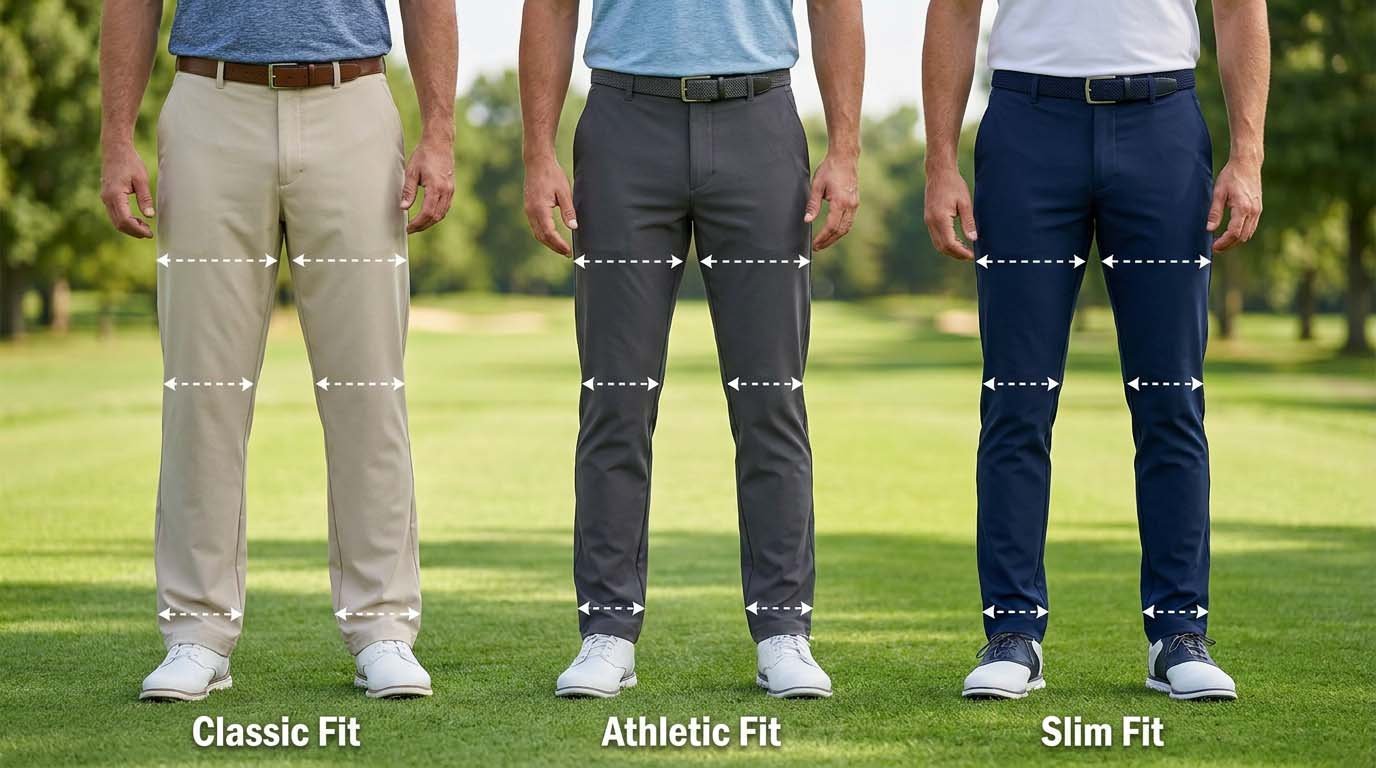
Reference Ranges (Men's Medium, 81cm Inseam)
These are reference examples from projects I have reviewed, not universal rules. Use them as a starting point, then adjust for your specific customer body type and fabric stretch.
Classic Fit (Comfort Priority)
| Point | Target | Notes |
|---|---|---|
| Waist | 86-88cm | Finished garment |
| Seat | 110-114cm | Generous ease for movement |
| Front Rise | 29-30cm | Higher for comfort |
| Back Rise | 41-43cm | Proportional to front |
| Thigh | 68-70cm | Relaxed, minimal restriction |
| Knee Point | 58-60cm from waist | Lower, gentle taper |
| Knee Width | 48-50cm | Generous |
| Hem Opening | 40-42cm | Wide, easy on/off |
Classic fit prioritizes comfort and ease of movement. It is the safest choice for tech pack beginners because the extra ease forgives small measurement errors.
Athletic Fit (Balance of Mobility and Modern Look)
| Point | Target | Notes |
|---|---|---|
| Waist | 84-86cm | Slightly trimmer |
| Seat | 106-110cm | Moderate ease |
| Front Rise | 28-29cm | Moderate |
| Back Rise | 40-42cm | Proportional |
| Thigh | 64-66cm | Fitted but mobile |
| Knee Point | 60-62cm from waist | Higher, more defined taper |
| Knee Width | 46-48cm | Moderate taper |
| Hem Opening | 38-40cm | Fits over most shoes |
Athletic fit is the most requested style I see in tech packs. It requires careful balancing—too tight in the thigh and you lose mobility; too wide at the hem and it looks classic, not athletic.
Slim Fit (Appearance Priority, Requires Stretch)
| Point | Target | Notes |
|---|---|---|
| Waist | 82-84cm | Fitted |
| Seat | 104-106cm | Minimal ease—requires 5-8% elastane |
| Front Rise | 27-28cm | Lower, modern look |
| Back Rise | 39-41cm | Proportional |
| Thigh | 62-64cm | Close to body—stretch fabric required |
| Knee Point | 62-64cm from waist | High, aggressive taper |
| Knee Width | 44-46cm | Tapered |
| Hem Opening | 36-38cm | Minimum for shoe clearance |
Slim fit has the narrowest margin for error. If you request slim fit in a non-stretch fabric, I will flag it immediately. The measurements do not allow enough movement without stretch.
Stretch Fabric Changes the Equation
When a client specifies 5-8% elastane, I reduce ease requirements by 1-2cm at each point. The fabric itself provides the mobility. But I also warn them: stretch fabric can hide fit problems during sampling. A pant that feels fine on a fit model might feel restrictive to a customer with a slightly different body shape.
How Do You Add Mobility Allowances: Ease, Gussets and Articulated Knees?
A client sent a tech pack for a non-stretch pant with the same measurements as their stretch pant line. I sent it back with a note: without elastane, you need to add 2cm at the seat and thigh, or add a gusset at the crotch, or both. The measurements as-is will create a pant that restricts movement.
Mobility in non-stretch or low-stretch fabrics comes from three sources: static ease (extra room built into the measurements), dynamic ease (additional fabric at stress points like the crotch or knee), and articulated construction (curved seams that follow the body's natural motion). You must specify which method you are using.
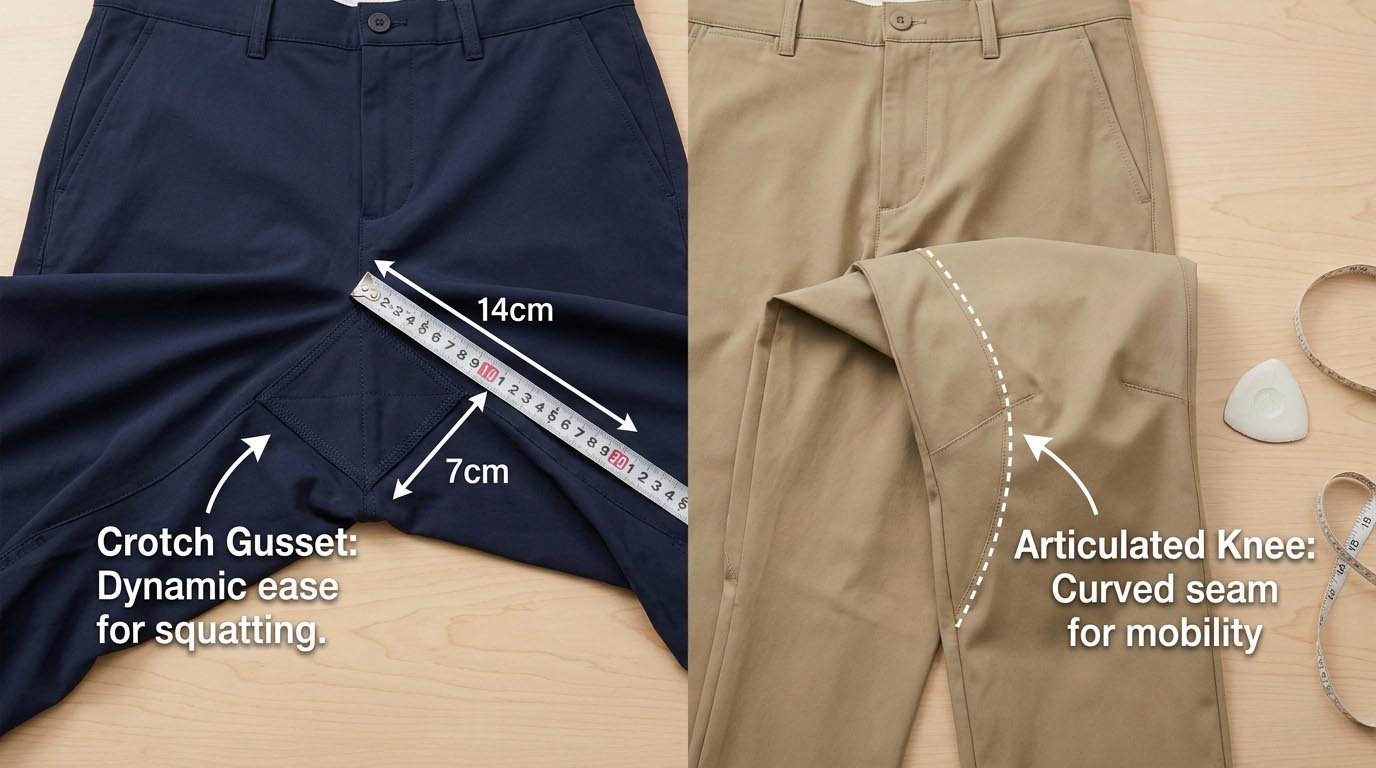
Static Ease vs Dynamic Ease
Static ease is the difference between the body measurement and the finished garment measurement at rest. For example, if the customer's seat measures 100cm, and the pant seat measures 106cm, there is 6cm of static ease.
Dynamic ease is additional fabric that is not visible at rest but becomes available during movement. This is usually achieved through:
- Gussets (a diamond-shaped fabric insert at the crotch that expands during squatting)
- Pleats or darts that release during movement
- Articulated knees (curved seams that pre-shape the fabric to a bent-knee position)
I see clients confuse these. They specify adequate static ease but request full squat mobility. Static ease alone is often not enough. A deep squat can pull an additional 4-6cm of fabric at the seat and thigh. You need dynamic ease for this.
When to Use a Gusset
A gusset adds fabric at the crotch without adding bulk at the waist or hem. It is a good solution when:
- The client requests slim fit but needs squat mobility
- The fabric has minimal stretch (under 3% elastane)
- The rise depth is short (under 28cm front rise)
In tech packs, I specify gusset dimensions separately:
- Gusset length: typically 12-15cm along the inseam
- Gusset width: typically 6-8cm at the widest point
A gusset changes the pattern construction significantly, so it must be specified upfront, not added after sampling.
When to Use Articulated Knees
Articulated knees are curved seams at the knee that pre-shape the pant leg to a bent position. They reduce fabric pull during squatting and make the pant more comfortable for extended crouching.
Articulated knees work best when:
- The customer spends significant time squatting (e.g., reading greens frequently)
- The fabric is structured and does not drape naturally into curves
- The fit is slim and needs every bit of mobility help
The trade-off is appearance. Articulated knees look different—they have a visible curve even when the leg is straight. Some customers love this performance look; others think it looks odd. I always confirm with the client before specifying articulated construction.
How Do You Spec Hem Opening for Golf Shoes and Break?
Hem opening must be sized for the thickest golf shoe the customer will wear, plus 1-2cm clearance. Inseam length must be tested on-body with shoes to determine the correct break—how the pant hem sits on the shoe. Flat-lay measurements do not account for fabric drape or shoe interaction.
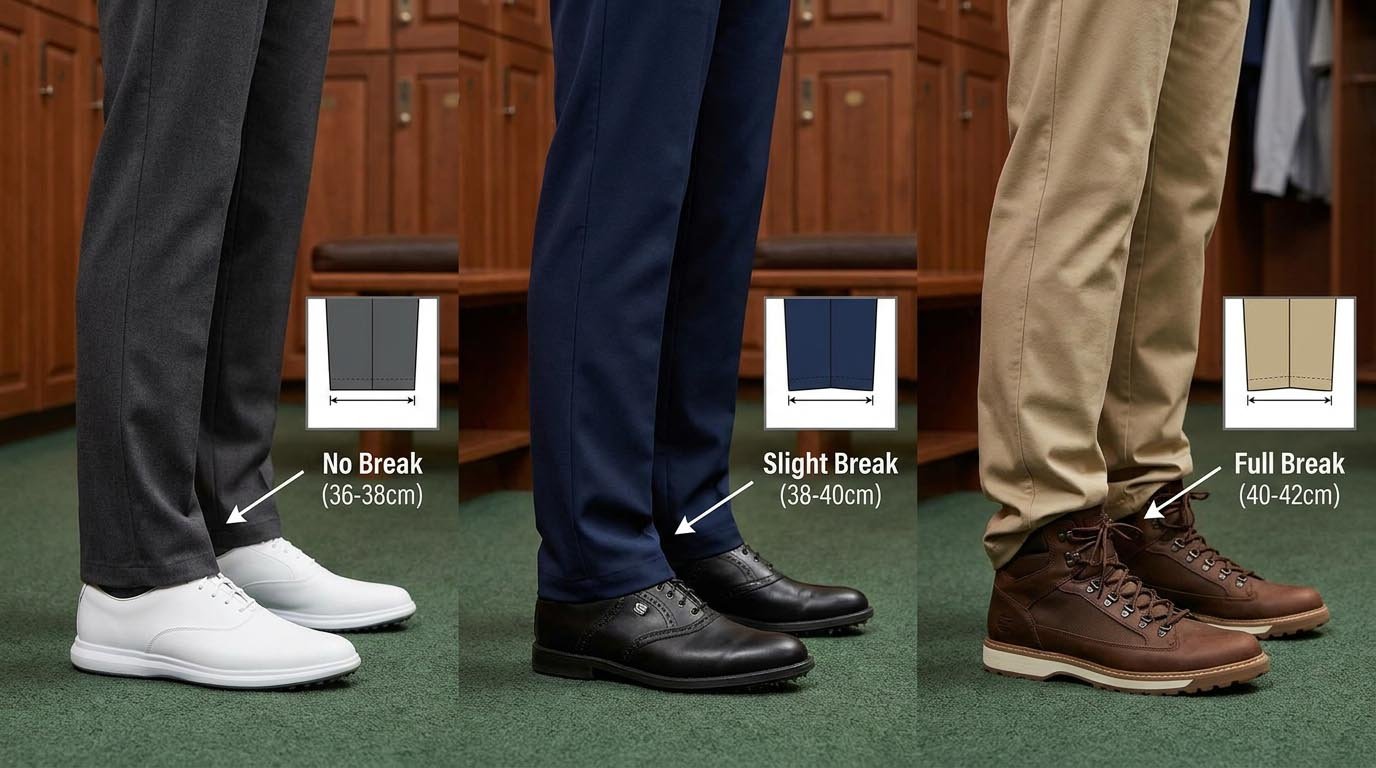
Shoe Type Dictates Minimum Hem Opening
I ask every client to specify the shoe type their customer wears. This determines the minimum hem opening.
| Shoe Type | Minimum Hem Opening | Reason |
|---|---|---|
| Spikeless (sneaker-style) | 36-38cm | Similar to athletic shoes |
| Low-cut spiked | 38-40cm | Thicker sole, wider toe box |
| High-top or boot-style | 40-42cm | Ankle height requires clearance |
| Orthotics or wide-fit | 40-42cm | Extra width and height |
If the client requests a hem opening below these minimums, I flag it as a potential issue. The customer will struggle to put the pant on, or they will stretch the hem permanently, distorting the shape.
Break and Inseam Testing
Break is the amount of fabric pooling or folding where the pant hem meets the shoe. Golf pants typically use one of three breaks:
- No break: The hem just touches the top of the shoe with no excess fabric. Clean, modern look. Requires precise inseam length—too short looks like you outgrew the pant.
- Slight break (quarter break): A small fold or crease at the front of the pant where it touches the shoe. Most common for golf pants. Forgives small inseam errors.
- Full break: Significant fabric pooling on the shoe. Traditional, conservative look. Less common in modern golf pants.
The problem I see in tech packs: clients specify inseam length in flat lay without testing it on a body with shoes. Fabric drapes differently when worn, and shoes add height. An 81cm inseam flat might become a no-break on one shoe and a slight break on another.
I require clients to test inseam length on a fit model wearing the target shoes, then adjust the spec based on the desired break. This cannot be done flat.
How Do You Grade Sizes and Set QC Tolerances?
Grading is the process of scaling a base size into a full size run. Not all measurement points increase by the same amount per size. Rise depth increases slowly (about 1cm per size), while waist and seat increase more (about 4-5cm per size). You must specify grading rules or review the graded spec sheet before production.
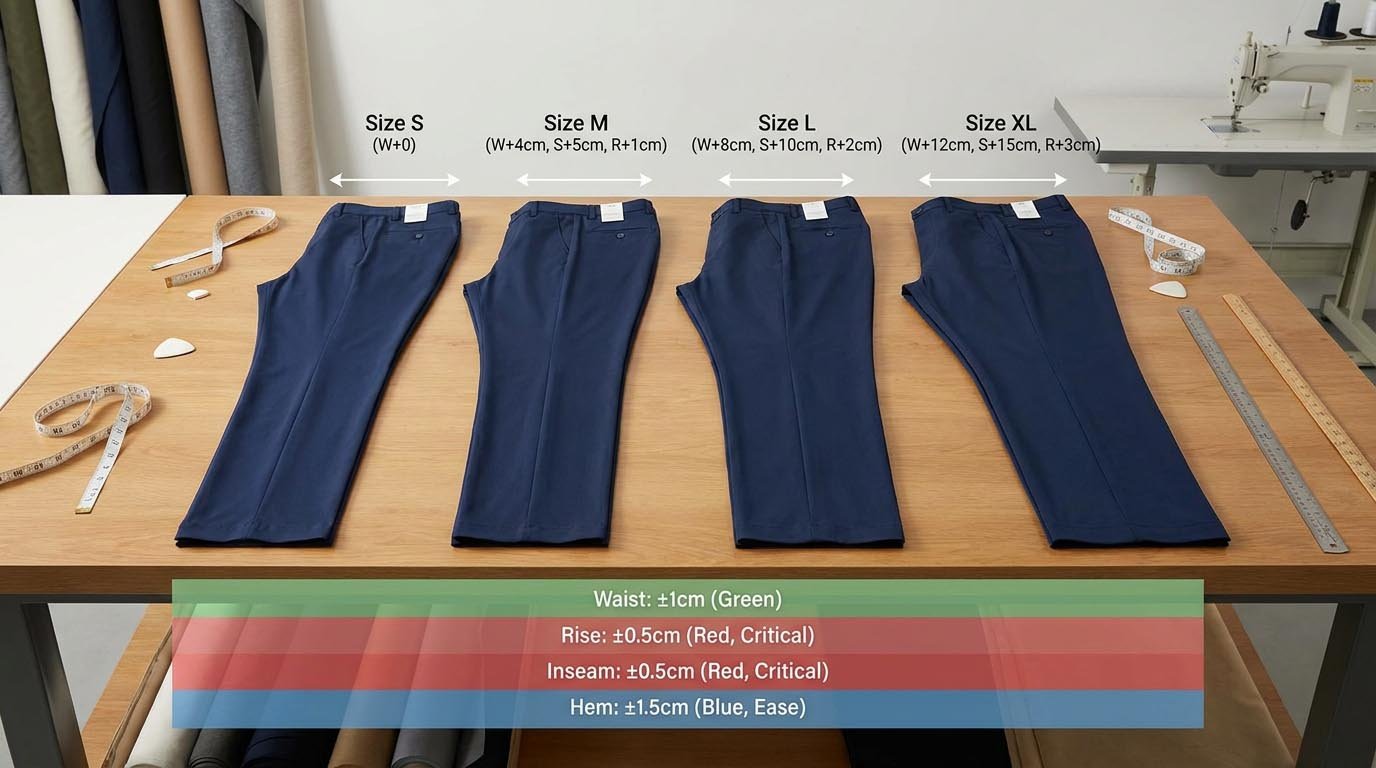
Standard Grading Increments (Reference Only)
These are typical grading increments I see in golf pant projects. They are not universal rules—body proportions vary by region and demographic.
| Measurement | Size S to M | Size M to L | Size L to XL | Notes |
|---|---|---|---|---|
| Waist | +4cm | +4cm | +4cm | Consistent increase |
| Seat | +5cm | +5cm | +5cm | Consistent, slightly more than waist |
| Front Rise | +1cm | +1cm | +1cm | Slow increase—rise does not grow proportionally with body size |
| Back Rise | +1cm | +1cm | +1cm | Same as front |
| Thigh | +3cm | +3cm | +3cm | Moderate increase |
| Knee Width | +2cm | +2cm | +2cm | Slower than thigh |
| Inseam | +2-3cm | +2-3cm | +2-3cm | Some brands use a single inseam for multiple sizes |
| Hem Opening | +1-2cm | +1-2cm | +1-2cm | Minimal increase to maintain proportions |
The key insight: rise depth grows much slower than width measurements. A size XL does not need twice the front rise of a size S, but it does need nearly twice the waist width.
QC Tolerances
Every spec must include a tolerance range—the acceptable deviation from the target measurement. A tolerance of ±1cm at the waist means the finished garment can measure 85-87cm if the target is 86cm.
I set tolerances based on the measurement's impact on fit. Critical measurements (rise, inseam) get tighter tolerances (±0.5cm). Less critical measurements (hem opening) get looser tolerances (±1.5cm).
Conclusion
Rise, knee point, and hem opening are not isolated numbers—they constrain each other. Specify each measurement with its posture, ease, and tolerance. Prioritize which motion matters most, and test samples on-body with the actual shoes. The tech pack is a communication tool, not a wish list.