
You've finally landed on the perfect name for your new golf apparel brand. But what if a legal letter arrives on launch day, telling you to cease and desist?
Choosing a brand name is a risk-control process, not just a creative one. The correct sequence is crucial: brainstorm distinctive names, conduct trademark and common-law searches, verify domain and social handle availability, and only then invest in design and legal filing.
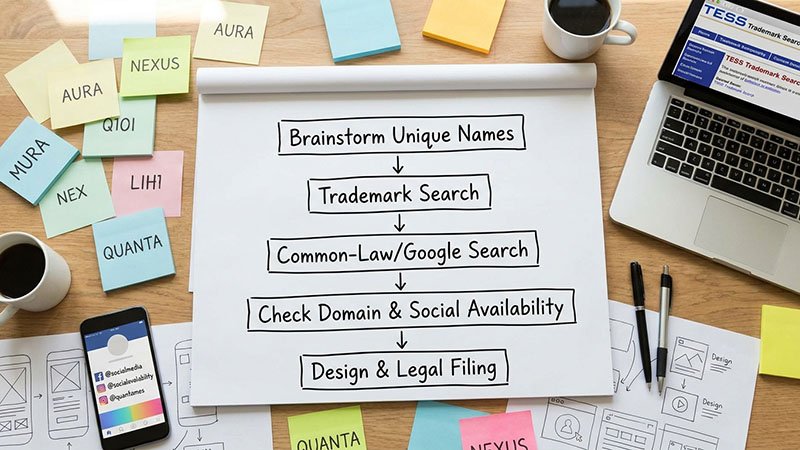
In my years of helping new brands get off the ground, I've seen the same heartbreaking mistake over and over. A founder falls in love with a name, buys the domain, prints labels, even gets samples made. Then they discover the name is already trademarked. Everything has to be scrapped. It's a costly and demoralizing setback. Brand naming is not a creative exercise; it's a sequential task. Getting the order wrong is the single most expensive mistake you can make at this stage. This guide will walk you through the right sequence to build a brand name that is strong, memorable, and legally defensible.
What Are the Quick Answers on Names, Trademarks, and Domains?
| Question | Quick Answer |
|---|---|
| Can I use TM before registration? | Yes. In most countries, "TM" can be used for an unregistered trademark to claim rights. The "®" symbol, however, can only be used after your trademark is officially registered by the government. |
| Is Class 25 enough for my brand? | Class 25 is essential as it covers clothing, including golf shirts and hats. As you grow, you may need to file in related classes like Class 18 (bags), Class 28 (golf balls, gloves), or Class 35 (retail store services). |
| Are golf terms like “PAR” or “BIRDIE” safe? | These are generally weak and risky. They are descriptive and the trademark landscape is incredibly crowded with them. Your chances of getting a registration and defending it are low. Aim for more distinctive names. |
| Can I use “Masters”, “PGA”, or club/player names? | Absolutely not without a license. These are highly protected trademarks and names with publicity rights. Using them is a fast track to a legal battle you can't win. |
| How deep should my initial search be? | Before hiring a lawyer, do a "knockout search" yourself. Check trademark registries, Google, major online marketplaces (like Amazon), and domain/social handle availability. This will eliminate 90% of problematic names. |
| Do I absolutely need the .com domain? | The .com is the gold standard. If it's taken, strong alternatives include a country-specific domain (like .ca or .co.uk), the new .golf domain, or adding a short, clean modifier like [brand]golf.com. |
| What if my Instagram handle is taken? | If it's an active competitor, the name is likely a no-go. If it's a dormant account, you can try adding a clean modifier like [brand]golf, [brand]wear, or [brand]official. Avoid using too many underscores or numbers. |
| Should I file the word mark or logo first? | Always file the word mark first if you can. It protects the name itself, regardless of how it's styled. It gives you the broadest protection. You can file a separate application for your logo (the design mark) later. |
| Legal Disclaimer | This guide is for educational purposes only and is not legal advice. Trademark laws are complex and vary by country. You must consult a qualified trademark attorney for advice specific to your situation. |
What Makes a Good (and Safe) Golf Brand Name?
You want a name that sounds cool and connects with golfers. But how do you balance creativity with the legal need for the name to be defensible and unique?
The best names are distinctive, not descriptive. They are easy to say, spell, and remember, and they don't have negative meanings in other languages. Your goal is to find a name that stands on its own, away from the crowded field of generic golf terms.

The first step is brainstorming, but you need to do it with the right framework in mind. A trademark examiner will evaluate your name based on a "distinctiveness spectrum." Understanding this will save you from falling in love with a name that is legally weak.
The distinctiveness spectrum—generic, descriptive, suggestive, arbitrary, fanciful
- Generic (Unprotectable): Calling your brand "Golf Shirt." These are common words for the product itself and can never be trademarked.
- Descriptive (Weak): Names like "Quick-Dry Golf" or "Fairway Fashion." They describe a quality or aspect of the product. They are very difficult to trademark unless they acquire "secondary meaning" over many years. Avoid these.
- Suggestive (Good): Names that hint at a benefit without directly describing it. Think of a name like "SwingFlow" or "Apex Wear." It suggests smooth movement and high performance. This is a great category to aim for.
- Arbitrary (Strong): Using a real word that has no connection to golf apparel. The classic example is Apple for computers. For golf, this could be a name like "Anchor Golf" or "Oasis Golf Co."
- Fanciful (Strongest): A completely made-up word, like "Kodak" or "Exxon." For golf, this might be something like "Zentee" or "Rova." These are the easiest to trademark but can be harder to market initially as they have no inherent meaning.
Golf vocabulary pitfalls—overused terms and rights-protected names
Avoid the temptation to use common golf slang like "Birdie," "Par," "Ace," or "Links." These words are overused, and the trademark space is saturated. You will spend a fortune on legal fees trying to carve out a space. Also, stay far away from the names of famous tournaments ("The Masters," "The Open"), organizations ("PGA," "USGA"), or players.
Linguistic checks—pronunciation, negative meanings, easy spelling
Before you commit, say the name out loud. Is it easy to pronounce? Is it easy to spell after hearing it once? Run the name through Google Translate to check for negative or embarrassing meanings in other major languages, especially if you have international ambitions.
Internationalization—transliteration and country risk screens
If you plan to sell in markets like China or Japan, consider how your name will be transliterated. Does the sound of your brand name translate into characters with a positive or negative meaning? A quick check now can prevent a major rebranding headache later.
Style directions—modern, heritage, performance; shortlists and rules
What is the personality of your brand? Is it modern and technical, classic and heritage-inspired, or bold and rebellious? Your name should reflect this. Create shortlists of names for each style direction to see which one feels most authentic to your vision.
How Do You Actually Clear a Trademark?
You've got a great name that feels distinctive. How do you check if it's legally available before you invest any more time or money into it?
Trademark clearance is a multi-step search process. You must check for "likelihood of confusion" with existing trademarks in Class 25 (apparel) and related classes, looking not just for exact matches but for similar-sounding and similar-looking names.
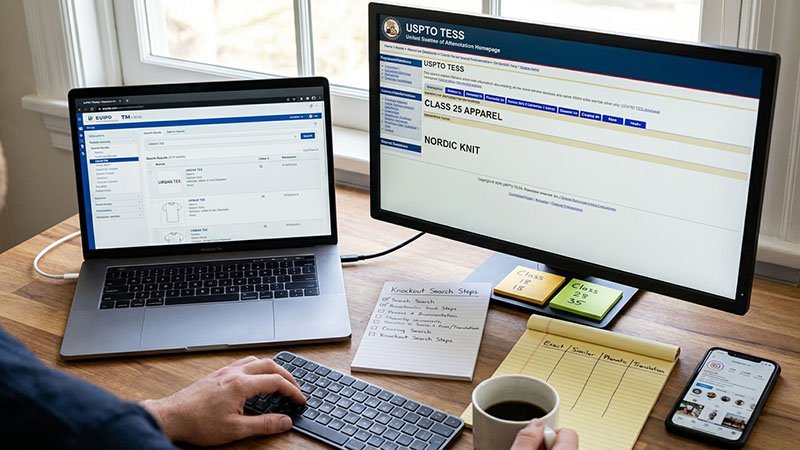
This is the most critical stage. A thorough search can feel tedious, but it is infinitely cheaper than a lawsuit. The core legal test is "likelihood of confusion." An examiner or a court will ask: Would a typical consumer be confused into thinking your brand is affiliated with an existing brand?
Nice Class 25 scope and adjacent classes (18/28/35)
Your primary focus is Nice Classification Class 25, which covers all clothing, footwear, and headwear. However, your search should also dip into adjacent classes where a golf brand might expand: Class 18 (leather goods, like golf bags), Class 28 (sporting goods, including golf clubs, balls, and gloves), and Class 35 (retail services). A clothing brand named "Apex" and a golf ball brand named "Apex" could still be found confusingly similar.
Likelihood of confusion factors—similarity, goods, channels, fame
An examiner looks at several factors. How similar are the names in appearance, sound, and meaning? How related are the goods or services? Would they be sold in the same channels (e.g., a pro shop)? Is the existing mark famous? This is where many founders get tripped up. They search for "EliteFit Golf" and find nothing. But they fail to see the dozen other registered marks that use the word "Elite" for athletic apparel. An examiner would likely see your brand as just another "Elite" brand, creating a likelihood of confusion.
Knockout search steps—exact, similar, phonetic, translations
Your initial search should be broad.
- Exact Match: Search for your exact name.
- Similar Variations: Search for common misspellings and variations.
- Phonetic Equivalents: Search for names that sound the same but are spelled differently (e.g., "Fore" vs. "Four").
- Translations: Search for the English translation of any foreign words in your name.
Common-law sweep—web, marketplaces, social, media mentions
A trademark doesn't have to be registered to have rights. "Common-law" rights can be established simply by using a name in commerce. Therefore, your search must go beyond the official databases. Google your proposed name. Search for it on Amazon, Etsy, Instagram, and TikTok. Look for any other business using a similar name for similar products.
Design/logo search—image-based, Vienna codes; disclaimers
If your logo is a key part of your brand, you or your attorney will also need to search for visually similar designs. This is more complex and often involves searching by design codes (like the Vienna Classification system) that categorize visual elements (e.g., "birds," "circles," "crowns").
What Tools and Workflow Should You Use for Your Search?
The idea of searching global databases seems overwhelming. What is a practical, step-by-step workflow, and which free tools can you use to perform a solid initial search?
Create a systematic workflow. Use free government databases like USPTO's TESS and WIPO's Global Brand Database. Be methodical, use search wildcards, and document every single result with screenshots in a dedicated folder for each name you vet.

Think of yourself as a detective building a case file for each potential name. Your goal is to gather enough evidence to decide if the name is a "go" (low risk), a "no-go" (high risk), or an "amber" (needs a lawyer's opinion).
Registries to check—USPTO, EUIPO/TMview, WIPO Global Brand DB, UKIPO, CNIPA
These are your primary targets and are all free to use.
- USPTO (United States): Use their TESS database to search for US trademarks.
- EUIPO / TMview (European Union): TMview is a fantastic tool that searches the registries of all EU member states and many other international offices at once.
- WIPO Global Brand Database (International): This searches marks filed through the international Madrid System.
- National Offices: Also check the individual offices of your other key markets, like the UKIPO (UK) or CNIPA (China).
Query tactics—wildcards, truncation, stems, look-alikes
Don't just search for the exact name. Use the search operators the databases provide. For example, in TESS, a dollar sign ($) is a wildcard. Searching for SWING$ will find "Swing," "Swings," and "Swinger." This helps you find variations you might have missed.
Evidence logging—screenshots, dates, goods IDs, counsel notes
For every search you run, take a screenshot. Save it in a folder for that specific name. Note the date of the search. If you find a conflicting mark, save a screenshot of its details, especially the list of goods and services it covers. This organized file will be incredibly valuable when you eventually talk to a trademark attorney.
Risk scoring—red/amber/green and go/no-go gates
After your search, assign a risk level to each name.
- Red (No-Go): An identical or very similar mark already exists for clothing. Abandon this name.
- Amber (Consult Counsel): A similar mark exists, but it's for a slightly different product, or the name is not identical. This requires a professional legal opinion.
- Green (Go): Your thorough search revealed no significant conflicts. This name can proceed to the next step.
Professional searches and watch services
While your initial search is crucial, for your final chosen name, it is highly recommended to have a trademark attorney conduct a professional, comprehensive search. After you file, you can also subscribe to a "watch service" that will notify you if someone later tries to register a name similar to yours.
How Do You Secure Your Digital Identity?
You've found a name that seems clear from a trademark perspective. Now, how do you lock down your brand's presence online before someone else does?
Your digital identity—your domain and social media handles—must be secured immediately after your name clears the initial trademark search. Aim for perfect consistency across all platforms, and have a backup plan if your first-choice handle is taken.
This is another area where the correct sequence is vital. Do not buy the domain name until you have done your trademark knockout search. But once you have a "green light" name, you must act fast. Securing your digital assets is a race.
Domain patterns—.com first, .golf/.co/.io backups; short modifiers
The .com is still the most trusted and recognized domain extension. This should always be your first choice. If yourbrand.com is taken but available for purchase on the aftermarket, it might be worth the investment. If not, consider strong alternatives:
yourbrand.golfyourbrand.coyourbrandapparel.com
Availability checks—WHOIS, registrars, aftermarket, trademarks names
Use a domain registrar like GoDaddy or Namecheap to check availability. If it's taken, do a WHOIS search to see who owns it and when it expires. Sometimes you can acquire it if it's about to expire or by negotiating with the owner through a service like Sedo or Afternic.
Handle checks—Namechk, platform searches; consistency rules
Use a tool like Namechk.com. It will instantly search for your brand name's availability across dozens of social media platforms. Your goal is to have the exact same handle on Instagram, TikTok, Facebook, Pinterest, and X (Twitter). This consistency makes it easy for customers to find you.
Acquisition and disputes—negotiation, escrow, UDRP, platform claims
If a domain or handle you need is held by a "squatter" (someone who registers it in bad faith), you have options. You can try to negotiate a purchase, always using an escrow service to handle the transaction safely. For domains, you might be able to file a UDRP (Uniform Domain-Name Dispute-Resolution Policy) complaint. For social media, you can report impersonation accounts to the platform.
Security and hygiene—DNS/SSL, WHOIS privacy, DMARC, squatters watch
Once you own your domain, secure it. Install an SSL certificate (to get the https:// and padlock). Enable WHOIS privacy to protect your personal information. Set up email authentication (DMARC) to prevent spoofing. And keep an eye out for anyone trying to register similar-sounding domains to confuse your customers.
What's the Plan for Filing and Protecting Your Trademark?
You've cleared your name, secured your domains and handles, and you're ready to make it official. What is the actual process for filing a trademark application and protecting your brand long-term?
File for your word mark first to get the broadest protection. Choose the right filing basis (in use vs. intent to use), and consider your international strategy early. Once registered, use the ® symbol correctly and actively monitor for infringers.
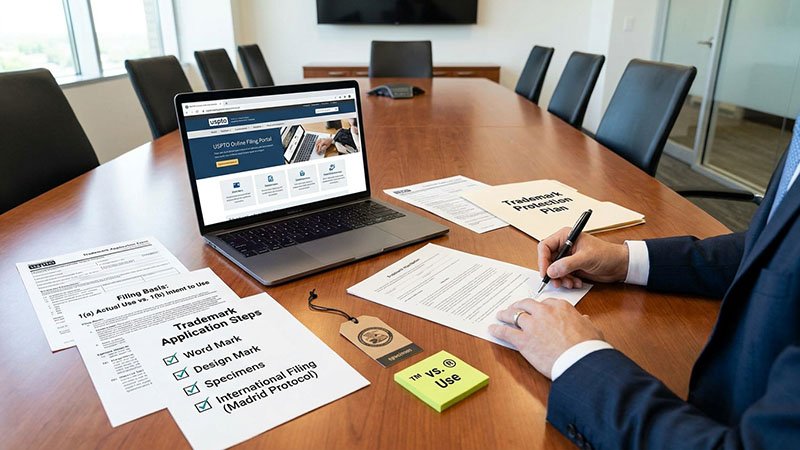
Filing a trademark application is a formal legal process. While you can do it yourself, working with a trademark attorney is highly recommended to avoid common mistakes that can lead to rejection or weaker protection.
Word vs design marks; when to file each
As mentioned, your word mark is your top priority. It protects the name itself. File this as soon as you are confident in the name. You can file for your design mark (logo) later, once your visual identity is finalized. Filing them separately gives you more flexibility to update your logo in the future without losing the rights to your brand name.
US filing—1(a)/1(b), specimens, IDs, office actions basics
In the US, you will file on one of two bases:
- 1(a) "In Use": You are already selling products with the name on them. You must submit a "specimen" (like a photo of a hangtag or website) as proof.
- 1(b) "Intent to Use": You plan to use the name but haven't started selling yet. This lets you reserve your spot. You will have to file a "Statement of Use" with a specimen later.
After you file, an examiner may issue an "Office Action" asking for clarification or raising an issue. This is a normal part of the process.
International routes—Madrid Protocol vs national filings, priority
If you plan to sell internationally, you have two main paths. You can file separate applications in each country, or you can use the Madrid Protocol. This system allows you to file one application in your home country and then extend that protection to any of the 130 member countries.
Using TM and ® correctly; false-marking risks
Use TM (for trademark) or SM (for service mark) next to your name at any time to signal that you claim it as your brand. Only use the ® symbol after the trademark has been officially granted by the government. Using the ® symbol prematurely is illegal and can jeopardize your rights.
Maintenance, watches, enforcement, coexistence agreements
A trademark is not a "set it and forget it" asset. You must periodically file maintenance documents and fees to keep it active. You also have a duty to "police" your mark—actively watch for and take action against others who use a confusingly similar name. Sometimes, this can result in a "coexistence agreement" where two parties agree on how to use their similar marks without confusing customers.
How Do You Make the Final Decision and Launch?
You've researched several names and are facing a decision. How do you objectively choose the best one and ensure a smooth, legally-compliant launch?
Use a decision matrix to score your final candidates on legal risk, memorability, and digital availability. Before launch, get final legal sign-off, lock down all assets, and create a brand guide for consistent use of your new trademark.

This is the final gate. All your research comes together to inform one critical choice. Being systematic here will give you the confidence to invest fully in your chosen name.
Score candidates—legal risk, memorability, SEO, domain/handle fit
Create a simple spreadsheet to score your top 2-3 names. Create columns for criteria like:
- Legal Risk: (Low, Medium, High) - based on your searches.
- Memorability: (Easy, Medium, Hard) - how easy is it to remember and spell?
- SEO Potential: Does the name have search potential?
- Domain/Handle Fit: How close were you able to get to the exact match?
This scoring will often make the best choice obvious.
Legal sign-off—counsel review, searches archived, approvals
Before you pull the trigger, have your trademark attorney review your final choice and the search evidence you've gathered. Archive all your search screenshots and notes. Get their formal "green light" before proceeding.
Lock assets—domains, handles, email, app names; brandbook
The moment you have the legal go-ahead, purchase the domains and register all social media handles. Set up your yourname@yourbrand.com email addresses. Create a simple brand guidelines document (brand book) that shows the correct logo, colors, and fonts.
Content and labels—logo usage, ™/® placement, packaging, web
Ensure all your launch materials use the new trademark consistently. Decide where you will place the TM symbol on your hangtags, packaging, and website footer. This reinforces your claim from day one.
Post-launch monitoring—watch lists, impersonation, renewals
Your work as a brand guardian has just begun. Set up watch services or regular Google Alerts for your name. Periodically search for impersonation accounts on social media. And most importantly, set a calendar reminder for your trademark renewal deadlines, which are typically between the 5th and 6th years, and then every 10 years after that.
Conclusion
Choosing a name for your golf apparel brand is a foundational business decision, not an art project. By following a disciplined sequence of creative brainstorming, rigorous searching, and strategic filing, you build an asset that is not only memorable but legally sound and ready for growth.
Notes
This guide is not legal advice. Trademark laws vary by jurisdiction; consult qualified counsel before filing or enforcing rights.