
I get calls every month from brands whose women's polos are flooding back with fit complaints. The chest pulls, the sides ride up, or customers say it "fits like a men's shirt." Most think they just need better patterns, but the real problem runs deeper.
Women's golf polo fit depends on matching your bust contouring method—darts, zoned stretch panels, or hybrid construction—to your target body types, fabric choice, and production budget. There is no single "correct" technique, only the right approach for your specific customer and constraints.
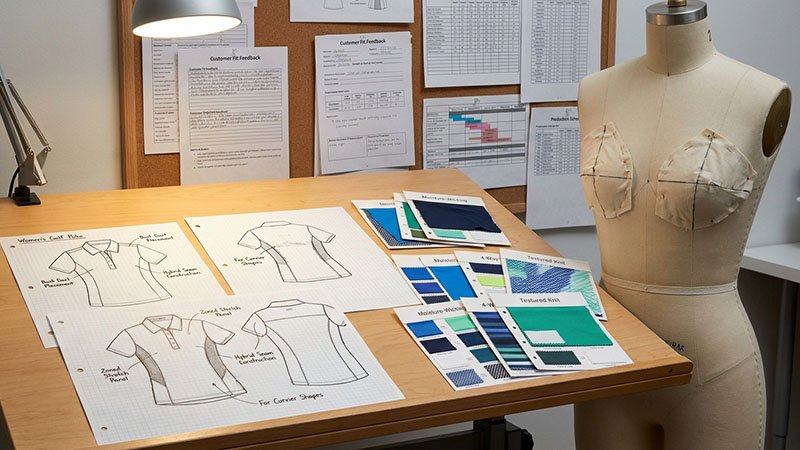
I started working with women's golf apparel five years ago. Back then, I thought fit was just about following measurement charts. A brand sent us a spec sheet for sizes XS through XL and asked why their samples fit well on the fit model but got terrible reviews from real customers. That project taught me that designing women's polos is about understanding who will actually wear the shirt, not just hitting numbers on paper.
Quick Answer: Bust Contouring, Zoned Stretch & 3D Fit Explained
Can you use the same contouring method across all sizes?
Not effectively. Bust contouring that works for size 2-8 often fails at size 12-16 because body proportions change, not just measurements. Larger sizes typically need deeper darts, wider side panels, or different seam placements to maintain the same fit quality.
What is the biggest mistake brands make with women's golf polo fit?
They design for one body type and scale it up or down, assuming proportions stay the same. I see this constantly—a polo fits beautifully in medium but pulls across the bust or sags at the waist in large. You need to test across your full size range, not just the middle.
How much does bust contouring increase production cost?
It depends on the method. Basic stretch panels might add $0.50-$1.00 per unit and raise your MOQ by 100-200 pieces. Built-in darts add $1.00-$2.00 and increase cutting waste by 5-10%. Engineered knit fabrics with built-in zones can add $3.00-$5.00 per unit but require MOQs of 1,000+ pieces.
What fabric weight works best for opaque, breathable women's polos?
I recommend 160-180 GSM (grams per square meter) for most applications. Lighter fabrics (120-140 GSM) often become see-through, especially in light colors or when stretched. Heavier fabrics (200+ GSM) provide great opacity but can trap heat. The sweet spot balances coverage and cooling.
Do you need different fabrics for different bust sizes?
Not different fabrics, but you need to test fabric behavior across your size range. A fabric with 20% stretch might work perfectly on a 34B bust but become sheer or lose structure on a 38D bust. Always sample your actual production fabric in your smallest and largest sizes before committing.
How long should the prototyping phase take for a women's polo line?
From first pattern to production-ready, expect 8-12 weeks if you test properly. That includes three sample rounds, wear testing with diverse body types, and fit adjustments. Brands that rush this phase usually spend more time and money on returns and redesigns later.
Can you launch women's golf polos without wear testing?
You can, but I do not recommend it. Fitting room tests do not show you what happens after nine holes in the heat. Wear testing catches problems like chafing after three hours, hems that pull out during the swing, or collars that irritate when you are sweating. These issues kill repeat purchases.
Why Do Women's Golf Polos Need Bust Contouring?
A customer once told me her team loved the fabric and color of their custom polos but hated how the shirts hung. They looked boxy from the side and tight across the chest. She asked if we could just "make it more fitted." I had to explain that fitting the bust is not one change—it is three different problems.
Bust contouring addresses three distinct fit challenges: creating physical space for bust volume, preventing fabric from riding up or pulling sideways, and maintaining freedom of movement during the golf swing. Each problem requires different pattern engineering, and most brands need solutions for at least two of these issues.
The Three Fit Problems You Are Solving
When I review fit complaints with brands, I ask them to separate the issues. Is the shirt too tight? That is an accommodation problem—you need more fabric volume in the bust area. Does it bunch up under the arms or sag in front? That is a support problem—the pattern needs structural changes to hold the fabric in place. Does the customer feel restricted when she reaches for a club? That is a mobility problem—you need stretch or cut lines that move with the body.
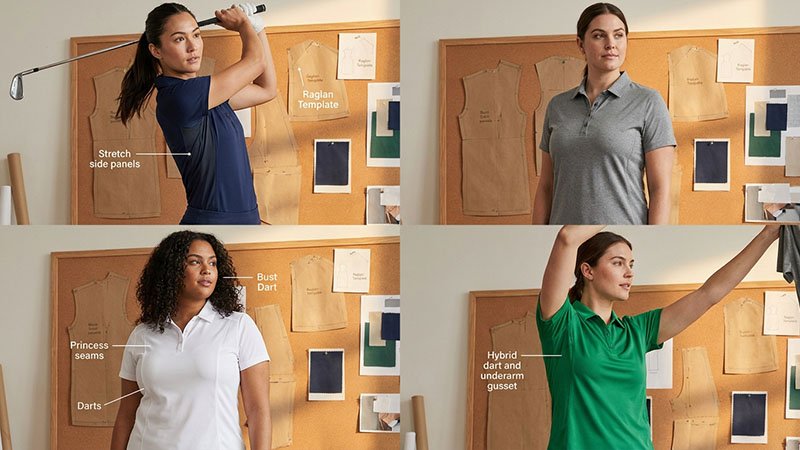
Most women's polos fail because brands try to solve all three with the same technique. A brand targeting athletic builds with smaller busts might only need mobility solutions—a bit of stretch fabric and a raglan sleeve (where the sleeve extends to the neckline instead of stopping at the shoulder). A brand selling to fuller-busted customers needs accommodation and support—that might mean bust darts (fabric folds sewn into the pattern to shape the chest area) or princess seams (vertical seam lines that curve to follow body contours).
Here is how different body types drive different solutions:
| Target Customer | Primary Fit Challenge | Typical Solution | Why It Works |
|---|---|---|---|
| Athletic build, sizes 2-8 | Mobility during swing | Stretch fabric + raglan sleeve | Minimizes restriction without adding pattern complexity |
| Moderate build, sizes 8-12 | Accommodation + mobility | Zoned stretch panels at sides | Provides volume where needed, simple to grade across sizes |
| Fuller bust, sizes 12-16 | All three: accommodation, support, mobility | Bust darts or princess seams + performance fabric | Engineered shaping holds fabric in place, stretch allows movement |
| High bust-to-underbust ratio (any size) | Support + accommodation | Hybrid: dart + stretch underarm gusset | Structured fit prevents sagging, stretch prevents pulling |
The mistake I see most often is brands copying a competitor's design without asking whether their customer has the same body type. A polo that works beautifully for a size 6 golfer with a 34B bust might be unwearable for a size 10 golfer with a 38D bust, even if you scale the measurements. The proportions change, and the fit strategy must change too.
How Does Zoned Stretch Mapping Create Mobility Where It Matters?
A brand came to us after their first production run sold poorly. They had used a basic performance knit fabric with four-way stretch (stretches both horizontally and vertically). It should have fit everyone comfortably, they said. But customers complained the polos felt loose and unsupportive. The brand had assumed stretch solved fit automatically.
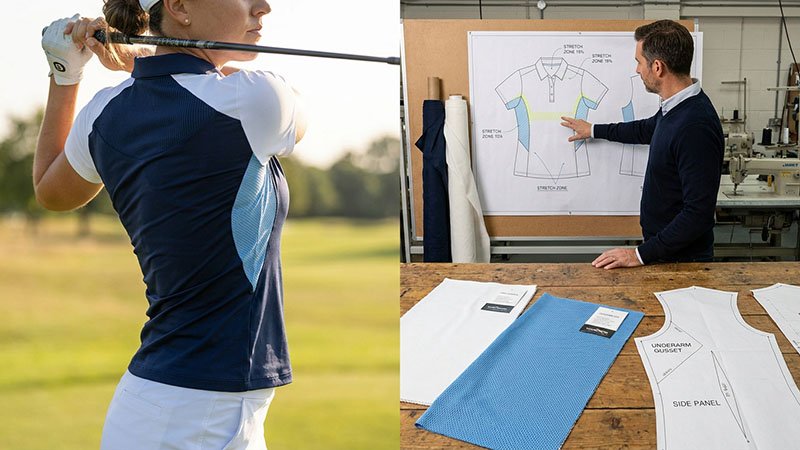
Zoned stretch mapping places stretch panels only where the body needs movement—typically underarms, side seams, and across the shoulders—while keeping firmer, less-stretchy fabric in areas that need structure. This approach balances support and mobility without making the entire garment feel loose.
Matching Stretch Zones to Swing Mechanics
I learned to map stretch zones by watching golfers move. The biggest range of motion happens when the arms swing back and rotate through impact. That movement pulls fabric at three points: across the shoulder blades, under the arms, and along the sides of the torso. If you put stretch in those spots, you reduce resistance. If you use stretch everywhere, you lose the structure that keeps the polo looking polished instead of athletic-casual.
Most brands have two options. The first is cut-and-sew zoning: you use different fabrics in different pattern pieces and seam them together. For example, the front and back panels might be a structured single-jersey knit with 10-15% stretch, while the underarm gussets (small triangular or diamond-shaped inserts) are a mesh or rib knit with 30-40% stretch. This method gives you precise control but adds seam lines, which increases cutting waste and labor cost. Your MOQ will usually jump because more pattern pieces mean more setup time.
The second option is engineered knit zoning: the fabric itself has different stretch properties woven into different areas. You see this in high-end activewear—tighter knit across the chest, open knit under the arms. It looks seamless and elegant, but you need much higher minimum orders because the fabric mill must program the knitting machine specifically for your design. I usually tell brands this option makes sense only if they are ordering 1,000+ units per style and have budget for premium fabric.
Here is how I guide clients through the decision:
| Zoning Method | Best For | Fabric Options | MOQ Impact | Cost Per Unit | Fit Flexibility |
|---|---|---|---|---|---|
| No zoning (uniform stretch) | Athletic builds, casual fit | Standard performance knit | Low (300-500 pcs) | $ | Limited—one fit for all |
| Cut-and-sew panels | Mid-range brands, sizes 6-14 | Mix of jersey, mesh, rib | Medium (500-800 pcs) | $$ | High—adjust panel size per size |
| Engineered knit | Premium brands, high volume | Custom-programmed fabric | High (1000+ pcs) | $$$ | Medium—locked into fabric design |
One thing I always mention: zoned stretch only works if your base fabric is stable. If you pair a high-stretch mesh gusset with a flimsy base fabric, the garment will distort after washing. The structured areas need to be firm enough to anchor the stretch zones. I have seen brands choose beautiful stretch fabrics and then wonder why the polos lose shape after two washes. The fabrics were not engineered to work together.
What Is the 3D Fit Workflow from Scan to Pattern to Course?
A brand founder once asked me if we could "do 3D fit" for her women's line. I said yes, but then I asked what she meant by 3D fit. She paused. She thought it meant we would scan a body and automatically generate a perfect pattern. I had to explain that 3D is a tool, not a magic solution, and how we use it depends on what fit outcome she wants.
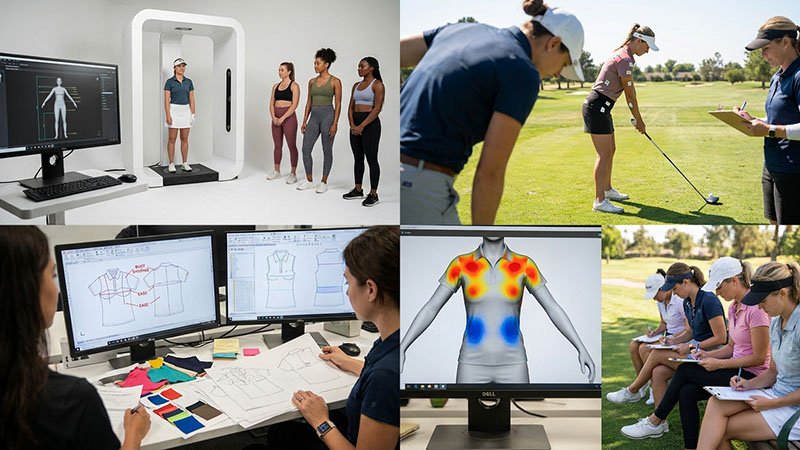
The 3D fit workflow starts with body scanning to capture real customer proportions, translates those measurements into digital patterns that accommodate volume and movement, and refines the design through virtual fitting before physical sampling. This process reduces sample iterations but requires clear definitions of fit intent before you begin.
Breaking Down the Workflow
I walk clients through three stages. Stage one is data collection. You can use full-body 3D scanners to capture measurements from your target customers, or you can work from fit models and measurement charts. The key is understanding variation—what is the difference between your size 8 and size 12, not just in chest circumference but in shoulder width, back length, and bust depth? Bust depth is the measurement from the back of the neck, over the highest point of the bust, down to the waist. It changes differently than chest circumference as sizes scale up. If you ignore this, your larger sizes will pull across the bust even if the chest measurement is correct.
Stage two is pattern translation. You take those body measurements and add ease (extra space for comfort and movement). For women's golf polos, I typically recommend 2-3 inches of ease at the bust for a fitted look, 3-4 inches for a relaxed fit. But ease is not uniform—you might add more at the underarm to prevent binding during the swing, less at the waist to maintain shape. Digital pattern software lets you visualize how fabric drapes over the body form, but it cannot tell you how the fabric will behave on course in 85-degree heat or after three hours of wear. That is where stage three comes in.
Stage three is virtual and physical validation. You fit the digital pattern onto a 3D avatar and check for pulling, gaping, or excess fabric. Then you produce a physical sample and test it. I always recommend wear testing—give samples to actual golfers and ask them to play nine holes. They will find problems no fitting room catches. Does the collar chafe after you have walked four holes? Do the sleeves ride up when you bend over to tee up? Does the hem stay tucked or pull out during the swing?
Here is the workflow I use with clients:
Scan & Measure
I collect body data from target size range. I focus on bust measurements, shoulder slope, and back length. I need at least five fit models across the size range to understand how proportions shift.
Pattern Draft
I translate measurements into flat patterns. I add bust shaping (darts or curved seams) based on target customer proportions. I calculate ease separately for bust, waist, and hips.
Virtual Fit
I load patterns into 3D software and check the drape. I look for stress points (fabric pulling tight) and collapse areas (fabric bunching). I adjust before making physical samples.
Physical Sample
I sew the first prototype. I check construction details—does the placket (the strip of fabric where buttons attach) lie flat? Do the seams align at the bust point?
Wear Test
I give samples to golfers and collect feedback. I ask specific questions: Does it pull when you address the ball? Does it ride up when you walk? How does it feel after 18 holes?
One thing clients underestimate is how much the fabric affects the final fit. A pattern that works in a stable cotton-poly blend might fail in a silky performance polyester because the drape and stretch are different. I always make samples in the exact fabric you plan to use for production, not a substitute.
What Fabrics, Plackets, and Construction Details Support Coverage and Cooling?
A buyer once sent me a panic email. Their first shipment of women's polos looked perfect in photos, but customers were posting reviews saying the shirts were see-through and too hot. The brand had chosen a lightweight single-jersey fabric to save cost, not realizing it would be sheer and trap heat. They had to recall the entire batch.
Fabric selection for women's golf polos must balance four factors: opacity to prevent see-through issues, breathability to cool the body, stretch for mobility, and structure to maintain shape. Construction details like placket width, hem length, and seam placement also affect coverage and comfort on course.
Fabric Selection for Function
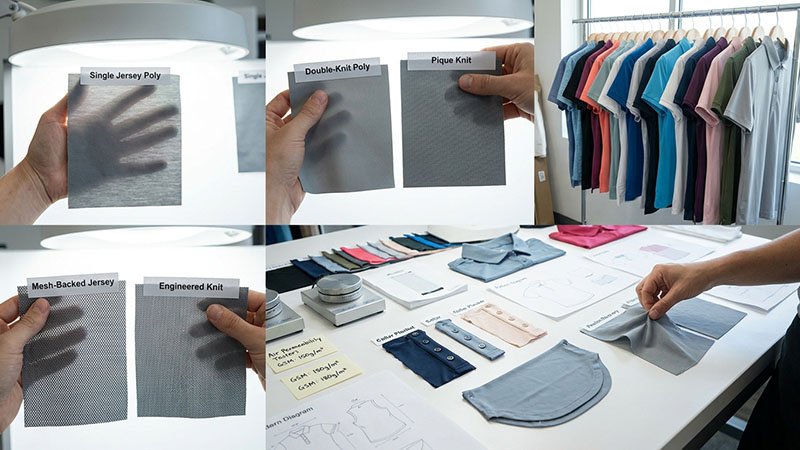
I help brands test fabrics before committing to production. Opacity is the first test—I hold the fabric up to a light and check if I can see a hand behind it. Single-layer lightweight knits often fail this test. You need either a heavier knit (160-180 GSM instead of 120-140 GSM, where GSM is grams per square meter, a measure of fabric weight), or a double-layer construction. Some mills offer "opacity-enhanced" knits with tighter stitch density or a slight brushing on the inside to block light.
Breathability comes from fiber choice and knit structure. Polyester wicks moisture but can feel clammy if it is a tight, solid knit. Cotton breathes well but absorbs sweat and stays wet. Most performance polos use polyester blends with an open knit or mesh structure. I look at the fabric specs: air permeability (how easily air flows through) should be at least 200 mm/s for hot-weather golf. Some brands add mechanical cooling—fabrics treated with minerals that reflect heat or yarns with hollow cores that increase airflow.
Stretch I covered earlier, but I will add this: too much stretch can compromise opacity. A fabric with 40% stretch might look fine at rest but become sheer when pulled across the bust. I test this by stretching the fabric over my fist—if I can see skin tone through it, customers will notice the same problem on course.
Structure is about how well the fabric holds its shape. A polo needs enough body to drape nicely, but not so much that it feels stiff. I pinch the fabric and release it—good structure means it bounces back without wrinkling. Poor structure means it stays crumpled. This affects how the garment looks after a few hours of wear, not just how it fits fresh out of the package.
Construction details matter more than most brands expect. Placket width affects coverage—a narrow placket (1 inch or less) can gap between buttons and create a see-through line. I recommend at least 1.5 inches for fuller-busted customers. Hem length is controversial—longer hems provide more coverage but can feel bulky when tucked. I usually suggest a curved hem that is longer in back (for coverage when bending) and shorter on the sides (for comfort when moving).
Here is how I match fabric to design:
| Fabric Type | Weight (GSM) | Stretch | Best For | Opacity | Breathability | Cost |
|---|---|---|---|---|---|---|
| Single jersey poly | 140-160 | 15-20% | Athletic builds, casual fit | Fair | Good | $ |
| Double-knit poly | 180-200 | 10-15% | Structured fit, all sizes | Excellent | Fair | $$ |
| Pique knit | 160-180 | 10-20% | Classic polo look, coverage | Good | Good | $$ |
| Mesh-backed jersey | 150-170 | 20-30% | Hot weather, active fit | Good (with backing) | Excellent | $$$ |
| Engineered knit (zoned) | 160-180 | Varies by zone | Premium brands, custom fit | Excellent | Excellent | $$$$ |
I also pay attention to color. White and light pastels are the hardest to keep opaque—you might need a heavier fabric or a lining. Dark colors hide more but can show sweat more visibly. Some brands use heathered or printed fabrics to mask both sheerness and moisture marks.
How Do Prototyping, Wear Testing, and Size Inclusivity Work Together?
A brand I worked with wanted to launch sizes 2-16 for their women's golf line. They sent fit specs and asked us to grade the patterns (scale them up and down). We made samples and sent them for approval. Three months later, they came back frustrated—their test group loved the small and medium sizes but said the large and extra-large fit terribly. The problem was not our pattern grading. The problem was they had designed for one body type and tried to stretch it across a much wider range.
Effective prototyping for size inclusivity means sampling across the full size range, not just the middle, and wear-testing with diverse body types to identify where proportional scaling fails. Bust contouring solutions that work for smaller sizes often need redesign for larger sizes, especially if bust-to-underbust ratios or shoulder widths change significantly.
Prototyping Beyond the Fit Model
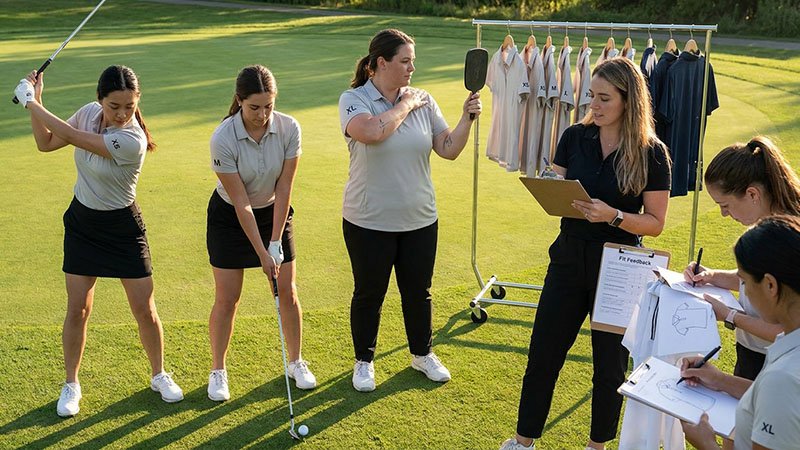
I encourage brands to prototype at three points in their size range: smallest, middle, and largest. If you are doing sizes XS-XL, make samples in XS, M, and XL. This shows you where the pattern breaks down. Maybe the dart depth is perfect in medium but too shallow in XL, leaving excess fabric above the bust. Maybe the armhole is fine in small but too tight in large because shoulder width did not scale enough.
Most brands use a fit model (a person whose measurements match the target size) to approve patterns. That model is almost always a size small or medium. Fit models for larger sizes are harder to find and more expensive. But if you skip them, you are guessing. I have seen patterns that looked beautiful on a size 6 model create pulling, gaping, and discomfort on a size 14 customer. The proportions are different—not just bigger, but shaped differently.
Wear testing is where theory meets reality. I set up test protocols with clients: each tester wears the polo for at least four hours, including 9-18 holes of golf or a practice session. They fill out a feedback form covering these points:
Fit Feedback
Does the bust area feel too tight, too loose, or just right? Mark on a scale. Does the shirt pull when you swing? Describe where.
Comfort Feedback
Does anything chafe, pinch, or irritate? Where? Does the fabric feel too hot, too cold, or comfortable?
Coverage Feedback
Does the shirt stay tucked or pull out? Do you feel exposed at any point? Is the neckline comfortable?
Style Feedback
Do you like how it looks? Would you buy this? Would you recommend it?
I need at least three testers per size, with different body types. A size 10 tester with a 34C bust will report differently than a size 10 tester with a 36D bust. Both are valid customers—if your design works for only one, you have a problem.
Size inclusivity is not just about offering more sizes. It is about adapting the design as sizes change. Here is where brands often fail:
| Size Range | Common Scaling Issue | What Breaks | Solution |
|---|---|---|---|
| XS-S | Armholes too large | Fabric bunches under arm | Reduce armhole depth in small sizes |
| S-M | Dart placement shifts | Bust point misaligned | Adjust dart angle and length per size |
| M-L | Shoulder width insufficient | Seams sit too far inward | Increase shoulder width more aggressively in larger sizes |
| L-XL | Bust-to-waist ratio changes | Excess fabric at waist or pulling at bust | Add graduated dart depth or use separate patterns for different proportions |
| XL+ | Hem balance off | Back hem rides up | Lengthen back hem more than front in larger sizes |
One thing I emphasize: size inclusivity costs more upfront. You need more samples, more testers, and possibly separate pattern blocks for different body types. But it saves money long-term. A brand that launches with fit problems will spend more on returns, customer service, and damaged reputation than they saved by skipping thorough testing. I would rather delay a launch by four weeks and get the fit right than rush to market and lose customer trust.
Conclusion
Designing women's golf polos that actually fit comes down to matching your contouring method to your real customer, not just following industry trends. Test across your full size range, invest in the right fabrics, and listen to golfers before you finalize production.