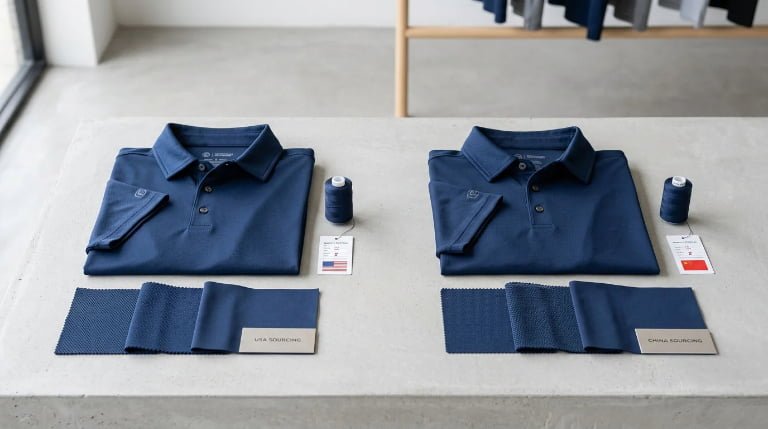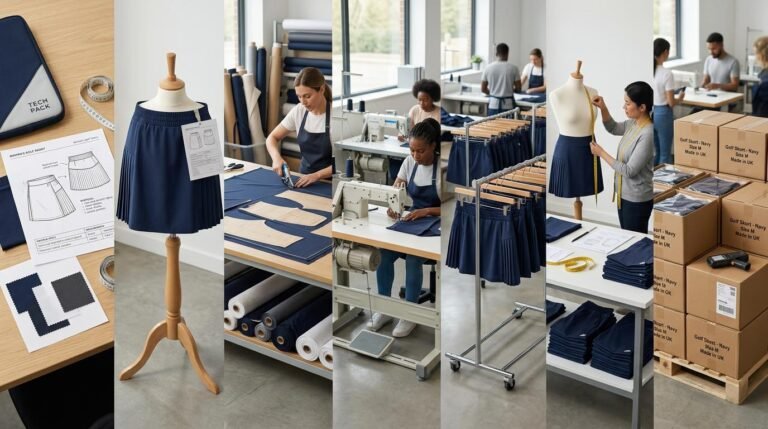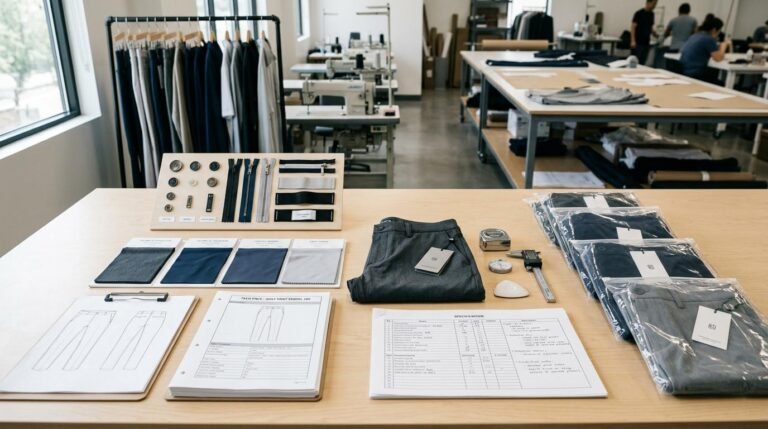
You send a specification sheet with "moisture-wicking polyester" to three suppliers. Three samples arrive. They all look different, feel different, perform different.
Performance fabric choice for custom golf shirts is not about finding the "best" material—it's about matching fiber type, knit construction, and finish durability to your target climate, price point, and production consistency requirements. Sample performance does not guarantee bulk stability.
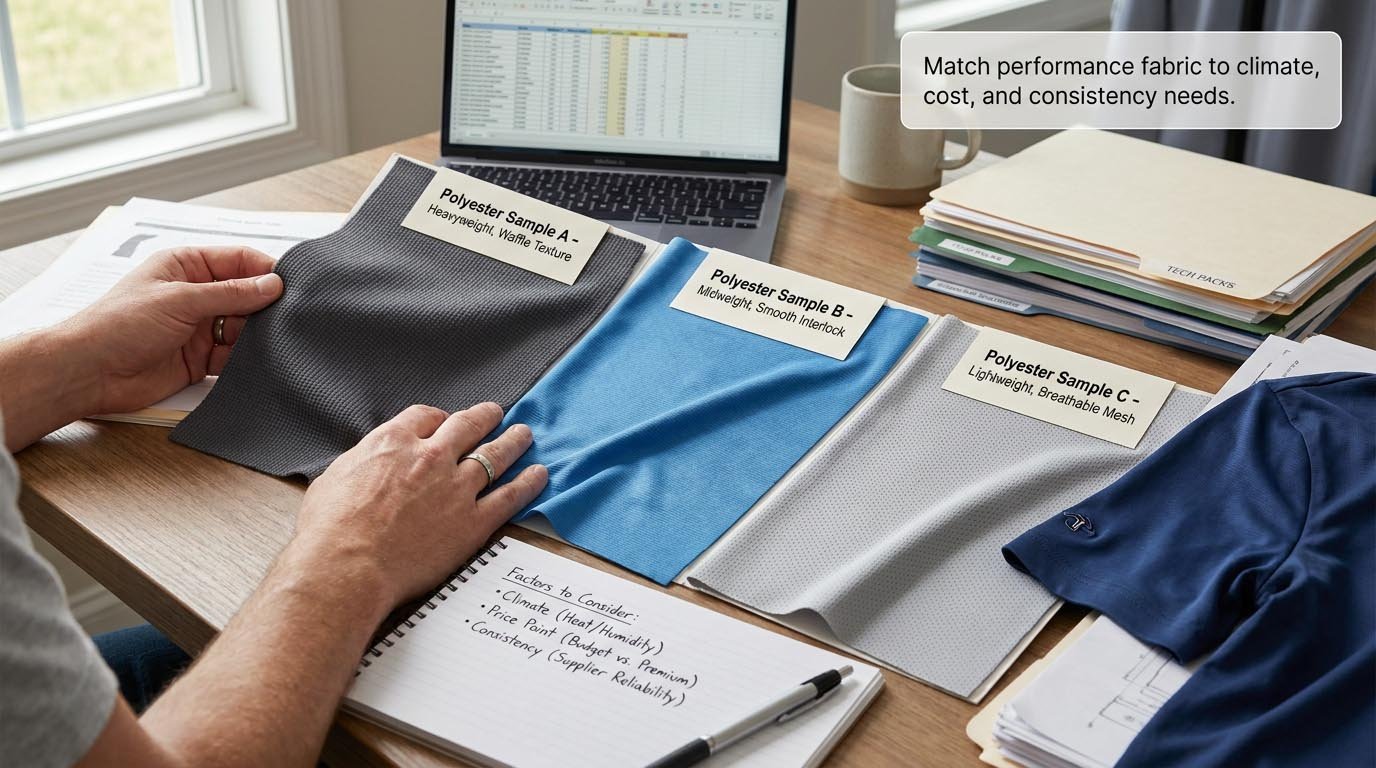
I work in fabric procurement at FUWAY, where we manage supply chains for international golf apparel OEM/ODM orders. Clients constantly ask me what the best performance fabric is. I always ask back: what is your target market climate, and what is your landed cost ceiling?
Quick Answers
What does "performance" actually mean in golf fabrics?
It means the fabric manages moisture, allows swing movement, resists UV damage, and maintains shape after washing—not just one isolated spec like "wicking" or "stretch."
Which fiber performs best: polyester or nylon?
Polyester holds color better and costs less. Nylon feels softer and resists abrasion longer. Neither is universally better—your choice depends on price tolerance and target handfeel.
Do all moisture-wicking fabrics perform the same?
No. Wicking performance depends on yarn shape, knit density, and whether the finish is topical or fiber-integrated. Topical finishes fade after 15-20 washes in our testing observations.
What fabric weight works for hot climates?
140-160 GSM polyester-spandex blends offer breathability without transparency. Below 130 GSM risks see-through issues. Above 180 GSM traps heat in humid conditions.
Can I trust sample quality for bulk orders?
Not automatically. We require suppliers to provide third-party test reports on shrinkage, colorfastness, and pilling resistance—plus pre-production bulk sampling to verify batch consistency.
What "Performance" Means in Golf Shirts
Performance in golf shirts is not a single feature—it is a system of five interdependent properties: moisture management, stretch mobility, durability under repeated use, UV protection, and care stability across washing cycles.
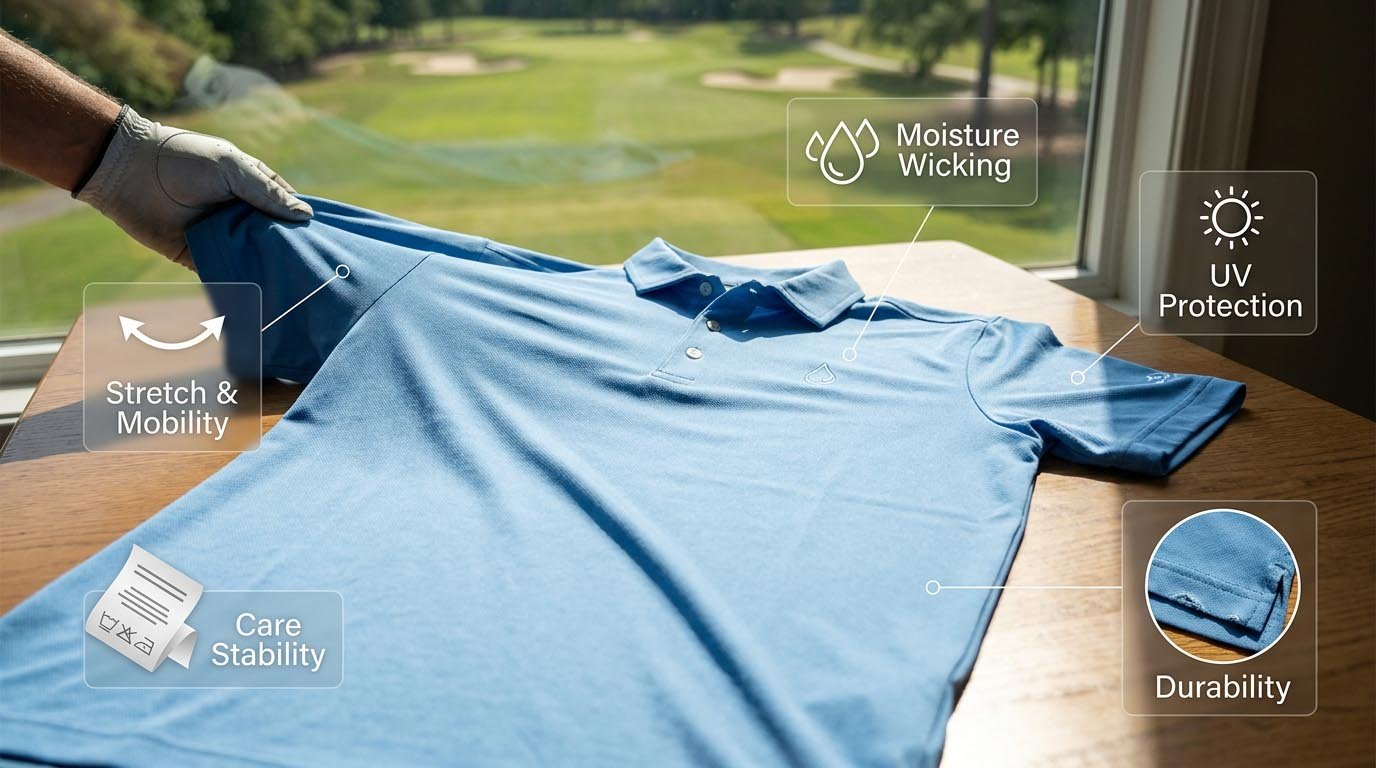
When clients send me an RFQ that just says "performance polo," I know we need to clarify expectations. A golf round can last 4+ hours in changing sun, humidity, and activity levels. The shirt has to wick sweat, allow full shoulder rotation during the swing, hold its shape after washing, and protect skin from UV exposure.
Here is the trade-off most buyers miss: breathability vs structure. A lightweight, open-knit fabric breathes better but loses shape faster. A denser knit holds structure but traps more heat. There is no universal solution. You pick based on whether your customer plays in Florida humidity or California dry heat.
The Real Performance Requirements
I break down fabric performance into measurable outcomes, not marketing terms:
- Moisture management: How fast does sweat move from skin to fabric surface, and how fast does it evaporate?
- Stretch and recovery: Does the fabric return to its original shape after a full golf swing, or does it sag at the elbows after 18 holes?
- Durability: Does the color fade or the fabric pill after a season of weekly play and washing?
- UV protection: Is UPF rating durable through washing, or does it degrade after 10-15 cycles?
- Care stability: Does the shirt shrink, twist, or lose handfeel after standard home laundering?
Clients often compare fabrics by isolated specs—180 GSM vs 160 GSM, or 88/12 blend vs 80/20. But I have seen production lines reject perfectly spec'd fabric because the knit structure caused seam puckering during assembly. Construction matters as much as fiber content.
Fabric Options Compared: Polyester, Nylon, Blends and Weaves
Polyester-spandex blends dominate performance golf shirts because they balance cost, colorfastness, and wicking efficiency. Nylon-spandex offers superior handfeel and abrasion resistance but costs 15-25% more and fades faster without UV finishing.
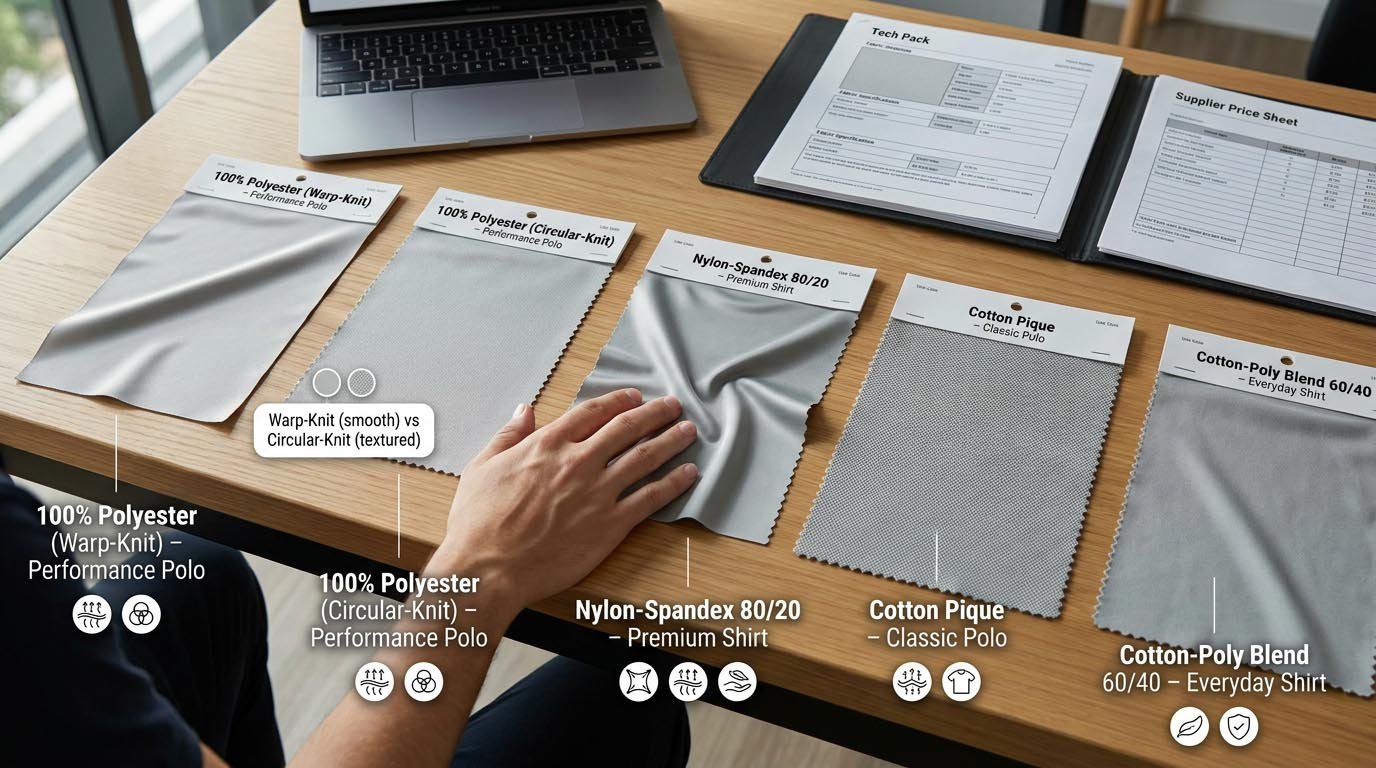
When I review fabric submissions from suppliers, I see the same fiber labels hiding very different performance profiles. A 100% polyester jersey-knit behaves nothing like a 100% polyester warp-knit tricot. The weave changes everything.
Polyester and Polyester-Spandex Blends
Polyester is the workhorse of performance golf apparel. It is lightweight, quick-drying, wrinkle-resistant, and holds dye well. When blended with spandex at ratios like 88/12 or 80/20, it delivers four-way stretch and shape recovery.
The trade-off: polyester can feel synthetic and retain odor faster than nylon. Anti-microbial finishes help, but topical treatments wash out. We ask suppliers whether their anti-odor finish is fiber-integrated or surface-applied—the answer determines whether it lasts 50+ washes or just 15.
Common polyester-spandex uses in our sourcing:
- Performance polos for warm climates
- Tournament shirts with branded logos (color retention matters)
- High-volume orders where cost control is critical
Nylon and Nylon-Spandex Options
Nylon feels softer and silkier than polyester. It is more abrasion-resistant, which extends garment life in high-friction areas like underarms and collar edges. Blended with spandex at 80/20 or 85/15 ratios, it offers excellent stretch and recovery.
The trade-off: nylon is more prone to UV degradation and color shift over time unless treated with protective finishes. It also costs more. In our procurement, nylon-spandex typically runs $1.80-$2.50 per meter, compared to $1.20-$1.80 for polyester-spandex at comparable weight.
We recommend nylon-spandex when:
- The brand positions itself as premium and targets elevated handfeel
- The customer plays in lower-UV climates or primarily indoors
- The budget allows for higher fabric cost
Cotton Pique and Cotton-Poly Blends
Cotton pique is the traditional golf polo fabric. Its raised texture adds surface breathability and a classic look. Pure cotton is soft but absorbs sweat instead of wicking it, leading to a damp, heavy feel in heat.
Cotton-poly blends at 60/40 or 50/50 offer compromise. They retain some cotton softness while improving dry time. These blends work well for corporate events, team uniforms, and casual golf settings where peak athletic performance is not the priority.
The trade-off: cotton blends shrink more than synthetics. We have seen 3-5% shrinkage in first wash for poorly stabilized cotton-poly fabrics. Always confirm pre-shrinking treatment with your supplier.
| Fabric Type | Moisture-Wicking | Stretch | Color Retention | Abrasion Resistance | Typical Cost/Meter |
|---|---|---|---|---|---|
| 100% Polyester | Good | Low-Moderate | Excellent | Good | $1.00-$1.50 |
| Polyester-Spandex (88/12) | Excellent | Four-way | Excellent | Good | $1.20-$1.80 |
| Nylon-Spandex (80/20) | Excellent | Four-way | Good* | Excellent | $1.80-$2.50 |
| Cotton Pique | Poor | Low | Fair | Fair | $0.80-$1.20 |
| Cotton-Poly Blend (60/40) | Fair | Low-Moderate | Good | Fair | $1.00-$1.50 |
*Requires UV-protective finish for long-term color stability
Warp-Knit vs Circular-Knit Construction
Here is where many buyers get tripped up. Two fabrics with identical fiber content—say, 80% polyester, 20% spandex—will perform differently if one uses warp-knit construction and the other uses circular-knit.
Warp-knit fabrics offer more controlled, even stretch and a smoother surface. They resist snagging better and hold shape during cutting and sewing. We prefer warp-knit for technical golf shirts where fit precision matters.
Circular-knit fabrics are often less expensive and work well for casual styles. But they can distort under tension and may cause seam puckering if the factory does not adjust tension settings during assembly.
In production trials, I have seen the same design require different seam allowances and stitch tension depending on whether the fabric was warp-knit or circular-knit. This affects both cost and lead time.
Key Technologies: Wicking, Stretch, UPF, Cooling and Anti‑Odor
Moisture-wicking, UV protection, and anti-odor are not inherent to fiber type—they result from yarn engineering, knit architecture, and chemical finishing. The durability of these features depends on whether they are built into the fiber or applied topically.
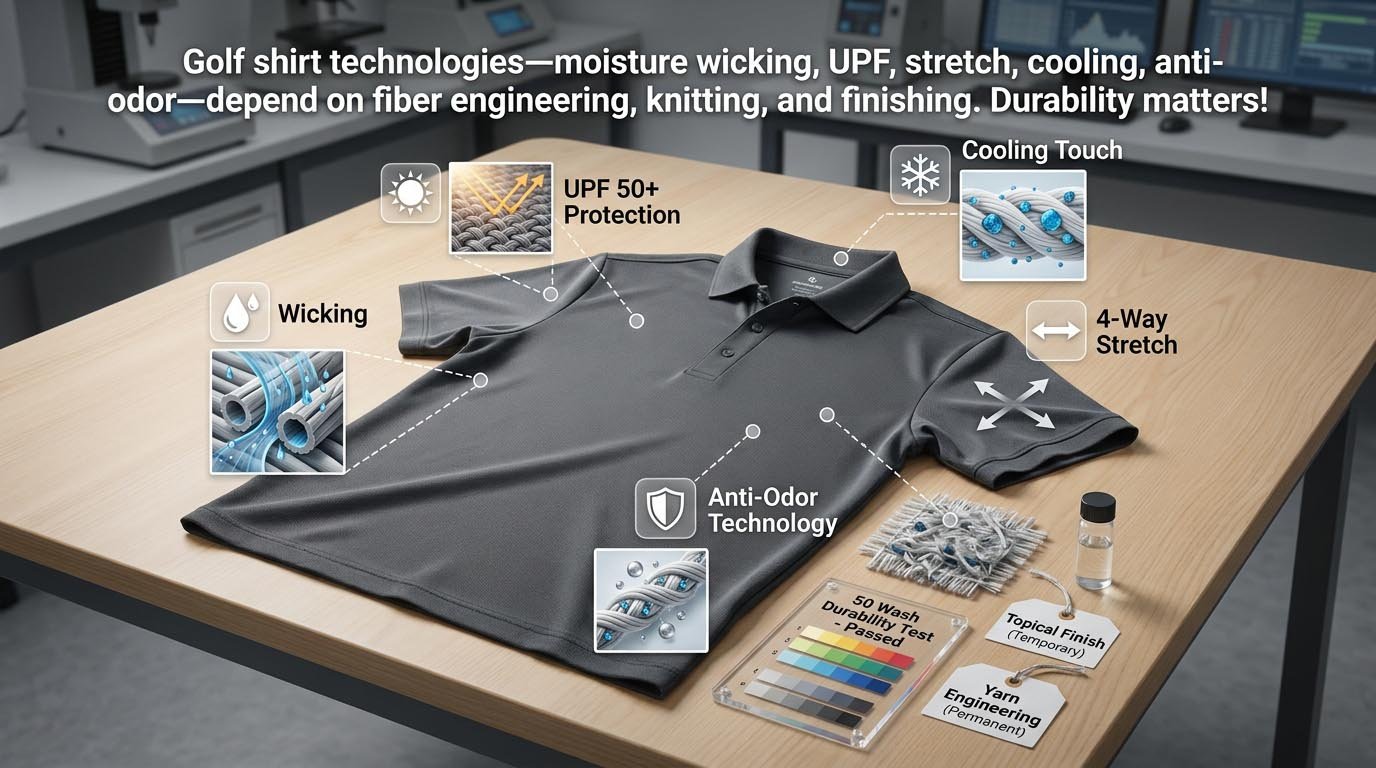
Clients send me spec sheets listing "moisture-wicking," "UPF 50+," "anti-odor," and "cooling touch" as if they were all equivalent features. They are not. Each comes from a different mechanism, and each has different durability.
Moisture-Wicking: Fiber Shape and Finish
Wicking is about moving liquid from skin to fabric surface. Polyester and nylon fibers do not naturally absorb water—they repel it. Wicking happens because of two things:
- Fiber cross-section shape: Engineered yarns with channels or grooves pull moisture along the fiber surface through capillary action
- Hydrophilic finish: Chemical treatment makes the fiber surface attract water temporarily, speeding evaporation
We require suppliers to specify whether wicking comes from yarn engineering or topical finish. Fiber-based wicking is permanent. Topical finishes degrade after 15-30 washes based on our supplier test data.
Stretch: Spandex Ratio and Knit Structure
Four-way stretch requires both spandex content and bidirectional knit construction. A fabric with 20% spandex in a unidirectional knit will not stretch evenly in all directions.
Common spandex ratios we see:
- 2-5% spandex: Light give, minimal recovery, used in casual polos
- 10-15% spandex: Moderate stretch, good recovery, standard for performance golf shirts
- 18-25% spandex: High compression, athletic fit, used in base layers and activewear
The trade-off: higher spandex content increases cost and can reduce durability. Spandex degrades faster than polyester or nylon under UV exposure and chlorine. If your customer swims or uses hot tubs frequently, high-spandex fabrics may lose elasticity within a season.
UPF: Fabric Density and Chemical Treatment
UPF (Ultraviolet Protection Factor) measures how much UV radiation passes through fabric. A UPF 50+ rating blocks more than 98% of UV rays.
UPF comes from:
- Tight knit density: More fabric coverage = less UV penetration
- Fabric weight: Heavier fabrics generally block more UV
- Chemical UV absorbers: Applied finishes that absorb or reflect UV light
According to supplier technical sheets, built-in UPF from density and weight is permanent. Chemical UPF treatments can degrade 30-50% after 40-50 washes. We ask for wash-durability test reports when UPF is a stated feature.
Cooling Touch and Anti-Odor Finishes
"Cooling" fabrics use one of two methods:
- Moisture-activated cooling: Fabric feels cool when wet due to enhanced evaporation
- Mineral-embedded cooling: Particles like jade or mica dissipate heat
Anti-odor treatments limit bacterial growth on fabric. Some are silver-ion based and built into the fiber (durable). Others are topical antimicrobials that wash out faster.
I have had clients complain that their "cooling, anti-odor" shirts lost those features after a season of use. When we traced it back, the supplier had used topical finishes that were not wash-durable. Now we require third-party wash-durability reports before approving any functional finish.
Handfeel, Weight and Breathability: Picking the Right Knit
Handfeel and breathability are not subjective—they are directly determined by fabric weight (GSM), knit tightness, and yarn denier. The right combination depends on target climate and whether you prioritize structure or airflow.
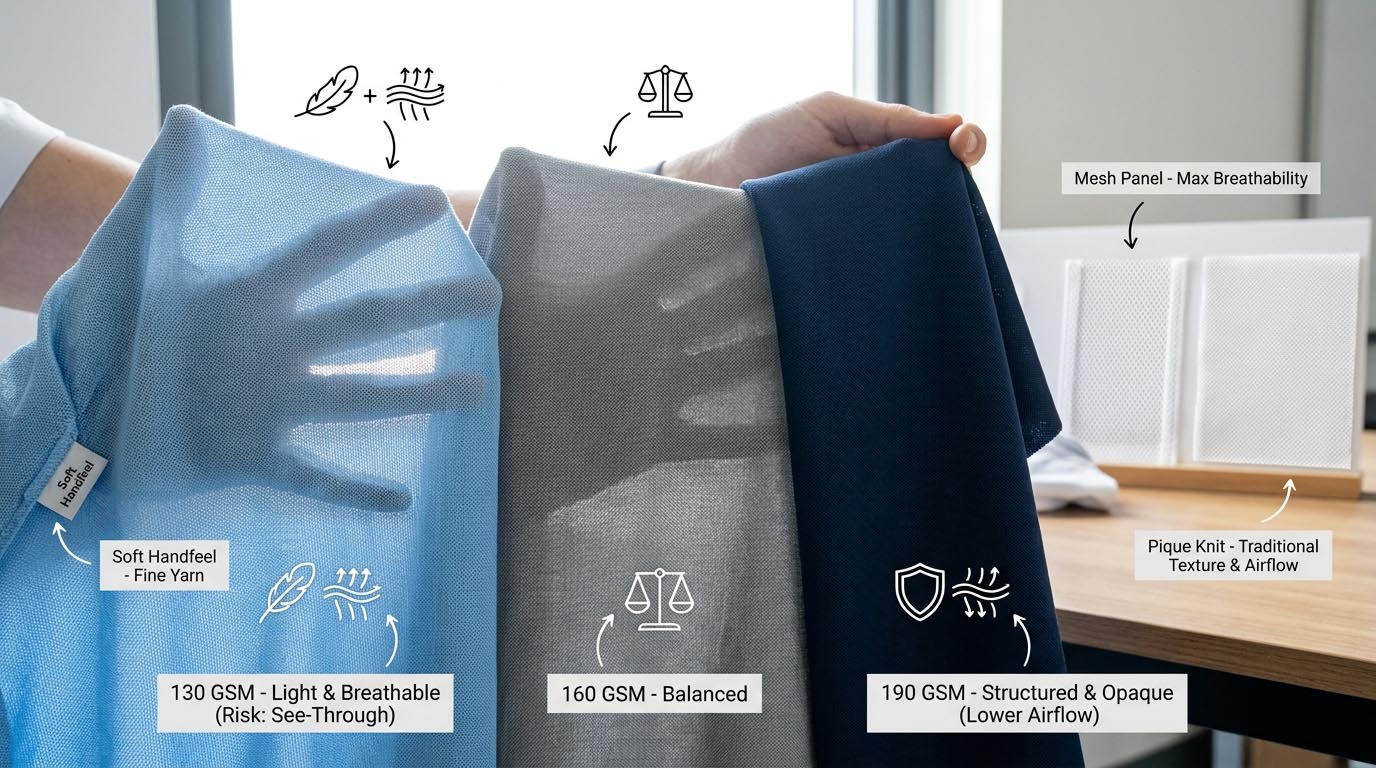
One of the most common mistakes I see is choosing fabric weight based only on cost. A buyer sees 130 GSM polyester at a lower price than 160 GSM and assumes lighter is better for hot weather. Then the finished shirts arrive semi-transparent, and the order gets rejected.
Fabric Weight and Transparency
GSM (grams per square meter) measures fabric weight. For golf shirts, the typical range is:
- 120-140 GSM: Very lightweight, high breathability, risk of transparency
- 150-170 GSM: Balanced weight, good opacity, standard for performance polos
- 180-200 GSM: Heavier, more structure, can trap heat in humid climates
We test samples by holding them against a light source. If you can clearly see a hand outline through the fabric, it will likely be see-through on-body, especially in lighter colors. Most brands target 150-170 GSM for opacity without sacrificing breathability.
Knit Tightness and Airflow
A tight, dense knit blocks UV better and resists snagging, but it reduces airflow. A loose, open knit breathes better but pills faster and may snag on golf bags or cart handles.
Pique knit (raised texture) adds surface area for airflow without making the knit too loose. Mesh panels or eyelet patterns improve breathability in high-sweat zones like the back and underarms.
We have worked with brands that specified ultra-lightweight, open-knit fabrics for tropical climates. The shirts breathed well but snagged easily during production, increasing defect rates and slowing output. The trade-off between breathability and production efficiency is real.
Handfeel: Yarn Denier and Finishing
Handfeel—how the fabric feels against skin—depends on:
- Yarn denier: Finer yarns (lower denier) feel softer
- Surface finish: Brushing, peaching, or chemical softening treatments
- Spandex content: Higher spandex often feels smoother and more compressive
Nylon naturally feels softer than polyester at the same denier. But polyester can be engineered to mimic nylon handfeel through finer yarn and finishing. The cost difference narrows when you compare premium polyester to standard nylon.
Quality and Testing: Snag, Pilling, Colorfastness and Fit
Sample performance does not predict bulk stability. Shrinkage variance, color deviation, and handfeel inconsistency are the most underestimated risks in fabric sourcing. Third-party testing and pre-production bulk sampling are non-negotiable.
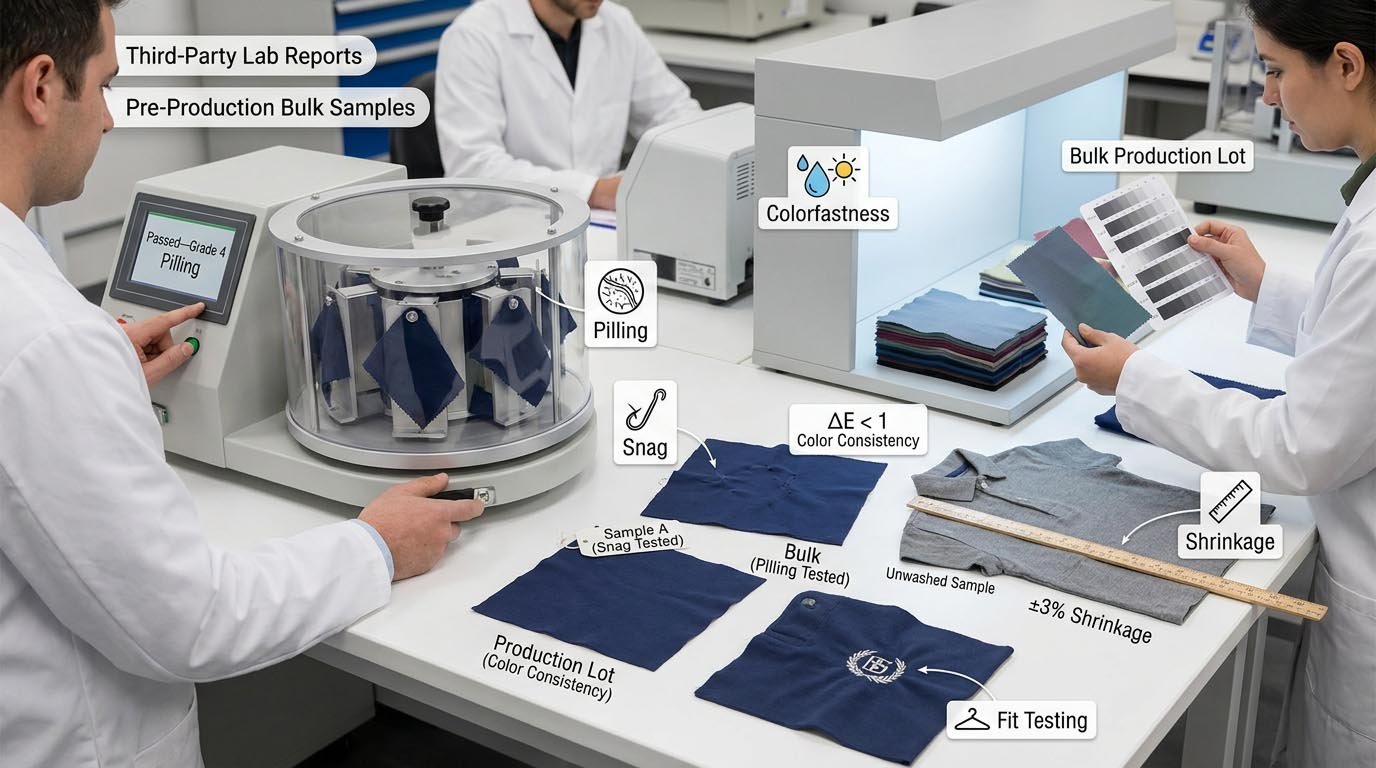
I have had clients approve a sample, place a 5,000-piece order, and then receive fabric that shrank 4% more than the sample after the first wash. The entire batch was unwearable. The issue? The supplier changed dye lots between sample and bulk production, and the new lot had not been heat-set properly.
Testing Standards We Require
Before we approve fabric for bulk orders, we ask suppliers to provide test reports on:
- Pilling resistance: ASTM D3512 or ISO 12945, typically targeting Grade 4 or higher after 5,000 cycles
- Colorfastness to washing: AATCC 61 or ISO 105-C06, minimum Grade 4
- Colorfastness to light: AATCC 16 or ISO 105-B02, minimum Grade 4 for outdoor use
- Dimensional stability (shrinkage): AATCC 135, acceptable range ±3% for length and width
- Snag resistance: ASTM D3939, especially for warp-knit fabrics
These are not theoretical standards. We have seen fabrics pass internal supplier testing but fail third-party lab testing. We now require original test reports from accredited labs, not supplier summaries.
Batch-to-Batch Consistency
The bigger risk is not that one batch fails testing—it is that batch-to-batch performance varies. A fabric might test perfectly in January and show 2-shade color deviation in March because the supplier switched dye suppliers or adjusted finishing temperatures.
We manage this by:
- Requiring pre-production bulk samples from the actual production lot, not leftover sample yardage
- Specifying acceptable color deviation in Delta E units (typically ΔE < 1.0 for critical colors)
- Requesting reserve yardage from each dye lot for future reference and claims
Sewing and Finishing Compatibility
High-performance fabrics do not always behave well in production. Some examples I have encountered:
- High-spandex blends can cause needle skipping or seam puckering if thread tension is not adjusted
- Moisture-wicking finishes can create uneven dye uptake during printing or embroidery
- Lightweight knits may distort during heat-press applications for logos
We ask suppliers whether the fabric has been tested for compatibility with common garment processes: cutting, sewing, printing, embroidery, and heat transfer. A fabric that looks great but cannot be embroidered without distortion is useless for branded golf shirts.
FAQ: Performance Fabrics for Custom Golf Shirts
What is the difference between moisture-wicking and quick-dry fabrics?
Moisture-wicking moves sweat from skin to fabric surface. Quick-dry refers to how fast the fabric dries after getting wet. Both are important, but they work through different mechanisms. Polyester and nylon both wick and dry quickly when engineered properly.
How do I know if a UPF finish is wash-durable?
Ask the supplier for third-party wash-durability test reports showing UPF performance after 30-50 wash cycles. If UPF comes from fabric density and weight rather than chemical treatment, it is permanent. Chemical UPF finishes degrade over time.
What spandex percentage is best for golf shirts?
10-15% spandex is standard for performance golf shirts. It provides four-way stretch and recovery without excessive compression. Higher spandex content increases cost and can reduce UV durability. Lower spandex content limits range of motion during the swing.
Why do some performance fabrics pill after a few washes?
Pilling happens when short fibers migrate to the fabric surface and tangle into balls. Low-quality yarns, loose knit construction, and friction during washing all contribute. Industry testing shows fabrics should achieve Grade 4 pilling resistance or higher after 5,000 cycles for acceptable durability.
Can I trust sample fabric quality for bulk production?
Not automatically. We require suppliers to provide pre-production bulk samples from the actual dye lot before cutting begins. Samples are often made from premium yardage that does not represent average production quality. Verify shrinkage, color, and handfeel on bulk fabric.
What causes color fading in golf shirts?
UV exposure, chlorine, sweat, and repeated washing all degrade dye. Polyester holds color better than nylon. We ask for AATCC 16 colorfastness to light testing (Grade 4 minimum) for outdoor golf apparel. Darker colors fade slower than bright colors in most fiber types.
How much fabric shrinkage is acceptable?
Industry standard allows ±3% dimensional change after washing. Shrinkage above 3% causes fit problems. We have seen poorly heat-set fabrics shrink 5-7% in the first wash, making garments unwearable. Always confirm heat-setting and pre-shrinking treatment with your supplier.
What is the typical MOQ for custom performance fabrics?
For standard polyester or nylon-spandex blends in stock colors, MOQ can be as low as 300-500 meters. Custom colors, prints, or functional finishes typically require 1,000-3,000 meters per color. Custom yarn blends may require 5,000+ meters. MOQ affects per-unit cost significantly.
Conclusion
Performance fabric selection is not about finding the best material. It is about matching fiber type, knit construction, and finish durability to your climate, budget, and production process. Sample quality is not bulk quality—verify batch consistency before committing to large orders.