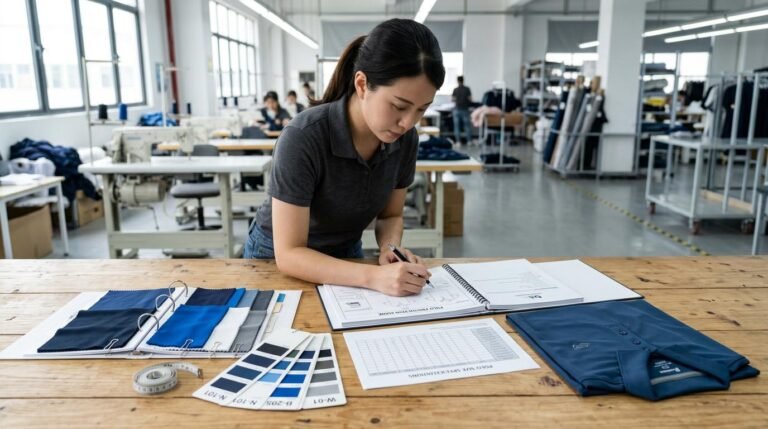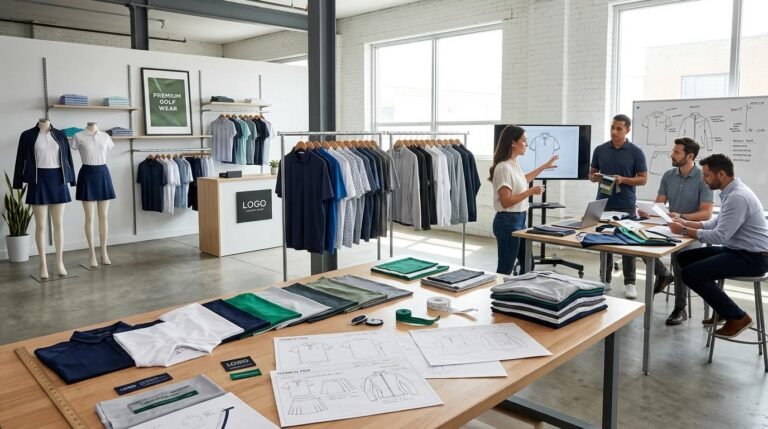
A client approved a beautiful sample. We ran 1,000 pieces. The fabric shade was three tones darker because we sourced from a different dye lot. They rejected the entire batch. The problem was not the production—it was that we never discussed fabric batch testing in the approval process.
Custom golf polo success depends on aligning your use case, budget, and order quantity with the right fabric-logo-MOQ combination, then implementing quality checkpoints that catch bulk failures before production. Sample approval alone does not predict bulk consistency.
I am Will, and I run FUWAY's OEM account management. My job is to translate what you tell me you want into specifications that our production floor can actually execute. Most custom polo failures happen in translation—between what you approved as a sample and what arrives in bulk shipment. Clients approve fabric hand feel in a sample but do not specify shrinkage tolerance, so bulk pieces shrink 3% after first wash and sizing is off. They approve a logo position on one sample but do not define placement tolerance, so bulk production varies by 2cm and looks inconsistent. This guide walks through the decision points that determine whether your custom polo order delivers what you expect.
Quick Answers: Custom Golf Polo Essentials
What is the typical MOQ for custom golf polos?
500-1,000 pieces per design for embroidered logos with standard fabrics. Lower MOQs (200-300 pieces) are possible with heat-transfer logos or if you accept fabric options from our in-stock rolls. Higher MOQs (1,500+ pieces) unlock better unit pricing and custom fabric development.
How much do custom golf polos cost per unit?
$8-12 for basic cotton-poly pique with heat-transfer logos, $12-18 for performance polyester with embroidery, $18-25 for premium fabrics with custom details. Price scales with fabric weight, logo complexity, and order quantity.
What is the lead time from order to delivery?
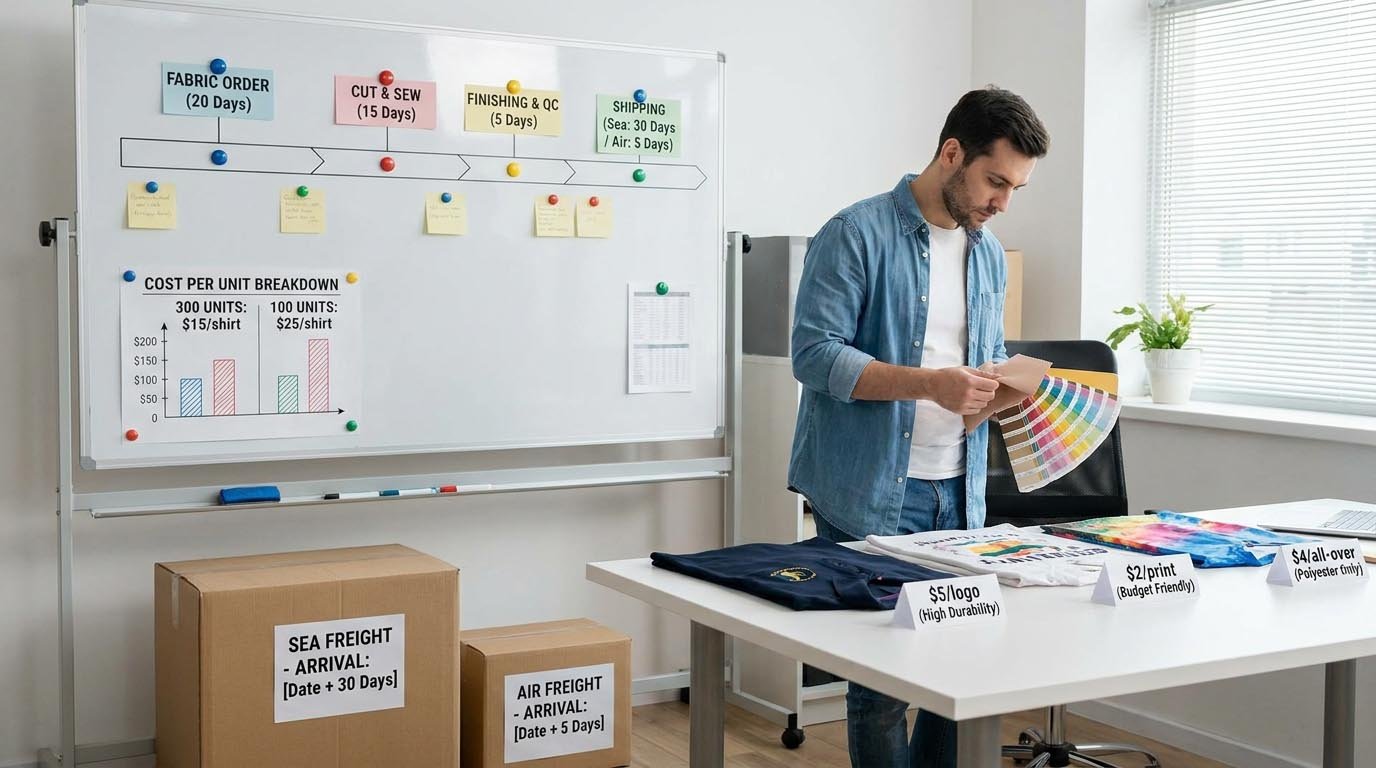
10-15 days for sampling, 30-45 days for bulk production after sample approval, plus 20-30 days for shipping if by sea. Rush orders (15-20 days bulk) cost 15-20% more and require fabric in stock.
Should I choose embroidery or heat-transfer logos?
Embroidery for orders over 500 pieces, premium positioning, and durability over 100+ washes. Heat-transfer for orders under 500 pieces, multi-color complex designs, or budget under $12 per unit. Screen print for large, simple logos on light fabrics.
What fabric weight is best for golf polos?
120-160 GSM for hot climates and athletic performance, 160-200 GSM for moderate climates and resort wear, 200-220 GSM for corporate uniforms and cooler weather. Lighter is not always better—stability and drape matter.
How much does sampling cost and how many rounds do I need?
$50-80 per sample for basic styles, $80-120 for complex constructions or custom fabrics. Most clients need 2-3 sampling rounds—first for fit and construction, second for final fabric and color, third for logo placement adjustment.
Can I mix sizes in one order to meet MOQ?
Yes. MOQ applies to total pieces across all sizes and colors within one design. Typical ratio: 20% S, 35% M, 30% L, 15% XL. Unusual ratios (too many XS or 3XL) may increase cost because fabric cutting efficiency drops.
How Do You Define Your Custom Polo Brief?
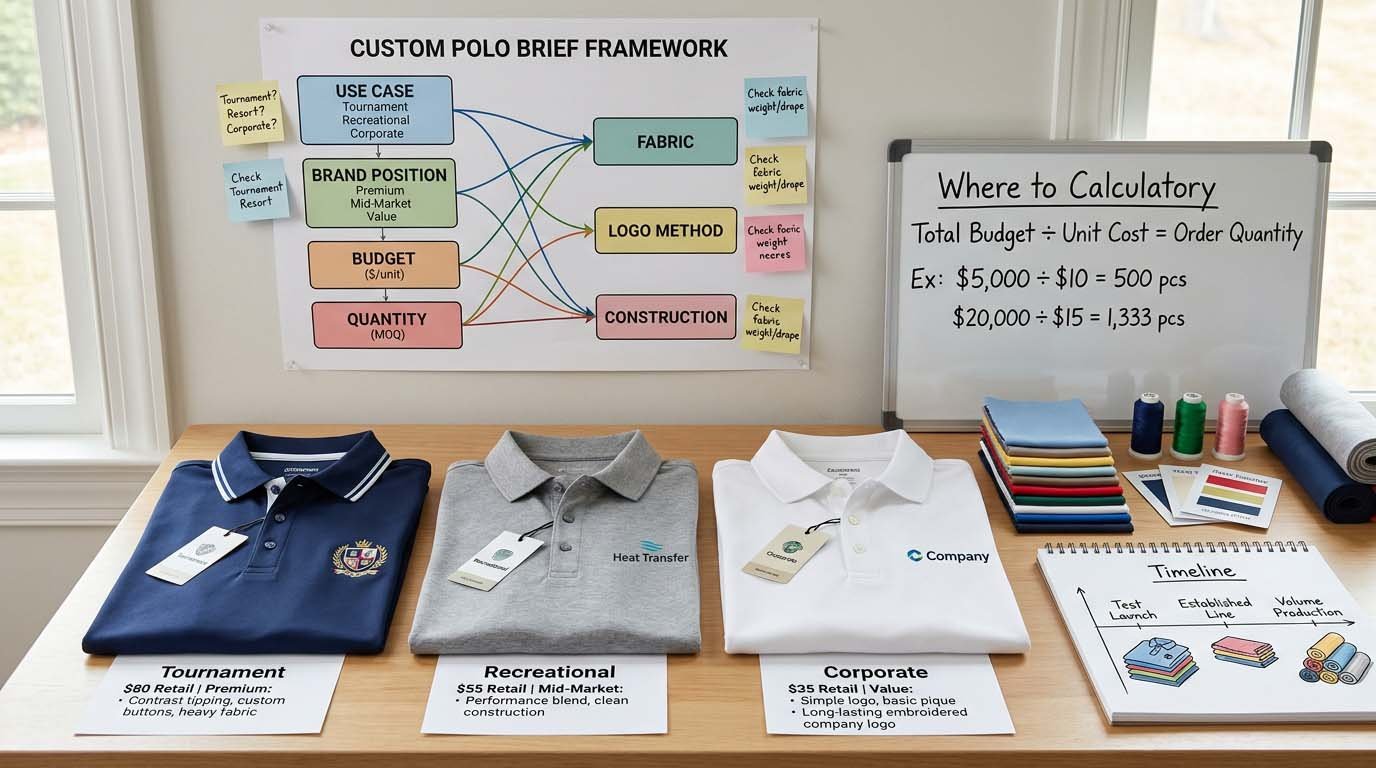
Your use case, brand positioning, budget ceiling, and order quantity determine which fabric-logo-construction combinations are feasible. Without clear answers to these four questions, you will waste time sampling options that are either overbuilt or underspec'd for your actual market.
Use Case: Who Wears This and Where?
I ask clients: Will your customer wear this polo during competition, at a resort course, or for corporate events? The answer changes everything.
Tournament players: Need maximum mobility, moisture management, lightweight fabric (120-140 GSM jersey or pique with high polyester content). Collar must stay crisp under a cap. Budget typically allows premium fabric and embroidery.
Recreational golfers: Want comfort and style, less focus on extreme performance. Can use heavier fabric (160-180 GSM pique), cotton blends for soft hand feel. Price sensitivity is higher—heat transfer logos may fit budget better than embroidery.
Corporate/resort uniform: Durability and easy care matter most. Frequent washing, multiple wearers, stain exposure. Need colorfast dye, reinforced seams, simple logo that survives 100+ washes. Embroidery is standard because it lasts.
I see brands try to build one polo for all three use cases. It always compromises. Tournament players complain the fabric is too heavy. Corporate buyers reject the price. Define one primary use case and optimize for that.
Brand DNA: Premium, Mid-Market, or Value Positioning?
Your brand positioning determines acceptable cost per unit and customer expectations.
Premium brands ($80+ retail):
Customers expect embroidered logos, 200+ GSM premium pique, contrast tipping, custom buttons. Your cost target might be $18-25 per unit. MOQ can be higher (1,000+ pieces) because your volume justifies custom fabric development.
Mid-market brands ($40-70 retail):
Balance of quality and cost. 160-180 GSM performance blends, embroidery or high-quality heat transfer, clean construction. Cost target $12-18 per unit. MOQ around 500-800 pieces per design.
Value brands ($30-40 retail):
Function over flair. 140-160 GSM basic pique or jersey, heat-transfer or screen logos, simple construction. Cost target $8-12 per unit. MOQ flexibility needed—200-500 pieces.
If your retail price is $50 but you want the same specs as an $80 polo, the math does not work. I help clients identify which features to keep and which to simplify.
Budget: Total Order Value and Per-Unit Cost
I need two numbers from you: total budget and per-unit cost ceiling.
Total budget determines MOQ negotiation power. A $5,000 budget at $10 per unit is 500 pieces—right at most factories' minimum. A $20,000 budget at $15 per unit is 1,333 pieces—enough to justify custom fabric or complex logo work.
Per-unit cost determines material and process choices. If your ceiling is $10 per unit, I immediately know we cannot do embroidered logos on premium fabric. We start with cotton-poly blends and heat transfer. If your ceiling is $20, we can explore performance fabrics and multi-position embroidery.
Quantity: Order Volume and Reorder Frequency
MOQ and unit cost both scale with quantity. I separate clients into three profiles:
Test launch (200-500 pieces):
You are validating the market. MOQ flexibility matters more than unit cost. Accept in-stock fabric options and heat-transfer logos to hit lower minimums. Plan for higher per-unit cost ($14-20).
Established line (800-2,000 pieces):
You have proven demand. Now optimize unit cost and lock in custom specs. This volume justifies embroidery setup costs and semi-custom fabric (choosing from mill options). Cost drops to $10-15 per unit.
Volume production (3,000+ pieces):
Full customization available. Custom fabric development, complex logo techniques, special finishes. Unit cost can drop to $8-12 depending on specs.
If you plan to reorder every quarter, tell me. I will recommend constructions and fabrics that remain consistent across batches, not one-off mill specials that disappear after your first order.
Which Fabric Properties Actually Matter for Golf Polos?
A client sent a tech pack specifying moisture-wicking, anti-microbial, UV protection, 4-way stretch, wrinkle resistance, and anti-pilling. I asked which two were non-negotiable. They said all of them. I explained that fabric meeting all six specs costs $12+ per meter and pushes unit cost to $22+. Their budget was $10 per unit.
Fabric properties have different cost impacts. Moisture-wicking and basic stretch add minimal cost. UV protection, anti-microbial finishes, and 4-way stretch add $2-5 per unit. Rank your requirements by necessity, not by marketing appeal.
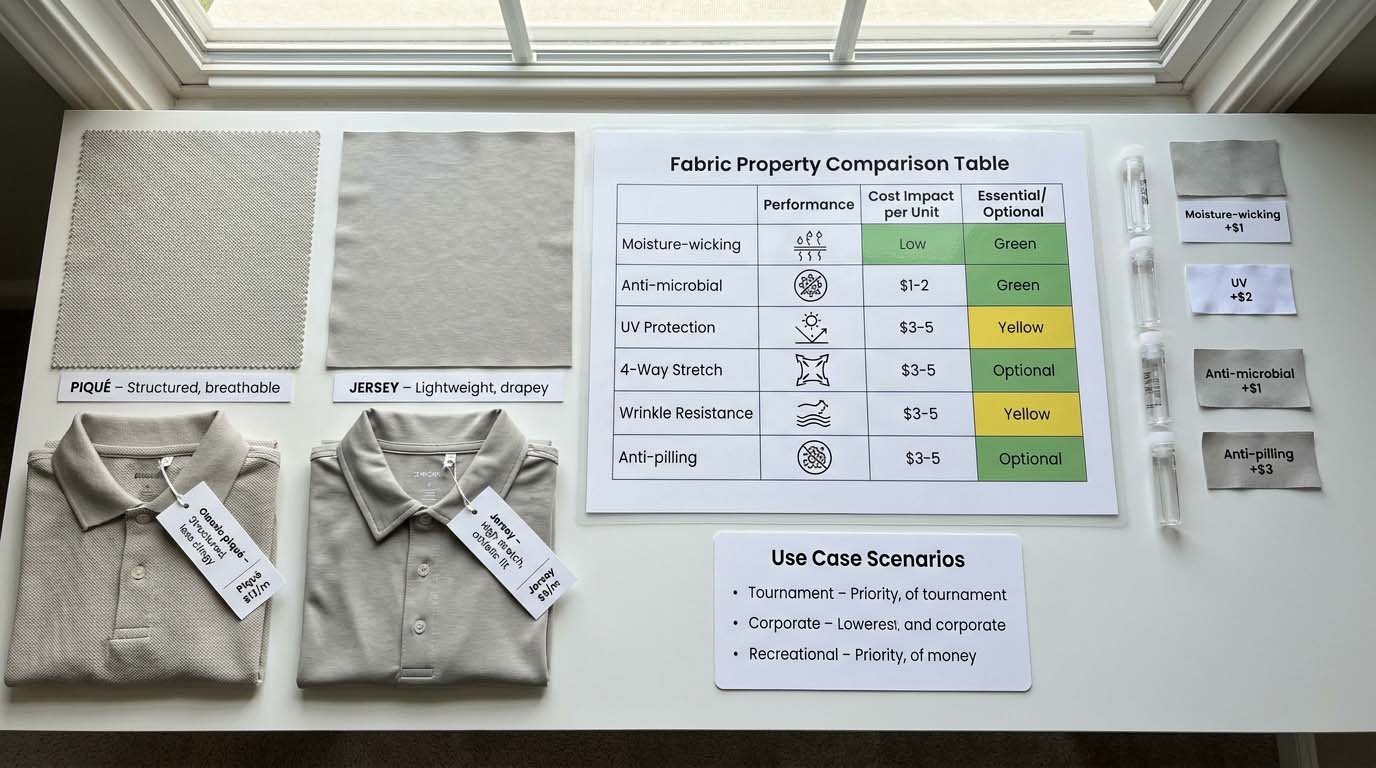
Piqué vs Jersey: Structure Drives Performance
The first decision is fabric structure. This affects breathability, weight, and cost more than material blend.
Piqué (textured, honeycomb structure):
Air pockets between yarns create breathability. Thicker, more structured appearance. Holds shape better, less prone to cling. Slightly heavier for the same GSM. Preferred for traditional golf styling and corporate uniforms.
Typical specs: 180-220 GSM, 95-100% cotton or 50/50 cotton-poly, better wrinkle resistance.
Jersey (smooth, knit structure):
Tight knit, flat surface. Lighter weight, more drape, better moisture transfer to the surface for evaporation. Less structured, can cling when wet. Preferred for athletic performance and modern fits.
Typical specs: 120-160 GSM, 85-100% polyester or poly-spandex blends, higher stretch.
I see clients choose pique because it looks more "golf-like," then complain it is too hot. Or they choose jersey for performance, then complain it wrinkles. Match structure to your use case.
Material Blends: Cotton, Polyester, and Spandex Ratios
100% Cotton:
Soft hand feel, breathable, no synthetic feel. Absorbs moisture but dries slowly. Shrinks 3-5% after first wash. Wrinkles easily. Cost: $3-5 per meter. Rarely used in modern golf polos except for classic luxury lines.
Cotton-Poly Blends (50/50 to 65/35):
Balance of soft feel (cotton) and easy care (polyester). Minimal shrinkage (1-2%). Moderate moisture wicking. Cost: $4-6 per meter. This is the workhorse blend for mid-market polos.
100% Polyester:
Maximum moisture wicking, fast dry, minimal shrinkage. Can feel synthetic or slippery. Holds odor more than cotton. Cost: $5-8 per meter. Standard for performance and athletic lines.
Poly-Spandex (92/8 to 95/5):
Adds stretch and recovery to polyester. Better mobility, returns to shape after stretching. Cost: $6-9 per meter. Necessary for slim fits and athletic movement.
The cost difference between a 50/50 cotton-poly and a 95/5 poly-spandex performance blend is $2-4 per meter, which translates to $1.50-2.50 per unit. Make sure your use case justifies it.
Finishes: Which Add Real Value vs Marketing Claims
Fabric mills offer many finishing treatments. Some are essential, some are optional, some are purely marketing.
Moisture-wicking (essential for polyester):
Treated or engineered to pull sweat away from skin to fabric surface. Minimal cost add ($0.20-0.40 per meter) because it is standard in most polyester knits. If your fabric is polyester and the mill says it is not moisture-wicking, find a different mill.
UV protection (optional, climate-dependent):
UPF 30-50 rating. Adds $0.50-1.00 per meter. Necessary for hot, sunny climates (Florida, California, Middle East). Less critical for northern or cloudy regions.
Anti-microbial (optional, hygiene-focused):
Silver-ion or zinc treatment to reduce odor-causing bacteria. Adds $1-2 per meter. Useful for corporate uniforms (frequent wear, infrequent washing) or multi-day tournaments. Not necessary for recreational weekend wear.
4-way stretch (premium, mobility-focused):
Fabric stretches in both horizontal and vertical directions. Requires spandex content and special knitting. Adds $2-3 per meter. Essential for slim fits and athletic lines. Overkill for relaxed fits.
Anti-pilling (essential for jersey, less critical for pique):
Prevents fiber balls forming on surface after repeated wear. Achieved through yarn quality and knitting tension. Cost varies—cheap jersey pills immediately, premium jersey resists. Ask for pill-test results, not just claims.
I guide clients to pick 2-3 properties that align with their use case, not all of them. Tournament players need moisture-wicking and stretch. Corporate buyers need anti-microbial and wrinkle resistance. Recreational players just need comfortable hand feel and durability.
How Do Fit, Pattern, and Construction Define Quality?
Construction details—collar interlining weight, placket reinforcement, seam allowance, and hem finish—separate premium from budget polos. These specs must be written into your tech pack and verified during pre-production inspection, not just assumed.
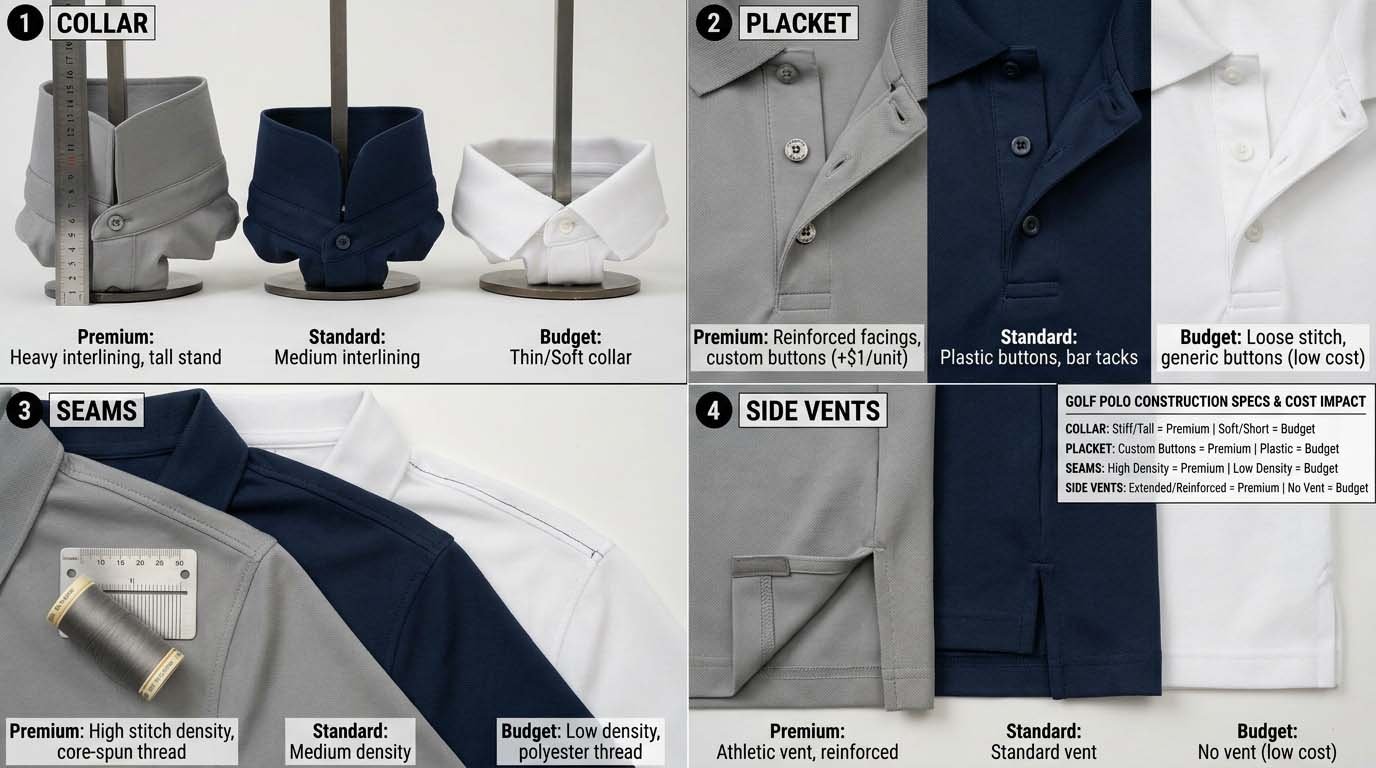
Collar: Stiffness, Height, and Points
The collar makes the first impression. It must hold shape under a cap, after washing, and throughout a round.
Collar construction:
Two-piece (top collar and under collar) with interlining fused in between. Interlining thickness determines stiffness.
Light interlining (0.8-1mm): Soft, casual feel. Folds under cap. Used in jersey polos and athletic styles.
Medium interlining (1-1.2mm): Balanced. Holds shape but not stiff. Standard for most golf polos.
Heavy interlining (1.3-1.5mm): Very structured, traditional. Stays crisp even after 50 washes. Used in premium and corporate polos.
Collar height:
Low collar (6-7cm): Modern, athletic look. Can look too casual for traditional golf settings.
Standard collar (7-8cm): Versatile, suits most face shapes and settings.
High collar (8-9cm): Traditional, formal. Can look dated on younger customers.
Clients often copy a collar style they like without measuring these dimensions. Then bulk production looks different because my factory's "standard collar" is 7cm and their reference was 8cm.
Placket: Buttons, Reinforcement, and Facing
The placket is the front opening where buttons attach. It takes stress during wear and washing.
Button count:
2-button: Casual, athletic, modern. Sufficient for recreational wear.
3-button: Traditional golf standard. Balanced formality.
4-button: Very formal, rarely used in modern golf polos.
Placket construction:
Separate facing strip (reinforcement fabric) sewn behind the button area. Cheap polos skip this—buttons pull through the single layer of body fabric after a few washes. Proper construction uses facing strip + bar tack stitching at the bottom button to prevent tearing.
Button quality:
Plastic: Lightweight, cheap ($0.02-0.05 per button), can crack after repeated washing.
Resin: Mid-range ($0.08-0.12 per button), durable, good color options.
Custom branded: Premium ($0.30-0.60 per button), engraved logo, elevates brand perception.
Button cost seems small but adds up. A 3-button polo with custom buttons adds $1-2 per unit. Make sure your positioning justifies it.
Seams: Stitches Per Inch, Thread Type, and Allowance
Seam quality affects durability and visual finish.
Stitch density:
Budget construction: 10-12 stitches per inch (SPI). Looks loose, gaps form after washing.
Standard construction: 12-14 SPI. Adequate for most use cases.
Premium construction: 14-16 SPI. Very tight, professional finish.
Higher SPI costs more in labor time but prevents seam failure.
Thread:
Core-spun polyester thread is standard—strong, colorfast. Cheap factories use 100% polyester thread that is less flexible and can break under stress.
Seam allowance:
Budget: 1-1.2cm allowance. Minimal fabric waste, but seam can unravel if stressed.
Standard: 1.5cm allowance. Good balance.
Premium: 1.8-2cm allowance, often with overlocked edges. Maximum durability.
Side Vents: Functional vs Decorative
Vents at the hem sides allow the polo to drape without pulling tight around the hips.
No vents: Budget option, can ride up during movement.
Side vents (4-6cm): Standard, improves mobility and drape. Used in 80% of golf polos.
Extended vents (8-10cm): Athletic, modern look. Better for customers with larger hip-to-waist ratio.
Which Logo Method Fits Your Brand and Budget?
Logo method affects unit cost, minimum order quantity, design complexity limits, and wash durability. Embroidery is not always better—match the method to your order volume, logo complexity, and expected garment lifespan.
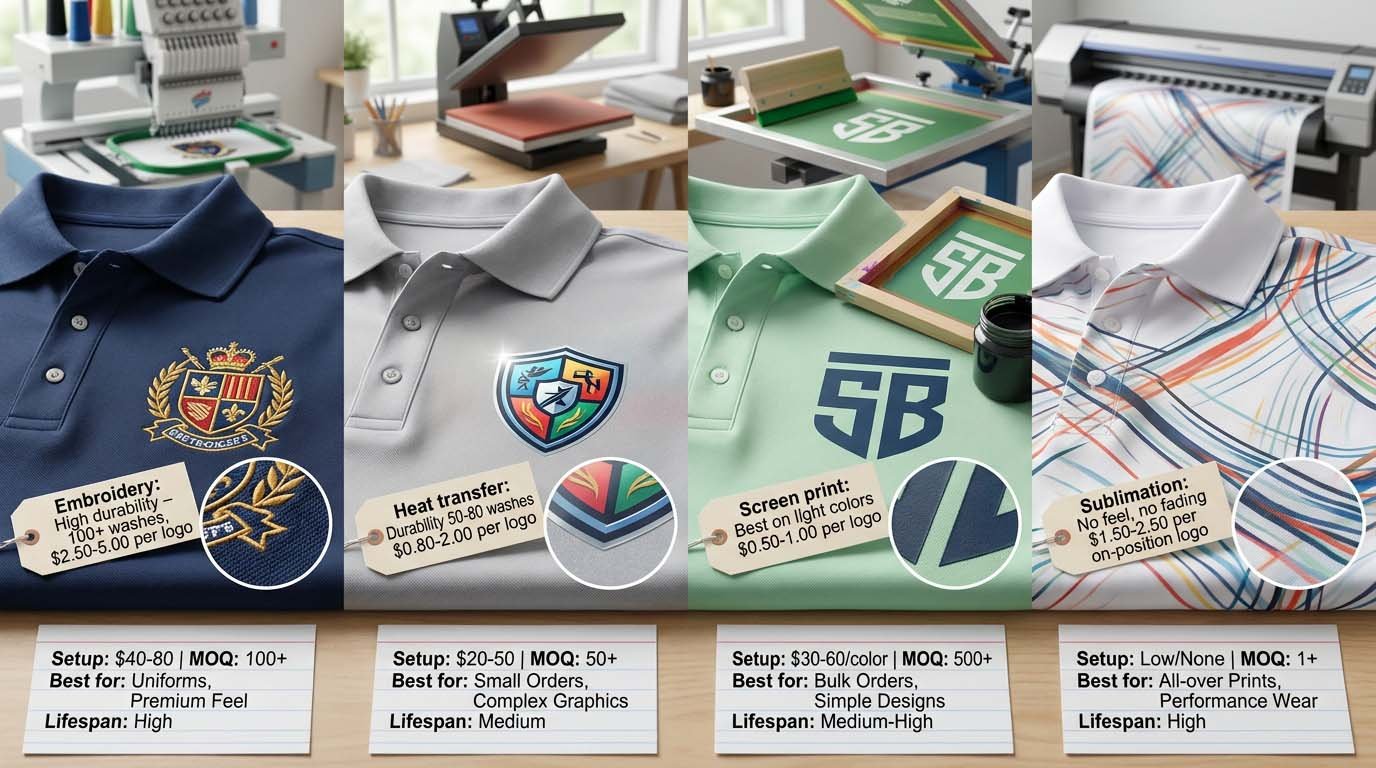
Embroidery: Best for Durability and Premium Feel
Stitches sewn directly into the fabric. Creates texture and dimension.
Advantages:
- Lasts 100+ washes without fading
- Premium appearance, elevates brand perception
- Works on any fabric color and weight
- Feels permanent, professional
Limitations:
- High setup cost ($150-300 per design for digitizing)
- Cost per logo $2.50-5.00 depending on stitch count
- Design complexity limited—fine details and gradients do not translate well
- Can create puckering on lightweight fabrics (<140 GSM)
Cost structure:
Setup fee amortizes across order quantity. For 500 pieces, $200 setup = $0.40 per unit. For 200 pieces, same setup = $1.00 per unit.
Stitch count drives unit cost. Simple logo (3,000-5,000 stitches): $2.50-3.00. Complex logo (8,000-12,000 stitches): $4.00-5.00.
Best for: Orders over 500 pieces, simple logos with 1-4 colors, premium positioning, corporate uniforms.
Heat Transfer: Best for Multi-Color Designs and Lower MOQ
Printed design applied to fabric using heat and pressure.
Advantages:
- Low setup cost ($50-100 for screen or digital printing)
- Handles complex designs, gradients, photos
- Cost per logo $0.80-2.00, lower than embroidery
- No fabric weight restrictions
Limitations:
- Durability varies—50-80 washes before cracking or fading
- Feels like a layer on top of fabric, not integrated
- Can stiffen the fabric area under the logo
- Less premium appearance than embroidery
Cost structure:
Setup fee is minimal. Unit cost scales with logo size and color count.
Small logo (8x8cm), 2 colors: $0.80-1.20 per unit
Large logo (12x15cm), full color: $1.50-2.00 per unit
Best for: Orders under 500 pieces, multi-color complex designs, budget under $12 per unit, short product lifespan (seasonal items).
Screen Print: Best for Large, Simple Logos on Light Fabrics
Ink pushed through a mesh screen onto fabric. Each color requires a separate screen.
Advantages:
- Very low cost per unit ($0.50-1.00 for simple designs)
- Bold, saturated colors
- Fast production after setup
Limitations:
- High setup cost per color ($80-120 per screen)
- Only works well on light-colored fabrics (white, pastels)
- Design complexity limited—no fine details or gradients
- Durability moderate—80-100 washes before fading
Cost structure:
Setup: $80-120 per color. A 3-color logo costs $240-360 setup.
Unit cost: $0.50-1.00 per logo regardless of quantity.
Setup amortization: For 1,000 pieces, $300 setup = $0.30 per unit. For 300 pieces, same setup = $1.00 per unit.
Best for: Large orders (1,000+ pieces), simple 1-3 color logos, light fabric colors, budget positioning.
Sublimation: Best for All-Over Prints and Athletic Styles
Dye infused into polyester fabric using heat. Becomes part of the fabric.
Advantages:
- No setup fee for digital sublimation
- Unlimited colors and complexity
- Does not add weight or stiffness
- Excellent wash durability (does not fade or crack)
Limitations:
- Only works on 100% polyester or high-polyester blends
- Only works on white or very light fabrics (the dye is transparent)
- Minimum order quantity often higher (500-1,000 pieces) due to process setup
Cost structure:
All-over print: $3-5 per unit
Single logo position: $1.50-2.50 per unit
Best for: Performance polos with all-over patterns, athletic brands, modern designs with complex graphics.
What Drives Pricing, MOQ, and Lead Times?
MOQ exists because fabric mills sell in minimum roll lengths (usually 500-1,000 meters), and cutting rooms operate efficiently in batches of 300+ pieces. Unit cost drops with quantity because fixed costs (setup, pattern making, sampling) spread across more units.
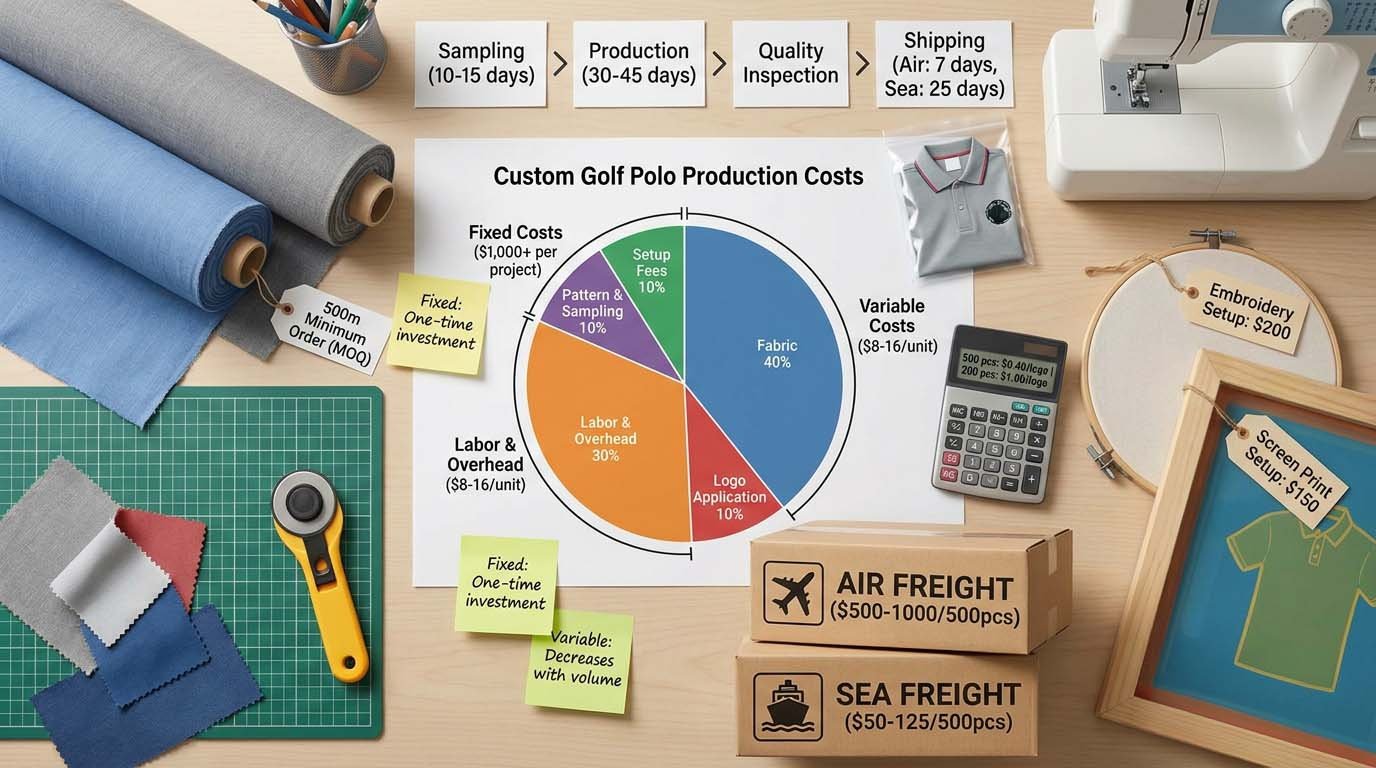
MOQ: What It Covers and How to Negotiate
Most factories quote 500-1,000 piece MOQ for custom polos. Here is what drives that number:
Fabric roll minimums:
Mills sell fabric in rolls of 500-1,500 meters. A polo uses 1.2-1.5 meters per piece. So 500 polos need 600-750 meters—one full roll. If you order 200 pieces, I still need to buy 500+ meters, and the remaining fabric sits in inventory.
Cutting efficiency:
Cutting rooms work in lays (layers of fabric stacked and cut simultaneously). Minimum efficient lay is 50-100 layers. Cutting 200 pieces across 4 sizes means 50 pieces per size—one lay per size. Cutting 500 pieces means 125 pieces per size—more efficient spreading and less waste.
Logo setup amortization:
Embroidery digitizing, screen making, or print setup costs $150-300. At 500 pieces, that is $0.30-0.60 per unit. At 200 pieces, that is $0.75-1.50 per unit.
How to negotiate lower MOQ:
Ask if the factory has your fabric in stock from previous orders. If yes, MOQ can drop to 200-300 pieces because fabric is already sourced.
Accept the fabric options the factory has in inventory, not custom fabric. This eliminates roll minimum issues.
Use heat-transfer logos instead of embroidery to reduce setup costs.
Pay a higher per-unit cost to compensate for lower efficiency.
Pricing: Fixed vs Variable Costs
Understanding cost structure helps you negotiate better.
Fixed costs (do not change with quantity):
- Pattern making and grading: $100-200
- Sample development: $150-300
- Logo digitizing or screen setup: $150-300
- Fabric development (if custom): $200-500
Total fixed costs: $600-1,300 depending on complexity.
Variable costs (scale with quantity):
- Fabric: $4-9 per meter × 1.3 meters per polo = $5-12 per unit
- Logo application: $0.80-5.00 per unit
- Labor and overhead: $2-4 per unit
At 200 pieces: Fixed cost per unit = $3-6.50, Variable cost = $8-16, Total = $11-22.50
At 500 pieces: Fixed cost per unit = $1.20-2.60, Variable cost = $8-16, Total = $9-18.60
At 1,000 pieces: Fixed cost per unit = $0.60-1.30, Variable cost = $8-16, Total = $8.60-17.30
This is why bulk pricing drops 15-25% as quantity increases.
Lead Times: Sampling, Production, and Shipping
Sampling phase: 10-15 days
- Day 1-3: Receive tech pack, clarify specs, source fabric swatches
- Day 4-8: Cut and sew first sample
- Day 9-12: Ship sample to client, receive feedback
- Day 13-15: Revise and produce second sample if needed
Most projects need 2-3 sample rounds. Total sampling time: 3-6 weeks.
Bulk production: 30-45 days after sample approval
- Day 1-7: Order fabric from mill (if not in stock)
- Day 8-12: Fabric arrives, pre-production inspection
- Day 13-20: Cutting and printing/embroidery prep
- Day 21-35: Sewing
- Day 36-40: Quality inspection, packing
- Day 41-45: Ready for shipment
Rush production (15-20 days) is possible if fabric is in stock and production line has capacity. Cost premium: 15-20%.
Shipping:
Air freight (5-7 days): $4-8 per kg. A polo weighs 200-250g. For 500 pieces, air freight adds $500-1,000.
Sea freight (20-30 days): $0.50-1.00 per kg. For 500 pieces, sea freight adds $50-125.
Most clients choose sea freight unless launch deadline is urgent.
How Do You Ensure Bulk Quality Matches Your Sample?
Sample approval does not guarantee bulk consistency. You need three checkpoints: bulk fabric approval before cutting, pre-production sample from actual bulk fabric, and in-line inspection during sewing. Skipping any of these creates risk.
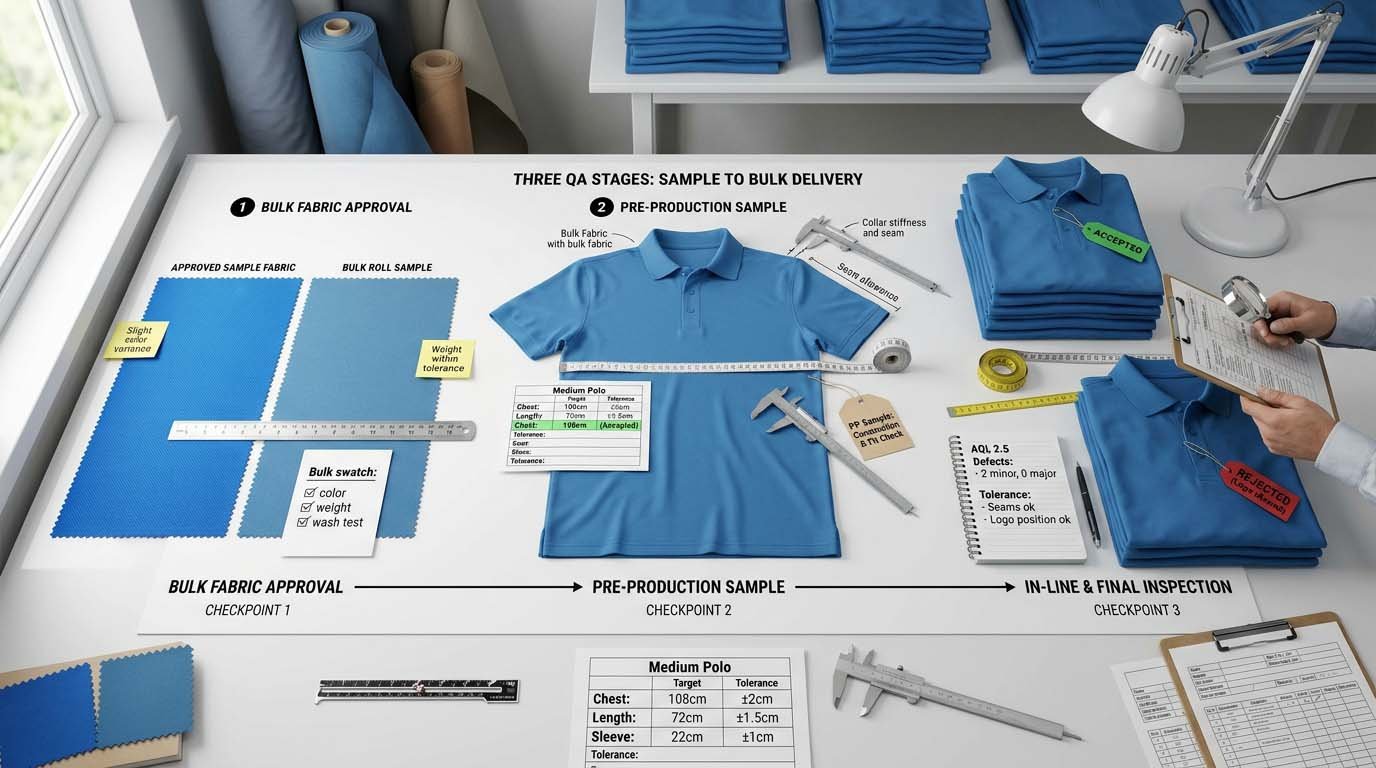
Checkpoint 1: Bulk Fabric Approval
Your sample fabric and bulk fabric may not match, even if they are "the same" fabric. Here is why:
Dye lot variation:
Fabric is dyed in batches. Each batch has slight color variation—usually within 1-2 shades on a standard color card. This is industry normal, but if you do not specify acceptable tolerance, you might reject bulk that is technically within standard.
Shrinkage inconsistency:
Sample fabric might come from a test batch that has been relaxed and pre-shrunk. Bulk fabric might come fresh from the mill with residual shrinkage. After cutting and sewing, bulk pieces may be 2-3% smaller than your sample.
Hand feel changes:
Different fabric roll batches can have slightly different softness or stiffness due to finishing chemicals or knitting tension variation.
What to require:
Before the factory cuts bulk fabric, request a fabric swatch from the actual bulk roll. Compare it to your approved sample under natural light. Check color, hand feel, and weight. Wash the swatch and measure shrinkage. Approve this before cutting begins.
Checkpoint 2: Pre-Production Sample from Bulk Fabric
A pre-production sample (also called "gold sample" or "size set sample") is sewn from the actual bulk fabric before mass production starts.
What it validates:
- Bulk fabric color and hand feel
- Construction accuracy (seam allowances, stitch count, collar stiffness)
- Logo placement and quality from bulk production setup
- Sizing accuracy after shrinkage
This is your last chance to catch problems before 500-1,000 pieces are sewn. Most factories offer this at no extra cost if you request it.
Checkpoint 3: In-Line and Final Inspection
Inspection catches construction errors during and after sewing.
In-line inspection (during production):
Inspector checks the first 10-20 pieces off the sewing line. Verifies logo placement, seam quality, collar symmetry. If problems are found, production stops and corrections are made before more pieces are sewn.
Final inspection (after production completes):
Random sample inspection (usually AQL 2.5 standard). Inspectors check:
- Measurement accuracy (each size matches size spec within ±1cm)
- Construction defects (skipped stitches, uneven hems, loose threads)
- Logo quality (position within ±1cm tolerance, no thread breaks in embroidery)
- Fabric defects (holes, stains, color streaks)
Standard acceptance: 2.5% major defects allowed, 4% minor defects allowed.
If your brand does not have an inspection team, hire a third-party inspection company ($150-250 per inspection day). This investment prevents costly bulk rejections.
Size Spec Grading and Tolerance
Your size chart must include tolerance ranges, not just target measurements.
Example size spec for Medium:
- Chest: 108cm ±2cm (acceptable range: 106-110cm)
- Length: 72cm ±1.5cm (acceptable range: 70.5-73.5cm)
- Sleeve: 22cm ±1cm (acceptable range: 21-23cm)
Without tolerance ranges, the factory does not know if 107cm chest is acceptable or a defect. Every sewn garment has natural variation—stitching tension, fabric stretch, operator technique. Realistic tolerance prevents unnecessary rejections.
Standard tolerances:
- Chest, waist, hips: ±2cm
- Length, sleeve: ±1.5cm
- Collar, cuff: ±0.5cm
Conclusion
Custom golf polo success requires aligning fabric-logo-MOQ with your use case and budget, then implementing three quality checkpoints—bulk fabric approval, pre-production sample, and in-line inspection—to ensure your sample quality carries through to bulk delivery.