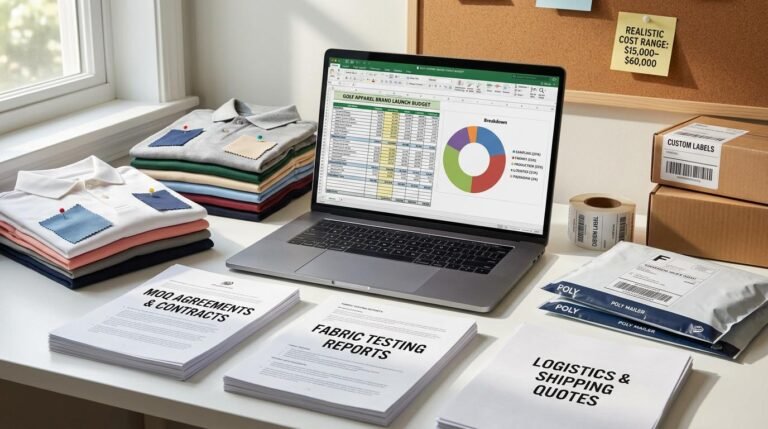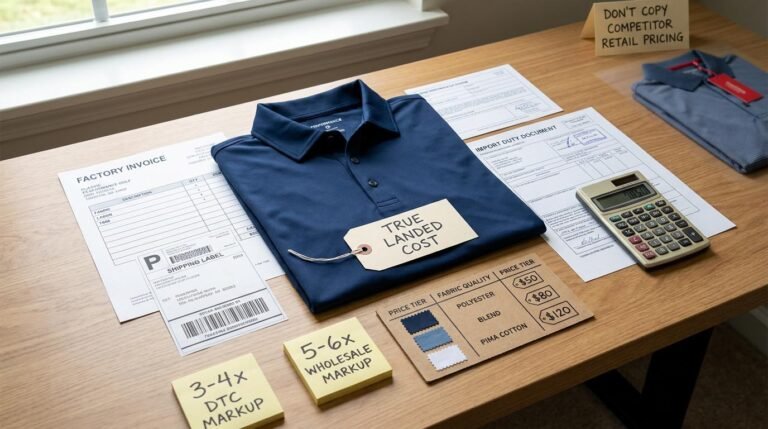
A client sent me a tech pack with beautiful color swatches and logo mockups. But they left blank the most critical fields: target retail price, order quantity, and use case. I asked if this was for tournament players or resort wear. They said "both." I explained that building one polo for both creates compromises that satisfy neither market.
Successful custom golf polo design requires aligning your use case, brand positioning, and order volume before selecting fabric and logo methods. Design decisions without cost structure and production feasibility create polos that look good on paper but fail in production or market.
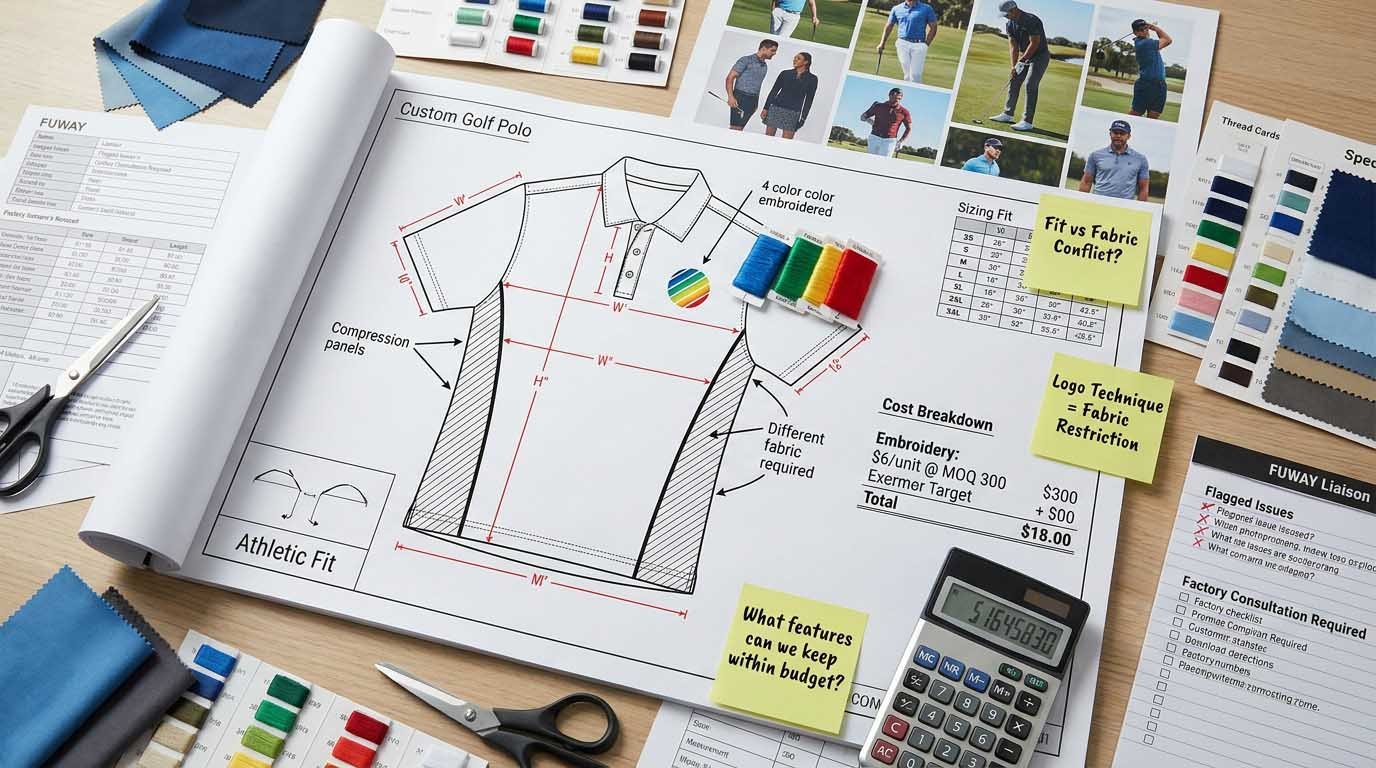
I am Will from FUWAY. I translate what golf brands tell me they want into specifications our factory can actually produce. Most design failures happen in the translation—between what looks good in a mockup and what delivers consistent quality across 1,000 pieces. Clients see a competitor's polo they like and say "make this but cheaper." I explain that specific fabric, collar construction, and embroidery methods created that quality level and price point. We cannot keep the same specs and cut 30% of the cost. This guide shows you how to build a design playbook that aligns your vision with production reality.
Quick Answers: Custom Golf Polo Design Essentials
What information do I need before designing a custom golf polo?
Target retail price, order quantity (200, 500, or 1,000+ pieces), primary use case (performance, casual, or corporate), and brand positioning (premium, mid-market, or value). These four parameters determine which fabric-logo-construction combinations are feasible.
How much do fabric choices affect final cost?
Fabric accounts for 40-60% of total unit cost. A basic cotton-poly pique costs $4-5 per meter; premium performance jersey with stretch costs $8-10 per meter. Since each polo uses 1.2-1.4 meters, fabric choice alone creates a $5-7 per unit price difference.
Should I design multiple polo styles or start with one versatile design?
Start with one well-executed design for your core customer. A single polo optimized for your primary use case outsells a line of three compromised designs. After proving demand with 500-1,000 pieces, add variants.
What is the minimum order quantity for fully custom design?
500-1,000 pieces for custom fabric and embroidered logos. 200-300 pieces if you accept in-stock fabric options and heat-transfer logos. Below 200 pieces, unit cost rises 40-60% due to setup cost concentration.
How many color options should I offer in my first production?
2-3 solid colors maximum. Each color requires separate cutting and sewing setup. More colors split your inventory and increase stockout risk. Test market with core colors, expand based on sales data.
What is the typical design-to-delivery timeline?
15-20 days for sampling (2-3 rounds), 30-45 days bulk production after approval, plus 7-30 days shipping depending on method. Total: 60-90 days from design freeze to warehouse delivery.
Can I use the same design across different fabric weights for different seasons?
Yes, but you must re-sample and adjust grading. Heavier fabric (200 GSM vs 140 GSM) requires different pattern allowances because drape and stretch change. Same visual design, different technical specs.
How Should You Define Your Design Brief to Avoid Conflicts?
Your design brief must specify use case (competitive vs casual golf), target customer profile (age, body type, climate), budget per unit including all decoration, and minimum order quantity. Vague briefs lead to mismatched fabric-fit-logo combinations that look good in concept but fail in production feasibility checks.
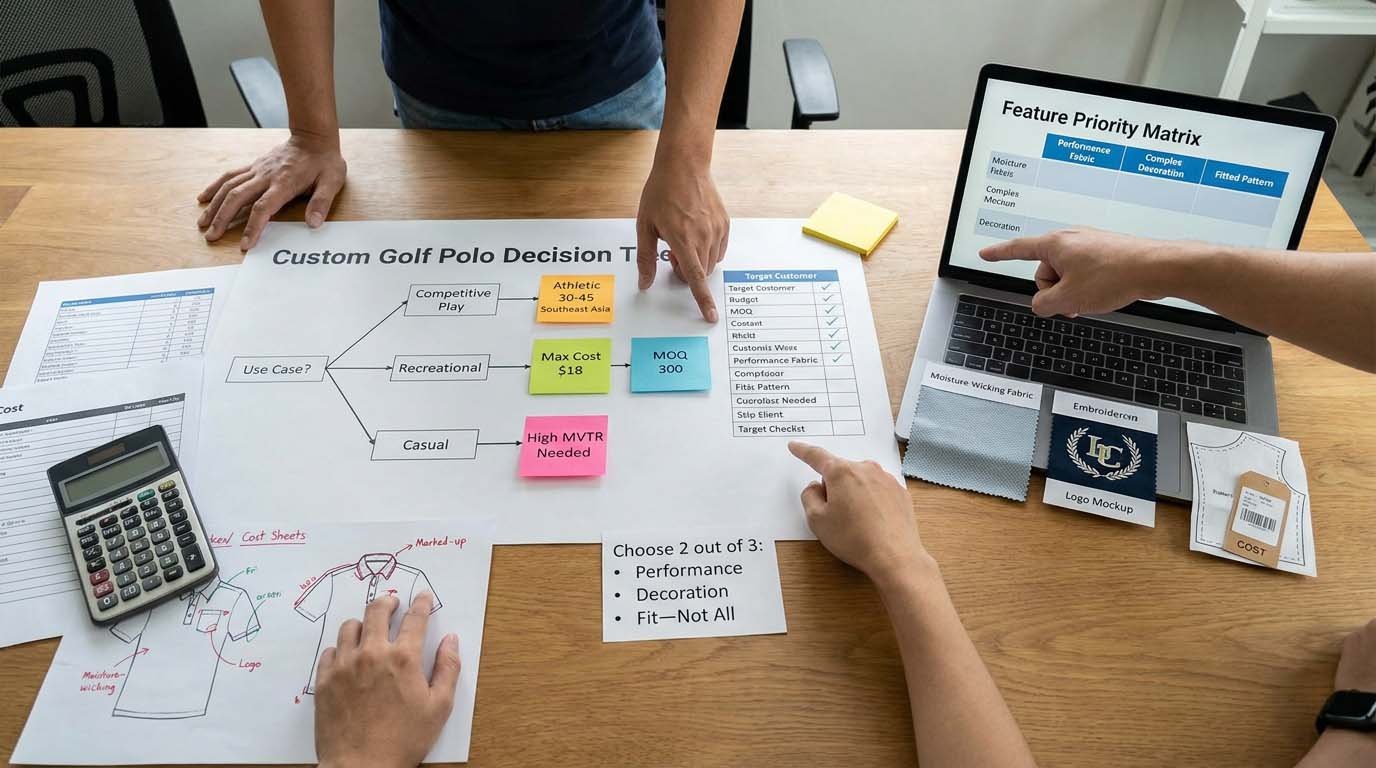
Critical Brief Elements That Control Production
When I receive a design inquiry, I need these answered before I can recommend fabric or sampling options:
Use Case Definition
Competitive tournament play, recreational weekend golf, or off-course casual wear? Each requires different performance priorities. Tournament play demands maximum mobility and moisture management. Casual wear prioritizes comfort and style over technical features. This decision affects fabric selection, fit tolerance, and cost.
Target Customer Profile
Age range, average build, and geographic market. A 30-year-old athletic customer needs a different fit profile than a 60-year-old recreational player. Hot, humid climates require higher MVTR fabrics. These factors determine which fabric-fit combinations will generate returns.
Budget Reality Check
Not your retail price—your landed unit cost including fabric, construction, decoration, packaging, and shipping. Brands often tell me their retail target without knowing their cost ceiling. If your retail is $40 and you need 50% margin, your maximum cost is $20. That budget eliminates certain fabric-logo combinations immediately.
Quantity Commitment
MOQ affects everything—embroidery setup costs, fabric pricing tiers, pattern grading complexity, and sampling rounds you can afford. Below 300 pieces, multi-color embroidery becomes cost-prohibitive. Below 500 pieces, custom fabric dyeing is impractical. I need to know your quantity before recommending decoration methods.
The Feature Priority Matrix
I created a simple framework I share with brands during brief discussions. You can prioritize two of these three feature categories, but not all three simultaneously within typical golf polo budgets:
| Feature Category | What It Includes | Cost Impact | Production Complexity |
|---|---|---|---|
| Performance Fabric | Moisture-wicking, stretch, quick-dry, UV protection | +30-50% vs basic | Moderate—requires specific yarn and knit |
| Complex Decoration | Multi-color embroidery, all-over sublimation, metallic threads | +$3-8 per unit | High—needs specialized machinery or manual steps |
| Fitted Pattern | Athletic cut, compression panels, articulated sleeves | +20-30% vs standard | High—requires multiple sampling rounds and size testing |
Brands that request all three usually need to compromise during sampling when they see the cost breakdown. Starting this conversation in the brief stage saves time.
What Fabric and Knit Choices Create Production Conflicts?
Piqué knit offers texture and breathability but limits logo clarity for screen printing. Jersey knit provides a smooth surface for graphics but shows sweat marks more visibly. Performance blends (polyester/spandex) enable stretch and wicking but feel less natural than cotton blends. Every fabric choice trades one benefit for another constraint.
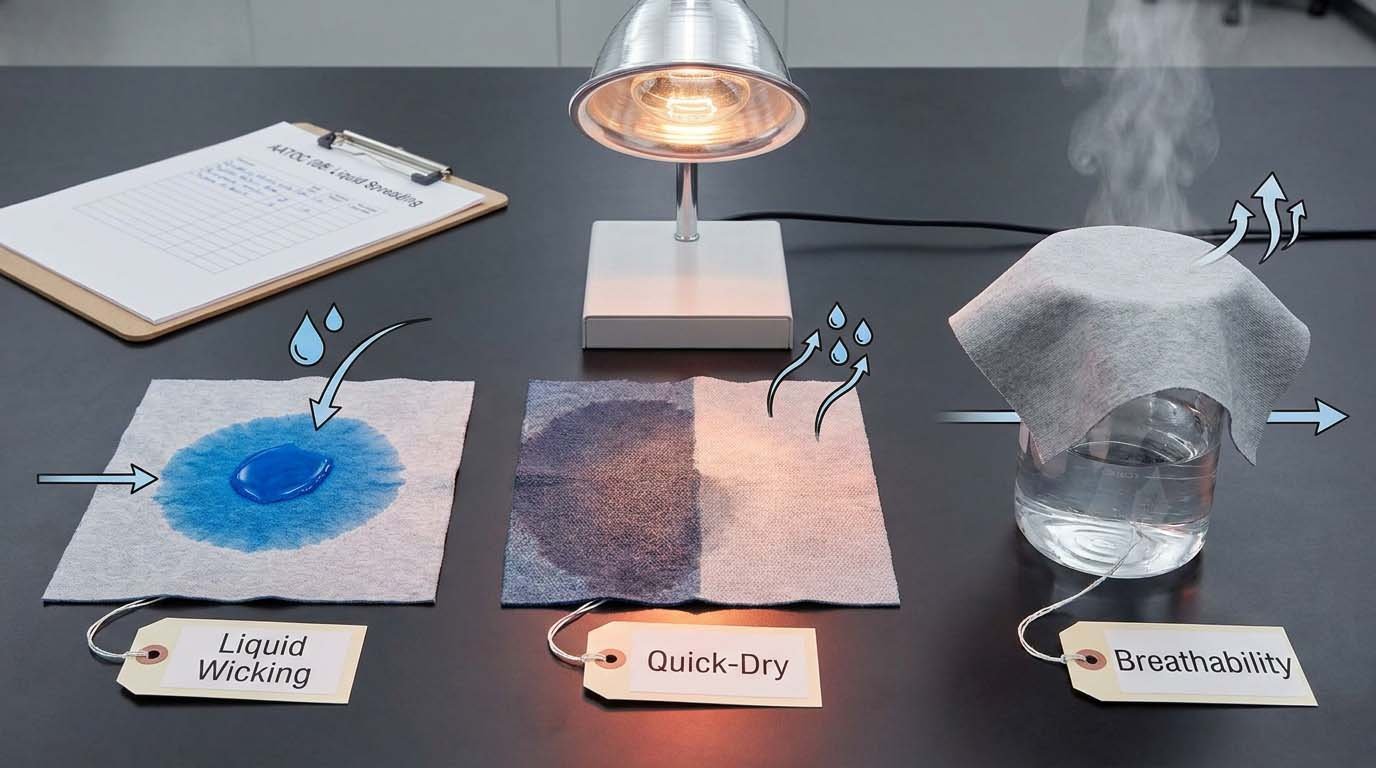
Piqué vs Jersey: The Core Decision
Piqué Knit
The textured surface with raised geometric patterns. Traditional golf polo look. Creates air gaps between fabric and skin for ventilation.
Production considerations I explain to brands:
- Texture interferes with screen printing—ink does not sit flat on raised surface. Embroidery works better.
- The knit structure requires specific yarn weights. You cannot make lightweight piqué—it loses structural integrity below 180 GSM.
- Color matching is harder because the texture creates shadows that alter perceived color. Pantone matches may not look exact.
Best for: Traditional golf aesthetic, embroidered logos, brands prioritizing classic look over technical performance claims.
Jersey Knit
Smooth, flat surface. Modern athletic appearance. Closer skin contact for faster wicking.
Production considerations:
- Smooth surface is ideal for screen printing and sublimation—graphics appear sharp.
- Shows body contours more clearly. Requires better fit accuracy or customers complain it looks too tight.
- More prone to visible sweat marks because the flat surface shows moisture darkening.
Best for: Modern performance aesthetic, large graphic placements, brands prioritizing technical claims.
Blends That Contradict Performance Claims
Brands often request fiber blends without understanding how the ratios affect the properties they advertise.
Cotton/Polyester Blends
Common request: "50/50 blend for natural feel with performance."
Reality: At 50/50, you lose cotton's softness and polyester's wicking. The blend wicks slower than 100% polyester and feels less soft than 100% cotton. You get the middle of both, not the best of both.
When blends work: 65% polyester / 35% cotton. The polyester dominates moisture management while cotton adds enough softness to reduce synthetic feel. Or 80% cotton / 20% polyester for casual styles where wicking is secondary to comfort.
Polyester/Spandex Performance Fabrics
Common request: "4-way stretch with moisture-wicking."
Reality: Spandex (elastane) is hydrophobic—it repels water. Adding more than 8-10% spandex reduces the fabric's wicking capability. Brands requesting 15-20% spandex for extreme stretch need to accept lower moisture management scores.
When it works: 92% polyester / 8% spandex. Enough stretch for golf mobility without significantly compromising wicking.
Performance Finishes That Wash Out
Brands list desired finishes—moisture-wicking, antimicrobial, UV protection, wrinkle resistance—without asking which are permanent and which degrade.
From my experience handling post-production complaints:
Wicking finishes (chemical application): Wash out after 15-20 launderings unless you specify durable finish, which adds 10-15% to fabric cost.
Antimicrobial treatments: Standard silver-ion treatments lose effectiveness after 20-30 washes. Permanent antimicrobial requires special fiber treatment, available only in limited fabric options.
UV protection: Only reliable when built into the fiber (UV-absorbing additives) or achieved through tight knit structure. Topical UV finishes wash out.
I always ask brands whether their performance claims need to survive 50+ washes or if initial performance is acceptable. This determines fabric selection and cost tier.
How Do Fit and Construction Details Affect Sampling Timelines?
Collar styles, placket configurations, and hem shapes are aesthetic choices with minimal production impact. Fit adjustments for specific body types or movement patterns require pattern engineering and multiple sampling rounds. Brands that treat fit as a simple spec change underestimate the timeline.
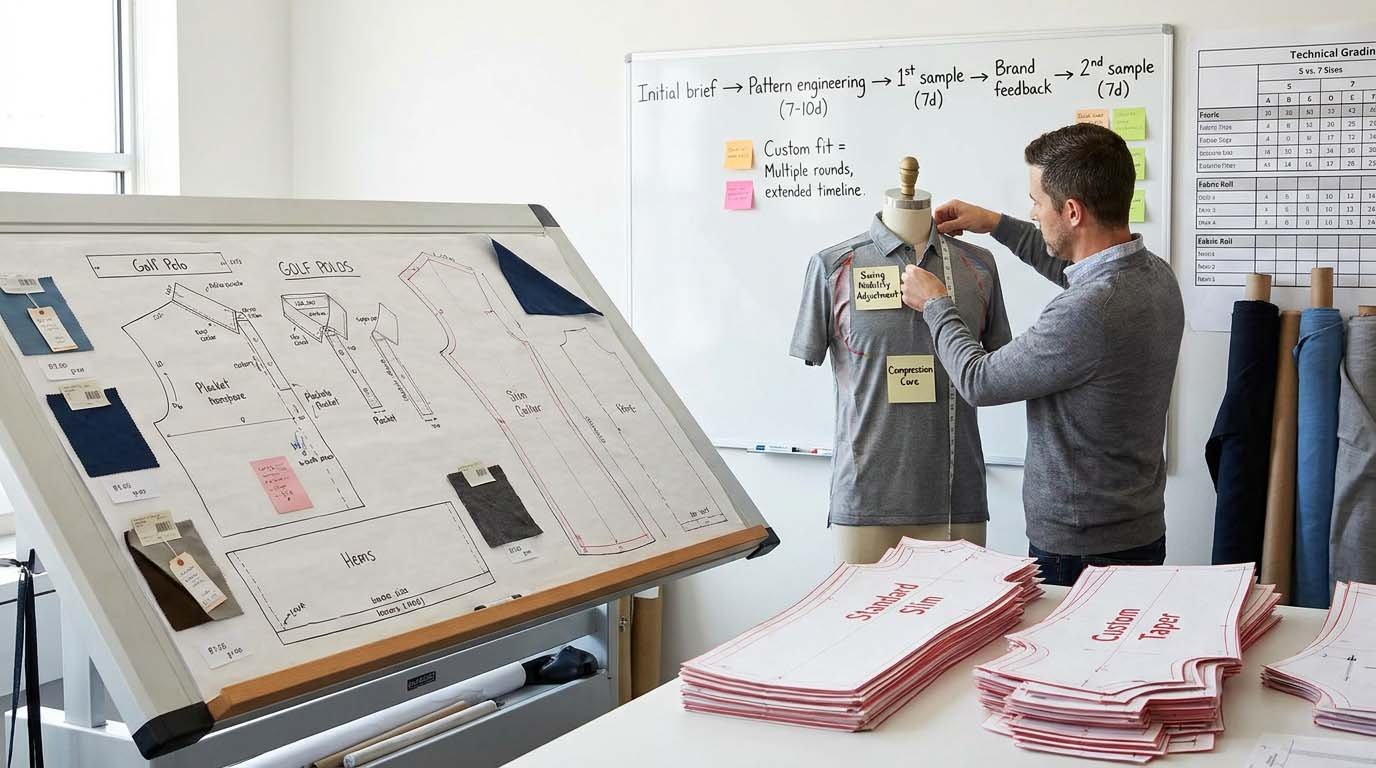
Aesthetic Construction Choices
These decisions affect appearance and cost modestly but do not require pattern development:
Collar Styles
- Flat knit collar (traditional, stiff)
- Self-fabric collar (matches body fabric, softer)
- Contrast color collar (requires separate fabric dyeing)
- Ribbed knit collar (adds texture)
Cost difference: $0.10-0.30 per unit. Production impact: minimal—we stock multiple collar options.
Placket Styles
- Two-button (casual)
- Three-button (standard golf)
- Four-button (formal)
- Hidden placket (modern, clean front)
Cost difference: $0.05 per additional button. Production impact: minimal—standard sewing operations.
Hem and Vent Options
- Straight hem with side vents (traditional, allows tucking)
- Curved hem (modern, designed for untucked wear)
- No vents (cleaner look, restricts movement slightly)
Cost difference: negligible. Production impact: minimal—pattern adjustment only.
Fit Adjustments That Extend Timelines
Standard Fit Pattern
We maintain graded patterns for straight fit, slim fit, and relaxed fit across standard size runs (S, M, L, XL, XXL). If your fit falls within one of these categories, we can start sampling immediately after fabric selection.
Custom Fit Requirements
Brands request:
- Extra shoulder width for swing mobility
- Dropped back hem for bend-over coverage
- Tapered body with relaxed sleeves
- Compression fit in core with standard fit in arms
These require pattern engineer involvement. Each adjustment adds 7-10 days to sampling timeline and typically requires 2-3 sample iterations to finalize. The cost impact is not in the garment itself but in the extended sampling and approval cycle.
I ask brands during brief review: Are you willing to accept a standard fit category, or do you need custom pattern work? If custom, does your project timeline allow for 3-4 weeks of additional sampling?
The Hidden Cost of Size Range Expansion
A brand requested our standard five sizes (S-XXL), then during sampling asked to add XXXL and XS. I explained this requires full pattern grading across seven sizes and new fit samples for approval. They thought it was a simple addition.
Pattern grading complexity:
- Five-size run: Standard, minimal cost
- Seven-size run: +15-20% pattern development cost
- Extended sizes (XXXL, XXXXL): May require different fabric weight or construction to maintain structure
If you know you need extended sizes, specify it in the brief. Adding sizes mid-sampling restarts grading work.
Which Logo and Decoration Techniques Conflict With Fabric Choices?
Embroidery provides durability and premium feel but cannot reproduce fine details or gradients, and adds significant cost on low quantities. Screen printing allows detail and color but requires flat fabric surfaces and compatible inks. Sublimation offers unlimited colors but only works on polyester, and cannot be done on dark fabrics. Heat transfer is cost-effective for low quantities but has lower wash durability.
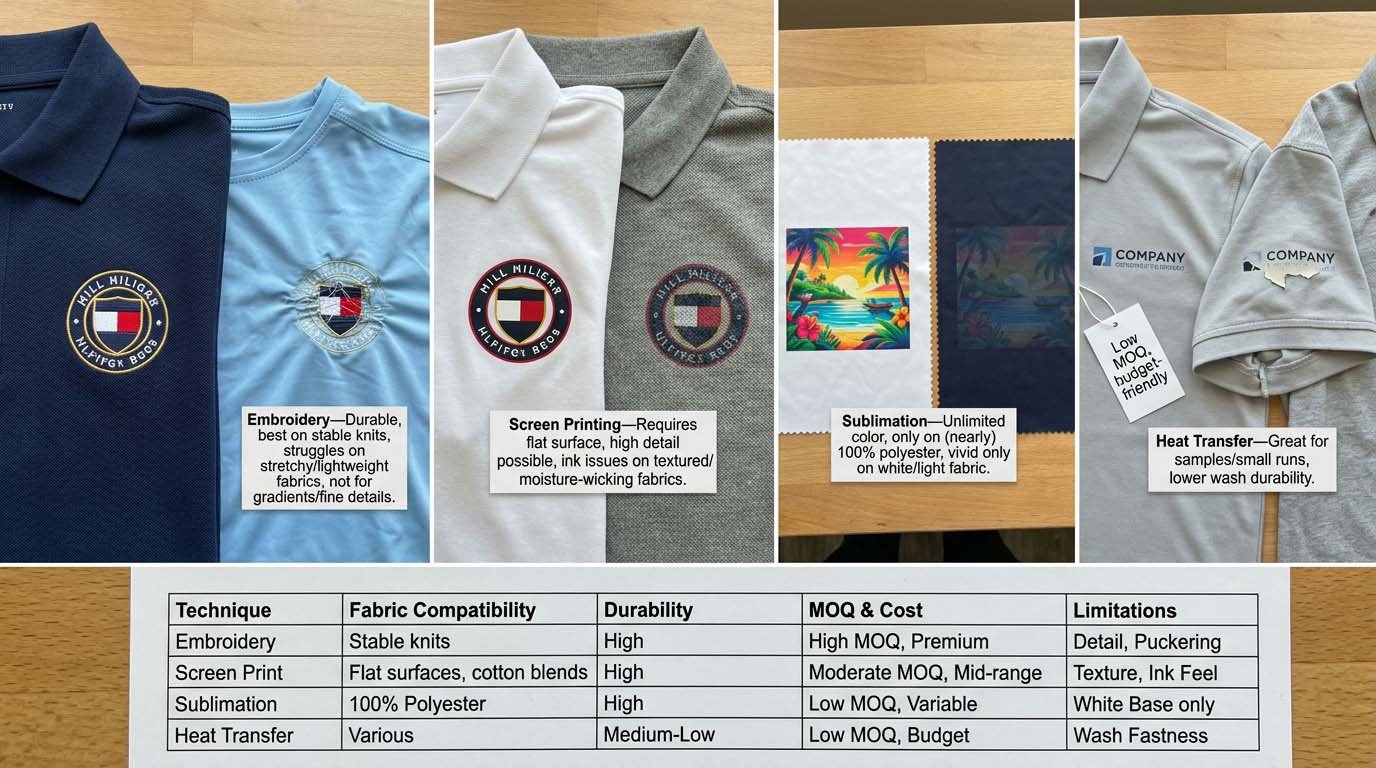
Embroidery: Cost vs Quality Tradeoffs
Brands love embroidery for its premium look and durability. But embroidery has strict limitations that affect design feasibility.
When embroidery works well:
- Logo has clean lines and solid color fills (no gradients or fine detail)
- Stitch count under 10,000 per logo
- Quantity above 500 pieces (setup costs spread across volume)
- Fabric is stable knit (piqué, heavier jersey) that does not distort under hoop tension
When embroidery creates problems:
- Logo has gradients or shading—embroidery cannot blend colors smoothly
- Fine text under 3mm height—thread thickness makes letters illegible
- Multiple logo placements (chest, sleeve, back)—each position adds setup and stitching time
- Lightweight stretch fabrics—fabric distorts during embroidery, creating puckering
Cost reality check:
A brand asked for three-color embroidery on chest, left sleeve, and back collar. At their 300-piece MOQ, embroidery alone would cost $9 per unit ($3 per placement). Their target cost was $15 total. Not feasible.
Screen Printing: Fabric and Color Constraints
Screen printing is cost-effective for larger designs and quantities but requires specific fabric characteristics.
When screen printing works:
- Jersey knit or smooth piqué (flat surface for ink adhesion)
- Design has solid color separations (each color is a separate screen)
- Quantity above 300 pieces per colorway
- Fabric is pre-tested for ink compatibility
When screen printing fails:
- Heavy texture piqué—ink does not sit flat, colors look inconsistent
- Moisture-wicking finishes that repel water-based inks
- Very stretchy fabrics (high spandex content)—design distorts when worn
- All-over prints or large back graphics—requires specialized oversized screens
I have seen brands submit screen print artwork designed for paper, not fabric. Fine lines and small details that look sharp on screen turn into blobs when printed on textile. I request artwork at actual size and explain minimum line weights (1mm) and text heights (6mm).
Sublimation: Polyester-Only Limitation
Sublimation allows full-color, photo-realistic graphics with no hand feel (the ink becomes part of the fiber). But it has a hard constraint.
Requirement: Fabric must be 100% polyester or near-100% (95%+ polyester blends).
Brands requesting sublimation on cotton blends discover mid-sampling that sublimation does not work. The cotton fibers do not accept the dye. The design appears faded or disappears entirely.
Second constraint: Sublimation only shows on white or light-colored fabric. Dark fabric shows no color change. Brands wanting sublimation on navy or black polos cannot—the base fabric must be white or very light gray.
How Do Size Specs and Sampling Prevent Production Failures?
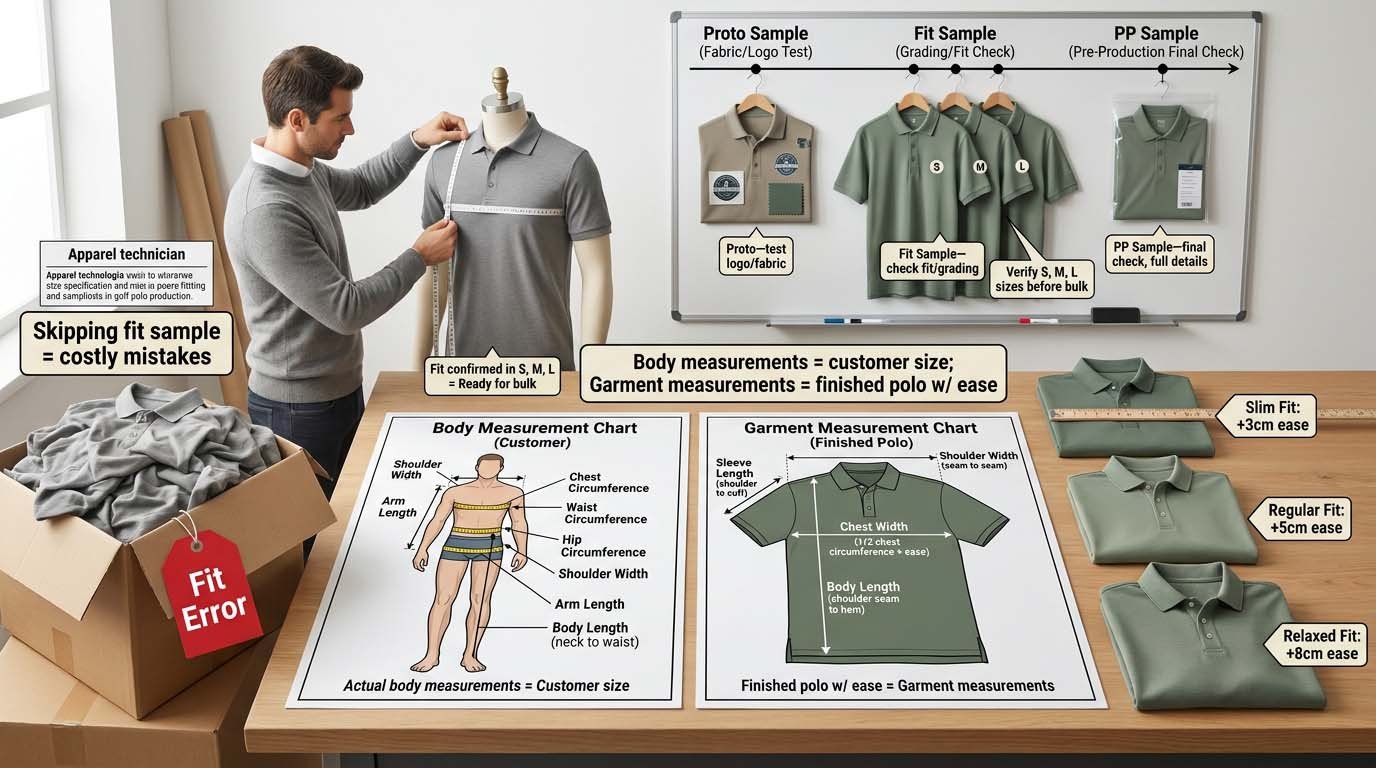
Size specifications must include actual body measurements for your target customers, not just standard size labels. Pattern grading should be tested across your full size range before pre-production approval. Brands that approve only one size and assume grading will work for all sizes face fit issues discovered too late.
Measurement Specifications That Matter
When I request size specs from a brand, I need their customers' actual body measurements, not their desired garment measurements. Many brands confuse these.
Body measurements (what the customer measures on their body):
- Chest circumference
- Waist circumference
- Hip circumference
- Shoulder width
- Arm length
- Body length (neck to waist)
Garment measurements (what the finished polo measures when laid flat):
- Chest width (1/2 chest circumference + ease)
- Body length (shoulder seam to hem)
- Sleeve length (shoulder seam to cuff)
- Shoulder width (seam to seam)
The garment measurements must be larger than body measurements to allow wearing ease and movement. The amount of ease depends on fit type—slim fit uses 3-4cm ease, relaxed fit uses 6-8cm ease.
Brands that submit garment measurements without specifying ease or body measurements force us to guess their intended fit. This creates sampling errors.
The PP Sample Approval Trap
Our sampling process:
- Proto sample—first sample to test fabric, construction, and logo placement
- Fit sample—second sample to confirm sizing and fit after any pattern adjustments
- PP sample (pre-production)—final sample from bulk fabric with all details finalized
Brands sometimes approve the Proto and skip Fit sample to save time. Then during bulk production they discover the graded sizes do not fit their team properly. By that point, fabric is cut and production is started. Changes require restarting production with new fabric.
I always recommend Fit samples in at least three sizes (S, M, L or M, L, XL) to verify grading before PP approval. The extra sample round saves more time than it costs.
What Production Realities Affect Your Timeline and Budget?
MOQ, lead times, and quality testing requirements are not negotiable production constraints. Attempting to reduce MOQ below 300 pieces increases per-unit costs by 40-60%. Requesting faster delivery than standard lead times requires air freight that doubles shipping costs. Skipping quality tests to save time creates customer return risk that exceeds the cost savings.
MOQ and Cost Relationship
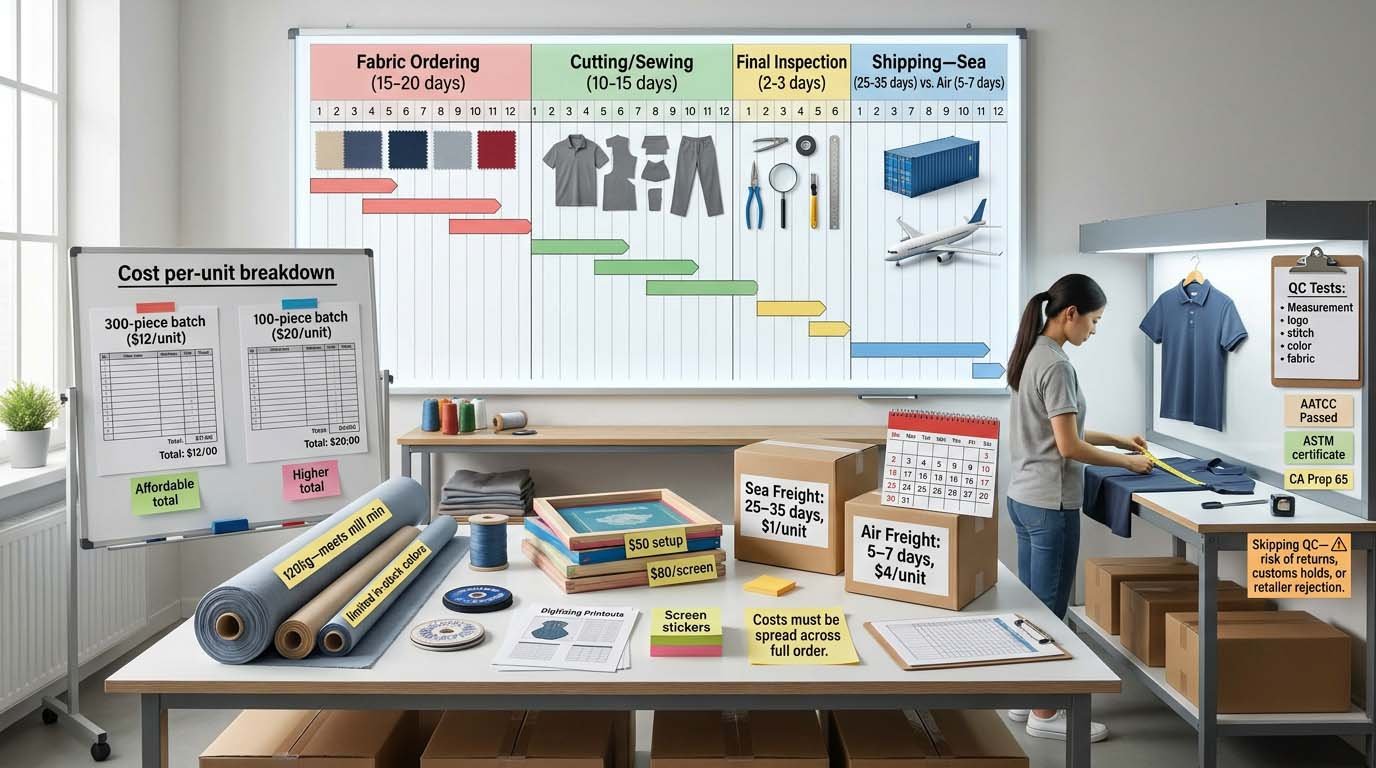
Our standard MOQ is 300 pieces per style (not per colorway—per complete design including all colors). Brands requesting lower quantities need to understand the cost structure.
Why 300-piece MOQ exists:
Fabric minimum: Mills require minimum 50-100kg fabric orders. One polo uses approximately 0.4kg fabric. 300 pieces = 120kg, meeting mill minimums for custom colors.
Setup costs: Embroidery machines require digitizing ($50-100) and setup time. Screen printing requires screen making ($30-80 per color). These fixed costs must spread across volume.
Grading and pattern costs: Pattern development and grading across five sizes costs $200-400. At 300 pieces, that is $0.70-1.30 per unit. At 100 pieces, it is $2-4 per unit.
What happens below 300 pieces:
- Cost per unit increases 40-60%
- Fabric choice limited to in-stock colors only
- Decoration limited to single-color embroidery or heat transfer
- Extended lead times (waiting for other orders to combine for fabric minimums)
Standard Lead Time Reality
From PO approval to delivery:
| Stage | Duration | What Happens |
|---|---|---|
| Fabric ordering | 15-20 days | Mill dyes and knits fabric to spec |
| Cutting and sewing | 10-15 days | Pattern cutting, assembly, decoration, QC |
| Final inspection | 2-3 days | Check measurements, logo quality, packaging |
| Shipping (sea) | 25-35 days | Container to port, customs, delivery |
| Shipping (air) | 5-7 days | Express delivery, higher cost |
Total standard lead time: 55-70 days from PO to delivery by sea, 35-45 days by air.
Brands requesting delivery in 30 days need to accept one of these compromises:
- Use in-stock fabric colors only (saves 15-20 days)
- Air freight (adds $3-5 per unit)
- Accept pre-production sample as standard without full bulk QC
Quality Tests and Compliance
Standard QC includes:
- Measurement check (5% random sample)
- Logo placement and quality (10% random sample)
- Stitch quality and seam strength (2% random sample)
- Color matching against approved standard
- Fabric defect inspection
Brands selling in US/EU markets often need additional compliance testing:
- AATCC testing for colorfastness and shrinkage
- ASTM testing for flammability (children's apparel)
- CA Prop 65 lead and phthalate testing
- Care label compliance
These tests add 7-10 days and $200-500 per style. Brands that skip testing to save cost sometimes face retailer rejection or customs holds when products are tested at the border.
Conclusion
Custom golf polo success depends on matching design features with production constraints before sampling begins. Specify use case, customer profile, and budget clearly. Understand that performance fabrics, complex logos, and fitted patterns cannot all coexist within typical budgets. Approve fit samples across multiple sizes before bulk production. Accept standard lead times and MOQ to avoid cost overruns.