
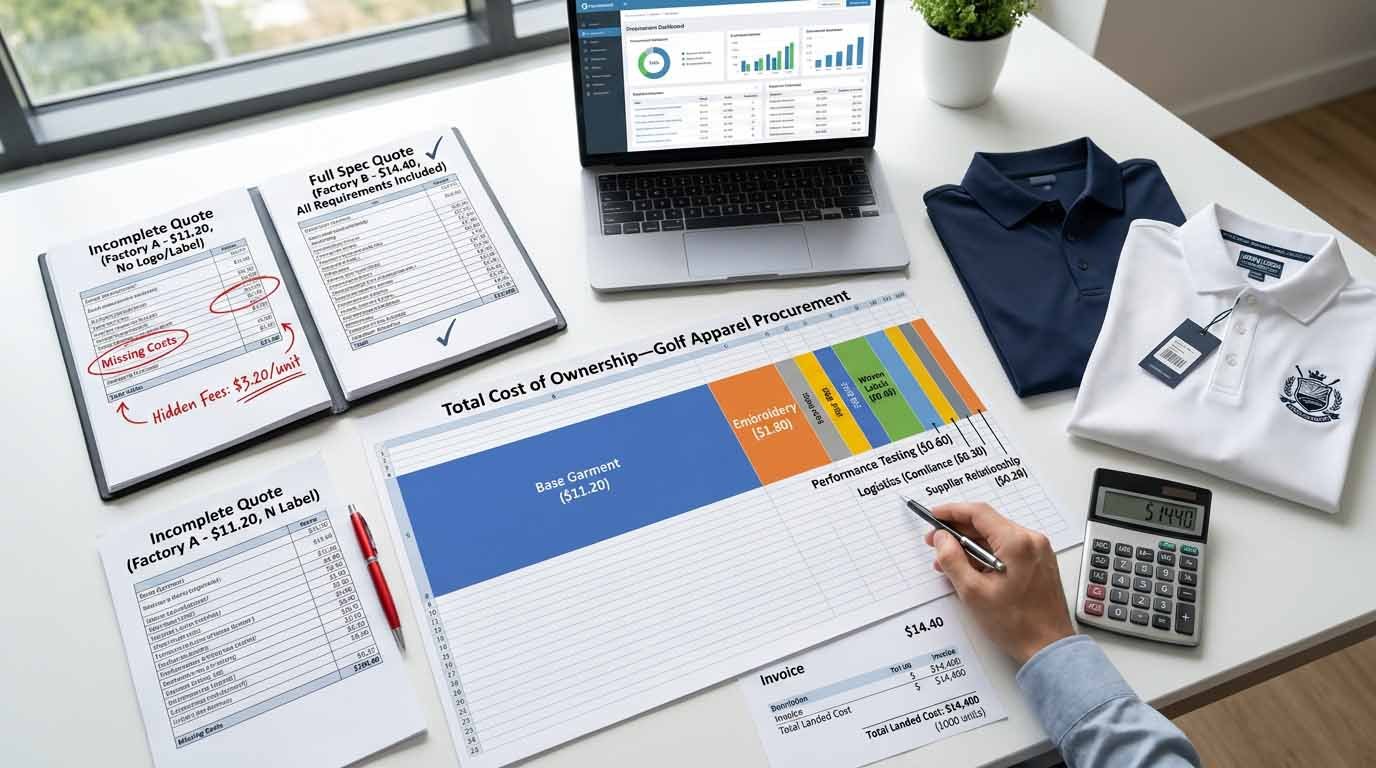
A buyer contacted me requesting quotes for 500 golf polos. I quoted $13.80 per unit. They said another factory quoted $11.20 and asked if I could match it. I asked to see the competing quote. It showed $11.20 for base garment only—no embroidered logo ($1.80), no woven labels ($0.45), no hang tags ($0.35), no performance fabric testing ($0.60 per unit amortized). After adding these required elements, the "cheaper" quote was $14.40—more expensive than mine. The buyer had compared incomplete quotes.
B2B golf apparel procurement profitability depends on calculating total cost of ownership—including quality risk, logistics, compliance, flexibility penalties, and supplier relationship costs—not just comparing unit prices across incomplete quote specifications.
I am Will from FUWAY. I manage B2B accounts for golf apparel buyers placing orders from 500 to 50,000 pieces annually. I see the same procurement mistakes repeatedly: buyers selecting suppliers based only on unit price, switching suppliers every 6-12 months chasing minor savings, demanding low MOQs without understanding cost implications, and negotiating production price while ignoring 30% of total landed cost. Over five years working with 200+ B2B accounts, I have tracked which procurement strategies actually reduce costs versus which ones create hidden losses that erase apparent savings. This guide shares what I have learned from both successful long-term partnerships and failed relationships that cost buyers significant money.
Quick Answers: B2B Golf Apparel Procurement Strategy
What is total cost of ownership (TCO) in golf apparel procurement?
TCO includes unit manufacturing cost plus sampling and development fees, logistics and freight, customs duties and broker fees, quality control and testing, payment terms cost of capital, inventory carrying costs, returns and defect replacements, and supplier switching costs (resampling, communication delays). TCO typically runs 25-35% higher than quoted unit price.
How much does supplier switching actually cost?
$2,000-$4,000 per new supplier relationship in resampling, pattern development, and initial communication overhead. Plus 8-12 weeks timeline delay. Plus quality inconsistency risk in first 1-2 orders that often creates 5-15% defect rates. Switching suppliers to save $0.50 per unit on 1,000 pieces ($500 savings) often costs $3,000-$5,000 in hidden expenses.
What is the real cost difference between low MOQ flexibility and standard MOQ?
300-piece MOQ typically costs 25-40% more per unit than 1,000-piece MOQ for identical specifications. Buyers paying $16 per unit at 300 pieces would pay $11-12 per unit at 1,000 pieces. The flexibility premium is $4-5 per unit. For 300 pieces, flexibility costs $1,200-$1,500 extra versus committing to larger volume.
Should I use platform fabrics or custom fabrics for better margins?
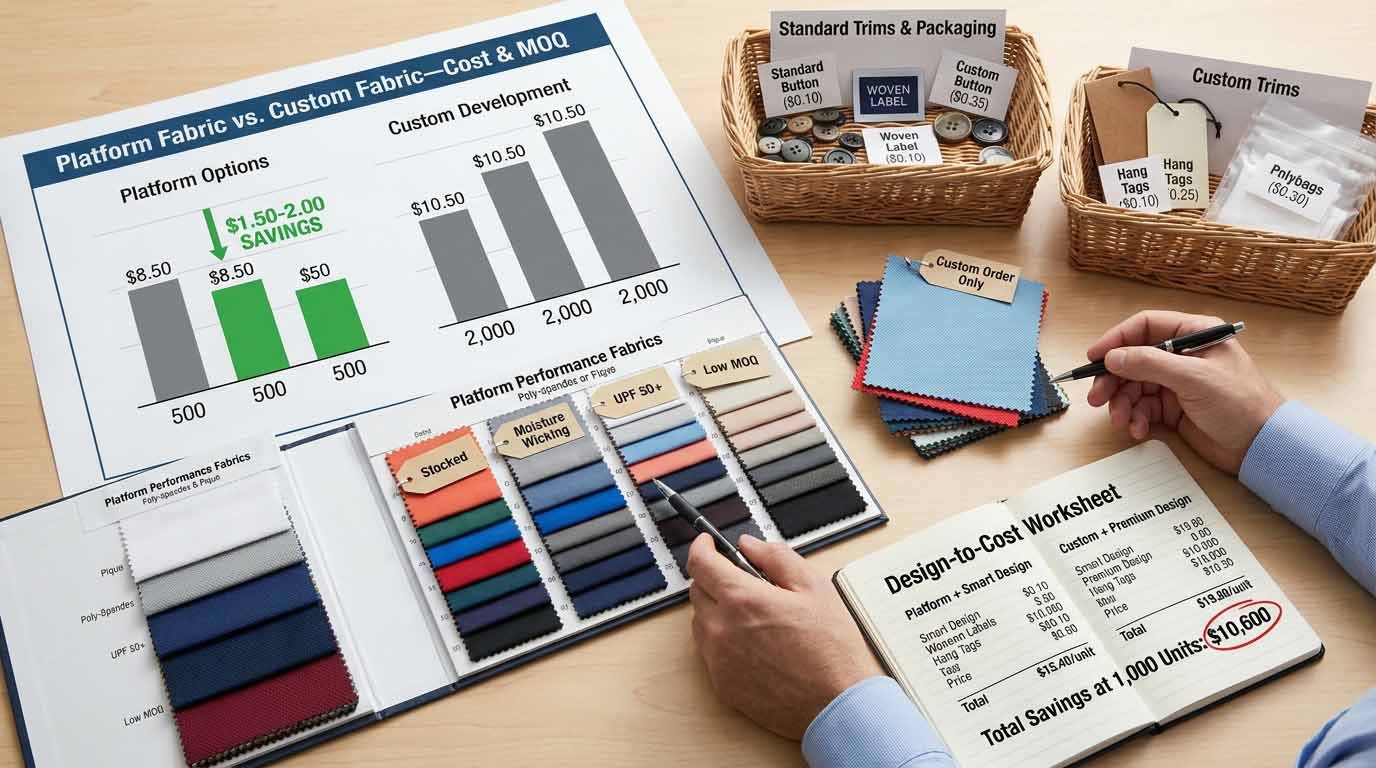
Platform fabrics (factory stocks 20-40 performance fabrics) reduce MOQ by 30-50%, cut lead time by 2-3 weeks, and lower per-unit cost by $1-2. Custom fabric development offers differentiation but requires 1,500+ piece commitment and adds $2-4 per unit. Platform fabrics maximize margin for B2B buyers with limited volume or testing markets.
How do I evaluate if a supplier's price is genuinely competitive?
Request complete itemized quotes including: base garment, all logos and branding, labels and tags, packaging specifications, FOB or EXW terms, freight estimate, required certifications and testing. Compare total landed cost per unit, not just garment price. Verify comparable fabric quality, construction methods, and customization depth.
What payment terms actually affect my cash flow and total cost?
30% deposit / 70% before shipment: standard, no cost premium. 50% deposit / 50% before shipment: sometimes available, no premium. Net 30-60 days after delivery: rare for new buyers, may add 3-8% to unit cost. Letter of credit: adds $300-800 per transaction. Payment terms impact cash flow more than total cost unless you negotiate volume discounts for faster payment.
How much should I budget for compliance and testing per order?
$800-$2,000 per order for new product development: fabric performance testing ($400-800), chemical compliance testing ($400-600), third-party quality inspection ($200-400). Ongoing orders with established products: $200-600 per order for inspection only. Compliance costs are fixed per order, not per unit, so they hit small orders harder.
Why Platform Fabrics and Design-to-Cost Thinking Reduce Risk and Increase Margin
Platform fabric strategies and design-to-cost approaches reduce procurement costs by 15-25% while lowering MOQ requirements by 30-50% compared to custom development—enabling B2B buyers to test markets efficiently and maintain healthy margins.
What Platform Fabrics Mean for B2B Buyers
Platform fabric definition:
Fabrics the manufacturer stocks or has immediate access to through mill partnerships without custom development. Typically 20-50 performance fabric options in various weights, blends, and finishes.
Cost advantages:
No fabric development fees ($800-1,500 savings per style)
Lower MOQ because fabric is already available (500-800 pieces vs 1,500-2,500)
Faster sampling because mills do not need to produce custom batches (save 2-3 weeks)
Lower per-unit fabric cost because manufacturer orders platform fabrics in bulk ($1-2 per unit savings)
Quality consistency:
Platform fabrics have established specifications and performance history. Less risk of fabric variation between orders. Easier to reorder without resampling.
Design-to-Cost Framework
Most buyers design products then ask for quotes. Smart B2B buyers ask manufacturers what their cost-efficient design boundaries are, then design within those boundaries.
Questions to ask manufacturers before finalizing design:
"What fabric blends do you stock that achieve moisture-wicking and UPF 50+ performance?"
"What logo methods are most cost-efficient at my target volume?"
"What collar and placket constructions do you produce routinely versus custom builds?"
"What trim and label options do you stock versus need to order custom?"
Example cost impacts of design choices:
| Design Element | Premium Choice | Cost-Efficient Choice | Savings Per Unit |
|---|---|---|---|
| Fabric | Custom 4-way stretch blend | Platform performance piqué | $2-3 |
| Logo | 3-position embroidery | Single left-chest embroidery | $2-3 |
| Collar | Custom stand collar | Standard flat collar | $0.50-1.00 |
| Trim | Custom woven labels | Stock label with printed customization | $0.30-0.60 |
| Packaging | Fully custom box | Stock polybag with custom header card | $1.50-3.00 |
| Total Savings | $6.30-10.60 |
At 1,000 pieces, design-to-cost thinking saves $6,300-$10,600 without sacrificing quality or brand presentation.
Trim and Component Standardization
Stock components buyers should leverage:
Buttons: Use manufacturer's stock button inventory instead of custom buttons. Saves $0.15-0.40 per unit and eliminates button MOQs (typically 2,000-5,000 pieces).
Labels: Use factory's stock label blanks with your brand printed or woven in, rather than fully custom labels. Saves $0.20-0.50 per unit.
Hang tags: Template-based hang tags with your branding printed saves $0.30-0.80 per unit versus fully custom die-cut tags.
Packaging: Stock polybags with custom printed header cards instead of custom boxes saves $1.50-3.50 per unit.
I tell B2B buyers to reserve customization budget for elements customers see and value—fabric performance, fit, logo execution—and use standard components for everything else. This maximizes perceived quality while controlling costs.
How Do MOQ Structures, SKU Allocation and Yield Management Affect Your Real Unit Cost?
MOQ and SKU allocation decisions affect per-unit cost more than supplier selection. Splitting volume across too many SKUs or holding back volume to stay under MOQ thresholds typically costs 20-40% in unnecessary premiums.
Understanding True MOQ Economics
What drives MOQ requirements:
Fabric cutting efficiency: Below 120-150 pieces per color, fabric cutting waste increases 15-30%. Manufacturers pass this cost to buyers.
Logo setup amortization: Embroidery digitizing and machine setup costs $100-200. Spread across 100 pieces = $1-2 per unit. Spread across 300 pieces = $0.33-0.67 per unit.
Production line efficiency: Switching colors or styles requires line cleanup and setup (15-30 minutes per changeover). More SKUs = more downtime = higher overhead per unit.
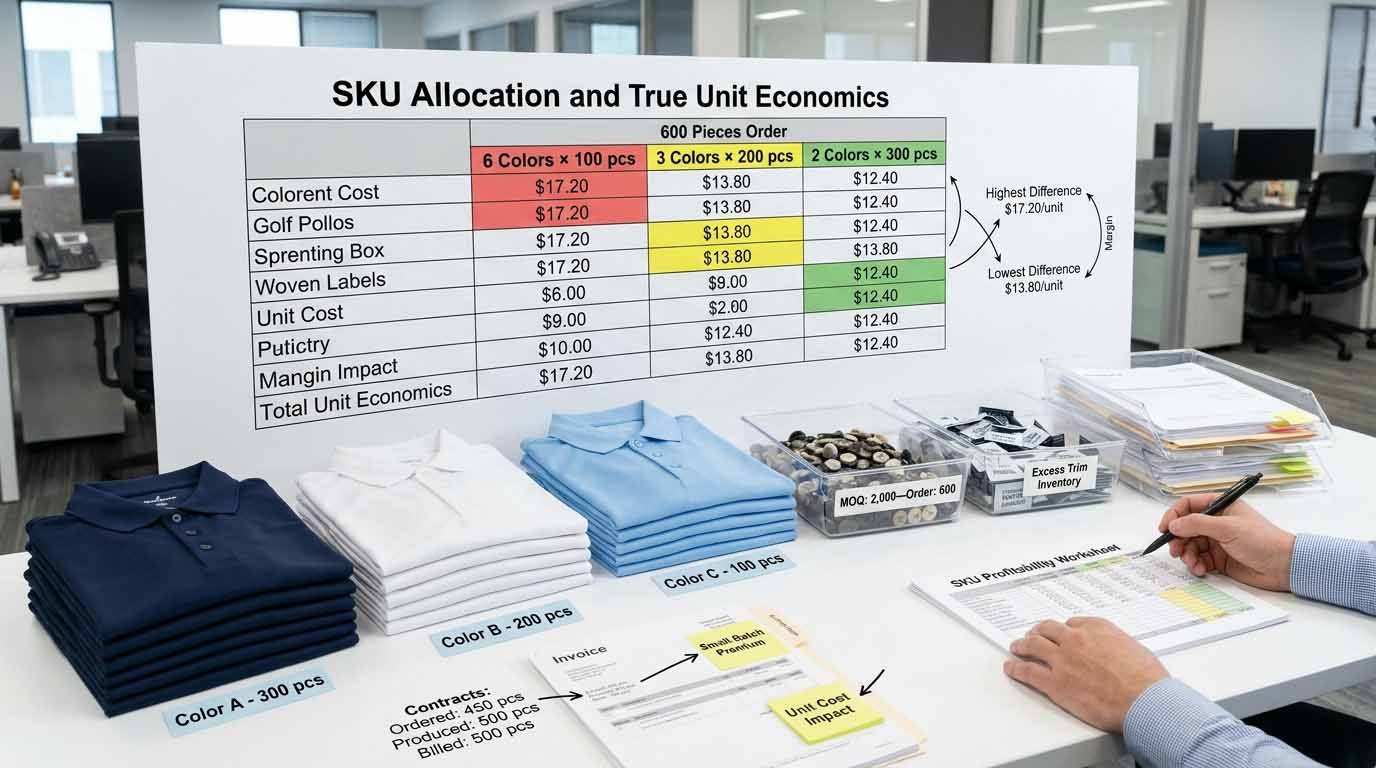
Trim and component ordering: Many trims have their own MOQs (buttons 2,000 pieces, woven labels 1,000 pieces). Small orders force manufacturers to hold excess trim inventory or charge premiums.
Real cost comparison by SKU allocation:
Order: 600 total pieces
Option A: 6 colors × 100 pieces each = $17.20 per unit
Option B: 3 colors × 200 pieces each = $13.80 per unit
Option C: 2 colors × 300 pieces each = $12.40 per unit
Same total volume. 38.7% cost difference between Option A and Option C.
SKU Architecture Strategy
Start with core SKUs, expand carefully:
New product launches: 1-2 styles in 2-3 colors maximum. Concentrate volume for best pricing. Prove demand before expanding SKU count.
Established products: Add new colors or styles only when each new SKU can support 200+ pieces per order. Otherwise colorway proliferation destroys margin.
Calculate SKU profitability individually:
Do not average costs across all SKUs. Your core colors at 300 pieces each may cost $12 per unit while specialty colors at 80 pieces cost $19 per unit. If specialty colors do not command premium retail pricing, they lose money.
Yield Management and Overproduction
How manufacturers handle MOQ flexibility:
Some manufacturers will accept orders slightly below stated MOQ but produce to full MOQ and charge for overproduction. Example: You order 450 pieces, MOQ is 500, they produce 500 and charge you for 500 at negotiated price.
Alternative: They produce exactly 450 but charge small-batch premium (typically 15-25% higher per unit).
Which approach is better depends on your situation:
If you have storage capacity and expect to reorder within 6-12 months: Accept overproduction at standard pricing. Extra 50 pieces cost less than paying premium on 450.
If storage is expensive or product is seasonal: Pay small-batch premium for exact quantity. Extra inventory carrying cost exceeds premium.
I recommend asking manufacturers their overproduction policy upfront. Many buyers order 480 pieces thinking they are 20 pieces under MOQ, then receive invoices for 500 pieces and get surprised.
Why TCO Negotiation Matters More Than Unit Price Negotiation
Negotiating unit price without optimizing logistics terms, payment terms, quality risk, and flexibility costs typically achieves 3-8% apparent savings while hiding 10-15% in additional costs that erase the gains.

Incoterms and Logistics Cost Allocation
Common Incoterms for B2B apparel:
EXW (Ex Works): Buyer handles everything from factory door. Lowest quoted price but highest logistics complexity and risk. Hidden costs in forwarder markup, documentation mistakes, and customs delays.
FOB (Free On Board): Manufacturer delivers to port and handles export customs. Buyer arranges ocean/air freight and import customs. Most common for experienced importers.
DDP (Delivered Duty Paid): Manufacturer handles everything to buyer's door including customs and duties. Highest quoted price but simplest for buyer. Only available from suppliers with destination country logistics capabilities.
Real cost comparison example (1,000 piece order):
EXW quoted price: $12.50 per unit = $12,500
Add freight arranged by buyer: $2,800
Add customs broker (buyer arranges): $350
Add mistakes/delays (10% of orders): $400 average
Total landed cost EXW: $16.05 per unit
FOB quoted price: $13.20 per unit = $13,200
Includes export handling and port delivery
Add freight (quoted by seller): $2,200
Add customs broker (buyer arranges): $350
Total landed cost FOB: $15.75 per unit
DDP quoted price: $15.90 per unit = $15,900
Includes everything to buyer's door
Total landed cost DDP: $15.90 per unit
In this example, lowest quoted price (EXW) results in highest total cost. Middle quoted price (FOB) results in lowest total cost due to manufacturer's freight negotiating power.
Payment Terms and Cost of Capital
Standard payment structures:
30% deposit / 70% before shipment: Industry standard, no premium
50% deposit / 50% before shipment: Sometimes available, usually no premium
100% prepayment: May earn 2-5% discount for large buyers
Net 30-60 after delivery: Rare for orders under $50,000, may cost 3-8% premium
Cash flow analysis:
$20,000 order with 30/70 terms:
$6,000 deposit at order placement
$14,000 payment 6-8 weeks later before shipment
Average capital tied up: 8-10 weeks
$20,000 order with Net 30 terms:
$0 upfront
$20,000 payment 30 days after delivery (week 12-14)
Average capital tied up: 0 weeks until delivery
Hidden Costs of Quality Risk
Defect rate impact on TCO:
Scenario: Two suppliers quote 1,000 pieces. Supplier A quotes $13.50, delivers 3% defect rate. Supplier B quotes $14.20, delivers 0.5% defect rate.
Supplier A total cost:
$13,500 production cost
30 defective units unsellable = $405 lost inventory (at $13.50 cost)
Inspection time and handling = $150
Customer complaints and returns = $200
Total cost: $14,255 or $14.26 per sellable unit
Supplier B total cost:
$14,200 production cost
5 defective units unsellable = $71 lost inventory
Minimal inspection time = $50
Almost no complaints
Total cost: $14,321 or $14.32 per sellable unit
In this example, cheaper supplier ends up costing less total. But if Supplier A's defect rate hits 8-10% (not uncommon for problematic factories), their true cost balloons to $15-16 per sellable unit.
I track this data for clients. Buyers who switch suppliers to save $0.50-1.00 per unit often experience 5-12% defect rates in first orders with new suppliers versus 1-3% with established suppliers. The quality risk cost exceeds the price savings.
How Production Calendar Planning Reduces Rush Fees and Capacity Penalties
Production calendar planning with 3-6 month lead time visibility eliminates 20-30% in rush fees and secures better factory capacity allocation, while last-minute ordering forces buyers into premium pricing or accepts delays that miss selling windows.
Understanding Factory Capacity Cycles
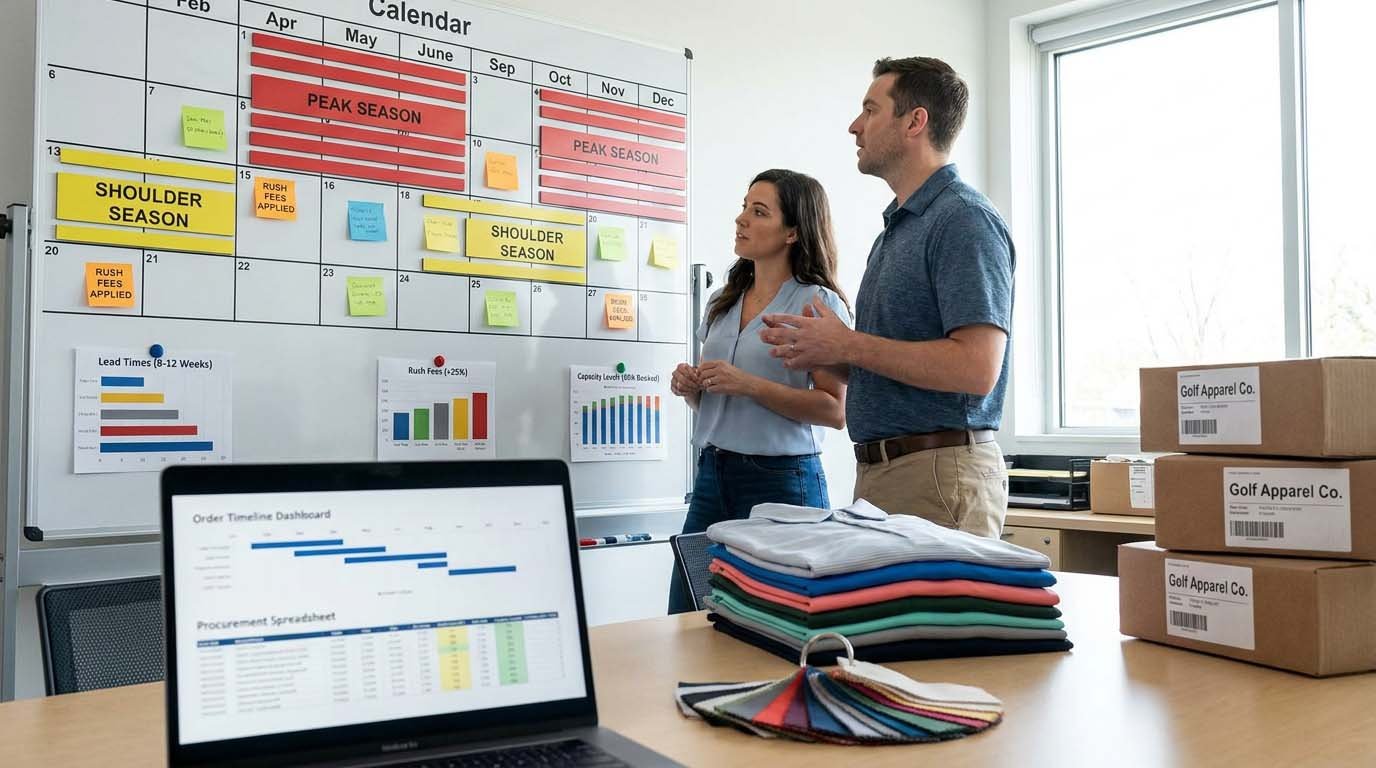
Peak season (March-June, September-November):
Golf apparel factories run 85-100% capacity serving major brands preparing for spring/summer and fall seasons. New orders face 8-12 week lead times. Rush fees apply frequently. Sampling takes longer due to queue backlog.
Shoulder season (January-February, July-August):
Capacity runs 60-75%. Factories seek orders to maintain production lines. Lead times drop to 6-8 weeks. More negotiating leverage for buyers. Sampling faster.
Pre-booking advantages:
Place orders 90-120 days before needed delivery date: Standard pricing, guaranteed capacity, flexibility for minor adjustments.
Place orders 45-60 days before delivery: Possible but tighter, may face 5-10% rush premium or capacity limitations.
Place orders under 30 days before delivery: Almost always requires 20-30% rush premium, limited customization, high quality risk due to compressed timeline.
Calendar-Based Procurement Strategy
Quarterly planning cycle:
90 days before quarter start: Finalize designs and specifications, request quotes, negotiate terms
60 days before quarter start: Place purchase orders, begin sampling
30 days before quarter start: Approve samples, authorize bulk production
Quarter begins: Inventory arrives and enters sales channels
This cycle eliminates rush fees and ensures inventory availability when demand hits.
Pre-Book Programs and Volume Commitments
Some manufacturers offer pre-book programs with advantages:
Volume commitment discounts: Commit to 3,000-5,000 pieces annually spread across 2-4 orders, receive 8-15% discount versus one-off ordering.
Guaranteed capacity: Your orders get priority scheduling during peak seasons.
Flexible delivery windows: Manufacturer holds completed inventory and ships as you need (within reasonable windows).
Payment term improvements: Volume commitment may unlock Net 30 terms or reduced deposits.
Requirements:
Minimum annual volume commitment
Forecasting accuracy (typically 80%+ accuracy on committed volumes)
Lead time on order releases (typically 60-90 days)
Pre-book programs work well for B2B buyers with predictable seasonal demand and established product lines. Not suitable for first-year market testing.
Why Forecasting Accuracy and Inventory Strategy Determine Cash Flow Health
Inventory planning tied to demand forecasting and order timing determines whether growing sales improve cash flow or drain capital through excess inventory carrying costs that can exceed 10-20% of product cost annually.

Forecasting Fundamentals for B2B Buyers
Initial order sizing:
For new products with no sales history, order 60-90 days of projected demand at expected sales velocity. Err conservative. Running out of stock is better than drowning in inventory.
Reorder triggers:
Place restock orders when inventory drops to 45-60 days of remaining supply at current sales velocity. This accounts for 8-12 week production and shipping lead time.
Seasonal planning:
Golf apparel has distinct seasons. Spring/summer polos need inventory by March. Fall layers need inventory by September. Orders placed 4-5 months before season start arrive on time without rush fees.
Replenishment Programs and VMI
Standard replenishment:
You forecast demand and place orders proactively. You own inventory timing risk and forecasting accuracy risk.
Vendor Managed Inventory (VMI):
Manufacturer holds agreed inventory levels and ships as you request within parameters. You reduce inventory carrying costs. Manufacturer charges 3-8% premium for holding inventory risk.
VMI suitability:
Works best for established products with predictable demand patterns. Requires minimum annual volumes (typically $50,000-100,000+). Not practical for seasonal products or first-year launches.
Cash Flow Planning Model
Example B2B buyer financial planning:
Annual revenue target: $200,000
Average retail price: $65 per polo
Units needed: 3,077 polos
Manufacturing cost: $13 per unit
Total production investment: $40,000
Scenario A: Single large order (3,000 pieces)
$39,000 upfront capital required
Inventory turns over 9-12 months
Average inventory carrying cost: 12% × $39,000 × 0.75 year = $3,510
Cash tied up for extended period
Scenario B: Three smaller orders (1,000 pieces each, quarterly)
$13,000 capital per order
Inventory turns every 3-4 months
Average inventory carrying cost: 12% × $13,000 × 0.33 year × 3 orders = $1,287
Capital freed faster for other uses
Scenario B saves $2,223 in carrying costs but may pay 5-8% higher unit cost due to smaller batch sizes ($0.65-1.00 per unit premium). On 3,000 pieces: $1,950-3,000 higher production cost.
Net comparison: Scenario B costs $1,950-3,000 more in production but saves $2,223 in carrying costs. Roughly breakeven on hard costs, but significantly better cash flow flexibility.
I recommend B2B buyers model both scenarios and choose based on their working capital constraints and growth plans. Buyers with limited capital should prioritize smaller frequent orders despite slightly higher unit costs. Established buyers with strong cash flow can optimize unit costs with larger orders.
Conclusion
B2B golf apparel procurement profitability depends on total cost of ownership calculation—integrating platform fabric strategies (15-25% cost reduction), SKU consolidation (20-40% efficiency gain), Incoterms and logistics optimization (10-15% hidden cost recovery), production calendar pre-booking (20-30% rush fee elimination), and inventory forecasting accuracy (reducing carrying costs by 8-15% annually)—not comparing incomplete unit price quotes from multiple suppliers.