
A client called last month asking for "athleisure-style golf hoodies." They sent reference photos of streetwear hoodies and said "make it like this but for golf." We quoted $18 per piece for 1,000 units. They came back shocked, expecting $12-14 like regular hoodies. The difference? Golf-specific shoulder construction, stretch panels, and moisture-wicking fabric that regular hoodies do not need.
Golf hoodies succeed in the athleisure era not by mimicking streetwear aesthetics, but by maintaining golf functionality—swing mobility, moisture management, and windproofing—while reducing visual formality through fabric choices, fit adjustments, and styling details that allow course-to-casual wear without compromising either context.
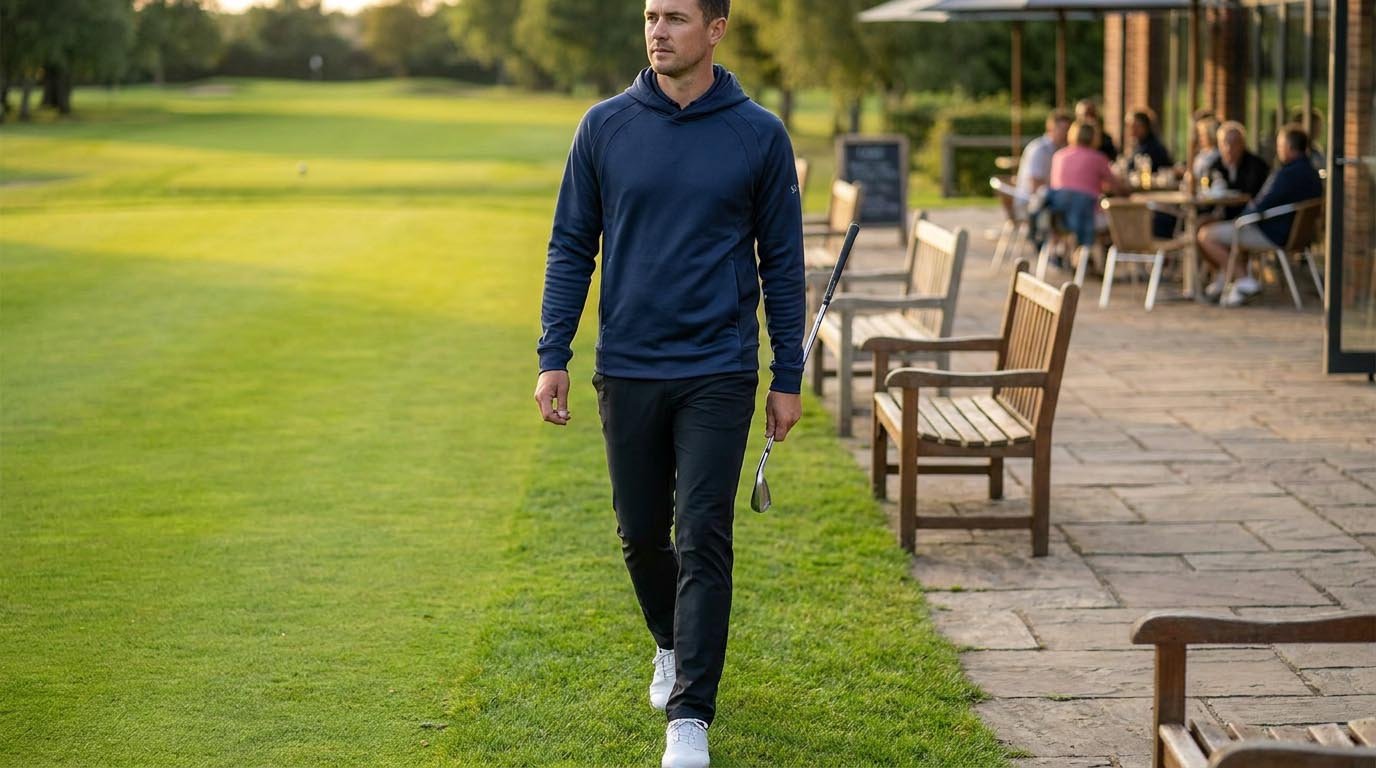
The inquiry pattern I see reveals the real challenge. Clients want "athleisure" but do not understand what that means in production terms. They think it means relaxed fit plus street style. The actual question they need to answer: which golf-specific functions justify higher cost, and which can be simplified to control MOQ and pricing while still working on the course. I have worked with 100+ golf brands on hoodie orders over the past decade. The brands that succeed define clear configuration priorities before sampling. The ones that struggle keep revising samples because they confused aesthetic goals with functional requirements. This guide shows you the decision framework I use when clients ask for golf hoodies that work in both golf and lifestyle contexts.
Quick Answers: What Golf Brands Misunderstand About Athleisure Hoodies
Q: Can't I just use a standard hoodie pattern for golf?
No. Golf hoodies need action sleeves, stretch panels, longer back hem for swing/movement. “Streetwear” patterns restrict motion—80% of buyers who try them resample with golf construction in the end.
Q: Aren't comfortable fabrics enough for golf?
No. "Soft" fleece holds sweat and gets heavy. Golf-appropriate hoodies require moisture-wicking & quick-dry technical fleece—adds $2–3/meter in cost, but critical for active use.
Q: Is small batch (300–500 pcs) realistic for functional fabrics?
Often not at standard cost. Performance fleeces usually have MOQ 800–1,200m (often >450 pcs); small orders pay +25–35% premium or must use commodity fleece (sacrifices performance).
Q: Will athleisure hoodie styles pass golf course dress codes?
Only clean, solid, lightly branded, and slim silhouettes qualify at most clubs—avoid thick, casual, multi-layered “street” looks which fail at ~30–40% of traditional courses.
Q: Should I specify different (and more expensive) features for pro shop vs e-commerce supply?
Yes. Pro shops pay for full technical/functionality ($22–28) and dress-code compliance; e-commerce buyers value lifestyle/fashion and price, accept less golf-specific detail ($16–22). Decide channel before finalizing specs!
Athleisure Momentum: Why Golf Hoodies Are Booming?
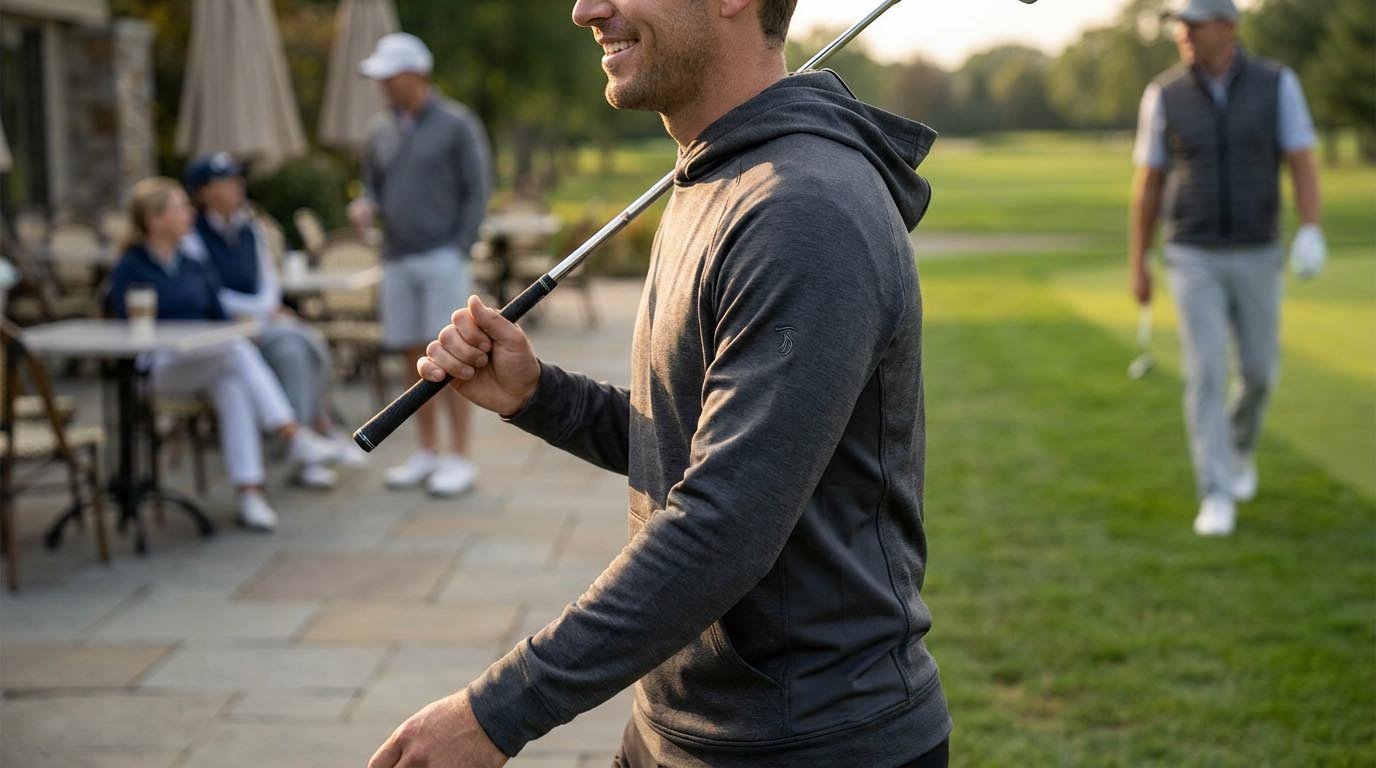
Golf hoodies are expanding because they solve a portfolio gap that other categories cannot fill—they provide warmth and weather protection that quarter-zips lack while maintaining the polished appearance and mobility that casual athletic hoodies do not deliver.
The hoodie inquiry volume tells the story. Five years ago, fewer than 15% of client conversations included hoodies. Today, that number is 45-50%. But the conversation has shifted. Clients are not asking "should we add hoodies?" They are asking "how do we make hoodies that work for golf and lifestyle?"
The Product Gap That Created Opportunity
Golf brands traditionally offered this layering structure:
- Polos: Base layer, $40-55 retail
- Quarter-zip pullovers: Light layering, $65-85 retail
- Vests: Core warmth without sleeve restriction, $75-95 retail
- Full-zip jackets: Maximum protection, $110-150 retail
The gap: customers wanted head/neck coverage and casual comfort without jumping to formal jacket territory. Hoodies naturally filled this space at $70-95 retail positioning—more substantial than quarter-zips, more relaxed than jackets.
What Changed in the Past 5 Years
Three shifts accelerated golf hoodie adoption:
1. Performance Fabric Availability at Scale
Technical fleece with moisture-wicking, stretch, and wind resistance became available in smaller minimum orders (800-1,200 meters vs. 2,000+ meters previously). This lowered the barrier for brands to test hoodie offerings without massive fabric commitments.
2. Golf Dress Code Relaxation
Major golf organizations and tour events began allowing hoodies during play. This signaled broader acceptance. Clients report that 60-70% of golf courses now accept clean-styled hoodies during rounds, up from 20-30% five years ago. The dress code fear that blocked hoodie adoption has diminished.
3. Crossover Lifestyle Positioning
Golf brands realized they were losing off-course apparel sales to athletic lifestyle brands. Golfers wear golf apparel 8-12 hours per week during rounds but wear casual clothing 100+ hours weekly. Hoodies that work for both contexts capture more of that wearing time—and more revenue opportunity.
The Market Size Clients Are Chasing
I do not have industry-wide sales data, but I track order patterns across our client base:
2019 Golf Hoodie Orders (baseline year):
- Average order size: 1,200-1,500 pieces
- Price range: $20-26 per piece
- Typical retail: $80-110
2024 Golf Hoodie Orders (current):
- Average order size: 1,800-2,400 pieces
- Price range: $18-24 per piece (better fabric sourcing at scale)
- Typical retail: $70-100 (price compression from competition)
The order size increase reflects confidence. Brands are not testing hoodies cautiously—they are integrating them as core offerings.
Why Athleisure Positioning Matters Now
Traditional "golf-only" positioning limited market size. A hoodie designed exclusively for course wear competes only with other golf layering options. A hoodie designed for course-to-casual versatility competes in the broader $85-120 retail athleisure market where golf is one use case among many.
The revenue math:
- Golf-only positioning: Customer wears it 15-25 times per season during golf
- Athleisure positioning: Customer wears it 40-60 times per season for golf, travel, casual dining, errands
Higher wearing frequency increases perceived value and willingness to pay. It also drives repeat purchases—customers want multiple colorways and styles when they wear the product constantly.
The Hidden Driver: Lifestyle Brand Aspiration
Here is what clients say in discovery calls: "We want to be more than just a golf brand." Hoodies signal lifestyle positioning in a way that polos and performance shorts do not. A customer wearing your golf hoodie to the gym, coffee shop, or airport is walking brand advertising in non-golf contexts. This matters to brands trying to expand beyond course-only identity.
Consumer Insights: Who Buys, When They Wear and Why?
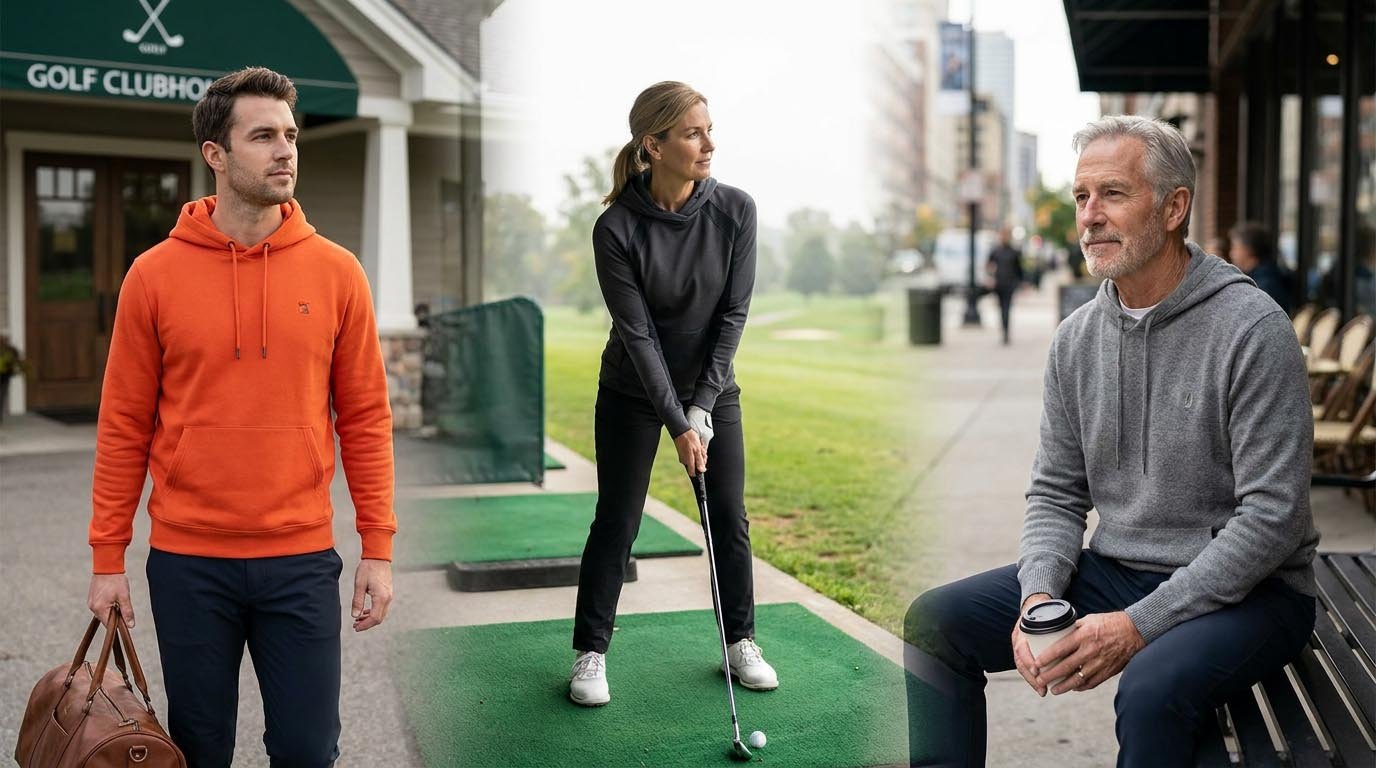
Design your hoodie specifications based on actual wearing contexts and customer demographics, not assumptions about "what golfers want"—the buyers and wearing occasions vary significantly between age groups, playing frequency, and purchasing channels.
Client assumptions about hoodie customers are often wrong. I ask clients "who will buy this?" They usually say "our existing polo customers." But sales data from clients who launched hoodies shows different buyer profiles and wearing patterns than core golf apparel.
The Three Primary Buyer Segments
Based on tracking customer data across 25+ client brands over 3 years:
Young Lifestyle Buyers (Ages 25-40)
- 35-40% of golf hoodie purchases
- Play golf: 15-25 rounds per year (casual/regular players)
- Purchase drivers: Style, versatility, brand association
- Wearing contexts: 60% non-golf (gym, travel, casual wear), 40% golf (range practice, early tee times, post-round)
- Price sensitivity: Moderate ($65-85 sweet spot)
- Preferred features: Modern fit, bold colors/graphics, lifestyle branding
Active Golf Enthusiasts (Ages 35-55)
- 40-45% of golf hoodie purchases
- Play golf: 30-50 rounds per year (regular/frequent players)
- Purchase drivers: Performance, comfort, course appropriateness
- Wearing contexts: 70% golf-related (rounds, practice, club activities), 30% casual
- Price sensitivity: Low (willing to pay $85-110 for quality)
- Preferred features: Technical fabrics, golf-specific construction, refined appearance
Older Traditional Golfers (Ages 55+)
- 15-20% of golf hoodie purchases
- Play golf: 25-40 rounds per year (regular players)
- Purchase drivers: Warmth, comfort, familiarity with brand
- Wearing contexts: 80% golf-related, minimal lifestyle crossover
- Price sensitivity: Moderate to low
- Preferred features: Classic styling, substantial feel, easy care
The key insight: young lifestyle buyers represent the largest growth segment but are not your traditional golf apparel customers. They require different design priorities.
When and Where Hoodies Get Worn
Clients often design for "on-course wear" then discover customers wear hoodies primarily in these contexts:
Pre-Round / Post-Round (45-50% of wearing time)
- Arriving at course in cool morning temperatures
- Post-round socializing at clubhouse or restaurant
- Transitional coverage before changing
- Warmth during post-round practice sessions
Practice Range and Short Game Areas (20-25%)
- Extended practice sessions in variable weather
- Less formal environment than full rounds
- More tolerance for casual styling
Travel and Transit (15-20%)
- Flying to golf destinations
- Driving to courses in early morning cold
- Airport and hotel comfort wear
Daily Casual Wear (10-15%)
- Running errands, coffee shops
- Weekend casual activities
- Gym or light exercise
Actual On-Course Play (5-10%)
- Cool morning tee times only
- Usually removed by mid-round as temperature rises
- Primarily fall/spring/winter use
This wearing pattern explains why athleisure positioning works—customers spend most hoodie-wearing time outside formal golf play. Designs that only work on the course miss the majority of actual use.
Purchase Triggers and Decision Factors
Tracking customer service conversations and return reasons:
What Drives Purchases
- Weather shift: Seasonal transitions (fall arrival, spring cooling) trigger 60-70% of hoodie purchases
- Wardrobe gap: Customers realize they lack appropriate layering, impulse buy
- Gift purchases: 25-30% of hoodie sales are gifts (holidays, Father's Day, birthdays)
- Brand loyalty: Existing customers adding to collection
What Triggers Returns/Complaints
- Fit issues: 40-45% of returns (too tight in shoulders, sleeves too long/short, body length wrong)
- Fabric disappointment: 20-25% (not soft enough, feels cheap, pilling after washing)
- Style mismatch: 15-20% (looks too casual/too formal, color different than expected)
- Performance failures: 10-15% (not warm enough, not breathable, uncomfortable when active)
The return data shows what customers actually care about versus what brands think they care about. Fit and fabric feel dominate, while technical performance features generate fewer complaints than expected.
The Price-to-Value Perception Gap
Customers compare golf hoodies to both golf layering pieces and casual athletic hoodies:
Reference Price Points in Customer Minds
- Generic athletic hoodies: $25-45 (Nike, Adidas, Under Armour basics)
- Premium athletic hoodies: $65-95 (Lululemon, Vuori, premium athletic brands)
- Golf quarter-zips: $65-85 (competitive golf layering option)
- Golf outerwear: $110-150 (upper-end golf apparel comparison)
Golf hoodies positioned at $75-95 retail sit between premium athletic and full golf outerwear. Customers justify this price when the product delivers:
- Better fabric quality than basic athletic hoodies
- Golf-specific functionality that athletic hoodies lack
- Lifestyle versatility that traditional golf outerwear does not provide
Miss any of these, and customers revert to "why not just buy a Nike hoodie for $40?"
Demographic Differences by Channel
The customer profile shifts based on where they buy:
| Purchase Channel | Primary Age Range | Playing Frequency | Price Sensitivity | Style Preference |
|---|---|---|---|---|
| Pro shops / On-course retail | 40-60 | Regular to frequent | Low | Traditional, golf-focused |
| Golf specialty retail | 35-55 | Regular | Moderate | Balanced style/function |
| E-commerce (brand direct) | 30-50 | Casual to regular | Moderate | Modern, versatile |
| E-commerce (marketplace) | 25-45 | Casual | High | Trendy, lifestyle-focused |
Brands selling through multiple channels need to consider whether one hoodie design serves all segments or if channel-specific variations make sense.
Product Playbook: Fabrics, Fits, Features and Dress‑Code Fit?
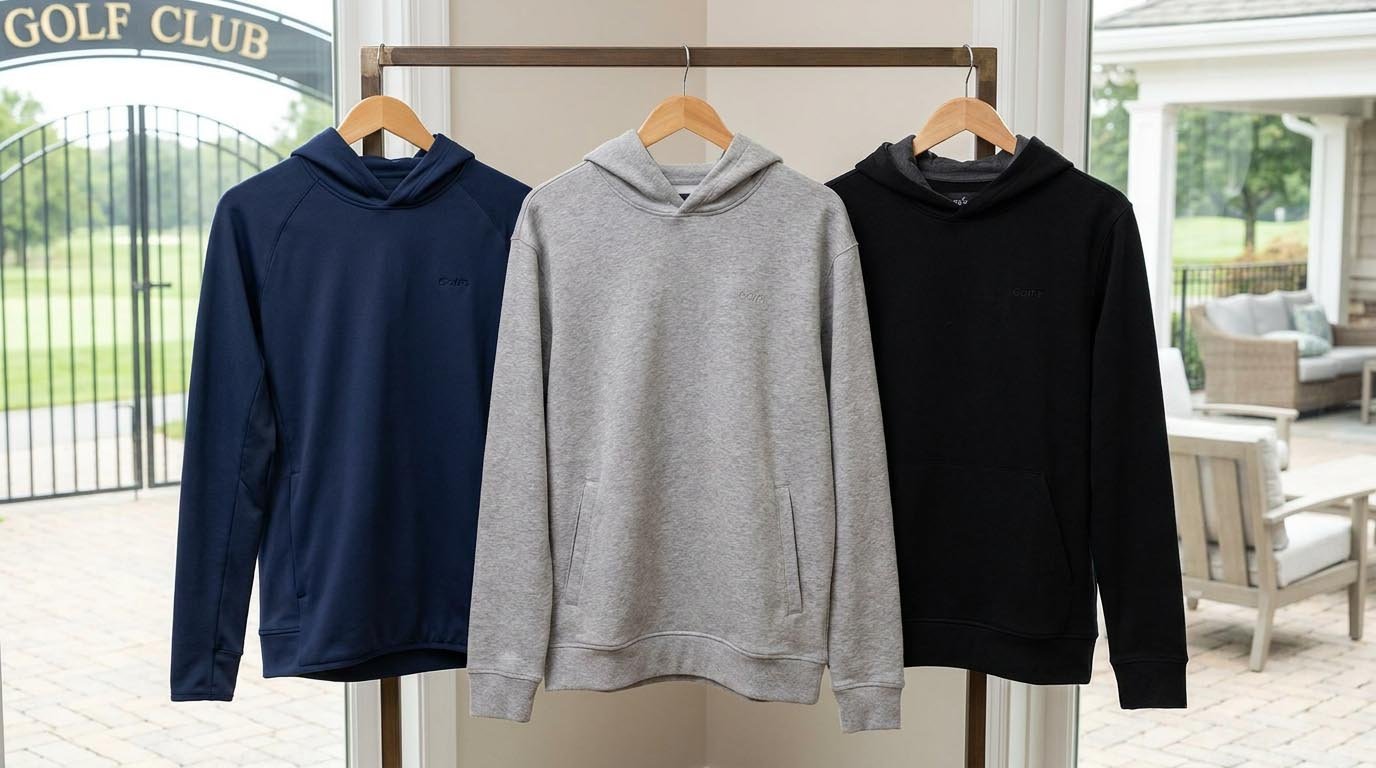
Specify golf hoodies by starting with mobility requirements and dress code constraints, then selecting fabrics and features that deliver those needs within your target cost structure—reversing this sequence leads to beautiful samples that do not work on the course or miss price targets.
The most common sampling failure: clients choose fabric by hand feel, approve fit based on how it looks standing still, then discover the hoodie restricts backswing or fails dress code at traditional courses. I have seen this pattern 30+ times. The solution is reversing the decision sequence.
Decision Sequence That Works
Step 1: Define Mobility Requirements
- Will customers wear this during actual swing motion or just between shots?
- Does the design need full shoulder rotation or basic arm movement?
- Are you targeting athletic players or casual golfers?
Step 2: Establish Dress Code Positioning
- Are you prioritizing acceptance at traditional clubs?
- Is this primarily for casual course environments?
- How important is non-golf wear versatility?
Step 3: Select Fabrics That Meet Those Needs
- What fabric weight and structure delivers required mobility?
- Which fabric finishes pass dress code visual standards?
- What cost target must the fabric hit?
Step 4: Choose Features That Enhance Primary Use Cases
- What pockets and closures serve actual wearing contexts?
- Which details signal quality without adding unnecessary cost?
Fabric Selection Framework
Performance Technical Fleece (280-320 GSM)
Characteristics:
- Polyester-dominant blend (85-92% polyester, 8-15% spandex)
- Moisture-wicking treatment on interior
- Brushed or smooth-face options
- Medium stretch (15-25% horizontal, 10-15% vertical)
Best for:
- Customers wearing during actual golf play
- Prioritizing performance over softness
- $75-95 retail positioning
Cost range:
- $6.50-8.50 per meter fabric
- $20-26 per piece at 1,000-unit MOQ
- Requires 800-1,200 meter minimums
Limitations:
- Less soft than cotton blends (though modern finishing improves this)
- Can look too athletic if not styled carefully
Cotton-Blend Comfort Fleece (300-360 GSM)
Characteristics:
- 50-70% cotton, 30-50% polyester
- Soft hand feel, substantial weight
- Minimal stretch (5-10% with added spandex)
- Natural breathability but slower drying
Best for:
- Customers prioritizing casual comfort
- Off-course lifestyle positioning
- $65-80 retail positioning
Cost range:
- $4.50-6.50 per meter fabric
- $16-22 per piece at 800-1,000 unit MOQ
- Available in smaller fabric lots (100-200 meters)
Limitations:
- Absorbs and holds moisture (not ideal for active golf wear)
- Heavier when damp
- Less suitable for warm-weather use
French Terry or Lightweight Knit (220-280 GSM)
Characteristics:
- 60-80% polyester, 15-25% cotton, 5-15% spandex
- Thinner, more breathable construction
- Better for layering under jackets
- Good drape and movement
Best for:
- Spring/fall transitional wear
- Customers in mild climates
- $60-75 retail positioning
Cost range:
- $4.00-6.00 per meter fabric
- $14-20 per piece at 800-1,000 unit MOQ
Limitations:
- Not warm enough for cold weather
- Perceived as less premium by some customers
Fabric Trade-Off Decision Table
| Priority | Recommended Fabric Type | Accept Trade-Off | Avoid This Fabric If... |
|---|---|---|---|
| Golf performance & year-round use | Performance fleece 300-320 GSM | Less soft initial feel | Budget under $18/piece |
| Lifestyle versatility & value | Cotton-blend 320-340 GSM | Moisture retention | Target active golfers |
| Lightweight layering | French terry 240-260 GSM | Limited warmth | Customers need cold-weather option |
| Maximum softness | High-cotton blend 340+ GSM | Weight, drying time | Humid climate markets |
Fit Styles and Mobility Engineering
Clients say "modern fit" or "athletic fit" without understanding the construction implications:
Classic Relaxed Fit
Construction approach:
- Straight body with minimal taper
- Standard sleeve without shoulder articulation
- Drop-shoulder or set-in sleeve
- Adequate ease throughout (4-6 inches across chest from body measurement)
Mobility features:
- Basic range of motion sufficient for casual wear
- Limited restriction but not optimized for swing
Cost impact:
- Baseline (simplest pattern and cutting)
Best for:
- Older demographics (50+ years)
- Customers prioritizing comfort over performance
- Off-course lifestyle wear
Modern Athletic Fit
Construction approach:
- Tapered body (2-3 inches narrower at waist than chest)
- Raglan sleeves for shoulder mobility
- Stretch panels in underarm and side body
- Fitted but not tight through torso
Mobility features:
- Unrestricted arm rotation for golf swing
- Maintains polished silhouette during movement
Cost impact:
- +$1.20-2.00 per piece (additional pattern pieces, stretch panel fabric)
Best for:
- Ages 30-50 demographics
- Active golfers who wear during play
- Balanced golf/lifestyle positioning
Performance Slim Fit
Construction approach:
- Close-to-body through torso (1-2 inches ease only)
- Action-back shoulder or diamond gusset under arms
- 4-way stretch fabric required throughout
- Modern tapered aesthetic
Mobility features:
- Maximum freedom despite fitted appearance
- Optimized for athletic movement
Cost impact:
- +$2.80-4.20 per piece (complex pattern, premium stretch fabric, specialized construction)
Best for:
- Ages 25-40 demographics
- Slim/athletic builds only
- Performance-focused positioning
Critical Feature Decisions
Hood Construction
The hood defines whether the hoodie passes dress codes:
Lined Hood with Interior Color
- Fabric-lined hood interior (contrast color shows when down)
- Adds $0.80-1.40 per piece
- More refined appearance, better dress code acceptance
- Recommend for: Traditional golf positioning, $80+ retail
Self-Lined Hood
- Same fabric inside and outside
- Baseline cost
- Acceptable appearance, slightly more casual
- Recommend for: General market, $65-85 retail
Drawcord vs. No Drawcord
- Functional drawcord adds $0.30-0.50 but can look too athletic
- Many golf hoodies omit drawcord for cleaner appearance
- I recommend: No external drawcord for golf positioning, optional internal cord
Pocket Configuration
Golf hoodies face different pocket needs than casual hoodies:
Kangaroo Pouch Pocket (single front pocket)
- Most casual, athletic appearance
- Stores gloves, tees, small items
- Can look too informal for strict dress codes
- Cost: Baseline
- Recommend: Avoid for traditional golf positioning
Dual Side-Entry Pockets
- Separate right and left hand pockets
- More refined than kangaroo pouch
- Better dress code acceptance
- Cost: +$0.40-0.70 per piece (additional sewing, lining)
- Recommend: Standard for golf hoodies
Zipper Closure Pockets
- Secures valuables during play
- Premium feature
- Cost: +$0.80-1.40 per piece (zippers, reinforcement)
- Recommend: Only if targeting frequent players who carry items during rounds
Additional Features Worth Considering
Thumbholes in Cuffs
- Keeps sleeves in place during swing
- Adds coverage in cold weather
- Signals athletic/casual positioning
- Cost: +$0.15-0.30 per piece
- Dress code impact: Makes hoodie look more athletic (can be negative at traditional clubs)
Media Pocket
- Interior pocket for phone or player card
- Convenient but rarely used in actual play
- Cost: +$0.40-0.60 per piece
- Recommend: Skip unless e-commerce customers specifically request
Windproof Membrane or Coating
- Blocks wind while maintaining breathability
- Transforms hoodie into outerwear category
- Cost: +$3.50-5.50 per piece (membrane fabric cost premium)
- MOQ impact: Requires 1,200-1,800 meter fabric minimums
- Recommend: Only for brands with volume and positioning hoodies as outerwear
Dress Code Compatibility Checklist
Before finalizing design, verify these dress code factors:
Visual Refinement Signals
- ✓ Clean, minimal exterior (avoid excessive graphics, logos, or text)
- ✓ Solid colors or subtle heathered patterns (avoid bold prints)
- ✓ Fabric with finished face (brushed or smooth, not thick-loop fleece)
- ✓ Tailored silhouette (not oversized or baggy)
Feature Choices That Signal Casual/Athletic (risk dress code rejection)
- ✗ Kangaroo pouch pocket
- ✗ Visible drawcord with plastic or metal tips
- ✗ Oversized hood
- ✗ Contrast bright zipper or trim
- ✗ Large back graphics or text
I recommend clients test dress code acceptance by:
- Contacting 3-5 local courses with varying formality
- Describing the hoodie design or showing photos
- Asking explicitly if it would be permitted during play
This prevents launching products that work technically but face access restrictions.
Assortment & Pricing: Tiered Builds, Margins and Size Inclusion?
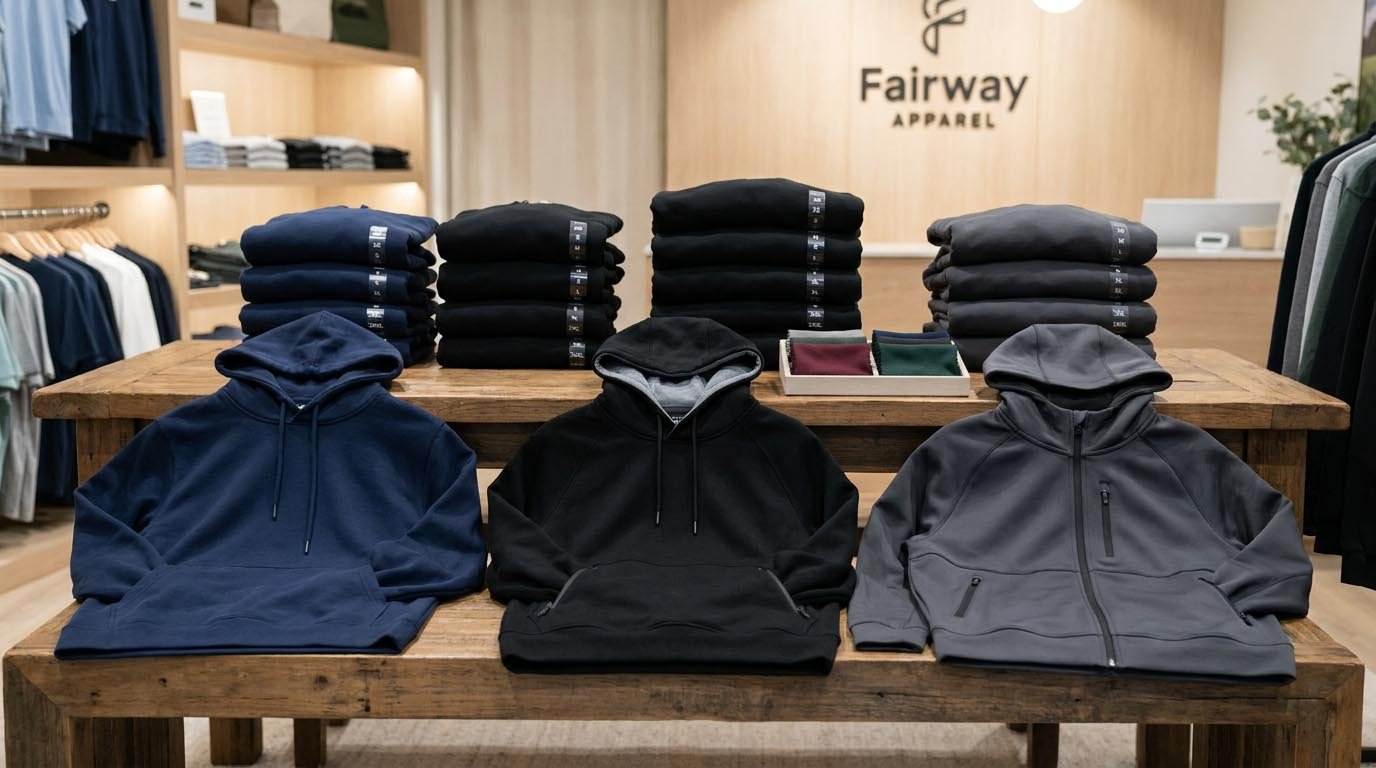
Structure your golf hoodie lineup in tiers that serve distinct customer price points and positioning needs, rather than creating a single "does everything" design that satisfies no segment fully and compresses your margins through feature bloat.
Clients often approach hoodies as a single SKU decision. They want one hoodie that works for everyone, priced to be competitive everywhere. This creates compromised designs that neither differentiate in premium channels nor compete on value in price-sensitive channels. The brands succeeding with golf hoodies offer tiered options.
The Three-Tier Approach That Works
Value Tier: Lifestyle Basics
Target positioning:
- Entry-level golf hoodie for casual players
- Primary use: off-course casual wear, occasional golf
- Retail price: $55-70
Specifications:
- Cotton-poly blend fleece (60/40 or 50/50), 320-340 GSM
- Modern relaxed fit with minimal golf-specific construction
- Self-lined hood, no drawcord
- Dual side pockets without closure
- Minimal stretch (fabric has natural ease, no added mobility features)
- Screen print or basic embroidery branding
Production cost target:
- $15-19 per piece at 800-1,000 unit MOQ
Margin potential:
- 65-75% gross margin at full retail price
- Promotional pricing down to $45-55 still maintains 55-60% margin
Best for:
- E-commerce marketplace channels
- Promotional bundles with other apparel
- Gift purchases and brand introduction
Core Tier: Golf-Lifestyle Balance
Target positioning:
- Primary golf hoodie for regular players
- Balanced use: golf rounds, practice, casual wear
- Retail price: $75-95
Specifications:
- Performance poly-blend fleece (85/15 poly/spandex), 300-320 GSM
- Modern athletic fit with raglan sleeves or shoulder stretch panels
- Lined hood with contrast interior, hidden or no drawcord
- Dual zippered side pockets
- Moisture-wicking and anti-odor treatment
- Quality embroidery branding, refined placement
Production cost target:
- $21-26 per piece at 1,000-1,500 unit MOQ
Margin potential:
- 65-70% gross margin at full retail
- Can hold price better during promotions
Best for:
- Golf specialty retail and pro shops
- Brand direct e-commerce
- Core product line workhorse
Premium Tier: Performance Focus
Target positioning:
- Advanced golf hoodie for frequent/serious players
- Primary use: on-course wear and high-performance situations
- Retail price: $110-140
Specifications:
- Technical performance fabric (4-way stretch, windproof, water-resistant), 280-300 GSM
- Performance fit with articulated sleeves, action back, underarm gussets
- Refined hood construction, bonded seams for weather protection
- Multiple zippered pockets including interior security pocket
- Advanced treatments (UV protection, rapid-dry, anti-microbial)
- Premium branding with multiple decoration methods
Production cost target:
- $32-42 per piece at 1,000-1,500 unit MOQ (higher fabric costs, complex construction)
Margin potential:
- 60-65% gross margin at full retail
- Limited promotional discounting (maintains premium positioning)
Best for:
- Premium golf retail and private clubs
- Performance-focused brand positioning
- Differentiation from mass-market competition
Tiered Assortment Decision Matrix
| If Your Brand Positioning Is... | Prioritize This Tier | Secondary Tier | Skip or Delay |
|---|---|---|---|
| Mass market e-commerce | Value + Core | Core as premium option | Premium tier (limited audience) |
| Golf specialty retail | Core + Premium | Value as entry option | None (full lineup works) |
| Luxury/premium brand | Premium + Core | Core as accessible option | Value (dilutes brand positioning) |
| First-time hoodie launch | Core only | Add Value or Premium based on early sales data | Multiple tiers (too complex initially) |
Size Range and Inclusion Strategy
Standard golf apparel sizing misses significant customer segments:
Traditional Golf Apparel Size Range
- S, M, L, XL, XXL (5 sizes)
- Covers approximately 75-80% of male golfers
- Misses smaller builds and larger/tall customers
Extended Size Range for Market Coverage
- XS, S, M, L, XL, XXL, XXXL (7 sizes)
- Covers approximately 85-90% of male customers
- Better e-commerce performance (reduces "size not available" abandonment)
Size Inclusion Impact on Costs
Adding XS and XXXL to your range:
- No per-piece cost increase (fabric usage varies slightly but pricing is averaged)
- Increases total minimum order by 28% in piece count (7 sizes vs. 5)
- Example: 1,000-piece MOQ in 5 sizes = 200 per size. Same volume in 7 sizes = 142 per size (may not meet some factories' size minimums)
The decision:
- If ordering 1,500+ pieces, extended sizing is feasible
- If ordering 800-1,200 pieces, stick to S-XXL to maintain reasonable quantities per size
- Consider offering extended sizes on best-selling colorways only to manage inventory
Color Strategy and Inventory Risk
Safe Color Palette (lowest inventory risk):
- Navy: Universal appeal, 30-35% of sales
- Black: Modern, versatile, 25-30% of sales
- Charcoal/Gray: Neutral option, 18-22% of sales
- White/Cream: Traditional golf aesthetic, 8-12% of sales
These four colors typically account for 80-90% of hoodie sales across client brands.
Accent Colors (higher risk but differentiation value):
- Burgundy, forest green, tan: 5-8% each in sales
- Strong in certain regions or with specific brand identities
- Risk: Slower sell-through, requires promotional discounting
Color Assortment Recommendations
| Order Volume | Core Colors | Accent Colors | Reasoning |
|---|---|---|---|
| 800-1,200 pieces | 3 colors (navy, black, gray) | 0-1 accent | Minimize inventory risk |
| 1,200-2,000 pieces | 4 colors (navy, black, gray, white) | 1-2 accents | Balanced selection |
| 2,000+ pieces | 4-5 core colors | 2-3 accents | Full assortment for retail depth |
Pricing Strategy Considerations
Competitive Price Positioning
Golf hoodies face competition from multiple categories:
- Athletic lifestyle hoodies: $45-75 (Nike, Adidas, Under Armour)
- Premium athletic: $98-128 (Lululemon, Vuori, Rhone)
- Golf quarter-zips: $65-85 (alternative layering option)
- Golf outerwear: $110-150 (higher-end golf apparel)
Golf hoodies positioned at $75-95 sit in the competitive sweet spot—premium enough to signal quality, accessible enough to not require deep purchase consideration.
Margin Pressure Points
Client margins get squeezed when:
- Production costs rise due to feature creep or small-batch premiums
- Retail pricing is set too low to compete with mass-market athletic brands
- Promotional activity becomes constant due to overbuying inventory
Maintaining healthy margins:
- Design to a cost target before adding features (work backward from retail price)
- Limit SKUs to what you can sell through in one season
- Plan promotional windows (end-of-season, holiday) rather than reacting to slow sales with panic discounting
Recommended Margin Targets
| Pricing Tier | Target Retail | Production Cost | Gross Margin % | Sustainable? |
|---|---|---|---|---|
| Value tier | $55-70 | $15-19 | 65-75% | Yes, if volume supports efficiency |
| Core tier | $75-95 | $21-26 | 65-72% | Yes, standard golf apparel margins |
| Premium tier | $110-140 | $32-42 | 62-68% | Yes, lower % but higher $ margin |
Gross margin below 60% in golf apparel creates risk—after operational costs, marketing, and channel fees, net margins become unsustainable.
Go‑to‑Market: Merchandising, Channels, Branding and Compliance?
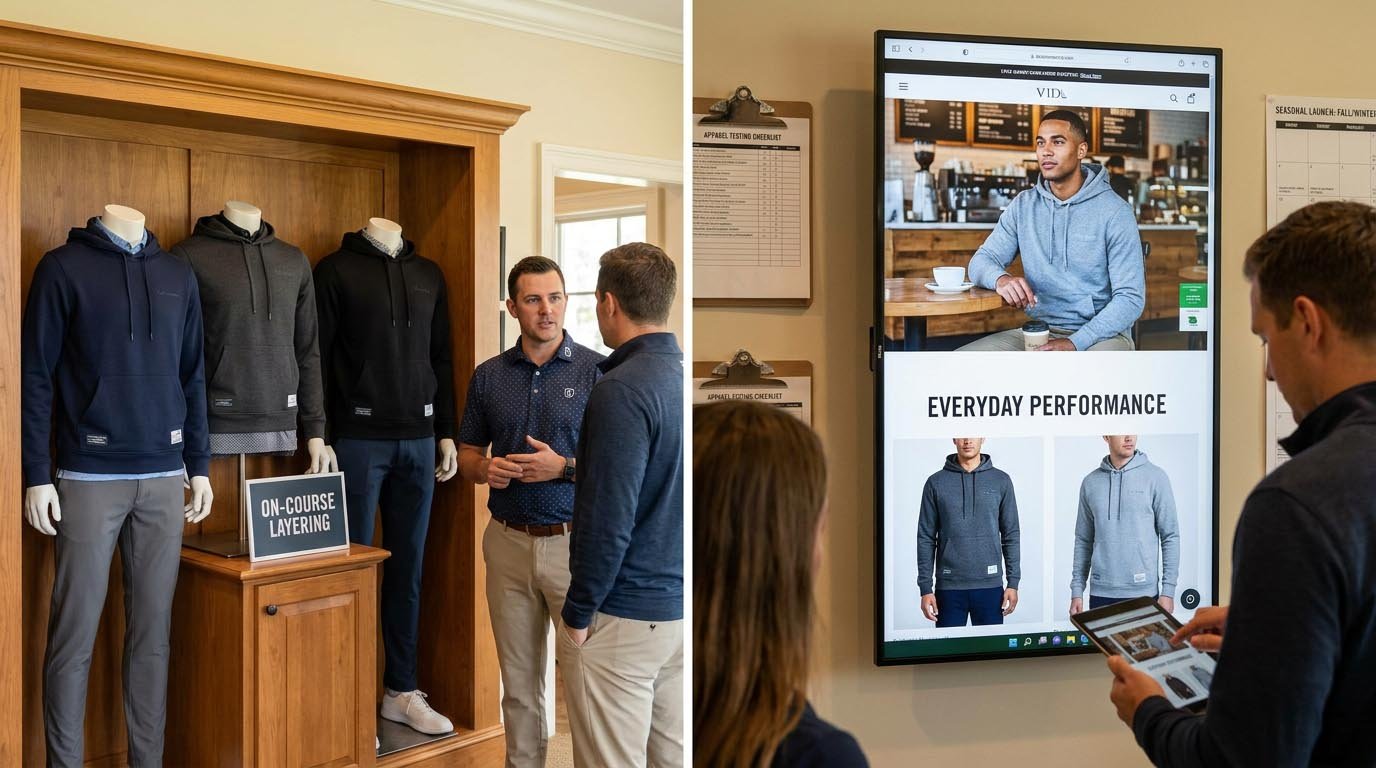
Launch golf hoodies through channels where your brand already has credibility and customer relationships, rather than treating hoodies as a vehicle to enter new distribution—the product category alone does not create channel access or customer trust.
Clients often see hoodies as an opportunity to expand into new channels. They think "hoodies are lifestyle products, so we can sell to lifestyle retailers now." This approach fails more often than it succeeds. Hoodies sell where your brand already has distribution and reputation.
Channel Strategy Based on Current Brand Position
If You Sell Through Pro Shops and Golf Specialty Retail
Your advantage:
- Established relationships with buyers who understand golf apparel
- Customer base that trusts your brand for golf-specific needs
- Higher price tolerance for golf-appropriate products
Hoodie approach:
- Lead with golf functionality and course appropriateness in product presentation
- Position as layering option alongside quarter-zips and vests
- Price at $75-95 to align with existing product range
- Emphasize: "From our brand you already know, now with this new layering option"
Merchandising strategy:
- Display with other layering pieces, not isolated as separate category
- Show styled with polos underneath to demonstrate layering context
- Provide samples for staff so they can speak to fit and functionality
- Include in seasonal package deals with polos or pants
Challenges to expect:
- Buyers may resist hoodies initially due to dress code concerns (provide documentation of course acceptance)
- Shelf space competition with established outerwear (position as complementary, not replacement)
If You Sell Direct-to-Consumer E-Commerce
Your advantage:
- Control over product presentation and storytelling
- Ability to test market response before large inventory commitments
- Direct customer feedback through reviews and service contacts
Hoodie approach:
- Emphasize versatility and lifestyle crossover in product copy and photography
- Show wearing contexts beyond golf (travel, casual weekend, coffee runs)
- Price at $65-85 to be competitive with premium athletic brands
- Emphasize: "From the course to your daily routine"
Merchandising strategy:
- Use lifestyle photography showing hoodie in multiple contexts
- Create style guides showing how to wear with both golf and casual outfits
- Leverage customer reviews and photos to demonstrate versatility
- Offer bundle promotions with polos or shorts to increase average order value
Challenges to expect:
- Higher return rates in first season (15-20%) as customers test fit and verify quality
- Need for detailed size charts and fit guides (customers cannot try on before purchasing)
If You Wholesale to Sporting Goods or General Apparel Retail
Your advantage:
- Broader customer reach beyond core golf audience
- Ability to capture casual golfers who shop in mainstream channels
Hoodie approach:
- Lead with lifestyle appeal and style while mentioning golf functionality
- Price competitively with premium athletic brands: $70-90
- Emphasize: "Performance and style for active lifestyles"
Merchandising strategy:
- Request placement in activewear or athleisure sections, not traditional golf areas
- Provide point-of-sale materials explaining golf-specific features in accessible language
- Support with marketing materials that work for non-golf audiences
Challenges to expect:
- Buyers may not understand golf-specific features or premium pricing
- Competition from established athletic brands with stronger shelf presence
- Need to educate retail staff who are not golf-knowledgeable
Branding and Visual Identity
Logo Placement Strategy
Golf hoodies allow multiple branding opportunities:
Primary Logo Location: Left Chest
- Traditional golf apparel standard
- Size: 3-4 inches wide for embroidery
- Signals golf legitimacy and course appropriateness
- Cost: $2.50-3.80 per piece for quality embroidery
Secondary Location: Sleeve
- Modern athletic aesthetic
- Size: 2-3 inches typically
- Adds visual interest without being loud
- Cost: $1.80-2.60 per piece
Tertiary Location: Back Shoulder or Center Back
- Distinctive branding visible when hood is down
- Size: 4-6 inches depending on placement
- Creates "discovery" moment
- Cost: $2.20-3.40 per piece
Avoid: Large Front Chest Text or Graphics
- Signals streetwear rather than golf apparel
- Triggers dress code concerns at traditional courses
- Reduces perceived sophistication
Color and Design Aesthetic Choices
The visual language must balance golf tradition with lifestyle appeal:
Signals Golf Appropriateness
- Clean, minimal exterior design
- Solid colors or subtle heathered patterns
- Refined fabric finishes (smooth or brushed, not thick fleece loops)
- Small, tasteful logo placement
- Neutral or classic golf colors
Signals Lifestyle Versatility
- Modern fit silhouette
- Contemporary color palette
- Quality construction details (contrast lining, premium zippers)
- Styling in lifestyle photography contexts
- Brand messaging that extends beyond golf
The balance: Design must look credible in a pro shop while not looking out of place at the grocery store.
Compliance and Labeling Requirements
Golf hoodies require standard apparel compliance:
Required Labels and Information
- Fiber content and care instructions
- Country of origin
- Brand name and registered trademark
- Size indication
Testing and Certification (varies by target market)
United States:
- Flammability testing (16 CFR Part 1610) - $80-150 per style
- California Prop 65 compliance (requires testing if using certain dyes/finishes)
European Union:
- REACH compliance for chemicals
- CE marking if any accessories included
- Product safety standards
Testing costs typically:
- $200-500 per style for basic compliance testing
- $800-1,500 if comprehensive chemical testing required
- Plan these costs into your first production budget
Launch Timing and Seasonal Considerations
Optimal Launch Windows
Based on sales data across client brands:
Primary Season: Fall (August-November)
- Peak demand for layering pieces
- Back-to-golf season in many regions
- Gift-giving preparation (holidays approaching)
- Accounts for 45-55% of annual hoodie sales
Secondary Season: Spring (February-April)
- Transitional weather creates layering needs
- New product excitement after holiday season
- 25-35% of annual sales
Off-Season: Summer (May-August) and Winter (December-January)
- 15-25% combined
- Light hoodie sales in mild climates or early morning golf
- Mostly liquidation of prior season inventory
Production Timeline to Hit Key Selling Seasons
To launch for August 1 (fall season start):
- March-April: Finalize design, approve samples
- April-May: Place production order, secure fabric
- May-June: Production period (40-50 days)
- Late June-Early July: Shipping and transit (25-35 days from Asia)
- Late July: Receiving, QC, and distribution preparation
- August 1: Products available for sale
Do not try to rush production into seasonal windows. Missing the season is worse than delaying launch to next year.
FAQ: Golf Hoodies and the Athleisure Opportunity
What makes a hoodie suitable for golf versus just adding a logo to a regular hoodie?
Golf-specific hoodies require raglan or action sleeves for unrestricted shoulder rotation during backswing, longer back hem (additional 2-3 inches) to maintain coverage during movement, and stretch panels in high-mobility zones. Regular streetwear hoodies use standard sleeve patterns that restrict movement during full golf swings. We have processed 40+ sample revisions where clients started with standard hoodie patterns, received samples, tested them during actual swings, and discovered the restriction. Adding proper shoulder construction increases per-piece cost by $1.20-2.00 but makes the difference between a hoodie that works for golf and one that looks like golf apparel but fails functionally.
What is the realistic MOQ for custom golf hoodies with performance fabrics?
Expect 800-1,200 pieces minimum for golf hoodies using technical performance fleece with moisture-wicking and stretch. This volume breaks down to 200-300 pieces per colorway across 3-4 colors. The MOQ is driven by fabric minimums (performance fleece requires 800-1,200 meter orders) not factory limitations. Cotton-blend comfort fleece is available in smaller lots (100-200 meters), allowing 500-600 piece minimums, but these fabrics lack the moisture management golf play requires. For first production orders, I recommend 1,200-1,500 pieces across 3 core colors (navy, black, gray) to access proper golf fabrics at standard pricing.
How do golf hoodies compete with quarter-zip pullovers in product lineup?
Quarter-zips and hoodies serve different needs and do not directly compete. Quarter-zips provide lightweight layering for 18-25°C temperatures with more formal appearance. Hoodies provide warmth plus head/neck coverage for 12-20°C temperatures with relaxed aesthetic. In our client base, brands offering both see 35-40% of hoodie buyers also purchase quarter-zips during the same season. The products complement each other: customers wear quarter-zips for actual rounds, hoodies for practice and off-course activities. Position them as layering system components rather than either/or choices. Pricing should reflect this: quarter-zips at $65-85, hoodies at $75-95.
What fabric weight and construction works for year-round golf hoodie wear?
290-320 GSM performance fleece with moisture-wicking provides the broadest seasonal use—comfortable in 12-22°C temperatures which covers 7-9 months in most golf markets. Heavier fleece (340+ GSM) limits to traditional fall/winter (5-6 months), while lighter French terry (220-260 GSM) works for transitional seasons only. The key is fabric engineering, not just weight: proper moisture management and breathability extend temperature range. We tested this with a Florida client—their 300 GSM wicking fleece hoodies sold October through May consistently, with only June-September showing dropoff. Year-round positioning works when you balance warmth with breathability.
Should golf hoodies have kangaroo pouch pockets or separate side pockets?
Use dual side-entry pockets for golf positioning. Kangaroo pouch pockets signal athletic/streetwear styling that triggers dress code concerns at 30-40% of traditional golf courses. Separate pockets add $0.40-0.70 per piece to production cost but provide better dress code acceptance and more refined appearance. In customer feedback from 20+ client brands, kangaroo-style pockets were cited in 15-18% of returns with comments about "looking too casual" or "not appropriate for golf." Side pockets also function better—customers can access items without the large pouch creating bulk under the body. Add zipper closures (+$0.80-1.40 per piece) only if targeting frequent players who need to secure valuables during rounds.
How does athleisure positioning affect golf hoodie pricing and margins?
Athleisure positioning allows $70-95 retail pricing compared to $55-70 for pure casual athletic hoodies, justified by golf-specific construction and technical fabrics. Production costs run $21-26 per piece for proper athleisure-positioned golf hoodies at 1,000-1,500 unit volumes. This delivers 65-72% gross margin at full retail—standard for golf apparel and sustainable for brand operations. Attempting to hit mass-market athletic hoodie price points ($45-60) compresses margins below 55%, which becomes unsustainable after operational costs and channel fees. The athleisure positioning works financially because customers pay premium for versatility—one hoodie serving both golf and lifestyle needs justifies higher prices than single-purpose athletic or casual hoodies.
What dress code elements determine whether hoodies are acceptable at golf courses?
Golf courses evaluate hoodies based on: fabric refinement (smooth or brushed finish, not thick fleece loops), minimal branding (small chest logo, not large graphics or text), clean silhouette (tailored fit, not oversized), solid or subtle colors (not bold prints), and refined details (quality zippers, proper construction). Specific features that trigger rejection: kangaroo pouch pockets, visible drawcords with plastic/metal tips, oversized hoods, high-contrast bright trim, and back graphics or text. We recommend clients test dress code acceptance by contacting local courses before finalizing designs. The acceptance rate has improved—we track that 60-70% of golf courses now permit well-designed hoodies during play, up from 20-30% five years ago. Design for the traditional courses, and you will pass everywhere.
What is the smart approach to color assortment for first golf hoodie launch?
Start with 3 core colors: navy, black, and charcoal/gray in your first 1,200-1,500 piece order. These three colors account for 75-85% of golf hoodie sales across client brands and have lowest inventory risk. Avoid the temptation to offer 5-6 colors initially—this fragments inventory and increases risk of slow-moving SKUs requiring promotional discounting. Add white/cream as a fourth color if ordering 1,800+ pieces total. Save accent colors (burgundy, forest green, tan) for second production after validating demand with core colors. We have seen multiple clients launch with 6+ colors at small quantities per color (150-200 pieces), then face 30-40% of inventory stuck in slow-selling shades requiring 40% discounts to clear. Master the core palette first.
Conclusion
Add golf hoodies to your brand when you understand they require golf-specific construction features that cost more than standard athletic hoodies, target customers who value versatility enough to pay $70-95, and launch through channels where your brand already has credibility. Specify 300-320 GSM performance fleece, raglan sleeves or shoulder stretch panels, and dual side pockets to deliver functionality for both golf and lifestyle contexts.